9 Best Support Automation Tools for Global Companies in 2026
This guide reviews the 9 best support automation for global companies platforms in 2026, evaluating each on multilingual capability, AI resolution quality, integration depth, and the ability to scale across time zones and markets without growing headcount proportionally.
 Matt PattoliFounder14 min read
Global support teams operate under a particular kind of pressure. Customers in Tokyo expect answers at 2am. A product update rolls out and suddenly your Paris team is buried. A new market opens in Brazil and your existing stack doesn't speak Portuguese. The right support automation platform doesn't just deflect tickets: it resolves them intelligently, adapts to context, and scales without requiring you to hire a support rep in every time zone you serve.
This list covers the top support automation tools built for global operations, evaluated on multilingual capability, integration depth, AI resolution quality, and how well each handles the complexity of cross-border support. Halo AI appears first because it's the platform behind this content, but every other tool is assessed on genuine merit. Whether you're running a lean team across three continents or managing thousands of daily tickets from enterprise customers, there's a fit here for your operation.
1. Halo AI
Best for: B2B SaaS and product-led growth companies wanting AI-first support with built-in business intelligence
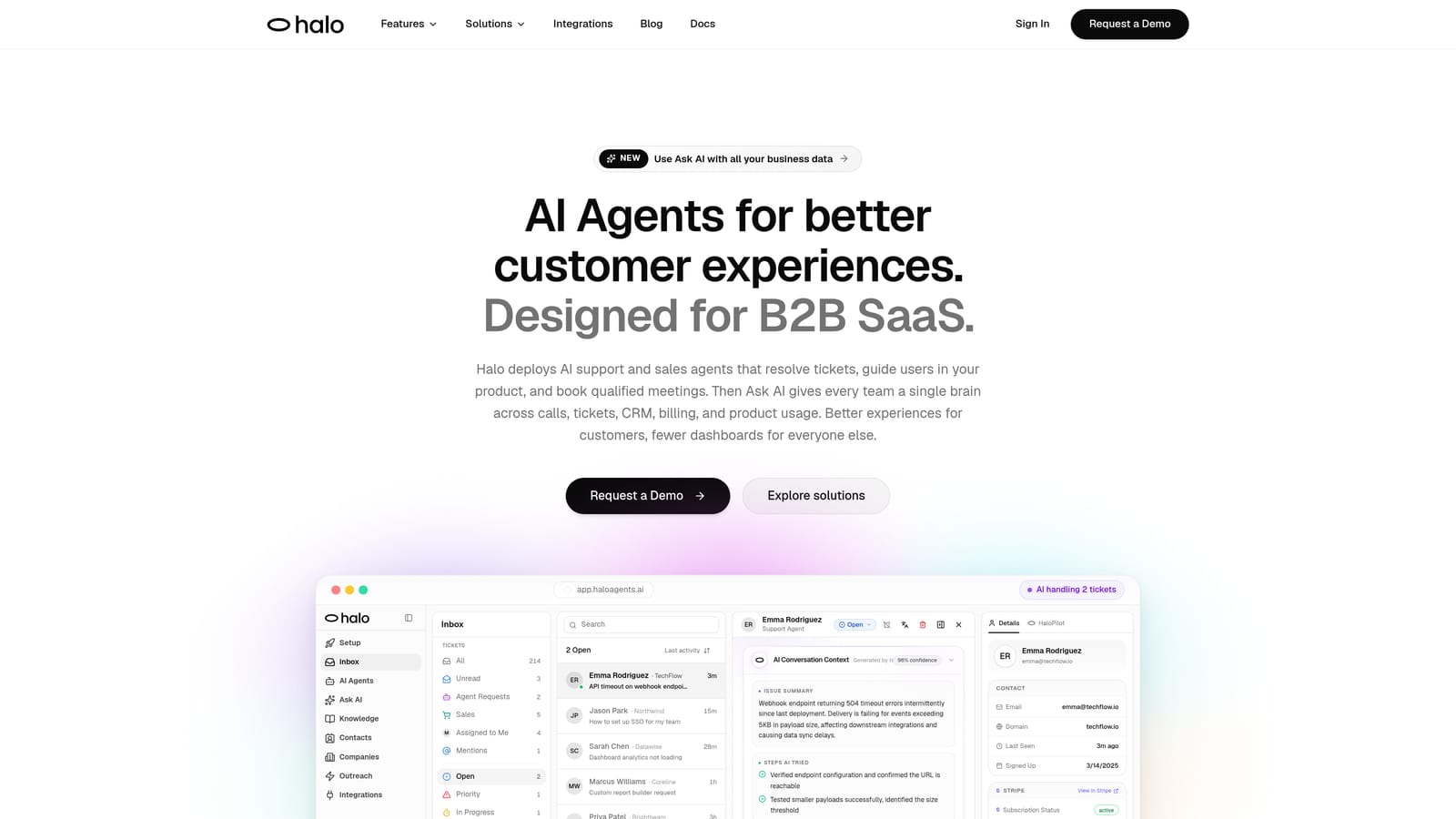
Halo AI is an AI-first customer support platform that resolves tickets, guides users through your product, and surfaces business intelligence signals without requiring an existing helpdesk as a foundation.
Where This Tool Shines
Most support automation tools are built as a layer on top of an existing helpdesk. Halo is architected differently: AI is the core, not an add-on. The most distinctive capability is page-aware context, where the AI agent actually sees what the user is looking at in your product and uses that context to resolve the issue rather than offering generic answers.
Beyond resolution, Halo surfaces business intelligence that most support tools ignore entirely. Customer health signals, revenue anomalies, and support pattern changes are surfaced in the smart inbox, giving support and product teams visibility into what's happening across the customer base, not just what's in the queue.
Key Features
Page-Aware AI Agents: The agent sees the user's current product context, enabling precise, situationally relevant resolution rather than generic knowledge base responses.
Continuous Learning: Every resolved interaction improves the model, so resolution quality compounds over time rather than staying static.
Auto Bug Ticket Creation: Recurring product issues are automatically detected and routed to engineering tools like Linear, closing the loop between support and product.
Smart Inbox with Business Intelligence: Customer health signals, revenue anomalies, and support trend detection give teams insight beyond individual tickets.
Live Agent Handoff: Complex issues escalate to human agents with full conversation context preserved, so customers never have to repeat themselves.
Integration Ecosystem: Connects with Slack, HubSpot, Intercom, Stripe, Zoom, PandaDoc, and Fathom, fitting into the existing B2B SaaS stack without friction.
Best For
Halo is best suited for B2B SaaS companies and product teams that want AI to own a significant portion of support resolution, not just assist agents. It's particularly strong for teams that want support intelligence to feed back into product and revenue decisions, not just close tickets.
Pricing
Contact for pricing at haloagents.ai. Given the AI-first architecture and business intelligence capabilities, it's positioned for teams serious about automation rather than entry-level deployments.
2. Intercom
Best for: SaaS companies with high chat volume wanting LLM-powered end-to-end ticket resolution
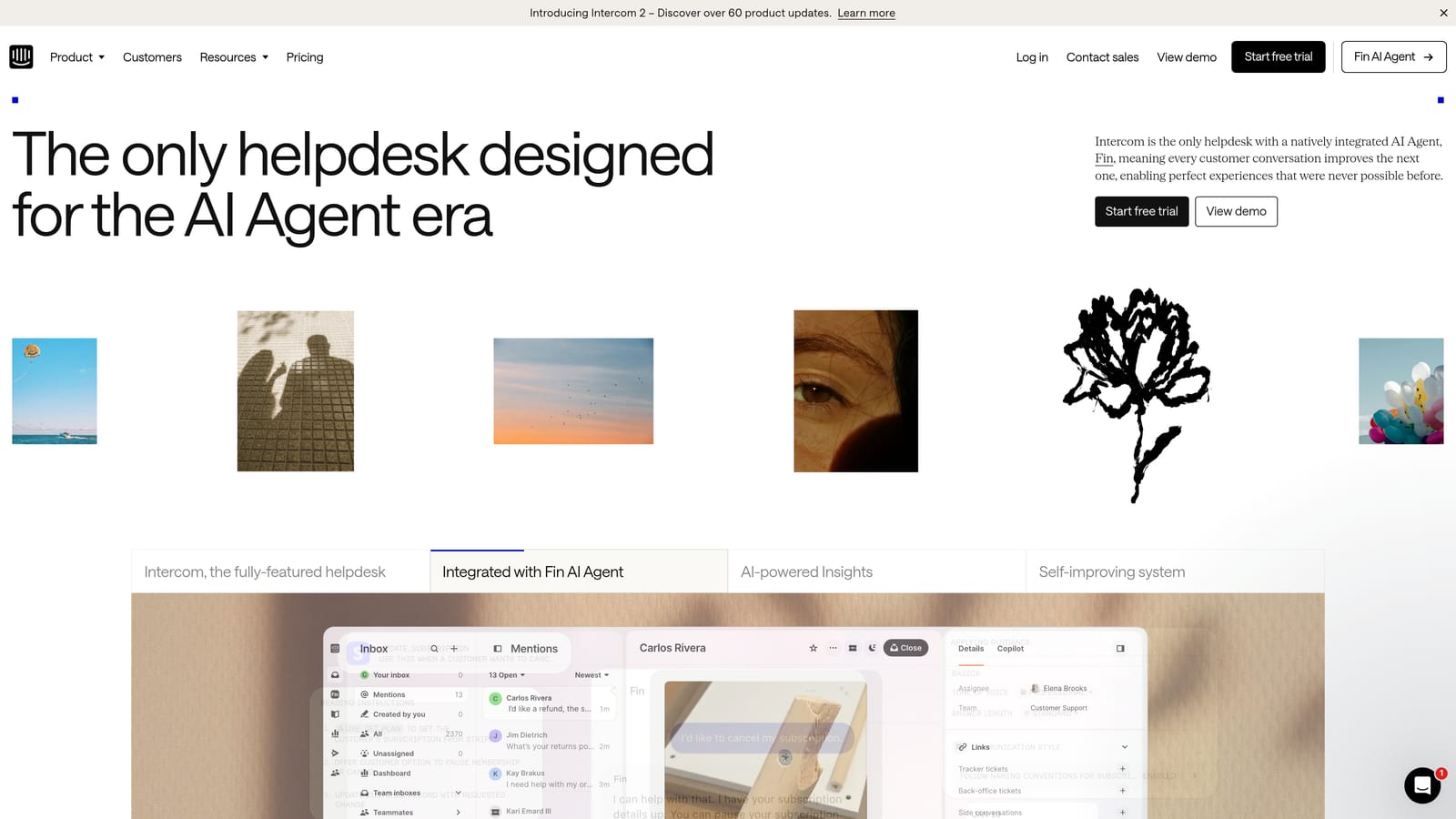
Intercom is a customer messaging platform with Fin, an AI agent powered by large language models that handles end-to-end resolution across chat, email, and in-app channels.
Where This Tool Shines
Fin is one of the more capable AI agents in the market for SaaS support. It uses your help center content to generate contextually appropriate responses rather than just pattern-matching keywords, and it handles multilingual conversations across major languages without requiring separate configuration per region.
The platform's unified inbox consolidates chat, email, and in-app messaging in one workspace, which matters for global teams managing multiple channels simultaneously. The app marketplace is also extensive, making it straightforward to connect Intercom into an existing stack.
Key Features
Fin AI Agent: LLM-powered resolution that can handle full ticket conversations end-to-end using your existing knowledge base.
Multilingual Chat Support: Handles conversations in major global languages without separate language-specific setup.
Unified Inbox: Consolidates chat, email, and in-app messaging into a single agent workspace.
Proactive Messaging and Product Tours: Onboarding flows and proactive outreach reduce inbound support volume before tickets are created.
Integration Ecosystem: A large app marketplace connects Intercom with CRMs, billing platforms, and engineering tools.
Best For
SaaS companies with significant chat volume and a well-maintained help center will get the most from Fin. Teams already using Intercom for customer communication will find upgrading to AI resolution a natural progression rather than a platform change.
Pricing
Starts at approximately $39 per seat per month. Fin AI usage is billed per resolution, so costs scale with volume. Verify current pricing at intercom.com as it changes regularly.
3. Zendesk
Best for: Enterprise teams needing mature ticketing infrastructure with AI layered on top
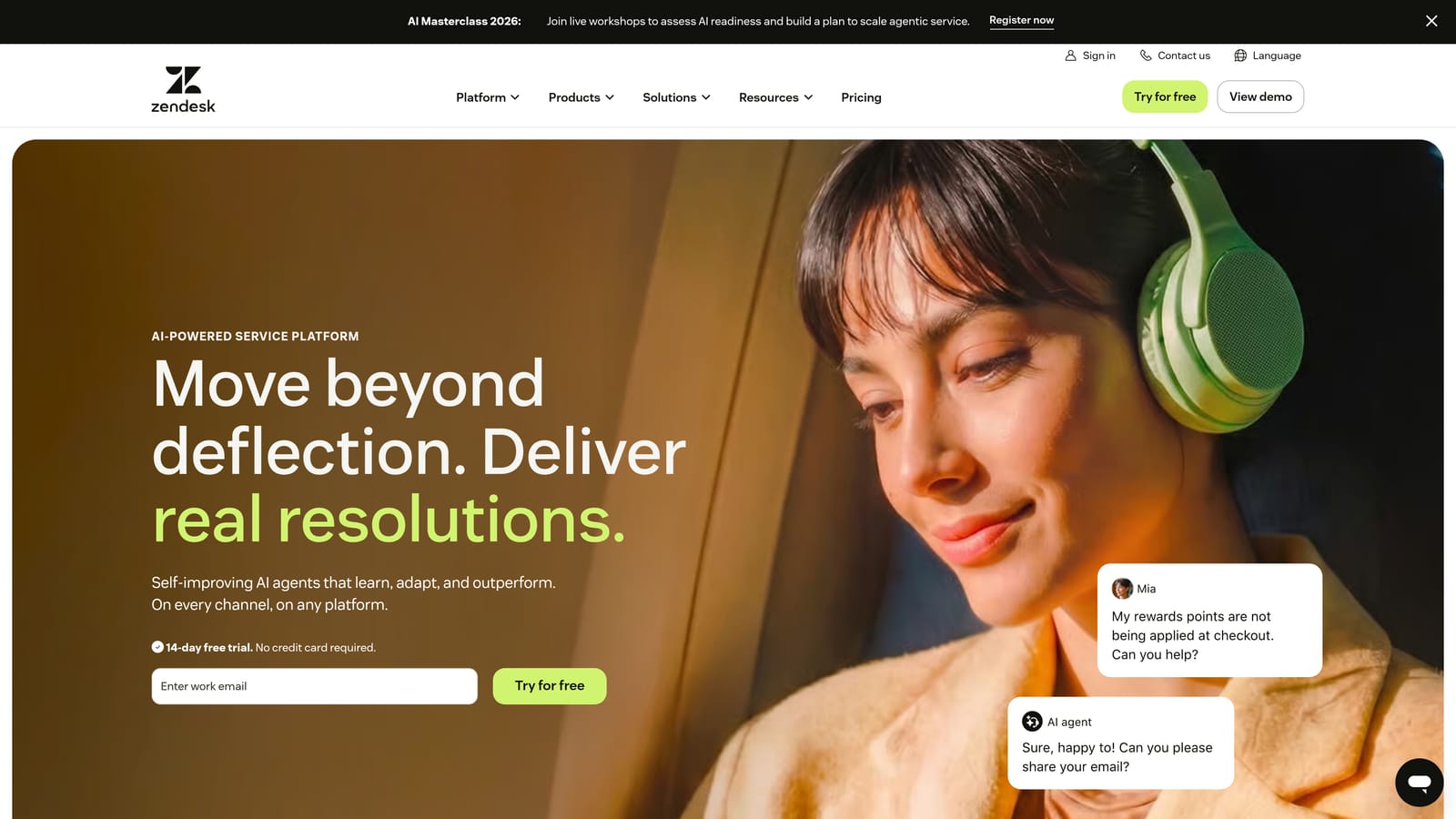
Zendesk is the dominant enterprise helpdesk platform, with AI automation built on top of a mature ticketing, routing, and SLA management engine that has been refined over many years.
Where This Tool Shines
Zendesk's strength is its depth of workflow customization. Conditional routing logic, SLA policies, escalation rules, and compliance reporting are all configurable at a granular level, which matters for global teams operating across different service agreements and regulatory environments.
The AI layer, powered by OpenAI, handles intelligent triage, suggested replies, and agent assist. It's not as autonomous as newer AI-first platforms, but it integrates cleanly with Zendesk's existing workflow engine and the 1,000-plus integrations available in the marketplace.
Key Features
Zendesk AI: Intelligent triage, suggested replies, and agent assist built on OpenAI models, integrated directly into the ticketing workflow.
Advanced Workflow Automation: Conditional logic, routing rules, and escalation paths that handle complex support operations.
SLA Management: Robust SLA tracking and compliance reporting suitable for enterprise service agreements across multiple regions.
1,000+ Integrations: One of the largest helpdesk marketplaces available, covering virtually every business tool category.
Multilingual Support: Localization options for help centers and agent interfaces across major global languages.
Best For
Zendesk is the right choice for enterprise teams with complex workflow requirements, strict SLA obligations, and existing investments in the Zendesk ecosystem. Teams evaluating it fresh should factor in configuration complexity and the higher price point for full AI feature access.
Pricing
Suite plans start at approximately $55 per agent per month. AI features are available on higher tiers. Pricing scales significantly with team size and feature requirements.
4. Freshdesk
Best for: Mid-market teams making their first move into AI-assisted support automation
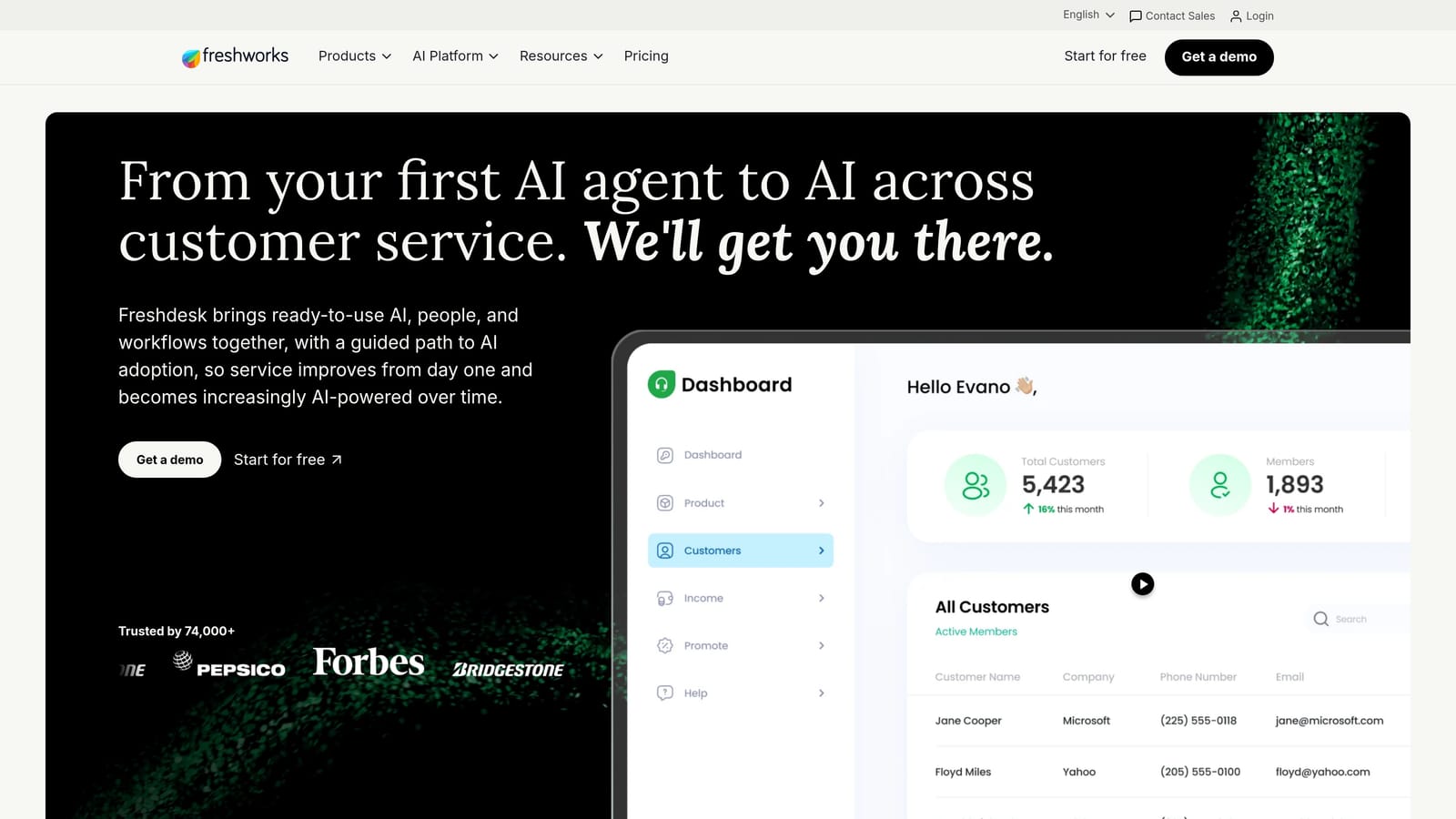
Freshdesk is a mid-market helpdesk platform with Freddy AI handling ticket automation, agent assist, and self-service at a price point that's accessible for growing teams.
Where This Tool Shines
Freshdesk hits a practical sweet spot: enough AI capability to meaningfully reduce agent workload, at a price that doesn't require an enterprise budget to justify. Freddy AI classifies incoming tickets, suggests canned responses, and summarizes conversations, which accelerates resolution even when the AI isn't handling tickets end-to-end.
The omnichannel coverage is solid for the price tier, spanning email, chat, phone, and social. The multilingual help center and customer portal make it viable for teams supporting customers across multiple regions without requiring a separate localization platform.
Key Features
Freddy AI: Handles ticket classification, response suggestions, and conversation summarization to reduce agent effort per ticket.
Omnichannel Support: Email, chat, phone, and social channels unified in one platform.
Automation Rules: Routing, escalation, and SLA tracking automation without requiring technical configuration expertise.
Multilingual Help Center: Customer-facing portal and knowledge base support for multiple languages.
Free Tier: A functional free plan makes it accessible for small teams evaluating automation for the first time.
Best For
Growth-stage companies and mid-market teams that need solid helpdesk functionality with AI assist at a competitive price. Also a strong choice for teams migrating from basic email-only support to a structured ticketing system with automation built in.
Pricing
Free plan available for small teams. Paid plans start at approximately $15 per agent per month. AI features are available on higher tiers.
5. Salesforce Service Cloud
Best for: Enterprise companies already invested in the Salesforce ecosystem needing deep CRM-to-support integration
Salesforce Service Cloud is an enterprise support platform deeply integrated with Salesforce CRM, powered by Einstein AI for case management, next-best-action recommendations, and knowledge suggestions.
Where This Tool Shines
The core advantage of Service Cloud is native CRM integration. When a support agent opens a case, they see the customer's complete Salesforce record: deal history, account health, open opportunities, and previous interactions. That context changes how agents handle cases, particularly for enterprise accounts where support issues often have revenue implications.
Einstein AI layers on top of that CRM data to provide case classification, knowledge article suggestions, and next-best-action guidance. For global enterprises with complex compliance requirements, Service Cloud also offers data residency options and enterprise-grade security controls.
Key Features
Einstein AI: Case classification, knowledge suggestions, and next-best-action recommendations powered by Salesforce's AI layer.
Native CRM Integration: Full customer context from Salesforce CRM available on every case without manual data syncing.
Omni-Channel Routing: Routes cases across voice, chat, email, and social based on agent skills and availability.
Global Compliance Options: Data residency choices and enterprise compliance controls for regulated industries and global operations.
Analytics Suite: Extensive reporting on case volume, resolution time, agent performance, and customer satisfaction.
Best For
Enterprises already running Salesforce as their CRM will find Service Cloud the most natural support platform choice. For companies not already in the Salesforce ecosystem, the implementation complexity and cost may outweigh the integration benefits.
Pricing
Starter plans begin at approximately $25 per user per month. Enterprise tiers with full Einstein AI capabilities are significantly higher. Implementation costs should be factored into total cost of ownership.
6. Kustomer
Best for: High-volume B2C and DTC brands managing complex customer histories across multiple channels
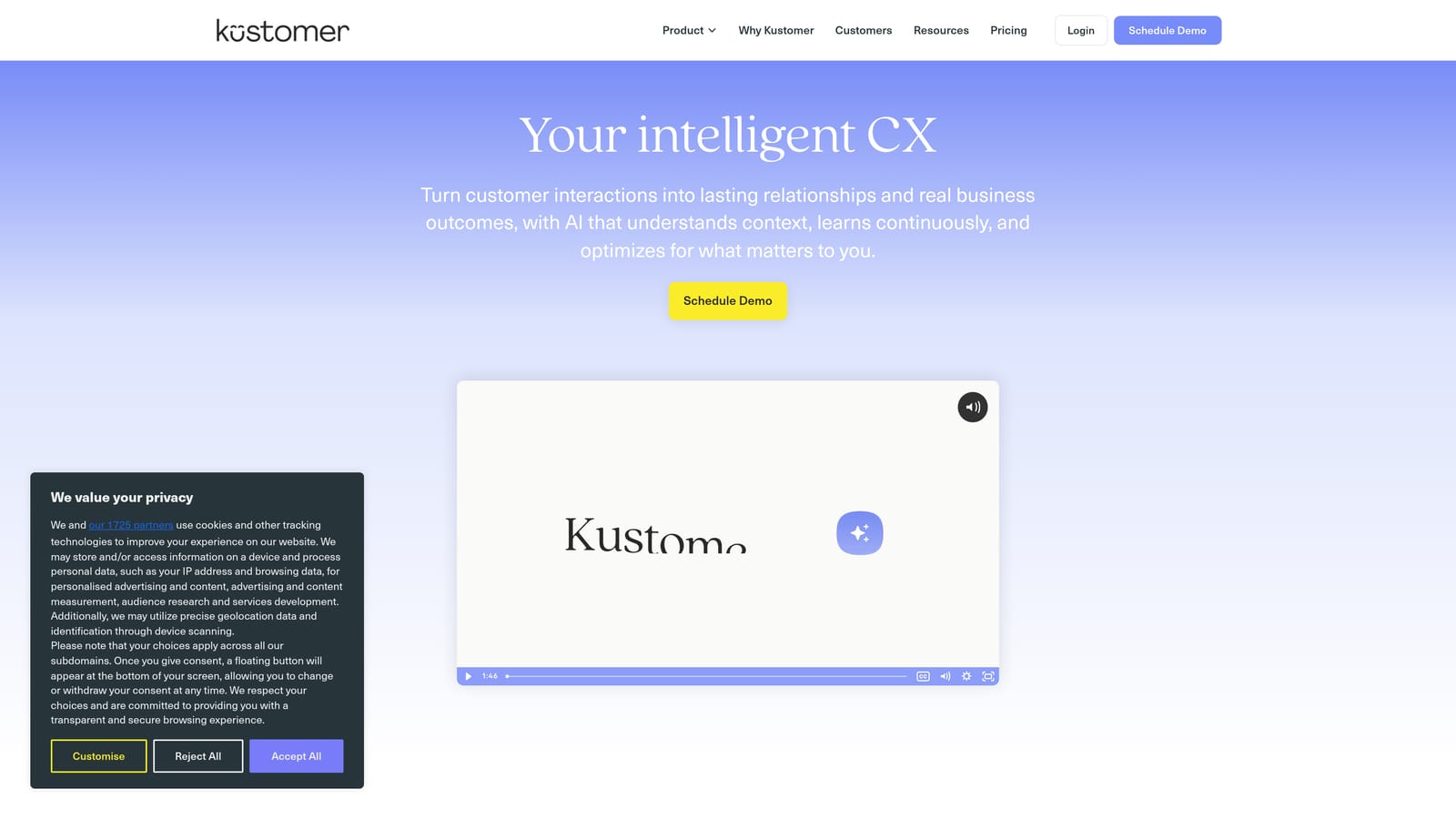
Kustomer is a CRM-native support platform organized around unified customer timelines rather than individual tickets, with AI automation designed for high-volume consumer operations.
Where This Tool Shines
Kustomer's fundamental design choice is to organize support around the customer, not the ticket. Every interaction, order, and support conversation appears in a single timeline view, which gives agents the context to handle complex situations without digging through multiple systems. For brands where a single customer might have dozens of orders and interactions, this changes the quality of support significantly.
AI-powered workflow automation handles repetitive tasks across that omnichannel footprint, including chat, email, SMS, social, and voice. The order management integrations make it particularly practical for e-commerce and DTC brands where order status, returns, and fulfillment questions make up a large portion of support volume.
Key Features
Unified Customer Timeline: Orders, interactions, and support history combined in a single view per customer rather than isolated tickets.
AI Workflow Automation: Automates repetitive support tasks across channels based on customer data and conversation context.
Omnichannel Coverage: Chat, email, SMS, social, and voice in one unified workspace.
Proactive Outreach: Customer segmentation and proactive messaging tools for reaching out before issues escalate.
E-Commerce Integrations: Order management integrations suited to DTC and retail support workflows.
Best For
High-volume B2C brands, DTC companies, and e-commerce operations where customer history and order context are central to support quality. Less suited for B2B SaaS teams where the ticket-centric model is a better fit.
Pricing
Enterprise pricing; contact Kustomer directly for quotes. Not designed for small teams or entry-level budgets.
7. Tidio
Best for: Small teams and SMBs needing fast, affordable support automation without technical setup complexity
Tidio is an SMB-focused live chat and AI chatbot platform with Lyro AI, designed for quick deployment and accessible pricing rather than enterprise-scale complexity.
Where This Tool Shines
Tidio's defining advantage is speed to value. Teams can be operational within hours rather than weeks. Lyro AI handles conversational resolution without requiring technical configuration, and when it reaches the limits of what it can resolve, it hands off to a live agent cleanly. That combination works well for small teams that want automation without dedicating engineering resources to implementation.
The e-commerce integrations with Shopify, WooCommerce, and BigCommerce make Tidio a practical choice for online retailers. Multilingual chat support is included, which extends its usefulness for small businesses with international customer bases.
Key Features
Lyro AI: Conversational AI for ticket resolution without technical setup, designed for non-technical teams to deploy quickly.
Live Chat with Agent Takeover: Seamless handoff from AI to human agents when conversations exceed AI capability.
Multilingual Chat: Supports conversations across multiple languages without separate configuration.
E-Commerce Integrations: Native integrations with Shopify, WooCommerce, and BigCommerce for retail support workflows.
Quick Deployment: Operational within hours, not weeks, making it practical for teams without dedicated implementation resources.
Best For
Small businesses, SMBs, and e-commerce brands that need functional support automation quickly and affordably. Teams with complex enterprise workflows or high customization requirements will find Tidio's capabilities limiting at scale.
Pricing
Free plan available. Lyro AI starts at approximately $29 per month. Pricing is accessible relative to enterprise alternatives.
8. Dixa
Best for: Teams where conversation quality and customer satisfaction matter more than raw ticket throughput
Dixa is a conversation-first customer service platform with AI-powered routing and a unified agent workspace, built around the philosophy that quality interactions matter more than ticket volume metrics.
Where This Tool Shines
Dixa's most distinctive design choice is the elimination of ticket numbers. Conversations are routed to the right agent based on skills, availability, and customer data, without the queue-centric model that most helpdesks use. This changes how agents think about their work and often improves the quality of interactions as a result.
For global teams, Dixa's GDPR-native design and European data hosting options are meaningful differentiators. Companies serving European customers with strict data residency requirements will find compliance easier to maintain on Dixa than on platforms that treat GDPR compliance as an afterthought.
Key Features
Intelligent Conversation Routing: Routes conversations based on agent skills, availability, and customer data rather than simple queue assignment.
Unified Workspace: Voice, chat, email, and social in one interface with no ticket numbers or queue-centric model.
AI Agent Assist: Suggested responses and knowledge retrieval to support agents during conversations.
GDPR-Native Design: Built with European data protection requirements in mind, with EU data hosting options available.
Quality-Focused Analytics: Reporting centered on conversation quality and customer satisfaction rather than purely volume metrics.
Best For
Teams in European markets or serving European customers who need GDPR compliance built in. Also well-suited for companies that prioritize support quality over throughput and want analytics that reflect that priority.
Pricing
From approximately $39 per agent per month. Contact Dixa for enterprise pricing on larger deployments.
9. Zoho Desk
Best for: Budget-conscious teams already using Zoho products who want solid AI-assisted support without switching ecosystems
Zoho Desk is a full-featured helpdesk within the Zoho ecosystem, with Zia AI providing sentiment analysis, ticket tagging, and support anomaly detection at a competitive price point.
Where This Tool Shines
Zoho Desk's value proposition is straightforward: comprehensive helpdesk functionality with AI capabilities at a price that undercuts most comparable platforms. Zia AI handles sentiment detection, ticket tagging, and response suggestions, which meaningfully reduces agent workload even without full autonomous resolution.
For teams already using Zoho CRM or other Zoho products, the native integration is a genuine advantage. Customer data flows between systems without custom connectors, and the broader Zoho suite covers most business functions that a growing company needs. The multilingual help center and competitive free tier make it accessible for teams at various stages of growth.
Key Features
Zia AI: Sentiment detection, ticket tagging, response suggestions, and support anomaly detection built into the helpdesk workflow.
Multi-Channel Support: Email, chat, phone, social, and web forms managed from a unified interface.
Zoho Ecosystem Integration: Native connection with Zoho CRM and the broader Zoho product suite for seamless data flow.
Generous Free Tier: Free plan for up to three agents makes it accessible for small teams evaluating the platform.
Best For
Teams already invested in the Zoho ecosystem will get the most value from Zoho Desk. It's also a strong choice for budget-conscious mid-market teams that need solid AI-assisted support without enterprise-level pricing.
Pricing
Free plan for up to three agents. Paid plans start at approximately $14 per agent per month, making it one of the more affordable options on this list with meaningful AI capabilities included.
Which Tool Is Right for Your Global Team
The right support automation platform depends on your team size, existing stack, and how much of your support you want AI to own versus assist. Here's a practical decision guide based on the tools covered above.
If you're a B2B SaaS team that wants AI-first resolution with business intelligence baked in, start with Halo AI. The page-aware context and continuous learning architecture are built specifically for product-led companies where support quality directly affects retention.
For enterprise teams with complex workflow requirements and existing Zendesk or Salesforce investments, those platforms remain proven choices. Zendesk suits teams that need deep workflow customization and SLA management. Salesforce Service Cloud is the natural fit if CRM-to-support context is a priority and you're already in that ecosystem.
Growth-stage SaaS companies with high chat volume will find Intercom's Fin agent hard to beat on resolution quality and deployment speed. Mid-market teams on tighter budgets will find that Freshdesk or Zoho Desk covers the essentials well without requiring enterprise pricing to access meaningful AI features.
Dixa suits teams where conversation quality matters more than ticket throughput, particularly in European markets where GDPR compliance needs to be built in rather than bolted on. Kustomer fits DTC and e-commerce brands managing complex customer histories across many channels. Tidio is the fastest path to automation for small teams that need something working today.
Before committing to any platform, run a proof of concept with real tickets from your actual support queue. Measure resolution rate, not just deflection rate. Deflection tells you how many tickets the AI touched. Resolution tells you how many it actually closed. That's the number that determines whether automation is genuinely working for your team.
Your support team shouldn't scale linearly with your customer base. See Halo in action and discover how continuous learning transforms every interaction into smarter, faster support, with AI agents handling routine tickets, guiding users through your product, and surfacing business intelligence while your team focuses on the complex issues that genuinely need a human touch.