9 Best Support Automation Tools for Healthcare SaaS in 2026
Support automation for healthcare SaaS presents unique compliance and clinical challenges that generic helpdesk tools can't handle. This guide evaluates the 9 best platforms for 2026, comparing HIPAA-compliant messaging, AI-powered ticket resolution, and clinical context capabilities to help healthcare software teams find the right solution at every stage of growth.
 Grant CooperFounder15 min read
Healthcare SaaS companies face a support challenge unlike any other. Patients, providers, and administrators all need fast, accurate answers, but every interaction touches sensitive data governed by HIPAA, HITECH, and a growing web of state-level regulations. A single compliance misstep can mean six-figure fines. Slow response times can directly affect patient outcomes. And generic helpdesk tools, designed for e-commerce or tech startups, often buckle under the compliance rigor, clinical terminology, and multi-stakeholder workflows that healthcare software demands.
The good news is that a new generation of support automation platforms has emerged with healthcare SaaS teams in mind. Whether you need AI-powered ticket resolution, HIPAA-compliant messaging, or intelligent triage that understands clinical context, there are strong options at every price point and stage of growth. Here are the top tools for 2026, evaluated on compliance capabilities, AI sophistication, integration depth, and scalability.
1. Halo AI
Best for: Healthcare SaaS teams that want AI-first support automation with continuous learning and deep product integration.
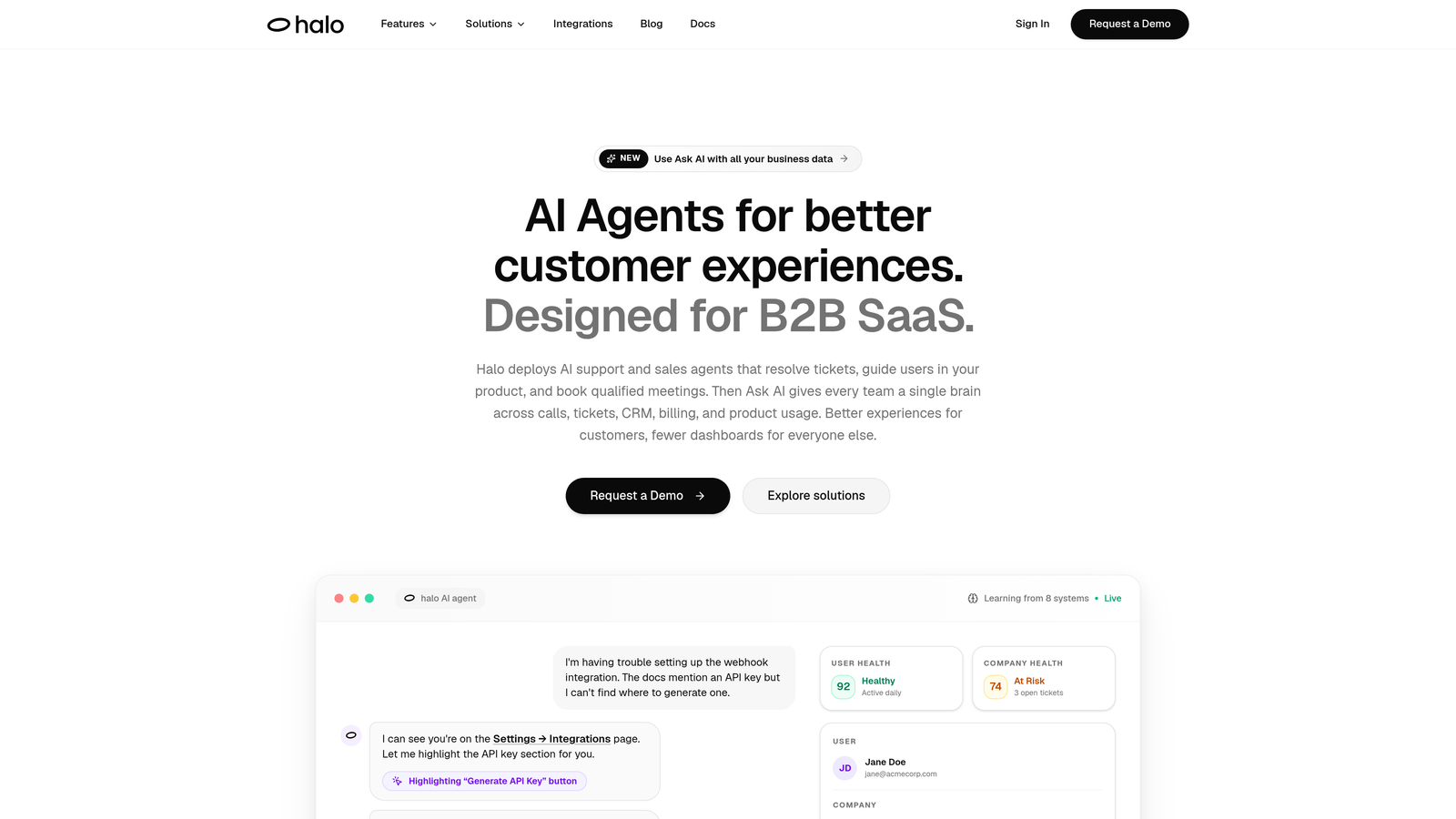
Halo AI is an AI-native support platform that deploys intelligent agents to resolve tickets, guide users through your product with page-aware context, and surface business intelligence from every support interaction.
Where This Tool Shines
What separates Halo from traditional helpdesks is its architecture. Rather than bolting AI onto an existing ticketing system, Halo is built AI-first, meaning the intelligence layer is central to how tickets are resolved, not an add-on feature. For healthcare SaaS teams, this matters because your support agents need to understand product-specific clinical workflows, not just keyword-match to a FAQ article.
The page-aware chat widget is particularly valuable in healthcare contexts. It sees what the user sees, so when a provider is confused about a billing module or a care coordinator is stuck in a workflow, the AI can offer contextual, visual guidance rather than generic instructions. This reduces escalations and shortens resolution time without requiring more headcount.
Key Features
Page-Aware AI Chat Widget: The AI understands the user's current context within your product, enabling precise, step-by-step visual guidance rather than generic help content.
Continuous Learning: Every resolved interaction improves the model's accuracy over time, so your support gets smarter as your product evolves and your user base grows.
Automatic Bug Ticket Creation: When the AI detects a recurring issue or product error, it automatically creates a bug ticket in tools like Linear, closing the loop between support and engineering.
Smart Inbox with Business Intelligence: The inbox surfaces customer health signals, revenue insights, and anomaly detection, turning support data into strategic intelligence for product and customer success teams.
Live Agent Handoff: Complex or sensitive issues escalate seamlessly to human agents with full conversation context preserved, ensuring no information is lost in the transition.
Best For
Scaling B2B healthcare SaaS teams that want to reduce ticket volume without sacrificing support quality. Especially strong for product-led companies where in-app guidance and proactive support are part of the user experience strategy.
Pricing
Contact for pricing. Halo is designed for scaling B2B SaaS teams and offers tailored plans based on team size and usage requirements.
2. Zendesk for Healthcare
Best for: Large healthcare SaaS organizations that need enterprise-grade helpdesk infrastructure with HIPAA compliance built in.
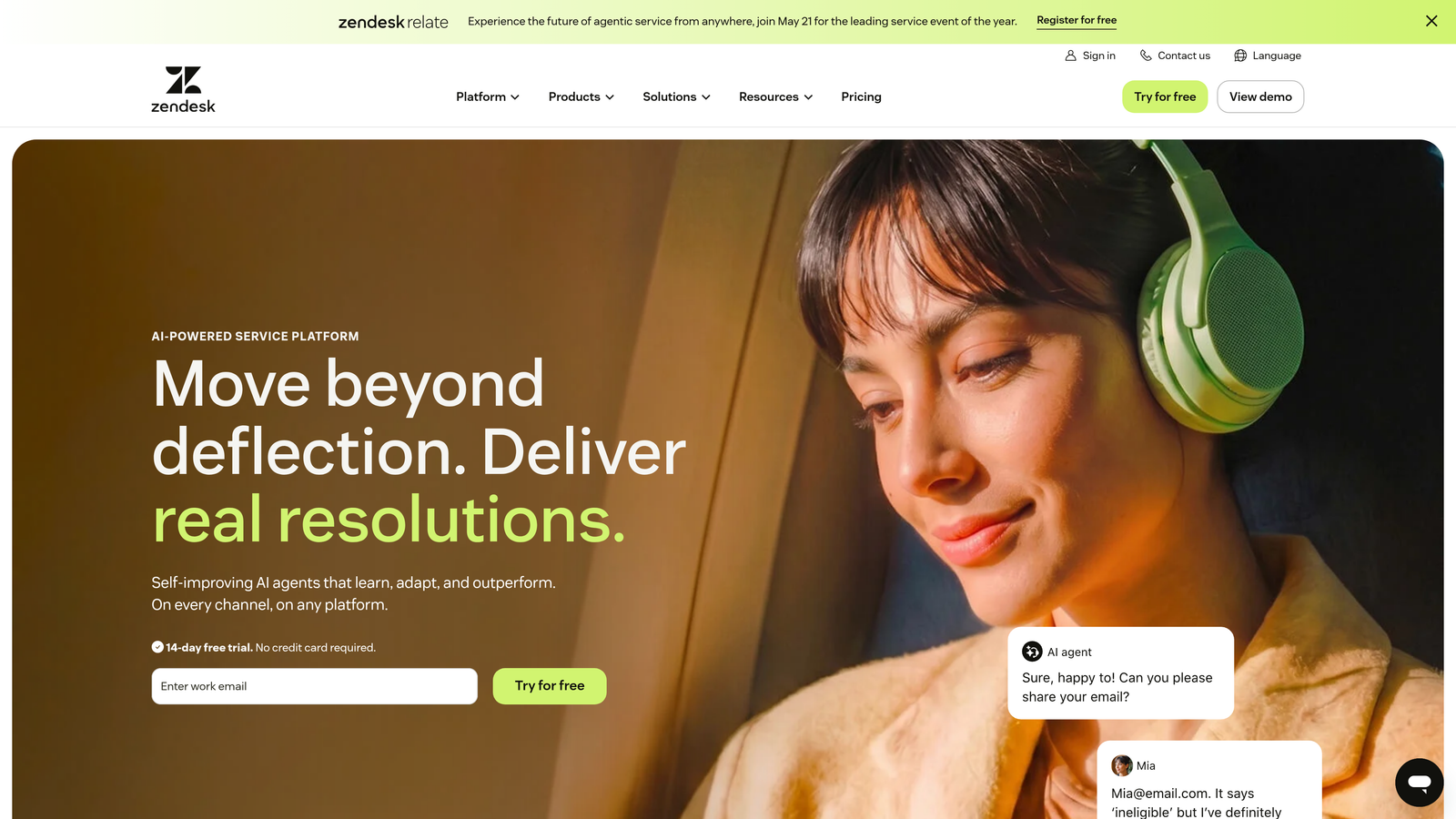
Zendesk is a well-established enterprise helpdesk platform offering HIPAA-eligible plans, a vast integration marketplace, and advanced workflow automation for complex support operations.
Where This Tool Shines
Zendesk's strength is its depth. After years of enterprise deployments, it has built one of the most feature-complete helpdesk platforms available, and its HIPAA-eligible Enterprise tier makes it a viable choice for healthcare SaaS teams handling protected health information. The Business Associate Agreement (BAA) is available, and the platform supports data encryption and granular access controls.
The AI capabilities, including the Answer Bot and Agent Assist features, have improved significantly and can handle a meaningful portion of routine tickets. However, Zendesk's AI is more of an enhancement to a human-agent workflow than a fully autonomous resolution engine, which is worth considering if your goal is high automation rates.
Key Features
HIPAA BAA on Enterprise Plans: Includes data encryption at rest and in transit, audit logging, and role-based access controls for PHI handling.
Advanced SLA Management: Customizable SLA policies and escalation rules for multi-tier support teams managing different user segments.
AI-Powered Answer Bot and Agent Assist: Deflects common questions and surfaces relevant articles or suggested responses to speed up agent workflows.
Healthcare Marketplace Integrations: A large third-party app marketplace includes connectors for EHR systems, CRMs, and healthcare-specific tooling.
Robust Reporting and Analytics: Customizable dashboards and pre-built reports give managers visibility into team performance and ticket trends.
Best For
Mid-to-large healthcare SaaS companies with dedicated support teams that need a proven, enterprise-grade platform with strong compliance credentials and extensive customization options.
Pricing
Suite plans start around $55 per agent per month. Enterprise plans, required for HIPAA BAA access, are priced higher and typically negotiated based on team size.
3. Intercom with Fin AI
Best for: Product-led healthcare SaaS companies that want conversational support combined with in-app onboarding and proactive messaging.
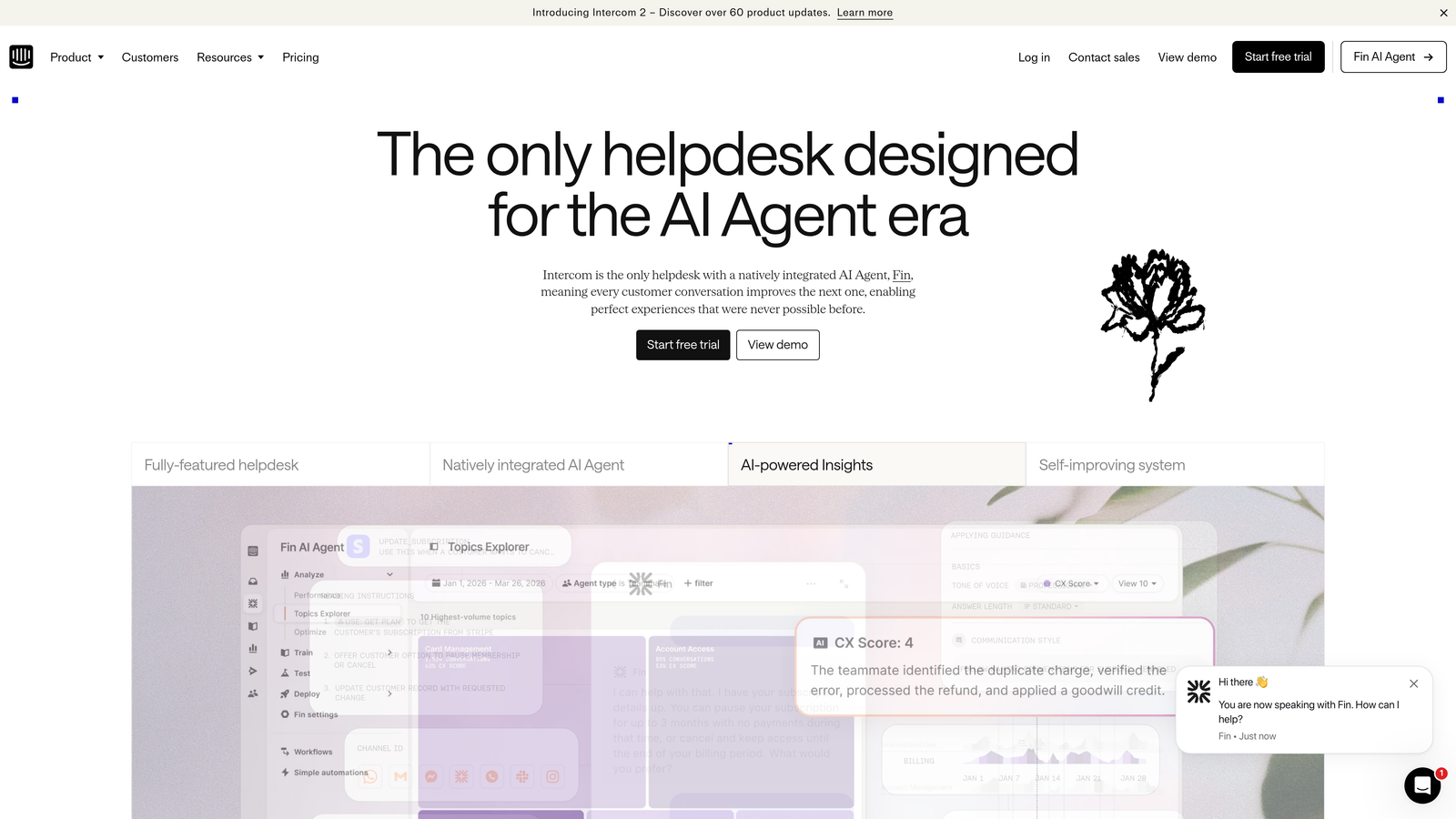
Intercom is a conversational support platform that combines its Fin AI agent with in-app messaging, product tours, and a modern messenger experience.
Where This Tool Shines
Intercom's Fin AI agent is one of the more capable AI resolution engines in the market. Trained directly on your help center content, it can handle a wide range of support queries autonomously before routing to a human. For healthcare SaaS teams, this means routine questions about billing, access permissions, or feature navigation can be resolved without agent involvement.
The platform's in-app messaging and product tour capabilities add a layer of proactive support that reduces inbound ticket volume in the first place. If your healthcare SaaS product has complex onboarding flows for providers or administrators, Intercom's contextual tooltips and guided tours can significantly reduce confusion before it becomes a support ticket.
Key Features
Fin AI Agent: Trained on your help center for automated ticket resolution, with the ability to escalate to human agents when queries exceed its confidence threshold.
In-App Messaging and Product Tours: Proactive onboarding flows, tooltips, and checklists that guide users through complex product workflows without requiring support contact.
Custom Bots for Triage and Routing: Build routing logic based on user attributes, plan type, or conversation content to ensure tickets reach the right team.
Conversation-Level Encryption and Data Residency: Options for data residency and encryption to support compliance requirements, though teams should verify BAA availability for their specific plan.
Broad Integration Ecosystem: Connects with CRMs, analytics platforms, and engineering tools for a connected support workflow.
Best For
Growth-stage healthcare SaaS companies with a product-led motion, particularly those where onboarding and in-app guidance are as important as reactive ticket resolution.
Pricing
Starts at $39 per seat per month. Fin AI is billed per resolution, so costs scale with automation volume rather than team size alone.
4. Freshdesk (Freshworks)
Best for: Mid-market healthcare SaaS teams that need omnichannel support automation at a competitive price point.
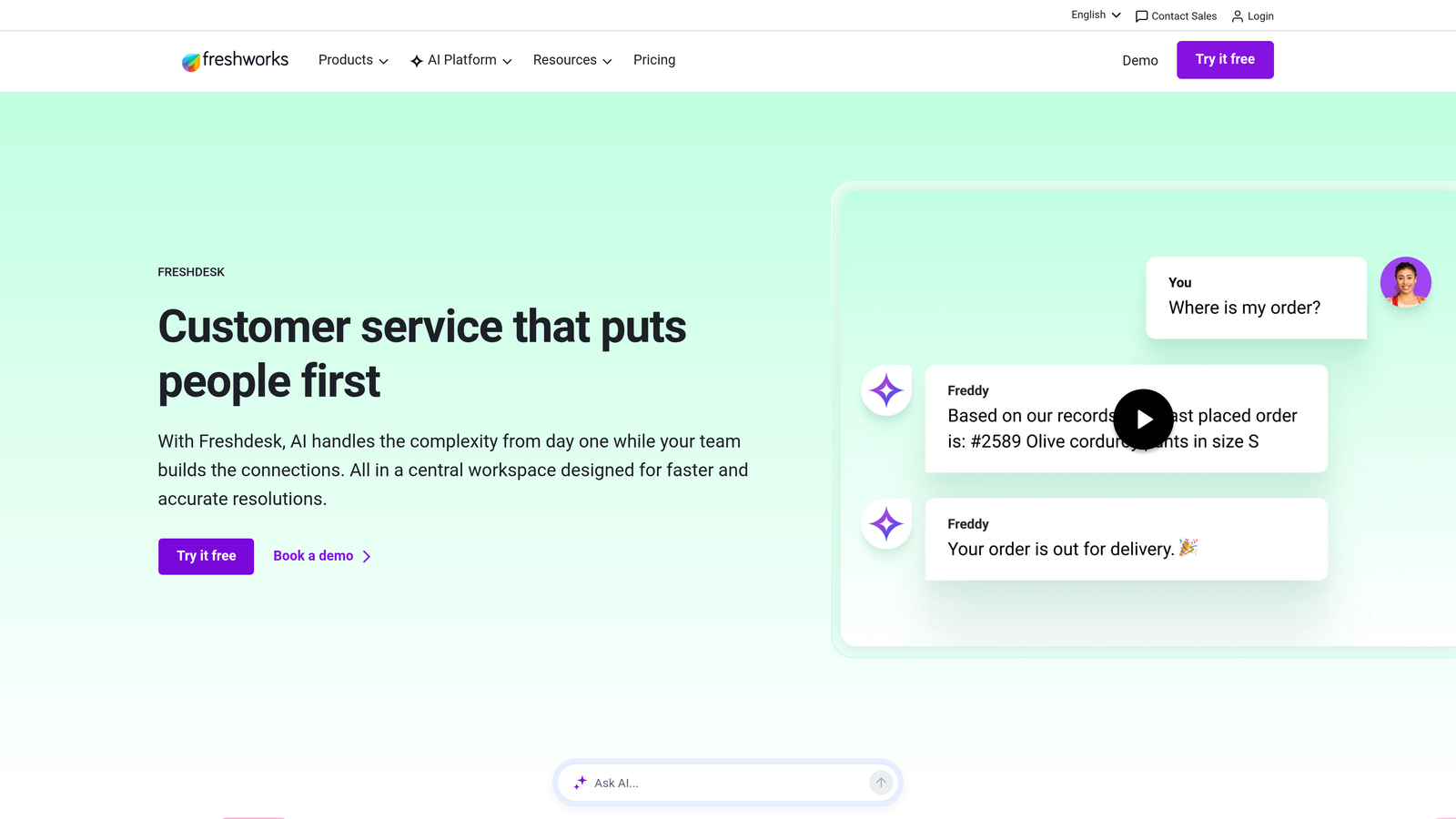
Freshdesk is a cost-effective omnichannel helpdesk with Freddy AI for triage, sentiment analysis, and workflow automation built into its higher-tier plans.
Where This Tool Shines
Freshdesk offers strong value for healthcare SaaS teams that need solid automation capabilities without the enterprise price tag of Zendesk or Salesforce. Freddy AI handles the most time-consuming parts of the support workflow: auto-triaging incoming tickets, detecting sentiment, and suggesting responses to agents. This speeds up resolution times even when tickets still require a human touch.
HIPAA compliance is available on higher-tier plans, which is an important consideration when evaluating whether Freshdesk fits your compliance requirements. Teams at earlier stages should confirm BAA availability and specific data handling features before handling PHI through the platform.
Key Features
Freddy AI: Handles auto-triage, sentiment analysis, and agent response suggestions to accelerate ticket resolution across the team.
Omnichannel Support: Unified inbox for email, chat, phone, and social channels, giving support teams a single view of all customer interactions.
HIPAA Compliance on Higher-Tier Plans: Data encryption, audit logs, and BAA availability for teams handling protected health information.
Scenario Automations: Multi-step workflow automations that can trigger across multiple conditions, useful for complex healthcare support routing logic.
Free Tier for Small Teams: A functional free plan lets early-stage teams get started before committing to paid tiers.
Best For
Mid-market healthcare SaaS companies that want capable AI-assisted support across multiple channels without the cost structure of enterprise platforms. Also a good entry point for early-stage teams that may grow into more advanced features.
Pricing
A free tier is available for small teams. The Pro plan starts around $49 per agent per month, with HIPAA-eligible features available at higher tiers.
5. Ada
Best for: Healthcare SaaS companies that want AI-native, automated resolution at scale without building complex chatbot flows.
Ada is an AI-native customer service automation platform with a reasoning engine, no-code agent builder, and multilingual capabilities designed for high-volume automated resolution.
Where This Tool Shines
Ada's differentiator is its reasoning engine, which moves beyond the scripted decision trees of traditional chatbots. Rather than following a fixed flow, Ada's AI can reason through a user's query, pull from your knowledge base, and generate an appropriate response dynamically. For healthcare SaaS, this is valuable when users ask nuanced questions about clinical workflows or product configurations that don't map neatly to a single FAQ answer.
The no-code builder makes it accessible for support or operations teams that want to train and update the AI without depending on engineering resources. As your product evolves, keeping the AI current is a real operational challenge, and Ada's interface is designed to make that manageable.
Key Features
Reasoning Engine: Goes beyond scripted chatbot flows to generate contextually accurate responses from your knowledge base and connected systems.
No-Code Agent Builder: Create, train, and update AI agents through an intuitive interface without requiring developer involvement.
Multilingual Support: Handles queries in 50+ languages, useful for healthcare SaaS companies serving global provider or patient populations.
Broad Integration via API: Connects with major helpdesks, CRMs, and backend systems to pull real-time data into conversations.
Resolution and Containment Analytics: Dashboards tracking automation rates and where the AI hands off to humans, helping teams continuously improve coverage.
Best For
Healthcare SaaS companies with high support volume that want to automate a large percentage of interactions and have the internal resources to invest in proper AI agent training and ongoing optimization.
Pricing
Custom pricing based on resolution volume. Contact Ada directly for a quote tailored to your team's scale and use case.
6. Forethought
Best for: Healthcare SaaS teams that want to add intelligent AI triage and response generation on top of their existing helpdesk without migrating platforms.
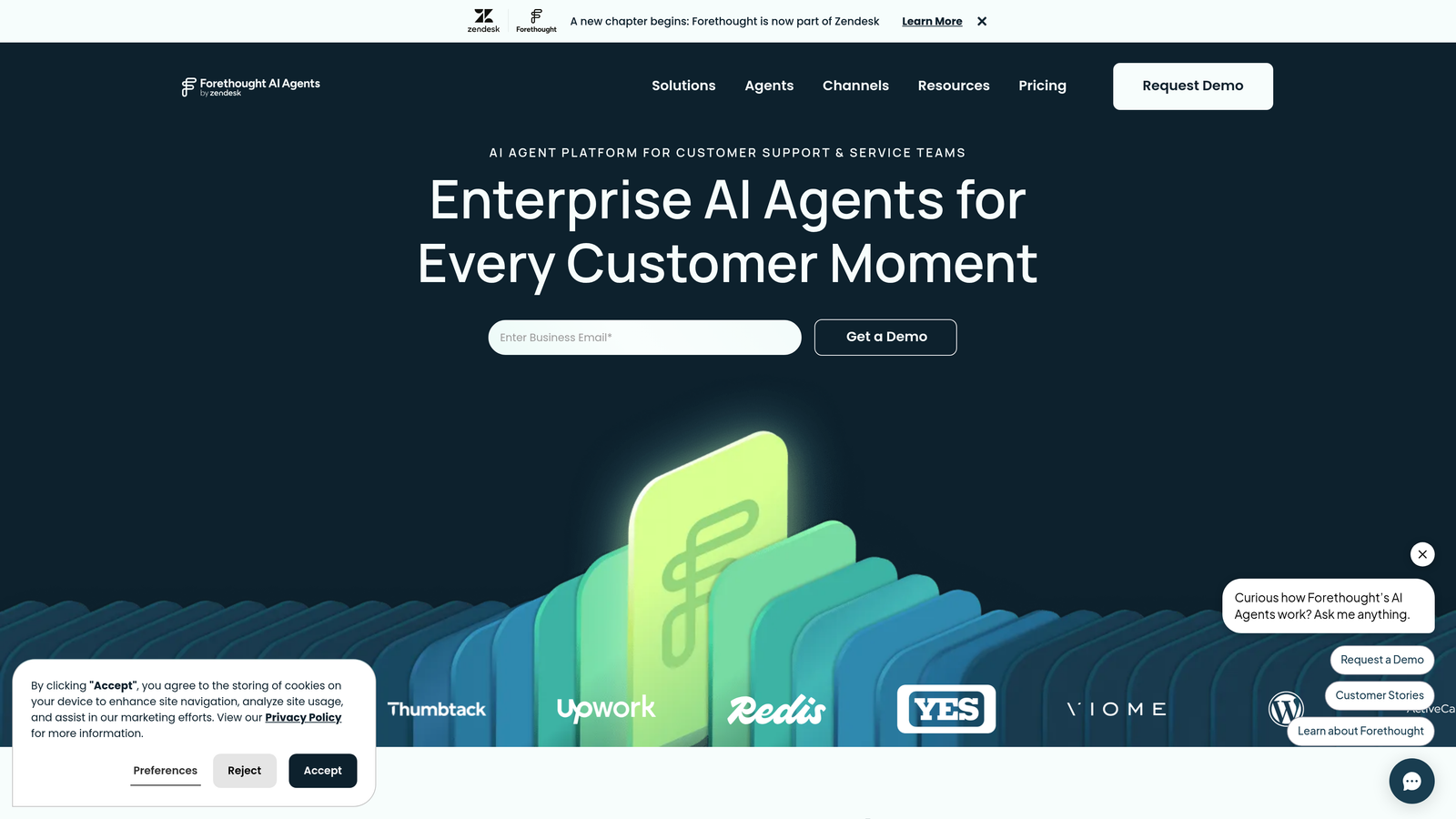
Forethought is an AI layer that sits on top of existing helpdesks to provide intelligent routing, AI-generated responses, and knowledge retrieval across your support operation.
Where This Tool Shines
Forethought's core value proposition is additive intelligence. If your team has already invested in Zendesk or Salesforce and doesn't want to migrate, Forethought enhances those platforms with AI capabilities rather than replacing them. This is a significant practical advantage for healthcare SaaS teams where switching costs, compliance re-validation, and change management can be prohibitive.
The SupportGPT feature generates accurate, context-aware responses by pulling from your existing knowledge base, which means the AI improves as your documentation improves. For healthcare SaaS, where product documentation often includes clinical terminology and complex workflows, this knowledge-grounded approach reduces the risk of the AI generating inaccurate guidance.
Key Features
SupportGPT: Generates context-aware responses grounded in your knowledge base, reducing hallucination risk and improving accuracy for technical healthcare queries.
Solve AI Widget: Customer-facing automated resolution layer that handles common queries before they reach a human agent.
Triage AI: Intelligent ticket classification and routing based on content, intent, and priority signals.
Helpdesk Overlay Architecture: Works on top of Zendesk, Salesforce, and other platforms, eliminating the need for a full migration.
Compliance-Aware Deployment: Healthcare and compliance-aware deployment options for teams handling sensitive data.
Best For
Healthcare SaaS teams already invested in a major helpdesk platform that want to layer in AI capabilities without the disruption of a platform switch. Particularly strong for teams with mature knowledge bases.
Pricing
Custom pricing based on ticket volume and modules deployed. Contact Forethought for a quote specific to your team's requirements.
7. Salesforce Health Cloud + Service Cloud
Best for: Enterprise healthcare SaaS organizations that need deep CRM integration, a native healthcare data model, and compliance infrastructure at scale.
Salesforce Health Cloud combined with Service Cloud delivers an enterprise-grade support platform with patient and provider 360-degree views, Einstein AI automation, and HIPAA-compliant infrastructure.
Where This Tool Shines
For large healthcare SaaS companies where support is deeply entangled with customer success, account management, and clinical data, the Salesforce ecosystem offers a level of integration that standalone helpdesks cannot match. Health Cloud's native healthcare data model understands patient timelines, care plans, and provider relationships, giving support agents context that goes far beyond a standard ticket view.
The Einstein AI layer handles case classification, routing, and next-best-action recommendations, which can meaningfully reduce manual triage work for large support teams. The trade-off is complexity and cost: Salesforce implementations require significant configuration investment and ongoing administration.
Key Features
Native Healthcare Data Model: Built-in support for patient timelines, care plans, and provider relationships, giving agents rich clinical context.
Einstein AI: Case classification, intelligent routing, and next-best-action recommendations to guide agents and automate routine decisions.
Salesforce Shield for Compliance: Platform encryption, event monitoring, and field audit trails to meet HIPAA requirements and support audit readiness.
EHR/EMR Integration: Deep integration capabilities with major electronic health record systems and healthcare APIs for a connected data environment.
Omnichannel Routing: Routes interactions across chat, phone, email, and SMS to the right agent or team based on case type and priority.
Best For
Enterprise healthcare SaaS companies that are already in the Salesforce ecosystem or that have complex, data-rich support workflows requiring deep CRM and clinical data integration.
Pricing
Health Cloud starts around $325 per user per month. Service Cloud plans begin from $25 per user per month for basic tiers, with costs increasing significantly for enterprise features.
8. Help Scout
Best for: Small to mid-sized healthcare SaaS teams that prioritize human-centric support with clean tooling, HIPAA compliance, and simple automation.
Help Scout is a collaborative shared inbox platform with HIPAA BAA availability, a lightweight Beacon widget, and straightforward automation rules designed for teams that value simplicity.
Where This Tool Shines
Help Scout occupies a useful niche: it's genuinely easy to use, HIPAA-compliant on its Plus plan, and focused on making human agents more effective rather than replacing them entirely. For healthcare SaaS companies where support interactions are sensitive and often require a personal touch, this balance is appealing. Agents can collaborate on tickets with internal notes, avoid double-responses with collision detection, and access a clean knowledge base for self-serve support.
The Beacon widget embeds help articles and contact forms directly in your product, giving users a self-service option before they escalate to a live agent. It's not as AI-sophisticated as some other tools on this list, but for teams that want reliable, compliant, and human-centered support without a steep learning curve, Help Scout is a strong fit.
Key Features
HIPAA BAA on Plus Plan: Business Associate Agreement available with appropriate data handling controls for teams managing PHI.
Beacon Widget: In-app help articles and contact forms that give users a self-serve layer before reaching a live agent.
Saved Replies and Workflow Automation: Speed up repetitive responses and automate routing rules for common ticket types.
Docs Knowledge Base: A built-in knowledge base for creating and maintaining self-serve support content accessible to users and agents.
Collision Detection and Internal Notes: Team collaboration features that prevent duplicate responses and keep agent communication organized within tickets.
Best For
Small to mid-sized healthcare SaaS teams that want HIPAA-compliant, human-centered support without the complexity or cost of enterprise platforms. A good fit for teams where relationship quality matters as much as automation efficiency.
Pricing
Standard plan starts at $25 per user per month. The Plus plan, which includes HIPAA BAA access, is $50 per user per month.
9. Drift (Salesloft)
Best for: Healthcare SaaS companies where support conversations frequently intersect with sales, expansion, and upsell opportunities.
Drift, now part of the Salesloft platform, is a conversational AI platform that bridges support and revenue, useful for healthcare SaaS teams where support interactions often signal expansion potential.
Where This Tool Shines
Drift's positioning is distinct from the other tools on this list. Where most support automation platforms focus on deflection and resolution, Drift is built to connect support conversations to revenue outcomes. For healthcare SaaS companies with account-based expansion models, where a provider's support question might signal an upsell opportunity or a renewal risk, Drift's ability to route conversations to sales or customer success in real time is genuinely useful.
The AI chatbots handle initial triage and qualification, then route to the right team based on account attributes or conversation content. The integration with Salesforce, HubSpot, and other CRMs means that every conversation is tied back to account records, giving revenue teams visibility into support-driven signals.
Key Features
AI Chatbots for Support and Lead Qualification: Handle initial triage and qualification in a single conversational flow, routing to support or sales based on intent signals.
Account-Based Marketing Integration: Personalize conversations based on account attributes, plan type, or firmographic data for targeted engagement.
Conversational Playbooks: Pre-built interaction flows for common scenarios, including support escalation, renewal conversations, and product education.
CRM Integration: Deep integration with Salesforce, HubSpot, and other CRMs to tie support conversations directly to account and pipeline records.
Revenue-Focused Analytics: Dashboards that connect support conversation data to pipeline influence and revenue outcomes, not just ticket metrics.
Best For
Mid-market to enterprise healthcare SaaS companies with a strong account-based motion where support and sales teams need to share context and act on the same signals. Less suited for teams focused purely on ticket resolution efficiency.
Pricing
Custom pricing, typically structured for mid-market and enterprise budgets. Contact Salesloft for current Drift pricing and packaging.
Finding the Right Fit for Your Team
The best support automation tool for your healthcare SaaS company depends on three things: where you are in your growth journey, how much of your support you want to automate, and how much compliance complexity you're managing today.
For enterprise teams with deep Salesforce investment and complex clinical data workflows, Salesforce Health Cloud and Service Cloud offer unmatched integration depth. For large operations that want a proven helpdesk with HIPAA credentials, Zendesk remains a reliable choice. Teams already on a major helpdesk that want to add AI without migrating should look closely at Forethought.
Mid-market teams balancing cost and capability will find strong options in Freshdesk and Help Scout, both of which offer HIPAA-eligible plans without the enterprise price tag. For product-led companies where in-app guidance is as important as reactive support, Intercom's Fin AI and proactive messaging features are worth exploring. Ada is a strong fit for teams with high volume who want to invest in a dedicated AI resolution engine.
If your support conversations are closely tied to revenue and expansion, Drift's conversational approach to blending support and sales is a differentiated option worth evaluating.
And if you're looking for an AI-first platform that learns from every interaction, understands what your users are doing inside your product, and turns support data into business intelligence, that's exactly what Halo AI is built for. Your support team shouldn't scale linearly with your customer base. Let AI agents handle routine tickets, guide users through your product, and surface business intelligence while your team focuses on complex issues that need a human touch. See Halo in action and discover how continuous learning transforms every interaction into smarter, faster support.