9 Best Support Automation Tools for Healthcare Software in 2026
Support automation for healthcare software demands more than a generic helpdesk — it requires intelligent triage, compliance-aware workflows, and seamless human escalation. This guide reviews the 9 strongest tools available in 2026 for teams supporting EHR platforms, healthcare SaaS products, and patient-facing applications.
 Matt PattoliFounder13 min read
Healthcare software support isn't like supporting a typical SaaS product. Your users might be a nurse trying to document patient care between rounds, a billing specialist untangling a claims workflow, or an administrator troubleshooting an integration that's holding up a critical process. Every unresolved ticket has downstream consequences, and the pressure to respond quickly while maintaining compliance makes the stakes genuinely high.
Generic helpdesk tools weren't designed for this environment. They don't account for the complexity of healthcare workflows, the sensitivity of the data passing through support conversations, or the need for precise escalation control when automation reaches its limits. The tools below were selected specifically for their ability to handle these demands: intelligent automation, integration depth, continuous learning, and the ability to hand off gracefully when a human needs to step in.
Whether you're running support for an EHR platform, a healthcare SaaS product, or a patient-facing application, here are the strongest options available in 2026.
1. Halo AI
Best for: B2B healthcare SaaS teams that need AI-first support with deep product context and business intelligence.
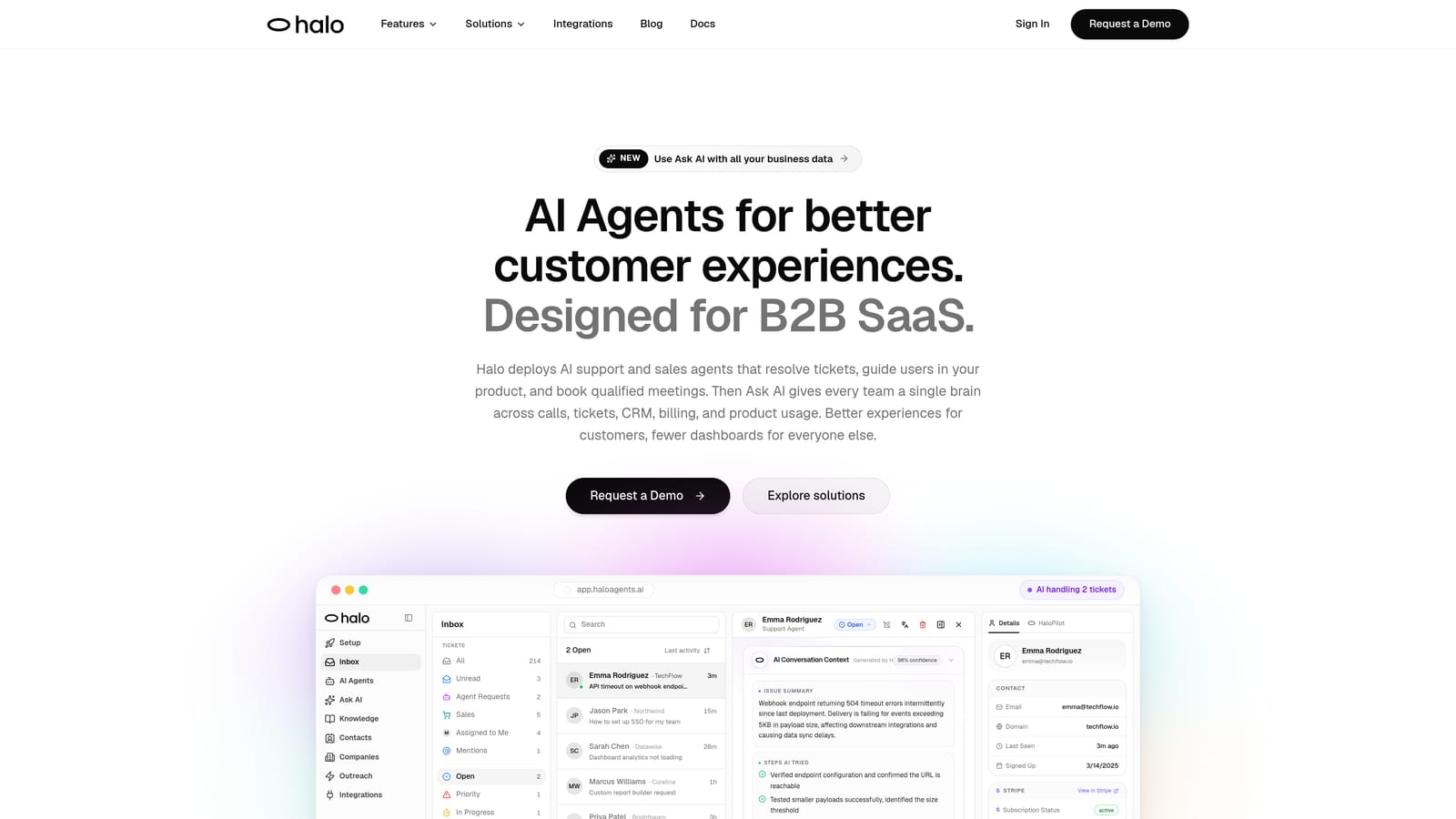
Halo AI is an AI-native customer support platform that deploys intelligent agents to resolve tickets, guide users through your product, and surface strategic insights from every interaction.
Where This Tool Shines
What separates Halo from most support tools is its page-aware architecture. The AI agent understands what screen or workflow a user is currently on, which means it can deliver contextual visual guidance rather than generic answers. For healthcare software where workflows are complex and context-dependent, this is a meaningful advantage.
Halo also goes beyond reactive support. Its smart inbox surfaces customer health signals, revenue intelligence, and anomaly detection, turning support interactions into strategic data. For healthcare SaaS teams where a single churning customer might represent significant ARR, that kind of visibility matters.
Key Features
Page-Aware Chat Widget: The AI agent sees what the user sees, delivering contextual guidance based on their current location in the product.
Intelligent AI Agents: Resolve tickets autonomously and continuously learn from every interaction, improving accuracy over time without manual retraining.
Smart Inbox with Business Intelligence: Surfaces customer health signals, revenue intelligence, and anomaly detection directly from support data.
Auto Bug Ticket Creation: Automatically generates structured bug reports from user-reported issues, eliminating the manual handoff between support and engineering.
Live Agent Handoff: Seamlessly transfers conversations to human agents with full context preserved, so nothing gets repeated or lost.
Integration Ecosystem: Connects with Linear, Slack, HubSpot, Intercom, Stripe, Zoom, PandaDoc, and Fathom.
Best For
Healthcare SaaS teams that want an AI-first approach rather than AI bolted onto an existing helpdesk. Particularly well-suited for product-led organizations where support interactions carry product and revenue signals worth capturing.
Pricing
Contact Halo AI directly for pricing. The platform is positioned for B2B SaaS teams with enterprise-grade needs.
2. Intercom
Best for: Healthcare software companies with high chat volume and an existing Intercom investment.
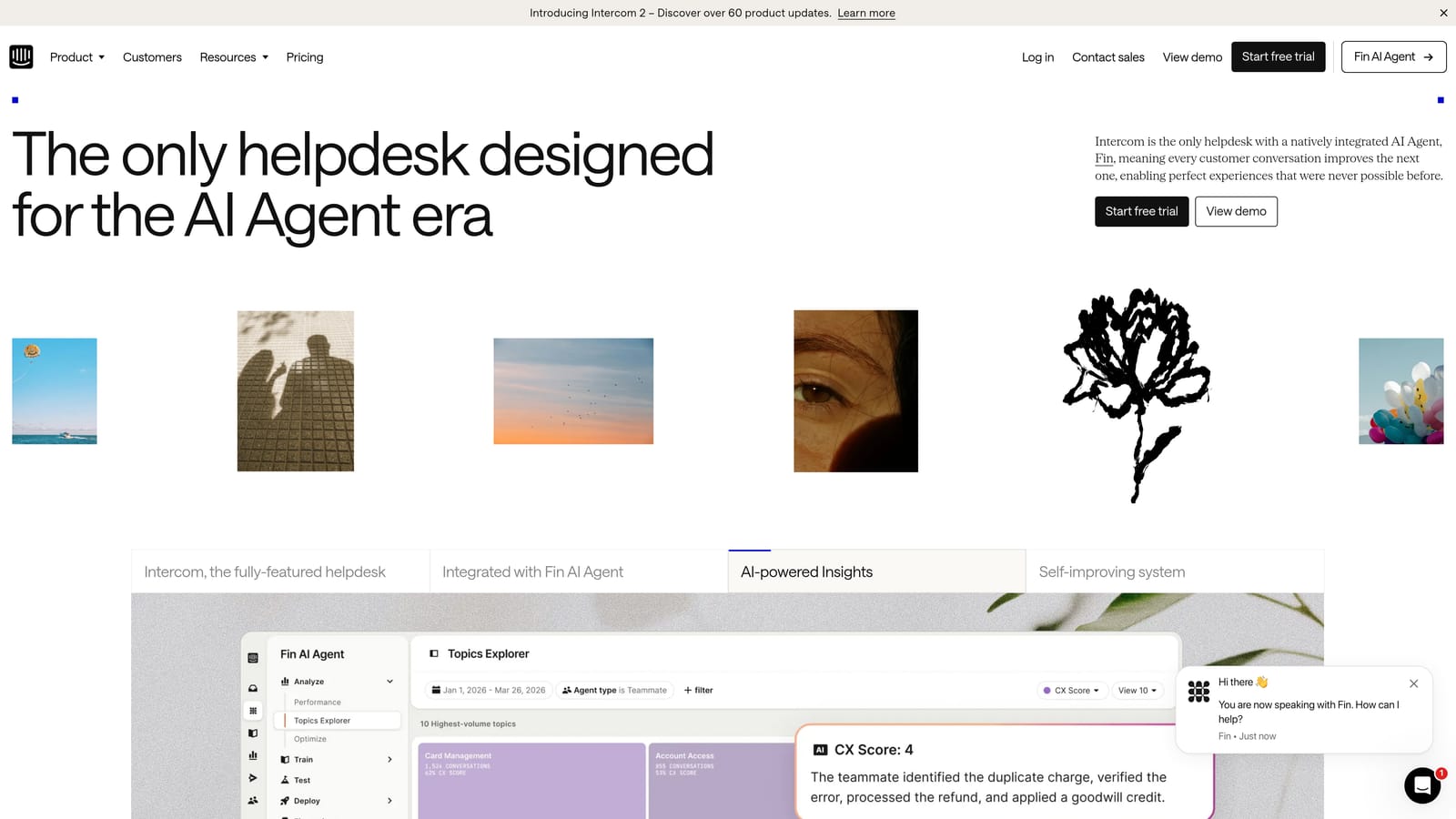
Intercom is a mature conversational support platform with a capable AI agent, Fin, built on top of a well-established messaging infrastructure.
Where This Tool Shines
Intercom's Fin AI agent is one of the more polished AI resolution tools on the market. It answers questions using your existing help content without requiring manual bot-building, which lowers the barrier to getting automation running quickly. For healthcare software teams with solid documentation, this can translate into meaningful deflection on common how-to questions.
The platform's omnichannel messaging and robust product integrations also make it a strong choice for teams that need to support users across multiple touchpoints. The caveat is that Fin is AI layered on top of a messaging-first platform, not an AI-native architecture, which can limit how deeply it understands product context.
Key Features
Fin AI Agent: Resolves questions using existing help documentation without manual bot-building or flow configuration.
Omnichannel Messaging: Supports chat, email, and in-app communication from a unified platform.
App Marketplace: Robust integrations with popular SaaS tools and healthcare-adjacent platforms.
Conversation Routing: Automated assignment and routing rules to direct tickets to the right team or agent.
Usage-Based Pricing: Fin AI resolution is priced per resolved conversation, which scales with volume.
Best For
Healthcare software companies with high chat volume that already use or are evaluating Intercom. Teams that want AI-assisted resolution without building complex automation flows from scratch.
Pricing
Starts at approximately $39 per seat per month. Fin AI resolution is priced per resolved conversation, so costs can scale significantly at higher volumes.
3. Zendesk
Best for: Larger healthcare software organizations with complex, multi-team support structures.
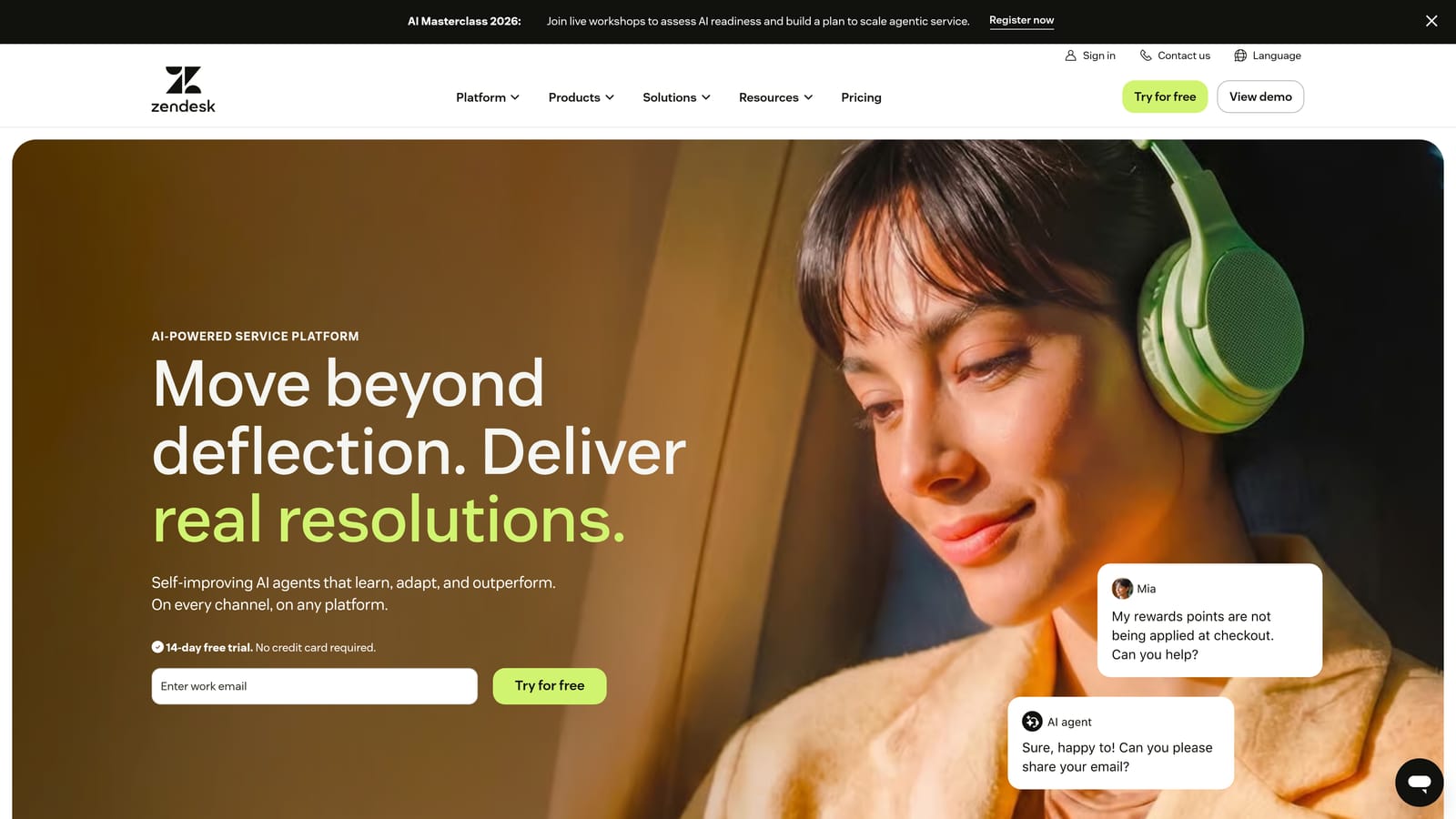
Zendesk is an enterprise-grade ticketing and support platform with AI triage, intent detection, and one of the largest integration ecosystems in the industry.
Where This Tool Shines
Zendesk's strength is its maturity. The platform has been refined for enterprise support operations over many years, and its SLA management, workflow automation, and multi-brand support structures are genuinely best-in-class for complex organizations. For a healthcare software company running support across multiple product lines or customer segments, that structural depth is valuable.
The AI capabilities, powered by OpenAI, handle triage, suggested responses, and intent detection reasonably well. These are useful additions, though they function more as agent assistance tools than fully autonomous resolution agents.
Key Features
AI Triage and Intent Detection: Automatically categorizes and routes incoming tickets based on detected intent and urgency.
Advanced SLA Management: Configurable SLA policies with escalation rules suited to complex support organizations.
App Marketplace: Hundreds of integrations including healthcare-adjacent and compliance-focused tools.
Multi-Brand and Multi-Team Support: Supports complex organizational structures with separate inboxes, views, and workflows.
Reporting and Analytics: Robust dashboards for tracking team performance, ticket volume, and resolution metrics.
Best For
Larger healthcare software organizations with dedicated support operations teams, multiple product lines, and the administrative capacity to configure and maintain an enterprise platform.
Pricing
Suite plans start at approximately $55 per agent per month. Enterprise pricing is available and typically required for advanced AI and customization features.
4. Freshdesk
Best for: Growth-stage healthcare SaaS teams that need automation without enterprise complexity or cost.
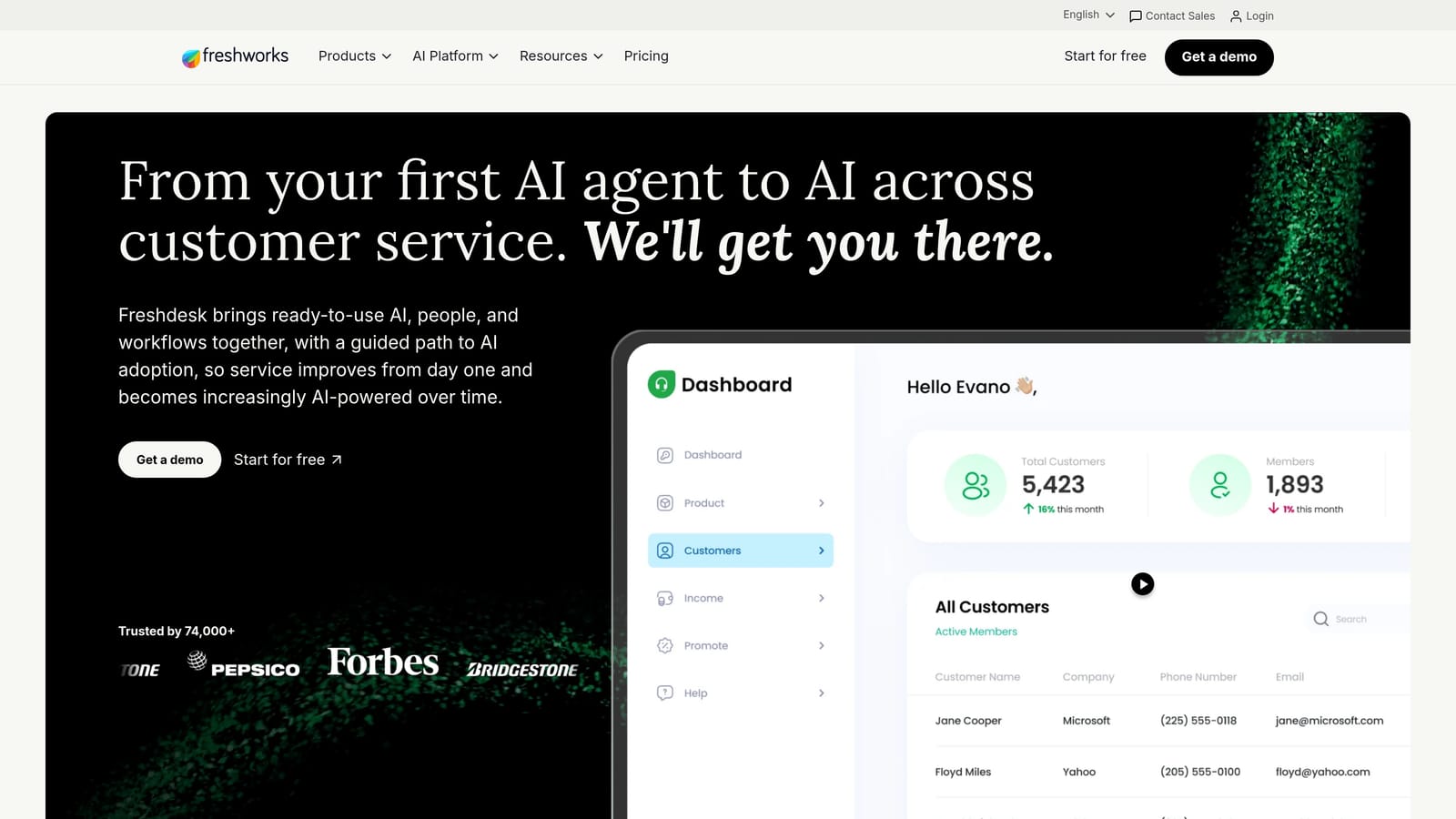
Freshdesk is a mid-market helpdesk platform with Freddy AI handling ticket suggestions, auto-triage, and self-service automation at a more accessible price point.
Where This Tool Shines
Freshdesk occupies a useful middle ground: more capable than lightweight tools, but without the implementation overhead and cost of Zendesk or Salesforce. Freddy AI Copilot assists agents with suggested responses and next steps, while Freddy Self Service handles end-user automation and chatbot flows. For a growing healthcare SaaS team, this balance of capability and simplicity is genuinely practical.
The omnichannel coverage across email, chat, phone, and social is solid, and the shared inbox features like collision detection make team collaboration cleaner. It won't satisfy every enterprise requirement, but for teams in the $1M to $20M ARR range, it often hits the right notes.
Key Features
Freddy AI Copilot: Assists agents with suggested responses, ticket summaries, and recommended next actions.
Freddy Self Service: Handles end-user automation and chatbot flows for common question resolution.
Omnichannel Support: Covers email, chat, phone, and social from a single platform.
Collision Detection: Prevents multiple agents from working the same ticket simultaneously.
Marketplace Integrations: Connects with popular SaaS tools across the business stack.
Best For
Healthcare SaaS companies in the growth stage that need a capable helpdesk with AI assistance but want to avoid the cost and complexity of enterprise platforms.
Pricing
A free plan is available for small teams. Paid plans start at approximately $15 per agent per month, making it one of the more accessible options on this list.
5. Salesforce Service Cloud
Best for: Healthcare software vendors already operating within the Salesforce ecosystem.
Salesforce Service Cloud is an enterprise support platform built on Salesforce's CRM infrastructure, with Einstein AI providing case classification, routing, and agent recommendations.
Where This Tool Shines
If your organization already runs on Salesforce, Service Cloud's integration with Sales Cloud, Health Cloud, and the broader Salesforce platform is genuinely compelling. The unified customer view across sales, support, and CRM data means support agents have full context on every account, and Einstein AI can surface relevant knowledge and next best actions based on that combined data.
The healthcare-specific angle is real: Salesforce Health Cloud provides additional data models and compliance considerations relevant to healthcare software vendors. That said, the platform's implementation complexity is significant. Most organizations need a dedicated Salesforce admin or implementation partner to get full value from it.
Key Features
Einstein AI: Handles case classification, intelligent routing, and agent recommendations based on historical data.
Unified Customer View: Combines CRM, sales, and support data into a single agent interface.
Salesforce Health Cloud Integration: Provides healthcare-specific data models and additional compliance tooling.
Omni-Channel Routing: Intelligently assigns cases based on agent availability, skill, and workload.
Extensive Customization: Flow and Apex allow deep customization for complex support workflows.
Best For
Enterprise healthcare software vendors already invested in the Salesforce ecosystem who want their support operations tightly integrated with sales and account management data.
Pricing
Starts at approximately $25 per user per month for the Starter tier. Enterprise plans with full AI and customization capabilities are significantly higher, and implementation costs add to the total investment.
6. Help Scout
Best for: Lean, early-stage healthcare SaaS teams that want clean, human-feeling support without over-engineering.
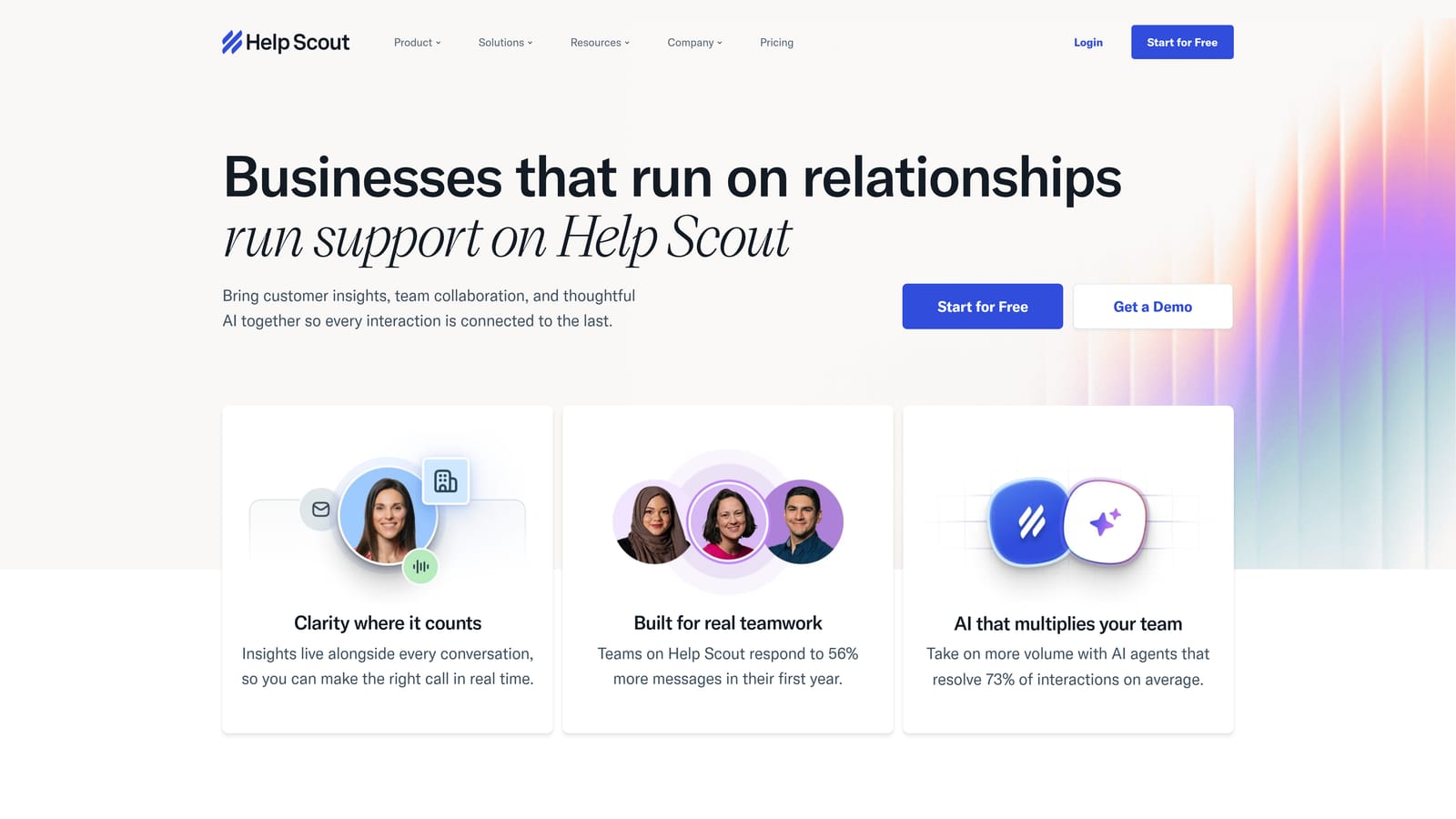
Help Scout is a shared inbox and knowledge base tool designed for teams that prioritize a straightforward, email-like support experience with light AI assistance.
Where This Tool Shines
Help Scout's appeal is its simplicity. The interface is clean, the learning curve is low, and it gets teams productive quickly without a long implementation cycle. For early-stage healthcare SaaS companies where the support team is small and the priority is responsiveness over automation depth, that simplicity is a genuine advantage.
The AI Drafts feature generates suggested replies based on conversation context, and the Docs knowledge base handles self-service reasonably well. Help Scout also takes a privacy-conscious approach to data handling, which resonates with healthcare software teams navigating data sensitivity requirements.
Key Features
AI Drafts: Generates suggested replies based on conversation context to speed up agent responses.
Docs Knowledge Base: A straightforward self-service knowledge base for end-user questions.
Shared Inbox: Includes collision detection and private notes for team collaboration.
Automation Rules: Simple routing and tagging automation for common ticket patterns.
Privacy-Conscious Design: Straightforward data handling approach suited to teams with compliance considerations.
Best For
Early-stage healthcare SaaS teams with small support operations that want a clean, reliable tool without the overhead of an enterprise platform. Not the right fit for teams that need deep automation or AI-driven resolution at scale.
Pricing
Starts at approximately $22 per user per month. Pricing is straightforward with no usage-based components that can create billing surprises.
7. Guru
Best for: Healthcare software teams with large, evolving knowledge bases and agents who need fast, accurate answers.
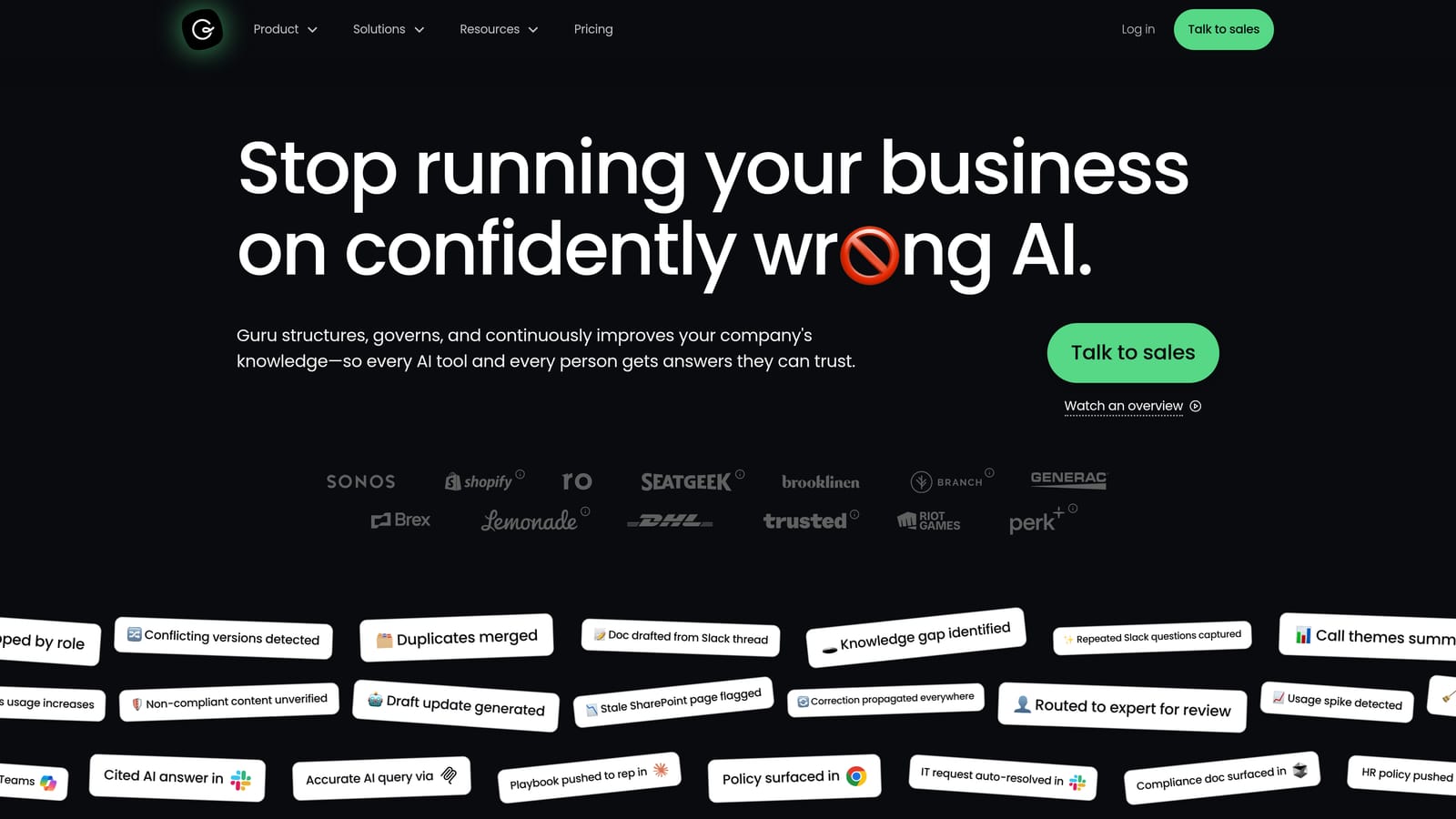
Guru is a knowledge management platform that surfaces relevant internal knowledge to support agents in real time, integrating directly into Slack, Chrome, and existing support tools.
Where This Tool Shines
Guru addresses a specific and common problem: support agents spending too much time searching for the right answer. In healthcare software environments where products evolve quickly and accurate information is critical, this is a real productivity drain. Guru surfaces relevant knowledge directly within the agent's existing workflow, whether they're in Zendesk, Slack, or a browser tab, without requiring them to stop and search a separate knowledge base.
The verification system is particularly valuable in healthcare contexts: designated experts can mark answers as verified and up-to-date, reducing the risk of agents relying on outdated information. Guru also identifies knowledge gaps from support interactions, which helps teams proactively improve their documentation.
Key Features
In-Workflow Knowledge Surfacing: Delivers relevant knowledge within Slack, Chrome, and support tools without requiring context switching.
Verified Answers: Expert-verified content ensures agents always access accurate, current information.
Knowledge Triggers: Suggests relevant articles automatically based on ticket or conversation context.
Knowledge Gap Analytics: Identifies where documentation is missing or insufficient based on support patterns.
Integrations: Connects with Zendesk, Salesforce, Intercom, and other major support platforms.
Best For
Healthcare software teams with complex, frequently updated product knowledge who use an existing ticketing system and want to improve agent efficiency without replacing their current stack. Works alongside other tools rather than replacing them.
Pricing
A free plan is available for small teams. Paid plans start at approximately $10 per user per month, making it an accessible add-on to an existing support stack.
8. Tidio
Best for: Small healthcare SaaS teams that need basic chat automation deployed quickly and affordably.
Tidio is a lightweight AI chatbot and live chat tool with straightforward automation flows and a low barrier to getting started.
Where This Tool Shines
Tidio's primary advantage is speed of deployment. Teams that need basic automation running without a lengthy implementation cycle will find it refreshingly approachable. The Lyro AI chatbot handles common questions using existing content, and the visual chatbot builder lets non-technical team members create automation flows without writing code.
It's worth being honest about the ceiling here: Tidio is designed for simpler support environments. For complex B2B healthcare software use cases with nuanced workflows and high compliance sensitivity, it may not offer the depth required. But for a small team handling a manageable volume of straightforward questions, it does the job cleanly.
Key Features
Lyro AI Chatbot: Resolves common questions using your existing content without complex configuration.
Visual Chatbot Builder: Creates automation flows without code, accessible to non-technical team members.
Live Chat Fallback: Seamless handoff to human agents when the chatbot reaches its limits.
Email and Messenger Integration: Extends coverage beyond on-site chat to additional channels.
Quick Setup: Low implementation overhead compared to enterprise alternatives.
Best For
Small healthcare SaaS teams or early-stage companies that want basic chat automation without a long implementation cycle. Teams with complex multi-channel support needs or deep compliance requirements will likely outgrow it.
Pricing
A free plan is available. Lyro AI starts at approximately $29 per month, making it one of the most affordable AI chatbot options on this list.
9. Kustomer
Best for: Healthcare software companies with complex customer histories and high-volume, multi-channel support needs.
Kustomer is a CRM-style support platform that unifies the entire customer history into a single timeline, combining AI-driven routing and intent detection with multi-channel automation.
Where This Tool Shines
Kustomer's defining feature is the unified customer timeline: every interaction across every channel, organized into a single view per customer. For healthcare software companies where a single account might involve dozens of contacts, multiple integration issues, and a long history of support interactions, this longitudinal view is operationally valuable. Agents have full context before they type their first response.
The AI-driven routing and intent detection layer adds meaningful efficiency for high-volume environments. One practical consideration for enterprise buyers: Kustomer was acquired by Meta and subsequently sold to a private equity firm, so it's worth evaluating platform stability and roadmap commitments before making a long-term investment.
Key Features
Unified Customer Timeline: Aggregates all interactions across channels into a single, chronological customer view.
AI-Driven Routing and Intent Detection: Automatically classifies and routes conversations based on detected intent and customer attributes.
Automated Workflows: Triggered by customer attributes or behavior, enabling proactive and reactive automation.
Multi-Channel Support: Covers email, chat, SMS, social, and voice from a unified platform.
CRM-Style Customer Profiles: Full interaction history and customer attributes accessible within every support conversation.
Best For
Healthcare software companies with high support volume, multi-channel operations, and complex customer histories that benefit from a CRM-style view. Best suited to teams with the budget and operational maturity to leverage its depth.
Pricing
Starts at approximately $89 per user per month, positioning it firmly in the enterprise tier. Factor in implementation and configuration time when evaluating total cost.
Which Tool Is Right for Your Healthcare Software Team?
The right tool depends on where your team is today and what your support motion actually looks like, not just which platform has the longest feature list.
If you're an early-stage team that needs something clean and functional without heavy setup, Help Scout or Tidio will get you moving quickly. They're honest tools that do what they promise without demanding a dedicated administrator to configure them.
For growth-stage healthcare SaaS companies that need real automation depth at a reasonable price, Freshdesk hits a practical balance. Teams that have already invested in Intercom will find Intercom's Fin a natural extension of what they're already using.
Enterprise organizations with complex multi-team structures will gravitate toward Zendesk for its operational maturity, or Salesforce Service Cloud if they're already running on Salesforce. Kustomer is worth evaluating for high-volume, multi-channel environments where customer history is central to every interaction.
Guru stands apart as the only tool on this list that works alongside your existing stack rather than replacing it. If your agents are slowed down by knowledge-hunting rather than ticket volume, it's a targeted fix worth considering.
For teams that want an AI-first approach built specifically for the complexity of B2B SaaS support, Halo AI is the strongest option. The page-aware context, continuous learning, and business intelligence layer make it particularly well-suited to healthcare software products where every support interaction carries product and revenue signals worth capturing.
Your support team shouldn't scale linearly with your customer base. Let AI agents handle routine tickets, guide users through your product, and surface business intelligence while your team focuses on complex issues that need a human touch. See Halo in action and discover how continuous learning transforms every interaction into smarter, faster support.