9 Best Support Automation Tools for High-Growth Companies in 2026
Support automation for high-growth companies is essential for scaling customer service without proportionally increasing headcount, and this guide evaluates the 9 best tools built to handle rapid volume spikes, complex routing, and enterprise-level demands. It covers what separates truly scalable automation platforms from those that buckle under growth pressure, helping fast-moving teams make smarter infrastructure decisions.
 Grant CooperFounder14 min read
High-growth companies face a support paradox that gets harder to ignore the faster you scale: ticket volume grows with revenue, but hiring support agents at the same rate destroys the margins you're working so hard to protect. The companies that break through this ceiling are the ones that automate intelligently, resolving routine issues instantly, routing complex problems to the right humans, and extracting business intelligence from every support interaction.
But not every automation tool is built for the speed and complexity of a high-growth environment. Some buckle under volume spikes. Others require months of setup that fast-moving teams simply can't afford. We evaluated the field and narrowed it to the tools that genuinely serve companies scaling rapidly, whether you're a Series A startup doubling your user base or a growth-stage company pushing into new markets.
What Separates Good Tools from Great Ones at Scale
Before diving into the list, it's worth understanding what high-growth companies actually need from support automation. Time-to-value matters enormously: a platform that takes three months to configure isn't useful when your user base doubles in six weeks. Integration depth matters too, since fast-growing teams typically run 10 or more SaaS tools and need support to connect to engineering, sales, billing, and communication systems simultaneously.
The other dimension is intelligence. There's a meaningful difference between tools that deflect tickets and tools that learn from them. The best platforms don't just resolve issues faster; they surface patterns, flag churn signals, and feed business intelligence back to the teams that need it most.
Here are the top support automation tools built for companies that can't afford to slow down.
1. Halo AI
Best for: AI-native support automation with business intelligence for scaling B2B teams
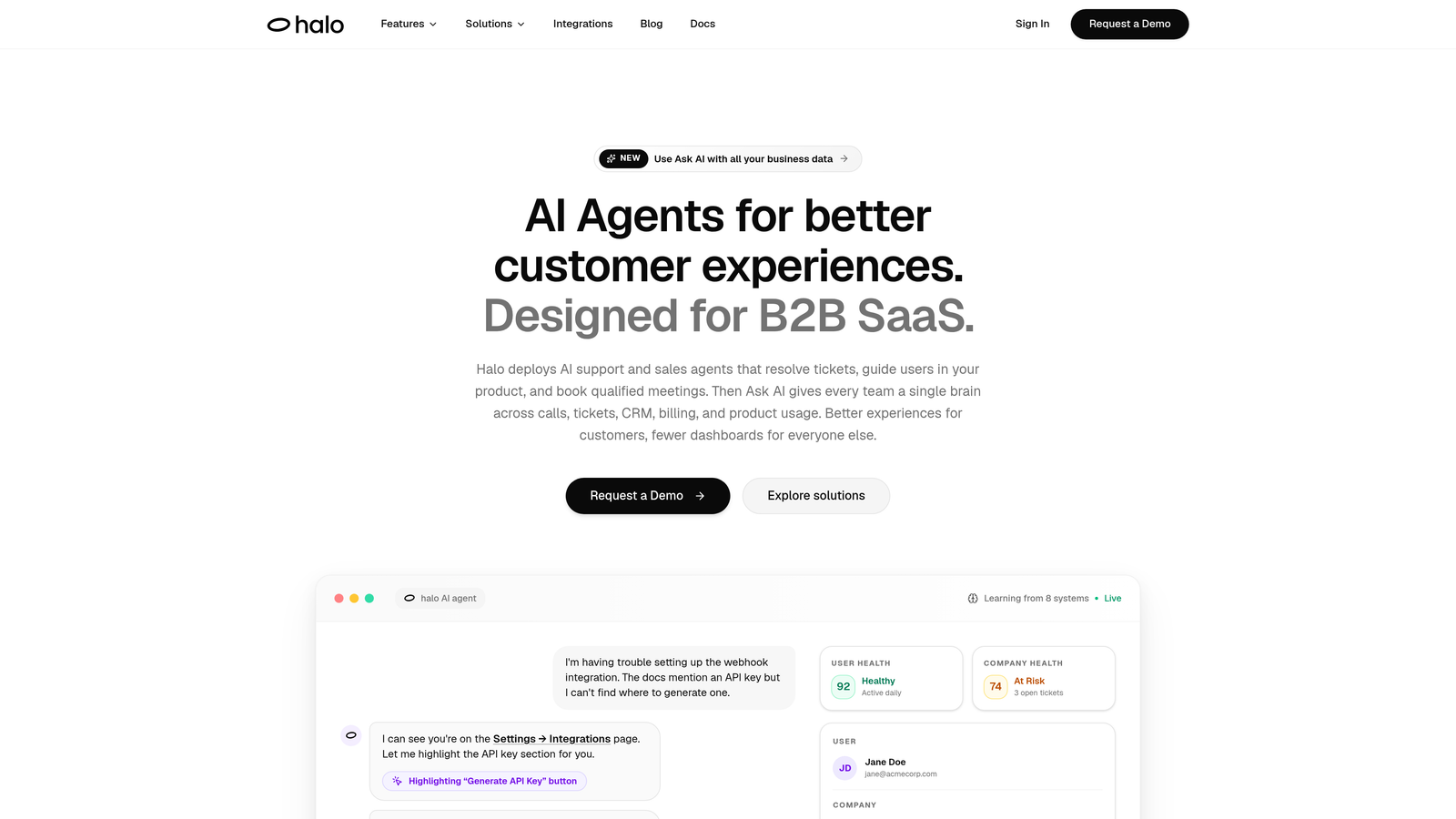
Halo AI is an AI-native customer support platform that deploys intelligent agents to resolve tickets, guide users with page-aware context, and generate business intelligence from every interaction.
Where This Tool Shines
What makes Halo genuinely different is the page-aware context layer. The AI agent doesn't just respond to what a user types; it sees what they're looking at in your product and provides guidance that's relevant to their exact situation. For SaaS companies with complex, multi-feature products, this eliminates a massive category of "I don't know where to start" tickets.
The business intelligence layer is the other standout. Most support tools tell you how fast tickets are resolved. Halo tells you what those tickets mean: which customers are showing churn signals, where revenue is at risk, and what bugs are quietly affecting your most valuable accounts. For growth-stage teams where support data is often a goldmine of product and customer intelligence, this is a meaningful differentiator.
Key Features
Page-Aware AI Agents: The AI sees what users see in your product, enabling contextual guidance that's relevant to their exact screen and workflow.
Continuous Learning: Every interaction improves resolution quality over time, so the system gets smarter as your product and user base evolve.
Smart Inbox with Business Intelligence: Customer health signals, revenue intelligence, and anomaly detection surface directly from support data, connecting support to growth metrics.
Auto Bug Ticket Creation and Live Agent Handoff: Bugs are automatically logged to your engineering system, and complex issues escalate to human agents without friction.
Deep Integrations: Connects natively to Linear, Slack, HubSpot, Intercom, Stripe, Zoom, PandaDoc, and Fathom, making it a genuine hub across your entire stack.
Best For
B2B SaaS companies and product teams that need support automation to do more than deflect tickets. Particularly strong for growth-stage companies that want support data to inform product, sales, and customer success decisions simultaneously.
Pricing
Contact for pricing. Halo is designed for growth-stage and scaling teams, so pricing is structured around team size and usage rather than a rigid per-seat model.
2. Intercom
Best for: Unified customer messaging with proactive engagement and AI-powered resolution
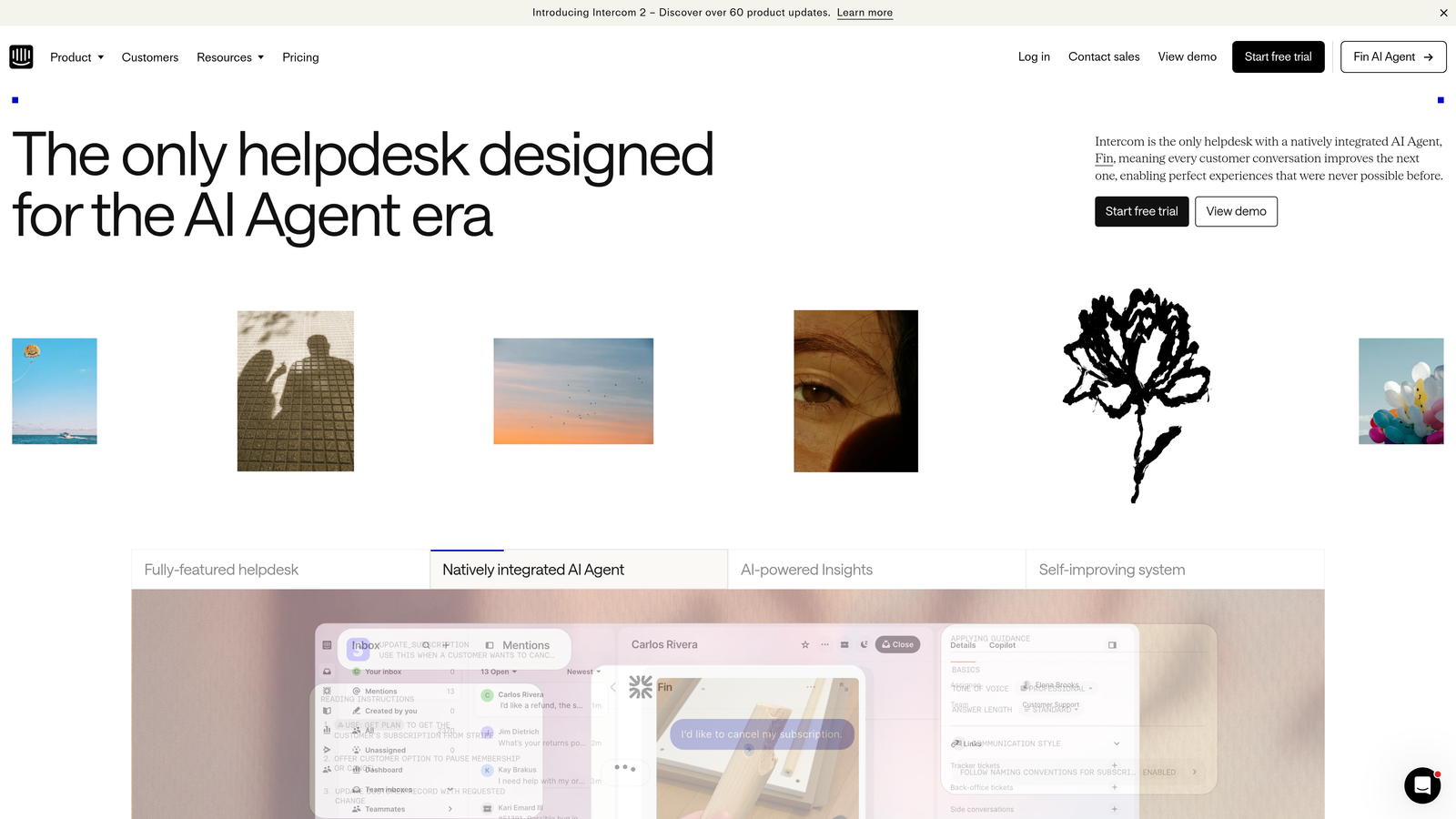
Intercom is a unified customer messaging platform combining its Fin AI agent with proactive messaging, product tours, and a robust customer data platform.
Where This Tool Shines
Intercom's strength is its combination of reactive and proactive support. Fin handles inbound resolution autonomously, while the broader platform lets you get ahead of support volume with in-app messages, product tours, and behavioral triggers that answer questions before users even ask them. For product-led growth companies, this proactive layer can meaningfully reduce inbound ticket volume.
The customer data platform is also well-developed. Behavioral segmentation lets you target messages and automation to specific user cohorts, which is particularly useful for companies with tiered customer bases where enterprise accounts need different treatment than self-serve users.
Key Features
Fin AI Agent: Autonomous ticket resolution across channels, trained on your content and capable of handling complex multi-step queries.
Proactive Messaging and Product Tours: Reduce inbound volume by addressing common questions before they become tickets.
Customer Data Platform: Behavioral segmentation for targeted automation and personalized support experiences.
Customizable Bots and Workflow Builder: Build automation flows without engineering resources using a visual interface.
Integration Marketplace: Strong API and a large ecosystem of third-party integrations.
Best For
Growth-stage companies that want a single platform for both support automation and proactive customer engagement. Especially strong for B2B SaaS teams already using Intercom for in-app messaging who want to add AI resolution without switching platforms.
Pricing
Starts at $39/seat/month. Fin AI resolution is priced per resolution, which can add up at high ticket volumes, so model your usage carefully before committing.
3. Zendesk
Best for: Enterprise-grade infrastructure with deep customization and compliance requirements
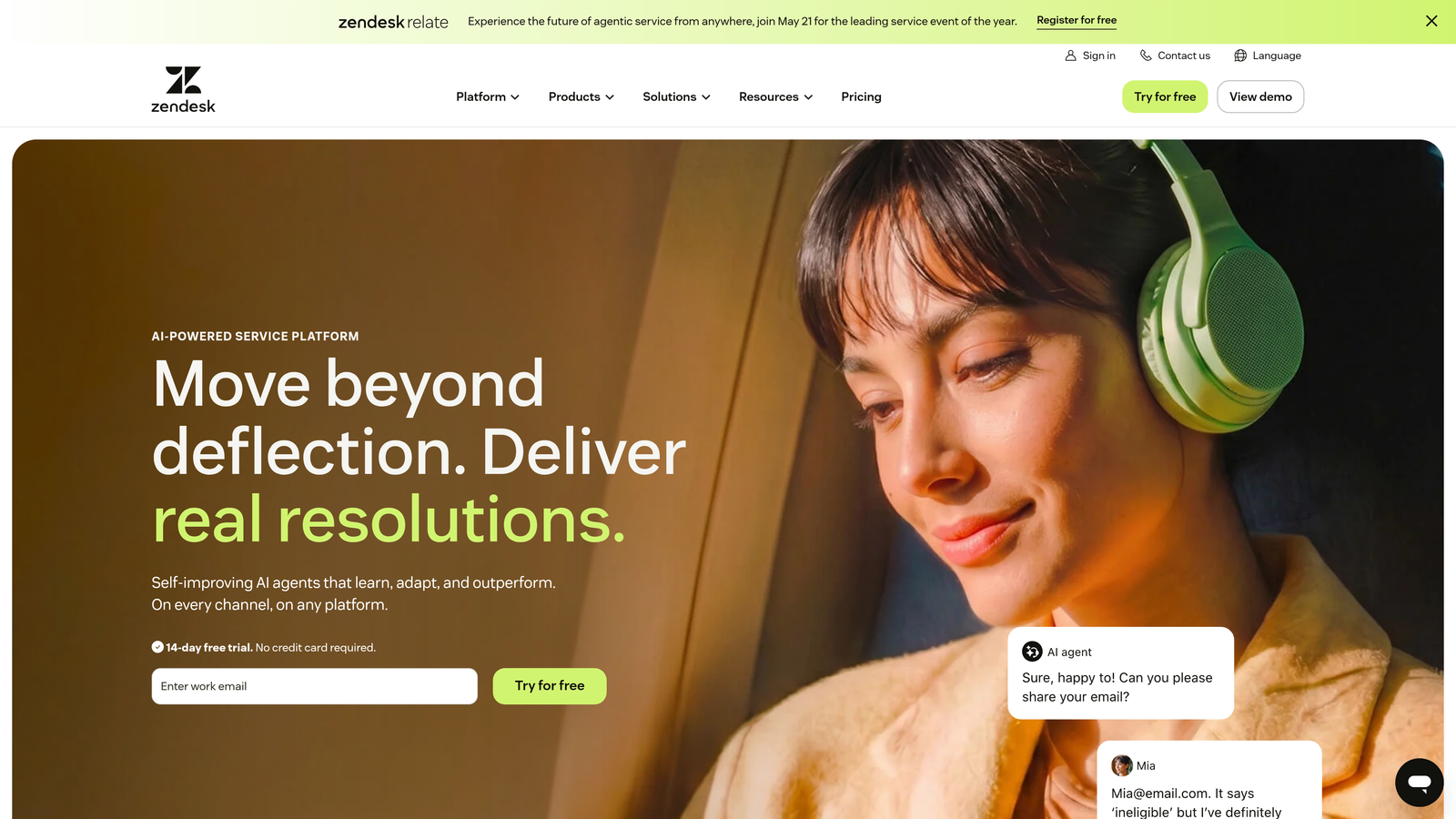
Zendesk is an enterprise-grade helpdesk platform with AI agents, advanced routing, SLA management, and one of the largest integration ecosystems in the industry.
Where This Tool Shines
Zendesk's primary advantage is its maturity. It has been refined over many years, and that shows in the depth of its routing logic, SLA management, reporting suite, and compliance certifications. For companies that have outgrown lighter tools and need enterprise-level infrastructure, Zendesk provides a stable foundation that can handle significant scale.
The integration marketplace is genuinely impressive. With over 1,500 apps available, Zendesk connects to almost every tool a growing company might use, and its API is well-documented for custom integrations. The tradeoff is complexity: getting the most out of Zendesk typically requires dedicated admin time and, at larger scales, a solutions partner.
Key Features
AI Agents Across Channels: Automated resolution across email, chat, voice, and social with AI-powered triage and response suggestions.
Advanced Routing and SLA Management: Sophisticated escalation workflows and service level tracking for teams with complex support operations.
Marketplace with 1,500+ Integrations: Connects to virtually any tool in your stack, from Salesforce to Jira to Shopify.
Robust Reporting Suite: Detailed analytics on agent performance, ticket trends, and customer satisfaction metrics.
Enterprise Security and Compliance: SOC 2, GDPR, HIPAA-compliant configurations for regulated industries.
Best For
Larger growth-stage or post-Series B companies with dedicated support operations teams, complex routing requirements, or enterprise compliance needs. Less ideal for early-stage teams that need fast time-to-value.
Pricing
Starts at $55/agent/month for Suite Team. AI add-ons are priced separately, so total cost can increase significantly depending on the features you need.
4. Freshdesk
Best for: Budget-conscious teams that need solid automation without enterprise complexity
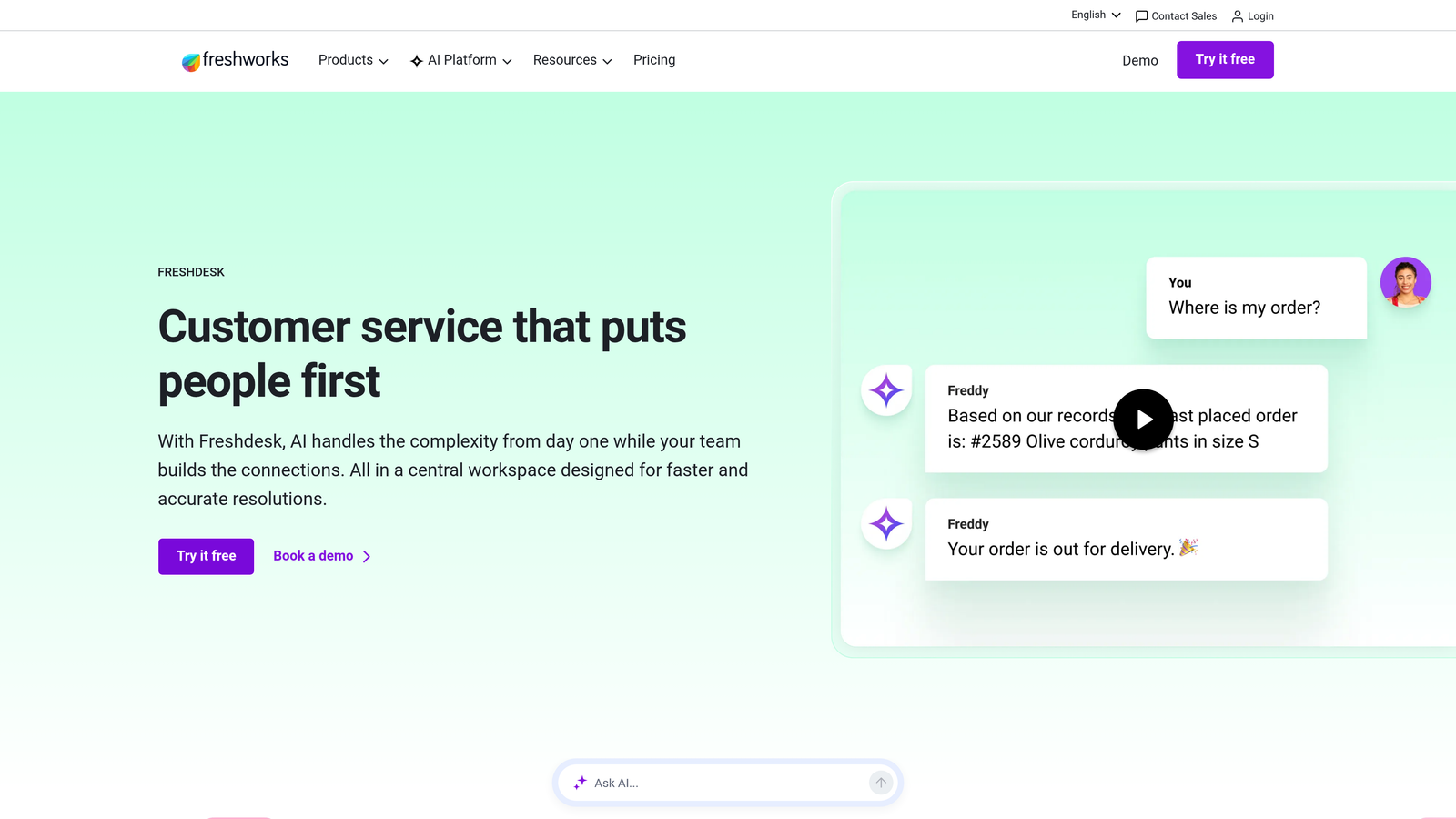
Freshdesk is a cost-effective helpdesk with Freddy AI for ticket triage and resolution, offering a generous free tier and fast setup for teams prioritizing speed over customization.
Where This Tool Shines
Freshdesk's value proposition is straightforward: you get a capable, AI-assisted helpdesk at a price point that works for early-stage and resource-constrained teams. Freddy AI handles auto-triage, suggested responses, and basic resolution without requiring significant configuration time, which means you can be operational within days rather than weeks.
The free tier is genuinely useful rather than just a trial mechanism, making Freshdesk a practical starting point for companies that haven't yet justified a larger support investment. As you grow, the paid tiers add omnichannel support and more sophisticated automation without a dramatic price jump.
Key Features
Freddy AI: Automated triage, suggested responses, and ticket resolution that improves as it processes more of your support data.
Free Tier for Up to 2 Agents: A functional starting point with basic automation included at no cost.
Omnichannel Support: Email, chat, phone, and social channels unified in a single helpdesk interface.
Built-In Collaboration Tools: Team huddles and shared ownership features for internal coordination on complex tickets.
SaaS Integration Marketplace: Connects to common tools including Slack, Jira, and Salesforce.
Best For
Early-stage startups and bootstrapped teams that need a functional helpdesk with AI capabilities without committing to enterprise pricing. Also a strong option for companies evaluating automation before migrating to a more sophisticated platform.
Pricing
Free tier available for up to 2 agents. Paid plans start at $15/agent/month, making it one of the most accessible options on this list.
5. Ada
Best for: High-volume multilingual resolution without scripted decision trees
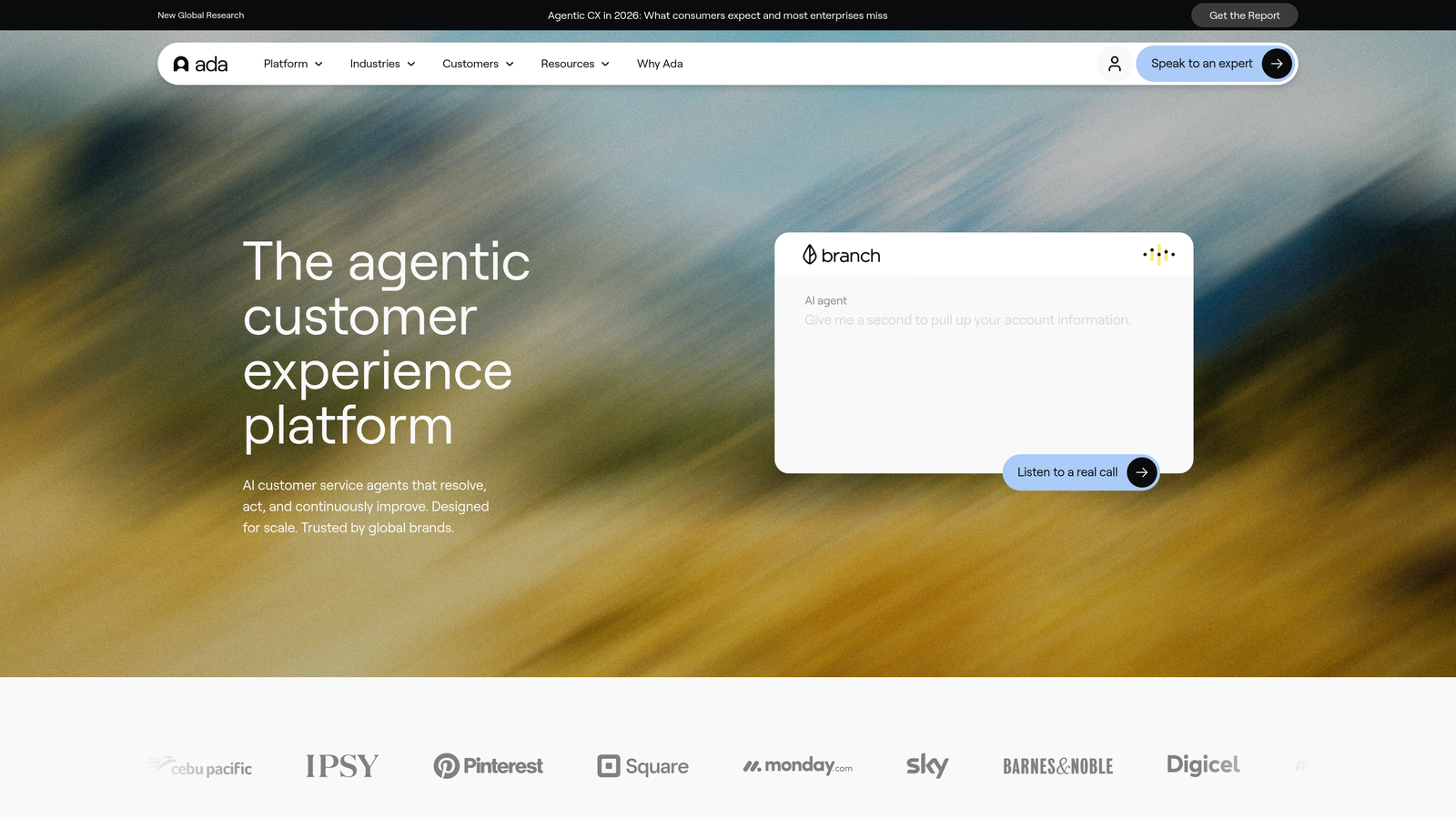
Ada is an AI-first customer service automation platform purpose-built for high-volume, multilingual resolution that doesn't rely on rigid scripted flows.
Where This Tool Shines
Ada's architecture is genuinely AI-first rather than a chatbot builder with AI features layered on top. The generative AI agent handles queries with natural language understanding, which means it can manage conversations that don't follow predictable patterns, a critical capability for high-growth companies whose user base is constantly evolving and asking new types of questions.
The multilingual capability is particularly strong. Support for over 50 languages with nuanced understanding, rather than just direct translation, makes Ada a natural fit for companies expanding internationally. Maintaining separate bot flows for each language is a significant operational burden; Ada's approach removes that entirely.
Key Features
Generative AI Agent: Resolves queries without rigid scripted flows, handling natural language variations and multi-step conversations autonomously.
50+ Language Support: Multilingual resolution with nuanced understanding rather than simple translation.
Omnichannel Deployment: Web, mobile, social, and SMS channels supported from a single platform.
Enterprise Analytics: Resolution rate tracking, CSAT scoring, and deflection metrics with granular reporting.
Helpdesk Integrations: Connects to Zendesk, Salesforce, Shopify, and other major platforms for seamless handoff.
Best For
Growth-stage companies with high inbound volume, international user bases, or complex product lines where scripted chatbot flows break down quickly. Strong fit for consumer-facing SaaS and marketplace businesses.
Pricing
Custom enterprise pricing. Contact Ada for quotes, as pricing is typically based on conversation volume and deployment scope.
6. Forethought
Best for: Adding AI intelligence to an existing helpdesk without migrating platforms
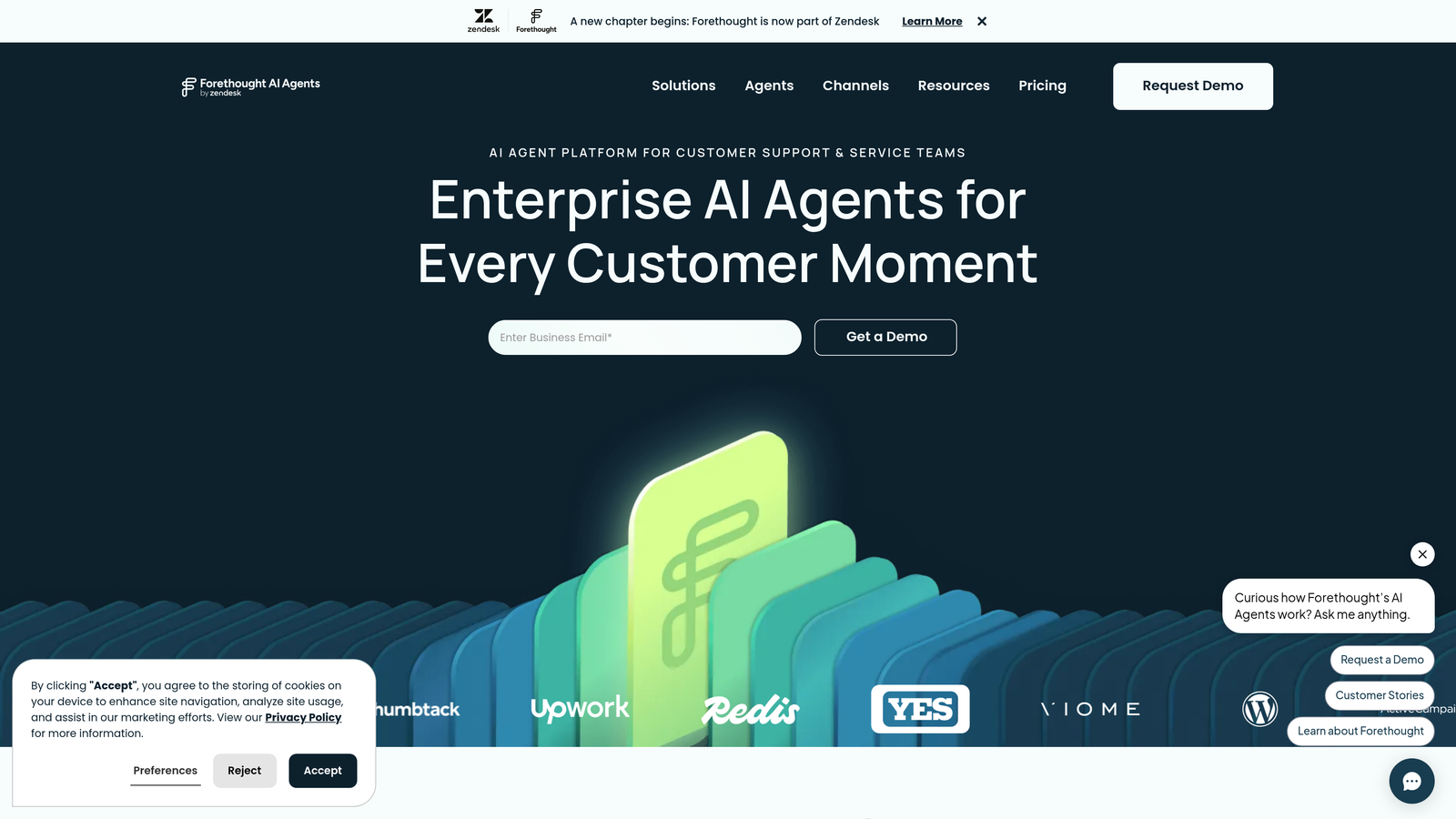
Forethought is an AI overlay platform that layers intelligent triage, routing, and autonomous resolution on top of existing helpdesks like Zendesk, Salesforce, and Freshdesk.
Where This Tool Shines
The overlay model is Forethought's defining characteristic. If your team has invested significantly in an existing helpdesk and doesn't want to migrate, Forethought adds AI capabilities without requiring you to abandon what you've built. This is a meaningful consideration for high-growth companies where a platform migration carries real operational risk.
The intent detection and predictive routing are particularly well-developed. Tickets are scored for priority and routed to the best-suited agent based on skills and availability, which reduces resolution time without requiring agents to manually triage their queues.
Key Features
AI-Powered Triage: Intent detection and priority scoring applied to every incoming ticket automatically.
Solve AI Agent: Autonomous resolution capability that operates within your existing helpdesk interface.
Predictive Routing: Matches tickets to agents based on skills, query type, and historical performance data.
Overlay Architecture: Works on top of Zendesk, Salesforce Service Cloud, Freshdesk, and others without requiring migration.
Deflection and Resolution Analytics: Dashboard tracking how AI is performing alongside your human team.
Best For
Companies already invested in a major helpdesk that want to add AI resolution and intelligent routing without the disruption of a platform switch. Particularly valuable for teams where migration risk outweighs the benefits of a fully native AI platform.
Pricing
Custom pricing based on ticket volume. Contact Forethought for quotes tailored to your support operation's scale.
7. Tidio
Best for: Lightweight chat automation for product-led growth and e-commerce companies
Tidio is a lightweight chat automation platform with a Lyro AI chatbot, visual flow builder, and easy integrations designed for fast deployment.
Where This Tool Shines
Tidio prioritizes simplicity and speed of deployment above all else. The Lyro AI chatbot ingests your existing knowledge base and FAQ content and starts resolving queries almost immediately, which makes it one of the fastest tools on this list to get from signup to live automation. For product-led growth companies that need to support self-serve users without a large support team, this is genuinely valuable.
The visual flow builder is accessible enough for non-technical team members to build and iterate on automation without engineering involvement. Combined with behavioral triggers and visitor tracking, Tidio gives small support teams proactive engagement capabilities that would otherwise require much more complex tools.
Key Features
Lyro AI Chatbot: Learns from your knowledge base and FAQs to resolve common queries autonomously without manual flow configuration.
Visual Drag-and-Drop Flow Builder: Custom automation workflows buildable by non-technical team members.
One-Click Platform Integrations: Shopify, WordPress, Wix, and other common platforms connect with minimal setup.
AI-Assisted Suggested Replies: Helps live agents respond faster with AI-generated response suggestions during active conversations.
Behavioral Triggers and Visitor Tracking: Proactive engagement based on user behavior, pages visited, and time on site.
Best For
Early-stage SaaS companies, PLG products, and e-commerce brands that need fast, affordable chat automation without enterprise complexity. Less suited for B2B teams with complex, multi-step support workflows.
Pricing
Free tier available. Paid plans start at $29/month, making Tidio one of the most accessible options for small and early-stage teams.
8. HubSpot Service Hub
Best for: Teams already in the HubSpot ecosystem that want support connected to CRM data
HubSpot Service Hub is a customer service platform natively integrated with HubSpot CRM, giving support teams full visibility into customer lifecycle data from marketing, sales, and product.
Where This Tool Shines
The native CRM integration is Service Hub's clearest advantage. When a support ticket arrives, the agent immediately sees the customer's full history: marketing touchpoints, sales conversations, deal value, and previous support interactions. For high-growth companies where customer success and support often overlap, this context dramatically improves the quality of support interactions without requiring agents to switch between systems.
The built-in feedback tools are also worth noting. NPS, CSAT, and CES surveys are included natively rather than requiring third-party integrations, which simplifies the data stack for teams that want customer sentiment data connected directly to their CRM records.
Key Features
Native CRM Integration: Full customer lifecycle context available in every support interaction without switching platforms.
AI-Powered Chatbot and Knowledge Base: Automated resolution and self-service content management within the HubSpot ecosystem.
Ticket Pipeline Management: SLA tracking and ticket workflows with the same interface as HubSpot's sales pipelines.
Built-In Feedback Surveys: NPS, CSAT, and CES collection natively tied to customer records.
Shared Inbox with Routing and Automation: Conversation management with rule-based assignment and automation triggers.
Best For
Companies already using HubSpot for CRM, marketing, or sales who want support data unified in the same platform. Less compelling for teams not already in the HubSpot ecosystem, where the CRM integration advantage disappears.
Pricing
Free tools available. Starter tier at $20/month; Professional at $100/seat/month with full automation and reporting capabilities.
9. Dixa
Best for: Agent-first omnichannel support with AI quality assurance and intelligent routing
Dixa is a conversation-first customer support platform that unifies email, chat, phone, and social into a single agent view with AI-powered quality assurance and intelligent routing.
Where This Tool Shines
Dixa's design philosophy centers on the agent experience rather than leading with AI deflection. Every channel converges into a single interface, which reduces the cognitive load on agents handling high volumes across multiple channels simultaneously. For companies scaling their support team quickly and onboarding new agents regularly, this simplicity translates into faster ramp time.
The AI quality assurance feature is distinctive. Conversations are automatically scored for quality, which gives team leads visibility into performance without manually reviewing transcripts. For high-growth companies where support quality can slip during rapid scaling, automated QA provides a meaningful safety net.
Key Features
Unified Conversational Interface: All channels, email, chat, phone, and social, visible and manageable from a single screen.
AI-Powered Quality Assurance: Automatic conversation scoring that surfaces quality issues without manual review.
Intelligent Routing: Routes based on customer value, query type, and agent skill to optimize both efficiency and customer experience.
Real-Time Analytics and Performance Dashboards: Live visibility into queue status, agent performance, and SLA compliance.
Native E-Commerce and CRM Integrations: Connects to Shopify, Magento, and major CRM platforms for customer context during conversations.
Best For
Growth-stage companies scaling their support team that need a clean omnichannel interface, automated quality oversight, and intelligent routing. Strong fit for teams where agent experience and onboarding speed are as important as AI deflection rates.
Pricing
Starts at $39/agent/month. Contact Dixa for growth and enterprise tier pricing based on team size and feature requirements.
Choosing the Right Tool for Your Growth Stage
The right choice depends less on feature lists and more on where you are in your growth trajectory and what your biggest constraint actually is.
If you need AI-native automation that goes beyond ticket deflection and surfaces business intelligence from every interaction, Halo AI is the strongest option. The page-aware context and continuous learning architecture are purpose-built for the complexity of scaling SaaS products, and the integrations with Linear, Stripe, HubSpot, and Slack make it a genuine hub rather than an isolated support tool.
For unified messaging with proactive engagement, Intercom remains a strong choice, particularly for teams already using it for in-app communication. If enterprise infrastructure and compliance are the priority, Zendesk's depth and integration ecosystem are hard to match. For teams watching budget carefully, Freshdesk and Tidio both offer meaningful automation at accessible price points.
Ada is the clearest choice for companies with high multilingual volume or complex product lines where scripted bots break down. Forethought solves a specific problem elegantly: adding AI intelligence to an existing helpdesk without the disruption of migration. HubSpot Service Hub makes the most sense when your team is already deep in the HubSpot CRM. And Dixa is worth serious consideration for teams where agent experience and automated quality assurance are as important as deflection rates.
Your support team shouldn't scale linearly with your customer base. AI agents can handle routine tickets, guide users through your product, and surface business intelligence while your human team focuses on the complex issues that genuinely need their attention. See Halo in action and discover how continuous learning transforms every interaction into smarter, faster support that grows with you.