9 Best Support Automation Tools for Marketplace Platforms in 2026
Marketplace platforms managing buyers, sellers, and third-party providers need specialized support automation for marketplace platforms that handles multi-sided complexity traditional helpdesks can't. This guide evaluates the 9 best tools in 2026 that resolve tickets instantly, route issues by user type, and scale platform support without proportionally growing headcount.
 Matt PattoliFounder13 min read
Marketplace platforms face a support challenge that most helpdesk tools weren't designed for. You're not serving one type of customer — you're simultaneously handling buyers frustrated about delayed orders, sellers confused about payout timelines, and sometimes third-party service providers with entirely different workflows and expectations. Order disputes, listing issues, account verification requests, and onboarding questions pile up on both sides of the platform, and traditional helpdesk setups often buckle under that complexity.
Support automation built for marketplace dynamics changes the equation. The right tool can resolve common tickets instantly, route complex issues to the right team based on user type, and scale with your platform without forcing you to hire a support agent for every thousand new users.
We evaluated dozens of tools and narrowed the field to the ones that handle the multi-sided nature of marketplace support particularly well. Selection criteria: AI-powered ticket resolution, multi-stakeholder workflow support, integration depth with marketplace tech stacks, analytics capabilities, and pricing flexibility for growing platforms. Here are the top tools worth your attention.
1. Halo AI
Best for: Marketplace platforms that want AI-first autonomous support with deep business intelligence and continuous learning
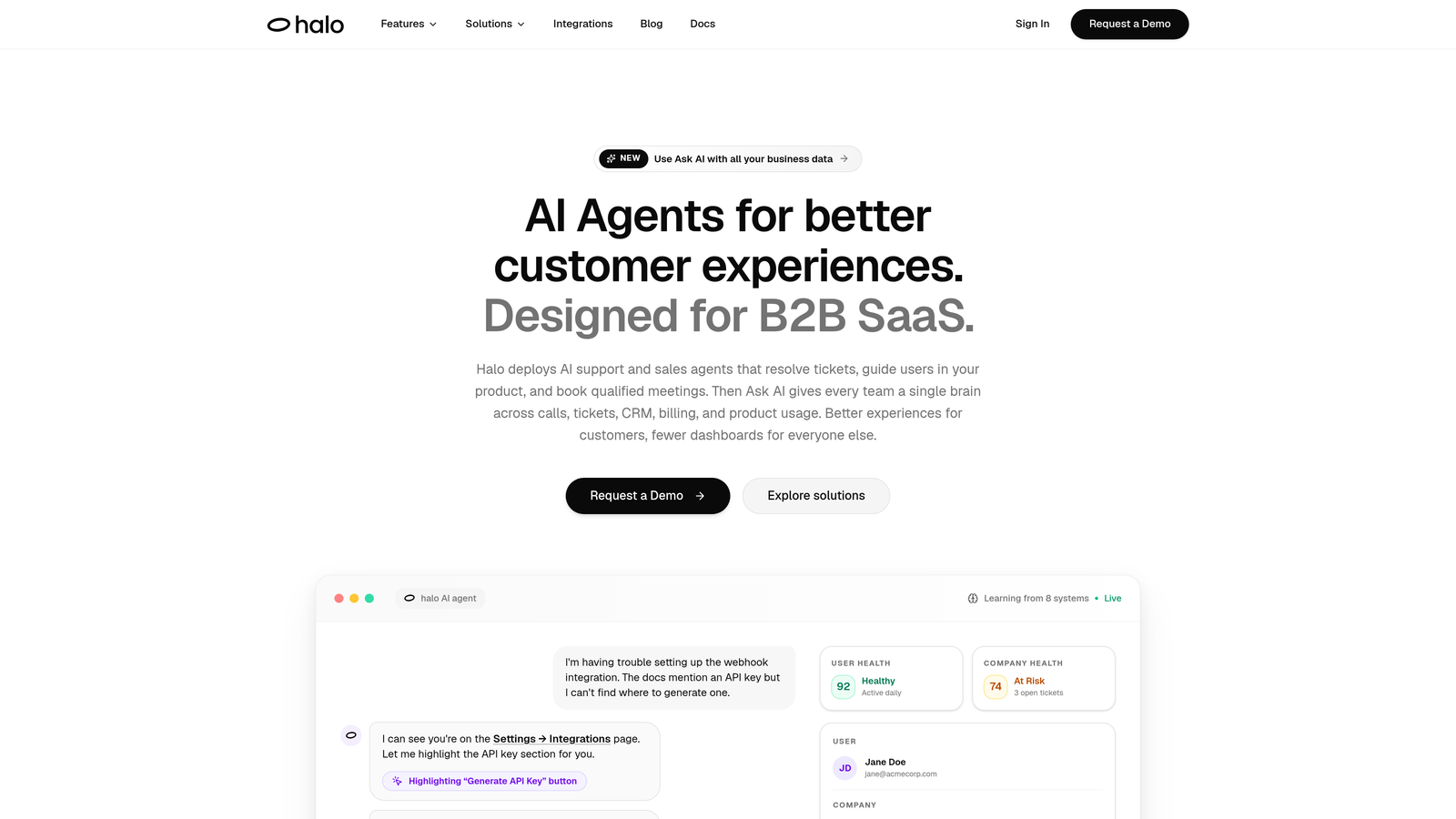
Halo AI is an AI-first customer support platform that deploys autonomous agents to resolve tickets, guide users through your product, and surface actionable business intelligence — all while learning from every interaction.
Where This Tool Shines
What sets Halo apart for marketplace platforms is its page-aware architecture. The chat widget doesn't just respond to what a user types — it sees what they're looking at, which means a seller struggling with a listing form gets contextual guidance specific to that screen, not a generic FAQ response. That level of context dramatically reduces back-and-forth for common issues that plague marketplace support queues.
The smart inbox goes beyond ticket management. It surfaces customer health signals and revenue intelligence alongside support data, giving marketplace operators visibility into patterns that traditional helpdesks miss entirely. When both sides of your platform are generating tickets, understanding which signals indicate churn risk or payment friction is genuinely valuable.
Key Features
Autonomous AI Agents: Resolve support tickets without human intervention, handling common buyer and seller queries end-to-end.
Page-Aware Chat Widget: Sees what users see in real time, enabling visual UI guidance that's specific to the exact page and context.
Smart Inbox with Business Intelligence: Combines ticket management with customer health signals, revenue intelligence, and anomaly detection.
Auto Bug Ticket Creation: Automatically generates bug reports and routes them to Linear, Slack, or your dev tool of choice when product issues surface in support conversations.
Live Agent Handoff: Escalates complex issues to human agents with full conversation context preserved, so nothing gets repeated.
Best For
Marketplace platforms at growth stage or beyond that want autonomous resolution rather than just routing assistance. Particularly strong for product-led platforms where support and product feedback loops matter, and for teams already using Intercom, HubSpot, Stripe, or Linear who want a connected support intelligence layer.
Pricing
Contact for pricing. Designed to scale with platform growth rather than charging per-seat in ways that penalize expansion.
2. Zendesk
Best for: Enterprise-scale marketplace platforms needing robust routing, SLA management, and a massive integration ecosystem
Zendesk is the industry-leading helpdesk platform with deep customization, advanced routing, and AI-powered automation built for complex, high-volume support operations.

Where This Tool Shines
For marketplaces managing separate buyer and seller portals, Zendesk's multi-brand support is genuinely useful. You can maintain distinct help centers, ticket flows, and SLA policies for each user type without stitching together separate tools. The skills-based routing engine ensures tickets land with agents who have the right context — whether that's a payment dispute specialist or a seller onboarding team.
The 1,500+ app integrations via the Zendesk Marketplace mean you can connect to payment processors, order management systems, and CRMs without custom development. For enterprises with complex tech stacks, that breadth is hard to match.
Key Features
Advanced Ticket Routing: Skills-based assignment with SLA tracking ensures the right tickets reach the right teams.
AI Answer Bot and Agent Assist: Deflects common queries automatically and surfaces relevant knowledge base content for agents handling complex issues.
Multi-Brand Support: Manage buyer and seller portals with separate help centers and ticket flows from a single account.
1,500+ Integrations: Connects to virtually every tool in a marketplace tech stack via the Zendesk Marketplace.
Custom Analytics Dashboards: Robust reporting with the ability to build custom views across ticket volume, resolution time, and team performance.
Best For
Mid-market to enterprise marketplace platforms with dedicated support operations, multiple user segments, and the technical resources to configure and maintain a complex helpdesk environment.
Pricing
Suite Team starts at $55/agent/month. Enterprise plans are available and scale significantly based on feature requirements and seat count.
3. Intercom
Best for: Marketplaces that prioritize conversational support and proactive in-app communication alongside ticket resolution
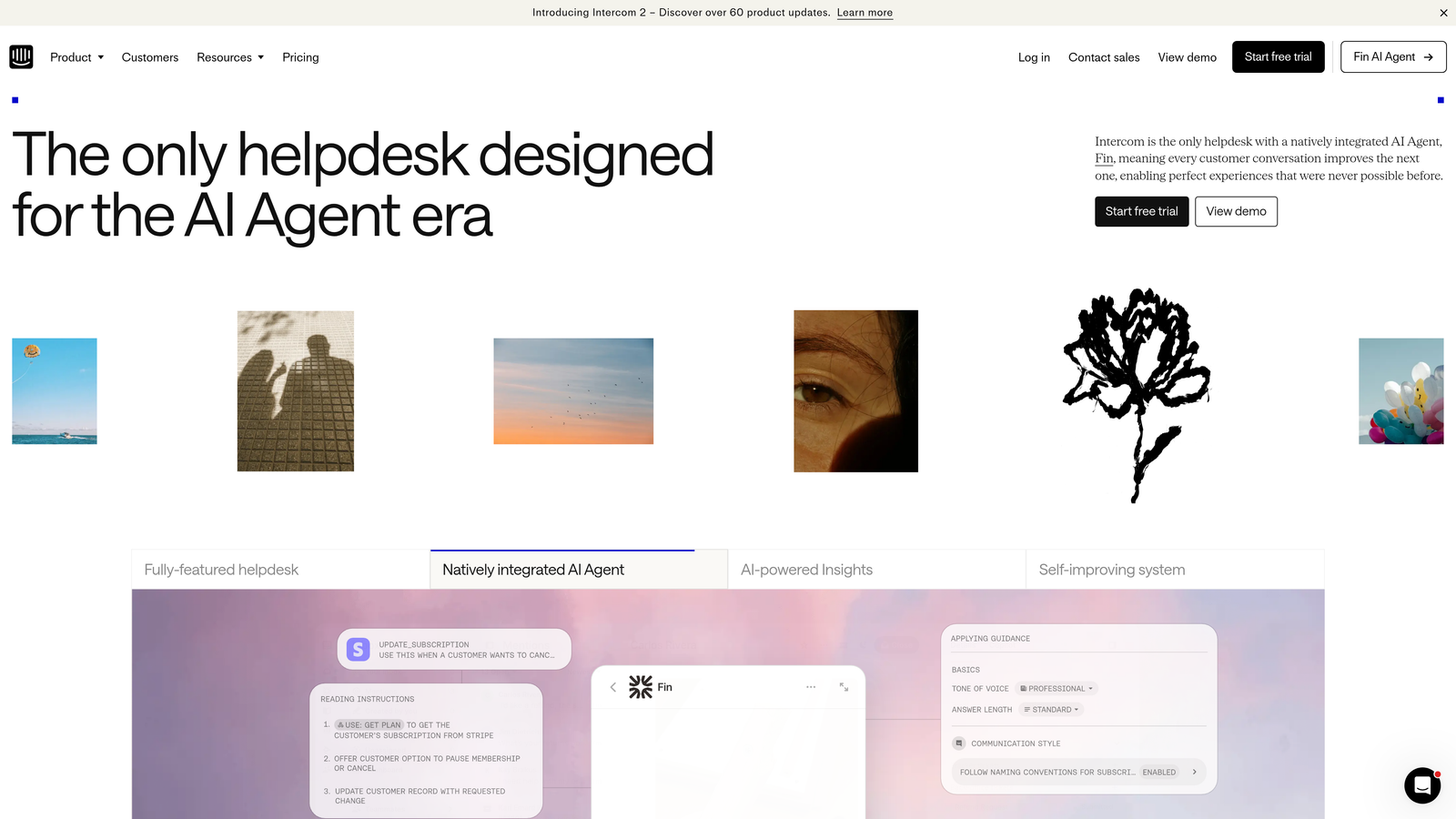
Intercom is a conversational support platform combining its Fin AI agent, proactive messaging, and in-app communication tools for modern customer engagement.
Where This Tool Shines
Intercom's strength for marketplace platforms lies in its ability to combine reactive support with proactive communication. You can trigger targeted messages to sellers who haven't completed onboarding, or send buyers proactive updates about order status changes — all from the same platform handling inbound support. That unified approach reduces inbound volume by addressing issues before they become tickets.
The Fin AI agent handles conversational resolution across channels and is trained on your knowledge base content without heavy configuration. For marketplaces with high volumes of repetitive queries — "where's my payout?" or "how do I edit my listing?" — Fin can deflect a meaningful share of that volume.
Key Features
Fin AI Agent: Conversational ticket resolution across channels, trained on your help content for autonomous query handling.
Proactive Messaging: In-app banners and targeted messages for buyer and seller communication based on behavior triggers.
Visual Workflow Builder: Create custom bots and automation flows without engineering resources.
Product Tours: Guided onboarding flows for seller setup and buyer education built directly into the product.
Unified Inbox: Conversation routing and team assignment with full context across channels.
Best For
Growth-stage marketplace platforms where support and product engagement are closely connected, and where proactive communication is part of the retention and onboarding strategy alongside reactive support.
Pricing
Essential plan starts at $39/seat/month. Fin AI resolution is priced per resolution, which can add up at high volume — worth modeling before committing.
4. Freshdesk
Best for: Growing marketplace platforms that need multi-brand support and AI automation at an accessible price point
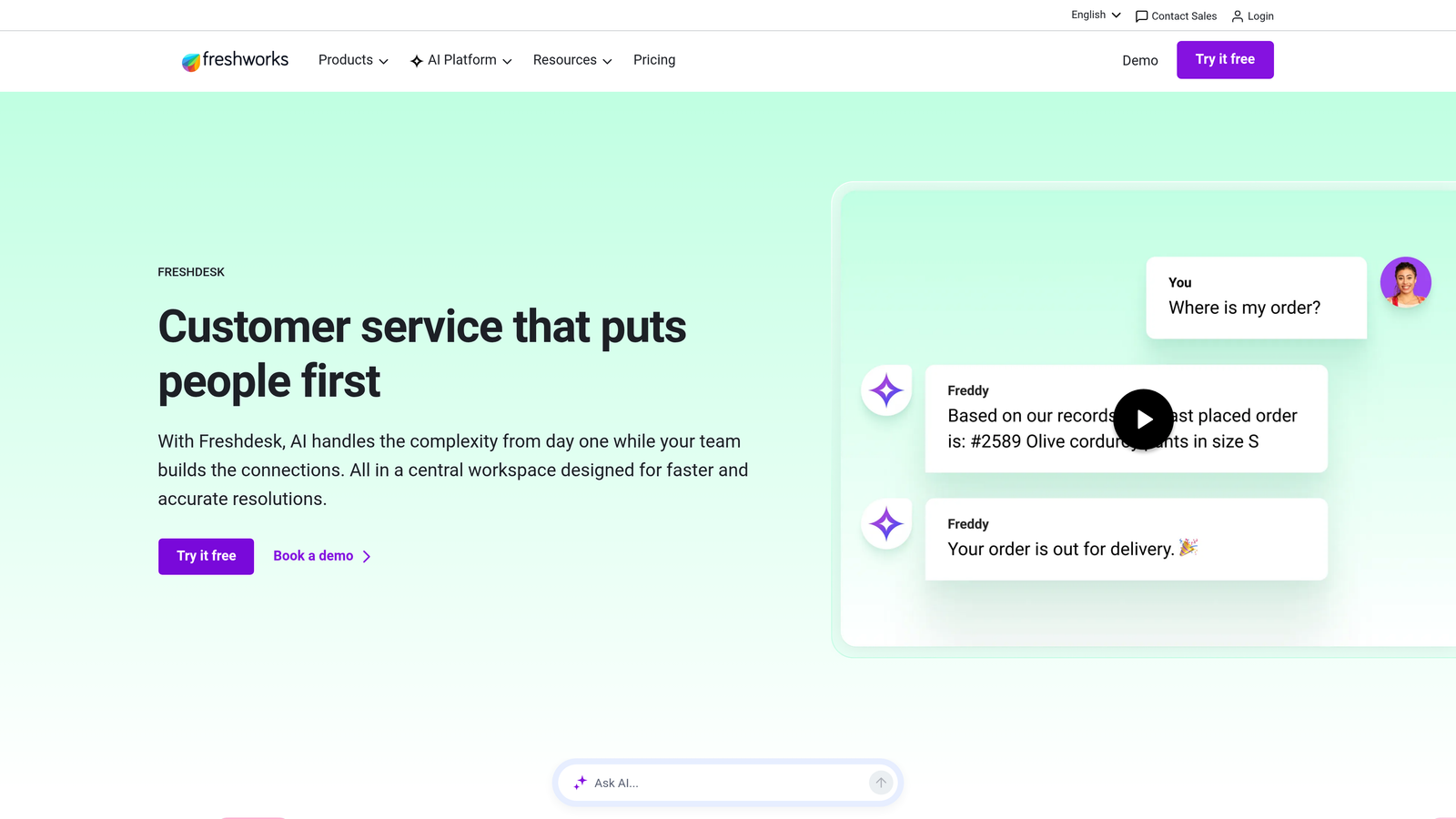
Freshdesk is a feature-rich helpdesk with Freddy AI for ticket triage and resolution, multi-brand support, and a generous free tier suited for platforms in earlier growth stages.
Where This Tool Shines
Freshdesk punches above its price point for marketplace platforms. The multi-brand and multi-product support from a single account means you can manage buyer-facing and seller-facing support operations without paying for separate tools or licenses. Freddy AI handles triage and suggested responses out of the box, reducing manual workload even on lower-tier plans.
The scenario automations are worth highlighting for marketplace use cases. You can build multi-step automated workflows that trigger based on ticket content, user type, or status — useful for routing order dispute tickets differently than listing issue tickets without complex custom development.
Key Features
Freddy AI: Auto-triage, suggested responses, and ticket resolution capabilities built into the core platform.
Multi-Brand Support: Manage buyer and seller support operations from a single Freshdesk account.
Scenario Automations: Multi-step workflow automation for complex marketplace routing and resolution logic.
Free Tier: Supports up to 2 agents with basic automation, useful for early-stage platforms testing the waters.
Marketplace App Ecosystem: Extend functionality with integrations across payment, CRM, and e-commerce tools.
Best For
Early to mid-stage marketplace platforms that need multi-brand support and AI-assisted automation without the enterprise price tag. The free tier makes it low-risk to evaluate before committing.
Pricing
Free tier available for up to 2 agents. Paid plans start at $15/agent/month on the Growth plan, scaling up with advanced automation and analytics features.
5. Gorgias
Best for: E-commerce marketplaces built on Shopify, BigCommerce, or Magento needing order data inside every support conversation
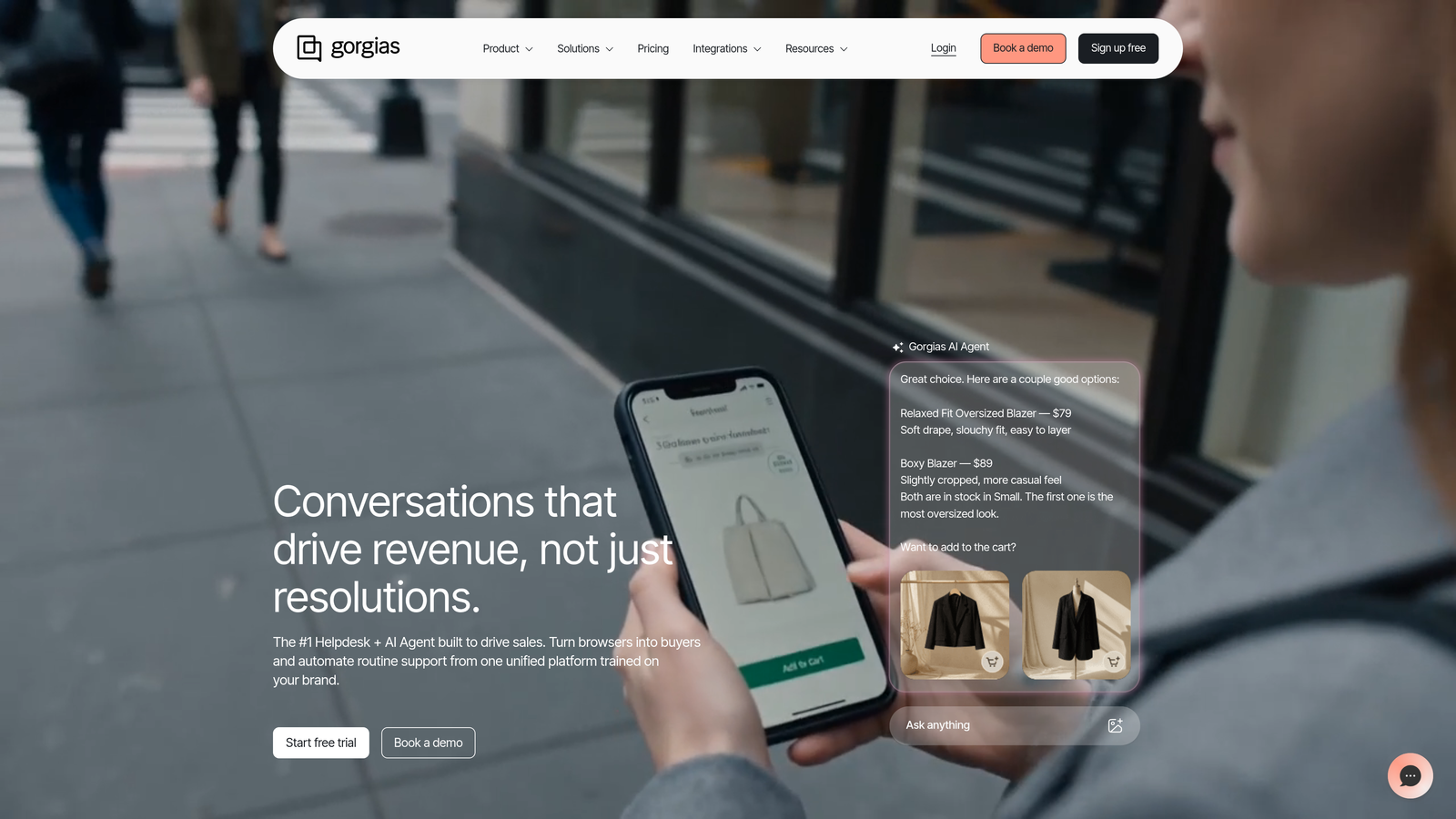
Gorgias is an e-commerce-focused support platform with deep integrations that pull order, shipping, and transaction data directly into support conversations.
Where This Tool Shines
For marketplace platforms built on major e-commerce infrastructure, Gorgias is purpose-built for exactly the kind of order-centric support queries that dominate buyer inboxes. When a buyer contacts support about a delayed shipment, the agent — or the AI auto-responder — already has the order details, tracking status, and refund eligibility visible without switching tabs or asking the customer to repeat themselves.
The revenue-tracking dashboard is a differentiator that most helpdesks don't offer. It links support interactions to sales outcomes, giving marketplace operators visibility into how support quality affects conversion and retention on the buyer side.
Key Features
Deep E-Commerce Integrations: Order, shipping, and refund data pulled directly into support tickets from Shopify, BigCommerce, and Magento.
AI Auto-Responses: Automatically handles common order-related queries without agent involvement.
Revenue-Tracking Dashboard: Links support interactions to sales data to quantify support's impact on marketplace revenue.
Macros and Rules Engine: Automate repetitive workflows for common marketplace ticket types.
Multi-Channel Support: Email, chat, social, and SMS from a unified inbox.
Best For
Marketplace platforms where the majority of support volume comes from order-related buyer queries, and where the platform is built on Shopify or another major e-commerce stack. Less suited for seller-heavy or B2B marketplace dynamics.
Pricing
Starts at $10/month for 10 tickets. Pricing scales based on ticket volume, which is worth modeling carefully during high-growth periods when marketplace activity spikes.
6. Ada
Best for: Global marketplace platforms with high support volume needing multilingual AI resolution at enterprise scale
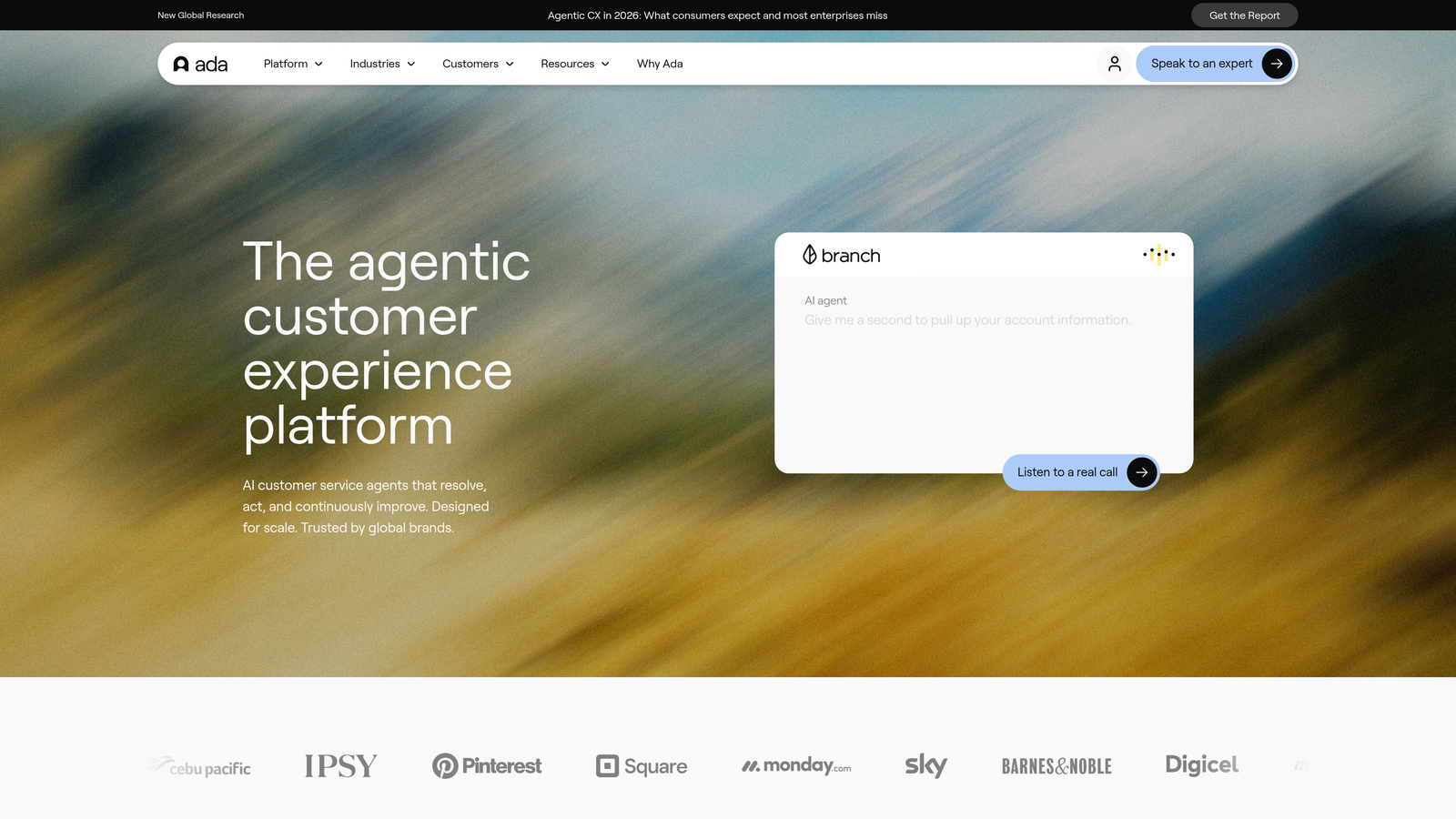
Ada is an enterprise AI-first customer service platform with a no-code agent builder, reasoning engine, and strong multilingual capabilities for complex, high-volume support operations.
Where This Tool Shines
Ada's reasoning engine is designed for queries that aren't simple FAQ lookups. For marketplace platforms where support issues often involve multiple steps — verifying account status, checking transaction history, applying policy logic — Ada's AI agent can work through that complexity rather than immediately escalating to a human. That's meaningful for platforms where the cost of human escalation is high.
The multilingual support across 50+ languages with automatic translation makes Ada particularly well-suited for global marketplace platforms serving buyers and sellers across different regions without maintaining separate support teams for each language.
Key Features
AI Reasoning Engine: Resolves complex, multi-step queries that require applying logic across multiple data points.
No-Code Agent Builder: Create and train AI agents without engineering resources, accessible to support operations teams.
50+ Language Support: Automatic translation for global marketplace platforms serving multilingual user bases.
Omnichannel Deployment: Web, mobile, social, and messaging app coverage from a single platform.
Analytics Dashboard: Resolution rates and conversation insights to track AI performance and identify gaps.
Best For
Enterprise marketplace platforms operating at global scale with high ticket volumes, multilingual user bases, and complex support scenarios that require reasoning rather than simple response matching.
Pricing
Custom enterprise pricing. Contact Ada's sales team for quotes. Budget accordingly for enterprise-tier investment.
7. Salesforce Service Cloud
Best for: Enterprise marketplaces with existing Salesforce CRM infrastructure and highly complex case management requirements
Salesforce Service Cloud is an enterprise service management platform with Einstein AI, deep CRM integration, and highly customizable case management for complex multi-stakeholder support environments.
Where This Tool Shines
For marketplace platforms already running Salesforce CRM, Service Cloud creates a unified view of every buyer, seller, and transaction. Support cases connect directly to account records, contact history, and transaction data — which means agents handling a complex dispute have the full relationship context available without switching systems. That level of integration is difficult to replicate with standalone helpdesk tools.
The customization depth is both a strength and a caveat. Service Cloud can be configured to handle virtually any marketplace workflow, but it requires Salesforce expertise to implement well. Platforms that invest in proper configuration get an extremely powerful tool; those that don't can end up with an expensive and underutilized system.
Key Features
Einstein AI: Case classification, next-best-action recommendations, and automated responses powered by Salesforce's AI layer.
Deep CRM Integration: Support cases linked to accounts, contacts, and full transaction history within the Salesforce ecosystem.
Customizable Case Management: Complex workflow rules and case routing logic for multi-stakeholder marketplace environments.
Omni-Channel Routing: Phone, email, chat, social, and messaging handled through a single routing engine.
AppExchange Ecosystem: Thousands of pre-built integrations extending Service Cloud's capabilities.
Best For
Enterprise marketplace platforms already invested in the Salesforce ecosystem with dedicated Salesforce administrators, complex case management requirements, and the budget for enterprise-tier tooling.
Pricing
Starter plans begin at $25/user/month, but enterprise tiers scale significantly. Most marketplace platforms with complex requirements will land in higher tiers.
8. Tidio
Best for: Small-to-mid-size marketplace platforms wanting quick-deploy AI automation without heavy implementation overhead
Tidio is an accessible live chat and chatbot platform with Lyro AI for platforms that need to get automation running quickly without extensive technical resources.
Where This Tool Shines
Tidio's appeal for smaller marketplace platforms is its speed to value. The Lyro AI chatbot learns from your existing knowledge base content and can start handling common queries quickly without a lengthy training process. For a marketplace platform that's growing but doesn't yet have a dedicated support operations team, that accessibility matters.
The visual chatbot flow builder with pre-built templates lets non-technical team members build and iterate on automation flows. Combined with behavioral triggers for proactive engagement — reaching out to buyers who've been on a checkout page for a while, for example — Tidio covers both reactive and proactive support use cases at a price point that makes sense for earlier-stage platforms.
Key Features
Lyro AI: Learns from knowledge base content to resolve common queries conversationally without manual rule-building.
Visual Flow Builder: Pre-built chatbot templates that non-technical teams can customize and deploy quickly.
Bot-to-Human Handoff: Smooth escalation from automated chat to live agent when queries exceed the bot's capabilities.
E-Commerce Integrations: Connects with Shopify, WordPress, and major e-commerce platforms for order context.
Behavioral Triggers: Visitor tracking and proactive engagement based on user behavior on specific pages.
Best For
Small-to-mid-size marketplace platforms, particularly those on Shopify or WordPress, that want AI-assisted support automation without the implementation complexity or cost of enterprise tools.
Pricing
Free tier available. Paid plans start at $29/month. Lyro AI is an add-on from $39/month, making the total cost very accessible for smaller platforms.
9. HubSpot Service Hub
Best for: Marketplaces where support, sales, and marketing teams need shared visibility into the customer lifecycle
HubSpot Service Hub is a unified CRM platform combining support, marketing, and sales data with Breeze AI copilot for teams that need cross-functional customer visibility.
Where This Tool Shines
Service Hub's strongest argument for marketplace platforms is the unified CRM layer. When a seller contacts support about a payout issue, the support agent can see that seller's entire relationship history — their acquisition source, their GMV contribution, their previous conversations with the sales team. That context changes how support teams prioritize and handle conversations, particularly for high-value marketplace participants.
The Breeze AI copilot handles the operational side: summarizing long ticket threads, drafting responses, and suggesting next steps. It's an assist tool rather than a fully autonomous agent, which suits teams that want AI to accelerate human agents rather than replace them entirely.
Key Features
Breeze AI Copilot: Ticket summarization, response drafting, and workflow suggestions to accelerate agent productivity.
Unified CRM: Support tickets connected to marketing, sales, and customer success data for full lifecycle visibility.
Knowledge Base: AI-powered search and self-service portal for buyer and seller self-resolution.
Customer Feedback and NPS: Built-in survey tools for tracking satisfaction across both sides of the marketplace.
Custom Reporting: Cross-functional reports spanning support, revenue, and customer lifecycle metrics.
Best For
Marketplace platforms where support is deeply connected to growth, retention, and sales — particularly those already using HubSpot CRM for marketing or sales who want to extend that data into support operations.
Pricing
Free tools available. Service Hub Starter from $20/seat/month; Professional from $100/seat/month. Free tier makes it easy to start before committing to paid plans.
Finding the Right Fit for Your Marketplace
The right tool depends heavily on where your marketplace sits today and what your biggest support pain points actually are. Here's a quick way to think through the decision.
Early-stage marketplaces with lean teams and tight budgets should look at Freshdesk or Tidio first. Both offer free tiers, fast setup, and enough automation capability to meaningfully reduce manual ticket handling without requiring a dedicated support operations function.
E-commerce marketplaces built on Shopify or BigCommerce will find Gorgias purpose-built for their most common ticket types. The order data integration alone eliminates a significant amount of back-and-forth on buyer queries.
Growth-stage platforms that want support to do more than just manage tickets — surfacing product insights, connecting to dev workflows, and learning continuously — should take a close look at Halo AI and Intercom. Both are built for platforms where support intelligence matters, not just ticket throughput.
Enterprise platforms with complex multi-stakeholder environments, global user bases, or existing Salesforce infrastructure will find their best options in Zendesk, Ada, or Salesforce Service Cloud depending on their specific configuration needs and existing tech stack.
One thing that holds true across all marketplace types: your support team shouldn't scale linearly with your customer base. Both sides of your platform generate tickets, which means volume grows faster than most operators expect. The platforms that maintain margins as they grow are typically the ones that invest in autonomous resolution early.
See Halo in action and discover how continuous learning transforms every interaction into smarter, faster support — letting your team focus on the complex issues that genuinely need a human touch while AI handles the rest.