9 Best Support Automation Tools for Product Companies in 2026
Product companies need support automation that goes beyond basic ticketing to deliver context-aware assistance for complex feature questions, bug reports, and technical issues. This guide evaluates the 9 best support automation tools for product companies in 2026, focusing on platforms that integrate with development workflows, provide AI-powered resolution with deep product knowledge, and generate insights that drive product improvements.
 Matt PattoliFounder13 min read
Product companies face a unique support challenge: users expect instant, context-aware help that understands their specific workflows, feature questions, and technical issues. Generic ticketing systems fall short when customers need guidance navigating complex product interfaces or reporting bugs that require developer attention.
Support automation built for product companies bridges this gap—combining AI-powered resolution with deep product context, seamless handoffs to engineering teams, and insights that actually improve your product. We evaluated dozens of platforms on their ability to handle product-specific support scenarios, integrate with development tools, and scale without sacrificing quality. Here are the top tools that stand out for product-focused teams in 2026.
1. Halo AI
Best for: Product teams needing AI support that understands in-app context and connects to engineering workflows
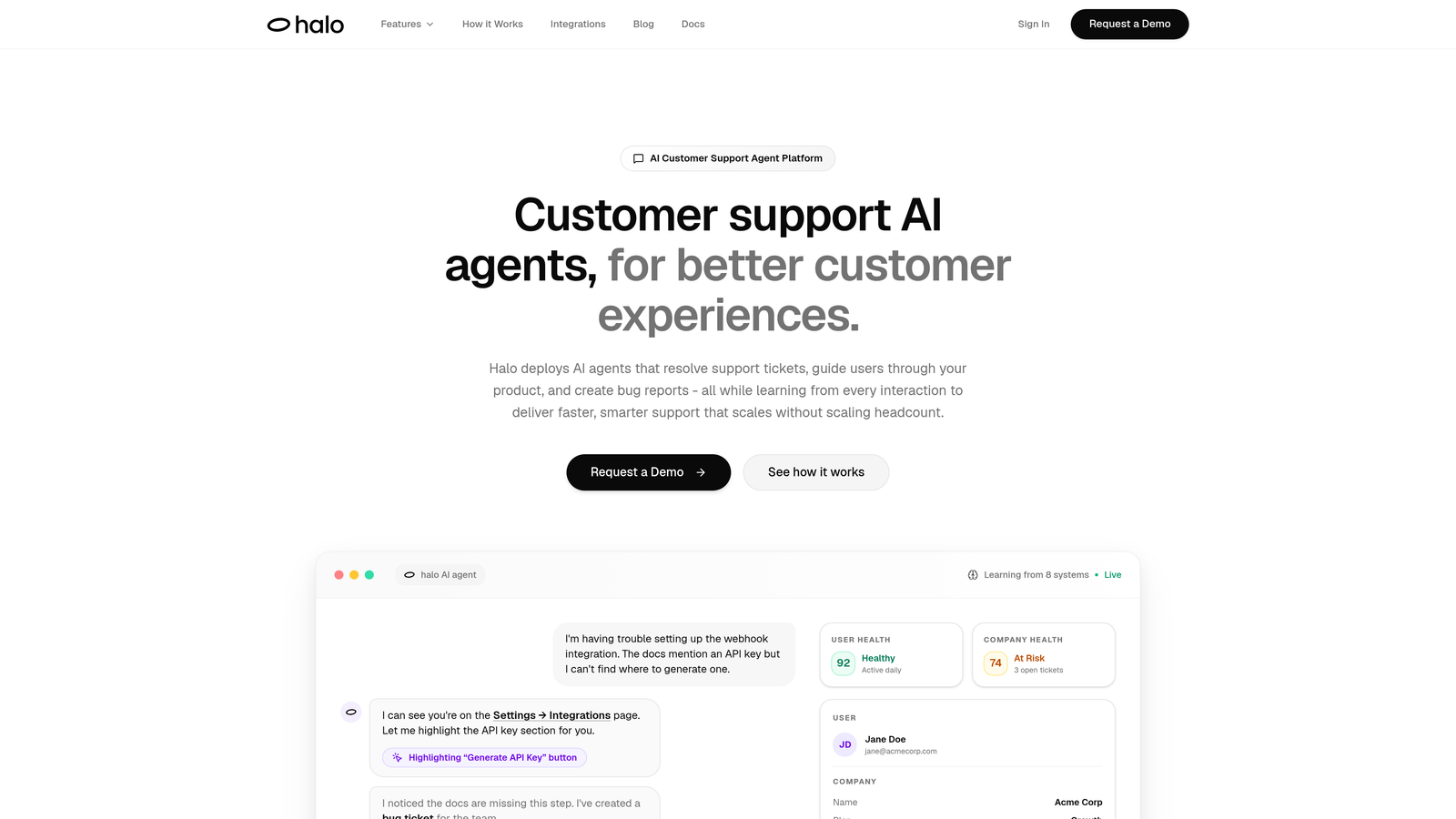
Halo AI is an AI-powered support platform that sees what your users see and learns from every interaction to deliver increasingly intelligent support.
Where This Tool Shines
What sets Halo apart is its page-aware technology. When a user asks for help, the AI knows exactly which screen they're on, what features they're using, and what actions they've taken. This contextual awareness eliminates the frustrating back-and-forth of "What page are you on?" and "Can you send a screenshot?"
The platform's continuous learning architecture means it gets smarter with every ticket. Unlike static chatbots that only know what you manually program, Halo's AI agents analyze successful resolutions and apply those patterns to future interactions. For product companies, this creates a support system that evolves alongside your product.
Key Features
Page-Aware Chat Widget: Provides visual UI guidance based on exactly what users are viewing in your product interface.
Auto Bug Ticket Creation: Automatically generates detailed bug reports in Linear with reproduction steps, screenshots, and user context when issues are detected.
Smart Inbox with Business Intelligence: Surfaces customer health signals, revenue intelligence, and anomaly detection beyond basic support metrics.
Live Agent Handoff: Seamlessly escalates complex issues to human agents with full conversation context and product state preserved.
Multi-System Integrations: Connects to your entire business stack including Linear, Slack, HubSpot, Intercom, Stripe, and development tools.
Best For
B2B product companies and SaaS teams that need support automation deeply integrated with engineering workflows. Particularly valuable for teams using helpdesk systems like Zendesk, Freshdesk, or Intercom who want AI-first architecture rather than bolted-on chatbots.
Pricing
Contact for pricing. Demo available to see the platform in action with your specific product use cases.
2. Intercom
Best for: Product-led growth companies prioritizing in-app messaging and user onboarding automation
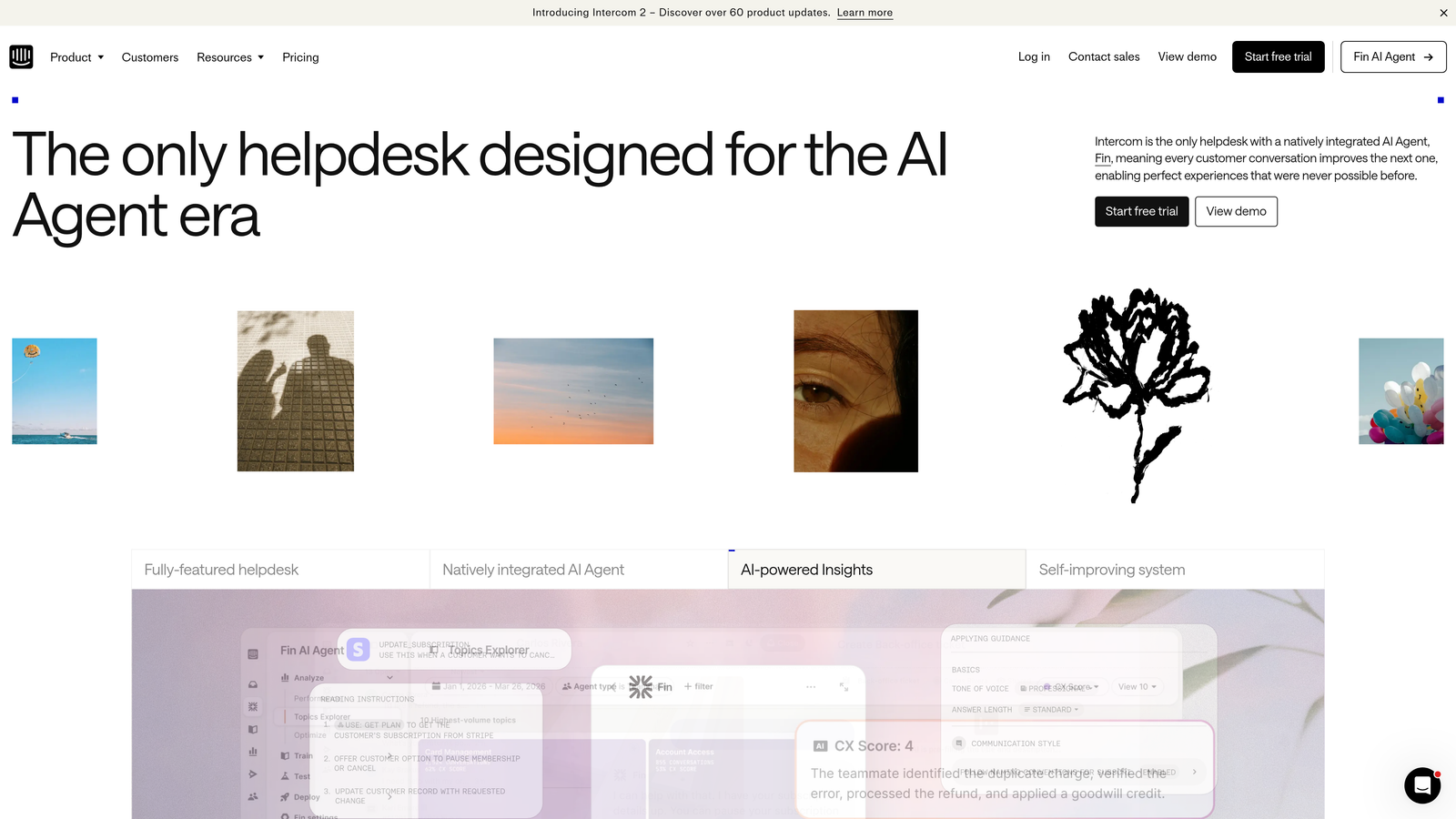
Intercom is a customer messaging platform that combines Fin AI agent capabilities with product tours and behavioral targeting.
Where This Tool Shines
Intercom excels at the intersection of support and product adoption. The platform's in-app messaging feels native to your product experience, and behavioral targeting lets you proactively reach users based on their actions. When someone gets stuck on a specific feature, you can trigger contextual help before they even ask.
Fin, their AI agent, has become increasingly sophisticated at handling common product questions. It can pull from your knowledge base, understand conversation context, and escalate to humans when needed. For PLG companies, the combination of automated support and proactive engagement drives both satisfaction and activation.
Key Features
Fin AI Agent: Resolves customer questions automatically using your knowledge base and conversation history with natural language understanding.
Product Tours and Onboarding: Creates guided walkthroughs and tooltips to help users discover features and complete key workflows.
Behavioral Targeting: Triggers messages based on user actions, properties, and lifecycle stage for contextual engagement.
Integration Marketplace: Connects with hundreds of tools including CRMs, analytics platforms, and development environments.
Series Campaigns: Automates multi-step messaging sequences for onboarding, feature adoption, and re-engagement.
Best For
SaaS companies with product-led growth strategies that want to blend support automation with user engagement and onboarding. Teams that value in-app communication over traditional ticketing will find Intercom's approach natural.
Pricing
Starts at $39 per seat per month for the base platform. Fin AI is priced separately based on resolution volume, which can add significant costs at scale.
3. Zendesk
Best for: Enterprise product companies requiring advanced analytics, compliance, and omnichannel support at scale
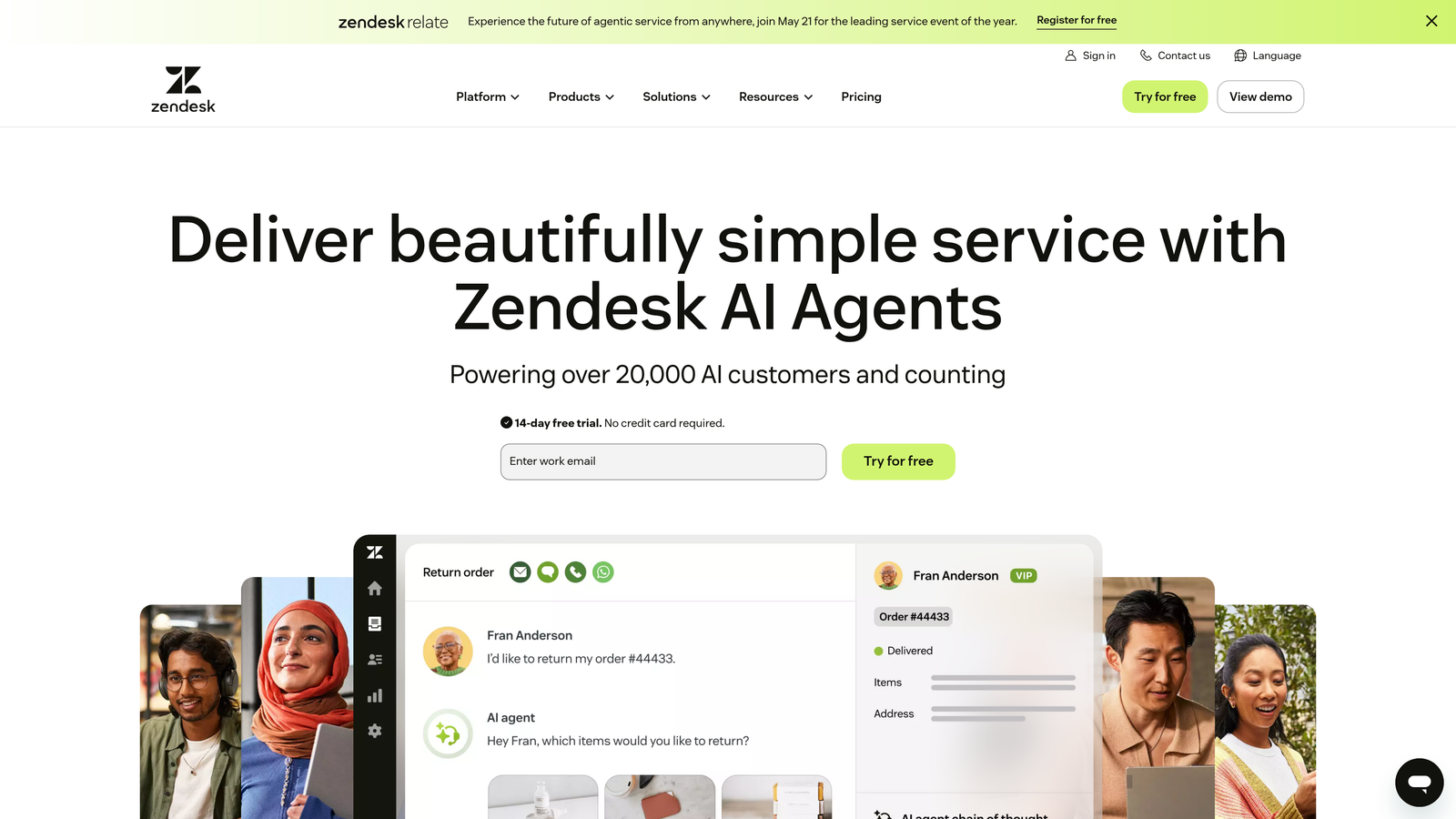
Zendesk is an enterprise-grade support platform with comprehensive AI capabilities and extensive customization options.
Where This Tool Shines
When you need enterprise-level features and security, Zendesk delivers. The platform handles massive ticket volumes across email, chat, phone, and social channels while maintaining detailed audit trails and compliance requirements. For product companies with complex security needs or regulatory obligations, this infrastructure matters.
The analytics and reporting capabilities go deep. You can track everything from first response times to resolution patterns by product area, identify knowledge gaps, and measure team performance across multiple dimensions. Answer Bot and agent assist AI help automate routine inquiries while surfacing relevant articles to support agents handling complex product questions.
Key Features
Answer Bot and Agent Assist: AI-powered automation suggests articles to customers and provides agents with relevant knowledge during conversations.
Advanced Analytics: Customizable dashboards track performance metrics, identify trends, and provide insights into support operations and product issues.
Omnichannel Management: Unified interface for email, chat, phone, social media, and messaging app conversations with consistent workflows.
Enterprise Security: SOC 2, ISO 27001, GDPR compliance with advanced permissions, SSO, and data residency options.
Marketplace and APIs: Extensive app marketplace and robust API for custom integrations with product and development tools.
Best For
Large product organizations with complex support operations, strict compliance requirements, or teams managing support across multiple products and channels. Best suited for companies with dedicated support operations teams.
Pricing
Suite Team starts at $55 per agent per month. AI capabilities require additional add-ons. Enterprise plans with advanced features require custom quotes.
4. Freshdesk
Best for: Growing product teams seeking affordable automation with strong collaboration features
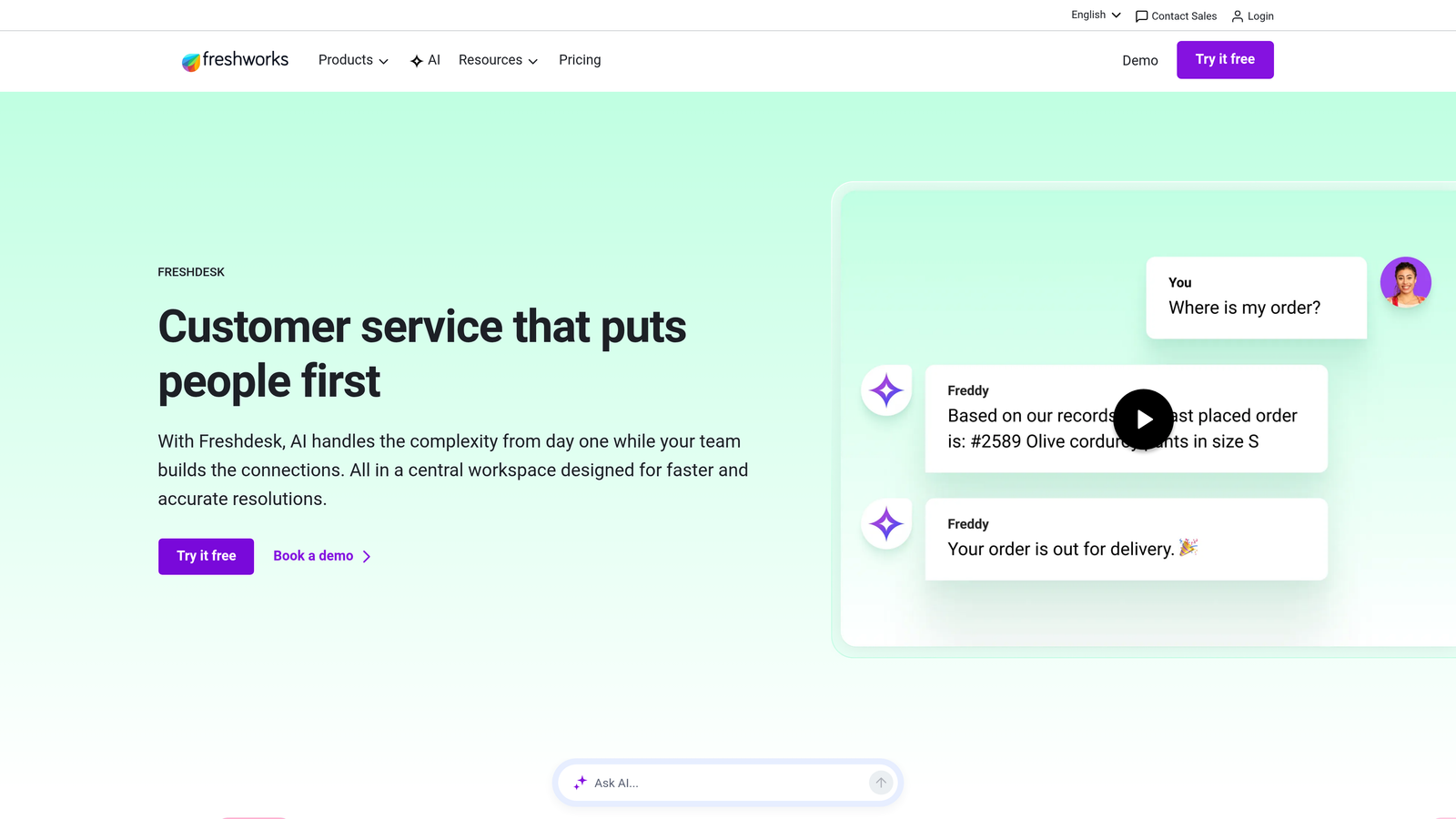
Freshdesk is an accessible helpdesk platform that balances Freddy AI automation with team collaboration tools and competitive pricing.
Where This Tool Shines
Freshdesk offers surprisingly robust features at price points that make sense for growing product companies. The free tier actually works for small teams, and paid plans provide serious value without enterprise-level costs. This makes it easier to get started with support automation without massive upfront investment.
Team huddle and collaboration features help product support teams work together on complex issues. Parent-child ticketing connects related problems, which is particularly useful when multiple users report the same product bug. Freddy AI handles routine ticket routing and provides agents with suggested responses based on historical patterns.
Key Features
Freddy AI: Automates ticket assignment, suggests responses to agents, and handles common customer questions with chatbot functionality.
Team Huddle: Internal collaboration on tickets with notes, mentions, and task assignments to resolve complex product issues together.
Parent-Child Ticketing: Links related tickets to track widespread product issues and coordinate resolution across multiple affected users.
Free Tier: Genuinely useful free plan for up to 10 agents with core helpdesk features and basic automation.
Field Service Management: Dispatch and scheduling capabilities for product companies with on-site support needs.
Best For
Small to mid-sized product teams that need solid automation and collaboration without enterprise pricing. Companies that want to start with free tools and scale up as support volume grows.
Pricing
Free tier available for up to 10 agents. Growth plan starts at $15 per agent per month. Pro plan at $49 per agent per month includes advanced automation and AI features.
5. Help Scout
Best for: Product teams prioritizing personal customer relationships alongside efficient automation
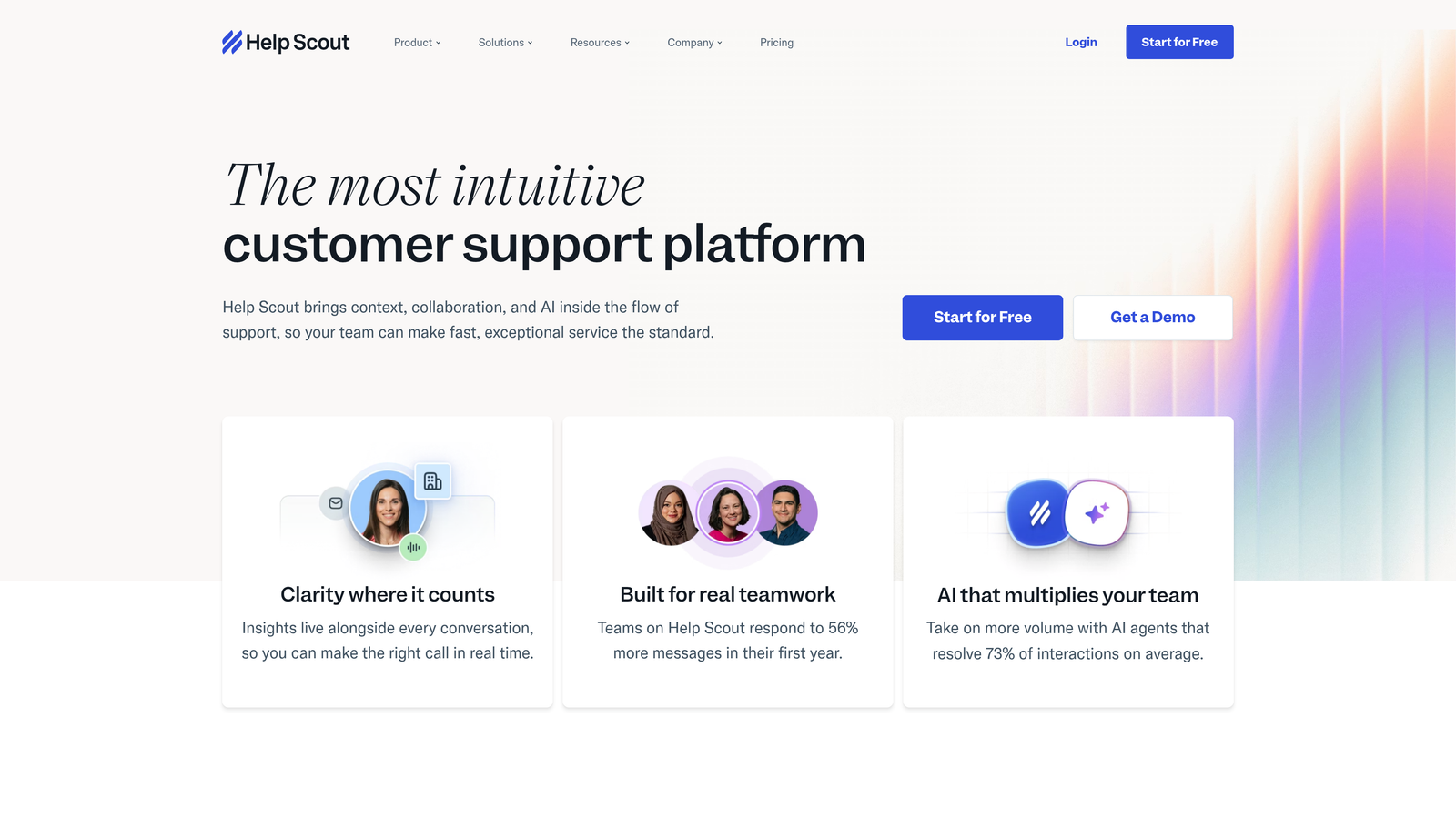
Help Scout is a human-centered support platform that combines shared inbox functionality with contextual help through its Beacon widget.
Where This Tool Shines
Help Scout takes a deliberately different approach than AI-first platforms. While it includes automation, the focus remains on enabling human agents to provide excellent, personal support efficiently. For product companies where customer relationships drive retention and expansion, this philosophy resonates.
The Beacon widget provides contextual help within your product, surfacing relevant knowledge base articles based on the page users are viewing. Collision detection prevents multiple agents from responding to the same ticket, and the shared inbox feels more like email than a traditional helpdesk. Customer satisfaction ratings are built directly into the workflow, making it easy to measure how well you're serving users.
Key Features
Beacon Widget: Embeddable help widget that provides contextual knowledge base articles and chat based on user location in your product.
Collision Detection: Prevents duplicate responses by showing when teammates are viewing or replying to the same conversation.
Docs Knowledge Base: Integrated documentation system with search, categories, and analytics on article effectiveness.
Customer Satisfaction Ratings: Built-in CSAT surveys after conversations to track support quality and identify improvement areas.
Saved Replies: Template library for common product questions with personalization variables to maintain efficiency without sacrificing personal touch.
Best For
Product companies that view support as a competitive advantage and relationship-building opportunity. Teams that want automation to enhance rather than replace human interaction.
Pricing
Standard plan starts at $20 per user per month. Plus plan at $40 per user per month adds advanced automation and reporting. All plans include unlimited email.
6. Front
Best for: Multi-channel product teams needing shared inbox collaboration with strong workflow automation
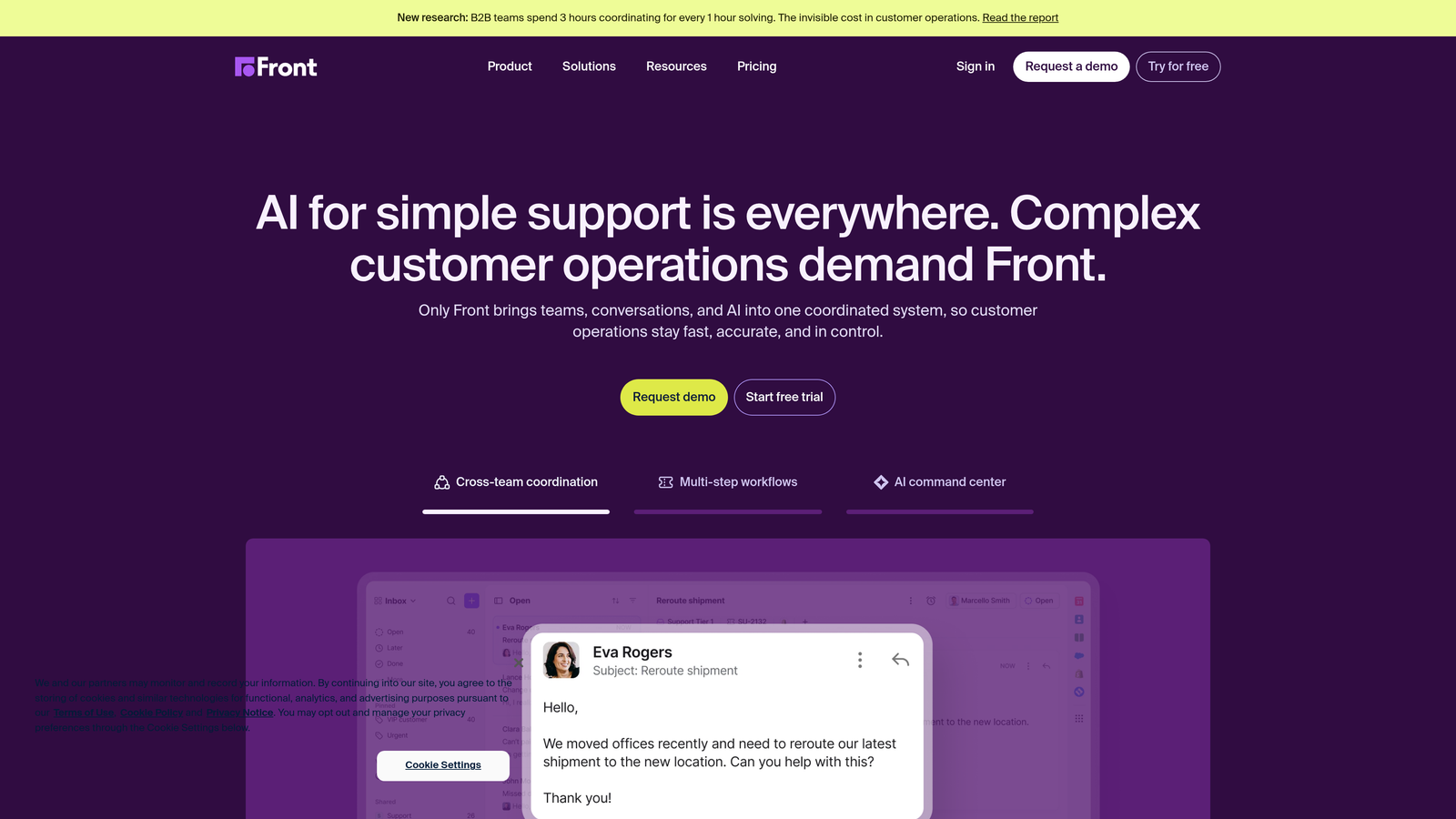
Front is a shared inbox platform that makes team email feel personal while providing helpdesk features and workflow automation.
Where This Tool Shines
Front bridges the gap between email and helpdesk systems. Your team gets the familiar feel of personal email while gaining assignment, tagging, and collaboration features typically found in support platforms. This makes it particularly effective for product teams that handle support across multiple channels—email, social media, SMS—but want a unified workflow.
Workflow automation rules let you route messages, assign conversations, and trigger actions based on content, sender properties, or team availability. Native integrations with CRMs and product tools mean you can see customer context and product usage data alongside support conversations. Team analytics and SLA tracking help you maintain quality standards without the overhead of enterprise platforms.
Key Features
Shared Inbox: Team email management that maintains personal sender addresses while providing assignment, tags, and collaboration features.
Workflow Automation: Rules engine for routing, assignment, and triggered actions based on message content, sender attributes, and team conditions.
Native Integrations: Built-in connections to CRMs, project management tools, and product analytics platforms for contextual customer information.
Team Analytics: Performance metrics, SLA tracking, and workload distribution insights to optimize team efficiency and response times.
Multi-Channel Support: Unified inbox for email, SMS, social media messages, and chat conversations with consistent workflows.
Best For
Product teams that receive support requests across multiple channels and need shared inbox collaboration without abandoning the email paradigm. Companies wanting automation and analytics without traditional helpdesk complexity.
Pricing
Starter plan at $19 per seat per month for basic shared inbox. Growth plan at $59 per seat per month includes automation rules and advanced integrations.
7. Pylon
Best for: B2B product companies managing technical support through Slack Connect
Pylon is a support platform designed specifically for B2B companies using Slack Connect to communicate with customers.
Where This Tool Shines
Many B2B product companies already use Slack Connect for customer communication, but managing support conversations across dozens of shared channels becomes chaotic. Pylon brings structure to this workflow by creating a unified view of all customer conversations, tracking response times, and ensuring nothing falls through the cracks.
The platform understands that technical B2B support often requires engineering involvement. Integrations with tools like Linear and Jira make it easy to escalate product issues from Slack conversations to engineering backlogs. You get the immediacy and relationship-building of Slack communication with the accountability and tracking of a proper support system.
Key Features
Slack Connect Management: Unified dashboard for all customer Slack channels with assignment, status tracking, and SLA monitoring.
Customer Communication View: Single timeline showing all interactions with each customer across Slack channels, email, and other touchpoints.
Engineering Tool Integrations: Native connections to Linear, Jira, and GitHub for seamless escalation of technical issues and bug reports.
Technical Support Workflows: Purpose-built for B2B product support scenarios including multi-stakeholder issues and engineering collaboration.
Analytics and Reporting: Track response times, resolution rates, and customer health across your Slack-based support operation.
Best For
B2B product companies that use Slack Connect as their primary customer communication channel and need to professionalize their support operations without abandoning the platform customers prefer.
Pricing
Contact for pricing. Plans are typically tailored to the number of connected customer Slack channels and team size.
8. Kustomer
Best for: Product companies wanting complete customer timeline visibility with omnichannel conversation management
Kustomer is a customer service CRM that provides agents with a complete view of each customer's history, interactions, and product usage on a single screen.
Where This Tool Shines
Kustomer's timeline approach fundamentally changes how agents handle product support. Instead of viewing isolated tickets, agents see the complete customer journey—past conversations, product usage, subscription details, and custom data—all in one interface. This context dramatically reduces resolution time because agents don't need to ask basic questions or switch between systems.
AI sentiment analysis helps prioritize conversations that need immediate attention, particularly valuable when dealing with frustrated users experiencing product issues. The omnichannel conversation threading keeps related messages together even when customers switch from email to chat to social media. Custom object and workflow builders let you tailor the platform to your specific product support needs.
Key Features
Customer Timeline View: Single-screen interface showing complete customer history, product usage, and all interactions across channels.
AI Sentiment Analysis: Automatically detects customer frustration and urgency to help prioritize responses and escalate critical issues.
Omnichannel Threading: Keeps conversations connected across email, chat, social media, and messaging apps for coherent support history.
Custom Objects and Workflows: Build custom data structures and automation rules tailored to your product's specific support scenarios.
Integrated Knowledge Base: Agents can access and share knowledge articles directly within conversations without switching tools.
Best For
Product companies with complex customer journeys who need agents to have complete context before responding. Teams that handle support across many channels and want unified conversation management.
Pricing
Enterprise pricing model. Contact for custom quote based on agent count, conversation volume, and required features.
9. Ada
Best for: Product companies seeking high AI containment rates for repetitive product questions
Ada is an AI-first automation platform that uses a no-code builder to create conversational agents optimized for high resolution rates.
Where This Tool Shines
Ada focuses relentlessly on one metric: what percentage of customer inquiries can AI resolve without human intervention. For product companies with high volumes of repetitive questions about features, setup, or common issues, this containment rate directly impacts support team efficiency and costs.
The no-code agent builder makes it accessible for product teams to create and refine automated responses without engineering resources. Multilingual support handles global product users automatically. When the AI can't resolve an issue, handoff to live agents preserves conversation context so customers don't repeat themselves. The platform continuously optimizes based on which conversation paths successfully resolve issues.
Key Features
No-Code Agent Builder: Visual interface for creating conversational flows, decision trees, and automated responses without programming.
Multilingual Automation: Supports conversations in over 100 languages with automatic translation and localized responses.
Containment Rate Optimization: Analytics and recommendations focused on increasing the percentage of fully automated resolutions.
Intelligent Handoff: Seamlessly transfers complex issues to human agents with full conversation history and customer context.
Performance Analytics: Detailed metrics on automation effectiveness, common failure points, and opportunities to improve resolution rates.
Best For
Product companies with high support volumes and significant numbers of repetitive questions that can be standardized. Teams focused on maximizing automation rates to scale support without proportional headcount growth.
Pricing
Contact for pricing. Uses a usage-based model typically tied to conversation volume and resolution counts rather than per-agent pricing.
Making the Right Choice
The best support automation tool for your product company depends on your specific workflows and priorities. If you need AI that understands in-app context and connects seamlessly to engineering tools, Halo AI delivers page-aware intelligence that evolves with every interaction. Product-led growth companies prioritizing in-app messaging and user onboarding will find Intercom's behavioral targeting and product tours valuable.
For enterprise scale with comprehensive compliance and omnichannel requirements, Zendesk provides the infrastructure and security features large organizations need. Teams on tighter budgets should consider Freshdesk's strong value proposition or Help Scout if maintaining personal customer relationships is central to your retention strategy.
Consider how support fits into your broader product ecosystem. Do bugs reported through support need to flow directly into Linear or Jira? Does your team primarily communicate with customers through Slack Connect? Are you measuring support success by containment rates or customer satisfaction scores? Your answers to these questions should guide your choice.
The trend toward AI-first platforms reflects a fundamental shift in what support automation can accomplish. Modern tools don't just route tickets—they understand product context, resolve issues autonomously, and surface insights that improve your product. The platforms that succeed are those that recognize support as part of the product experience, not a separate function.
Your support team shouldn't scale linearly with your customer base. Let AI agents handle routine tickets, guide users through your product, and surface business intelligence while your team focuses on complex issues that need a human touch. See Halo in action and discover how continuous learning transforms every interaction into smarter, faster support.