9 Best Support Automation Platforms to Transform Your Customer Service in 2026
Discover the nine leading support automation platforms for 2026 that go beyond simple ticket deflection to intelligently resolve customer inquiries, learn from interactions, and scale with your business. This comprehensive comparison examines critical support automation platform features including AI resolution capabilities, integration depth, analytics intelligence, and scalability to help startups and enterprises choose the right solution for their specific customer service needs.
 Grant CooperFounder14 min read
Support teams are drowning in repetitive tickets while customers expect instant, personalized responses around the clock. The right support automation platform doesn't just deflect tickets—it resolves them intelligently, learns from every interaction, and frees your team to handle complex issues that actually need a human touch.
But with dozens of platforms claiming AI-powered automation, choosing the right one requires understanding which features actually move the needle. This guide breaks down nine leading support automation platforms, examining the specific features that matter most: AI resolution capabilities, integration depth, analytics intelligence, and scalability.
Whether you're a growing startup handling your first thousand tickets or an enterprise managing millions, you'll find platforms matched to your specific automation needs.
1. Halo AI
Best for: Teams prioritizing autonomous AI resolution with continuous learning capabilities
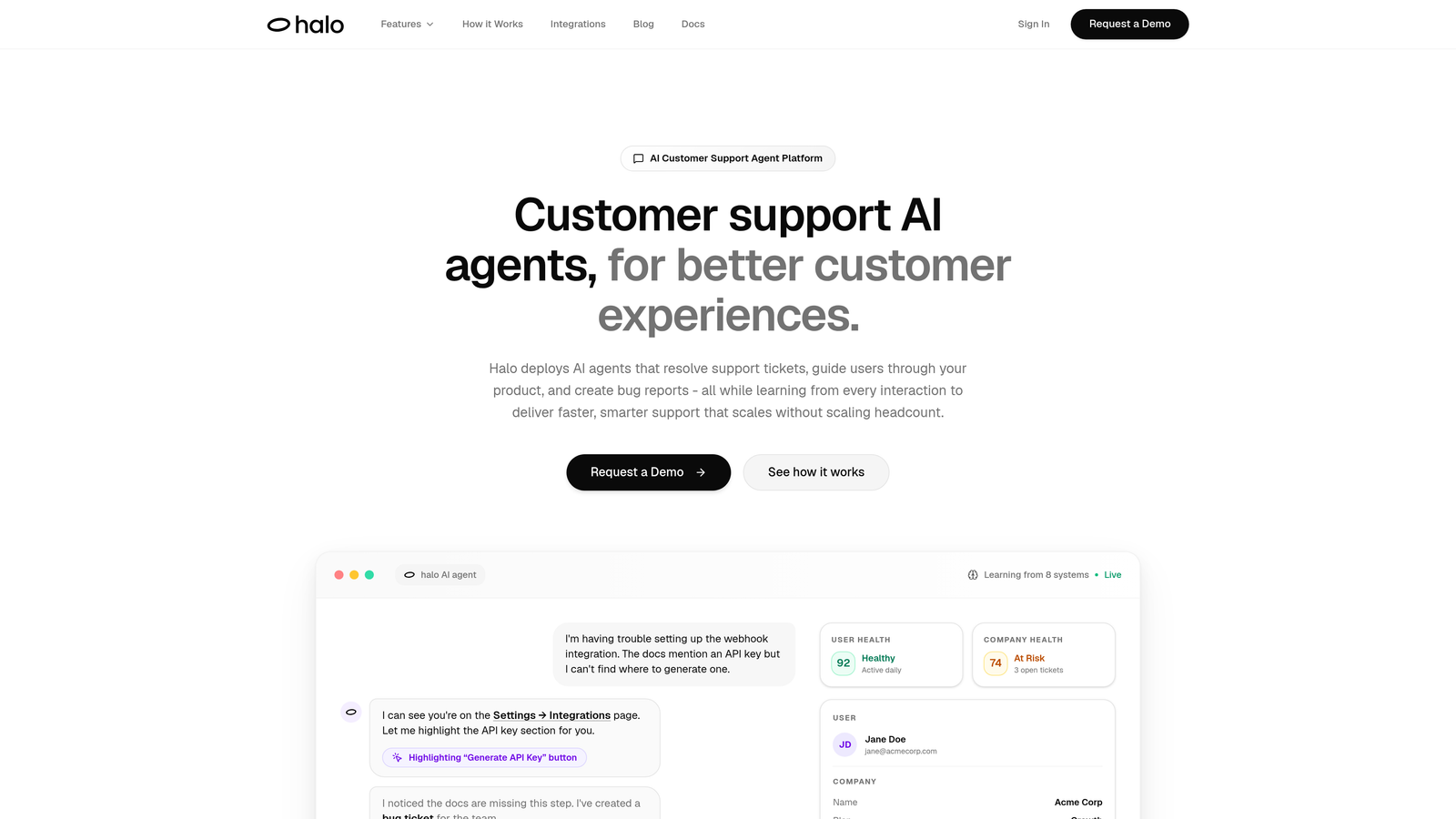
Halo AI is an AI-native support automation platform built from the ground up to deploy intelligent agents that resolve tickets autonomously while learning from every interaction.
Where This Tool Shines
Unlike legacy helpdesks that bolted AI onto existing architectures, Halo's AI-first design means every component works together to deliver genuinely intelligent support. The platform doesn't just route tickets or suggest canned responses. It actually resolves issues by understanding context, accessing your knowledge base, and taking action across your tech stack.
What sets Halo apart is its page-aware capability. The chat widget can see what users are experiencing in real-time, allowing it to provide visual guidance through complex workflows rather than generic text instructions. This contextual awareness dramatically improves resolution rates for product-related questions.
Key Features
Autonomous AI Agents: Resolve support tickets without human intervention by understanding intent, accessing documentation, and executing solutions across integrated systems.
Page-Aware Chat Widget: Sees what users see on your product interface, enabling visual UI guidance and context-specific help that goes beyond standard chatbot responses.
Smart Inbox with Business Intelligence: Surfaces customer health signals, revenue intelligence, and anomaly detection alongside traditional support metrics.
Automatic Bug Ticket Creation: Creates detailed bug reports in Linear when issues are identified, complete with reproduction steps and user context.
Deep Stack Integration: Connects to Slack, HubSpot, Intercom, Stripe, Zoom, PandaDoc, and Fathom to access data and take actions across your entire business stack.
Best For
B2B SaaS companies and product teams seeking maximum automation with minimal manual configuration. Particularly valuable for teams currently using Zendesk, Freshdesk, or Intercom who want AI that actually resolves issues rather than just deflecting them. The continuous learning approach means the platform gets smarter with every interaction rather than requiring constant rule updates.
Pricing
Contact for pricing. Scales with usage rather than per-seat licensing, making it cost-effective for teams with high ticket volumes.
2. Intercom
Best for: Unified conversational support across marketing, sales, and customer service touchpoints
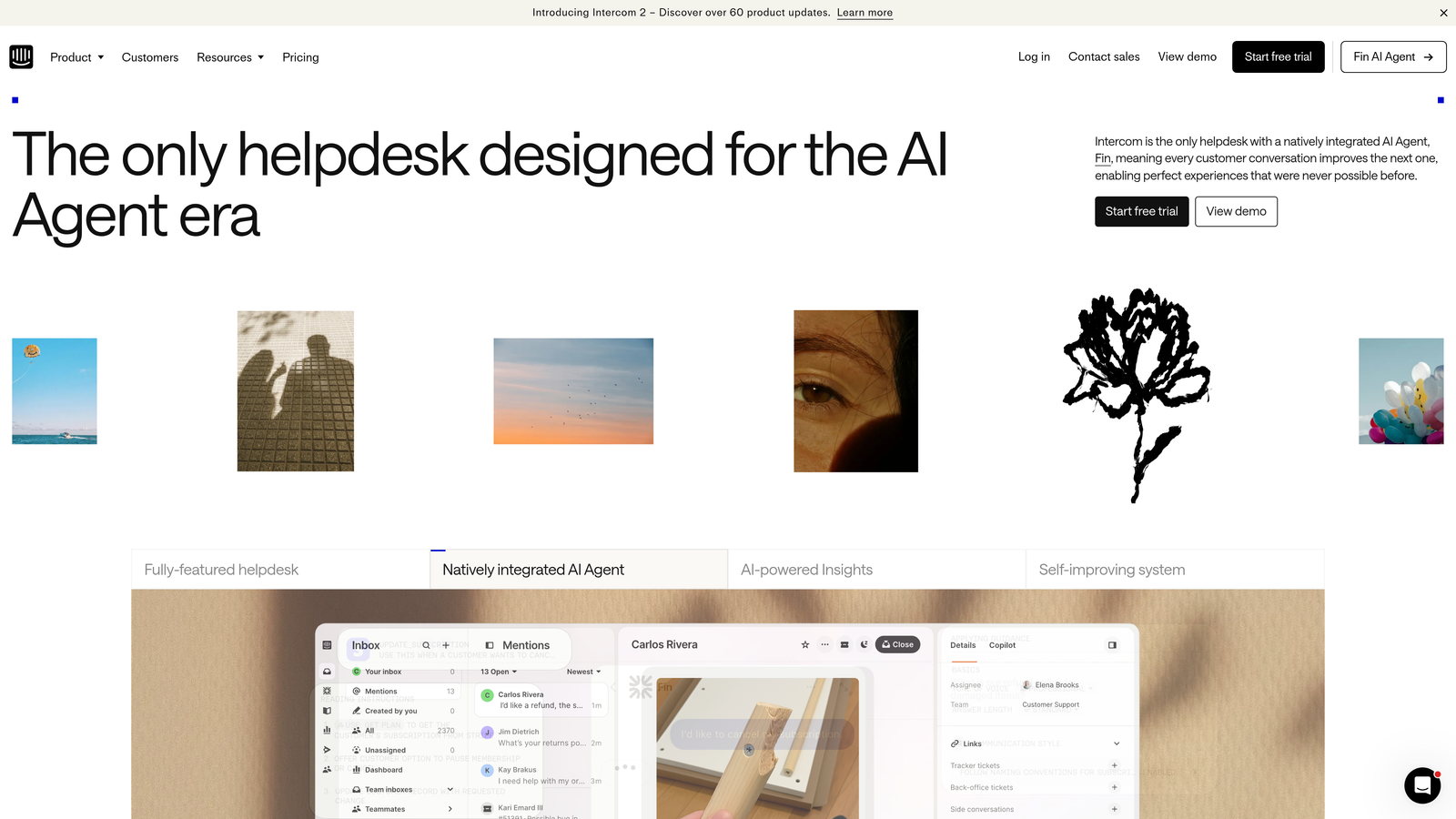
Intercom combines messenger, inbox, and AI-powered Fin agent into a conversational support platform designed for unified customer communication.
Where This Tool Shines
Intercom excels at blurring the lines between marketing, sales, and support. The same messenger widget handles product tours for new users, sales conversations for prospects, and support tickets for existing customers. This unified approach means customers never have to figure out which channel to use.
The Fin AI agent has improved significantly in 2026, moving beyond simple FAQ matching to handle multi-turn conversations and complex queries. It integrates directly with your help center content and can hand off seamlessly to human agents when it reaches its limits.
Key Features
Fin AI Agent: Handles automated responses using natural language processing trained on your help center content, with transparent confidence scoring for each answer.
Unified Inbox: Consolidates conversations from web, mobile, email, and social channels into a single interface with smart assignment rules.
Product Tours and Onboarding: Creates guided experiences directly in your product to reduce support volume by educating users proactively.
Custom Bots and Workflows: Visual builder for creating qualification bots, routing logic, and automated response sequences without coding.
Resolution Reports: Tracks AI resolution rates, conversation volumes, and customer satisfaction across all channels with detailed analytics dashboards.
Best For
Companies that want a single platform handling the entire customer journey from first website visit through ongoing support. Works particularly well for SaaS products with complex onboarding where proactive education reduces support volume.
Pricing
Starts at $39 per seat per month for the core platform. Fin AI is charged separately per resolution, which can add up quickly for high-volume teams.
3. Zendesk
Best for: Enterprise operations requiring extensive customization and third-party integrations
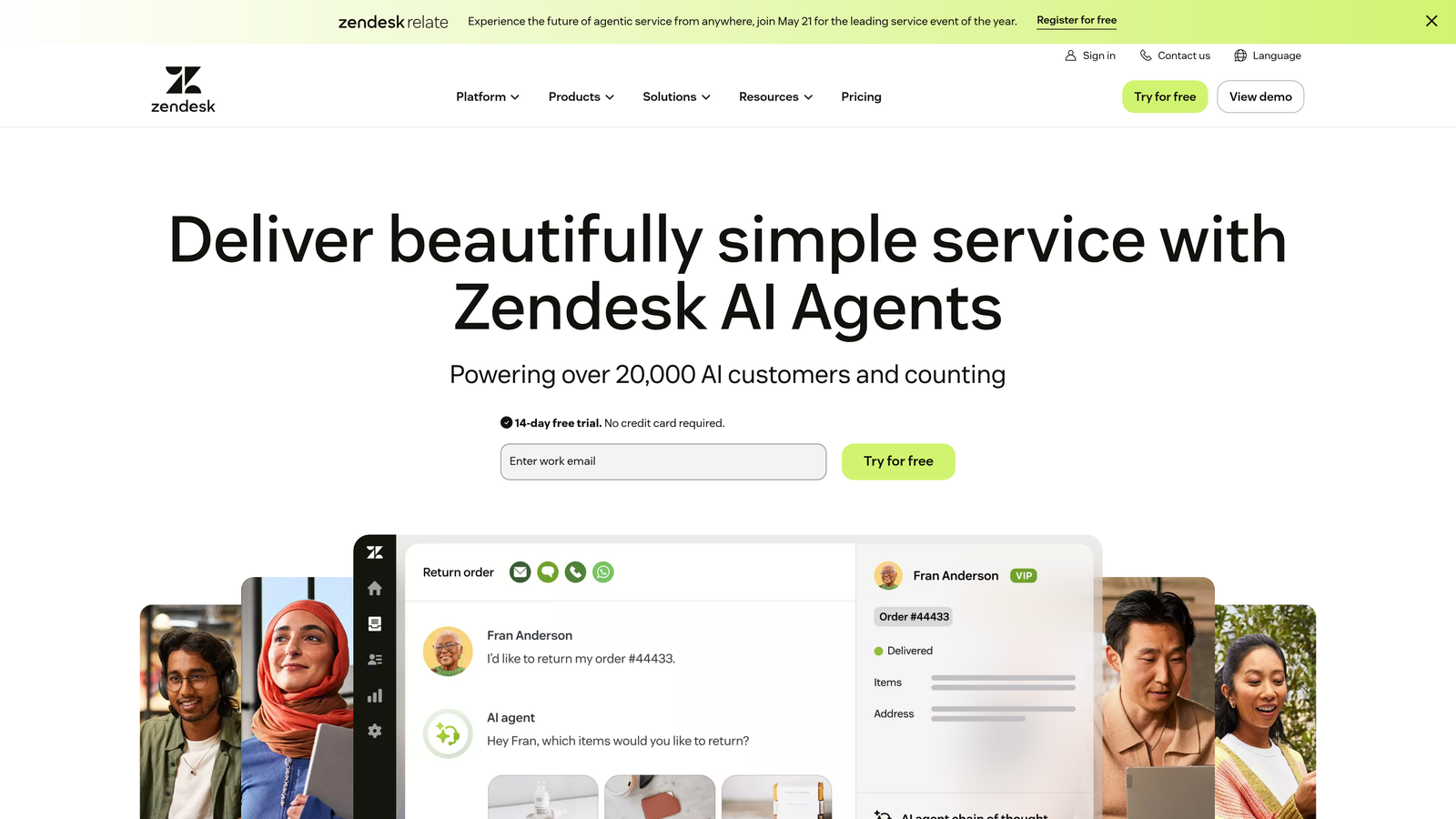
Zendesk is an enterprise-grade helpdesk platform offering deep customization capabilities, extensive marketplace integrations, and advanced AI features in higher pricing tiers.
Where This Tool Shines
Zendesk's strength lies in its maturity and flexibility. The platform has been refined over years to handle virtually any support workflow imaginable. If your team has unique processes or compliance requirements, Zendesk's customization options can accommodate them.
The app marketplace provides thousands of pre-built integrations, from niche CRMs to industry-specific tools. For large enterprises with complex tech stacks, this ecosystem proves invaluable. The platform also handles multi-brand support elegantly, allowing companies to manage multiple product lines or regional operations from a single instance.
Key Features
Advanced Ticket Routing: Sophisticated rules engine for automatic assignment based on skills, workload, language, timezone, and custom fields.
Extensive App Marketplace: Over 1,200 pre-built integrations plus APIs for custom connections to virtually any business system.
Answer Bot and AI Suggestions: AI-powered article recommendations and automated responses, though less autonomous than newer AI-native platforms.
Customizable Workflows: Triggers, automations, and macros that can handle complex multi-step processes with conditional logic.
Multi-Brand Support: Manage multiple help centers, ticket forms, and branding from a single Zendesk instance with separate SLAs and workflows.
Best For
Large enterprises with complex support operations, strict compliance requirements, or unique workflows that demand deep customization. The learning curve is steeper than newer platforms, but the flexibility justifies it for teams with sophisticated needs.
Pricing
Starts at $55 per agent per month for the Suite Team plan. AI features and advanced automation require Suite Professional or Enterprise tiers, which can exceed $150 per agent monthly.
4. Freshdesk
Best for: Mid-market teams seeking strong automation at competitive pricing
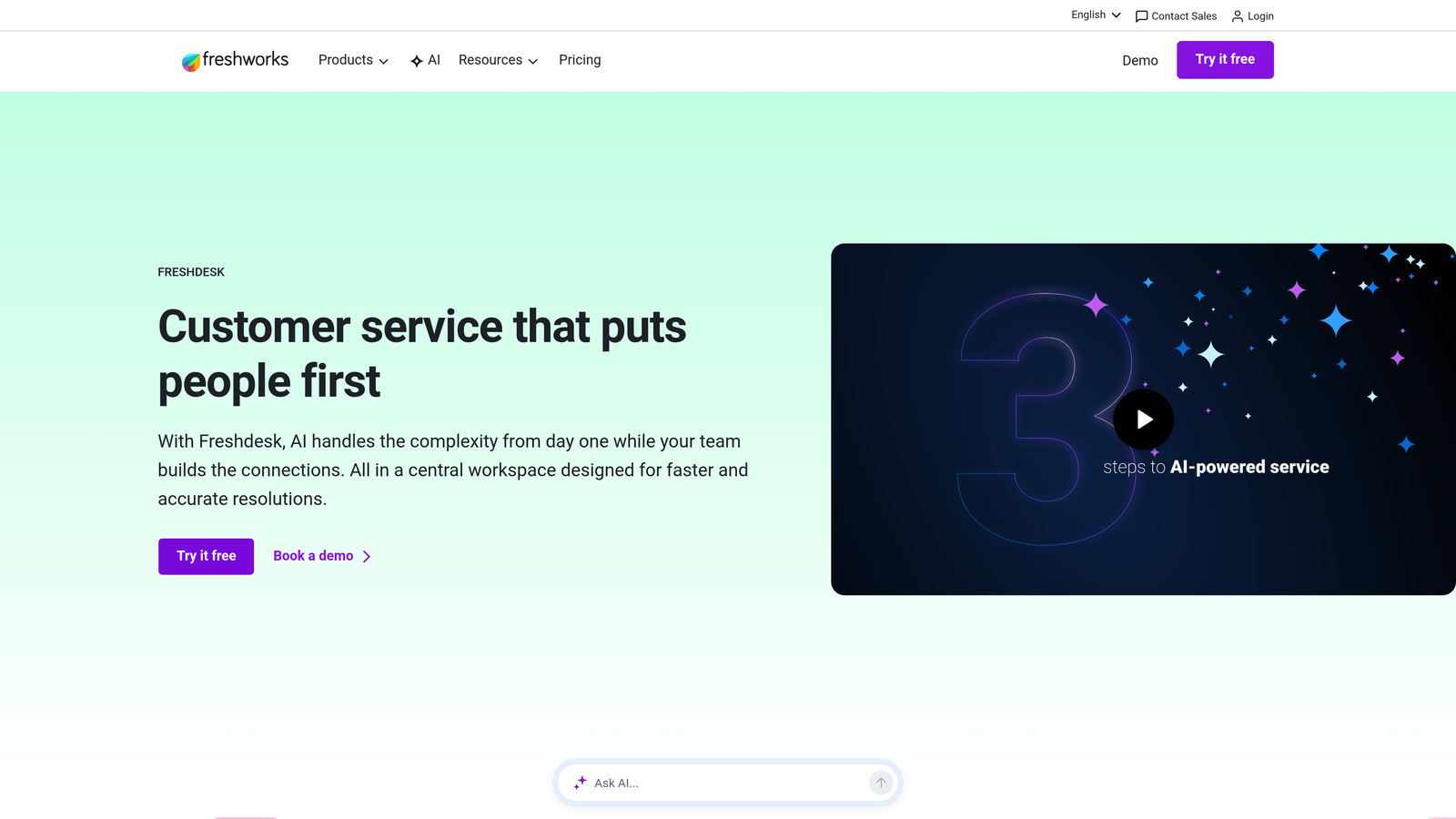
Freshdesk delivers helpdesk functionality with Freddy AI automation, an intuitive interface, and pricing that makes advanced features accessible to growing support teams.
Where This Tool Shines
Freshdesk strikes an excellent balance between capability and usability. The interface feels modern and uncluttered compared to legacy platforms, making onboarding new agents faster. Teams can be productive within days rather than weeks.
Freddy AI has evolved into a genuinely useful automation layer. It suggests responses based on ticket content, automatically categorizes incoming requests, and can handle straightforward queries without human intervention. The scenario automation builder lets you create complex workflows visually, which non-technical team leads appreciate.
Key Features
Freddy AI Automation: Suggests responses, categorizes tickets automatically, and handles routine queries with machine learning that improves over time.
Scenario Automation: Visual workflow builder for creating multi-step automations triggered by ticket properties, customer data, or time-based conditions.
Team Inbox with Collision Detection: Prevents multiple agents from working the same ticket simultaneously while maintaining conversational threading.
Self-Service Portal Builder: Customizable knowledge base with AI-powered search that surfaces relevant articles based on user queries.
SLA Management: Configurable service level agreements with escalation rules and real-time tracking across multiple priority levels.
Best For
Growing companies that have outgrown basic helpdesks but aren't ready for enterprise-level complexity or pricing. The free tier makes it easy to start small and scale up as your team grows.
Pricing
Free tier available for up to 10 agents with basic features. Paid plans start at $15 per agent per month, with Freddy AI included in Growth tier at $49 per agent monthly.
5. HubSpot Service Hub
Best for: Teams already using HubSpot CRM seeking unified customer data across all touchpoints
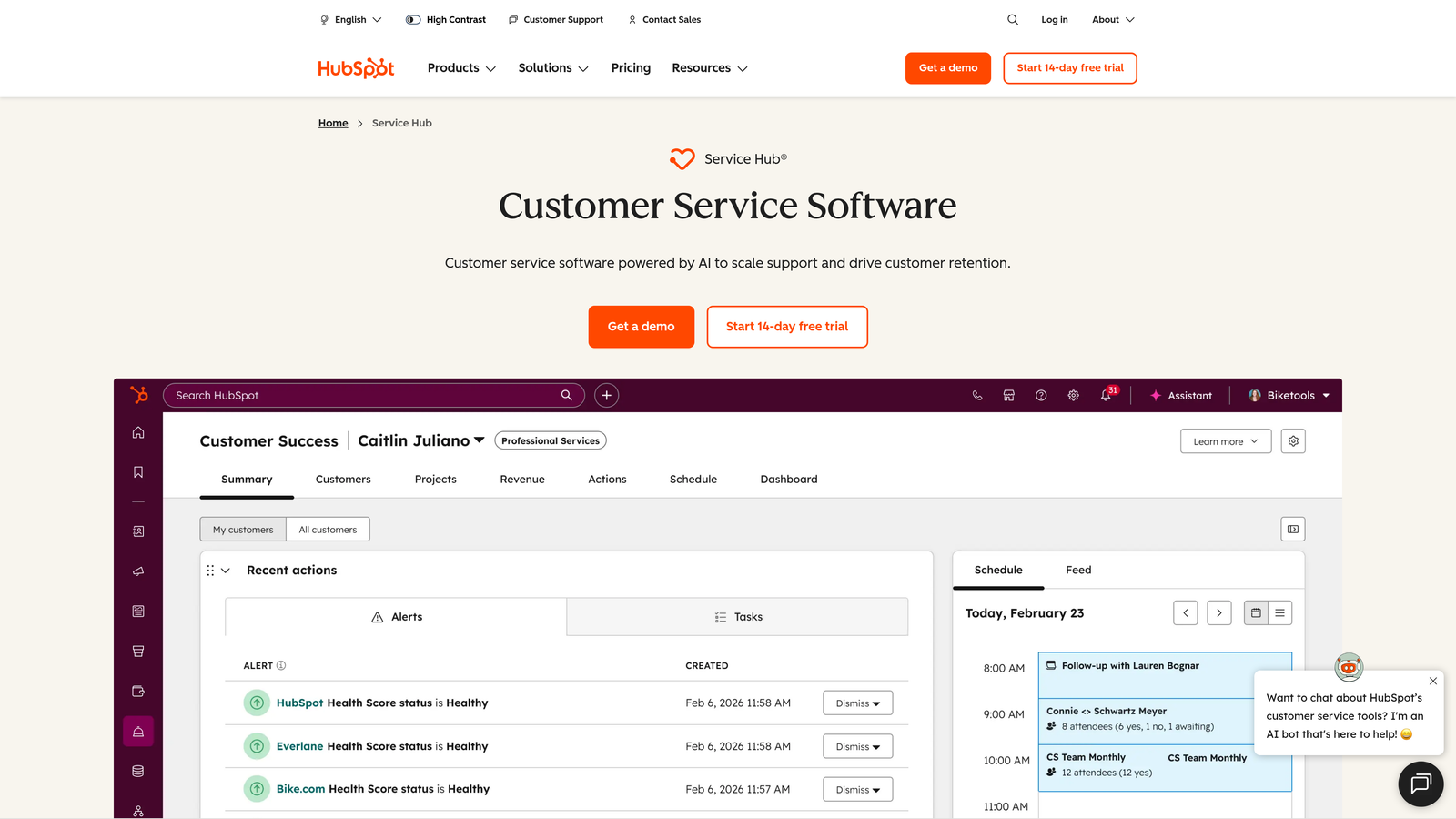
HubSpot Service Hub integrates support directly into the HubSpot ecosystem, offering unified customer views that span marketing, sales, and service interactions.
Where This Tool Shines
If you're already invested in HubSpot for marketing or sales, Service Hub provides unmatched context. Support agents see the complete customer journey: which marketing emails they opened, what sales conversations they had, previous support tickets, and current product usage. This 360-degree view enables genuinely personalized support.
The knowledge base integrates seamlessly with the CRM, allowing you to track which articles specific customers have viewed. You can identify knowledge gaps by seeing which topics generate the most tickets despite having documentation. The feedback survey tools close the loop by connecting satisfaction scores directly to customer records.
Key Features
Unified CRM Timeline: Complete customer interaction history across marketing, sales, and support in a single chronological view with context for every touchpoint.
Knowledge Base with AI Search: Self-service documentation with intelligent search that learns from user behavior and suggests relevant articles proactively.
Customer Feedback Surveys: NPS, CSAT, and custom surveys that automatically associate responses with customer records for trend analysis.
Ticket Automation and Routing: Workflow builder using CRM properties to route tickets based on customer segment, product tier, or any custom field.
Service Analytics Dashboards: Pre-built reports tracking ticket volume, response times, customer satisfaction, and team performance with CRM data correlation.
Best For
Companies already using HubSpot for marketing or sales who want support data integrated into their existing customer database. The value proposition weakens significantly if you're not in the HubSpot ecosystem.
Pricing
Free tools available with basic ticketing and live chat. Professional tier starts at $90 per month for two users, with additional seats at $45 monthly. Enterprise features require custom pricing.
6. Gorgias
Best for: E-commerce brands needing deep Shopify integration and revenue attribution
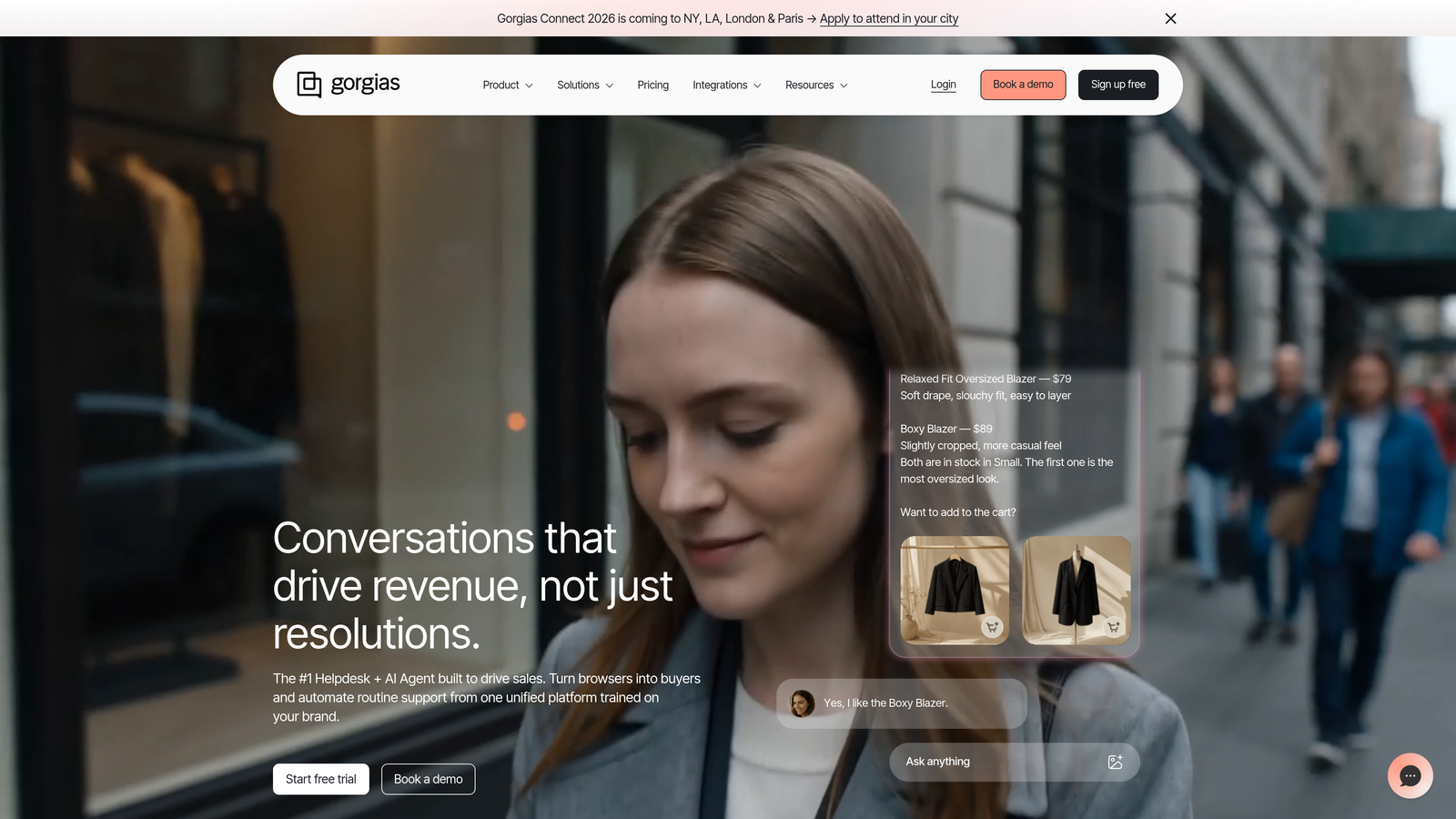
Gorgias is purpose-built for e-commerce support, offering deep integrations with Shopify, BigCommerce, and Magento alongside revenue tracking that connects support interactions to sales outcomes.
Where This Tool Shines
Gorgias understands e-commerce support is fundamentally different from SaaS support. Agents can view order details, process refunds, modify subscriptions, and update shipping addresses without leaving the ticket interface. This eliminates the constant tab-switching that slows down e-commerce support teams.
The revenue attribution feature tracks which support conversations lead to purchases, proving support's impact on the bottom line. You can create macros that dynamically insert order-specific information like tracking numbers or product details, making personalized responses scalable. Social media and SMS support are first-class citizens, not afterthoughts.
Key Features
Deep E-commerce Platform Integration: Native connections to Shopify, BigCommerce, and Magento that surface order data, customer history, and product information directly in tickets.
Order Management Within Tickets: Process refunds, cancel orders, modify subscriptions, and update shipping details without switching to your e-commerce platform.
Revenue Attribution: Tracks which support interactions lead to purchases, quantifying support's impact on revenue with detailed conversion reporting.
Dynamic Macros: Saved replies that automatically populate with customer-specific order data, product details, and shipping information for personalized responses at scale.
Social and SMS Support: Unified inbox handling Instagram, Facebook, SMS, and email with consistent automation rules across all channels.
Best For
E-commerce brands on Shopify, BigCommerce, or Magento handling order inquiries, shipping questions, and product support. The platform is overkill for non-e-commerce businesses but perfectly tailored for online retail.
Pricing
Starts at $10 per month for 50 tickets, scaling to $300 monthly for 2,000 tickets. Volume-based pricing makes it predictable for businesses with steady support loads.
7. Kustomer
Best for: Omnichannel support requiring unified customer timelines and proactive engagement
Kustomer positions itself as a CRM platform rather than just a helpdesk, offering unified customer timelines, AI-powered sentiment analysis, and proactive support capabilities.
Where This Tool Shines
Kustomer's timeline view fundamentally changes how agents interact with customer data. Instead of seeing isolated tickets, they see a chronological story of every interaction across every channel. This context dramatically improves first-contact resolution because agents understand the full situation immediately.
The AI sentiment and intent detection runs in real-time, flagging frustrated customers before they explicitly complain. This allows supervisors to intervene proactively on at-risk accounts. The business rules engine is remarkably powerful, letting you create complex automations based on customer data, conversation history, and external triggers without writing code.
Key Features
Single Customer Timeline: Unified view of all interactions across phone, email, chat, social media, and SMS in chronological order with full conversation context.
AI Sentiment and Intent Detection: Real-time analysis of customer messages to identify frustration, urgency, and intent, enabling proactive escalation of at-risk conversations.
Proactive Outreach Automation: Trigger messages based on customer behavior, product usage patterns, or business events to resolve issues before they become tickets.
Custom Objects and Data Modeling: Define custom data structures beyond standard ticket fields to model your specific business entities and relationships.
Business Rules Engine: Visual builder for complex automations with conditional logic, multi-step workflows, and external system triggers.
Best For
Mid-to-large enterprises with omnichannel support needs and complex customer data requirements. The custom data modeling appeals to companies with unique business processes that don't fit standard helpdesk structures.
Pricing
Enterprise pricing model with custom quotes based on conversation volume and feature requirements. Expect significant investment for full platform capabilities.
8. Help Scout
Best for: Teams prioritizing human connection and simplicity over extensive automation
Help Scout emphasizes personal customer relationships with a clean, distraction-free interface and thoughtful automation that enhances rather than replaces human support.
Where This Tool Shines
Help Scout's philosophy centers on making support feel personal even at scale. The inbox interface resembles email rather than a traditional ticketing system, which customers appreciate. There are no ticket numbers in customer-facing communications, just natural conversations.
The Beacon widget integrates help documentation directly into your product, allowing users to search for answers without leaving their workflow. When they can't find what they need, the transition from self-service to human support is seamless. The platform includes just enough automation to eliminate repetitive work without making interactions feel robotic.
Key Features
Clean, Distraction-Free Inbox: Email-like interface that focuses on conversations rather than ticket management, with customer context surfaced naturally alongside messages.
Beacon Widget: Embeddable help widget that surfaces relevant documentation based on page context, with smooth escalation to live support when needed.
Saved Replies and Workflows: Templates and automation for common scenarios that maintain personalization through variable insertion and conditional content.
Customer Satisfaction Ratings: One-click CSAT surveys embedded in every conversation resolution with trend tracking and agent-level reporting.
Collision Detection and Private Notes: Prevents multiple agents from responding to the same conversation while enabling internal collaboration through private annotations.
Best For
Small to mid-sized teams that want to maintain a personal touch as they scale. Companies with strong brand voices who view support as a relationship-building opportunity rather than a cost center to minimize.
Pricing
Starts at $20 per user per month for the Standard plan. Plus tier at $40 per user adds advanced reporting and custom fields. No free tier available.
9. Tidio
Best for: Small businesses and startups needing accessible automation on limited budgets
Tidio provides an accessible automation platform with a visual chatbot builder, live chat capabilities, and pricing that makes advanced features available to small businesses.
Where This Tool Shines
Tidio removes the technical barriers to support automation. The visual drag-and-drop bot builder lets non-technical team members create sophisticated chatbot flows without writing code or understanding complex logic. Pre-built templates for common scenarios like order tracking or FAQ handling get you started in minutes.
The Lyro AI conversational bot, introduced in 2025, brings genuinely intelligent responses to the small business market at an accessible price point. It learns from your website content and past conversations to handle common questions autonomously. For businesses just starting with automation, Tidio provides an easy entry point without overwhelming complexity.
Key Features
Visual Drag-and-Drop Bot Builder: Create chatbot workflows with conditional logic, user input collection, and multi-step conversations without coding knowledge.
Live Chat with Visitor Tracking: See what pages visitors are viewing in real-time, with proactive chat triggers based on behavior and time on page.
Pre-Built Chatbot Templates: Ready-made flows for common scenarios like lead qualification, order status, and FAQ handling that can be customized to your needs.
Email and Messenger Integration: Unified inbox handling website chat, email, and Facebook Messenger conversations with consistent automation across channels.
Lyro AI Conversational Bot: AI-powered bot that learns from your content to handle natural language queries without requiring manual flow building.
Best For
Small businesses, solo entrepreneurs, and startups with limited budgets who need basic automation and live chat. The free tier supports up to 50 conversations monthly, making it viable for very small operations.
Pricing
Free tier available with basic live chat and 50 conversations per month. Paid plans start at $29 monthly for increased conversation limits and Lyro AI access.
Finding Your Automation Match
The support automation landscape has evolved dramatically, with AI-native platforms now capable of genuinely resolving tickets rather than just routing them. The key differentiator in 2026 isn't whether a platform has AI, but how intelligently that AI operates and how deeply it integrates with your existing systems.
For teams prioritizing intelligent automation that learns continuously and resolves issues autonomously, Halo AI offers the deepest AI-first approach with page-aware context and business intelligence that goes beyond traditional support metrics. Enterprise operations with complex workflows and extensive customization needs will find Zendesk's mature ecosystem essential, despite the learning curve and higher costs.
E-commerce brands should look closely at Gorgias for its revenue-focused features and deep platform integrations that eliminate constant tab-switching. Companies already invested in HubSpot gain significant value from Service Hub's unified customer timeline. Teams that want to maintain a personal touch while automating repetitive work will appreciate Help Scout's human-centered approach.
Whatever your scale, the key is matching platform capabilities to your specific automation goals. Start by identifying your biggest pain points: Is it ticket volume overwhelming your team? Lack of context leading to repeated questions? Integration gaps forcing manual data entry? Missing business intelligence about customer health?
Your support team shouldn't scale linearly with your customer base. Let AI agents handle routine tickets, guide users through your product, and surface business intelligence while your team focuses on complex issues that need a human touch. See Halo in action and discover how continuous learning transforms every interaction into smarter, faster support that improves over time rather than requiring constant manual refinement.