9 Best Support Automation Platforms in 2026: Honest Reviews
These support automation platform reviews evaluate nine leading solutions for 2026, comparing automation depth, AI architecture, integration ecosystems, and human-agent handoff quality to help B2B SaaS teams, product managers, and ops leaders find the right fit for scaling support without growing headcount.
 Matt PattoliFounder13 min read
Support teams are drowning in repetitive tickets while customers expect faster resolutions than ever. The platforms that promise to close that gap vary wildly in how they actually deliver: some bolt AI onto legacy helpdesk infrastructure, while others are built AI-first from the ground up. That architectural difference matters enormously when you're trying to scale support without scaling headcount.
This roundup reviews nine of the most capable support automation platforms available in 2026. We evaluated each on automation depth, integration ecosystem, ease of deployment, and how gracefully each handles the handoff between AI and human agents. Whether you're a B2B SaaS company outgrowing manual support, a product team looking to deflect repetitive tickets, or an ops leader evaluating Zendesk alternatives, here's an honest look at what each platform actually does.
1. Halo AI
Best for: B2B SaaS teams wanting autonomous ticket resolution with built-in business intelligence
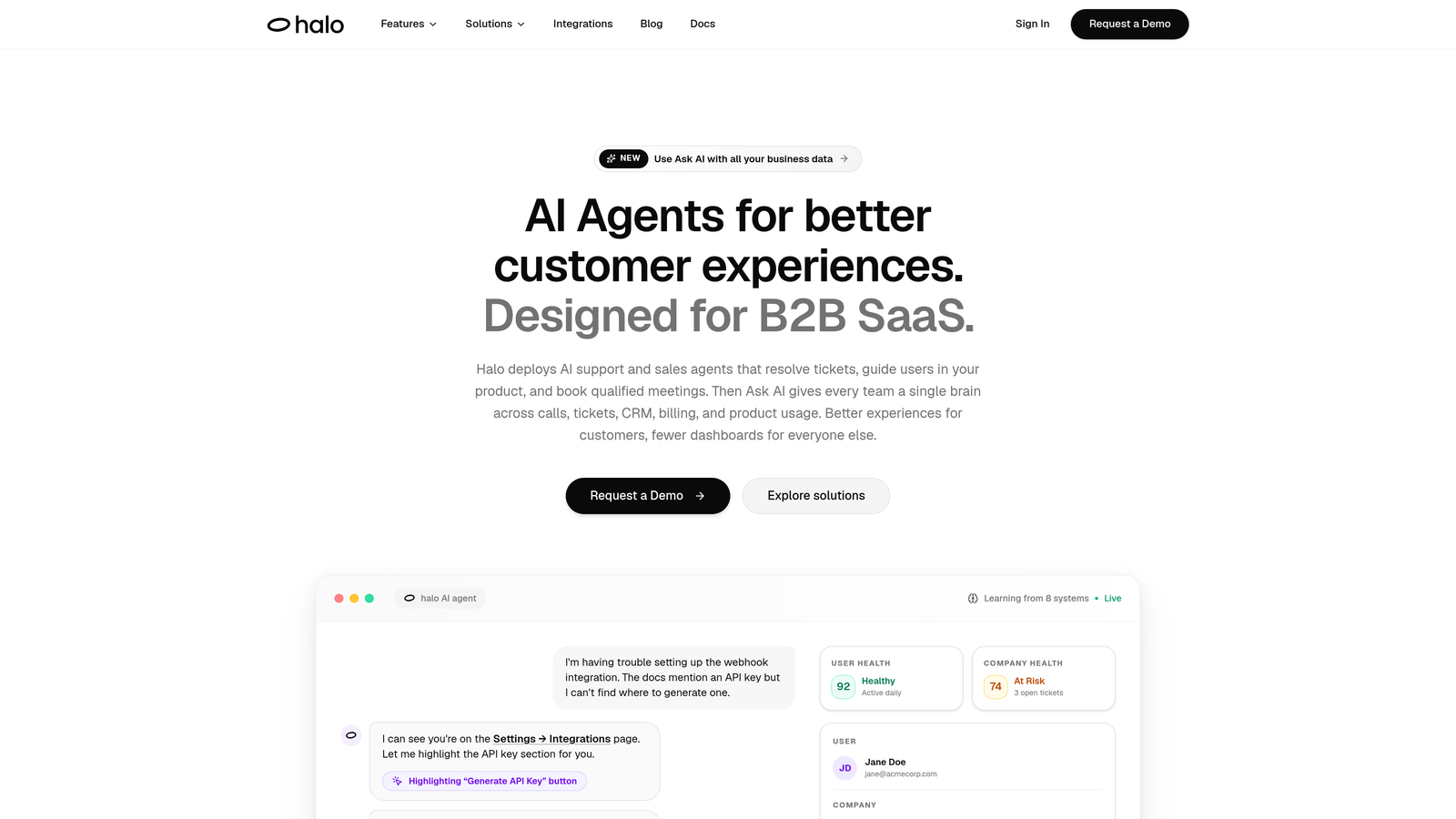
Halo AI is an AI-first customer support platform built around page-aware agents, autonomous ticket resolution, and business intelligence embedded directly into the support layer.
Where This Tool Shines
What separates Halo from most platforms on this list is its architectural starting point. Rather than layering AI onto an existing helpdesk, Halo was built AI-first, which means the intelligence isn't a feature you turn on. It's the foundation everything else runs on. The page-aware chat widget is a practical example of this: the AI agent understands which specific page or product context a user is currently in, allowing it to give contextually relevant guidance rather than generic answers.
The continuous learning loop is another genuine differentiator. Every resolved ticket feeds back into the system, making the AI incrementally smarter over time. For B2B SaaS teams handling recurring product questions, this compounds into meaningful deflection improvements without any manual retraining effort.
Key Features
Page-Aware Chat Widget: The AI agent understands the user's current product context, enabling precise, in-the-moment guidance rather than static FAQ responses.
Autonomous Ticket Resolution: AI agents handle tickets end-to-end with continuous learning from every interaction, improving resolution accuracy over time.
Auto Bug Ticket Creation: Automatically generates and routes bug reports to Linear or equivalent project management tools, closing the loop between support and engineering.
Smart Inbox with Business Intelligence: Surfaces customer health signals, revenue anomalies, and engagement patterns from support data, turning the inbox into a strategic asset.
Live Agent Handoff: Escalates to human agents with full conversation context preserved, so customers never have to repeat themselves.
Deep Integration Ecosystem: Connects to Linear, Slack, HubSpot, Intercom, Stripe, Zoom, PandaDoc, and Fathom out of the box.
Best For
B2B SaaS companies and product teams that want more than ticket deflection. If your support data should be informing customer success, product development, and revenue conversations, Halo is built for that. It's particularly well-suited for teams that have outgrown reactive, agent-heavy support models.
Pricing
Contact for pricing. Full details and a demo are available at haloagents.ai.
2. Zendesk
Best for: Enterprise teams wanting a mature, deeply integrated helpdesk with broad AI capabilities
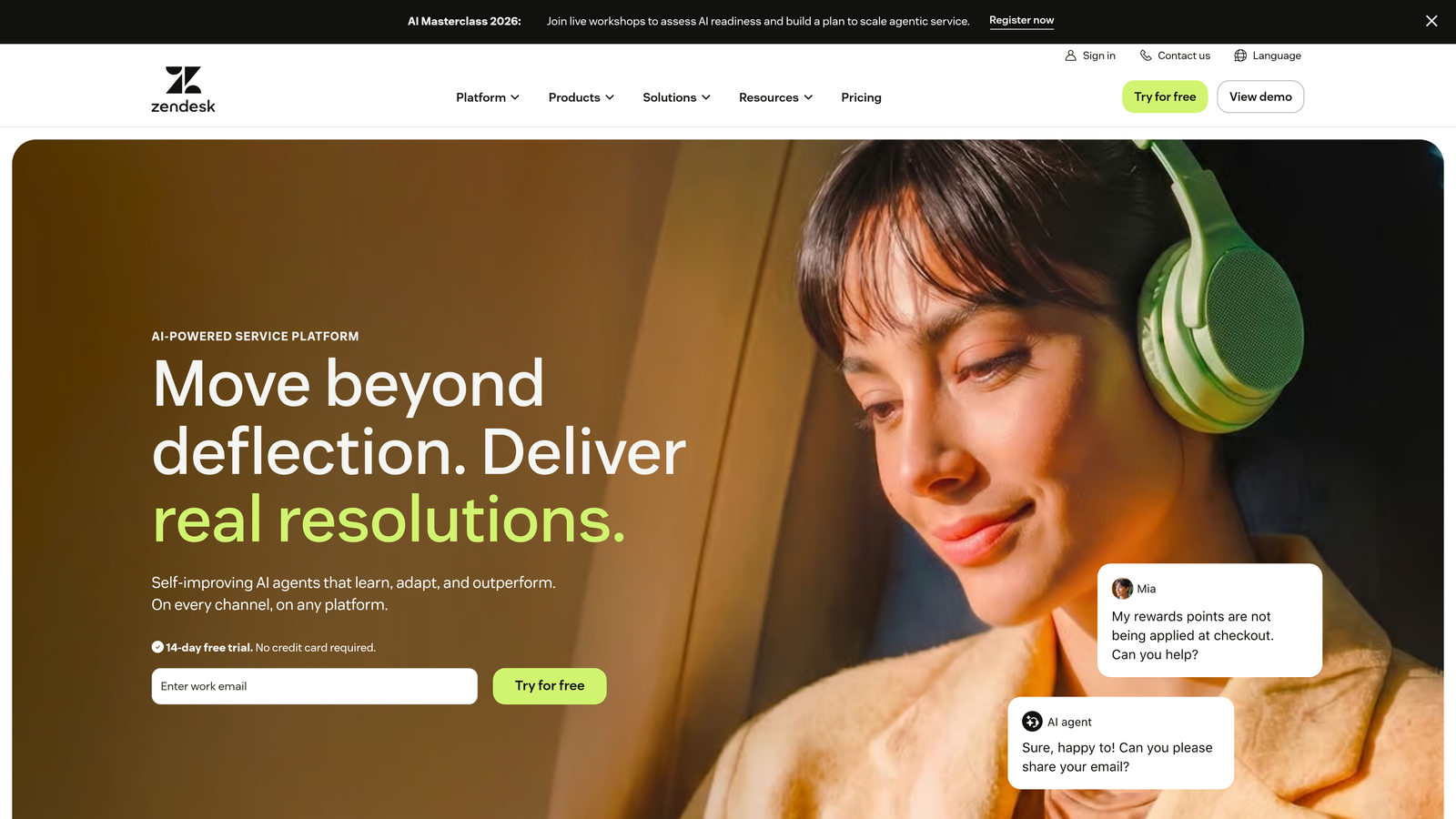
Zendesk is the market-leading enterprise helpdesk platform with AI-powered triage, an agent copilot, and one of the largest support app ecosystems available.
Where This Tool Shines
Zendesk's primary strength is breadth. The platform has been refined over many years and offers a level of configurability that enterprise teams with complex workflows genuinely need. Its app marketplace is extensive, meaning it likely connects to whatever tools your team already uses.
The AI layer, including intelligent triage, AI agents for first-response deflection, and the agent copilot for suggested replies, is capable and improving. That said, it's worth noting these features are additive to the core platform rather than foundational to it. Teams with simpler needs may find the platform heavier than necessary.
Key Features
Zendesk AI Triage: Automatically classifies and routes incoming tickets based on intent, sentiment, and category.
AI Agents: Handles automated first-response and ticket deflection for common queries before a human agent is needed.
Agent Copilot: Surfaces suggested replies and relevant knowledge base articles in real time as agents work tickets.
App Marketplace: Hundreds of integrations covering CRM, billing, project management, and communication tools.
Advanced Reporting: Robust analytics and workforce management tools for operations leaders tracking team performance.
Best For
Enterprise support organizations with established workflows, large agent teams, and a need for deep customization. Teams already invested in the Zendesk ecosystem will find the AI additions valuable. Smaller teams may find the cost and complexity harder to justify.
Pricing
Suite plans start at approximately $55/agent/month; AI add-ons are priced separately. Verify current pricing at zendesk.com.
3. Intercom
Best for: SaaS companies wanting customer messaging, in-app support, and AI resolution in one platform
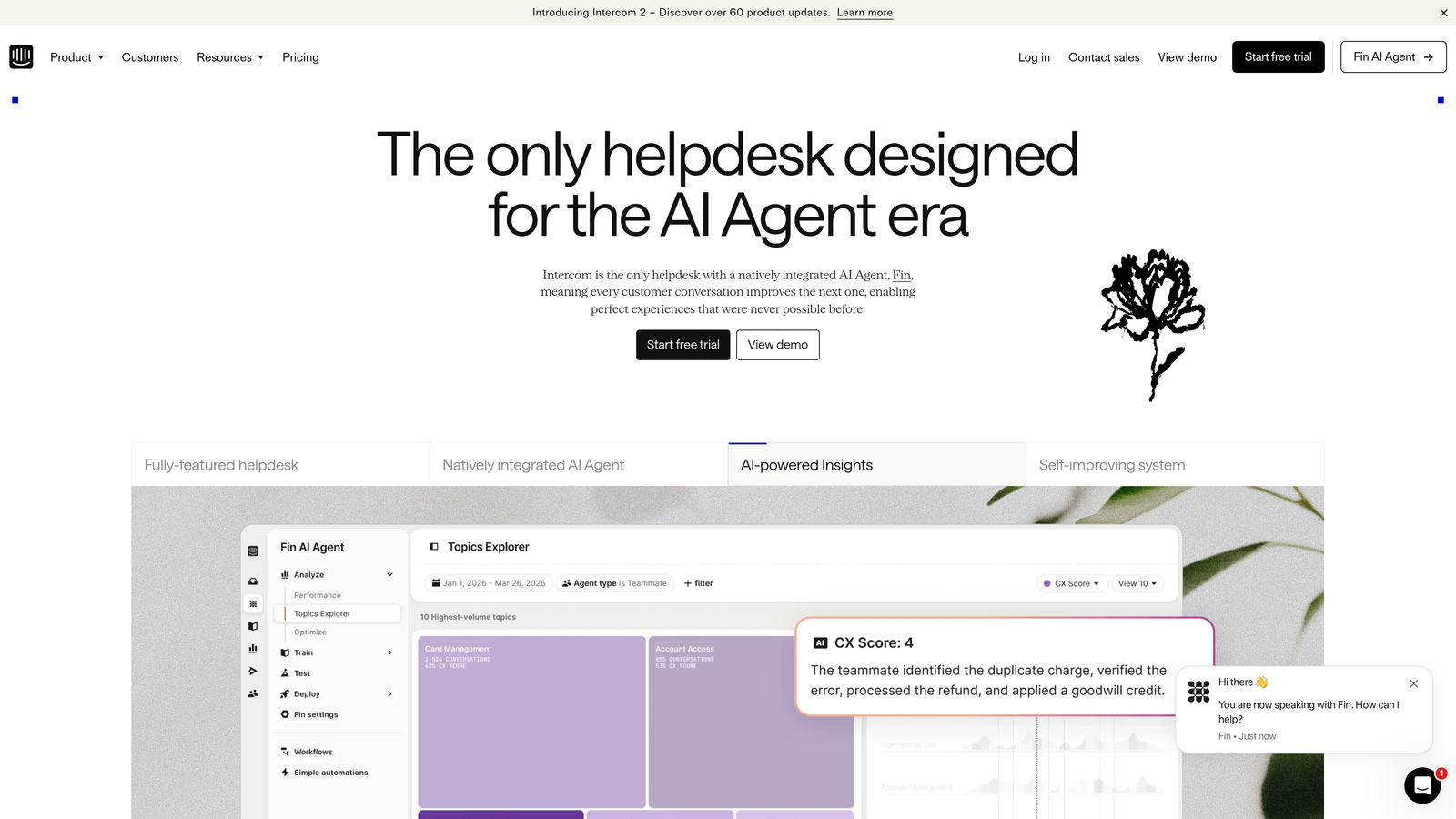
Intercom is a customer messaging platform combining its Fin AI agent, in-app support tools, and product engagement features in a single unified workspace.
Where This Tool Shines
Intercom's Fin AI agent is genuinely strong at autonomous query resolution, particularly for SaaS products with well-maintained help centers. The platform's real differentiator, though, is how it blends support with product engagement. In-app messaging, product tours, and onboarding flows live alongside the support inbox, which is a meaningful advantage for product-led growth companies.
The tradeoff is pricing. Intercom's usage-based model for Fin AI can become expensive at scale, and the platform's full feature set is only unlocked at higher tiers. Teams with straightforward support needs may find they're paying for product engagement features they don't use.
Key Features
Fin AI Agent: Resolves customer queries autonomously using your help center content and custom knowledge sources.
In-App Messaging and Product Tours: Delivers onboarding and feature guidance directly inside your product without leaving the platform.
Shared Inbox: Unified workspace with AI-assisted reply drafting for human agents handling escalated conversations.
Help Center: Customer-facing knowledge base with AI-powered article suggestions surfaced during conversations.
Workflows Builder: Visual automation builder for routing, escalation, and multi-step support processes.
Best For
SaaS companies with a product-led growth motion that want support and user engagement tools in one place. Particularly effective when your help center is well-maintained and Fin has strong content to work from.
Pricing
Starts at approximately $39/seat/month; Fin AI usage is priced separately on top. Verify current pricing at intercom.com.
4. Freshdesk
Best for: SMB and mid-market teams wanting capable AI automation at accessible price points
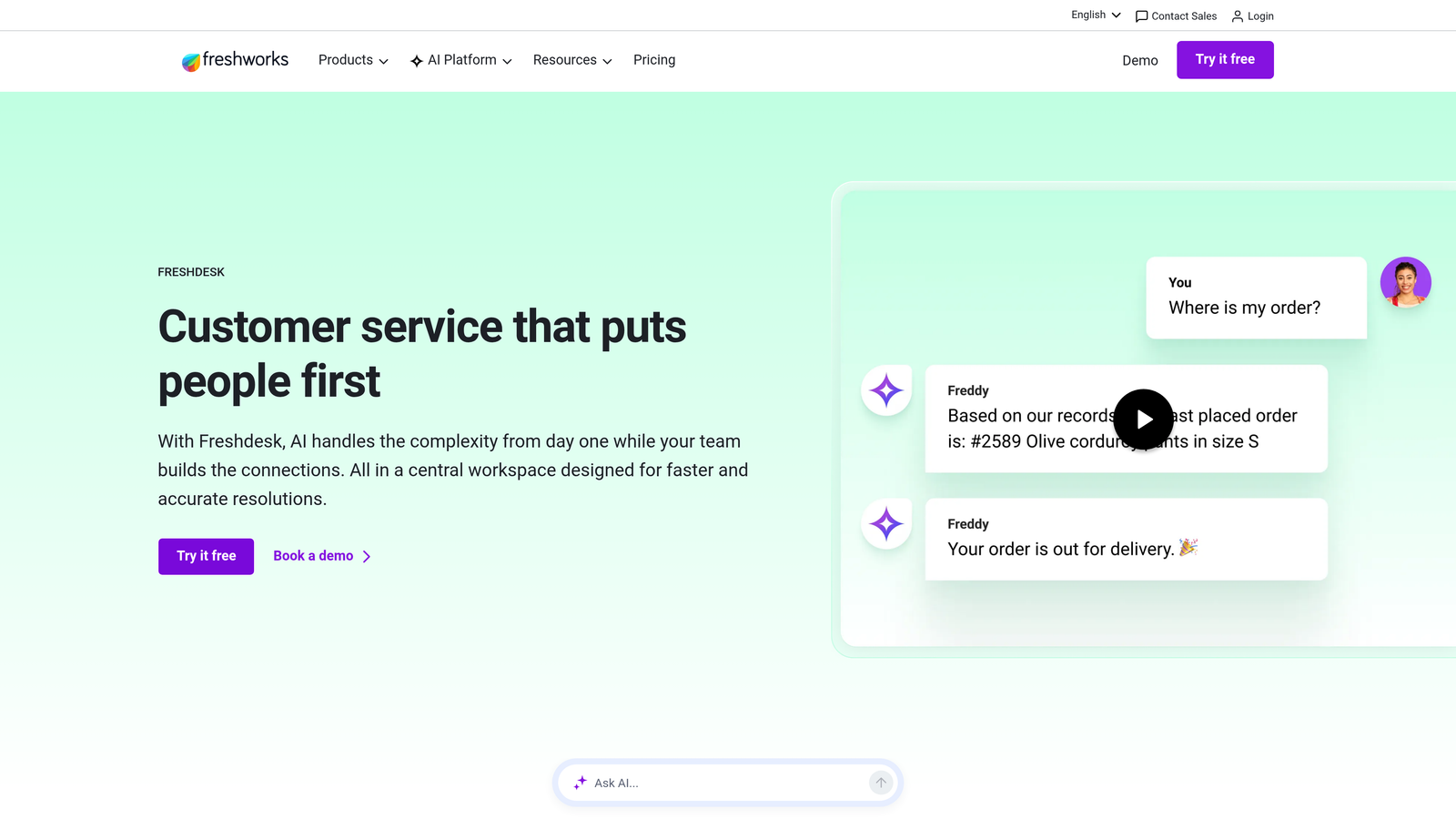
Freshdesk is a mid-market helpdesk platform powered by Freddy AI, offering ticket automation, agent assist, and self-service tools at competitive pricing.
Where This Tool Shines
Freshdesk occupies a practical middle ground: more capable than basic ticketing tools, more affordable than enterprise platforms like Zendesk or Salesforce. Freddy AI covers the core automation needs most support teams have, including ticket classification, auto-assignment, and agent reply suggestions, without requiring a large implementation budget.
Being part of the broader Freshworks suite is also a genuine advantage for teams that want CRM and sales alignment without building complex integrations. If your team uses Freshsales or Freshchat, the data sharing across those products is straightforward.
Key Features
Freddy AI Triage: Automatically classifies incoming tickets and assigns them to the right agent or team based on content and priority.
Freddy Copilot: Drafts reply suggestions and provides ticket summarization to help agents respond faster.
Freddy Self Service: AI-powered customer-facing bot that deflects common queries before they reach the inbox.
Multi-Channel Support: Handles email, chat, phone, and social channels from a single interface.
Freshworks Suite Integration: Native alignment with Freshsales and Freshchat for teams wanting a broader CRM-to-support stack.
Best For
SMB and mid-market teams that need solid AI-assisted automation without enterprise-level pricing. Also a strong fit for teams already using other Freshworks products who want to keep their stack consolidated.
Pricing
Free tier available; paid plans start at approximately $15/agent/month. Verify current pricing at freshdesk.com.
5. Salesforce Service Cloud
Best for: Enterprises already on Salesforce CRM that need deep case management and AI-assisted agent productivity
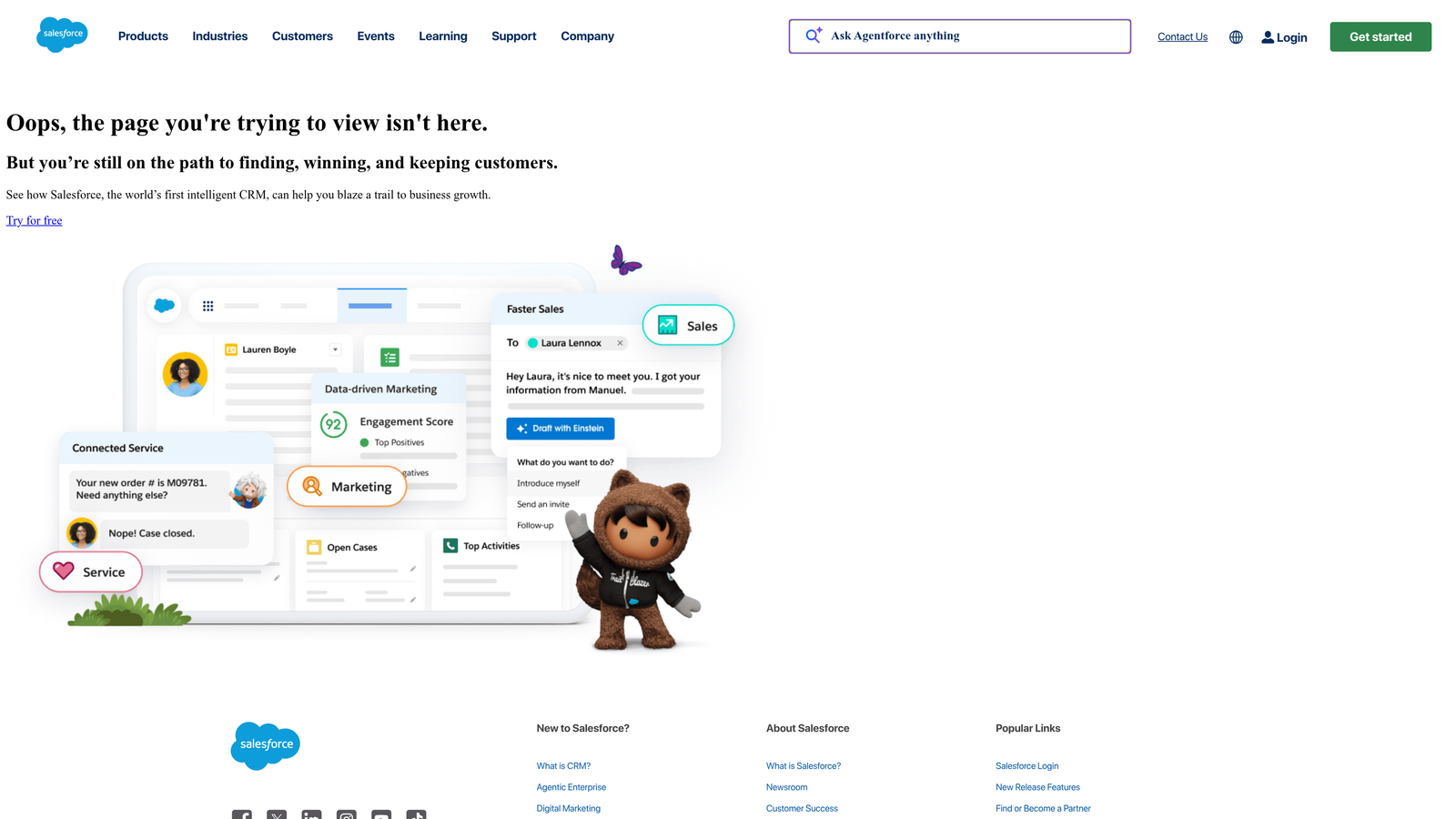
Salesforce Service Cloud is an enterprise support platform deeply integrated with Salesforce CRM, featuring Einstein AI for case management and agent productivity.
Where This Tool Shines
If your organization runs on Salesforce, Service Cloud is the natural support layer. The unified customer view, combining CRM data with full support history, gives agents context that standalone helpdesks can't replicate without complex integrations. Einstein AI's case classification and next best action recommendations are most powerful when they're pulling from a rich Salesforce data model.
The honest caveat here is significant: implementation complexity and total cost of ownership are real considerations. Service Cloud is not a platform you deploy in an afternoon. Teams without Salesforce expertise or a dedicated admin will find the onboarding steep.
Key Features
Einstein AI: Handles case classification, intelligent routing, next best action recommendations, and knowledge article surfacing.
Unified Customer View: Combines CRM data, purchase history, and support interactions in a single agent workspace.
Omni-Channel Routing: Distributes work across voice, chat, email, and social based on agent capacity and skill.
Knowledge Management: AI-powered article recommendations help agents find and share relevant documentation faster.
Field Service Management: Extends support to on-site and hardware scenarios, useful for companies with physical product lines.
Best For
Large enterprises already invested in the Salesforce ecosystem. The ROI is strongest when Service Cloud can leverage existing CRM data. Not recommended as a standalone purchase for teams without an existing Salesforce footprint.
Pricing
Starter plans begin at approximately $25/user/month; enterprise tiers are significantly higher. Verify current pricing at salesforce.com.
6. Tidio
Best for: Small businesses and e-commerce brands wanting fast AI chatbot deployment with minimal setup
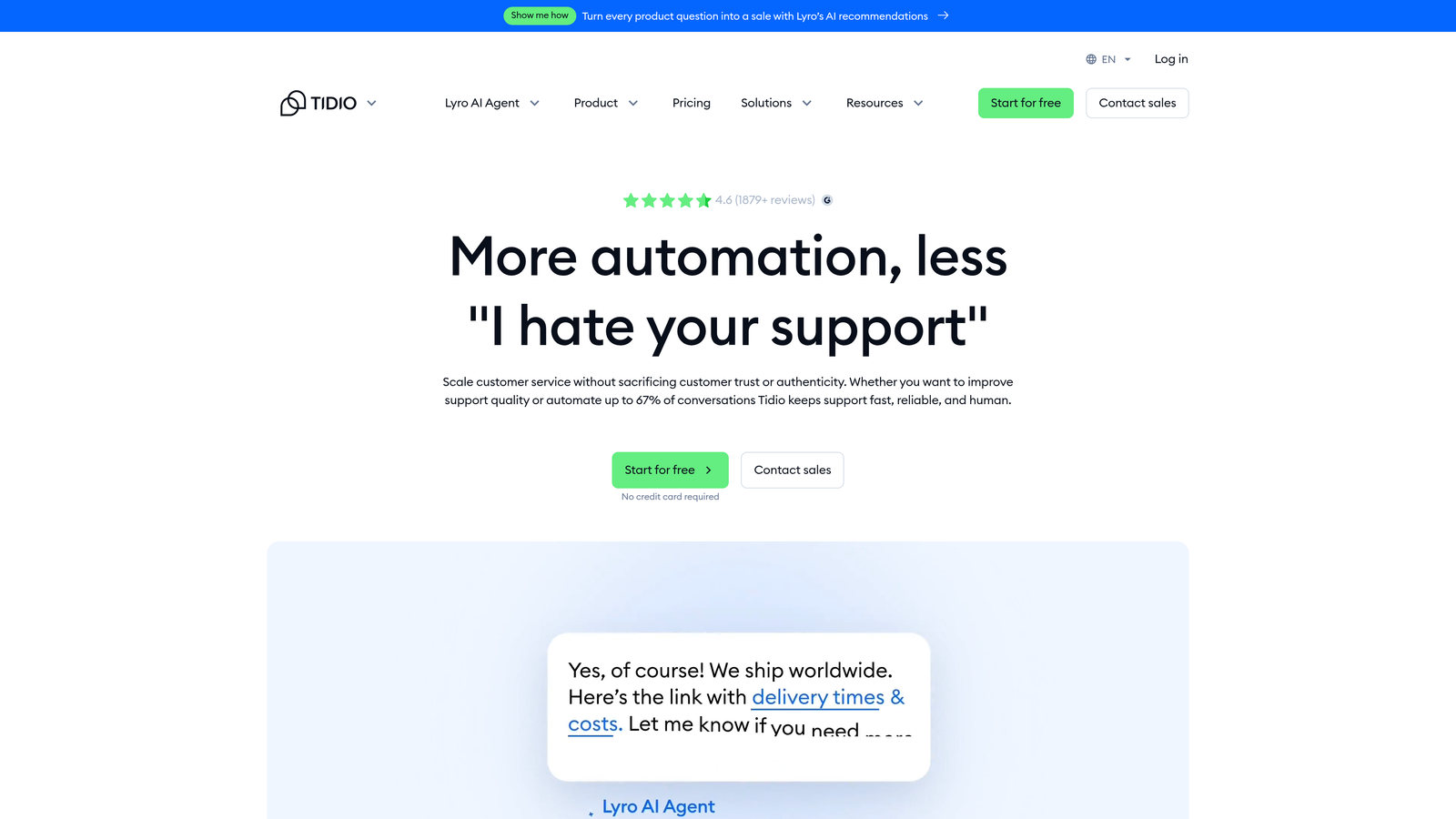
Tidio is an AI chat platform featuring the Lyro chatbot, designed for rapid deployment and accessible pricing for small businesses and e-commerce brands.
Where This Tool Shines
Tidio's primary appeal is speed and simplicity. The Lyro AI chatbot trains on your existing support content and can be live on your site quickly, without engineering resources or a lengthy implementation process. For e-commerce brands handling high volumes of order status, shipping, and returns queries, Lyro handles the repetitive load effectively.
The platform's e-commerce integrations, particularly with Shopify and WooCommerce, make it a natural fit for online retail. For pure B2B SaaS use cases with complex workflows or deep integration requirements, Tidio's capabilities are more limited compared to others on this list.
Key Features
Lyro AI Chatbot: Trains on your support content to answer customer questions autonomously without manual flow building.
Live Chat with Agent Takeover: Seamlessly transitions conversations from Lyro to a human agent when needed.
Visual Flow Builder: Drag-and-drop chatbot builder for custom automation sequences beyond Lyro's knowledge-based responses.
E-Commerce Integrations: Native connections to Shopify and WooCommerce for order data and customer context.
Simple Setup: Minimal technical requirements mean most teams can deploy without developer involvement.
Best For
Small businesses and e-commerce brands that need fast, affordable AI chat without complex configuration. Teams with straightforward support needs that don't require deep CRM or project management integrations.
Pricing
Free tier available; Lyro AI plans start at approximately $29/month. Verify current pricing at tidio.com.
7. Help Scout
Best for: Teams that prioritize agent experience and want AI assistance without heavy automation
Help Scout is a human-first helpdesk with AI features designed to assist agents rather than replace them, built around a clean shared inbox interface.
Where This Tool Shines
Help Scout occupies a distinct philosophical position: AI as an agent productivity tool, not an autonomous resolution engine. If your support philosophy centers on high-quality human interaction with AI reducing the friction around it, Help Scout's approach is genuinely well-executed. The interface is clean, the collision detection prevents duplicate replies, and the AI features feel like natural extensions of the agent workflow rather than bolted-on additions.
This is also one of the easier platforms to onboard. The inbox-style UI is familiar to anyone who uses email, which reduces training time considerably compared to more complex helpdesk platforms.
Key Features
AI Summarize: Generates quick ticket summaries so agents can get up to speed on long conversation threads without reading every message.
AI Assist: Helps agents draft, improve, and adjust reply tone before sending, speeding up response time without removing the human voice.
Shared Inbox with Collision Detection: Prevents two agents from responding to the same ticket simultaneously.
Docs Knowledge Base: Customer-facing help center with AI-powered search to surface relevant articles.
Customer Profiles: Conversation history, notes, and customer data consolidated in a sidebar view during every interaction.
Best For
Companies with strong customer experience values that want AI to make agents better, not replace them. A natural fit for teams where support quality is a brand differentiator and high-volume automation isn't the primary goal.
Pricing
Starts at approximately $22/user/month. Verify current pricing at helpscout.com.
8. Kustomer
Best for: High-volume consumer brands needing omnichannel support with a unified customer timeline
Kustomer is an omnichannel CRM-based support platform with a customer timeline view and AI-driven workflows, suited for high-volume consumer brands.
Where This Tool Shines
Kustomer's customer timeline view is its most distinctive feature. Rather than treating each support interaction as an isolated ticket, the platform consolidates every touchpoint, across every channel, into a single chronological view of the customer relationship. For consumer brands handling large volumes of repeat customers, this context makes a real difference in how agents respond.
The AI-powered routing and intent detection layer adds efficiency on top of that context. Kustomer is less commonly deployed in pure B2B SaaS environments and is better suited to consumer-facing brands with high interaction volumes across email, chat, SMS, and social.
Key Features
Customer Timeline View: Consolidates all interactions across every channel into a single chronological view for complete customer context.
AI Routing and Intent Detection: Automatically identifies conversation intent and routes to the appropriate team or workflow.
Omnichannel Support: Manages email, chat, SMS, social, and voice from a unified agent workspace.
Workflow Automation: Builds complex, multi-step support processes with conditional logic and automated actions.
CRM-Style Data Model: Stores rich customer data alongside support history, enabling context-rich interactions at scale.
Best For
High-volume consumer brands managing complex customer relationships across multiple channels. Less suited for B2B SaaS teams with simpler interaction models or those primarily using email and in-app chat.
Pricing
Enterprise pricing; contact Kustomer directly for a quote at kustomer.com.
9. Chatbase
Best for: Teams wanting a fast, no-code AI chatbot trained on existing documentation for first-line deflection
Chatbase is a no-code AI chatbot builder that trains on your existing documentation and knowledge base for rapid self-service deflection without helpdesk infrastructure.
Where This Tool Shines
Chatbase is the most accessible entry point on this list. If you have existing documentation, a help center, or even a collection of PDFs, you can have a functioning GPT-powered chatbot embedded on your site without writing a single line of code. For teams that need first-line deflection quickly and don't want to commit to a full helpdesk platform, that's a meaningful advantage.
The important framing here is that Chatbase is a deflection layer, not a full support platform. It handles the "can I find the answer myself" use case well. It doesn't replace a helpdesk for managing agent workflows, ticket tracking, or complex escalations.
Key Features
Custom GPT-Powered Chatbot: Trains on uploaded documents, PDFs, or URLs to answer customer questions using your own content.
No-Code Setup: Embeddable chat widget deployable without developer resources or technical configuration.
Conversation History and Analytics: Dashboard showing what customers are asking and how the chatbot is performing.
API Access: Enables custom integrations for teams that want to connect Chatbase to their existing stack.
Multiple Data Source Support: Ingests content from a variety of formats and sources for flexible knowledge base construction.
Best For
Small teams or startups that need fast self-service deflection without the overhead of a full helpdesk. Also useful as a supplementary layer for teams that already have a helpdesk but want an AI chatbot on their marketing site or docs portal.
Pricing
Free tier available; paid plans start at approximately $19/month. Verify current pricing at chatbase.co.
Which Platform Is Right for Your Team?
The honest answer is that the best support automation platform depends almost entirely on where you are and where you're trying to go. Here's a quick framework to orient your decision.
Enterprise teams with existing Zendesk or Salesforce investments: Stay in your ecosystem. Zendesk's AI additions are maturing, and Salesforce Service Cloud's CRM integration is unmatched for teams already on that stack. Switching costs are real.
SaaS teams with a product-led growth motion: Halo AI and Intercom are the strongest fits. Intercom bundles support with product engagement tools in a way no other platform does. Halo AI goes further on autonomous resolution and business intelligence, making it the better choice for teams that want support data to inform product, customer success, and revenue decisions.
SMBs and mid-market teams watching budget: Freshdesk delivers solid AI automation at a price point that's genuinely accessible. Tidio works well for e-commerce and simple use cases. Help Scout is worth considering if support quality and agent experience matter more than automation depth.
High-volume consumer brands: Kustomer's customer timeline view and omnichannel capabilities are purpose-built for this scenario. It's not the right tool for B2B SaaS, but for consumer brands managing complex customer relationships across many channels, it's a strong option.
Teams needing fast self-service deflection: Chatbase is the fastest path from zero to a working AI chatbot. It's a first-line deflection tool, not a helpdesk replacement, but for that specific need it's hard to beat on speed and simplicity.
Your support team shouldn't scale linearly with your customer base. Let AI agents handle routine tickets, guide users through your product, and surface business intelligence while your team focuses on complex issues that need a human touch. See Halo in action and discover how continuous learning transforms every interaction into smarter, faster support.