9 Best Support Automation Software for Growing Companies in 2026
Growing companies need support automation software that scales with their customer base without ballooning headcount — but not every tool is built for that stage. This guide evaluates nine support automation platforms on AI capability, scalability, ease of setup, integration depth, and growth-stage pricing, so you can find the right fit whether you're outgrowing your current solution or building your first automated support layer.
 Grant CooperFounder12 min read
Growing companies hit a predictable wall: your customer base scales faster than your support team can hire. Tickets pile up, response times slip, and the customers you worked hard to win start churning. Support automation software breaks that cycle, letting you handle more volume without proportionally growing headcount.
But not all automation tools are built for growth. Some are rigid rule-based bots that frustrate users. Others are enterprise-only platforms with price tags that don't match your stage. The best tools combine genuine AI intelligence, fast deployment, and integrations that fit your existing stack.
This list covers nine support automation platforms evaluated on AI capability, scalability, ease of setup, integration depth, and value at growth-stage pricing. Whether you're a SaaS product team outgrowing your current automation or a B2B company building your first automated support layer, there's a fit here for you.
1. Halo AI
Best for: B2B SaaS teams that want AI-first support with business intelligence built in
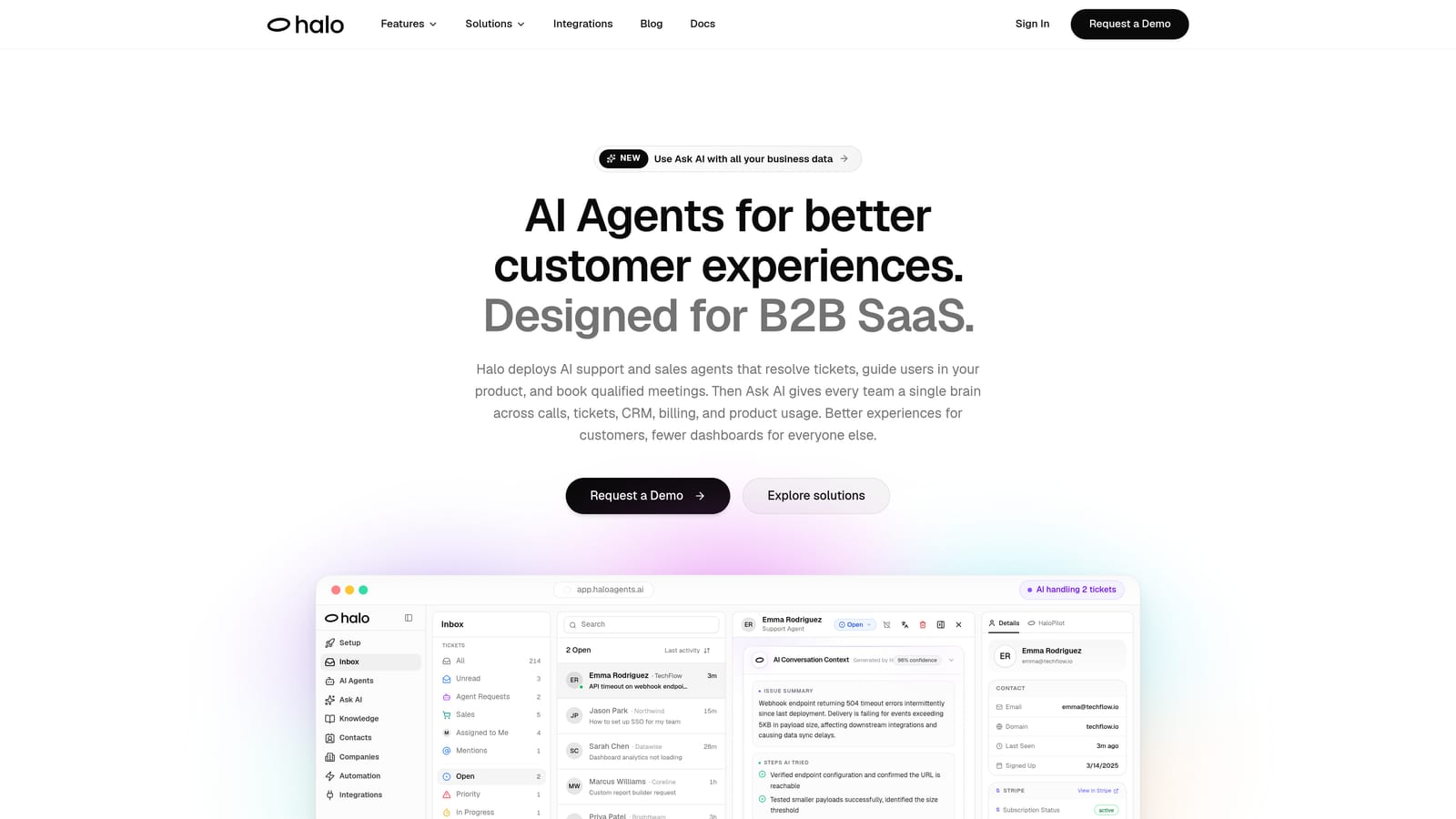
Halo AI is an AI-native customer support platform that deploys intelligent agents to resolve tickets, guide users through your product, and surface business intelligence signals — all while learning from every interaction.
Where This Tool Shines
What separates Halo from most tools on this list is its architecture. It's not a helpdesk with AI bolted on as an afterthought. The entire platform is built around autonomous AI agents that understand context, improve over time, and connect to your broader business stack.
The page-aware chat widget is a genuinely differentiated capability. The AI agent knows which product page or feature a user is on and provides contextual visual guidance accordingly. That's a meaningful step beyond generic chatbots that respond the same way regardless of where a user is stuck.
Key Features
Page-Aware AI Agents: The AI understands which product page or feature a user is on and delivers contextual guidance, not generic responses.
Continuous Learning Loop: Every resolved ticket and agent correction improves future resolution quality automatically over time.
Smart Inbox with Business Intelligence: Surfaces customer health signals, revenue anomalies, and product friction patterns, not just support metrics.
Auto Bug Ticket Creation: Automatically logs reproducible issues directly to Linear or connected engineering tools, closing the loop between support and product.
Live Agent Handoff: Escalates to human agents with full conversation context preserved, so customers never have to repeat themselves.
Deep Integrations: Connects to Linear, Slack, HubSpot, Intercom, Stripe, Zoom, PandaDoc, and Fathom.
Best For
Product-led growth companies and B2B SaaS teams that need support automation to do more than deflect tickets. Halo is particularly strong for teams where support insights should feed back into product development and customer success.
Pricing
Contact for pricing. Halo is positioned for growth-stage and scaling B2B teams; reach out directly for a custom quote.
2. Intercom
Best for: Teams already invested in the Intercom ecosystem wanting powerful AI on top
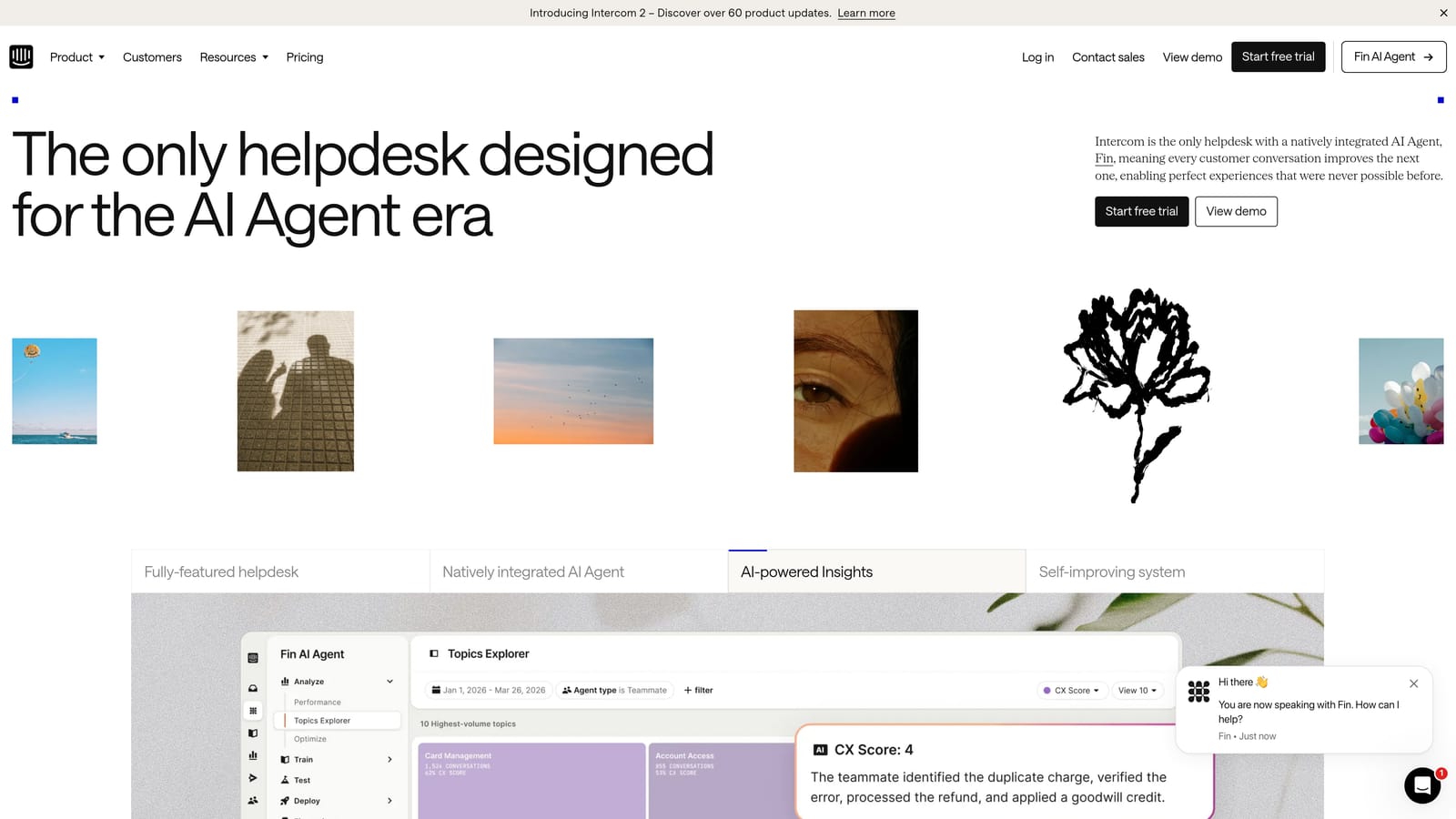
Intercom is a unified customer messaging platform featuring Fin, its GPT-4-powered AI agent, alongside outbound messaging, product tours, and a native inbox.
Where This Tool Shines
Fin is one of the most capable AI agents in this space when your knowledge base is well-maintained. It handles support conversations with high accuracy by dynamically referencing your documentation rather than relying on keyword triggers or scripted decision trees.
The broader Intercom suite is a genuine advantage for teams that want inbox, outbound messaging, product tours, and surveys under one roof. The trade-off is cost: Intercom can become expensive at scale, particularly with Fin's per-resolution pricing model.
Key Features
Fin AI Agent: GPT-4-powered resolution using your knowledge base, with high accuracy on well-structured content.
Unified Platform: Inbox, outbound messaging, product tours, and surveys in one interface.
AI-Assisted Classification: Conversation routing and tagging with intelligent categorization.
Extensive Integration Library: Connects to hundreds of tools across your stack.
Per-Resolution Pricing for Fin: Makes cost predictable at lower conversation volumes.
Best For
Companies already using Intercom for messaging and engagement who want to layer in AI resolution without switching platforms. Less ideal for teams starting fresh who want a leaner, more affordable entry point.
Pricing
Core plans from approximately $39 per seat per month; Fin AI is priced separately per resolution. Verify current pricing on Intercom's site.
3. Zendesk
Best for: Teams with complex routing rules, SLAs, and multi-channel support at scale
Zendesk is the enterprise-grade helpdesk standard, now with AI-powered triage, agent copilot, and self-service automation layered across its ticketing system.
Where This Tool Shines
Zendesk's strength is depth. The platform handles complex routing logic, multi-channel support, and SLA management in ways that few competitors match. Its 1,000-plus app marketplace means you can integrate almost anything your team uses.
The AI layer has matured considerably. Intelligent triage, macro suggestions, and the agent copilot all reduce manual work for agents handling high volumes. That said, setup and configuration can be heavy, making Zendesk less ideal for lean teams that want fast deployment over maximum configurability.
Key Features
AI-Powered Triage: Automatic ticket categorization, priority assignment, and routing without manual intervention.
Agent Copilot: Suggests macros and next-best responses in real time as agents work through tickets.
Massive App Marketplace: Over 1,000 integrations covering virtually every tool in a modern support stack.
Multi-Channel Support: Email, chat, voice, and social all managed in one platform.
Advanced SLA Management: Granular reporting dashboards and SLA tracking for teams with formal support agreements.
Best For
Mid-market and enterprise teams with complex support operations, dedicated admins, and multi-channel volume. Growing companies should weigh the configuration overhead against their available resources.
Pricing
Suite plans from approximately $55 per agent per month; advanced AI features available on higher tiers. Verify current pricing on Zendesk's site.
4. Freshdesk
Best for: Cost-conscious growing teams that need solid omnichannel automation without enterprise pricing
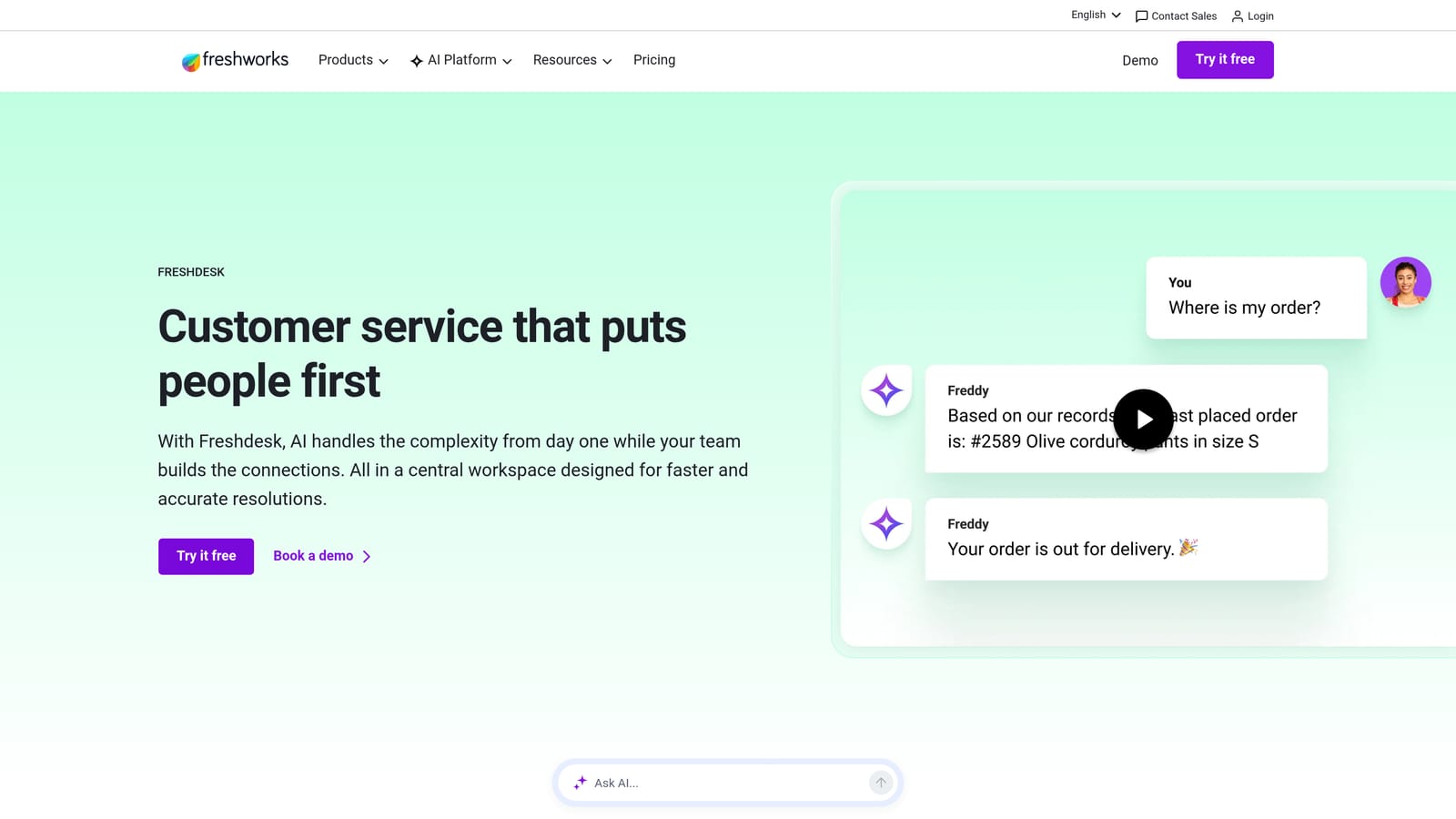
Freshdesk is a cost-competitive helpdesk platform with Freddy AI handling ticket categorization, agent assistance, and self-service deflection across email, chat, and phone.
Where This Tool Shines
Freshdesk's pricing model is one of its biggest advantages for growing companies. The free tier gives small teams a starting point, and the paid tiers scale reasonably as volume grows. Freddy AI covers the core automation needs: categorizing incoming tickets, suggesting replies, and deflecting common queries before they reach an agent.
The omnichannel coverage is solid for the price point. Email, chat, phone, and social all feed into one platform. Freddy's AI capabilities are less sophisticated than some competitors for nuanced or complex queries, but for teams handling high volumes of routine questions, it performs reliably.
Key Features
Freddy AI Triage: Automatically categorizes and prioritizes incoming tickets based on content.
Agent Assist: Suggests replies and surfaces relevant knowledge base articles as agents draft responses.
Freddy Self Service: Deflects common queries before they reach the agent queue.
Omnichannel Platform: Email, chat, phone, and social managed in one unified interface.
Free Tier: Available for small teams getting started before committing to a paid plan.
Best For
SMBs and growing teams that need omnichannel support automation at a competitive price point. Also a good fit for teams already using other Freshworks products.
Pricing
Free tier available; Growth plan from approximately $15 per agent per month; AI features on Pro and above. Verify current pricing on Freshdesk's site.
5. Tidio
Best for: SMBs and e-commerce teams that need working automation deployed quickly
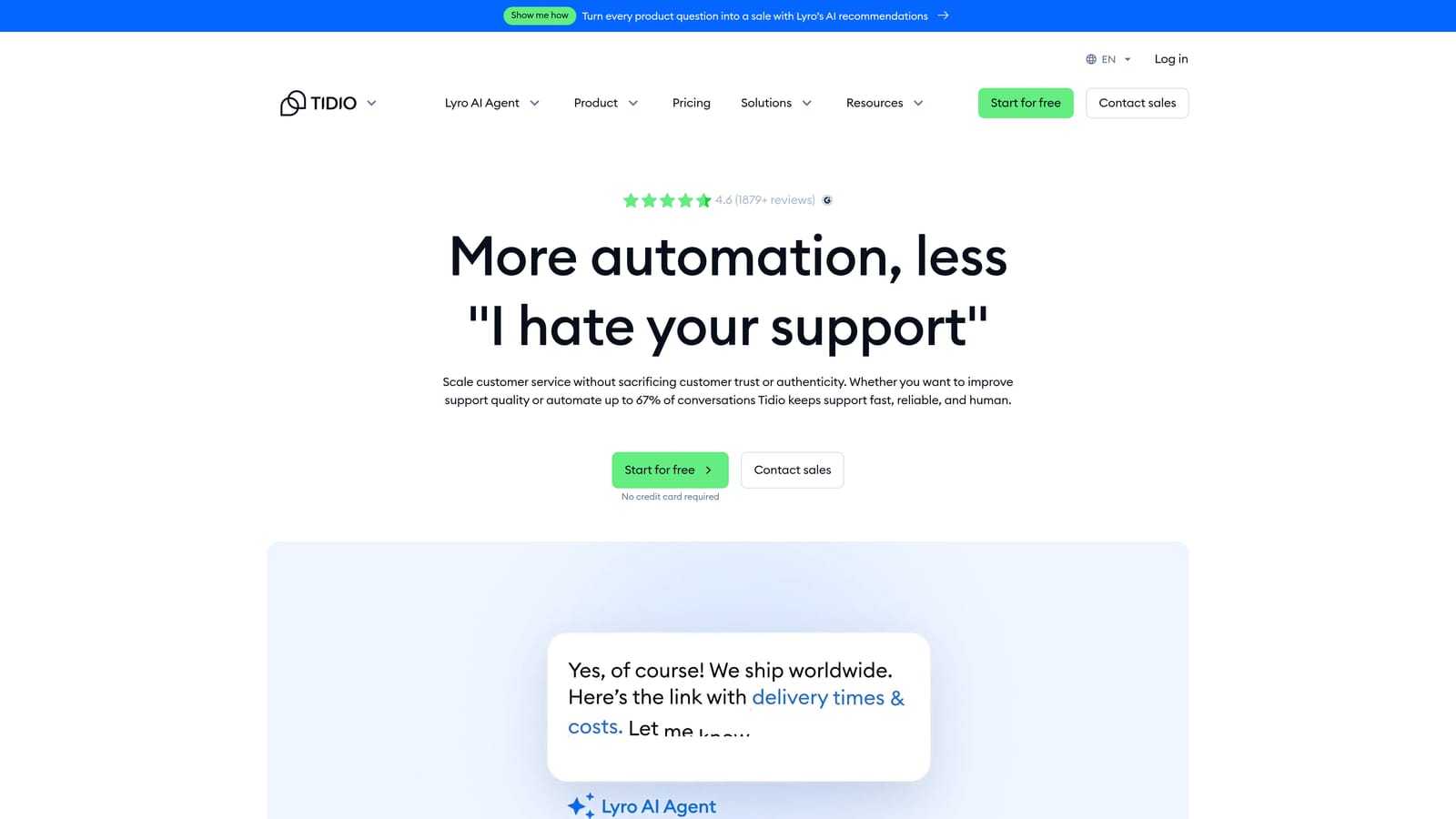
Tidio is a fast-deploy chat automation platform with Lyro AI, designed for teams that need automation running without a lengthy implementation project.
Where This Tool Shines
Speed of deployment is Tidio's headline advantage. Installation via website embed or CMS plugin gets you live quickly, and pre-built automation flows mean you're not starting from scratch. Lyro AI handles common queries conversationally rather than relying on keyword matching, which produces noticeably better user experiences than older chatbot approaches.
The live chat fallback is seamless when Lyro reaches its limits, which matters for teams that want automation without abandoning customers when queries get complex. Tidio is less suited for sophisticated B2B support scenarios with complex routing needs.
Key Features
Lyro AI Chatbot: Handles common queries conversationally without keyword-matching or rigid decision trees.
Pre-Built Automation Flows: Ready-to-use flows for typical SMB and e-commerce scenarios.
Live Chat Fallback: Seamless handoff to human agents when AI reaches its limits.
Quick Installation: Website embed or CMS plugin gets you live without heavy technical setup.
Performance Analytics: Dashboard tracking bot resolution rates, handoff rates, and conversation volume.
Best For
E-commerce brands and straightforward SaaS products with high volumes of repetitive queries. Less ideal for complex B2B support with nuanced routing requirements.
Pricing
Free tier available; Lyro AI from approximately $29 per month for a limited conversation volume. Verify current pricing on Tidio's site.
6. Drift
Best for: B2B companies where support conversations overlap with pipeline and sales qualification
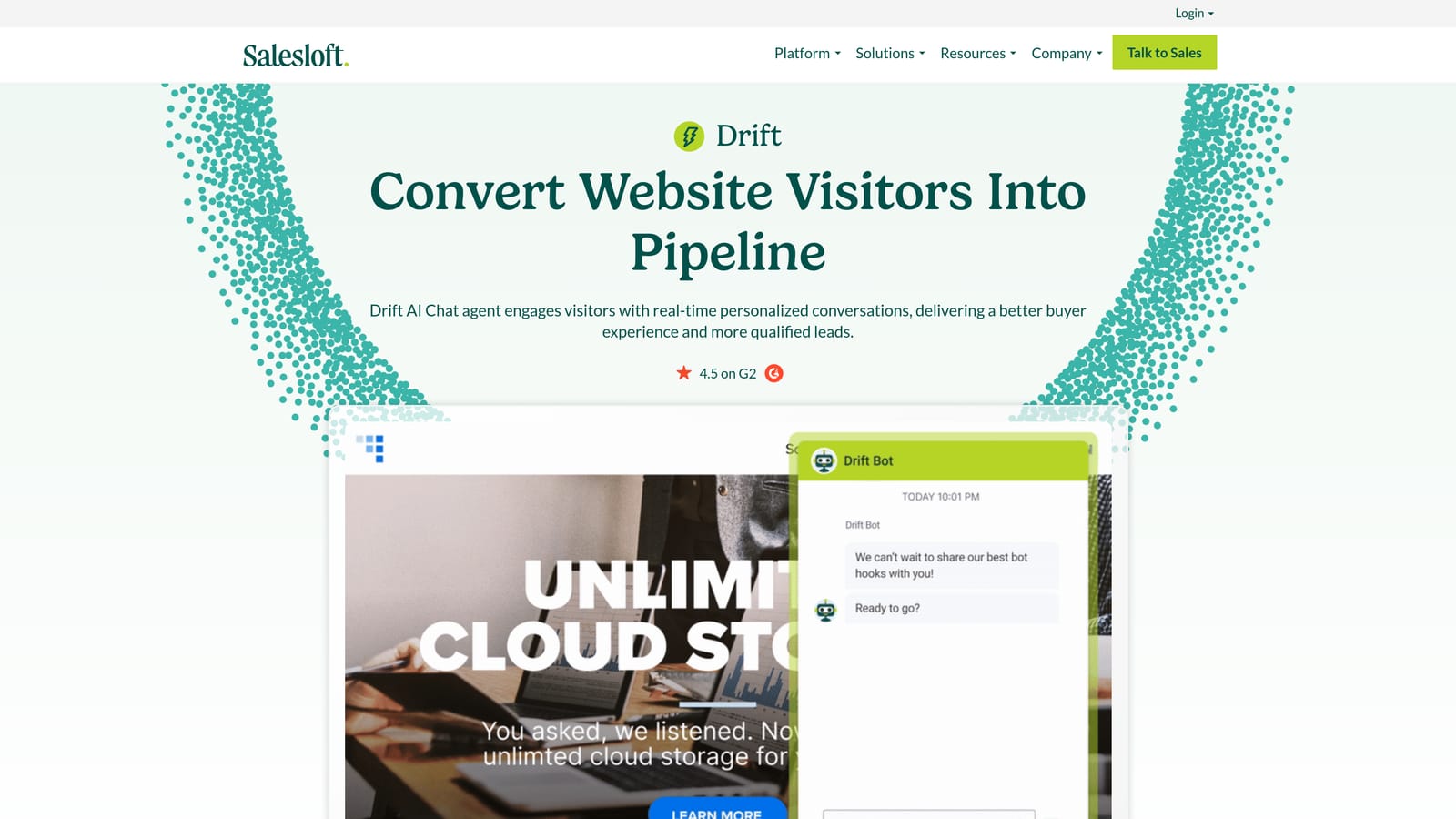
Drift is a conversational platform that blends support automation with sales qualification, routing B2B conversations based on intent signals between support, sales, and customer success teams.
Where This Tool Shines
Drift's differentiation is intent-based routing across revenue touchpoints. Rather than treating every conversation as a support ticket, the platform identifies whether a visitor needs help, wants to buy, or should speak with customer success, then routes accordingly. For B2B companies where the same chat widget serves multiple teams, that intelligence is genuinely useful.
The honest caveat: Drift is primarily a revenue platform. Support automation is a capability within a sales-first product, not the core focus. Teams whose primary need is ticket deflection and agent efficiency will find more purpose-built options elsewhere on this list.
Key Features
AI Intent Detection: Routes conversations to the right team or automated flow based on visitor intent signals.
Playbooks: Automate support, qualification, and meeting booking in one unified interface.
Account-Based Targeting: Personalizes conversations by company, segment, or account status.
CRM Integration: Connects to Salesforce, HubSpot, and major CRM platforms.
Cross-Functional Analytics: Conversation analytics spanning both support and revenue touchpoints.
Best For
B2B companies with overlapping support and sales motions, where qualifying and routing conversations is as important as resolving them. Less suited for pure support automation use cases.
Pricing
Not publicly listed; enterprise-oriented with custom pricing. Contact Drift directly for a quote.
7. Help Scout
Best for: Teams that want to make agents faster and smarter rather than replace them with AI
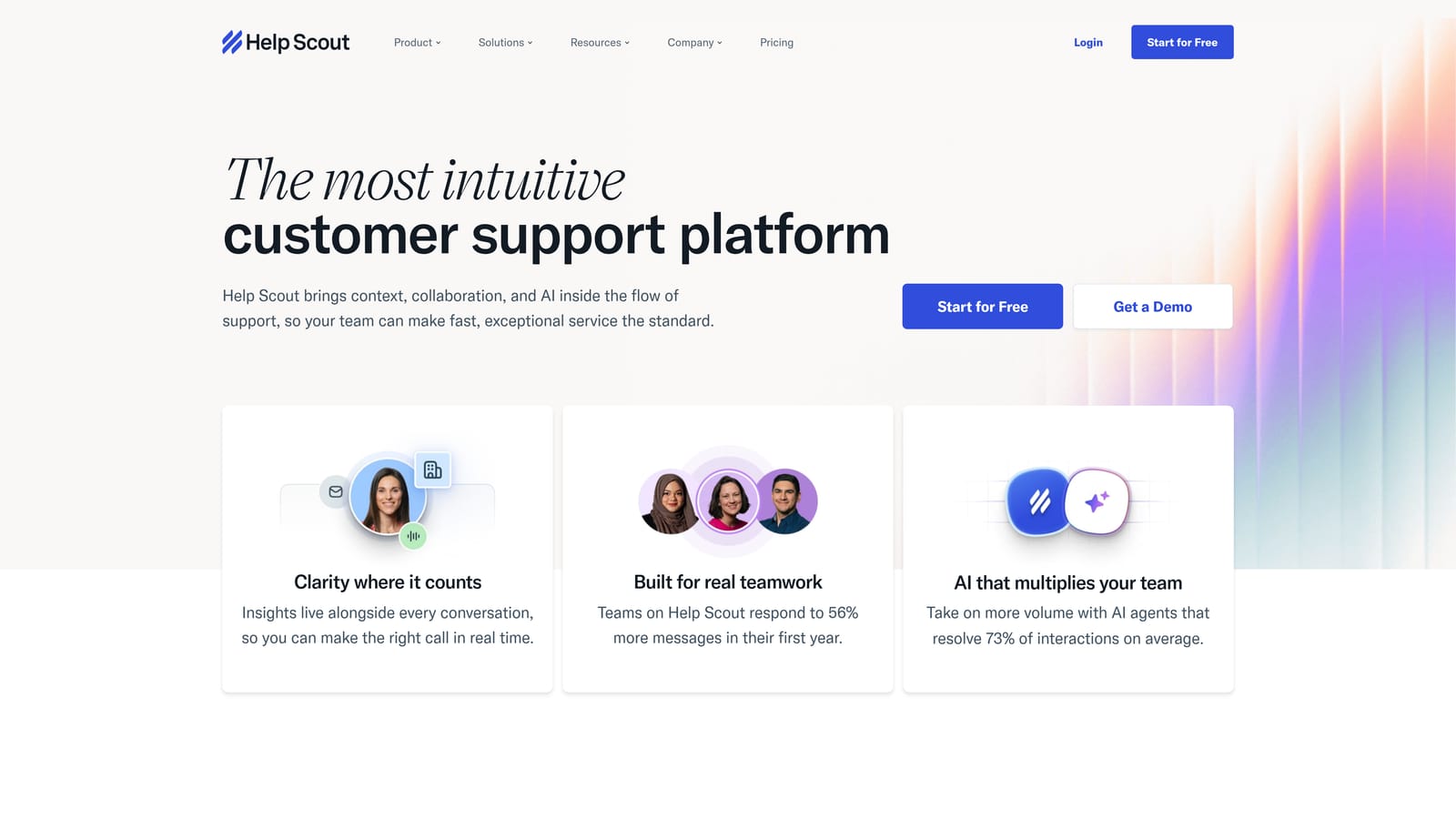
Help Scout is a human-first support platform with AI-assisted efficiency tools designed to enhance agent output rather than automate it away.
Where This Tool Shines
Help Scout takes a deliberate philosophical stance: AI should assist humans, not replace them. The result is a clean, well-designed platform where AI Summarize and AI Assist reduce the cognitive load on agents without removing them from the loop. For teams handling sensitive customer relationships where human judgment matters, that's a feature, not a limitation.
The Beacon widget handles self-service documentation and proactive chat, covering basic deflection needs. Help Scout won't give you fully autonomous AI resolution, and that's intentional. If your goal is maximum ticket deflection with minimal agent involvement, look elsewhere.
Key Features
AI Summarize: Condenses long email threads into concise context so agents can get up to speed instantly.
AI Assist: Helps agents draft replies with appropriate tone and completeness.
Beacon Widget: Enables self-service documentation and proactive chat on your product or site.
Shared Inbox: Clean inbox with collision detection and assignment workflows for team coordination.
Built-In CSAT: Customer satisfaction ratings integrated into every conversation automatically.
Best For
Customer success and support teams that handle complex, relationship-sensitive conversations where human judgment is non-negotiable. Not the right fit for teams seeking maximum autonomous resolution.
Pricing
From approximately $20 per user per month. Verify current pricing on Help Scout's site.
8. Kustomer
Best for: High-volume operations that need full customer history context in every automated interaction
Kustomer is a CRM-native customer service platform that combines complete customer history with AI automation, giving agents and bots full context for every interaction.
Where This Tool Shines
Kustomer's customer timeline view is the standout capability. Every interaction, order, subscription event, and conversation is aggregated into a single record. When AI automation handles routing or response suggestions, it does so with that full context rather than treating each ticket in isolation. That changes the quality of automated decisions meaningfully.
The platform is particularly strong for high-volume B2C and D2C operations where order history and customer lifecycle data are central to support quality. It's less commonly deployed in pure B2B SaaS contexts, where CRM-native support may be more complexity than the team needs.
Key Features
Customer Timeline View: Aggregates all interactions, orders, and history in one unified customer record.
AI Automation with CRM Context: Routing, tagging, and response suggestions informed by full customer history.
Omnichannel Support: Email, chat, SMS, social, and voice managed in one platform.
No-Code Workflow Automation: Automates repetitive processes without requiring engineering resources.
Lifecycle Reporting: Business intelligence reporting across the customer lifecycle, not just support metrics.
Best For
High-volume consumer operations, D2C brands, and subscription businesses where order and account history should drive every support interaction. The pricing reflects its enterprise positioning.
Pricing
From approximately $89 per user per month. Verify current pricing on Kustomer's site.
9. Zoho Desk
Best for: Teams already in the Zoho ecosystem that want solid AI at a competitive price
Zoho Desk is a helpdesk platform with Zia AI built in, offering sentiment analysis, ticket anomaly detection, and cross-Zoho data access for teams already invested in the Zoho stack.
Where This Tool Shines
Zia AI's anomaly detection is a genuinely useful capability that many platforms at this price point don't offer. When ticket volume spikes unexpectedly, Zia flags it so teams can respond proactively rather than discovering the problem after SLAs are already missed. Sentiment analysis adds another layer, helping prioritize tickets from frustrated customers before they escalate.
The cross-Zoho integration is the real multiplier for existing customers. Zia can reference CRM contacts, deals, and account data in context, which is a meaningful upgrade over siloed helpdesk data. For teams not already in the Zoho ecosystem, the platform's UI can feel dated compared to newer entrants.
Key Features
Zia Sentiment Analysis: Flags incoming tickets by customer sentiment for intelligent priority assignment.
Anomaly Detection: Alerts teams to unusual spikes in ticket volume before they become crises.
Cross-Zoho Data Access: Pulls CRM contacts, deals, and account data into support context automatically.
Auto-Tagging and Routing: Classifies and routes tickets based on content without manual configuration.
Self-Service Portal: AI-suggested articles help customers find answers before submitting tickets.
Best For
Growing teams already using Zoho CRM, Zoho Analytics, or other Zoho products. The ecosystem integration delivers outsized value for existing customers; standalone, other options on this list may offer a better experience.
Pricing
Free tier available; Standard from approximately $14 per agent per month; Professional from approximately $23 per agent per month. Verify current pricing on Zoho Desk's site.
Choosing the Right Tool for Your Stage
The right support automation platform depends on what problem you're actually solving. Deflecting tickets, making agents faster, and surfacing business intelligence are three different goals, and not every tool on this list addresses all three equally well.
Here's a practical framework for narrowing down your options:
If you need AI-first automation with business intelligence: Halo AI is the strongest fit for B2B SaaS teams that want support to feed insights back into product and customer success, not just reduce ticket volume.
If you're already in the Intercom ecosystem: Fin AI is a natural extension that avoids a platform migration. Just watch the per-resolution costs as volume grows.
If you have complex routing and SLA requirements: Zendesk's depth handles multi-channel complexity that lighter tools can't. Budget for setup time and admin resources.
If you need fast deployment on a tight budget: Freshdesk's free tier and affordable paid plans make it a practical starting point. Tidio is the fastest path to working chat automation for e-commerce and simple SaaS products.
If your support and sales motions overlap: Drift's intent-based routing handles the handoff between teams in ways a pure support tool won't.
If human judgment is central to your support quality: Help Scout's AI-assist approach keeps agents in control while reducing their workload.
If full customer history should drive every interaction: Kustomer's CRM-native model is built for that use case, particularly at high B2C volumes.
If you're already in the Zoho stack: Zoho Desk's cross-ecosystem integration makes it the obvious choice for existing Zoho customers.
Your support team shouldn't scale linearly with your customer base. Let AI agents handle routine tickets, guide users through your product, and surface business intelligence while your team focuses on complex issues that need a human touch. See Halo in action and discover how continuous learning transforms every interaction into smarter, faster support.