9 Best Support Automation Software for SaaS in 2026
This guide reviews the 9 best support automation software for SaaS teams in 2026, helping B2B companies handle repetitive tickets, intelligent routing, and product-specific customer questions without scaling headcount. Each tool is evaluated on AI capability, helpdesk integrations, and ease of deployment for lean teams using platforms like Zendesk or Intercom.
 Grant CooperFounder13 min read
Support teams at SaaS companies face a challenge that most automation tools weren't designed for: your customers are technical, your product ships constantly, and your team can't add headcount every time you release a new feature. Support automation software solves this by handling repetitive tickets, routing complex issues intelligently, and surfacing insights that help your whole company move faster.
But not all automation tools are built for SaaS. Some are optimized for e-commerce, others for enterprise call centers. The tools below were selected specifically for B2B SaaS teams, evaluated on AI capability, helpdesk integrations, ease of deployment, and how well they handle the technical, product-specific questions your customers actually ask.
Whether you're running a lean support team on Intercom, managing a high-volume ticket queue in Zendesk, or building your support stack from scratch, this list covers the right options for where you are today.
1. Halo AI
Best for: SaaS teams that want AI-first support with business intelligence built in
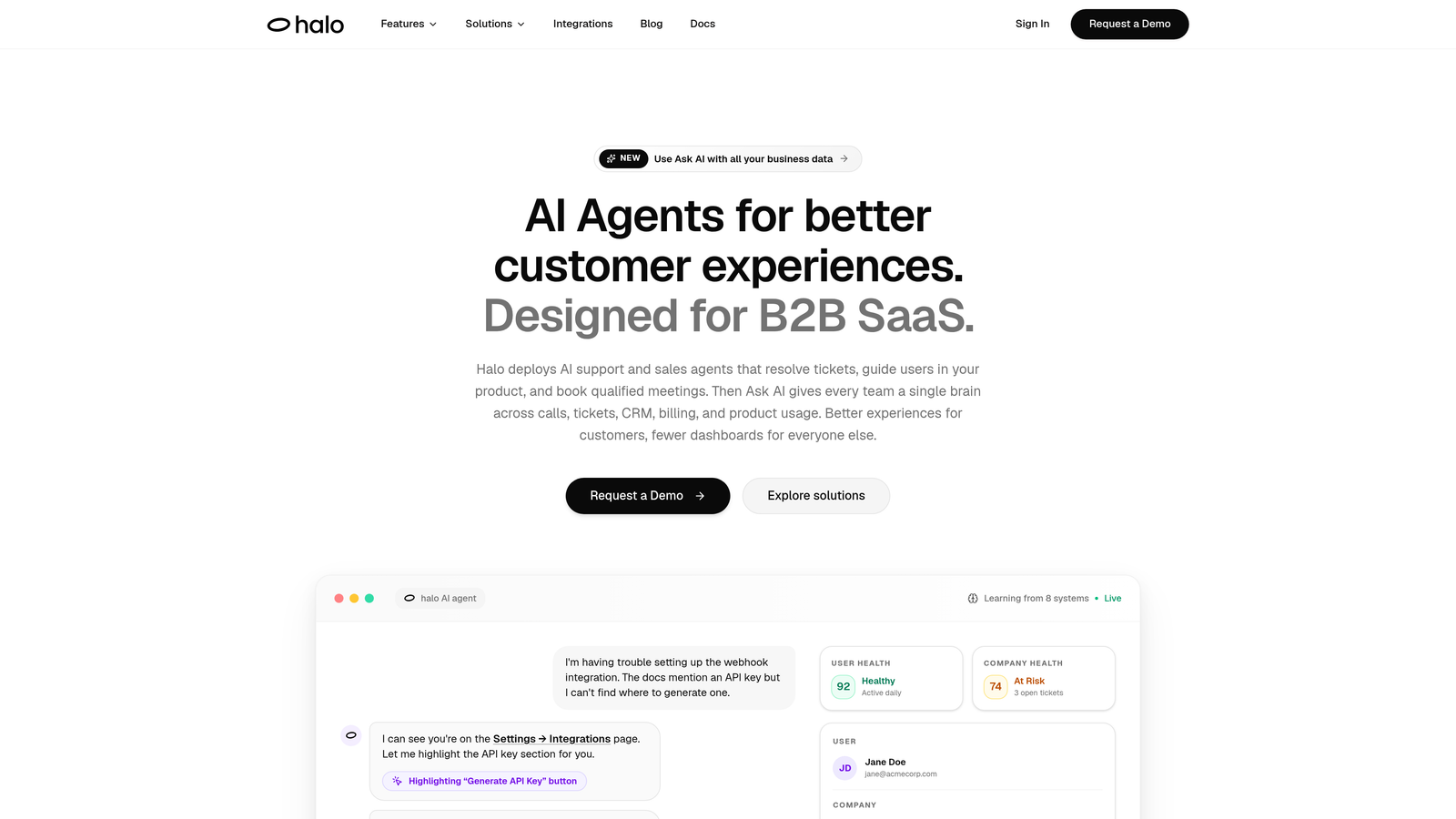
Halo AI is an AI-first support platform built specifically for SaaS teams, deploying intelligent agents that resolve tickets, guide users through your product, and surface business signals — all while learning from every interaction.
Where This Tool Shines
What separates Halo from most support tools on this list is its architecture. Rather than layering AI onto an existing helpdesk, Halo is built AI-first from the ground up. The page-aware context is a genuine differentiator: the AI agent sees exactly what the user is looking at inside your product, which means it can give step-by-step guidance that's actually relevant to where someone is stuck rather than generic help article links.
The smart inbox goes beyond ticket management. It surfaces customer health signals, revenue anomalies, and product feedback patterns that most support tools never surface at all. For SaaS teams where support data overlaps with retention and product roadmap decisions, that's a meaningful upgrade from counting CSAT scores.
Key Features
Page-Aware AI Agents: The AI sees what users see inside your product, enabling context-specific guidance rather than generic responses.
Smart Inbox with Business Intelligence: Customer health scoring, anomaly detection, and revenue signals surface directly in the support inbox.
Auto Bug Ticket Creation: Automatically creates and routes bug reports to Linear, Jira, or your preferred system without manual triage.
Live Agent Handoff: Transfers complex conversations to human agents with full conversation context preserved, so nothing gets repeated.
Broad Integration Stack: Connects to Slack, HubSpot, Intercom, Stripe, Zoom, PandaDoc, and Fathom for end-to-end workflow coverage.
Continuous Learning: Improves from every resolved interaction, getting smarter about your product and your customers over time.
Best For
SaaS teams that have outgrown basic helpdesk automation and want AI agents that understand their product, not just their knowledge base. Particularly strong for companies where support insights feed directly into product and revenue decisions.
Pricing
Custom pricing based on your team's needs. Contact Halo AI directly for a demo and quote at haloagents.ai.
2. Intercom
Best for: SaaS teams already in the Intercom ecosystem looking to automate with Fin AI
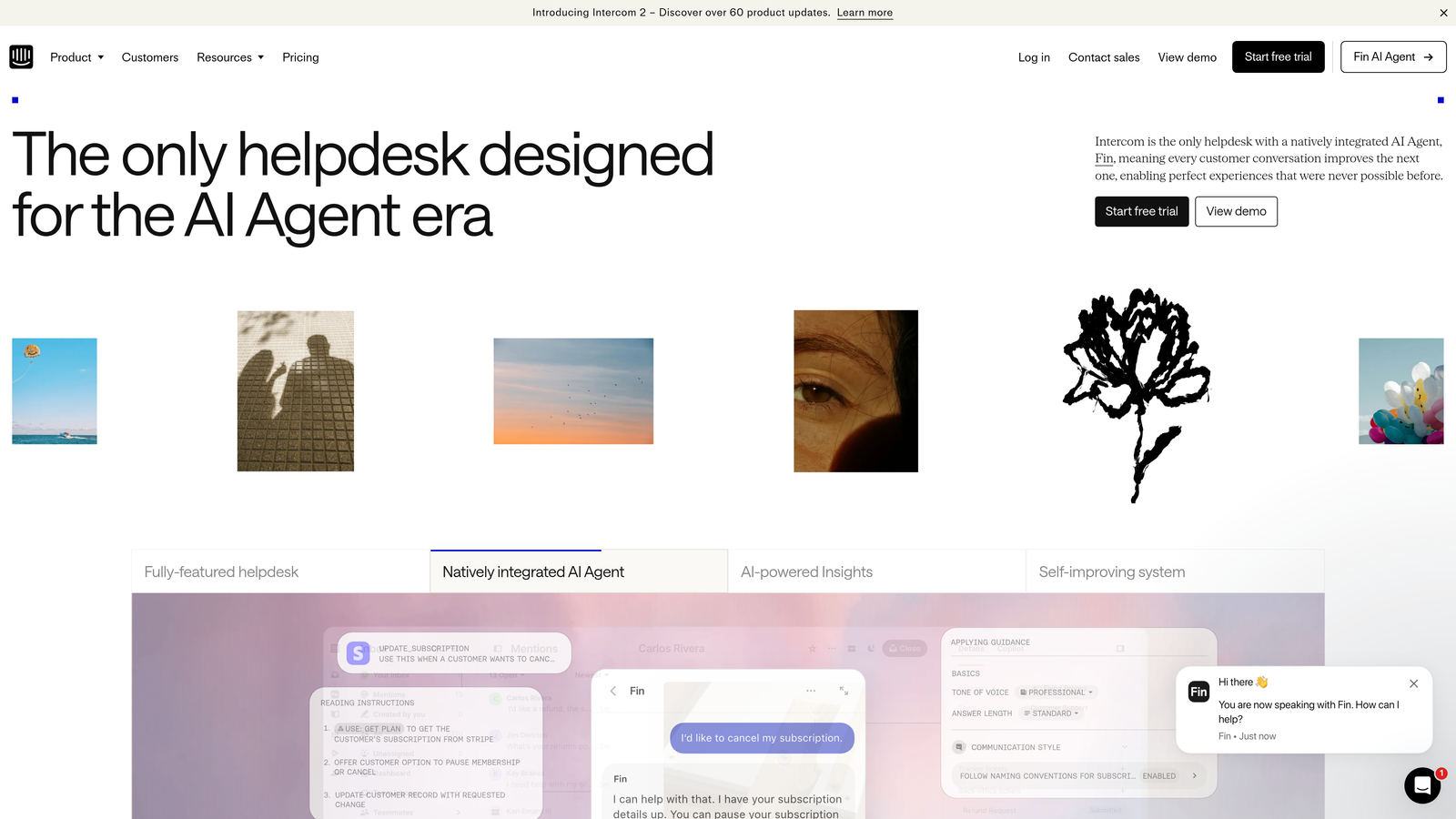
Intercom is one of the most widely adopted customer messaging platforms in SaaS, with Fin, an AI agent built on large language models that resolves support questions using your existing help content.
Where This Tool Shines
If your team is already using Intercom for customer communication, adding Fin AI is a natural next step. It works natively within the Intercom Messenger, uses your existing help center content as its knowledge base, and handles a meaningful portion of common questions without any complex setup.
The AI-assisted inbox also helps human agents work faster, with suggested replies and conversation summaries that reduce the time spent on each ticket. Intercom's routing and assignment rules are mature and well-documented, which matters when you're managing multiple support tiers.
Key Features
Fin AI Agent: Autonomous ticket resolution powered by large language models, trained on your help content.
Native Messenger Integration: Works directly inside the Intercom chat widget without additional configuration.
AI-Assisted Inbox: Suggested replies and conversation context help human agents close tickets faster.
Conversation Routing: Assignment rules and routing logic for directing tickets to the right team or tier.
Help Center Management: Built-in knowledge base with AI-powered search and content suggestions.
Best For
Teams already invested in the Intercom platform who want to add AI resolution without switching tools. Also strong for product-led SaaS companies that use Intercom across both support and onboarding.
Pricing
Tiered plans with Fin AI billed per resolution. Pricing has historically been a consideration for smaller teams. Check intercom.com for current pricing as plans change frequently.
3. Zendesk
Best for: Higher-volume SaaS support teams that need enterprise-grade routing and reporting
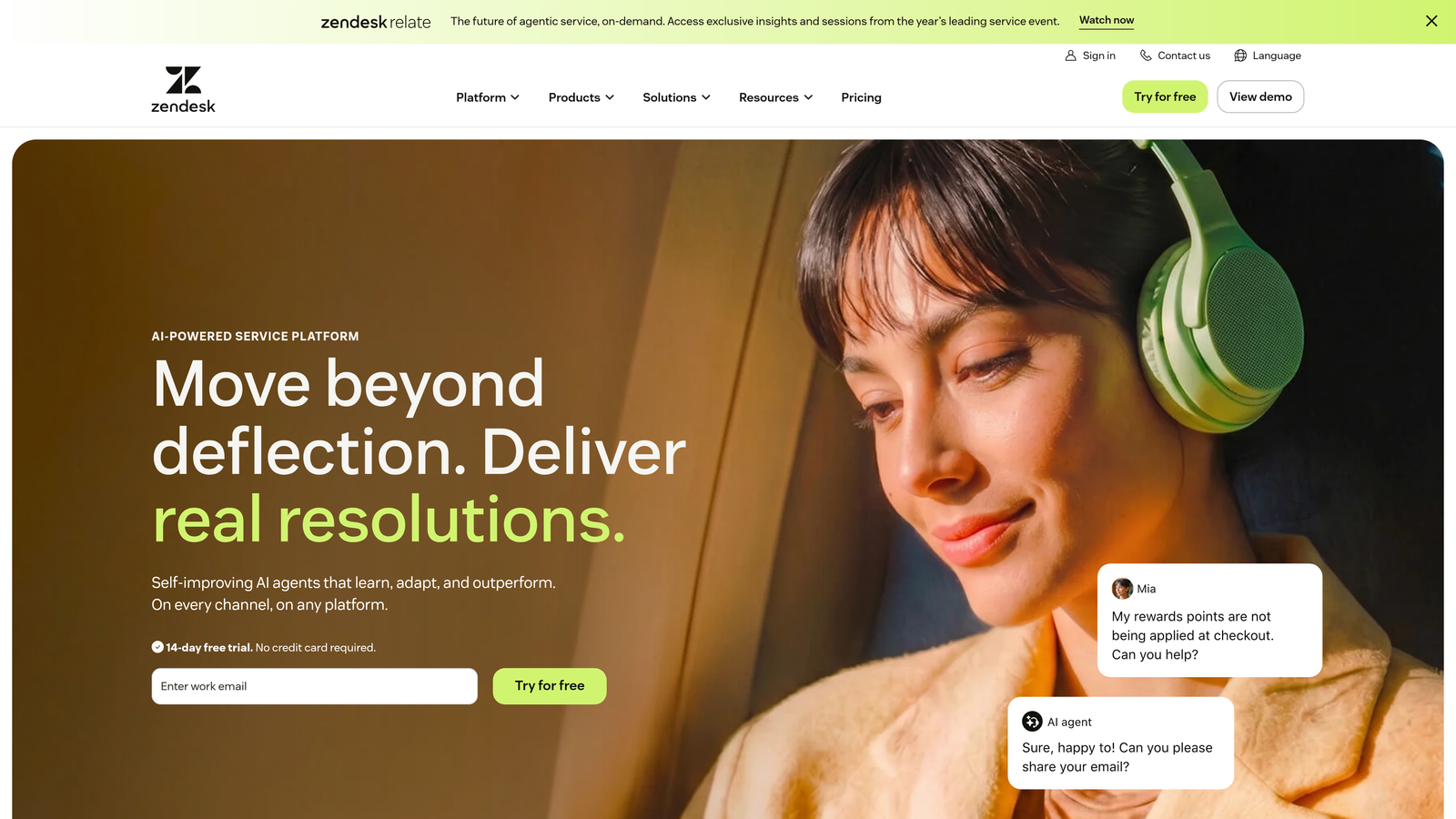
Zendesk is the industry's most established helpdesk platform, now with AI Agents, intelligent triage, and an agent copilot built into its Suite product.
Where This Tool Shines
Zendesk's strength is its depth. The integration marketplace, reporting capabilities, and workflow customization are difficult to match, and the platform has spent years refining how large support teams operate at scale. For SaaS companies with complex routing needs across multiple products or regions, that maturity is genuinely useful.
The AI features, including AI Agents for first-response handling and Agent Copilot for suggested next steps, have improved significantly. That said, Zendesk's AI is best understood as an enhancement to an existing helpdesk workflow rather than an AI-first architecture. Teams that need deep autonomous resolution may find it less capable than tools built around AI from the start.
Key Features
AI Agents: Automated first-response handling for common ticket types before human agents get involved.
Intelligent Triage: Automatic ticket classification and priority assignment based on content and context.
Agent Copilot: Suggested replies and next-best-action recommendations for human agents.
Integration Marketplace: Over 1,000 app integrations covering nearly every tool in a SaaS stack.
Advanced Reporting: Detailed CSAT tracking, SLA monitoring, and team performance dashboards.
Best For
Mid-to-large SaaS teams with high ticket volumes, complex routing requirements, or multi-region support operations. Can feel heavyweight for early-stage companies still finding their support motion.
Pricing
Suite plans start at approximately $19/agent/month, with enterprise tiers available at higher price points. Verify current pricing at zendesk.com before budgeting.
4. Freshdesk
Best for: Smaller SaaS teams that need a capable helpdesk with AI features at an accessible price
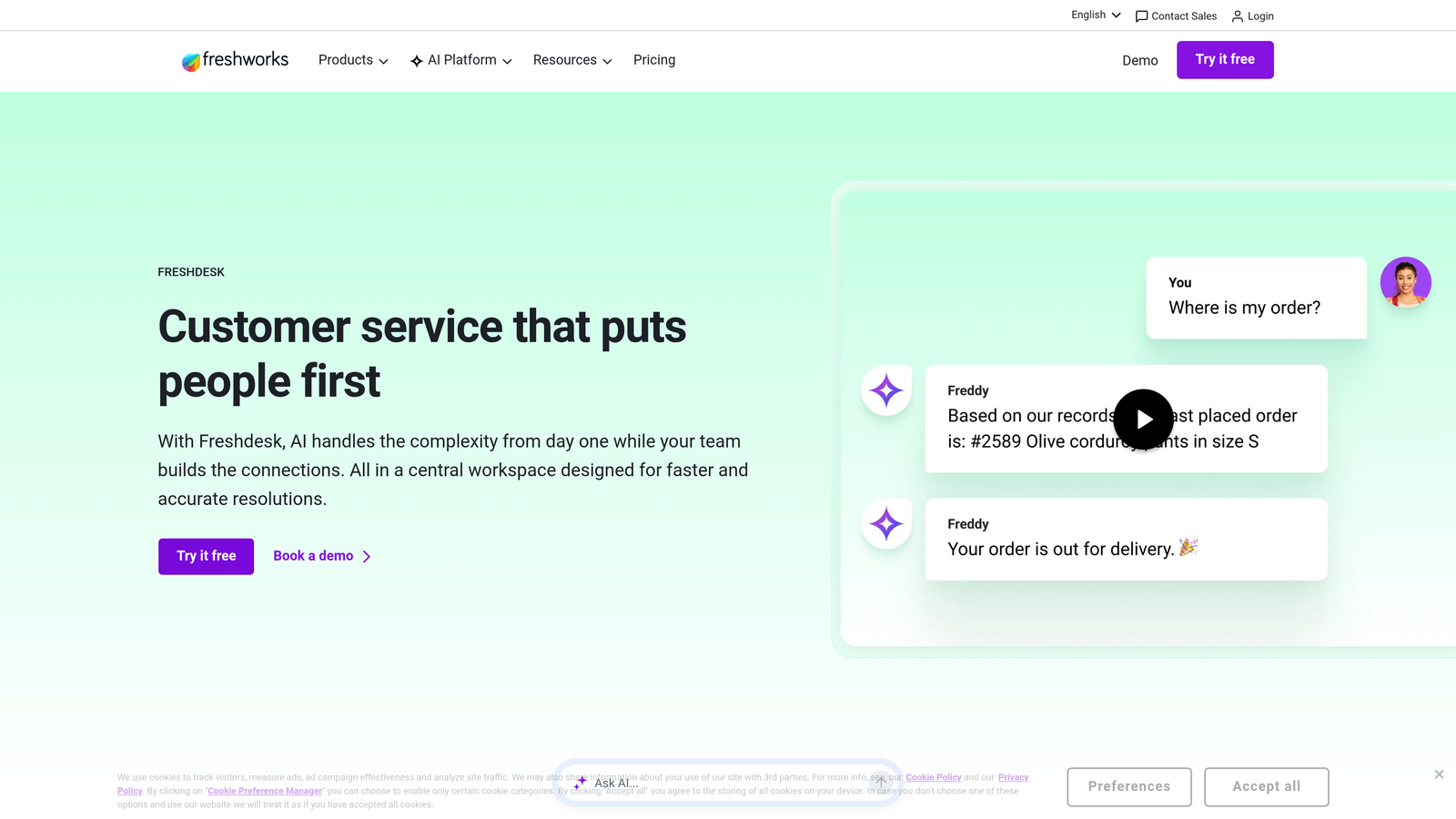
Freshdesk is a full-featured helpdesk platform with Freddy AI built in, offering automated ticket classification, suggested responses, and agent productivity tools at a price point that works for leaner teams.
Where This Tool Shines
Freshdesk competes directly with Zendesk on features but tends to feel more approachable for teams that don't have a dedicated support ops function to manage configuration. The free tier is genuinely functional for small teams getting started, and the upgrade path is gradual rather than requiring a large upfront commitment.
Freddy AI handles auto-triage and response suggestions well for common ticket patterns. The self-service chatbot (Freddy Self Service) can deflect a meaningful portion of repetitive questions, which matters when your team is small and every ticket counts.
Key Features
Freddy AI Auto-Triage: Automatic ticket classification and suggested responses based on content analysis.
Freddy Self Service: Chatbot for deflecting common questions before they reach the agent queue.
Collision Detection: Prevents two agents from working on the same ticket simultaneously.
Free Tier: Functional free plan for small teams, with no time limit.
Omnichannel Support: Handles email, chat, phone, and social channels from a single inbox.
Best For
Early-stage and growth-stage SaaS teams that want a solid helpdesk with AI features without the complexity or cost of enterprise platforms. The free tier makes it a low-risk starting point.
Pricing
Free tier available for small teams. Paid plans start at approximately $15/agent/month. Confirm current pricing at freshdesk.com.
5. Tidio
Best for: Small SaaS teams that want meaningful automation deployed quickly without complex setup
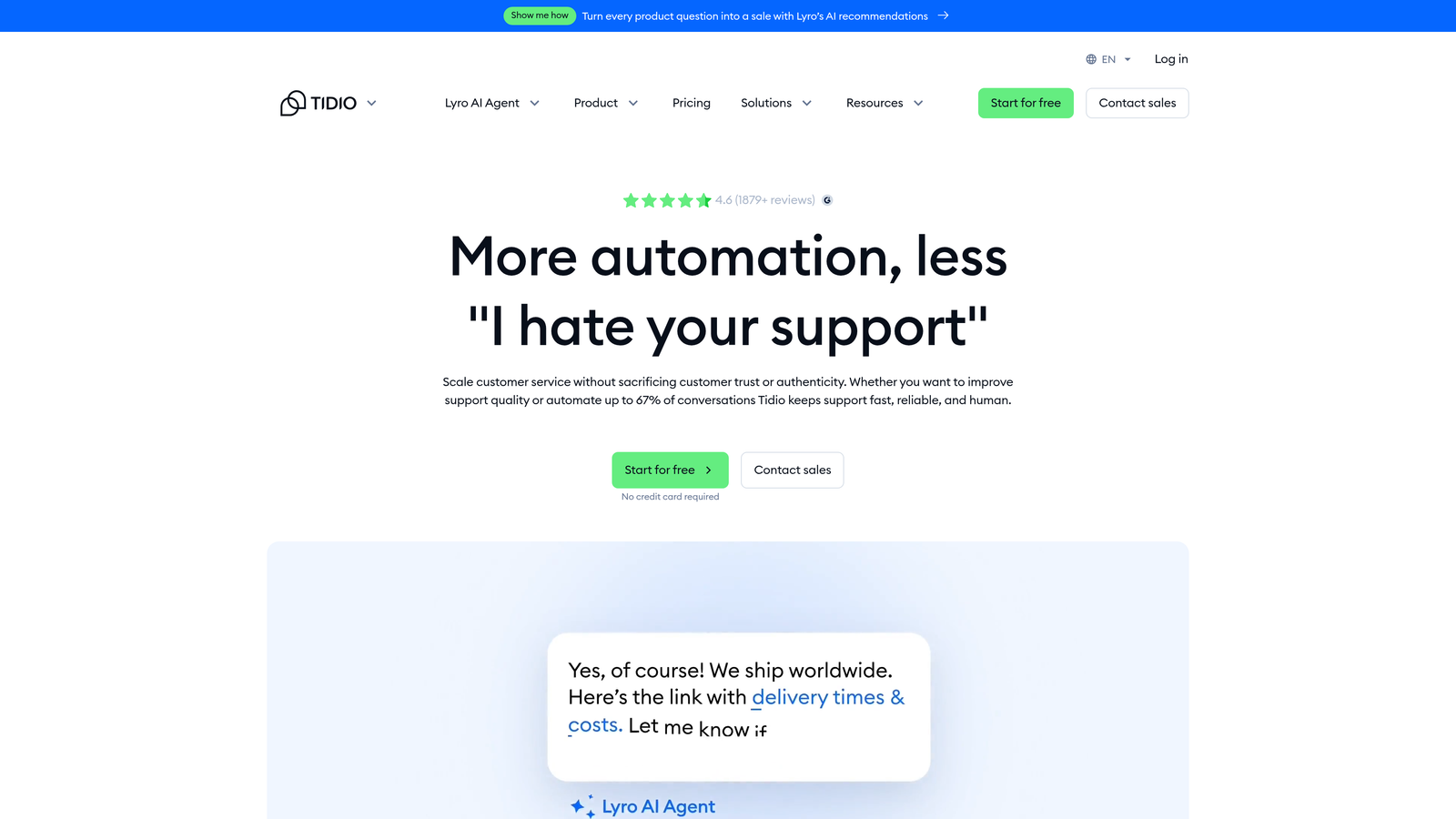
Tidio is a fast-to-deploy live chat and AI automation platform featuring Lyro AI, designed for teams that want real automation without a lengthy implementation process.
Where This Tool Shines
Tidio's biggest advantage is speed to value. Most teams can have the live chat widget installed and Lyro AI answering questions within a day, which is rare in a category that often requires weeks of configuration. For small SaaS teams without a dedicated support ops function, that matters.
Lyro AI handles common FAQ-style questions using your existing content, and the visual no-code chatbot builder lets you create more structured flows without engineering involvement. The live chat fallback is clean, making the handoff from AI to human feel natural to customers.
Key Features
Lyro AI: Automated resolution for common questions using your existing help content.
Visual Chatbot Builder: No-code workflow creation for structured conversation flows.
Live Chat with Agent Takeover: Seamless handoff from AI to human agents when needed.
Email and Messenger Integrations: Connects to email and social messaging channels.
Visitor Tracking: Real-time tracking with engagement triggers based on user behavior.
Best For
Small SaaS teams or those without a dedicated support ops function who want meaningful automation without a complex implementation. Less suited to high-volume teams needing advanced routing or deep helpdesk functionality.
Pricing
Free tier available. Paid plans start at approximately $29/month. Check tidio.com for current plan details.
6. Drift (Salesloft)
Best for: SaaS teams running product-led growth where support and sales conversations overlap
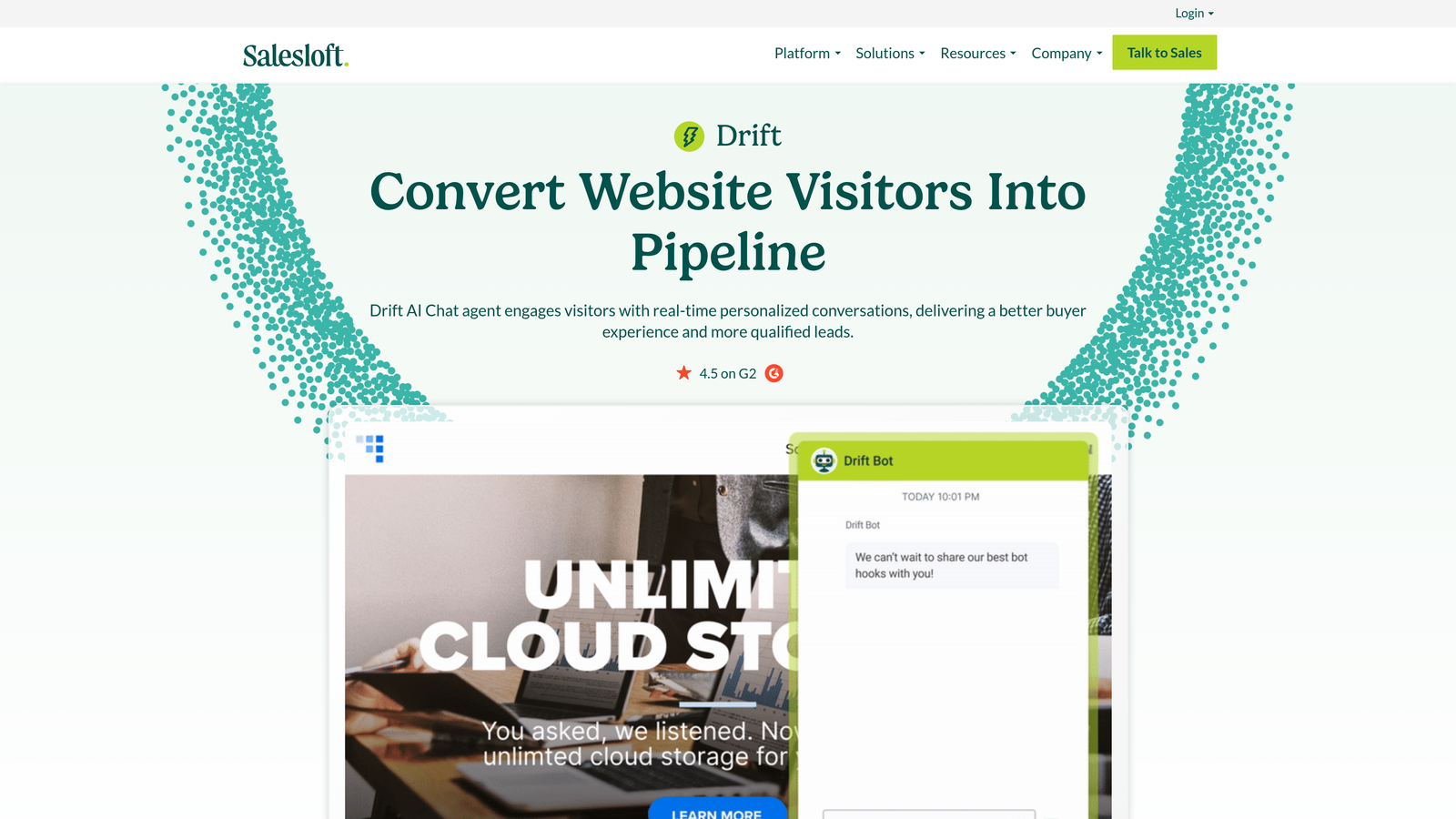
Drift, now part of Salesloft, is a conversational AI platform that bridges support and sales conversations, particularly useful for SaaS companies where a support question can turn into an expansion opportunity.
Where This Tool Shines
Drift's original strength was connecting website visitors to the right conversation, whether that's a support answer or a sales rep. That positioning still holds, especially for SaaS teams running PLG motions where the line between support and revenue is blurry. The ability to route conversations intelligently between support and sales within a single platform is genuinely useful in that context.
Since the Salesloft acquisition, Drift's CRM and pipeline integrations have deepened, which benefits teams that want support conversations to feed directly into account data. For pure support automation, however, other tools on this list offer more depth.
Key Features
AI-Powered Chat Routing: Routes conversations between support and sales based on intent and account data.
Conversational Playbooks: Structured chat flows for common support and sales scenarios.
Meeting Scheduling: Built-in calendar scheduling within chat flows for sales handoffs.
Account-Based Targeting: Personalizes conversations based on company and account data.
Salesloft Integrations: Deep CRM and pipeline connectivity through the Salesloft platform.
Best For
SaaS companies with PLG motions or blended support and sales teams where routing between functions matters. Less suited to teams looking for a pure support automation or helpdesk solution.
Pricing
Enterprise-focused pricing since the Salesloft acquisition. Contact Drift directly for a current quote at drift.com.
7. Help Scout
Best for: SaaS teams that prioritize human-centered support with AI as a productivity layer
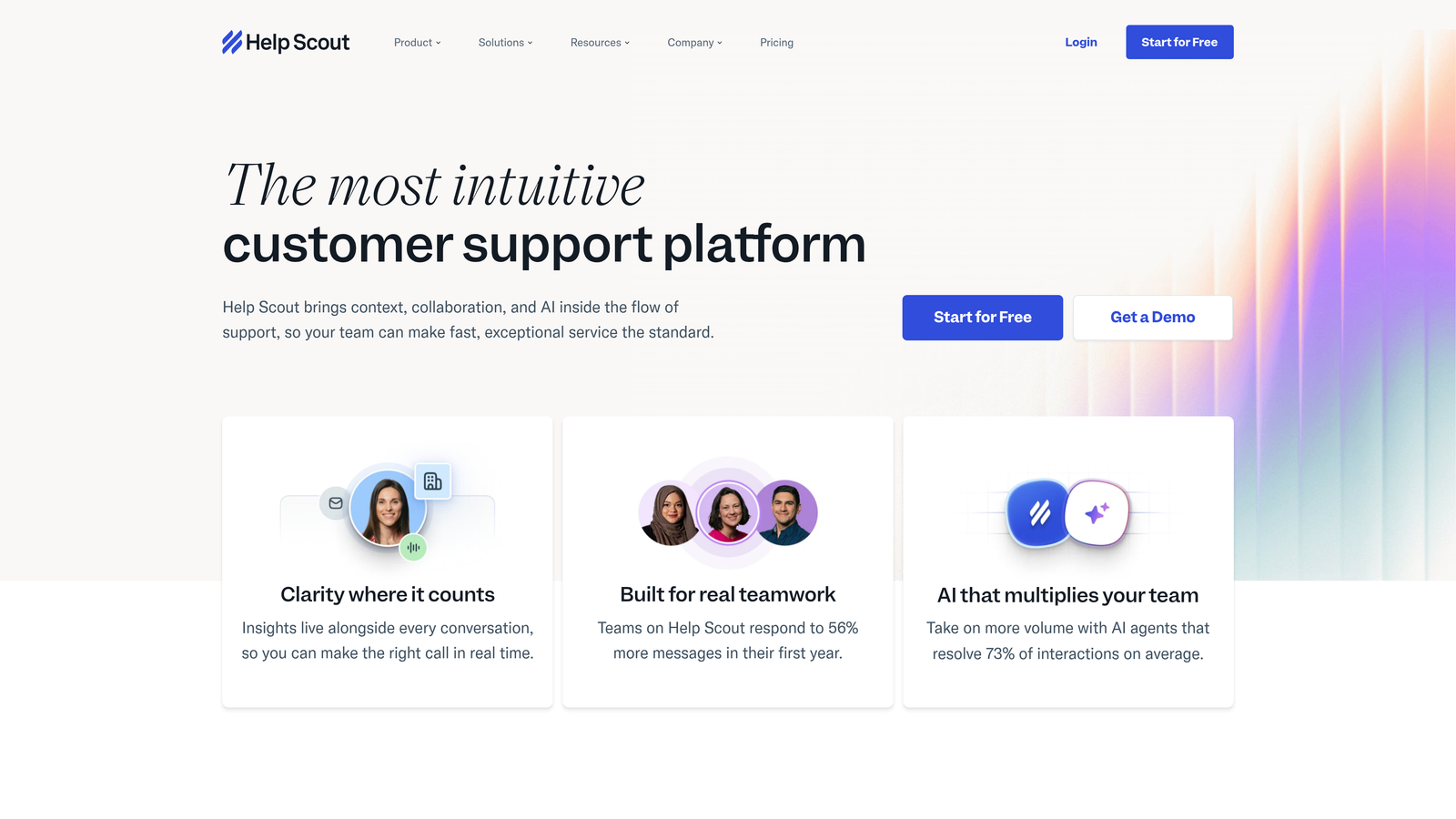
Help Scout is a customer support platform that keeps humans at the center, using AI tools like AI Summarize, AI Assist, and AI Drafts to help agents work faster without removing the human element from customer interactions.
Where This Tool Shines
Help Scout is built for teams that believe support quality matters as much as support speed. The AI features are designed to make agents better, not to replace them. AI Summarize gives agents instant context on long conversations, AI Drafts suggests replies that agents can edit before sending, and AI Assist helps improve tone and clarity. The result is faster, more consistent support without losing the personal touch.
The platform's UX is notably clean compared to enterprise helpdesks, which reduces training time and agent frustration. For SaaS companies where support quality directly affects retention, Help Scout's philosophy resonates.
Key Features
AI Summarize: Instant conversation summaries give agents immediate context without reading full threads.
AI Drafts: Suggested reply generation that agents review and edit before sending.
AI Assist: Tone and clarity improvements for agent-written replies.
Docs Knowledge Base: Built-in knowledge base with AI-powered search for self-service.
Shared Inbox with Collision Detection: Clean, collaborative inbox that prevents duplicate responses.
Best For
SaaS teams where support quality and customer experience are top priorities, and where the goal is to make human agents more effective rather than replace them with autonomous AI.
Pricing
Plans start at approximately $22/user/month. Verify current pricing at helpscout.com.
8. Gorgias
Best for: SaaS companies with subscription billing or transactional support needs
Gorgias was originally built for e-commerce, but its strong automation rules engine and AI-powered responses also serve SaaS teams with subscription, billing, and transactional support workflows.
Where This Tool Shines
Gorgias excels at automating high-volume, repetitive ticket types. Its rules engine is one of the more powerful on this list, allowing teams to create detailed conditional workflows without engineering support. For SaaS companies handling a lot of billing inquiries, subscription changes, or account management requests, that automation depth is valuable.
The ticket-based pricing model is also worth noting. For teams with fluctuating support volumes or small agent teams handling high ticket counts, paying per ticket rather than per seat can be more cost-effective than traditional per-agent pricing.
Key Features
AI Auto-Responses: Automated replies for common ticket types based on intent detection.
Intent and Sentiment Detection: Routes tickets based on what customers are asking and how they're feeling.
Billing Platform Integrations: Deep integrations with Stripe and other billing tools for transactional support.
Macros and Rules Engine: Powerful workflow automation with conditional logic for complex ticket routing.
Ticket-Based Pricing: Pricing based on ticket volume rather than agent seats.
Best For
SaaS companies with subscription billing workflows, high volumes of transactional support tickets, or teams where the per-ticket pricing model fits better than per-agent billing.
Pricing
Starts at approximately $10/month on a ticket-based pricing model. Check gorgias.com for current plan details and ticket volume tiers.
9. Kustomer
Best for: High-growth SaaS teams with omnichannel needs and complex customer data requirements
Kustomer is a CRM-native support platform with AI-powered routing and workflow automation, giving support teams a complete customer timeline alongside their ticket queue.
Where This Tool Shines
Kustomer's defining feature is the full customer timeline: every interaction, purchase, support ticket, and conversation in a single view. For SaaS teams supporting complex accounts with long histories, that context makes every conversation more informed. Agents don't have to switch between tools to understand what a customer has experienced.
The AI-powered routing and workflow automation are mature, and the omnichannel coverage is broad. Kustomer tends to be better suited to companies that have grown past basic helpdesk needs and want support data to live alongside CRM data rather than in a separate system.
Key Features
Full Customer Timeline: Every interaction and touchpoint visible in a single customer view.
AI-Powered Routing: Conversation classification and routing based on content and customer data.
Workflow Automation: Conditional logic workflows for complex ticket handling and escalation.
Omnichannel Support: Unified inbox for email, chat, SMS, social, and voice channels.
Deep CRM Integration: Customer data and support history in one place for context-rich responses.
Best For
High-growth SaaS companies with omnichannel support needs, complex customer accounts, or teams that want support data and CRM data unified rather than siloed.
Pricing
Enterprise pricing. Contact Kustomer directly for a quote at kustomer.com.
Which Tool Is Right for Your SaaS Team?
The right support automation tool depends on where your team is today and what you're optimizing for. Here's a quick-reference guide to help you narrow it down.
If you want AI-first architecture with business intelligence: Halo AI is the standout choice. Its page-aware agents, smart inbox with customer health signals, and continuous learning make it the most purpose-built option for SaaS teams that want support to feed product and revenue decisions, not just close tickets.
If you're already in the Intercom ecosystem: Fin AI is the natural starting point. Adding autonomous resolution to an existing Intercom setup is low-friction and well-integrated.
If you need enterprise-grade helpdesk depth: Zendesk remains the benchmark for high-volume teams with complex routing, SLA management, and reporting needs.
If you're an early-stage team watching budget: Freshdesk's free tier and gradual upgrade path make it the most accessible entry point, with Tidio as an alternative if fast deployment is the priority.
If your support and sales motions overlap: Drift's PLG-friendly routing makes it worth evaluating, especially for teams already in the Salesloft ecosystem.
If agent quality matters more than agent replacement: Help Scout's human-centered AI approach is the right fit for teams where support experience is a competitive differentiator.
Your support team shouldn't scale linearly with your customer base. Let AI agents handle routine tickets, guide users through your product, and surface business intelligence while your team focuses on complex issues that need a human touch. See Halo in action and discover how continuous learning transforms every interaction into smarter, faster support.