9 Best Support Automation Software Packages in 2026
This guide evaluates the 9 best support automation software packages available in 2026, comparing AI capability, integration depth, scalability, and total value. Whether you run a lean SaaS startup or a large enterprise support team, it cuts through the noise to match you with the right platform for autonomous ticket resolution and smarter customer service.
 Grant CooperFounder14 min read
Support teams are drowning in repetitive tickets while customers expect instant, accurate answers around the clock. Support automation software packages have evolved far beyond simple rule-based routing: today's platforms use AI to resolve tickets autonomously, surface business intelligence, and hand off complex issues to humans seamlessly. But with dozens of options on the market, picking the right package for your team's size, stack, and support maturity is genuinely difficult.
This guide covers the best support automation software packages available in 2026, evaluated on AI capability, integration depth, scalability, and total value. Whether you're a lean SaaS startup looking to deflect repetitive tickets or an enterprise team replacing a legacy helpdesk, there's a clear fit here. We'll cover what each tool does best, who it's built for, and what it costs — so you can make a confident decision without wading through marketing pages.
1. Halo AI
Best for: AI-native SaaS and B2B teams wanting autonomous ticket resolution with business intelligence built in.
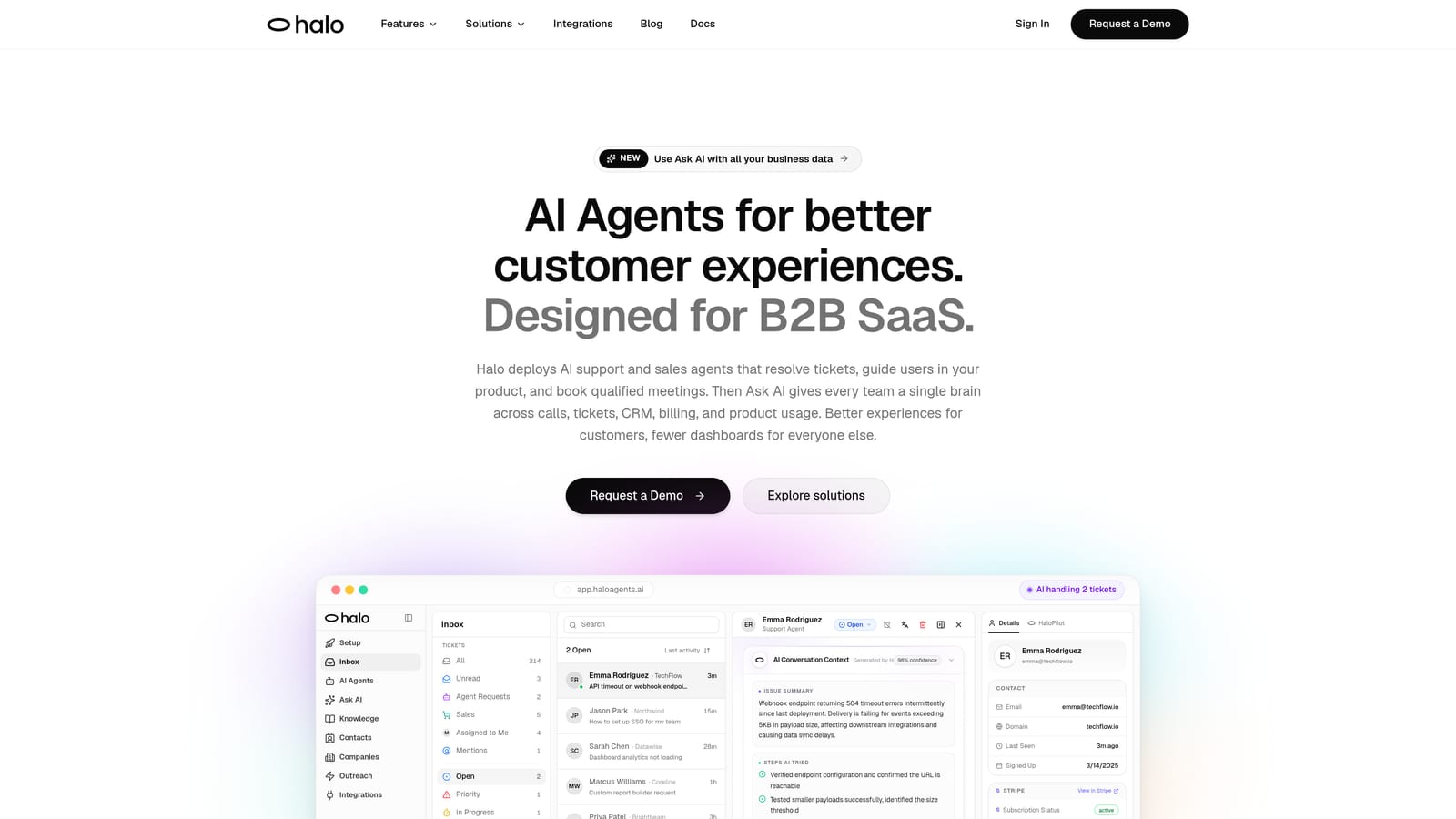
Halo AI is an AI-first customer support platform that deploys autonomous agents to resolve tickets, guide users through your product with page-aware context, and surface actionable business intelligence — all while continuously learning from every interaction.
Where This Tool Shines
Halo AI isn't a legacy helpdesk with AI bolted on. It was built from the ground up around autonomous agents, which means the AI isn't an add-on feature — it's the core product. The page-aware context capability is genuinely distinctive: the agent sees exactly what the user sees on-screen and can provide visual UI guidance rather than generic text instructions. That's a meaningful upgrade over chatbots that respond without knowing where the user actually is in your product.
The platform also goes beyond ticket deflection. The smart inbox surfaces customer health signals, revenue anomalies, and trend detection — turning your support channel into a source of business intelligence rather than just a cost center. When issues do require human judgment, live agent handoff preserves full context so agents don't start from zero.
Key Features
Page-Aware AI Agents: The AI sees what users see on-screen, enabling specific visual UI guidance rather than generic responses.
Smart Inbox with Business Intelligence: Surfaces customer health signals, revenue anomalies, and support trend detection beyond standard metrics.
Auto Bug Ticket Creation: Automatically logs bugs and routes them to Linear or connected project management tools without manual intervention.
Live Agent Handoff: Escalates complex issues to human agents with full conversation context preserved, so nothing gets lost in the transfer.
Deep Integration Stack: Connects to Slack, HubSpot, Intercom, Stripe, Zoom, PandaDoc, Fathom, and Linear for a genuinely unified support operation.
Continuous Learning: The AI improves from every resolved interaction, meaning the system gets smarter the more your team uses it.
Best For
B2B SaaS companies and product teams that want AI to handle routine tickets autonomously while also extracting business intelligence from support interactions. Particularly strong for teams already using tools like Linear, HubSpot, or Stripe who want their support layer connected to the broader business stack.
Pricing
Contact for pricing; Halo AI uses a demo-first sales motion. Visit haloagents.ai to book a demo and get current plan details.
2. Intercom
Best for: Teams wanting a mature AI agent built on LLMs with strong in-app messaging and chat.
Intercom is a customer communications platform featuring Fin, an AI agent built on large language models that resolves support queries using your existing help content.
Where This Tool Shines
Fin is one of the most widely adopted AI support agents in the market, and for good reason. It trains on your existing help center content and handles a meaningful share of inbound queries without agent involvement. The messenger experience is polished, and the combination of proactive messaging, product tours, and reactive support in one platform gives customer-facing teams significant flexibility.
Where Intercom can feel less natural is as a pure ticketing system for high-volume B2B support operations. It's strongest when in-app messaging and chat are central to your support motion, and less differentiated for email-heavy or complex technical support workflows.
Key Features
Fin AI Agent: Autonomous ticket resolution using your help center content, powered by large language models.
Unified Inbox: Combines chat, email, and social channels into a single agent workspace.
Conversation Routing: Automatically assigns conversations based on rules, skills, or team availability.
In-App Messaging and Product Tours: Proactive support and onboarding flows built into the product experience.
Usage-Based AI Pricing: Fin is charged per resolution, which aligns cost with value but requires volume forecasting.
Best For
SaaS companies and consumer apps that rely heavily on in-app chat and want an AI agent that can handle a large share of inbound queries autonomously. Less ideal for teams with complex B2B ticketing needs or those wanting deep project management integrations.
Pricing
Starts at approximately $39/seat/month; Fin AI is charged per resolution. Verify current pricing at intercom.com as plans change frequently.
3. Zendesk
Best for: Enterprise teams needing a proven, feature-rich helpdesk with a massive integration ecosystem.
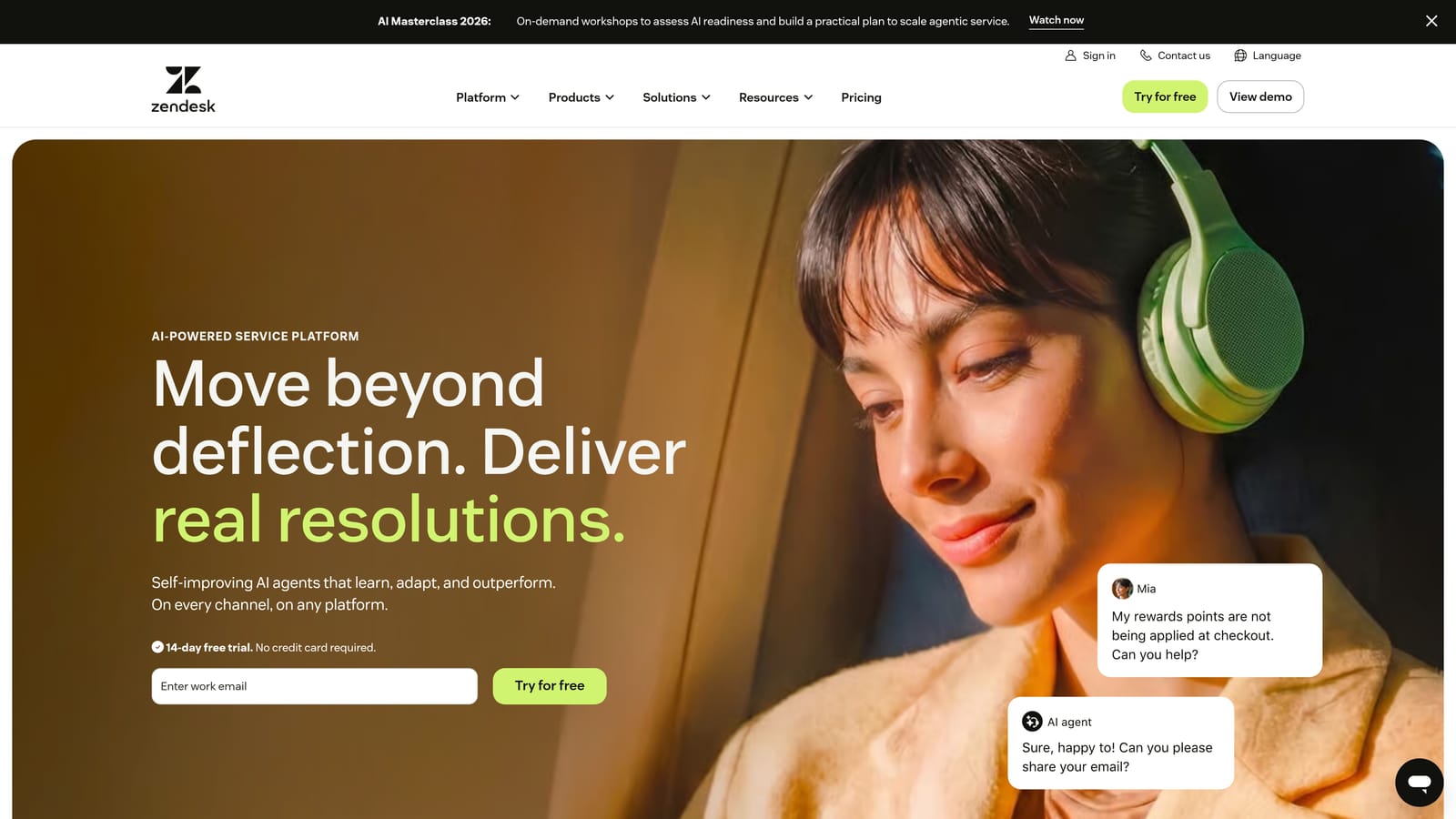
Zendesk is the market-leading enterprise helpdesk platform with an AI suite covering intent detection, automated triage, agent assistance, and workflow automation.
Where This Tool Shines
Zendesk's greatest strength is its ecosystem. Hundreds of marketplace integrations, a deep partner network, and years of enterprise deployments mean it can fit into almost any existing tech stack. The AI suite handles intent detection, sentiment analysis, macro suggestions, and ticket summarization — making agents meaningfully faster even if the AI isn't fully autonomous.
The honest trade-off is complexity and cost. Zendesk is powerful, but getting value from the AI features typically requires configuration work and higher-tier plans. Teams that need AI-first autonomous resolution rather than AI-assisted agents may find the architecture feels like a layer on top of a legacy foundation rather than a native capability.
Key Features
Zendesk AI Suite: Intelligent triage, intent and sentiment detection, macro suggestions, and ticket summarization for agents.
Advanced Workflow Automation: Triggers, automations, and business rules for complex routing and escalation logic.
Extensive App Marketplace: Hundreds of integrations covering CRM, billing, project management, and communication tools.
Enterprise SLA Management: Robust SLA tracking, reporting, and compliance tools for large support operations.
Omnichannel Support: Email, chat, voice, and social channels managed from a single platform.
Best For
Enterprise support teams with complex workflows, large agent headcounts, and a need for a proven system of record. Also well-suited to teams that want to layer AI tools on top of an existing Zendesk deployment rather than migrate platforms.
Pricing
Suite Team from approximately $55/agent/month; AI features available on higher tiers. Verify current pricing at zendesk.com.
4. Freshdesk
Best for: Growing teams that want solid AI-assisted support automation at a competitive price point.
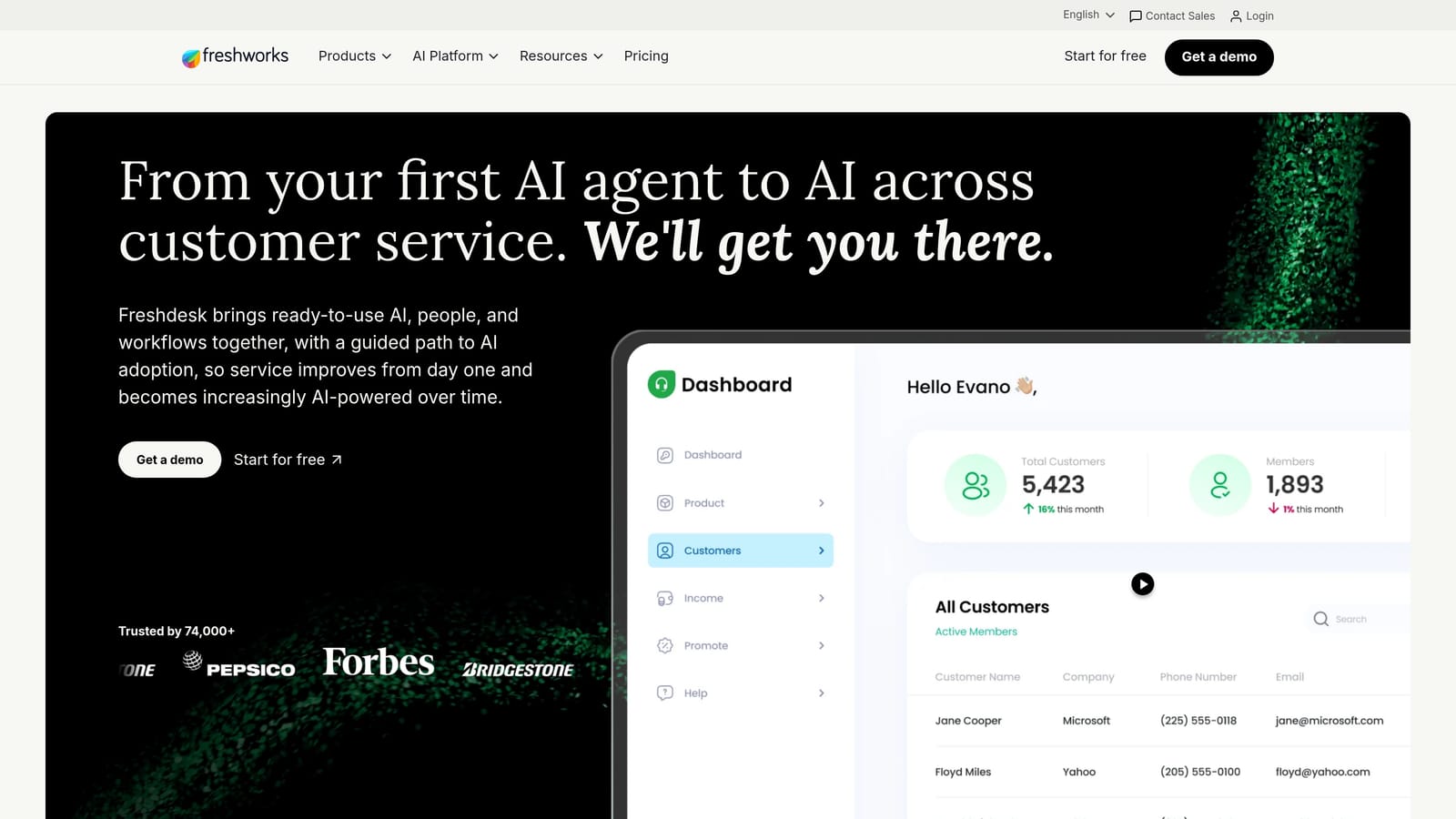
Freshdesk is a full-featured helpdesk with Freddy AI for ticket automation, suggested responses, and self-service — accessible to teams that don't have enterprise budgets.
Where This Tool Shines
Freshdesk hits a sweet spot for growing SMBs and mid-market teams. Freddy AI handles the fundamentals well: categorizing tickets, routing them to the right team, and suggesting responses that agents can send with a click. The setup process is generally considered faster and less complex than Zendesk, which matters when you don't have a dedicated admin team.
Freddy Self Service extends automation to the customer-facing layer with a chatbot that deflects common queries before they reach the inbox. It's not as AI-native as purpose-built autonomous agents, but for teams where AI assistance (rather than full autonomy) is the goal, Freshdesk delivers strong value for the price.
Key Features
Freddy AI: Ticket categorization, intelligent routing, and suggested replies to accelerate agent response time.
Freddy Self Service: Customer-facing chatbot for automated query deflection before tickets are created.
Collision Detection: Prevents multiple agents from working on the same ticket simultaneously.
Canned Responses and Scenario Automations: Pre-built responses and multi-step automation sequences for common workflows.
Free Tier Available: Functional free plan for small teams getting started with shared inbox management.
Best For
SMBs and growing teams that need a capable, affordable helpdesk with AI assistance. A natural fit for teams graduating from email-based support who want structure without the complexity or cost of enterprise platforms.
Pricing
Growth plan from approximately $15/agent/month; Freddy AI Copilot available as an add-on. Verify current pricing at freshdesk.com.
5. Tidio
Best for: Small businesses and e-commerce stores needing fast, affordable chat automation with minimal setup.
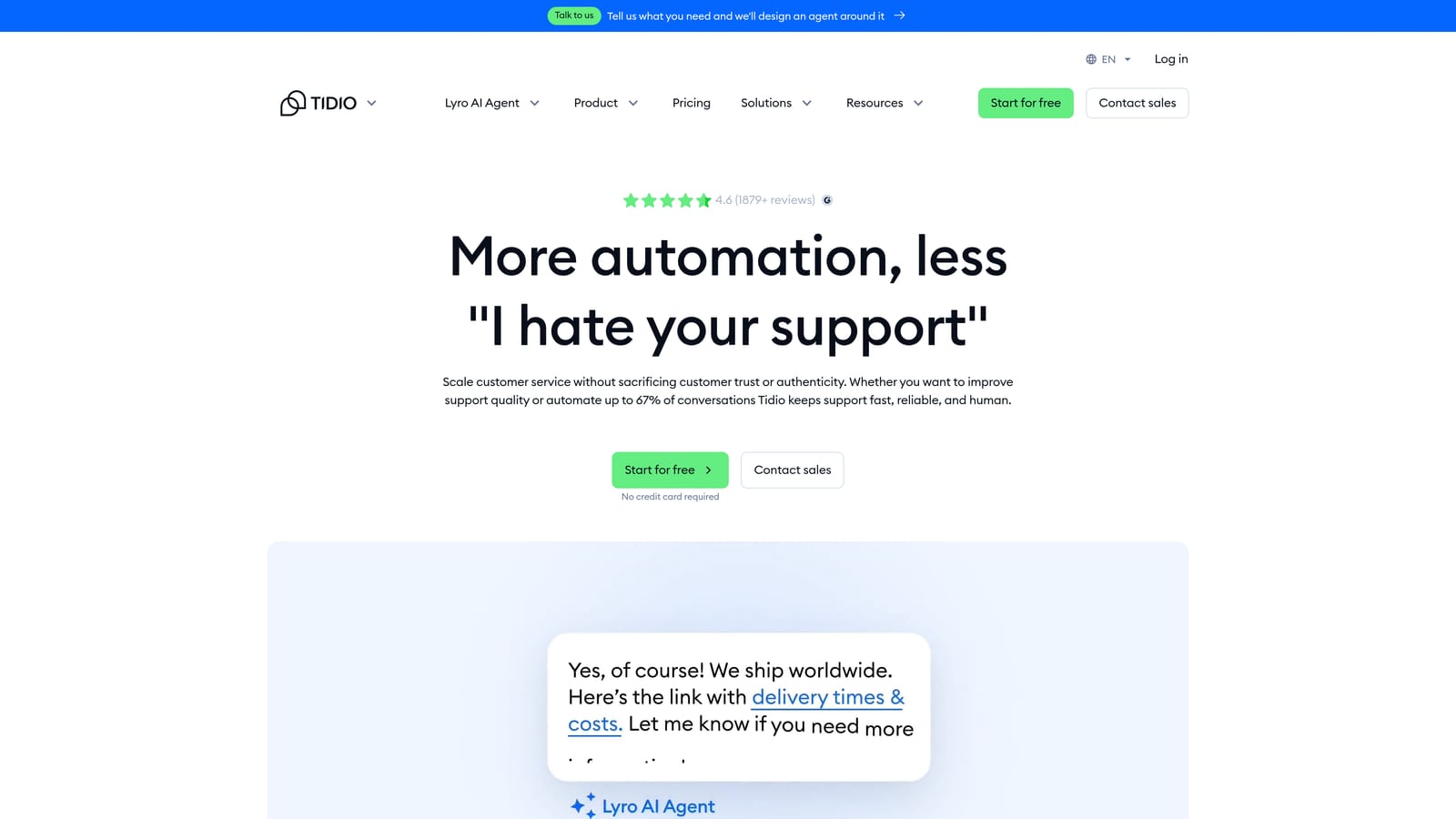
Tidio is a live chat and AI chatbot platform featuring Lyro AI, designed for small businesses that need conversational automation up and running quickly without a complex implementation.
Where This Tool Shines
Tidio's strongest card is speed to value. Most teams can have Lyro AI live and handling customer conversations within hours, not weeks. Lyro is context-aware and conversational, handling common queries in a natural way rather than falling back on rigid decision trees. For small businesses where support volume is manageable and the primary goal is reducing manual chat load, Tidio delivers well above its price point.
The visual chatbot flow builder also makes it accessible to non-technical teams who want to build custom automation sequences without developer involvement. That said, Tidio is less suited for complex B2B SaaS support workflows that require deep integrations, advanced routing logic, or business intelligence beyond basic chat metrics.
Key Features
Lyro AI Chatbot: Conversational, context-aware automated responses that handle common customer queries naturally.
Live Chat with Mobile App: Agents can respond on the go, keeping response times low for small teams.
Visual Flow Builder: Drag-and-drop chatbot sequence builder for custom automation without coding.
Shopify and WooCommerce Integrations: Pulls e-commerce context into chat conversations for more relevant responses.
Fast Setup: Typically live within hours, making it one of the lowest-friction options on this list.
Best For
Small businesses, e-commerce stores, and early-stage startups that need chat automation quickly and affordably. Not the right fit for enterprise teams or complex B2B support operations requiring deep integrations and autonomous ticket resolution.
Pricing
Free plan available; Lyro AI from approximately $29/month. Verify current pricing at tidio.com.
6. Gorgias
Best for: E-commerce brands on Shopify, BigCommerce, or Magento that need order data inside every support ticket.
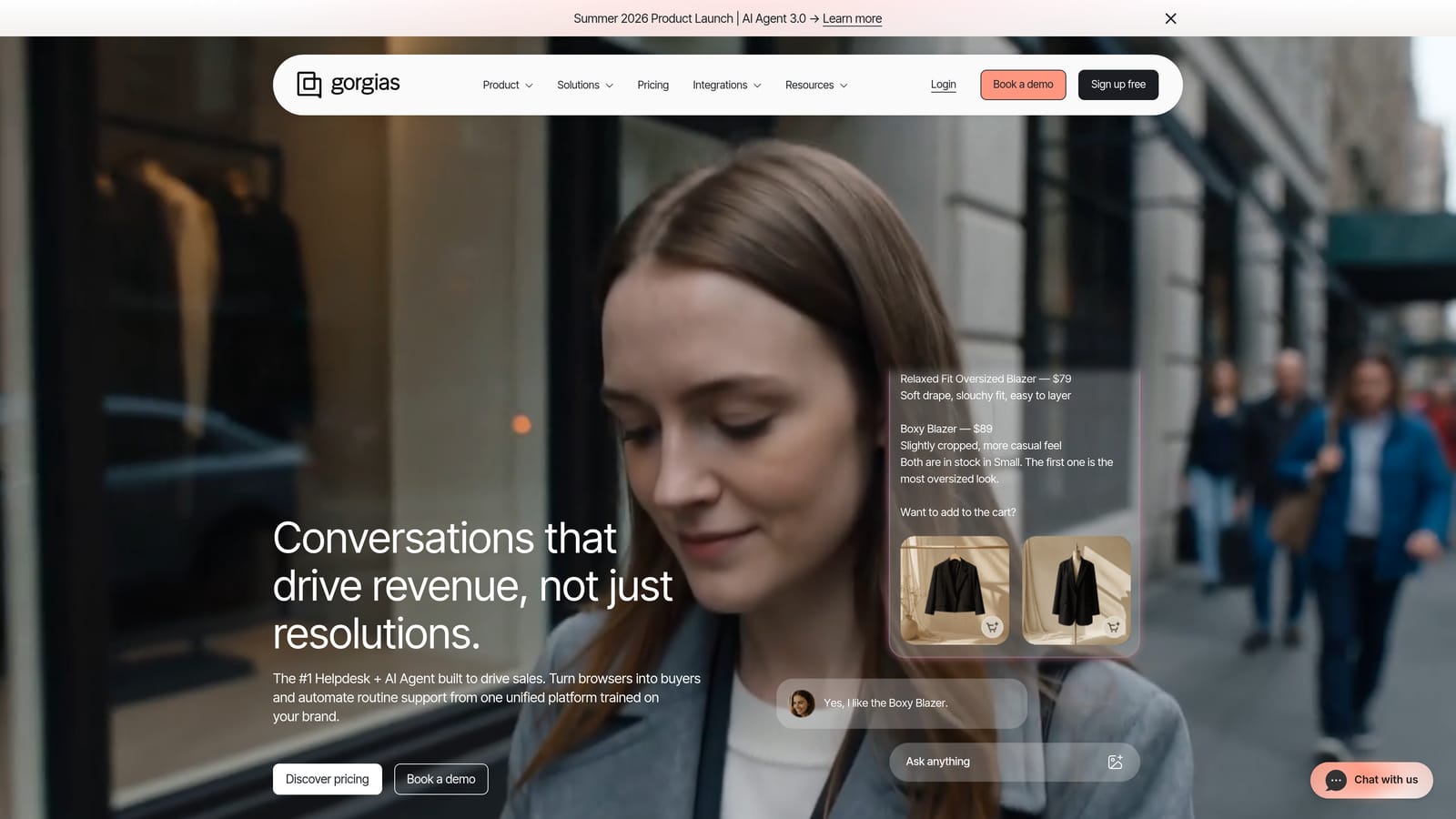
Gorgias is a helpdesk purpose-built for e-commerce, with deep platform integrations that pull order data, refund status, and customer history directly into every support conversation.
Where This Tool Shines
Gorgias does one thing exceptionally well: it makes e-commerce support fast. When an agent opens a ticket, they immediately see the customer's order history, refund status, and purchase data — no tab-switching required. Automation rules handle the highest-volume e-commerce queries (order status, tracking, return requests) without any AI involvement, which keeps things reliable and predictable.
The revenue statistics feature is a genuine differentiator for e-commerce teams: it links support interactions to sales impact, helping managers understand which support activities actually drive revenue. For B2B SaaS teams, though, Gorgias is largely irrelevant — its strengths are tightly coupled to the e-commerce use case.
Key Features
Native Shopify Integration: Order data, refund status, and customer history visible inside every ticket without leaving Gorgias.
E-Commerce Automation Rules: Handles order status, return, and tracking queries automatically without manual agent involvement.
Revenue Statistics: Links support interactions to sales impact to help teams understand the business value of support.
Macros and Templates: Pre-built responses for high-volume repetitive queries across chat, email, and social.
Omnichannel Inbox: Manages email, chat, social DMs, and SMS from a single workspace.
Best For
D2C and e-commerce brands with significant Shopify, BigCommerce, or Magento order volume. If your support queue is dominated by order status and return queries, Gorgias is purpose-built for your use case. Not relevant for B2B or non-commerce businesses.
Pricing
Starter from approximately $10/month with ticket-based pricing that scales with volume. Verify current pricing at gorgias.com.
7. Help Scout
Best for: Teams that prioritize a human, relationship-driven support experience with AI tools to improve agent speed.
Help Scout is a clean, email-first shared inbox platform that prioritizes human support quality, with AI features designed to make agents faster without removing the personal touch.
Where This Tool Shines
Help Scout's philosophy is deliberately different from AI-first platforms: the goal isn't maximum deflection, it's maximum quality. The interface feels like email rather than a ticketing system, which means customers never see ticket numbers and agents work in a familiar environment. AI Summarize and AI Assist help agents craft better responses faster, but the human remains in the loop on every interaction.
This approach resonates strongly with teams in industries where relationship quality matters as much as speed — professional services, high-touch SaaS, or any business where a warm, human response is part of the brand promise. If your primary goal is autonomous ticket deflection at scale, Help Scout isn't the right fit. But if you want AI to make your human team better rather than replace them, it's one of the cleanest implementations available.
Key Features
AI Summarize and AI Assist: Helps agents understand long conversations quickly and draft better responses without replacing the human voice.
Email-Like Shared Inbox: Clean interface with no ticket numbers visible to customers, preserving a personal support feel.
Beacon Chat Widget: Lightweight chat and knowledge base integration for customer self-service without heavy configuration.
Collision Detection: Prevents duplicate replies when multiple agents are viewing the same conversation.
Customer Data Sidebar: Conversation history and customer profile visible alongside every ticket for context.
Best For
Teams where support quality and relationship-building matter as much as efficiency. Strong fit for professional services, high-touch SaaS, and any brand where a human response is a deliberate differentiator rather than a cost to be minimized.
Pricing
Standard from approximately $22/user/month. Verify current pricing at helpscout.com.
8. Kustomer
Best for: High-volume consumer support operations that need a unified customer timeline across every channel.
Kustomer is a CRM-native customer service platform that gives agents a complete customer timeline across all channels, with AI-powered workflows for large-scale support operations.
Where This Tool Shines
Kustomer's CRM-first architecture is its defining characteristic. Rather than organizing work around tickets, it organizes around customers — every interaction, across every channel, shown in a single chronological timeline. For high-volume consumer support operations (retail, marketplace, subscription services), this gives agents the context they need to resolve issues without asking customers to repeat themselves.
AI-powered routing, sentiment detection, and suggested actions layer onto this foundation to help agents work faster. The workflow automation handles complex, multi-step support processes that would require significant manual coordination otherwise. Kustomer is less suited for lean B2B SaaS teams — its strengths emerge at scale with high agent headcounts and diverse channel volume.
Key Features
CRM-First Architecture: Full customer timeline across all channels in a single view, organized around the customer rather than the ticket.
AI-Powered Routing and Sentiment Detection: Automatically routes conversations and flags sentiment for priority handling.
Workflow Automation: Handles complex, multi-step support processes with conditional logic and cross-channel coordination.
Omnichannel Coverage: Email, chat, voice, SMS, and social managed from one platform.
Business Intelligence Reporting: Customer and team performance analytics for operational visibility.
Best For
High-volume consumer support teams in retail, marketplace, or subscription businesses where agent context and omnichannel coverage are critical. Enterprise-level pricing makes it less accessible for smaller teams.
Pricing
Enterprise pricing; contact Kustomer directly for current rates. Verify at kustomer.com.
9. Zoho Desk
Best for: SMBs and mid-market teams already invested in the Zoho ecosystem who want context-aware AI at a competitive price.
Zoho Desk is a context-aware helpdesk with Zia AI for sentiment analysis, anomaly detection, and auto-tagging — best leveraged as part of the broader Zoho product suite.
Where This Tool Shines
Zoho Desk's value proposition is strongest for teams already using Zoho CRM or other Zoho products. The tight integration means customer data flows naturally between sales, marketing, and support without custom connectors or middleware. Zia AI adds genuine capability: sentiment analysis flags frustrated customers before they escalate, anomaly detection surfaces unusual ticket volume spikes, and auto-tagging keeps the inbox organized without manual effort.
The Blueprint workflow automation tool is also worth highlighting — it structures support processes with defined steps and conditions, which is useful for teams that need consistency across a large or distributed agent team. Outside the Zoho ecosystem, though, integration flexibility is more limited, and teams with heterogeneous stacks may find the platform less compelling.
Key Features
Zia AI: Sentiment analysis, ticket auto-tagging, and response suggestions to improve agent speed and awareness.
Anomaly Detection: Flags unusual ticket volume spikes so teams can respond before issues compound.
Deep Zoho CRM Integration: Unified customer data across sales and support without custom integration work.
Blueprint Workflow Automation: Structured, step-by-step process automation for consistent support delivery.
Multi-Department Support: Manages support across multiple departments or business units from a single platform.
Best For
SMBs and mid-market teams already using Zoho CRM or other Zoho products, where the ecosystem integration delivers compounding value. Less compelling as a standalone choice for teams outside the Zoho stack.
Pricing
Standard from approximately $14/agent/month; Zia AI available on higher tiers. Verify current pricing at zoho.com/desk.
Which Support Automation Package Is Right for Your Team?
The right choice depends almost entirely on your team's size, support philosophy, and existing tech stack. Here's a quick decision guide to cut through the noise.
AI-native SaaS and B2B teams should look at Halo AI first. It's the only platform on this list built from the ground up around autonomous agents with page-aware context, business intelligence, and continuous learning — not a legacy helpdesk with AI features added on top. If you want your support layer to surface customer health signals and connect to your full business stack, nothing else here compares architecturally.
Enterprise teams with complex existing workflows will find Zendesk or Intercom the most natural fit. Both have mature ecosystems, established enterprise deployments, and AI features that layer onto existing processes without requiring a platform migration.
E-commerce brands should evaluate Gorgias first. Its native Shopify integration and e-commerce automation rules are purpose-built for the order-status-and-returns volume that dominates D2C support queues. Tidio is a strong alternative for smaller stores that prioritize fast setup and affordable chat automation.
SMBs on a budget will find Freshdesk and Zoho Desk the most accessible options, with Freshdesk offering a cleaner onboarding experience and Zoho Desk delivering the most value for teams already in the Zoho ecosystem.
Teams prioritizing human support quality over deflection volume should look at Help Scout. Its AI tools improve agent speed without removing the human voice from every interaction.
Your support team shouldn't scale linearly with your customer base. Let AI agents handle routine tickets, guide users through your product, and surface business intelligence while your team focuses on complex issues that need a human touch. See Halo in action and discover how continuous learning transforms every interaction into smarter, faster support.