9 Best Support Automation Software to Buy in 2026
This guide evaluates nine leading support automation software options to help B2B SaaS teams make a confident support automation software purchase, comparing platforms across AI capability, integrations, deployment ease, and total cost of ownership. Whether replacing a legacy helpdesk or building a new support stack, it covers the tools worth serious consideration before signing a contract.
 Matt PattoliFounder13 min read
Buying support automation software is a significant investment, and the market has never been more crowded. From AI-native agents to bolt-on chatbots, the options range from genuinely transformative to barely useful. The real challenge isn't finding a tool that claims to automate support: it's finding one that actually delivers on that promise without creating a new layer of complexity to manage.
This guide evaluates nine platforms across the criteria that matter most to B2B SaaS teams: AI capability depth, integration breadth, ease of deployment, scalability, and total cost of ownership. Whether you're replacing a legacy helpdesk, layering automation on top of an existing system, or building your support stack from scratch, these are the tools worth serious consideration before signing a contract.
1. Halo AI
Best for: B2B SaaS teams that want AI-native support with deep product context and business intelligence
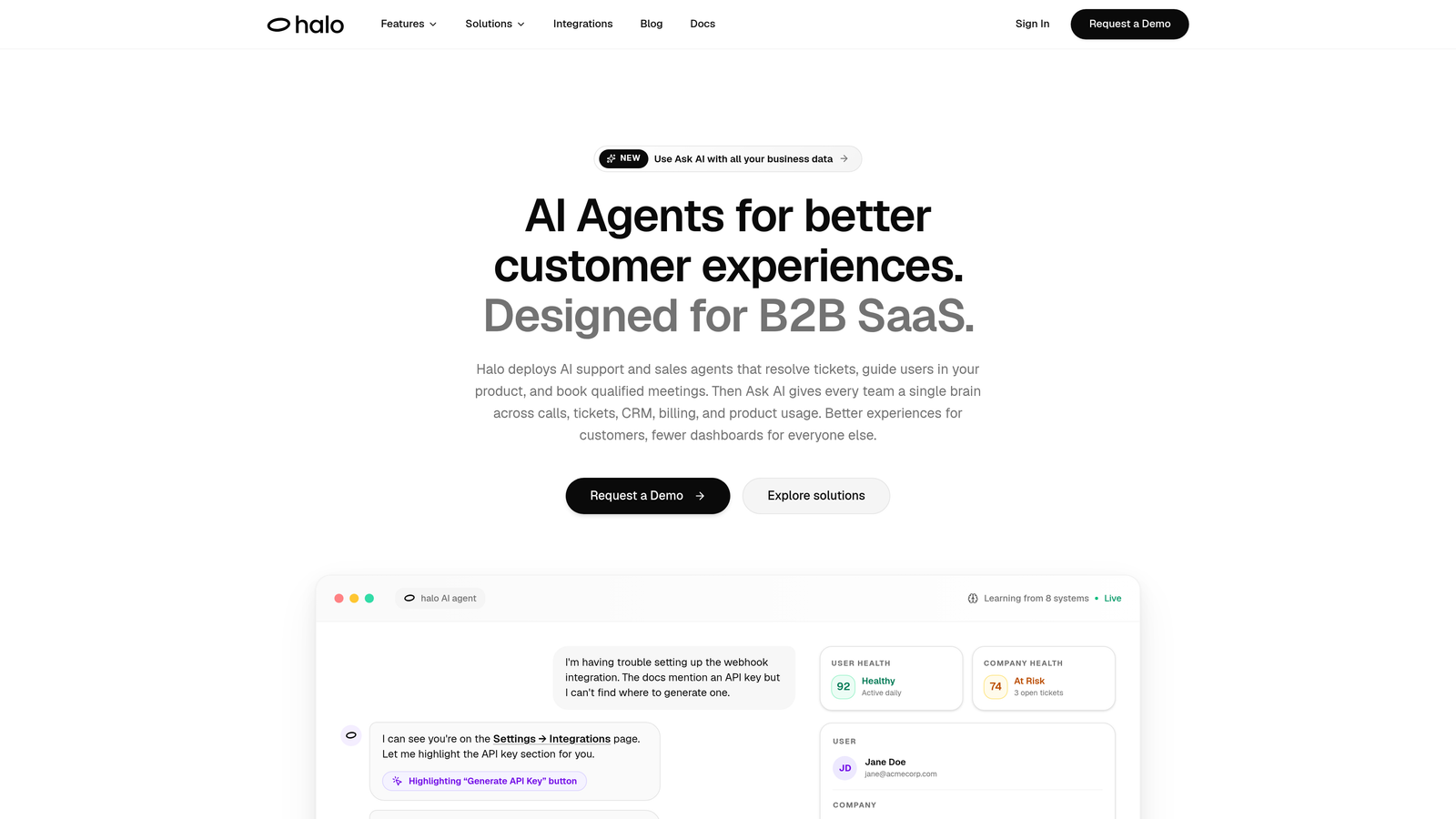
Halo AI is an AI-first customer support platform that deploys intelligent agents to resolve tickets, guide users through your product, and surface business intelligence — all while learning continuously from every interaction.
Where This Tool Shines
What separates Halo from most tools on this list is architecture. It was built AI-first, not retrofitted. That distinction matters when you're evaluating whether a platform can handle the nuanced, multi-step queries that B2B SaaS customers actually ask — not just FAQ lookups.
The page-aware chat widget is a standout differentiator. Halo sees where a user is in your product and responds with that context in mind, rather than delivering generic answers that ignore what the user is actually looking at. Combined with continuous learning from every resolved interaction, the system gets meaningfully smarter over time rather than staying static.
Key Features
Page-Aware Chat Widget: Understands the user's location within your product interface, enabling contextually relevant guidance rather than generic responses.
Autonomous Ticket Resolution: AI agents handle tickets end-to-end, with continuous learning from past interactions improving resolution quality over time.
Auto Bug Ticket Creation: Automatically identifies and routes bug reports to Linear, removing manual triage from your engineering-support workflow.
Smart Inbox with Business Intelligence: Surfaces customer health signals, revenue anomaly detection, and support trend insights beyond standard ticket volume metrics.
Live Agent Handoff: Escalates complex issues to human agents gracefully, with full context preserved so customers don't have to repeat themselves.
Deep Integrations: Connects with Linear, Slack, HubSpot, Intercom, Stripe, Zoom, PandaDoc, and Fathom, covering the full B2B SaaS stack.
Best For
B2B SaaS product teams that need more than ticket deflection. If your support operation is expected to surface customer health signals, route product bugs automatically, and scale without proportionally scaling headcount, Halo is built for exactly that context.
Pricing
Contact for pricing. Halo is positioned for B2B SaaS teams and priced accordingly. Given the AI-native architecture and integration depth, it's worth a direct conversation to understand total cost of ownership against your current stack.
2. Intercom
Best for: SaaS teams wanting a mature AI agent with strong messenger UX and unified inbox
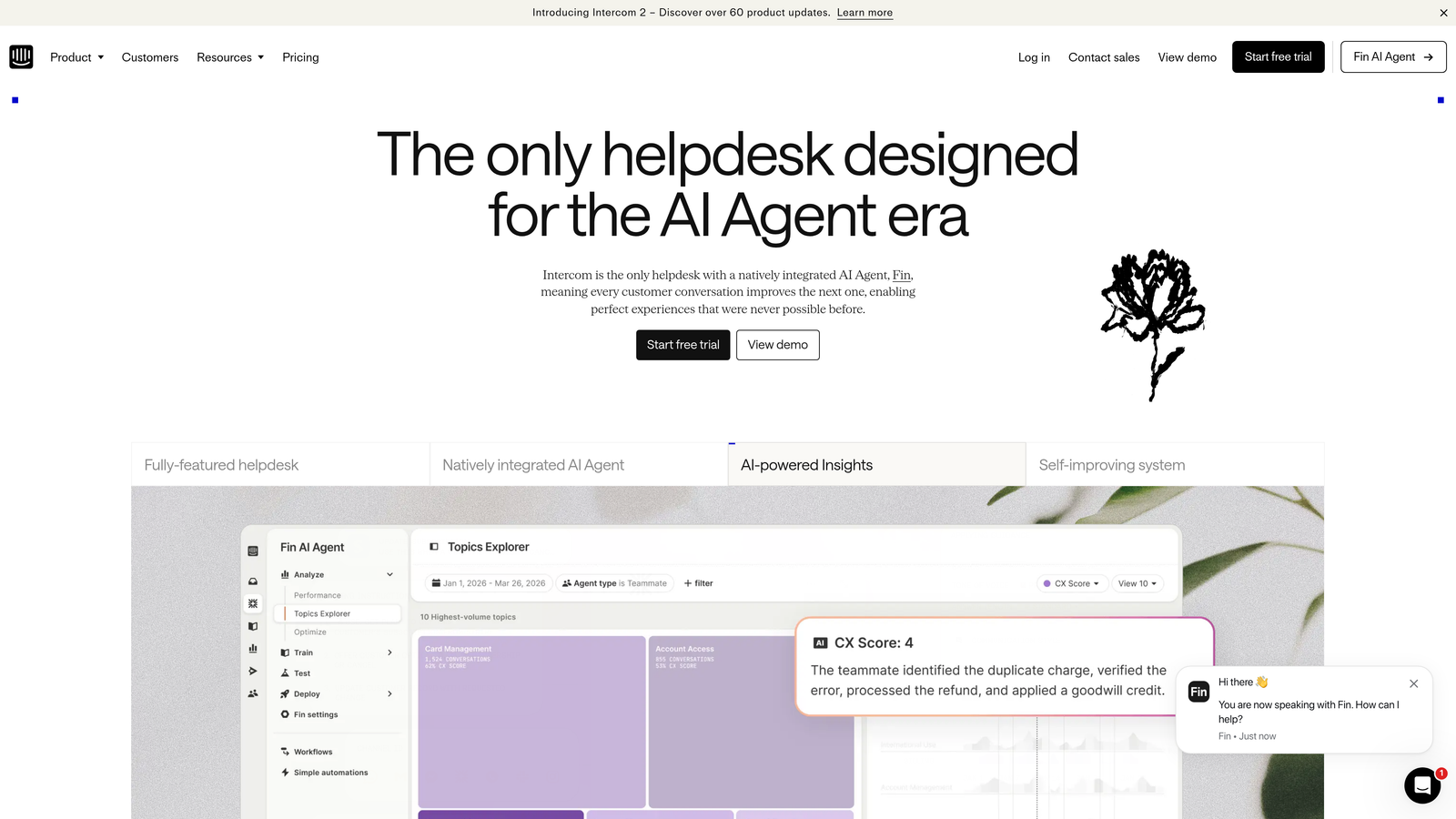
Intercom is a widely adopted customer communications platform featuring Fin, an AI agent capable of autonomously resolving support queries using your help content and conversation history.
Where This Tool Shines
Intercom's Fin AI agent has matured considerably. Built on large language models and trained against your existing help content, Fin can handle a meaningful portion of inbound queries without human involvement. The messenger UI remains one of the most polished in the category, and the unified inbox experience for blending AI and human agent conversations is genuinely well executed.
Where Intercom requires careful evaluation is cost. Pricing has moved upmarket, and for smaller SaaS teams, the per-seat and usage-based model can escalate quickly once AI features are factored in. It's a capable platform, but total cost of ownership deserves scrutiny before committing.
Key Features
Fin AI Agent: Autonomously resolves support queries using your help documentation and historical conversation data.
Unified Inbox: Combines AI-handled and human agent conversations in a single, organized interface.
In-App Messenger: Highly customizable chat widget with strong brand alignment options.
Workflow Automation Builder: Visual builder for creating automated routing, tagging, and escalation logic.
Conversation Analytics: Reporting on resolution rates, CSAT, and team performance metrics.
Best For
SaaS teams that are already in the Intercom ecosystem or need a proven AI agent with strong self-service content integration. Less ideal for teams with tight budgets or those needing deep product-context awareness beyond what Fin's training provides.
Pricing
Essential plans start at approximately $39 per month. AI features are available on higher tiers, and pricing scales with seat count and usage volume. Evaluate carefully against projected conversation volume.
3. Zendesk
Best for: Enterprise teams needing a customizable, deeply integrated helpdesk with AI layered on top
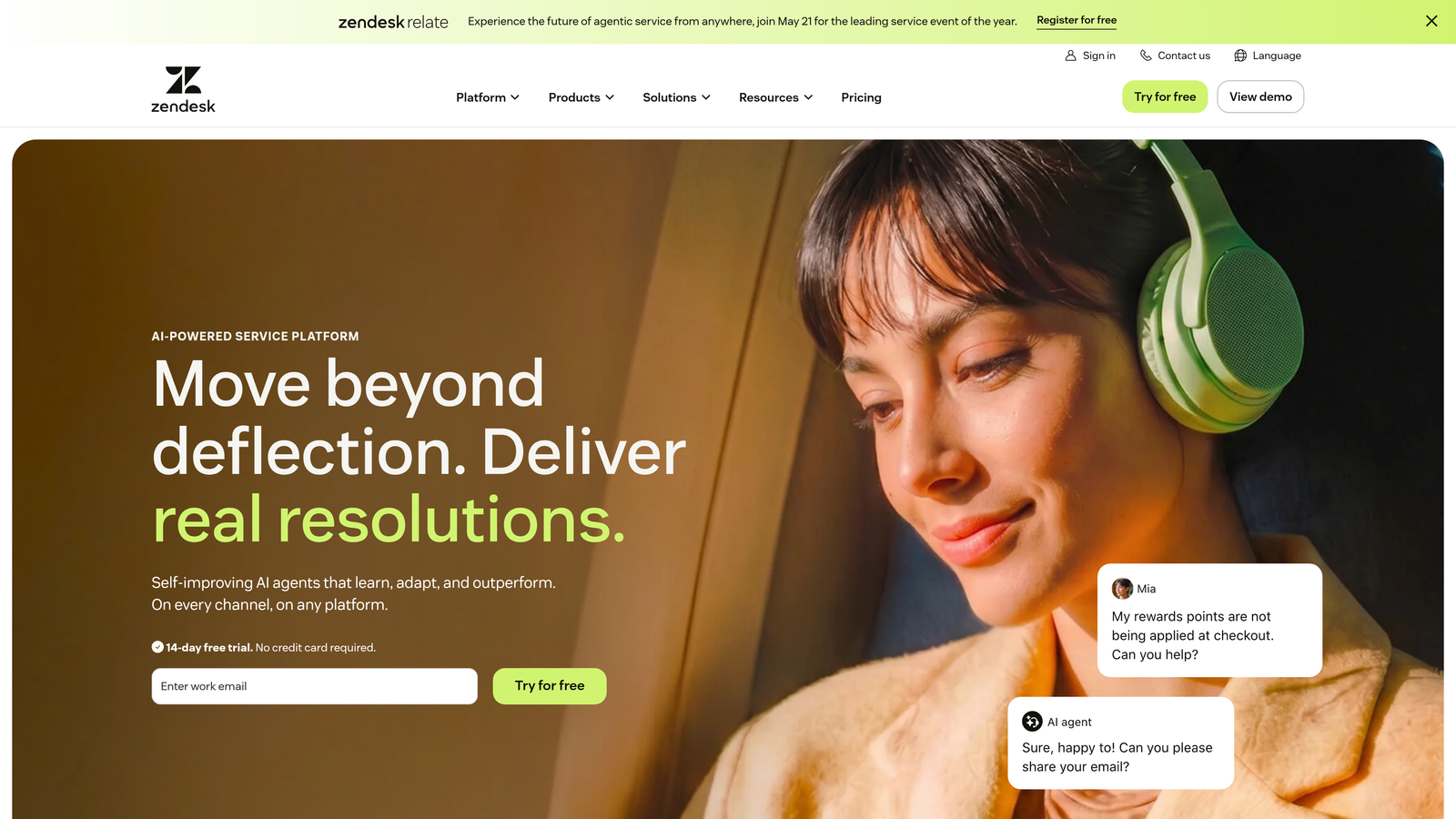
Zendesk is the enterprise helpdesk standard, now with AI-powered triage, agent assist, and self-service automation available across its Suite plans.
Where This Tool Shines
Zendesk's strength is its configurability and ecosystem. With over 1,500 marketplace integrations and decades of enterprise deployment experience, it can fit into almost any support operation. The AI features, including intelligent triage and Agent Copilot, have improved substantially and now offer genuine value for high-volume teams.
The honest caveat: Zendesk is a traditional helpdesk that has added AI capabilities, not an AI-native platform. Teams with dedicated admin resources to configure and maintain the system will get the most from it. For lean SaaS teams expecting plug-and-play AI performance, the setup investment can be significant.
Key Features
AI-Powered Intelligent Triage: Automatically classifies and routes incoming tickets based on intent, sentiment, and priority signals.
Agent Copilot: Suggests responses and next-best-actions to human agents in real time, reducing handle time.
Workflow Automation: Extensive trigger and macro system for building complex routing and escalation logic.
App Marketplace: 1,500+ integrations covering virtually every business tool category.
SLA Management and Reporting: Enterprise-grade reporting with SLA tracking and compliance monitoring.
Best For
Enterprise support operations with dedicated admins, complex routing requirements, and existing investment in the Zendesk ecosystem. Less suited to early-stage SaaS teams that need fast time-to-value without significant configuration overhead.
Pricing
Suite plans start at approximately $55 per agent per month. AI features and add-ons are priced separately, so model total cost carefully against your team size and feature requirements.
4. Freshdesk
Best for: SMB and mid-market teams wanting AI automation at accessible pricing with minimal complexity
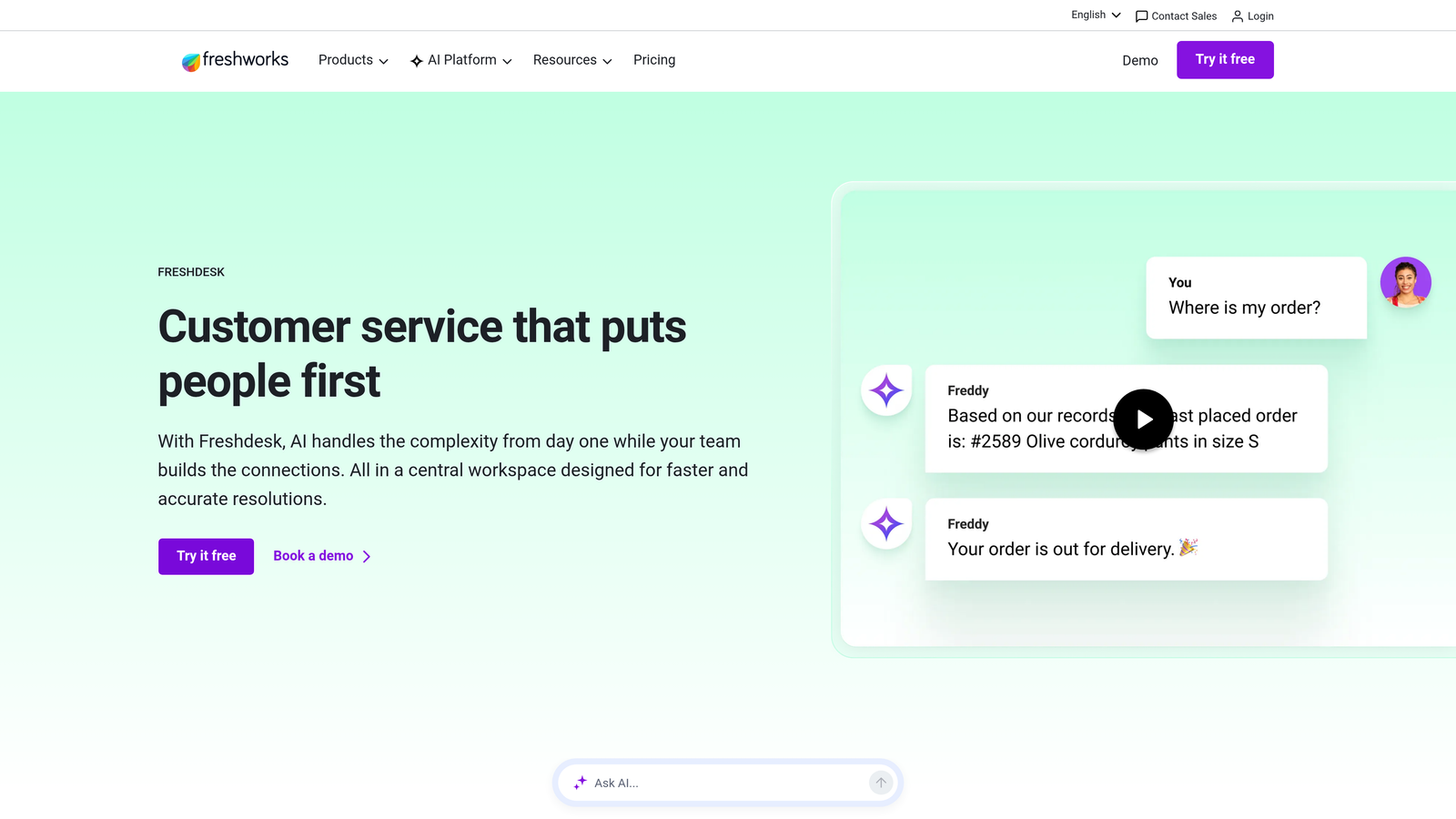
Freshdesk is Freshworks' helpdesk platform featuring Freddy AI across self-service, agent assist, and ticket triage, at pricing that suits teams that want automation without enterprise-level overhead.
Where This Tool Shines
Freshdesk occupies a strong middle ground: more AI capability than basic ticketing tools, more accessible pricing than Zendesk or Intercom. Freddy AI spans the full support workflow, from customer-facing bots to agent response suggestions and conversation summarization. The omnichannel coverage across email, chat, phone, and social is solid for teams managing multiple support channels.
The free tier makes Freshdesk particularly attractive for teams at an early stage or those piloting automation before committing to a larger investment. The jump to Freddy AI features requires moving to Growth tier and above, so plan that into your budget evaluation.
Key Features
Freddy Self Service: AI-powered customer-facing bots that resolve common queries without agent involvement.
Freddy Copilot: Provides agents with response suggestions, conversation summaries, and next-step recommendations.
Automated Ticket Routing: Intelligent assignment and prioritization based on ticket content and agent availability.
Omnichannel Support: Unified inbox covering email, live chat, phone, and social media channels.
Free Tier: Available for small teams, providing a genuine entry point before committing to paid plans.
Best For
SMB and mid-market SaaS teams that want meaningful AI automation without the complexity or cost of enterprise platforms. Also a strong choice for teams already in the Freshworks ecosystem.
Pricing
Free plan available. Paid plans start at approximately $15 per agent per month. Freddy AI features are available on Growth tier and above.
5. Tidio
Best for: E-commerce and small business teams needing fast deployment with AI chat automation
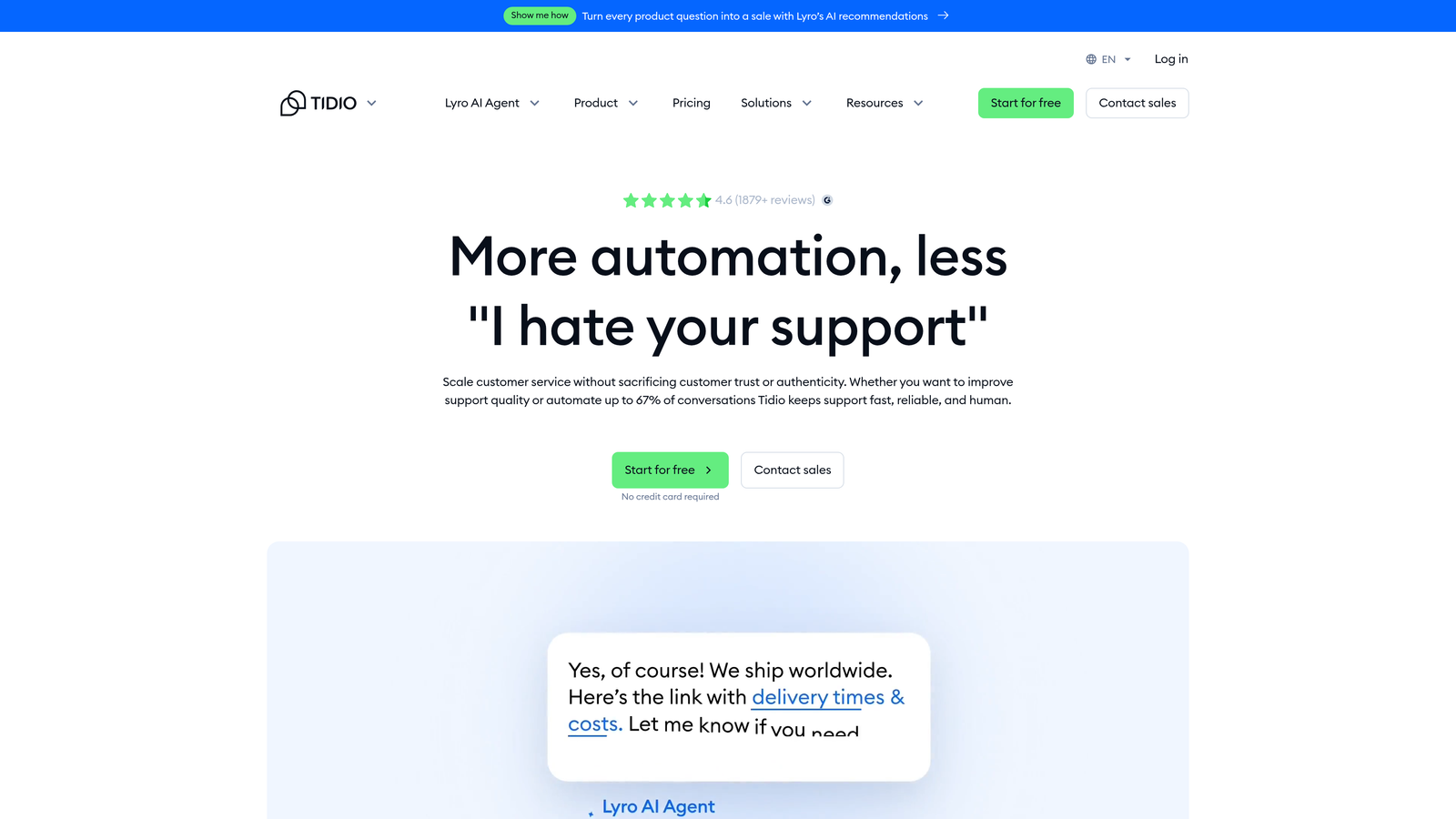
Tidio is a live chat and AI chatbot platform built for fast deployment, with Lyro AI handling common customer queries autonomously.
Where This Tool Shines
Tidio's primary advantage is speed. Teams can deploy Lyro AI and have a functioning chatbot handling common queries in a fraction of the time it takes to configure enterprise platforms. The Shopify and WooCommerce integrations make it particularly well suited to e-commerce environments where product and order queries dominate the support queue.
For B2B SaaS teams with nuanced, multi-step product questions, Tidio is less of a natural fit. Its strength is high-volume, relatively predictable query types rather than complex technical support scenarios. That's not a criticism; it's a use-case match consideration.
Key Features
Lyro AI Chatbot: Conversational AI that autonomously handles common customer queries using your existing content.
Live Chat with Agent Takeover: Smooth handoff from AI to human agents when queries exceed bot capability.
E-Commerce Integrations: Native connections to Shopify and WooCommerce for order-aware support conversations.
Visual Flow Builder: Drag-and-drop chatbot conversation designer for non-technical teams.
Multi-Channel Support: Covers email and Facebook Messenger in addition to web chat.
Best For
E-commerce businesses, small teams, and companies with straightforward, high-volume support queries that benefit from fast deployment over deep customization.
Pricing
Free plan available. Lyro AI starts at approximately $29 per month. Tidio+ plans are available for larger teams with higher volume requirements.
6. Drift (Salesloft)
Best for: Revenue-focused teams where support automation and sales engagement overlap significantly
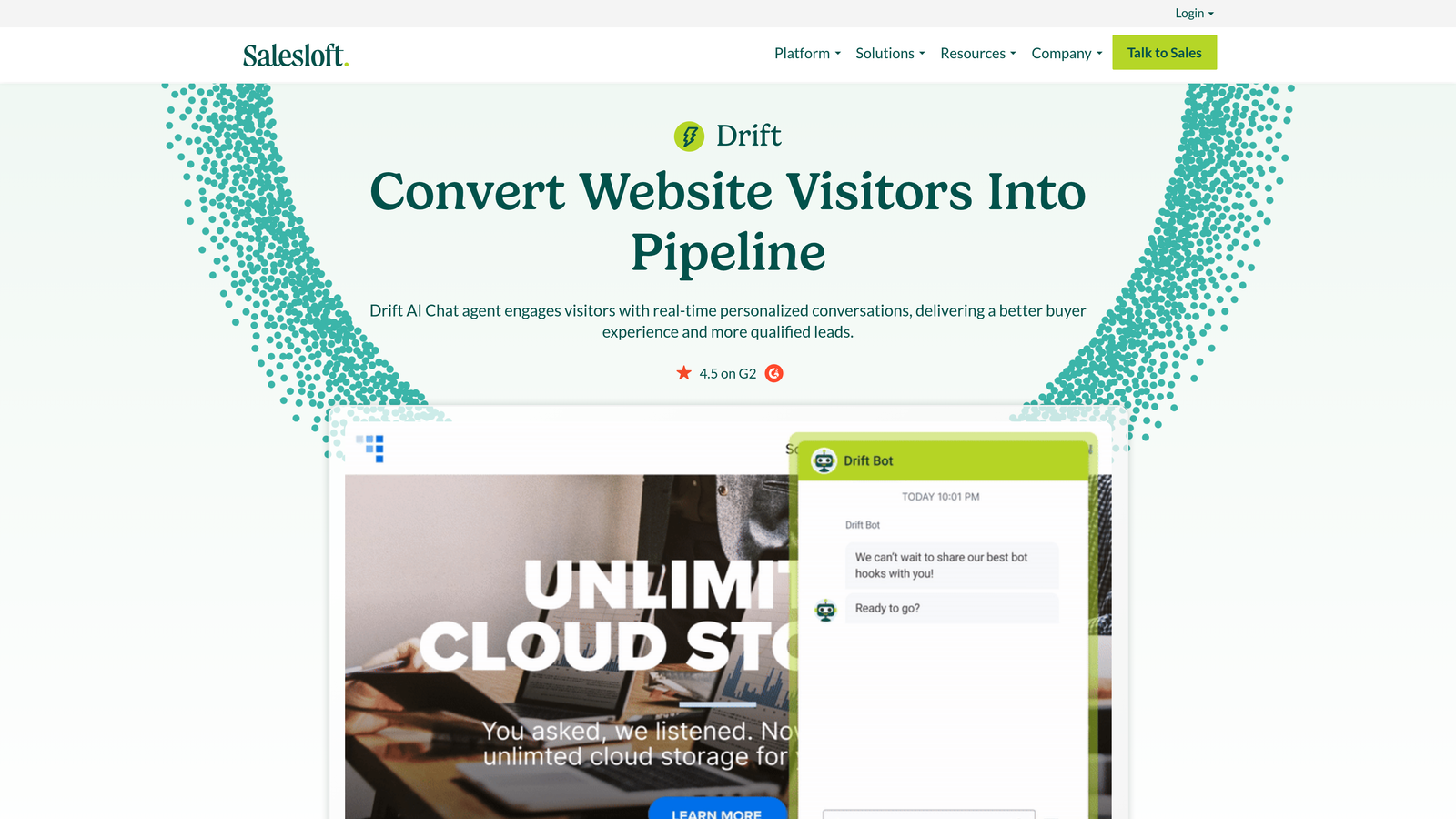
Drift is a conversational AI platform now part of Salesloft, designed for teams where support automation and sales engagement intersect.
Where This Tool Shines
Drift's differentiation is its revenue orientation. Where most support platforms focus purely on ticket resolution, Drift brings real-time visitor intelligence, intent signals, and pipeline qualification into the same conversation layer. For teams where the line between support and sales is deliberately blurred, the Salesloft integration creates a unified revenue team workflow that few other tools can match.
Teams evaluating Drift purely for support automation may find the sales-forward positioning either a strength or a distraction depending on their organizational structure. It's worth being clear about which problem you're primarily solving before engaging.
Key Features
Conversational AI Bots: Handles both support resolution and sales pipeline qualification within the same platform.
Visitor Intelligence: Real-time intent signals and account identification for proactive engagement.
Salesloft Integration: Deep alignment between support conversations and revenue team workflows.
Meeting Scheduling Automation: Allows prospects and customers to book meetings directly within chat conversations.
Account-Based Engagement: Tailored conversation experiences based on account-level data and segments.
Best For
Mid-market to enterprise teams where support, sales, and customer success functions share responsibility for revenue outcomes, and where the Salesloft ecosystem is already in use or under consideration.
Pricing
Contact for pricing. Drift is positioned as a mid-to-enterprise solution, and pricing reflects that positioning. Request a custom quote based on your team size and use case.
7. Help Scout
Best for: Customer-centric teams where relationship quality and agent experience drive retention
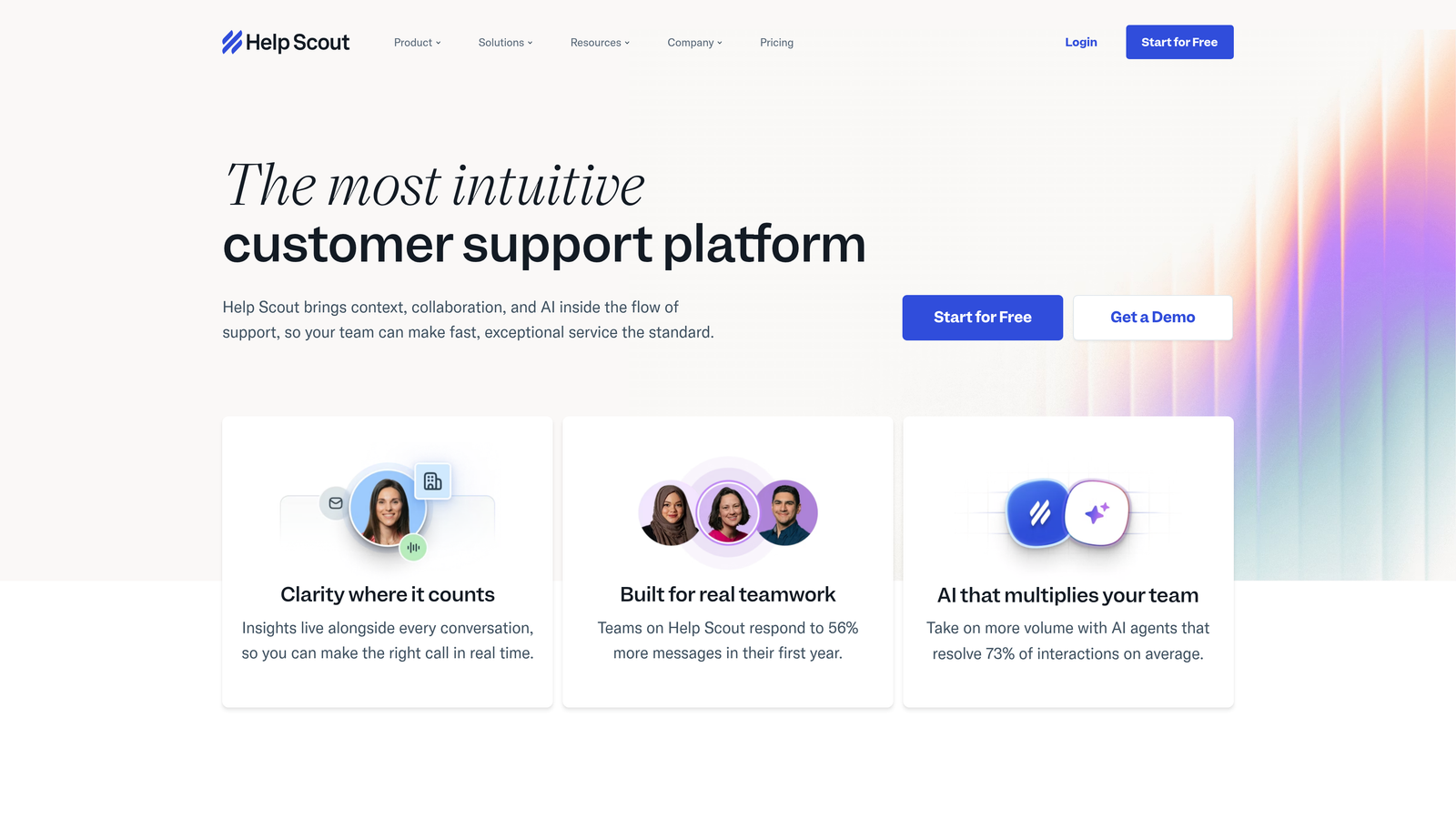
Help Scout is a support platform with a deliberately human-first philosophy, using AI to assist agents rather than replace them.
Where This Tool Shines
Help Scout has a clear and intentional point of view: AI should make human agents better, not sideline them. For teams where the quality of the support relationship is a genuine competitive differentiator, this philosophy translates into a product experience that agents actually enjoy using. The shared inbox with collision detection, clean UI, and AI-assisted drafting creates a low-friction environment for high-quality human responses.
If autonomous ticket deflection is your primary goal, Help Scout is the wrong tool. But if your support team is a key part of your retention strategy and you want AI to amplify their effectiveness rather than replace them, it's one of the most thoughtfully designed options in this category.
Key Features
AI Drafts: Generates response drafts for agents to review, edit, and send, reducing blank-page friction without removing human judgment.
AI Summarize: Condenses long conversation threads so agents can get up to speed instantly on complex tickets.
AI Answers: Powers self-service knowledge base queries so customers can find answers without opening a ticket.
Shared Inbox with Collision Detection: Prevents multiple agents from responding to the same conversation simultaneously.
Docs Knowledge Base: Built-in documentation tool with AI-enhanced search for customer self-service.
Best For
Teams where support quality is a brand differentiator, customer success and support overlap heavily, and the goal is augmenting skilled agents rather than maximizing autonomous deflection.
Pricing
Standard plans start at approximately $20 per user per month. AI features are included on Plus and Pro plans.
8. Kustomer
Best for: Teams needing CRM-native support with full customer timeline context embedded in every interaction
Kustomer is a CRM-native support platform owned by Meta, with AI-powered automation built around a unified customer timeline view.
Where This Tool Shines
Kustomer's defining feature is context depth. Every support conversation surfaces the full customer timeline: past purchases, previous tickets, subscription status, and behavioral data, all visible to the agent without switching tools. For teams managing complex customer relationships where historical context directly affects how a query should be handled, this is genuinely valuable.
The AI-powered routing, sentiment analysis, and workflow automation sit on top of that rich data layer, making automations smarter because they're working with more complete information. It's a strong fit for subscription businesses and teams where customer lifetime value shapes how support prioritization decisions are made.
Key Features
Unified Customer Timeline: Aggregates all customer touchpoints, purchases, and interactions into a single view accessible during every support conversation.
AI-Powered Routing and Sentiment Analysis: Automatically assigns tickets and flags emotional signals to prioritize high-risk conversations.
Business Rule Engine: Flexible workflow automation for complex routing, tagging, and escalation logic.
Omnichannel Inbox: Handles email, chat, SMS, social media, and voice in a unified interface.
CRM Data in Every Conversation: Customer data is embedded in the support view, eliminating context-switching between tools.
Best For
Subscription businesses, DTC brands, and mid-to-enterprise teams where customer lifetime value is a key support prioritization factor and CRM context needs to be embedded in every agent interaction.
Pricing
Enterprise plans start at approximately $89 per user per month. Contact Kustomer directly for current pricing, as it can vary based on team size and feature requirements.
9. Zoho Desk
Best for: Teams in the Zoho ecosystem or SMBs needing competitive pricing with solid AI assistance
Zoho Desk is Zoho's helpdesk solution featuring Zia AI for sentiment analysis, ticket tagging, and agent assistance, with deep integration across the broader Zoho product suite.
Where This Tool Shines
Zoho Desk's strongest case is value density. At pricing well below most competitors, it delivers a capable AI assistant in Zia, solid workflow automation, and native integration with over 40 Zoho applications including Zoho CRM and Zoho Analytics. For teams already operating in the Zoho ecosystem, the cross-suite data flow creates a genuinely connected operational environment.
Teams evaluating Zoho Desk outside the Zoho ecosystem should weigh the integration depth against their existing stack. It's less commonly chosen by pure-play SaaS companies with non-Zoho tooling, but for SMBs and teams where Zoho is the operating system, it's a compelling and cost-effective option.
Key Features
Zia AI Assistant: Provides sentiment detection, anomaly alerts, and reply suggestions to agents based on ticket content and history.
Workflow Automation: Multi-level escalation rules and routing logic for complex support operation requirements.
Zoho Suite Integration: Native connections to Zoho CRM, Zoho Analytics, and 40+ Zoho applications.
AI-Powered Self-Service Portal: Customer-facing knowledge base with intelligent search to reduce inbound ticket volume.
Multi-Department and Multi-Brand Support: Manage multiple support teams or brands from a single Zoho Desk instance.
Best For
SMBs and mid-market teams already using Zoho products, or any team prioritizing cost efficiency and solid AI assistance over cutting-edge AI-native architecture.
Pricing
Free plan available for up to 3 agents. Paid plans start at approximately $14 per agent per month. Zia AI features are available on the Enterprise tier.
Which Tool Is Right for Your Team
The right support automation platform depends heavily on what you're actually trying to solve. Here's a practical orientation to help you match the tool to the need.
For B2B SaaS teams building an AI-native support operation: Halo AI is the clearest fit. Page-aware context, continuous learning, auto bug routing to Linear, and business intelligence that goes beyond ticket metrics make it purpose-built for product-led SaaS environments.
For teams wanting a proven AI agent on a mature platform: Intercom's Fin is capable and well-integrated, though pricing warrants careful modeling at scale.
For enterprise teams with dedicated admin resources: Zendesk offers unmatched configurability and ecosystem depth, with AI capabilities that have improved meaningfully.
For SMBs and cost-conscious mid-market teams: Freshdesk delivers strong value, and Zoho Desk is worth evaluating if you're already in the Zoho ecosystem.
Before signing any contract, ask vendors these four questions: How does your AI handle multi-step, context-dependent queries rather than simple FAQ lookups? What does the human handoff experience look like for the customer? What integrations are native versus requiring third-party middleware? And what does total cost of ownership look like at our projected conversation volume, not just the base license?
The answers will surface more than any feature comparison matrix.
Your support team shouldn't scale linearly with your customer base. Let AI agents handle routine tickets, guide users through your product, and surface business intelligence while your team focuses on complex issues that need a human touch. See Halo in action and discover how continuous learning transforms every interaction into smarter, faster support.