9 Best Support Automation Software Options (With Pricing & Quotes) in 2026
This guide compares the 9 best support automation software options in 2026, providing transparent pricing details and support automation software quotes so teams can evaluate platforms and enter vendor conversations fully prepared—without sitting through unnecessary demos first.
 Grant CooperFounder14 min read
Finding the right support automation software is harder than it looks. Most vendors bury their pricing, use vague feature lists, and make you sit through a demo before you can get a real quote. This guide cuts through that noise.
We've rounded up the strongest support automation platforms available in 2026, covering what each one does well, who it's built for, and what you can expect to pay. Whether you're a B2B SaaS team outgrowing your helpdesk, a product team drowning in repetitive tickets, or an ops leader trying to scale support without scaling headcount, this list gives you the signal you need to shortlist the right tools and walk into vendor conversations prepared.
We've also flagged which platforms offer transparent self-serve pricing versus those that require a custom quote, so you know what to expect before you reach out.
How Pricing Works Across This Category
Before diving into the tools, it's worth understanding the pricing patterns you'll encounter. Most platforms use per-seat or per-agent pricing as their base model, with AI features gated behind higher tiers or sold as add-ons. Enterprise plans almost universally require a custom quote, and implementation fees are common but not always disclosed upfront.
A newer pattern is worth watching: AI-native tools are increasingly moving toward usage-based or per-resolution pricing, which can be more cost-effective at scale but harder to budget for upfront. As you evaluate vendors, ask specifically whether AI automation is included in your plan or billed separately per interaction.
Self-serve pricing available: Freshdesk, Tidio, Help Scout, Gorgias, and Intercom (base plans) all publish pricing publicly.
Custom quote required: Halo AI, Zendesk (enterprise tiers), Kustomer, and Salesforce Service Cloud all require direct contact for accurate pricing.
1. Halo AI
Best for: B2B SaaS teams that need autonomous ticket resolution, not just a chatbot layer.
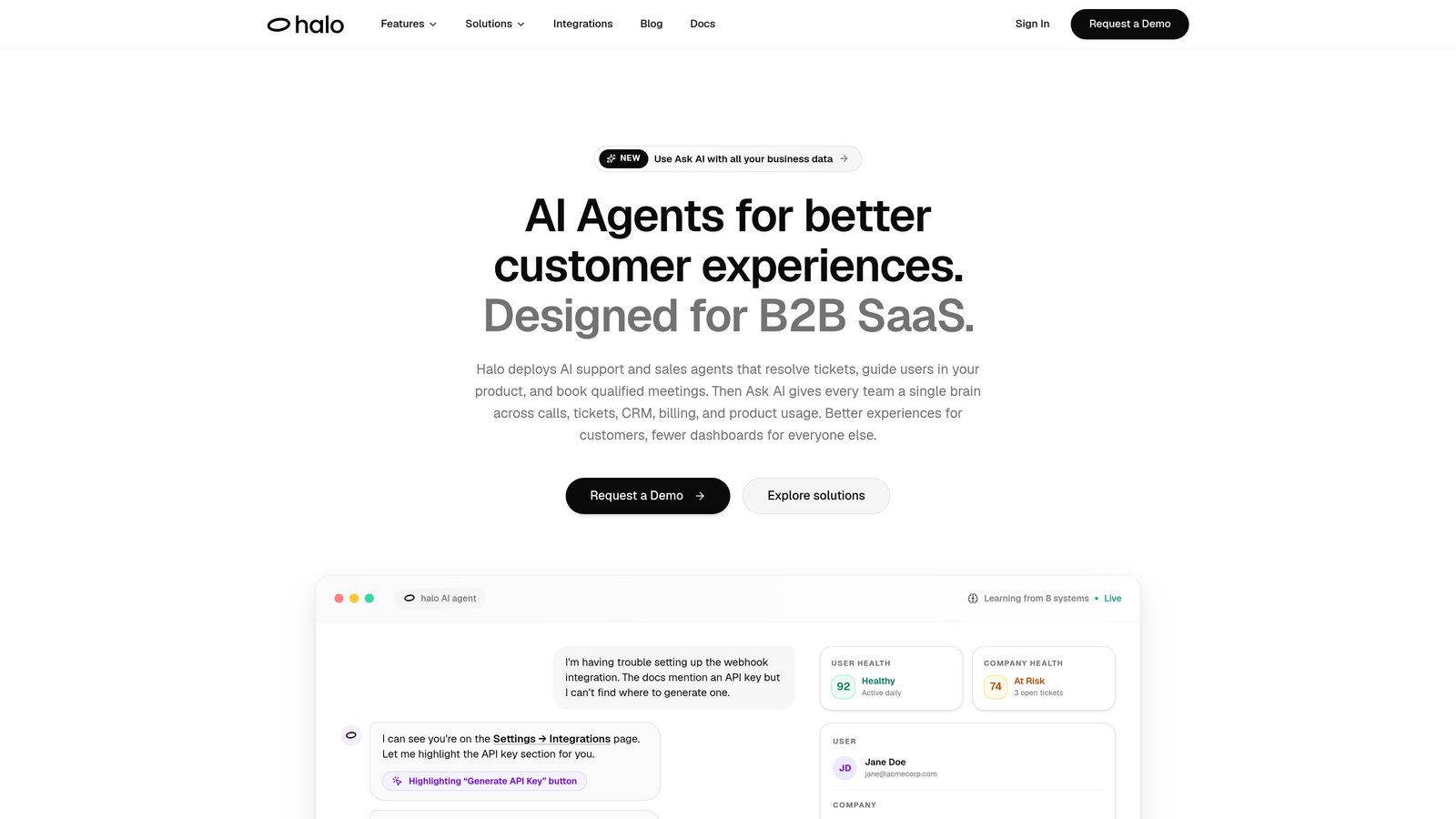
Halo AI is an AI-first customer support platform built natively for autonomous resolution, with page-aware agents, business intelligence built into the inbox, and deep integrations across the modern SaaS stack.
Where This Tool Shines
What separates Halo from most tools on this list is its architecture. Rather than layering AI onto an existing helpdesk, Halo was built from the ground up with autonomous resolution as the primary goal. The page-aware context engine is particularly distinctive: the AI agent understands which part of your product a user is currently viewing, so it can provide precise, contextual guidance rather than generic answers.
The smart inbox goes beyond ticket management. It surfaces business intelligence signals, including customer health indicators, churn risk, and revenue anomalies, directly in the support workflow. This means your support team isn't just resolving tickets; they're generating insights that feed back into product and revenue decisions.
Key Features
Page-Aware AI Agents: The AI understands the user's current context within your product, enabling precise guidance without requiring users to describe where they are.
Smart Inbox with Business Intelligence: Surfaces customer health signals, revenue anomalies, and churn risk directly alongside ticket data.
Auto Bug Ticket Creation: Automatically routes bug reports to engineering via a Linear integration, reducing the manual handoff between support and development.
Live Agent Handoff: Escalates complex issues to human agents with full conversation context passed through, so nothing gets repeated.
Broad Integration Stack: Connects with Slack, HubSpot, Intercom, Stripe, Zoom, PandaDoc, and Fathom, meaning support data flows into the tools your team already uses.
Continuous Learning: The platform learns from every resolved interaction, improving resolution accuracy over time without manual retraining.
Best For
Halo is best suited for B2B SaaS companies and product-led growth teams that are outgrowing traditional helpdesks and want AI agents that genuinely resolve tickets autonomously. It's particularly strong for teams that want support to generate business intelligence, not just close tickets.
Pricing
Custom quote based on team size and ticket volume. Contact Halo AI directly at haloagents.ai for pricing tailored to your use case.
2. Intercom
Best for: Teams that want a polished conversational AI agent with strong messenger UX.
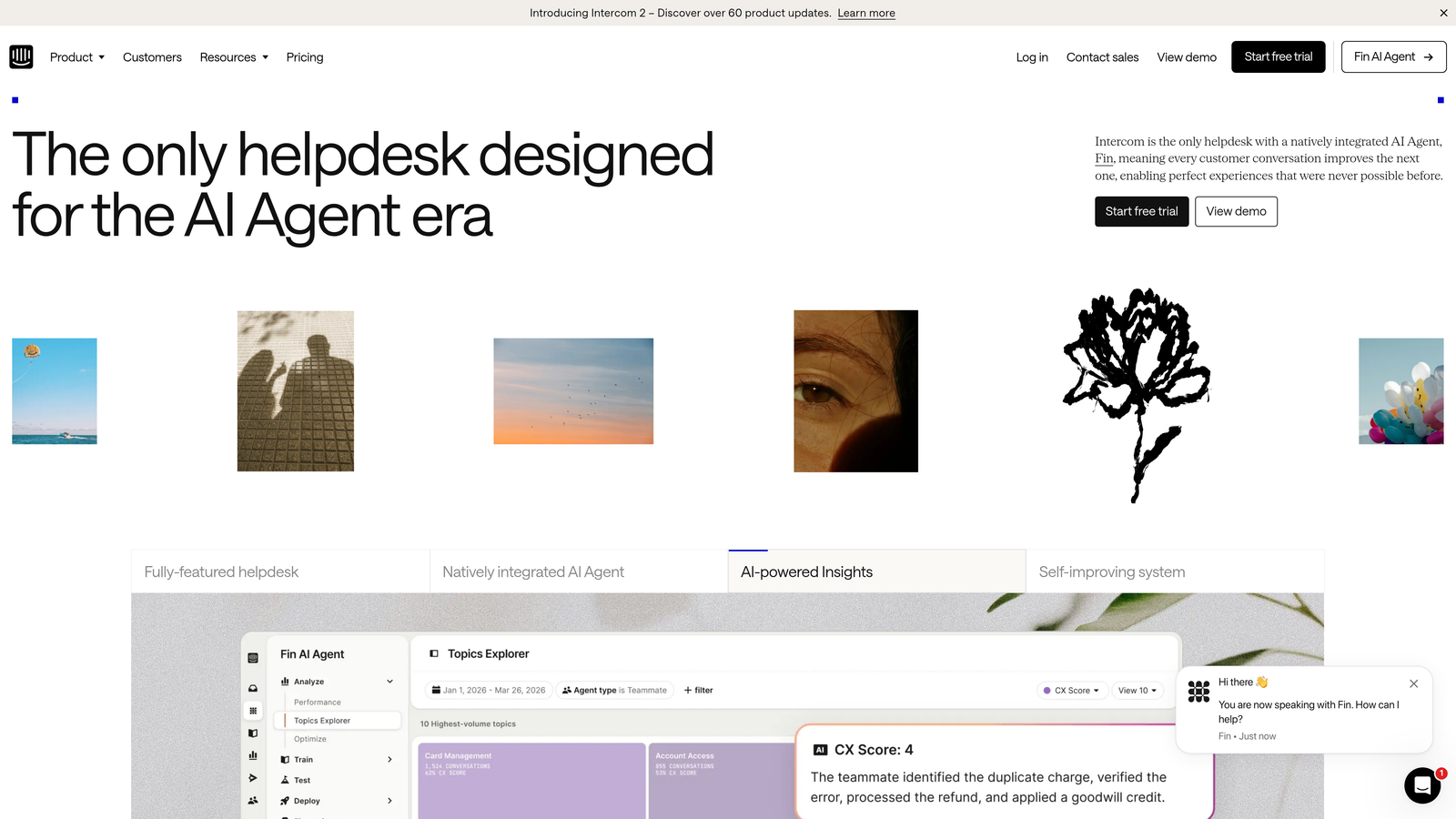
Intercom is a unified customer messaging platform featuring Fin, an AI agent built on large language models that resolves support queries conversationally across chat and email.
Where This Tool Shines
Intercom's Fin AI agent is one of the more mature AI resolution products in the market. It's designed to answer questions conversationally using your existing help content, and it handles escalation to human agents cleanly when it can't resolve an issue. The messenger experience is consistently well-regarded for its polish and ease of use.
The unified inbox across email, chat, and in-app messaging makes Intercom a strong choice for teams that need omnichannel coverage without stitching together multiple tools. The workflow builder for routing and escalation is also flexible enough to handle reasonably complex support logic.
Key Features
Fin AI Agent: Autonomous ticket resolution via chat and email, built on large language models and trained on your help content.
Unified Inbox: Consolidates email, chat, and in-app messaging into a single agent workspace.
Workflow Automation: Visual workflow builder for routing, tagging, and escalation logic.
Help Center Integration: AI-assisted article suggestions surface relevant content during conversations.
Usage-Based Fin Pricing: Fin AI resolutions are billed separately from the base plan, giving teams flexibility to scale AI usage independently.
Best For
Intercom works well for SaaS companies and tech-forward teams that prioritize conversational support UX and want a proven AI agent they can deploy without heavy configuration. It's a strong fit for teams already familiar with the Intercom ecosystem.
Pricing
Base plans start at approximately $39 per seat per month. Fin AI is billed per resolution on top of the base plan. Enterprise pricing requires a custom quote.
3. Zendesk
Best for: Enterprise teams that need deep routing logic, SLA management, and a large integration marketplace.
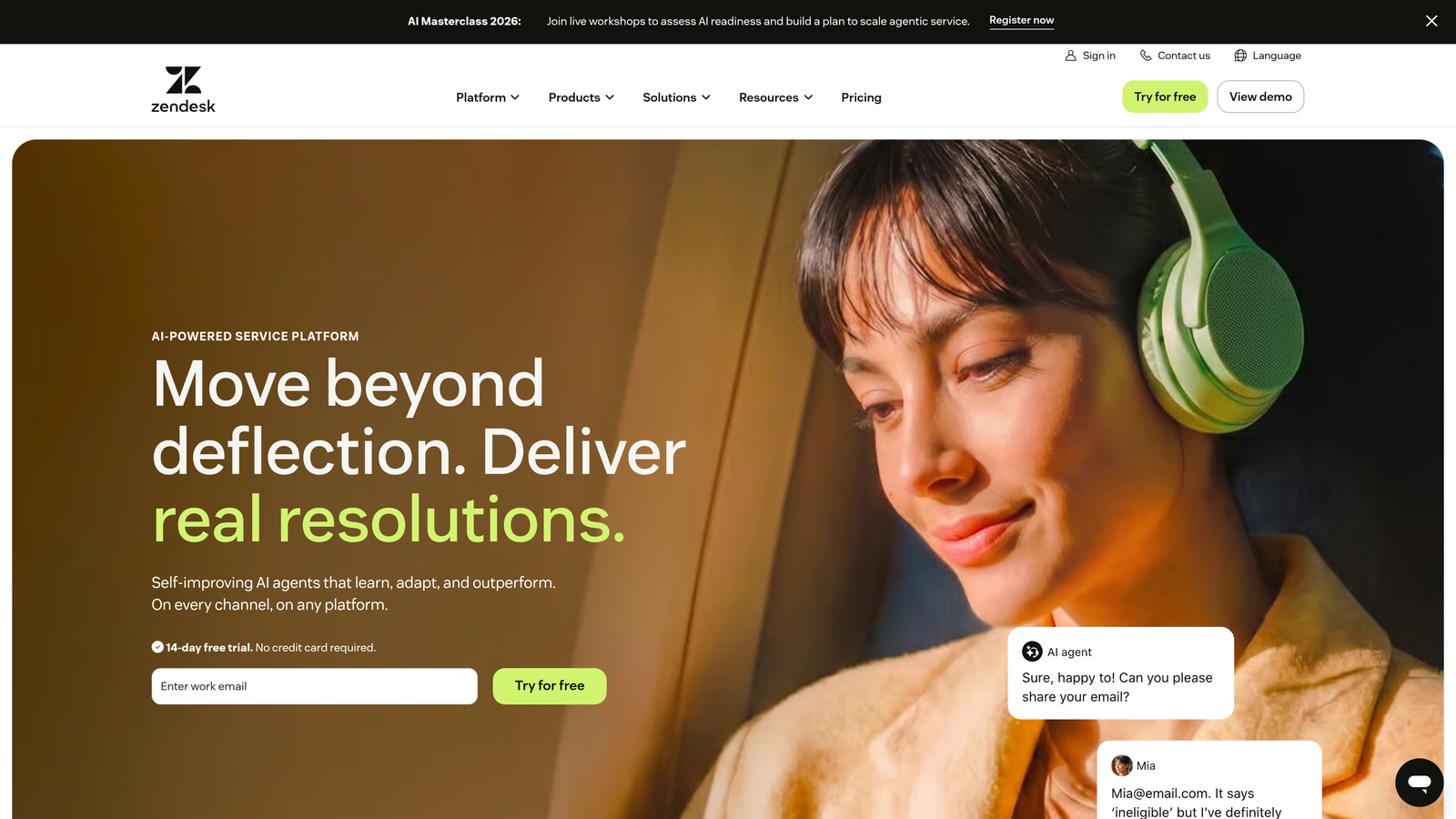
Zendesk is an enterprise-grade helpdesk platform with AI-powered automation, sophisticated routing capabilities, and one of the largest integration ecosystems in the support category.
Where This Tool Shines
Zendesk's strength is its maturity. After years of development and a significant push into AI, the platform now offers ticket triage, intelligent routing, and agent assist as part of its AI suite. For large teams managing high ticket volumes across multiple channels, the SLA management and reporting infrastructure is genuinely robust.
The integration marketplace is also a meaningful differentiator. If your team relies on specialized tools, there's a good chance a pre-built Zendesk integration already exists. This reduces the custom development work that often accompanies enterprise support deployments.
Key Features
Zendesk AI: Covers ticket triage, agent assist, and intelligent routing across the support workflow.
Omnichannel Support: Email, chat, voice, social, and messaging channels managed from a unified workspace.
Advanced SLA Management: Configurable SLA policies with reporting dashboards for tracking compliance.
Integration Marketplace: Hundreds of pre-built integrations covering CRM, billing, project management, and more.
Workforce Management Tools: Available on higher tiers, covering scheduling, quality assurance, and team performance tracking.
Best For
Zendesk is best for larger organizations with complex support operations, multiple channels, and a need for enterprise-grade SLA and reporting infrastructure. It's less ideal for small teams that want fast deployment and simple pricing.
Pricing
Suite plans start around $55 per agent per month billed annually. Enterprise plans require a custom quote. AI features are available on higher tiers.
4. Freshdesk
Best for: Growing teams that want AI-assisted automation at accessible price points.
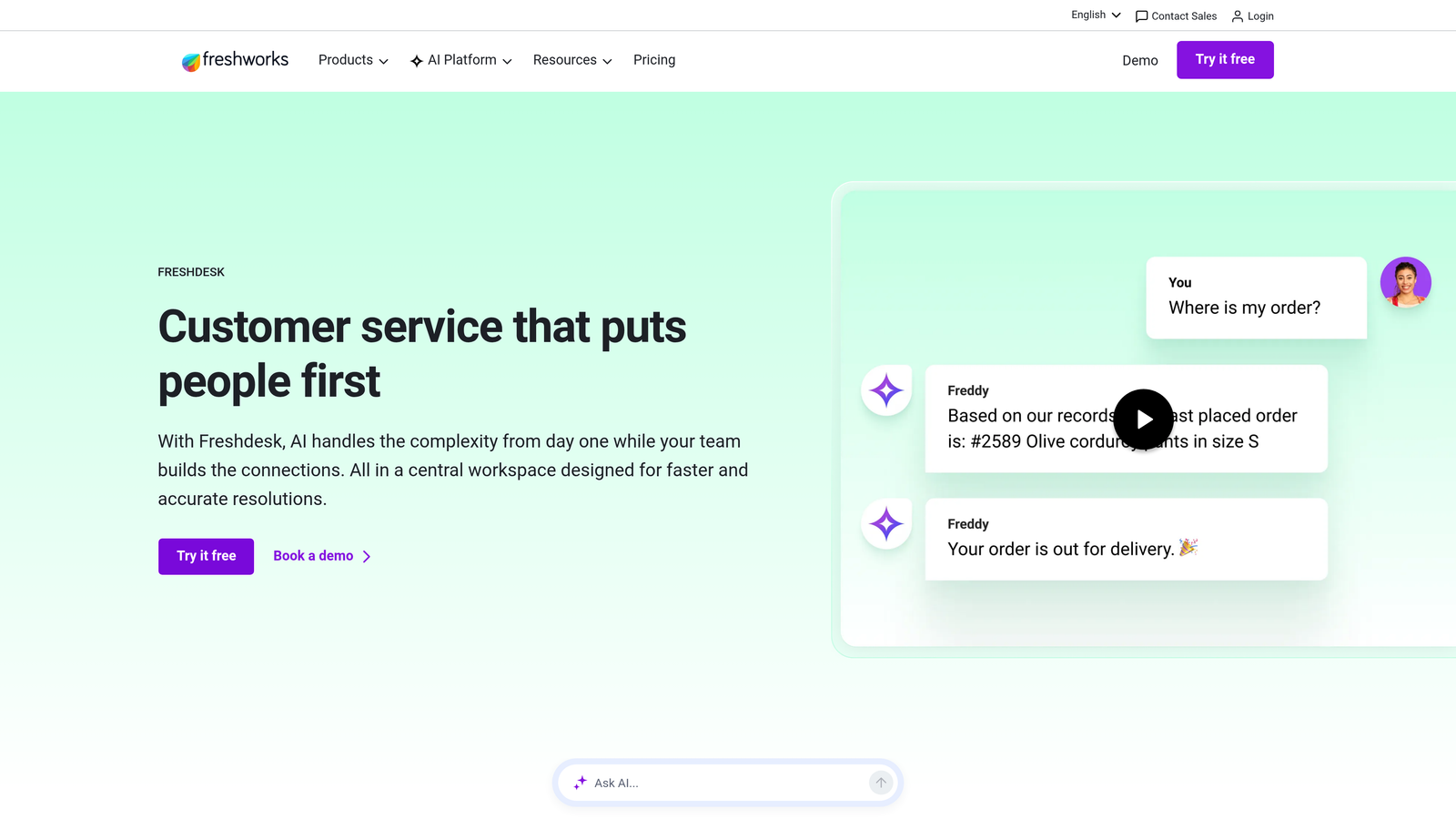
Freshdesk is a helpdesk platform with Freddy AI built in, covering ticket automation, agent assist, and conversational bots across a range of pricing tiers designed for growing teams.
Where This Tool Shines
Freshdesk's biggest advantage is accessibility. The free plan makes it genuinely viable for small teams just getting started, and the paid tiers are priced competitively enough that most SMBs can afford meaningful automation without committing to enterprise contracts. Freddy AI spans multiple use cases: categorizing tickets, suggesting responses to agents, and powering chatbot conversations.
Collision detection, which prevents two agents from working on the same ticket simultaneously, is a small but practically valuable feature that saves real time in shared inbox environments. The marketplace integrations with CRM and billing tools also mean Freshdesk fits into most existing stacks without significant friction.
Key Features
Freddy AI: Handles ticket categorization, agent response suggestions, and chatbot automation across the platform.
Free Plan: Available for small teams with limited features, making it accessible for early-stage companies.
Collision Detection: Prevents duplicate agent responses on the same ticket.
Canned Responses and Scenario Automations: Speed up repetitive workflows without requiring AI-level configuration.
Marketplace Integrations: Pre-built connections to CRM, billing, and project management tools.
Best For
Freshdesk is a strong fit for SMBs and growing teams that want AI-assisted automation without enterprise pricing. It's particularly appealing for teams that want to start free and scale up as their needs grow.
Pricing
Free plan available. Paid plans start around $15 per agent per month on the Growth tier. Pro and Enterprise tiers are priced higher; enterprise requires a custom quote.
5. Tidio
Best for: Small and mid-size businesses that want fast deployment without complex configuration.
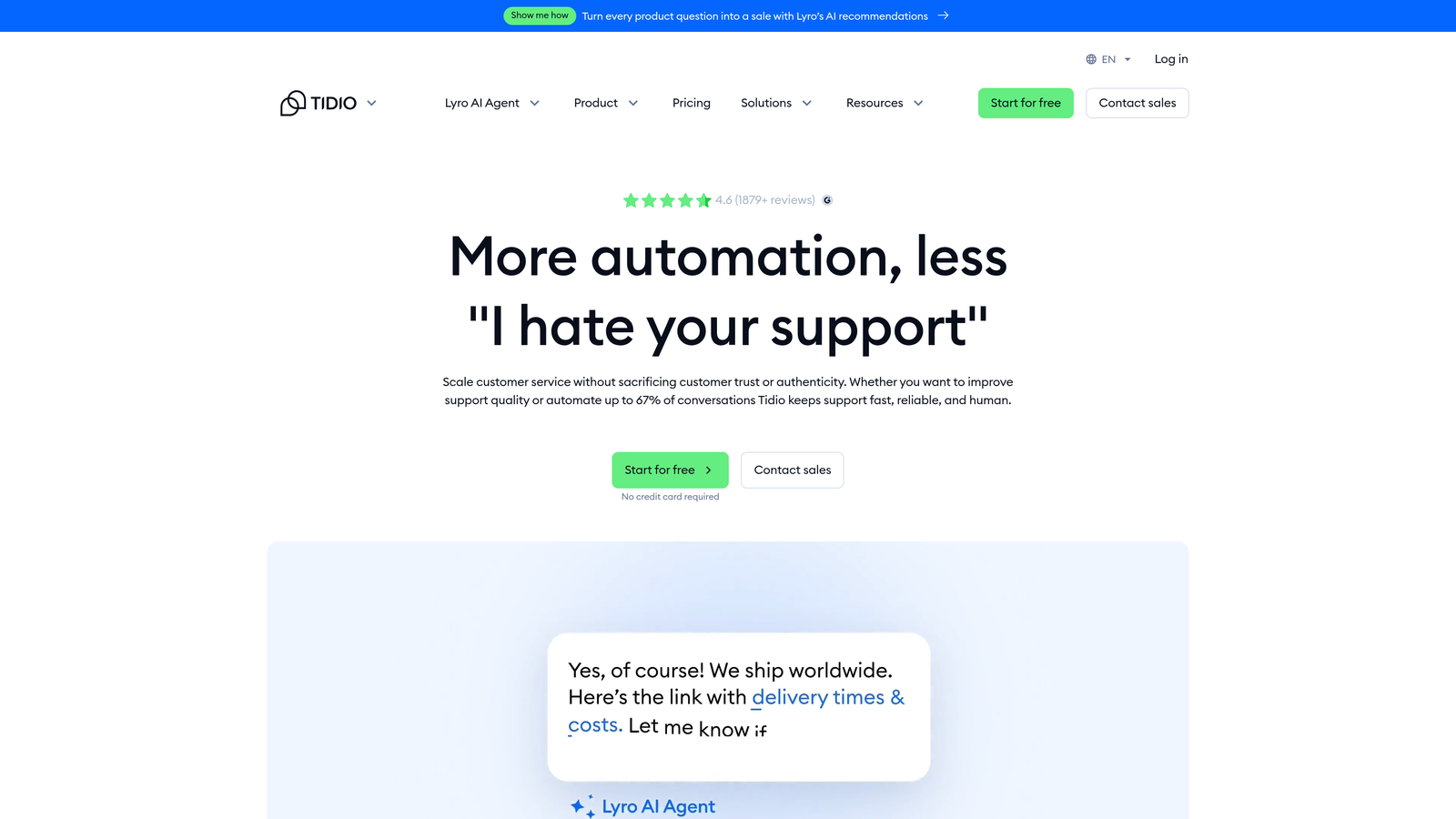
Tidio is a live chat and AI chatbot platform featuring Lyro, a conversational AI designed for teams that want to get up and running quickly without a lengthy implementation process.
Where This Tool Shines
Tidio's appeal is speed. The visual flow builder for chatbot logic requires no coding, and Lyro AI can be deployed against your existing help content without significant setup. For small businesses or e-commerce teams that need conversational automation fast, Tidio removes most of the friction that slows down other platform deployments.
The live chat agent takeover feature works cleanly: when Lyro can't resolve an issue, a human agent can step in without the customer experiencing a jarring transition. This makes the bot-to-human handoff feel natural rather than mechanical.
Key Features
Lyro AI: Conversational AI for automated support, trained on your help content with no coding required.
Visual Flow Builder: Drag-and-drop chatbot logic builder accessible to non-technical teams.
Live Chat with Agent Takeover: Smooth handoff from bot to human agent within the same conversation.
E-commerce Integrations: Native connections to Shopify and WooCommerce for order-related support queries.
Email and Messenger Support: Extends coverage beyond live chat to email and social messaging channels.
Best For
Tidio works best for small to mid-size businesses, particularly in e-commerce, that want conversational AI automation without a complex implementation. It's less suited for enterprise teams with sophisticated routing or SLA requirements.
Pricing
Free plan available. Paid plans start around $29 per month. Lyro AI conversations are billed separately based on volume, so factor this into your budget planning.
6. Gorgias
Best for: E-commerce brands that want support and order data in the same view.
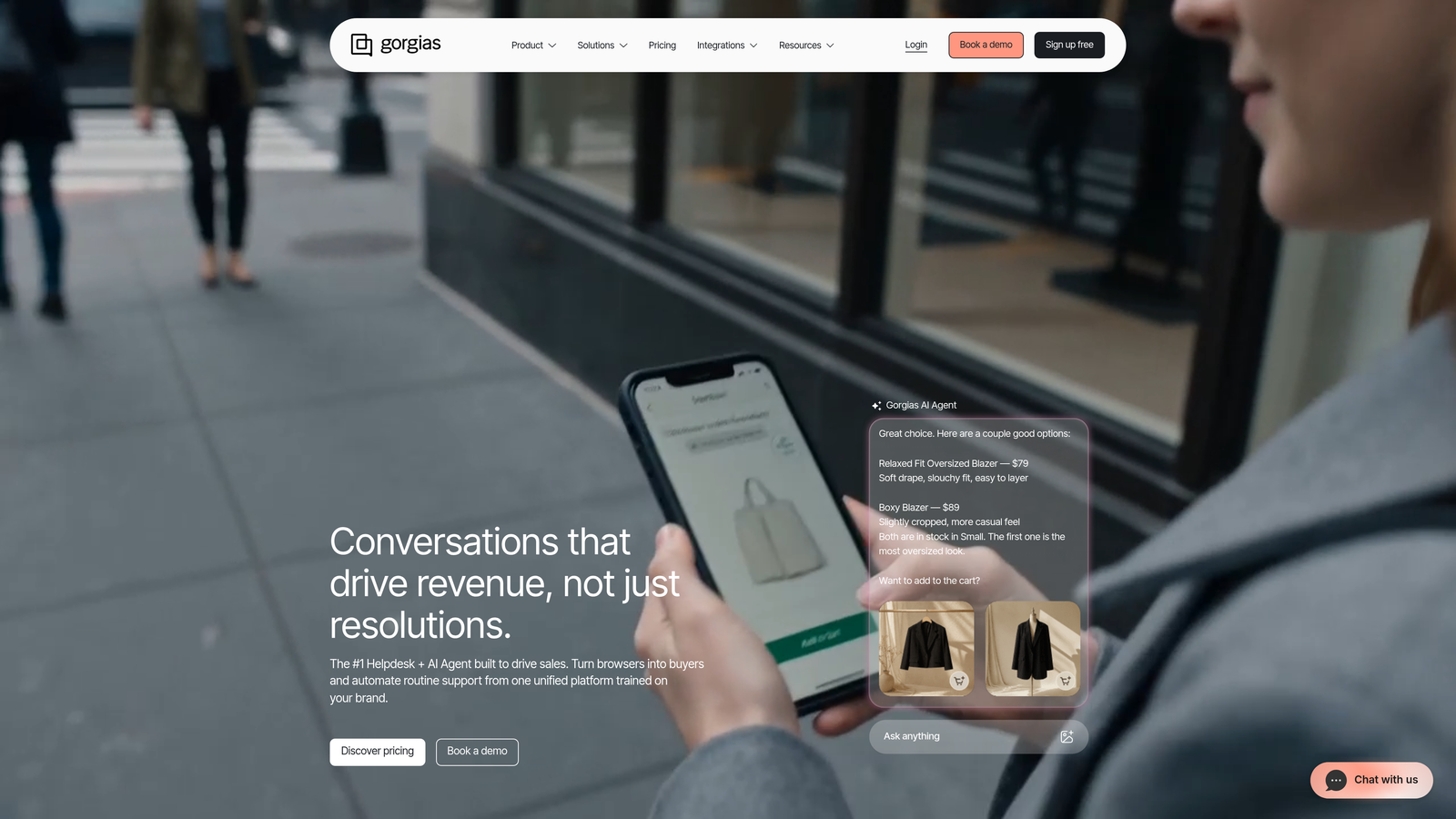
Gorgias is a helpdesk built specifically for e-commerce brands, with deep integrations into Shopify, BigCommerce, and Magento that surface order data directly within every support ticket.
Where This Tool Shines
Gorgias solves a specific and real problem for e-commerce support teams: the constant tab-switching between helpdesk and order management systems. By pulling order data directly into the ticket view, agents can handle order status questions, returns, and shipping issues without leaving the support interface. This reduces handle time meaningfully for teams whose ticket volume is dominated by these query types.
The ticket-volume-based pricing model is also unusual and worth highlighting. Most helpdesks charge per agent seat, which can penalize teams that use a small number of agents to handle high volumes. Gorgias's model scales with ticket count instead, which can be more predictable for e-commerce brands with seasonal volume spikes.
Key Features
Order Data in Tickets: Shopify, BigCommerce, and Magento order information surfaces automatically within every support ticket.
Volume-Based Pricing: Priced on monthly ticket volume rather than agent seats, which suits high-volume, lean-team operations.
Automation Rules: Pre-built automations for common e-commerce queries including order status, returns, and refunds.
Omnichannel Coverage: Email, chat, social, and SMS channels managed from a unified inbox.
Revenue Statistics: Ties support interactions to revenue impact, helping teams demonstrate the business value of support.
Best For
Gorgias is purpose-built for e-commerce brands running on Shopify or similar platforms. It's not designed for B2B SaaS or service businesses, but for its target use case, it's difficult to beat.
Pricing
Pricing is based on monthly ticket volume rather than agent seats. Starter plans begin around $10 per month for low volumes and scale with ticket count. Pricing is publicly listed on their website.
7. Help Scout
Best for: Teams that prioritize simplicity and a human-feeling support experience.
Help Scout is a clean, straightforward helpdesk with a shared inbox, Docs knowledge base, and AI features designed for teams that want powerful-enough tooling without unnecessary complexity.
Where This Tool Shines
Help Scout's defining characteristic is its restraint. The interface is genuinely clean, the learning curve is short, and the feature set covers what most growing teams actually need without overwhelming them with configuration options. For teams that have been burned by over-engineered helpdesks, this is a meaningful differentiator.
The AI Summarize and AI Assist features, added in recent years, help agents respond faster without requiring a full AI agent deployment. They're useful additions that fit naturally into the existing workflow rather than feeling bolted on.
Key Features
Shared Inbox: Collaborative inbox with collision detection and private notes for internal team communication.
Docs Knowledge Base: Built-in knowledge base with AI-powered article suggestions surfaced during conversations.
AI Summarize and AI Assist: Helps agents draft faster responses and get quick summaries of long conversation threads.
Beacon Widget: In-app help widget for proactive support and chat, embeddable in your product.
Simple Reporting: Team performance metrics and customer satisfaction scores without complex analytics configuration.
Best For
Help Scout is ideal for small to mid-size teams that want a well-designed helpdesk with solid AI assist features and transparent pricing. It's a particularly good fit for teams transitioning from email-based support who want structure without steep complexity.
Pricing
Plans start around $22 per user per month on the Standard tier. Plus and Pro tiers are available at higher price points. Pricing is publicly listed on their website.
8. Kustomer
Best for: Omnichannel teams that want a CRM-native support platform with a unified customer timeline.
Kustomer is a CRM-native support platform that unifies every customer interaction across email, chat, SMS, social, and voice into a single timeline view, with AI automation layered throughout.
Where This Tool Shines
Kustomer's core differentiator is the customer timeline. Rather than organizing work around individual tickets, the platform organizes everything around the customer, giving agents a complete view of every interaction across every channel in chronological order. For teams handling complex, multi-touch customer relationships, this context dramatically improves the quality of support.
The built-in CRM data also reduces the need for a separate CRM integration in many cases. For teams that find themselves constantly switching between a helpdesk and a CRM to get full customer context, Kustomer's unified approach removes that friction.
Key Features
Customer Timeline View: Aggregates all cross-channel interactions into a single chronological view per customer.
AI Intent Detection: Automatically identifies customer intent and routes conversations to the right team or workflow.
Omnichannel Inbox: Email, chat, SMS, social, and voice channels unified in one workspace.
Workflow Automation: Automates repetitive processes including routing, tagging, and follow-up tasks.
Built-In CRM Data: Customer profile and history data built into the platform, reducing dependency on external CRM tools.
Best For
Kustomer is well-suited for mid-market and enterprise teams managing complex customer relationships across many channels, particularly in retail, e-commerce, and consumer services where customer history matters as much as ticket resolution.
Pricing
Custom quote required. Kustomer is enterprise-focused; contact them directly for pricing based on your team size, channel mix, and feature requirements.
9. Salesforce Service Cloud
Best for: Enterprise teams already embedded in the Salesforce ecosystem.
Salesforce Service Cloud is an enterprise support platform deeply integrated with the Salesforce ecosystem, with Einstein AI powering case routing, agent recommendations, and self-service automation throughout.
Where This Tool Shines
If your organization is already running Salesforce for CRM and sales, Service Cloud's native integration is a genuine advantage. Agents have immediate access to full account data, opportunity history, and contract details without any additional integration work. Einstein AI uses this data to power case classification, routing, and next-best-action suggestions in ways that would require significant custom development on any other platform.
The reporting and analytics capabilities, built on Salesforce's dashboard infrastructure, are also enterprise-grade. For organizations that need to tie support performance to revenue metrics and account health, the native Salesforce data model makes this straightforward.
Key Features
Einstein AI: Powers case classification, intelligent routing, and next-best-action suggestions using your full Salesforce data.
Native CRM Integration: Full access to Salesforce account, contact, and opportunity data within every support case.
Omni-Channel Routing: Routes cases across email, chat, phone, and social based on configurable logic and agent availability.
AI-Recommended Knowledge Articles: Surfaces relevant knowledge base articles to agents during case resolution.
Advanced Analytics: Reporting built on Salesforce dashboards, enabling cross-functional visibility into support and business performance.
Best For
Salesforce Service Cloud is best for large enterprises already invested in the Salesforce platform. The implementation complexity and pricing make it a poor fit for smaller teams, but for organizations where Salesforce is the system of record, it's a natural extension.
Pricing
Custom quote required. Pricing varies significantly by edition, user count, and add-ons. Contact Salesforce directly for an enterprise quote tailored to your configuration.
Choosing the Right Platform for Your Team
The right support automation software depends heavily on your team's size, technical maturity, and what you actually need AI to do. Here's a quick orientation by use case.
If you're a B2B SaaS team that wants autonomous resolution and business intelligence: Halo AI is the strongest fit. Its page-aware agents, smart inbox, and continuous learning architecture are built specifically for this use case.
If you want a polished conversational AI agent with strong UX: Intercom's Fin is a proven option, particularly if you're already familiar with the Intercom ecosystem.
If you're an enterprise team with complex routing and SLA requirements: Zendesk or Salesforce Service Cloud (if you're in the Salesforce ecosystem) are the mature choices.
If you're a growing SMB that wants accessible pricing and fast setup: Freshdesk or Help Scout both offer transparent pricing, solid AI assist features, and manageable learning curves.
If you're running an e-commerce brand: Gorgias's order-data integration and volume-based pricing make it the obvious starting point.
When you reach out to vendors for quotes, come prepared with your monthly ticket volume, the number of agents who'll use the platform, the channels you need to cover, and whether you need AI to resolve tickets autonomously or just assist human agents. These four inputs will dramatically speed up the quoting process and help you compare proposals on equal footing.
Your support team shouldn't scale linearly with your customer base. Let AI agents handle routine tickets, guide users through your product, and surface business intelligence while your team focuses on complex issues that need a human touch. See Halo in action and discover how continuous learning transforms every interaction into smarter, faster support.