9 Best Support Automation Tools Compared for 2026
This support automation tool comparison evaluates nine leading platforms across AI capability, integrations, escalation handling, and total cost of ownership to help SaaS teams, B2B companies, and ops leaders find the right fit. Rather than ranking by price alone, the guide matches each solution to specific team situations—from reducing repetitive tickets to scaling support without adding headcount.
 Grant CooperFounder15 min read
Choosing the right support automation tool has never been more consequential, or more confusing. The market has matured well beyond simple rule-based chatbots, and today's options range from bolt-on AI layers to fully autonomous agent platforms with business intelligence baked in. The differences between them go far deeper than pricing tiers.
Whether you're a SaaS product team drowning in repetitive tickets, a B2B company trying to scale support without scaling headcount, or an ops leader evaluating a migration away from a legacy helpdesk, this comparison cuts through the noise. We evaluated nine tools across AI capability depth, integration ecosystem, escalation handling, analytics quality, and total cost of ownership.
Each tool covered here is genuinely strong in its category. The goal is to help you match the right solution to your team's actual situation. If you're also exploring foundational context, our guide to the best customer support automation tools is worth reading alongside this comparison.
1. Halo AI
Best for: SaaS and B2B teams wanting AI-first autonomous support with business intelligence built in.
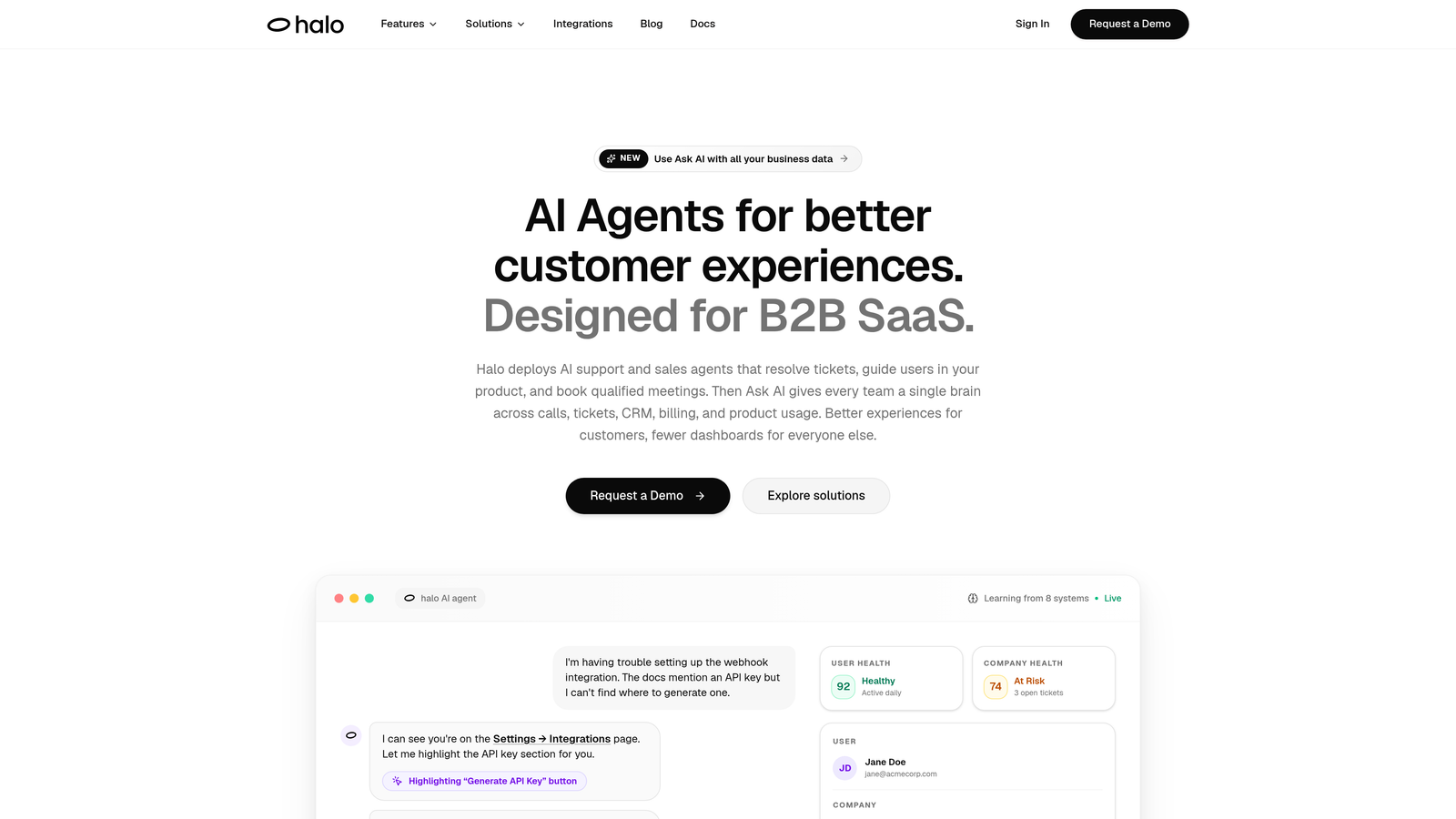
Halo AI is an AI-first customer support platform that deploys autonomous agents for ticket resolution, provides page-aware visual guidance, and surfaces business intelligence signals while continuously learning from every interaction.
Where This Tool Shines
Most support AI tools are bolted onto existing helpdesks. Halo is built AI-first from the ground up, which means the intelligence layer isn't an afterthought. The platform's page-aware context engine is a genuine differentiator: it sees what the user currently sees inside your product, enabling guidance that's precise and relevant rather than generic.
Beyond deflection, Halo surfaces business intelligence that most support tools simply don't touch. Customer health signals, revenue anomaly detection, and churn indicators emerge from support interactions, giving product and ops teams visibility they'd otherwise need a separate analytics tool to capture. For SaaS teams, the auto bug ticket creation routed directly to Linear is a standout feature that closes the loop between support and engineering without manual handoffs.
Key Features
Page-Aware Chat Widget: Understands the user's current product context to deliver precise, relevant guidance rather than generic help center links.
Autonomous Ticket Resolution: AI agents resolve tickets end-to-end with intelligent escalation to human agents for complex or sensitive issues.
Auto Bug Ticket Creation: Automatically generates and routes bug reports to Linear or your preferred issue tracker, removing manual engineering handoffs.
Smart Inbox with Business Intelligence: Surfaces customer health signals, revenue anomaly detection, and churn indicators directly from support data.
Deep Integration Ecosystem: Connects natively with Slack, HubSpot, Intercom, Stripe, Zoom, PandaDoc, Fathom, and Linear.
Continuous Learning Engine: Improves resolution quality with every interaction, meaning the system gets meaningfully smarter over time rather than staying static.
Best For
Halo is the strongest fit for SaaS product teams and B2B companies that want autonomous ticket resolution without sacrificing intelligence quality. Teams that need support data to feed into product and revenue decisions, rather than just measuring CSAT, will find the business intelligence layer particularly valuable. It's also well-suited for teams that currently bounce between multiple tools to manage support, engineering handoffs, and customer health monitoring.
Pricing
Contact for pricing. A free trial is available at haloagents.ai. Given the platform's depth, pricing is tailored to team size and usage.
2. Intercom (Fin AI Agent)
Best for: Teams already embedded in the Intercom ecosystem who want high-quality autonomous conversation resolution.
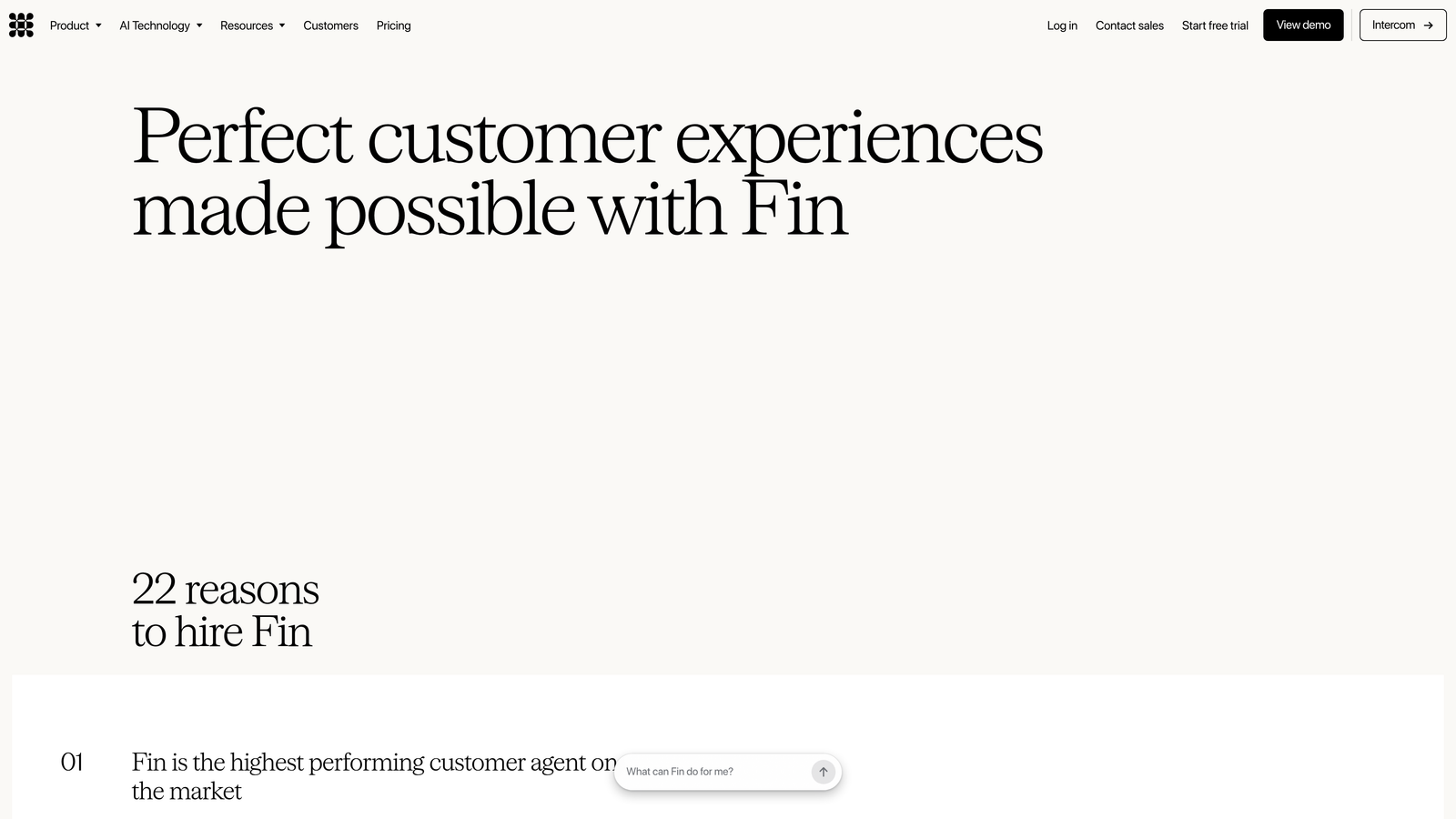
Intercom's Fin AI Agent is a conversational AI that resolves support queries autonomously using your help center content and custom answers, natively embedded in the Intercom messenger.
Where This Tool Shines
Fin is one of the more capable AI agents in the market for straightforward conversational resolution. It draws on your existing help center articles and custom knowledge to handle queries without human involvement, and the handoff to a human agent is smooth, preserving full conversation context so customers don't have to repeat themselves.
The resolution-based pricing model is an interesting structural choice. Instead of paying per seat or per conversation, you pay per resolved conversation, which aligns cost directly with value delivered. For teams with high deflection rates, this can be efficient. For teams with complex queries that resist automation, it's worth modeling carefully before committing.
Key Features
Autonomous Resolution: Handles queries end-to-end using help center articles and custom answers without agent involvement.
Resolution-Based Pricing: Pay per resolved conversation rather than per seat, aligning cost with actual outcomes.
Native Intercom Integration: Embedded directly in Intercom workflows, inbox, and reporting with no additional configuration layer.
Context-Preserved Handoff: Escalates to human agents with the full conversation history intact.
Multilingual Support: Handles multiple languages out of the box, useful for global support teams.
Best For
Fin is the natural choice for teams already using Intercom as their primary support platform. It's less suited for teams wanting helpdesk-agnostic AI or those who need business intelligence beyond conversation resolution. If you're not already in the Intercom ecosystem, the switching cost is worth factoring into the decision.
Pricing
Resolution-based pricing starting at approximately $0.99 per resolved conversation; Intercom plans from approximately $39 per seat per month. Verify current pricing at intercom.com.
3. Zendesk AI
Best for: Large enterprises with existing Zendesk investments looking for AI embedded across the full support lifecycle.
Zendesk AI is an AI layer embedded across the Zendesk Suite, covering intelligent triage, intent and sentiment detection, autonomous agents, and an AI copilot for human agents.
Where This Tool Shines
Zendesk AI's strength is breadth. Rather than a single AI feature, it covers the entire support workflow: incoming tickets are triaged intelligently, agents get suggested replies and ticket summaries, and autonomous agents handle self-service resolution. For organizations with large, established Zendesk deployments, adding the AI layer is a natural extension rather than a platform change.
Enterprise-grade compliance, security controls, and admin configurability are genuine advantages for regulated industries or organizations with strict IT governance requirements. The tradeoff is complexity. Smaller teams often find Zendesk's configuration overhead significant, and the AI features layer additional setup on top of an already substantial platform.
Key Features
Intelligent Triage: Automatically detects intent, sentiment, and language to route and prioritize tickets accurately.
Zendesk AI Agent: Autonomous self-service resolution for common queries without human agent involvement.
Agent Copilot: Provides suggested replies, ticket summarization, and next-best-action guidance to human agents in real time.
Advanced Analytics and QA: Quality assurance automation and detailed performance analytics built into the Suite.
Enterprise Security and Compliance: Robust admin controls, compliance certifications, and security configurations for large organizations.
Best For
Zendesk AI is best suited for large enterprises already running Zendesk at scale. Teams with complex compliance requirements, large agent workforces, and high ticket volumes will get the most from the platform's depth. Smaller teams or those evaluating fresh implementations should weigh the configuration overhead carefully against more streamlined alternatives.
Pricing
AI features available on Suite plans from approximately $115 per agent per month; Advanced AI add-on approximately $50 per agent per month. Verify current pricing at zendesk.com.
4. Freshdesk (Freddy AI)
Best for: SMB and mid-market teams wanting multi-layer AI at a more accessible price point than Zendesk.
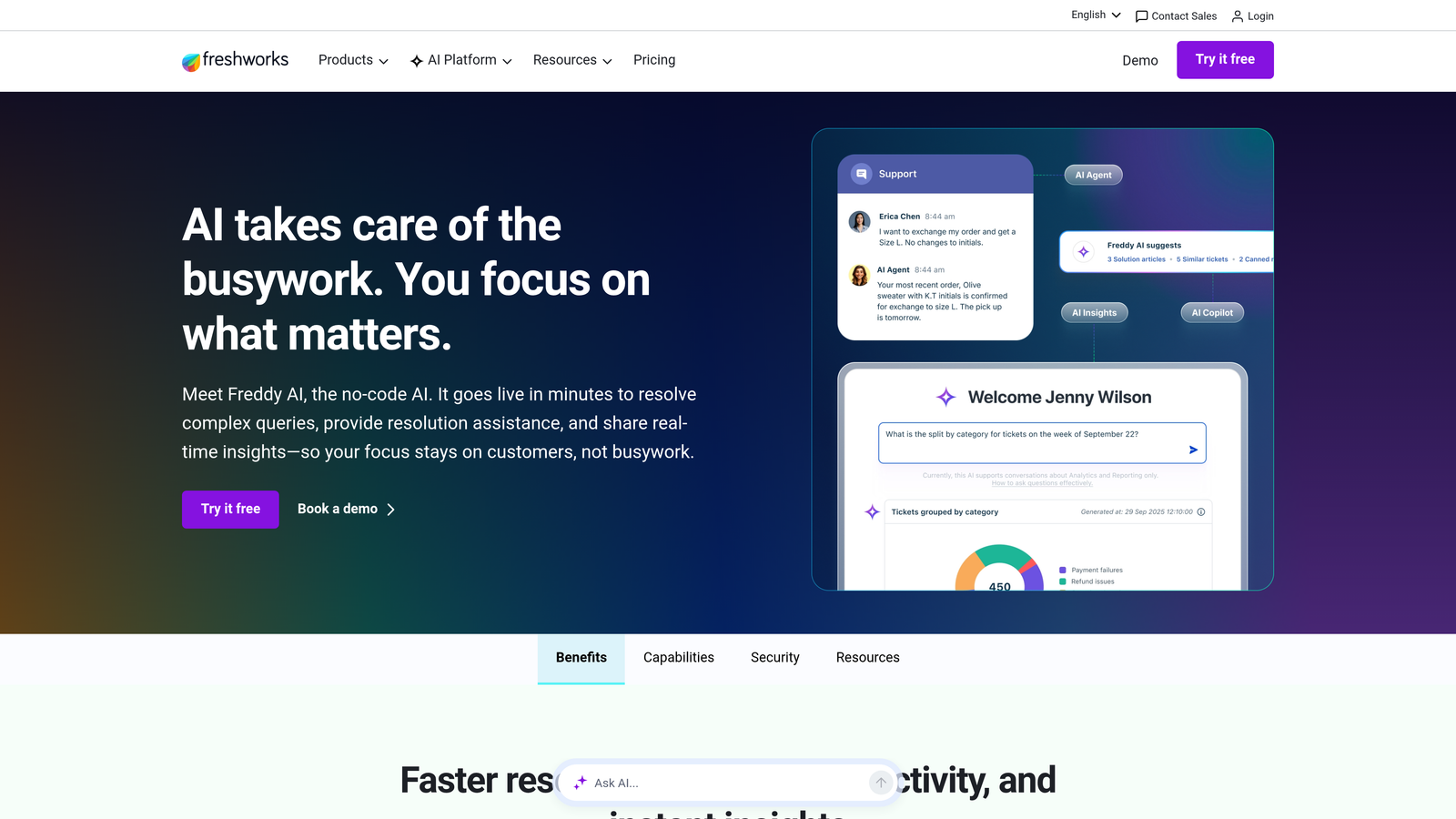
Freshdesk's Freddy AI spans three layers: self-service bots, agent copilot assistance, and analytics insights, within the broader Freshworks customer service suite.
Where This Tool Shines
Freddy AI's three-layer structure is thoughtfully organized. Freddy Self Service handles deflection before tickets are created, Freddy Copilot assists agents with reply suggestions and summarization, and Freddy Insights surfaces trends and anomalies in support data. The fact that these layers span Freshdesk, Freshchat, and Freshservice means teams already in the Freshworks ecosystem get unified AI across channels without additional integration work.
The pricing is meaningfully more accessible than Zendesk for comparable functionality, which makes Freshdesk Freddy a strong consideration for growing teams that need AI capability without enterprise-level spend. The honest tradeoff is that the AI resolution quality for complex queries is generally considered a step below Intercom Fin or Zendesk AI by teams that have evaluated all three.
Key Features
Freddy Self Service: AI bot that deflects common queries before they create tickets, reducing agent workload at the top of the funnel.
Freddy Copilot: Suggested replies, ticket summarization, and tone adjustment tools for agents handling live conversations.
Freddy Insights: AI-driven analytics that surface trends, anomalies, and performance signals in support data.
Freshworks Suite Integration: Unified AI across Freshdesk, Freshchat, and Freshservice without separate configuration.
Competitive SMB Pricing: More accessible entry point than comparable Zendesk tiers, with a free Freshdesk plan available.
Best For
Freshdesk Freddy is a strong fit for SMB and mid-market teams already using Freshworks products, or teams evaluating their first structured helpdesk with AI built in. It's less suited for organizations where autonomous resolution quality at scale is the primary requirement.
Pricing
Freddy AI Copilot from approximately $29 per agent per month as an add-on; Freshdesk plans from free to approximately $69 per agent per month. Verify current pricing at freshworks.com.
5. Tidio
Best for: E-commerce and small business teams wanting fast, low-friction AI chat deployment with native Shopify integration.
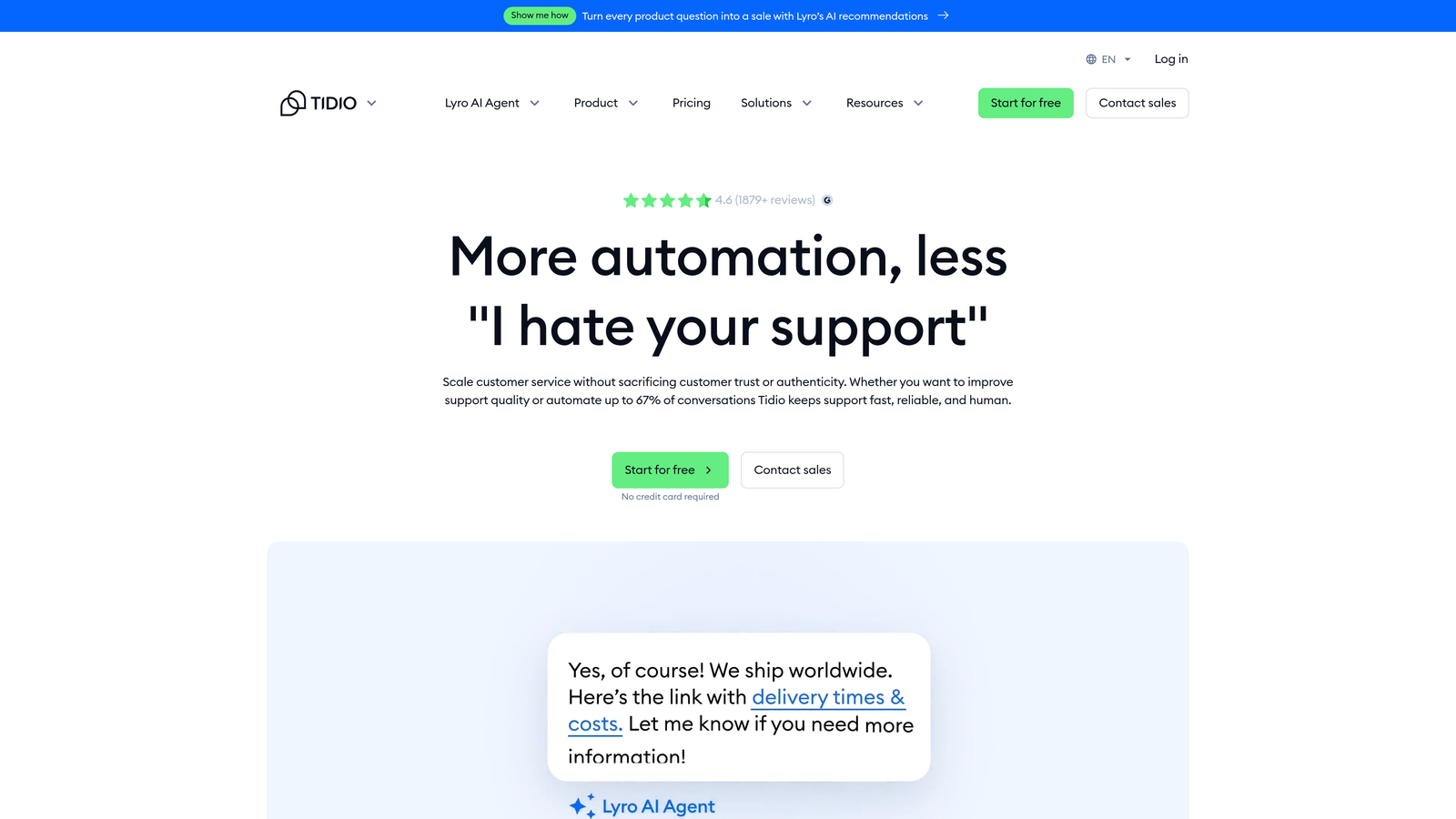
Tidio combines live chat, helpdesk, and its Lyro AI chatbot in a lightweight platform with strong e-commerce integrations, designed for fast deployment with minimal technical overhead.
Where This Tool Shines
Tidio's strongest asset is speed to value. Teams can deploy Lyro AI and have it handling customer queries in hours rather than days, which is genuinely unusual in this space. The visual flow builder makes automation accessible without developer involvement, and the native Shopify, WooCommerce, and WordPress integrations mean e-commerce teams don't need custom work to connect their store data.
For small teams where budget and simplicity are the primary constraints, Tidio delivers a meaningful amount of capability at a price point that larger platforms can't match. The limitation is ceiling: Tidio is built for relatively straightforward support workflows, and complex B2B support scenarios with nuanced escalation logic will quickly outgrow what the platform handles well.
Key Features
Lyro AI Chatbot: Conversational AI trained on your support content to handle common queries autonomously.
Visual Flow Builder: No-code automation builder for creating support workflows without developer resources.
E-Commerce Integrations: Native connections to Shopify, WooCommerce, and WordPress for store-aware support.
Unified Inbox: Live chat, email, and social channel management in a single interface.
Fast Deployment: Deployable in hours with minimal technical setup, lowering the barrier to getting AI support running.
Best For
Tidio is purpose-built for e-commerce brands, small businesses, and teams where simplicity and speed of deployment matter more than deep customization. B2B SaaS teams with complex support workflows or enterprise compliance requirements will find it limiting.
Pricing
Free plan available; paid plans from approximately $29 per month; Lyro AI from approximately $39 per month. Verify current pricing at tidio.com.
6. Drift (by Salesloft)
Best for: Revenue-focused B2B teams where support automation and sales pipeline acceleration need to work from the same platform.
Drift is a conversational AI platform now part of Salesloft, bridging customer support automation with sales pipeline acceleration for B2B teams where those functions overlap.
Where This Tool Shines
Drift occupies a genuinely unique position in this comparison: it's the only tool here that was designed from the ground up to serve both support deflection and revenue generation simultaneously. The conversational AI handles inbound queries while also qualifying leads, booking meetings, and routing opportunities into sales workflows. For B2B teams where the line between support and sales conversations is blurry, this unified approach has real appeal.
The Salesloft acquisition has deepened the revenue workflow integrations, connecting Drift conversations directly into sales sequences, CRM data, and pipeline reporting. The honest caveat is that Drift can feel over-engineered for teams with a pure support use case. If autonomous ticket resolution is the primary goal and revenue workflows are secondary, other tools on this list will deliver more focused value.
Key Features
Conversational AI for Support and Sales: Handles both query deflection and lead qualification from a single platform.
AI-Powered Meeting Booking: Automatically routes and books meetings with the right sales or success rep based on conversation context.
Salesloft Revenue Integration: Deep connection with Salesloft workflows, sequences, and CRM data for revenue teams.
Account-Based Personalization: Tailors conversation playbooks based on visitor identity or account data from your CRM.
Unified Conversation View: Combines support and sales conversations in one interface for teams that manage both.
Best For
Drift is the right choice for B2B revenue teams where support and sales conversations regularly intersect, particularly those already using Salesloft. Pure support teams with no revenue workflow requirements will likely find it more complex and expensive than necessary.
Pricing
Enterprise pricing. Contact Salesloft for current packages and verify at salesloft.com.
7. Help Scout
Best for: SMBs and mission-driven companies where support tone, personal relationships, and simplicity are brand priorities.
Help Scout is a human-first customer support platform with AI features designed to assist agents rather than replace them, favored by teams where the quality of human interaction is a competitive differentiator.
Where This Tool Shines
Help Scout's philosophy is refreshingly clear: AI should make human agents better, not eliminate them. The AI features, including Drafts, Summarize, and Answers, are all assistive rather than autonomous. Agents stay in control, and the platform's clean, distraction-free interface reflects the same design sensibility. For teams where a thoughtful, personal reply is more valuable than a fast automated one, this positioning makes sense.
The pricing model is also notably straightforward. Help Scout doesn't layer on per-feature add-on complexity the way many competitors do, which makes budgeting predictable. The platform bundles shared inbox, knowledge base, and live chat in one clean package without requiring teams to assemble a stack of integrations to get basic functionality working.
Key Features
AI Drafts: Generates reply suggestions that agents can review, edit, and send, keeping humans in the loop on every response.
AI Summarize: Condenses long conversation threads into quick context summaries for agents picking up mid-thread.
AI Answers: Deflects common questions in the Beacon chat widget using knowledge base content, reducing inbound volume.
Unified Platform: Shared inbox, knowledge base, and live chat in one interface without requiring additional integrations for core functionality.
Transparent Pricing: Per-user pricing without add-on complexity, making cost predictable as teams grow.
Best For
Help Scout is ideal for SMBs, nonprofits, and companies where brand voice and relationship quality are central to the support experience. Teams seeking high-volume autonomous deflection or advanced AI analytics will find the platform intentionally limited in those areas.
Pricing
Plans from approximately $22 per user per month (Standard) to approximately $65 per user per month (Pro). Verify current pricing at helpscout.com.
8. Kustomer
Best for: High-volume consumer brands and subscription businesses with complex customer histories needing CRM-native AI automation.
Kustomer is a CRM-native customer service platform that gives AI automation full access to complete customer timelines, making it particularly effective for brands where order history, account status, and prior interactions are central to resolving queries.
Where This Tool Shines
The core insight behind Kustomer is that great support automation requires complete customer context, not just the current conversation. By combining support history, order data, and CRM information in a unified customer timeline, Kustomer's AI can respond with a level of relevance that tools operating only on conversation history can't match. A customer asking about a delayed order gets a response that already knows their order status, not a generic deflection.
This context depth is particularly valuable for subscription businesses and D2C brands where customers regularly interact across multiple touchpoints. Kustomer's omnichannel support spans email, chat, SMS, social, and voice from a single platform, which reduces the fragmentation that often plagues high-volume consumer support operations.
Key Features
Unified Customer Timeline: Combines support history, orders, subscriptions, and CRM data in a single view for every customer.
Context-Aware AI Automation: AI responses informed by complete customer history rather than just the current conversation thread.
Omnichannel Coverage: Email, chat, SMS, social, and voice managed from one platform.
Workflow Automation Engine: Routing, tagging, SLA management, and escalation rules configurable without developer involvement.
D2C and Subscription Fit: Purpose-built for brands with complex customer data structures and high interaction volumes.
Best For
Kustomer is the strongest fit for consumer brands, subscription businesses, and D2C companies with high ticket volumes and complex customer data. It's less commonly adopted in pure B2B SaaS contexts, where the CRM-native depth may be more than the use case requires.
Pricing
Enterprise plans from approximately $89 per user per month. Verify current pricing at kustomer.com.
9. Forethought
Best for: Enterprises that want AI triage, deflection, and agent assist without replacing their existing Zendesk, Salesforce, or ServiceNow investment.
Forethought is a helpdesk-agnostic AI layer that adds intelligent triage, deflection, and agent assist capabilities on top of existing platforms, without requiring teams to migrate away from their current infrastructure.
Where This Tool Shines
Forethought solves a specific and common enterprise problem: the existing helpdesk is entrenched, replacing it isn't politically or operationally feasible, but the team still needs meaningful AI capability. Rather than competing with Zendesk or Salesforce Service Cloud, Forethought layers on top of them, adding Solve for deflection, Triage for intelligent routing, and Assist for agent copilot functionality without displacing the underlying system.
This positioning makes Forethought genuinely useful for large organizations navigating the tension between AI capability and helpdesk lock-in. The reporting on deflection rates, resolution quality, and agent productivity gives teams the metrics to demonstrate ROI on the AI layer independently of whatever their primary helpdesk reports.
Key Features
Solve: AI deflection bot that resolves common queries before a ticket is created, reducing inbound volume at the source.
Triage: AI-powered ticket routing, tagging, and prioritization that improves accuracy and reduces manual sorting.
Assist: Agent copilot that surfaces relevant knowledge articles and suggested responses in the agent's existing interface.
Helpdesk-Agnostic Architecture: Works natively on top of Zendesk, Salesforce Service Cloud, ServiceNow, and other major platforms.
Dedicated AI Reporting: Tracks deflection rates, resolution quality, and agent productivity metrics separately from the underlying helpdesk.
Best For
Forethought is purpose-built for large enterprises with established helpdesk infrastructure that cannot be replaced. Teams at smaller organizations or those open to a fresh platform implementation will likely find more value in a fully integrated solution rather than an overlay.
Pricing
Enterprise pricing. Contact Forethought for current packages and verify at forethought.ai.
Which Tool Is Right for Your Team?
The honest answer is that the best support automation tool depends entirely on where you're starting from and what you're optimizing for. Here's a quick-reference guide to cut through the decision.
If you want AI-first autonomous support with business intelligence: Halo AI is the strongest fit, particularly for SaaS and B2B teams that need support data to feed product and revenue decisions, not just CSAT scores.
If you're already embedded in Intercom: Fin AI Agent is the natural extension, with strong resolution quality and a pricing model that aligns cost with outcomes.
If you're a large enterprise on Zendesk: Zendesk AI adds meaningful capability without a platform change, though configuration complexity is real.
If budget is the primary constraint and you're SMB or mid-market: Freshdesk Freddy and Help Scout both deliver solid value at accessible price points, with different philosophies on how much AI autonomy you actually want.
If you're in e-commerce and want fast deployment: Tidio is purpose-built for this, with Shopify integration and minimal setup overhead.
If support and sales overlap in your B2B motion: Drift by Salesloft is the only tool here designed for that intersection.
If you can't replace your existing helpdesk: Forethought layers AI on top of Zendesk, Salesforce, and ServiceNow without requiring migration.
Your support team shouldn't scale linearly with your customer base. AI agents can handle routine tickets, guide users through your product, and surface business intelligence while your team focuses on complex issues that genuinely need a human touch. See Halo in action and discover how continuous learning transforms every interaction into smarter, faster support.