9 Best Support Automation Tools for Small Teams in 2026
Small support teams struggling with rising ticket volume and limited headcount will find practical relief in this curated breakdown of the best support automation tools for small teams available in 2026. The guide evaluates nine platforms—led by Halo AI—across ease of setup, automation depth, integrations, and small-team-friendly pricing, helping lean support functions handle repetitive tickets efficiently without enterprise-level complexity or cost.
 Matt PattoliFounder14 min read
Small support teams face a familiar paradox: customer expectations keep rising while headcount stays flat. You can't hire your way out of ticket volume, but you also can't afford enterprise-grade platforms built for 50-person support orgs.
The good news is that a new generation of support automation tools is designed specifically for lean teams. These tools handle repetitive tickets, surface business intelligence, and escalate gracefully when a human touch is needed. This list covers the top options available in 2026, evaluated on ease of setup, automation depth, integration breadth, and pricing that makes sense at small-team scale.
Whether you're a two-person startup support function or a growing SaaS team managing hundreds of daily tickets, there's a right tool here. We've featured Halo AI first because it's the most purpose-built option for this specific use case, but every tool on this list earns its spot on its own merits.
1. Halo AI
Best for: B2B SaaS product teams that want AI-first support automation from day one
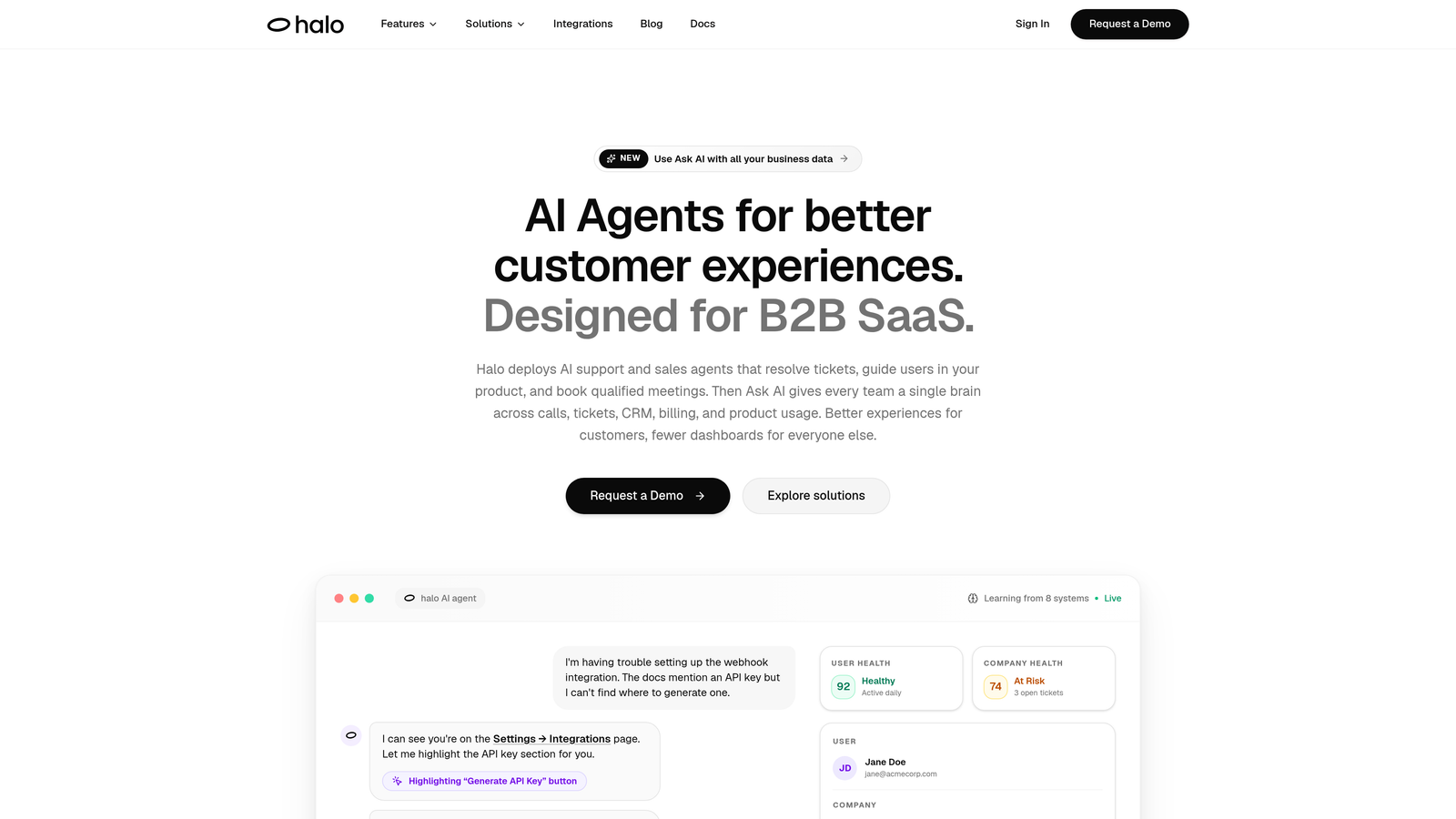
Halo AI is an AI-first customer support platform that deploys autonomous agents to resolve tickets, guide users through your product with page-aware context, and surface business intelligence — all while learning continuously from every interaction.
Where This Tool Shines
Most support tools add AI as a layer on top of an existing helpdesk. Halo is built the other way around: AI is the architecture, not the add-on. That distinction matters enormously for small teams, because you're not configuring AI rules on top of a legacy ticketing system. You're deploying agents that work autonomously from the start.
The page-aware context feature is particularly impressive. Halo's AI agents can see what page and UI state a user is currently on, which means they can provide genuinely contextual guidance rather than generic help article links. For SaaS product teams where "how do I do X in your product" tickets dominate the queue, this is a meaningful differentiator.
Key Features
Page-Aware AI Agents: The AI sees what the user sees, enabling in-context visual UI guidance rather than generic help content.
Smart Inbox with Business Intelligence: Surfaces customer health signals, revenue intelligence, and anomaly detection alongside support conversations.
Auto Bug Ticket Creation: Automatically routes product issues directly to engineering tools like Linear, closing the loop between support and product teams.
Live Agent Handoff: Escalates complex issues to human agents with full conversation context preserved, so nothing gets lost in the handoff.
Broad Integration Stack: Connects with Zendesk, Freshdesk, Intercom, Slack, HubSpot, Stripe, Zoom, PandaDoc, and Fathom.
Continuous Learning: Every resolved interaction makes the AI smarter, compounding value over time without manual retraining.
Best For
Halo is the strongest fit for B2B SaaS companies and product teams where support tickets are closely tied to product usage. If your queue is full of "how do I..." questions and bug reports that need to reach engineering, Halo's architecture handles both sides of that problem without duct tape.
Pricing
Visit haloagents.ai for current pricing details. Plans are designed to be accessible for small and growing teams.
2. Intercom
Best for: Teams wanting a mature, all-in-one messaging and AI resolution platform
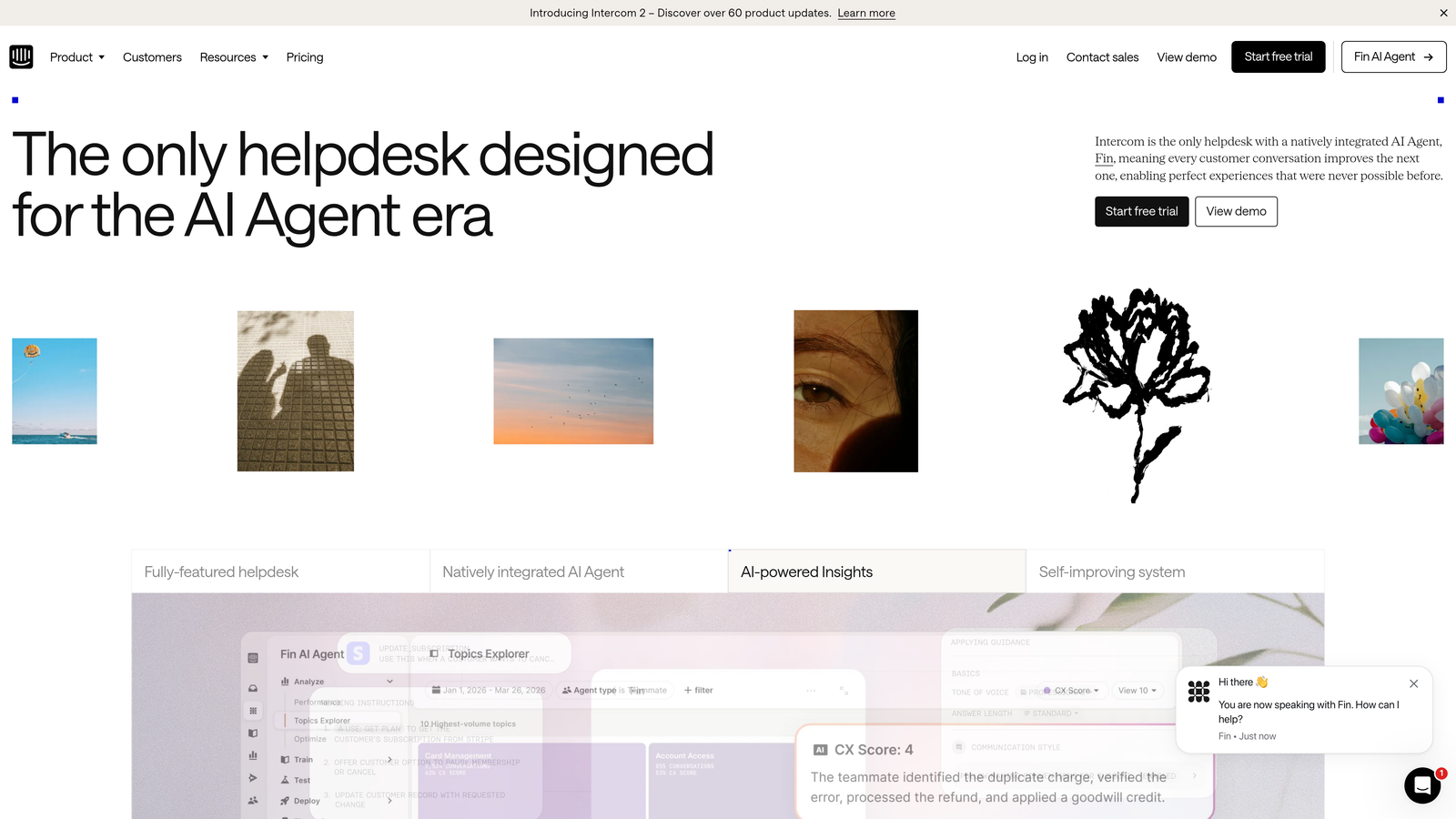
Intercom is one of the most established customer messaging platforms available, combining live chat, email, in-app messaging, and the Fin AI agent for autonomous ticket resolution.
Where This Tool Shines
Intercom's Fin AI agent is trained directly on your help content and can resolve a meaningful portion of incoming queries without human involvement. The unified inbox covering chat, email, and in-app messaging means your team has one place to manage every customer conversation, regardless of channel.
The workflow automation builder is genuinely powerful for routing and escalation logic, and the app marketplace gives you plenty of integration options. The main consideration for small teams is cost: Intercom's pricing can climb quickly as you add seats or usage, so it's worth mapping out your expected volume before committing.
Key Features
Fin AI Agent: Trained on your help content for autonomous resolution of common queries before they reach a human.
Unified Inbox: Covers chat, email, and in-app messaging in a single workspace.
Workflow Automation Builder: Visual builder for routing rules, escalation paths, and SLA logic.
Proactive Messaging and Product Tours: Reach users in-app with targeted messages and onboarding flows.
Extensive App Marketplace: Hundreds of integrations and a well-documented API for custom connections.
Best For
Intercom suits teams that need a proven, full-featured platform and are willing to invest in it. It's particularly strong for SaaS companies that want to combine support with proactive in-app engagement and onboarding in one tool.
Pricing
Starts at approximately $39/seat/month. Verify current pricing at intercom.com, as tiers and features change regularly.
3. Freshdesk
Best for: Small teams that want helpdesk structure and AI automation on a tight budget
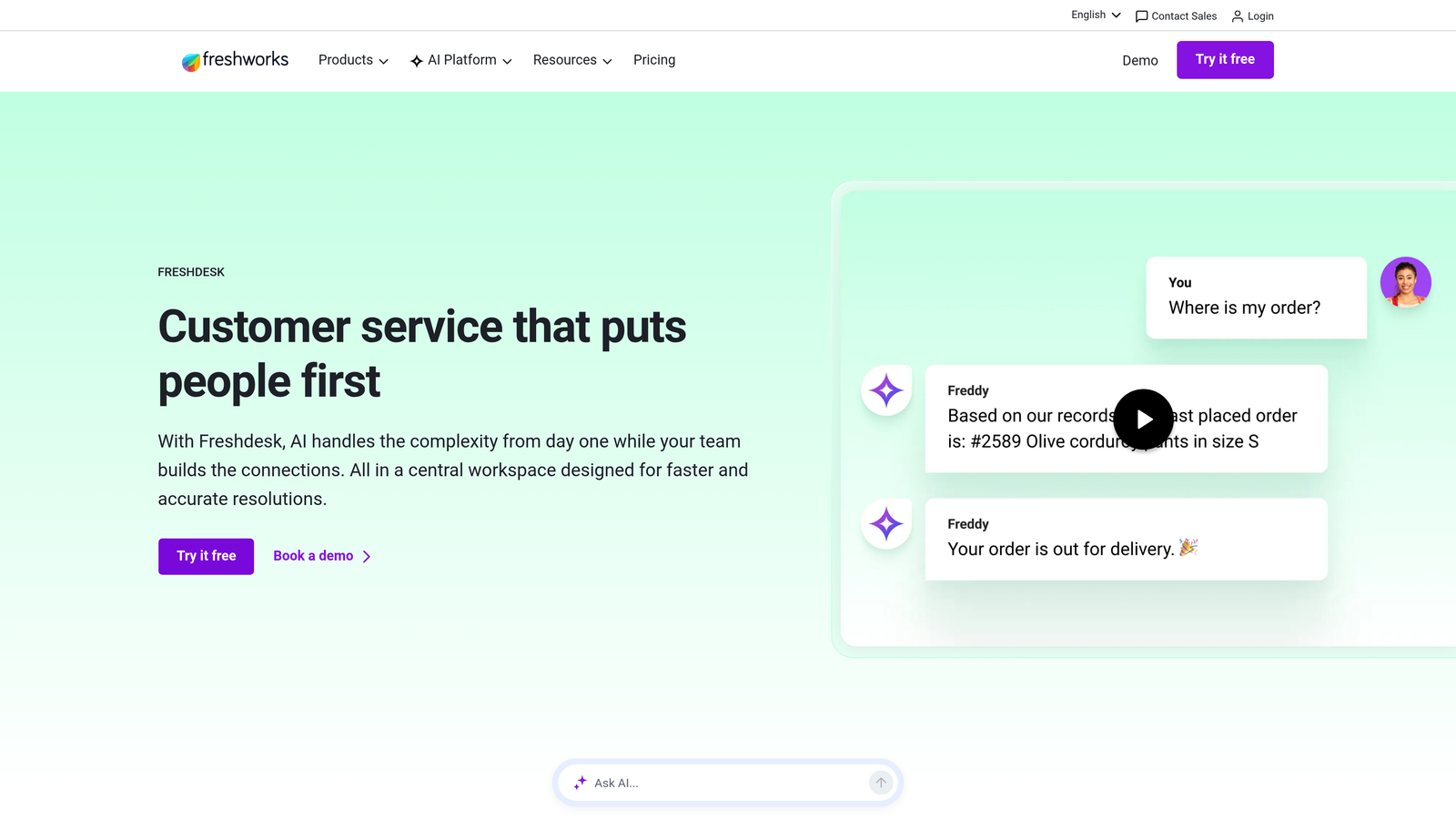
Freshdesk is a well-established helpdesk platform with a freemium model and Freddy AI for automated triage, suggested responses, and article recommendations.
Where This Tool Shines
The free plan is genuinely usable, not just a stripped-down teaser. For very early-stage teams, it's a legitimate starting point that doesn't force you into a paid commitment before you understand your support volume. As you grow, Freddy AI adds meaningful automation without requiring a platform switch.
Multi-channel support covering email, chat, phone, and social is baked in across most plans, and the automation rules for ticket routing and SLA management are flexible enough for most small-team workflows. The 1,000+ integration marketplace means you're unlikely to hit a wall on connectivity.
Key Features
Freddy AI: Handles auto-triage, response suggestions, and self-service article surfacing to reduce agent workload.
Multi-Channel Support: Email, chat, phone, and social all managed from a single inbox.
Automation Rules: Flexible routing and SLA management without requiring technical configuration.
Free Plan: A real, usable free tier for teams just getting started with structured support.
Large Integration Marketplace: 1,000+ integrations covering most common business tools.
Best For
Freshdesk is the go-to recommendation for budget-conscious teams that need structured helpdesk functionality and basic AI automation. It's also a solid choice if you're migrating from email-only support and want a gradual on-ramp to automation.
Pricing
Free plan available; paid plans from approximately $15/agent/month. Verify current pricing at freshdesk.com.
4. Tidio
Best for: Small businesses and e-commerce teams wanting a low-friction AI chatbot setup
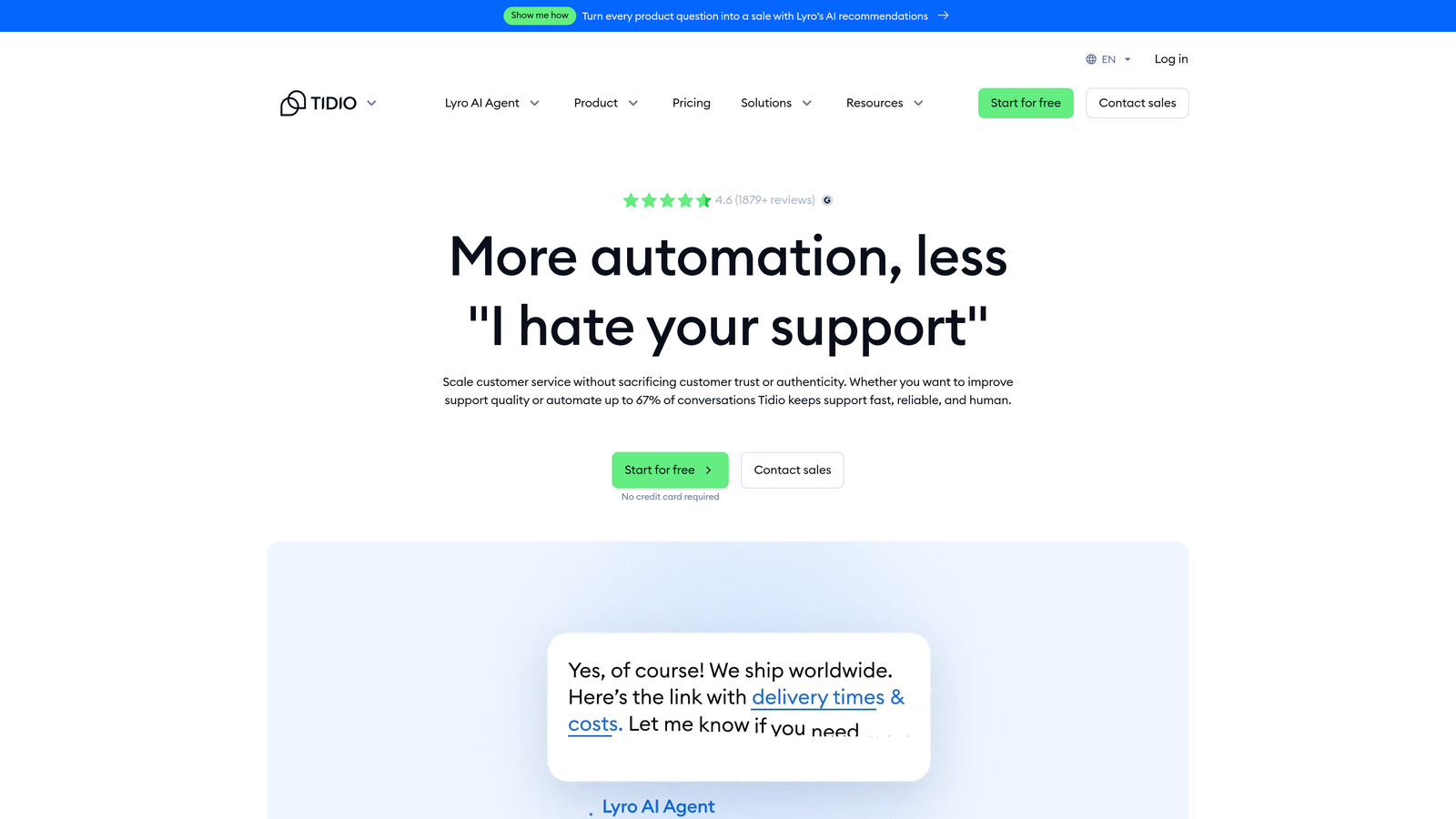
Tidio is a lightweight live chat and AI chatbot platform built for small businesses, featuring the Lyro AI chatbot that can be trained on your existing help content with minimal setup.
Where This Tool Shines
Setup friction is Tidio's strongest selling point. You don't need a developer to get Lyro running. Point it at your existing help content, and it starts handling common queries almost immediately. For teams that have been putting off chatbot automation because it "sounds complicated," Tidio removes that excuse.
The visual chatbot flow builder lets you design custom conversation paths for specific scenarios, like pricing questions or return requests, without writing a line of code. Visitor tracking and proactive triggers let you reach customers at the right moment rather than waiting for them to ask for help.
Key Features
Lyro AI Chatbot: Trained on your help content with no developer required, handling common queries autonomously.
Visual Flow Builder: Design custom conversation paths for specific use cases without coding.
Proactive Triggers: Reach visitors based on behavior, page, or time-on-site before they get frustrated.
Email and Messenger Integration: Extend coverage beyond live chat without adding complexity.
Free Tier: A usable starting point for early-stage teams testing chatbot automation.
Best For
Tidio works best for small businesses, e-commerce stores, and early-stage SaaS teams that want chatbot automation without a steep learning curve or a large upfront investment. It's less suited to complex B2B support environments with deep integration requirements.
Pricing
Free plan available; paid plans from approximately $29/month. Verify current pricing at tidio.com.
5. Zendesk
Best for: Growing teams that need enterprise-grade reliability with room to scale
Zendesk is the industry-standard helpdesk platform with a comprehensive AI layer covering intelligent triage, suggested macros, and Answer Bot for self-service deflection.

Where This Tool Shines
Zendesk's maturity is its biggest asset. The reporting, SLA management, and workflow capabilities are among the most robust available, and the app marketplace with thousands of integrations means you're unlikely to encounter a tool it can't connect to. If your team is growing quickly and you want a platform that won't need replacing in 18 months, Zendesk is a safe long-term bet.
The AI features, including intelligent triage, macro suggestions, and Answer Bot, are solid if not always cutting-edge. They handle the basics well. The honest caveat for small teams is that Zendesk can feel over-engineered if you're managing a modest ticket volume. The configuration overhead is real, and the price point is the highest on this list.
Key Features
AI-Powered Triage: Intelligent ticket routing based on content, intent, and priority signals.
Answer Bot: Automated self-service that deflects tickets before they're formally created.
Macro Suggestions: AI-recommended response templates based on ticket content to speed up agent replies.
Robust Reporting: Detailed analytics covering SLA performance, agent productivity, and customer satisfaction.
Massive App Marketplace: Thousands of integrations and a well-documented API for custom workflows.
Best For
Zendesk is best suited to teams that are scaling quickly and need a platform with room to grow, or teams that have compliance, reporting, or integration requirements that smaller tools can't meet. For very small teams with simple needs, the investment may not be justified yet.
Pricing
Starts at approximately $55/agent/month. Verify current pricing at zendesk.com.
6. Help Scout
Best for: Teams that prioritize relationship quality and a clean, human-friendly experience
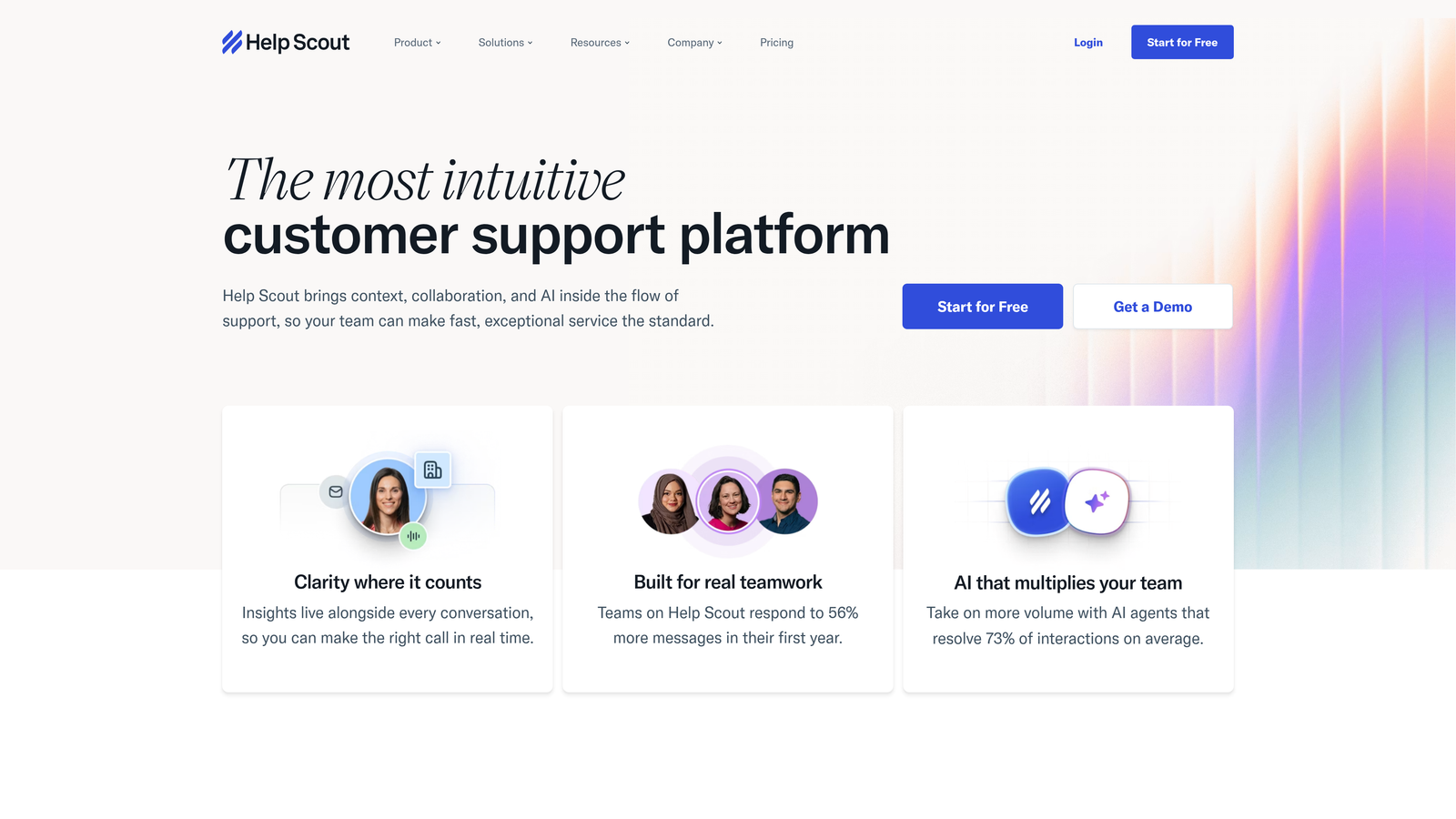
Help Scout is a human-first shared inbox and help center platform with AI features layered in for teams that want efficiency without sacrificing the personal feel of their support.
Where This Tool Shines
Help Scout's philosophy is that great support feels personal, and the product design reflects that. The shared inbox with collision detection prevents two agents from replying to the same ticket simultaneously, which is a surprisingly common problem in small teams using generic email. The UI is clean and fast, which means onboarding new team members takes hours, not days.
The AI features are thoughtfully integrated rather than bolted on. AI Summarize condenses long email threads so agents don't have to read through pages of back-and-forth. AI Assist drafts reply suggestions in your brand voice. The Answers widget deflects self-service queries before they become tickets. None of these are flashy, but they're genuinely useful in daily practice.
Key Features
AI Summarize: Condenses long email threads instantly so agents can get up to speed without reading everything.
AI Assist: Drafts reply suggestions in your brand voice, speeding up response time without losing personality.
Answers Widget: Self-service deflection that surfaces relevant help content before a ticket is opened.
Collision Detection: Prevents duplicate replies by showing when another agent is already working on a ticket.
Fast Onboarding: Clean, minimal UI means new team members are productive within hours of setup.
Best For
Help Scout is ideal for teams where customer relationship quality is a core brand value and the goal is to be efficient without becoming robotic. It's a particularly good fit for SaaS companies, agencies, and service businesses where support is a relationship touchpoint, not just a resolution queue.
Pricing
Starts at approximately $22/user/month. Verify current pricing at helpscout.com.
7. Chatbase
Best for: Teams that need a custom AI chatbot trained on their own content, without helpdesk overhead
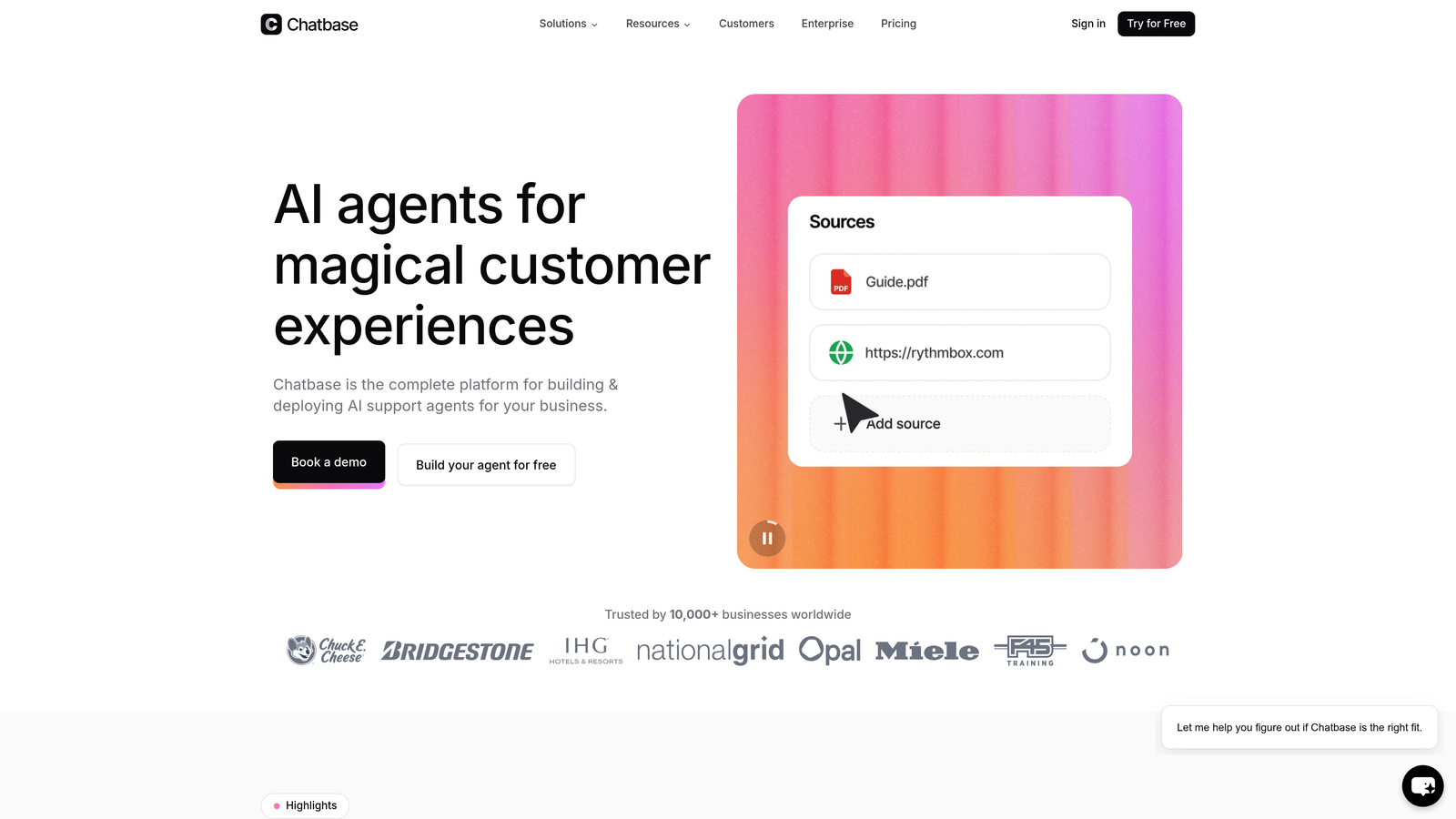
Chatbase is a specialized tool for building custom AI chatbots trained on your own documentation, knowledge base, or website content, with no engineering required.
Where This Tool Shines
Chatbase does one thing and does it well: it turns your existing content into a conversational AI that can answer customer questions. You point it at PDFs, URLs, Notion pages, or plain text, and within minutes you have a chatbot that speaks knowledgeably about your product or service. The setup process is genuinely as simple as it sounds.
It's worth being clear about what Chatbase is not: it's not a full helpdesk. There's no ticketing system, no SLA management, no agent inbox. It's purely a deflection and self-service layer. For teams that already have an email inbox or helpdesk and just need to reduce inbound volume, Chatbase slots in cleanly alongside existing tools.
Key Features
Content-Based Training: Train on PDFs, URLs, Notion pages, or plain text in minutes, no developer needed.
Embeddable Chat Widget: Drop onto any website with a simple embed code.
Conversation Analytics: Identify knowledge gaps by seeing what questions the chatbot can't answer confidently.
API Access: Connect to other tools for custom workflows when the standard embed isn't enough.
Multiple Chatbot Personas: Create different bots for different use cases or audiences.
Best For
Chatbase is the right choice for teams that have a solid knowledge base and want to put it to work autonomously, without committing to a full platform switch. It's also a good fit for teams running a pilot before investing in a broader automation strategy.
Pricing
Free tier available; paid plans from approximately $19/month. Verify current pricing at chatbase.co.
8. Gorgias
Best for: E-commerce support teams, especially those running on Shopify
Gorgias is a support helpdesk purpose-built for e-commerce teams, with deep Shopify integration and automation rules that resolve order and returns queries without agent involvement.
Where This Tool Shines
If you're running a Shopify store, Gorgias is in a category of its own. The integration pulls live order data directly into every support conversation, so agents, and automation rules, can see order status, tracking information, and purchase history without switching tabs. Automation rules handle the most common e-commerce queries, like "where is my order?" and "how do I return this?" without any human involvement.
The revenue statistics per ticket feature is genuinely useful for small teams: it shows the revenue associated with each customer, helping you prioritize high-value conversations when your queue is backed up. It's a practical tool that understands the economics of e-commerce support in a way that general-purpose helpdesks don't.
Key Features
Deep Shopify Integration: Live order data, tracking, and purchase history visible directly in every support conversation.
E-Commerce Automation Rules: Resolve order status, returns, and FAQ queries automatically without agent involvement.
Revenue Per Ticket: See the revenue value of each customer to prioritize high-value conversations intelligently.
Multi-Channel Coverage: Email, chat, social DMs, and SMS managed from a single inbox.
Dynamic Macros: Response templates that pull live order data into replies automatically.
Best For
Gorgias is purpose-built for e-commerce, and that specificity is both its strength and its limitation. If you're running a Shopify, BigCommerce, or Magento store, it's the most efficient option on this list. If you're not in e-commerce, look elsewhere.
Pricing
Starts at approximately $10/month for small ticket volumes. Verify current pricing at gorgias.com.
9. Crisp
Best for: Early-stage teams that want multi-channel coverage before committing to paid tools
Crisp is a multi-channel support platform with a generous free plan covering shared inbox, live chat, and basic chatbot, making it ideal for teams not yet ready to invest in paid tools.
Where This Tool Shines
Crisp's free plan is one of the most generous in the market. Shared inbox, live chat, and a basic chatbot are all available without paying anything, which makes it a serious option for early-stage teams that need to look professional and responsive without a software budget. The multi-channel coverage, including email, chat, WhatsApp, Messenger, and Twitter/X, is impressive for a free tier.
As teams grow, the MagicReply AI feature adds automated response drafting that speeds up agent replies without requiring a full AI platform investment. The no-code chatbot builder lets you create basic conversation flows for common queries. Crisp won't replace a more sophisticated platform as your support needs mature, but it's an excellent place to start.
Key Features
Generous Free Plan: Shared inbox, live chat, and basic chatbot included at no cost.
MagicReply AI: Automated response drafting that suggests replies based on conversation context.
Multi-Channel Coverage: Email, chat, WhatsApp, Messenger, and Twitter/X in one workspace.
CRM-Lite Features: Contact profiles and conversation history give agents useful context without a separate CRM.
No-Code Chatbot Builder: Visual flow editor for building basic conversation automations without technical help.
Best For
Crisp is the right starting point for very early-stage teams, bootstrapped startups, or side projects that need functional support infrastructure before they're ready to invest. It's also a practical choice for teams that want to test multi-channel support before committing to a paid platform.
Pricing
Free plan available; paid plans from approximately $25/workspace/month. Verify current pricing at crisp.chat.
Which Tool Is Right for Your Team?
The right choice depends less on features and more on where your team is right now, and where you're heading.
If you're a B2B SaaS team and your queue is dominated by product usage questions and bug reports, Halo AI is the most purpose-built option. The page-aware AI agents, auto bug ticket creation, and business intelligence layer solve problems that general-purpose helpdesks weren't designed for.
If you need a mature, all-in-one platform and budget isn't a primary constraint, Intercom or Zendesk are reliable long-term investments with broad ecosystem support. For budget-conscious teams that still want structured helpdesk functionality, Freshdesk offers the best value, especially on its free plan.
If relationship quality is a brand priority, Help Scout strikes the best balance between efficiency and human warmth. For e-commerce teams on Shopify, Gorgias is in a class of its own. And if you're just getting started and not ready to pay for anything yet, Crisp gives you more than enough to work with.
For teams that just need a chatbot layer on top of existing content without a full platform change, Chatbase is the fastest path to deflection. And for small businesses that want low-friction AI automation, Tidio removes almost every barrier to getting started.
Your support team shouldn't scale linearly with your customer base. Let AI agents handle routine tickets, guide users through your product, and surface business intelligence while your team focuses on complex issues that need a human touch. See Halo in action and discover how continuous learning transforms every interaction into smarter, faster support.