9 Best Support Automation Vendors Compared for 2026
This support automation vendors comparison evaluates nine leading platforms across core automation capabilities, integration depth, and deployment ease to help B2B SaaS teams identify the right fit for their needs. The guide distinguishes between traditional helpdesks with layered AI and purpose-built AI-first platforms, giving teams a clear framework for choosing a solution that deflects tickets, accelerates resolutions, and scales without adding headcount.
 Matt PattoliFounder13 min read
Choosing the right support automation vendor is one of the most consequential decisions a B2B product team can make. The wrong fit means wasted budget, frustrated agents, and customers who still can't get answers fast enough. The right fit means deflected tickets, faster resolutions, and a support operation that scales without adding headcount.
The market in 2026 is split between two fundamentally different approaches: traditional helpdesk platforms that have layered AI onto existing ticket management systems, and AI-first platforms built from the ground up around autonomous resolution. Understanding which camp a vendor falls into matters more than any individual feature comparison.
This guide covers leading support automation vendors evaluated on core automation capabilities, integration depth, ease of deployment, and fit for B2B SaaS teams. Whether you're migrating off a legacy helpdesk, layering AI onto an existing setup, or building a support stack from scratch, here's what you need to know.
1. Halo AI
Best for: B2B SaaS product teams that want AI-first autonomous resolution with deep business context
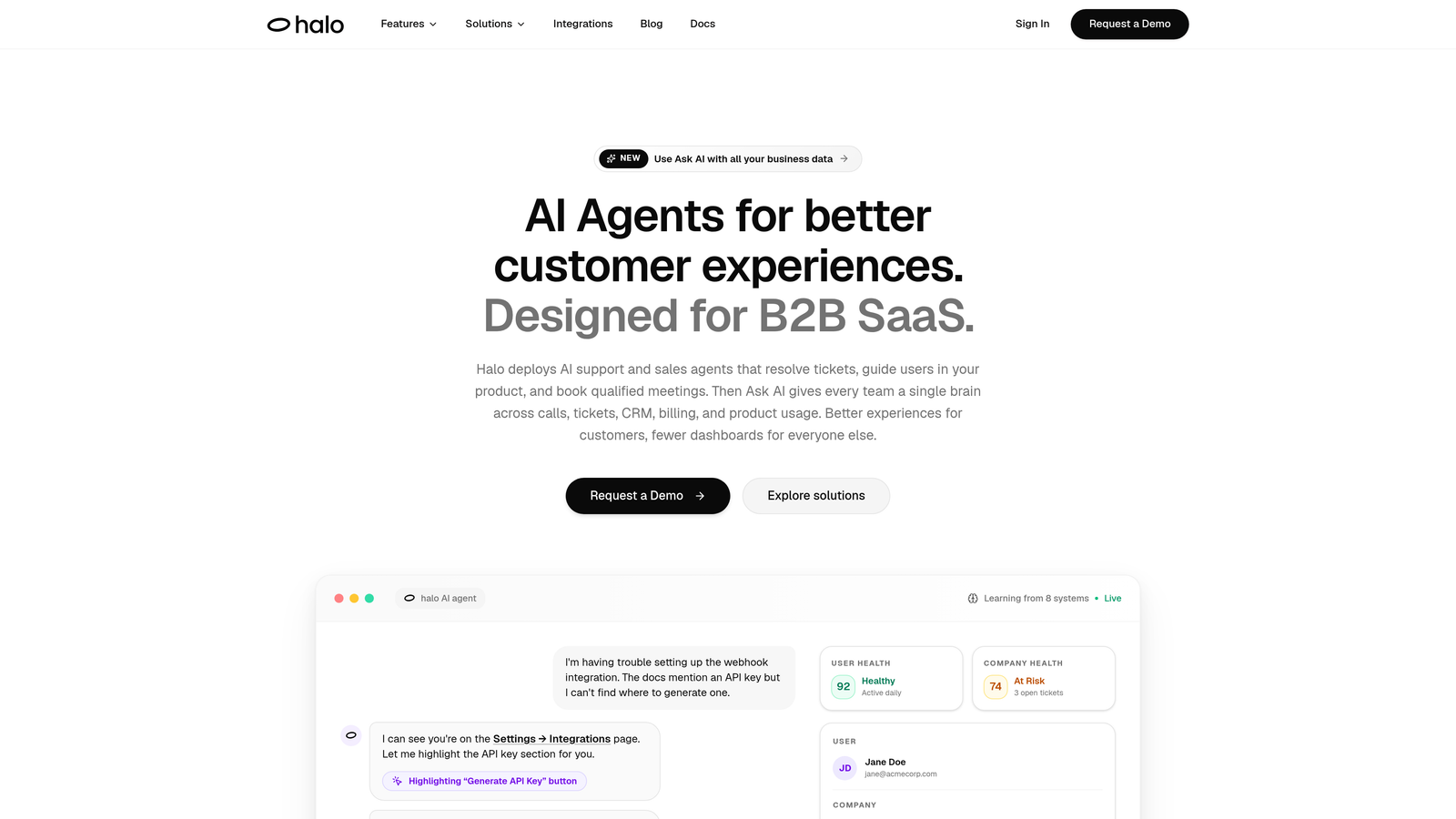
Halo AI is an AI-first customer support platform that deploys intelligent agents to resolve tickets, guide users through your product with page-aware context, and surface business intelligence from every interaction.
Where This Tool Shines
What separates Halo from helpdesk-with-AI-bolted-on vendors is the architecture. It was built around autonomous resolution from day one, not adapted toward it. The page-aware chat widget is a standout feature: it understands what the user is actually looking at in your product, which means guidance is contextual and specific rather than generic.
Beyond ticket resolution, Halo surfaces business intelligence from support interactions. Customer health signals, revenue anomalies, and product friction patterns emerge from the same system handling your tickets. That's a meaningful upgrade from a support tool that only tells you how many tickets you closed this week.
Key Features
Page-Aware Chat Widget: Sees what users see in your product and delivers contextual UI guidance rather than generic responses.
Intelligent AI Agents: Resolve tickets autonomously with continuous learning from every interaction, getting smarter over time.
Smart Inbox with Business Intelligence: Surfaces customer health signals, revenue intelligence, and anomaly detection beyond standard support metrics.
Auto Bug Ticket Creation: Automatically routes product issues to engineering tools like Linear, reducing manual handoff friction.
Live Agent Handoff: Escalates to humans with full context preserved so agents never start a conversation cold.
Deep Integrations: Connects to Linear, Slack, HubSpot, Intercom, Stripe, Zoom, PandaDoc, and Fathom for full business stack visibility.
Best For
B2B SaaS companies and product teams that need more than a chatbot. Particularly well-suited for teams where product complexity makes generic bot responses ineffective, and for organizations that want support data to feed broader business intelligence rather than sitting in a silo.
Pricing
Contact for pricing, tailored to team size and usage volume. Reach out via the Halo AI website for a custom quote.
2. Zendesk
Best for: Enterprise teams that need a mature, scalable helpdesk with a large integration ecosystem
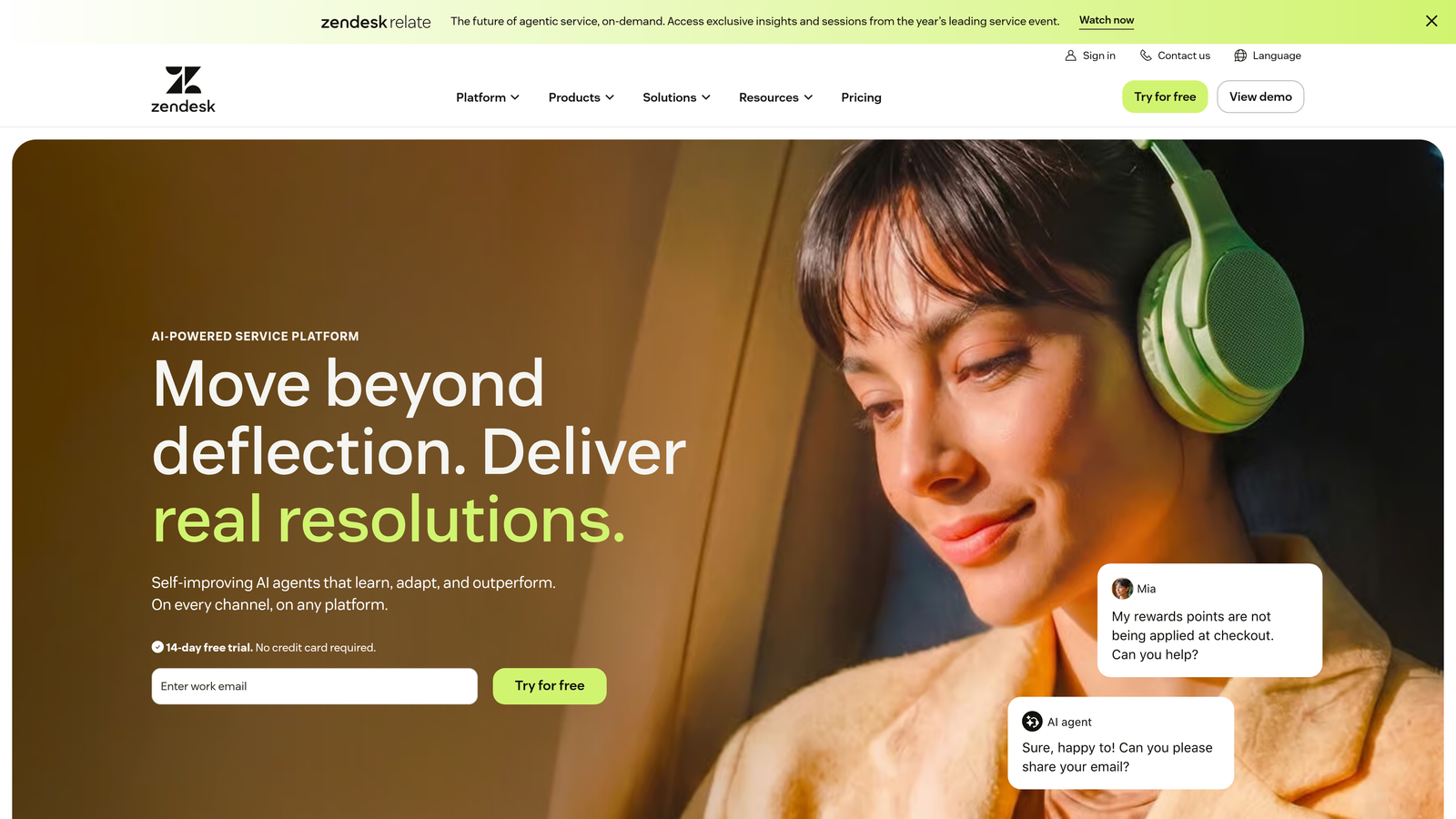
Zendesk is a market-leading helpdesk platform with AI automation features including intent detection, suggested replies, and intelligent triage layered onto a mature ticketing foundation.
Where This Tool Shines
Zendesk's strength is its depth and ecosystem maturity. It handles complex SLA configurations, multi-brand setups, and enterprise-scale routing with relative ease. If you need a proven, highly configurable ticketing backbone with access to a thousand-plus app integrations, Zendesk delivers.
The caveat is that its AI capabilities feel additive rather than native. Features like suggested replies and intent classification are useful, but they're built on top of a ticketing paradigm rather than designed around autonomous resolution. Teams expecting AI to handle tickets end-to-end may find themselves doing more configuration than anticipated.
Key Features
AI-Powered Ticket Triage: Intent classification and automatic routing to reduce manual sorting across high-volume queues.
Suggested Replies and Agent Assist: AI-generated response suggestions that help agents reply faster without full automation.
Advanced SLA Management: Granular service level configuration for enterprise teams with complex support tiers.
Large App Marketplace: Over 1,000 integrations spanning CRM, billing, analytics, and communication tools.
Enterprise Reporting: Detailed analytics on ticket volume, resolution time, agent performance, and customer satisfaction.
Best For
Mid-to-large enterprises with established support operations that need a reliable, scalable foundation. Also a strong choice for teams with complex multi-channel requirements who are willing to invest in configuration and admin resources.
Pricing
Suite Team starts at $55/agent/month; Suite Professional at $115/agent/month, billed annually. Pricing scales with advanced AI and enterprise features.
3. Intercom
Best for: SaaS teams that want conversational in-product support with an AI agent for autonomous resolution
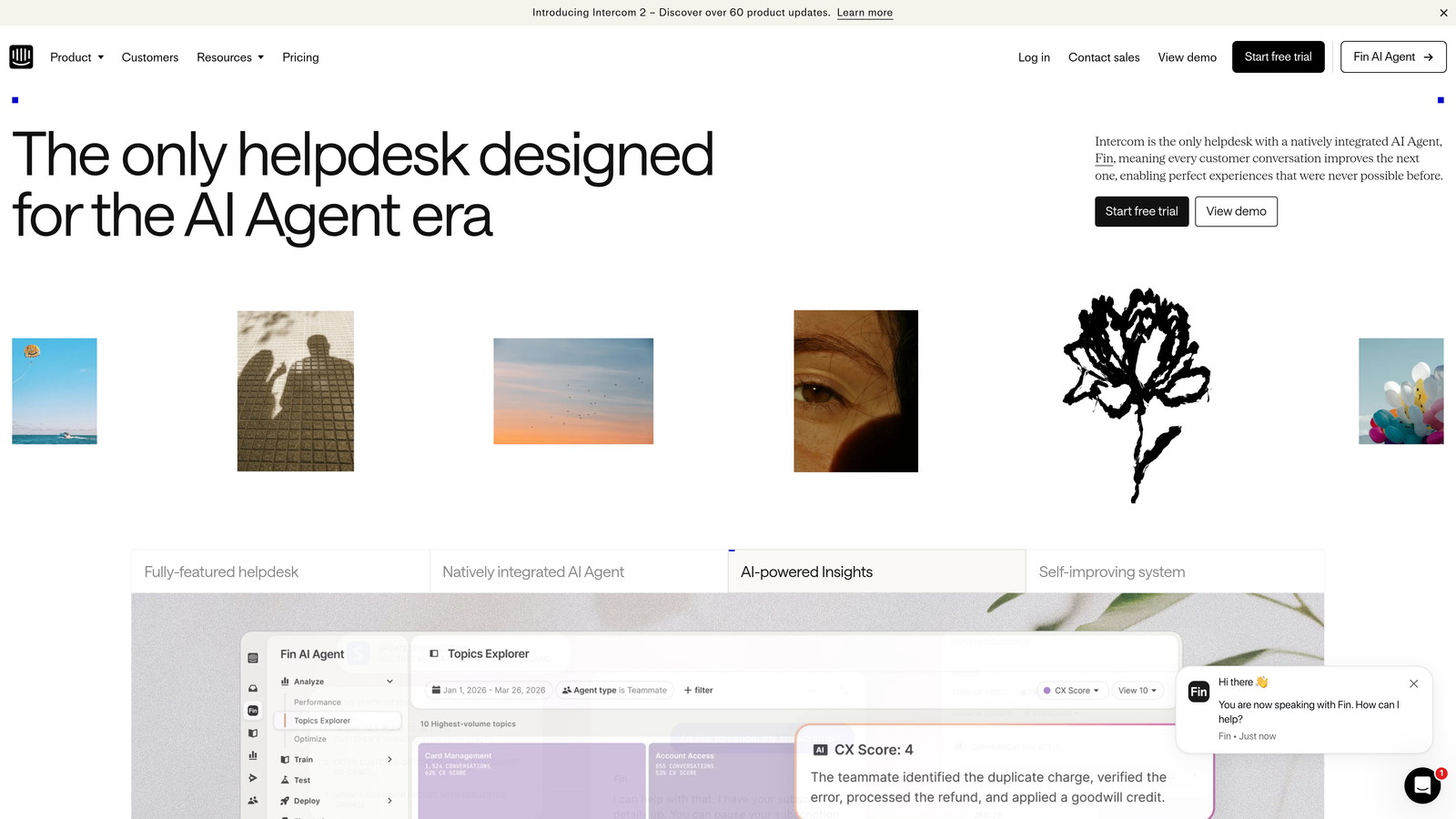
Intercom is a conversational support platform with Fin, its GPT-powered AI agent, designed for SaaS teams that want in-product messaging and automated resolution in a unified messenger.
Where This Tool Shines
Intercom has strong brand recognition in the SaaS world for good reason. Its in-product messenger is polished, and Fin AI can resolve a meaningful portion of common questions using your existing help content without requiring complex configuration. The unified inbox brings email, chat, and in-app conversations into one place, which reduces context-switching for support teams.
The main consideration at scale is pricing. Intercom's costs can escalate significantly as resolution volume grows, since Fin AI conversations are billed separately from seat costs. Teams should model their expected volume carefully before committing.
Key Features
Fin AI Agent: GPT-powered autonomous resolution using your help center content, with configurable escalation paths.
Unified Inbox: Consolidates chat, email, and in-app messages in a single workspace for support teams.
Custom Bot Builder: Visual workflow automation for routing, qualification, and self-service flows.
Product Tours and In-App Messaging: Onboarding and feature adoption tools built into the same platform.
Resolution Rate Reporting: Tracks Fin AI performance and customer satisfaction across automated and human-handled conversations.
Best For
SaaS companies that prioritize conversational, in-product support experiences and want AI resolution alongside onboarding and messaging capabilities in a single platform.
Pricing
Essential starts at $29/seat/month; pricing scales with usage and Fin AI resolution volume. Model your expected conversation volume before finalizing budget projections.
4. Freshdesk
Best for: Mid-market teams transitioning from manual to structured support processes at competitive price points
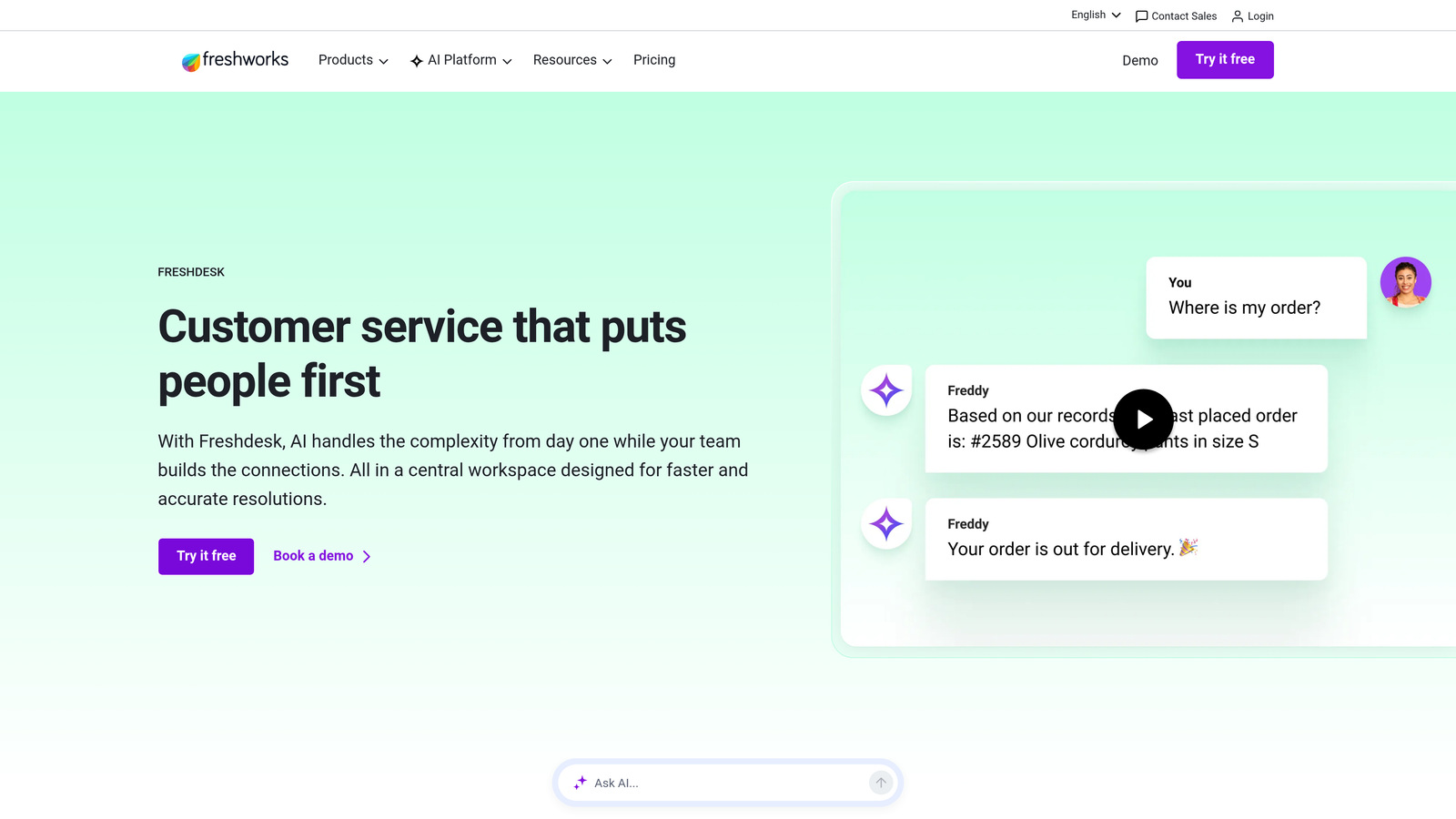
Freshdesk is a mid-market helpdesk with Freddy AI built in, offering ticket classification, auto-resolution suggestions, and workflow automation at competitive pricing.
Where This Tool Shines
Freshdesk hits a sweet spot for teams that have outgrown email-based support but aren't ready for the complexity and cost of enterprise platforms. Freddy AI handles the fundamentals well: classifying tickets, suggesting responses, and routing based on intent. Setup is more approachable than Zendesk for teams without dedicated admin resources.
The multi-channel support coverage is solid for the price tier, spanning email, chat, phone, and social in a single interface. Teams that need to consolidate channels without a six-figure platform investment will find Freshdesk a practical fit.
Key Features
Freddy AI: Handles ticket classification, suggested replies, and auto-resolution recommendations across incoming requests.
Automated Routing and Prioritization: Rules-based and AI-assisted assignment to keep queues organized without manual sorting.
Self-Service Portal: Knowledge base with AI-powered article suggestions to deflect common questions before they become tickets.
Collision Detection: Prevents multiple agents from working the same ticket simultaneously, reducing duplicate effort.
Multi-Channel Support: Email, live chat, phone, and social media managed from a unified interface.
Best For
Growing mid-market teams that need structured helpdesk capabilities and basic AI automation without the cost or complexity of enterprise platforms. Also a good fit for teams evaluating a step up from shared inbox tools.
Pricing
Free plan available for small teams. Growth starts at $15/agent/month; Pro at $49/agent/month, billed annually.
5. Salesforce Service Cloud
Best for: Enterprise B2B organizations already standardized on Salesforce that need deep CRM and support integration
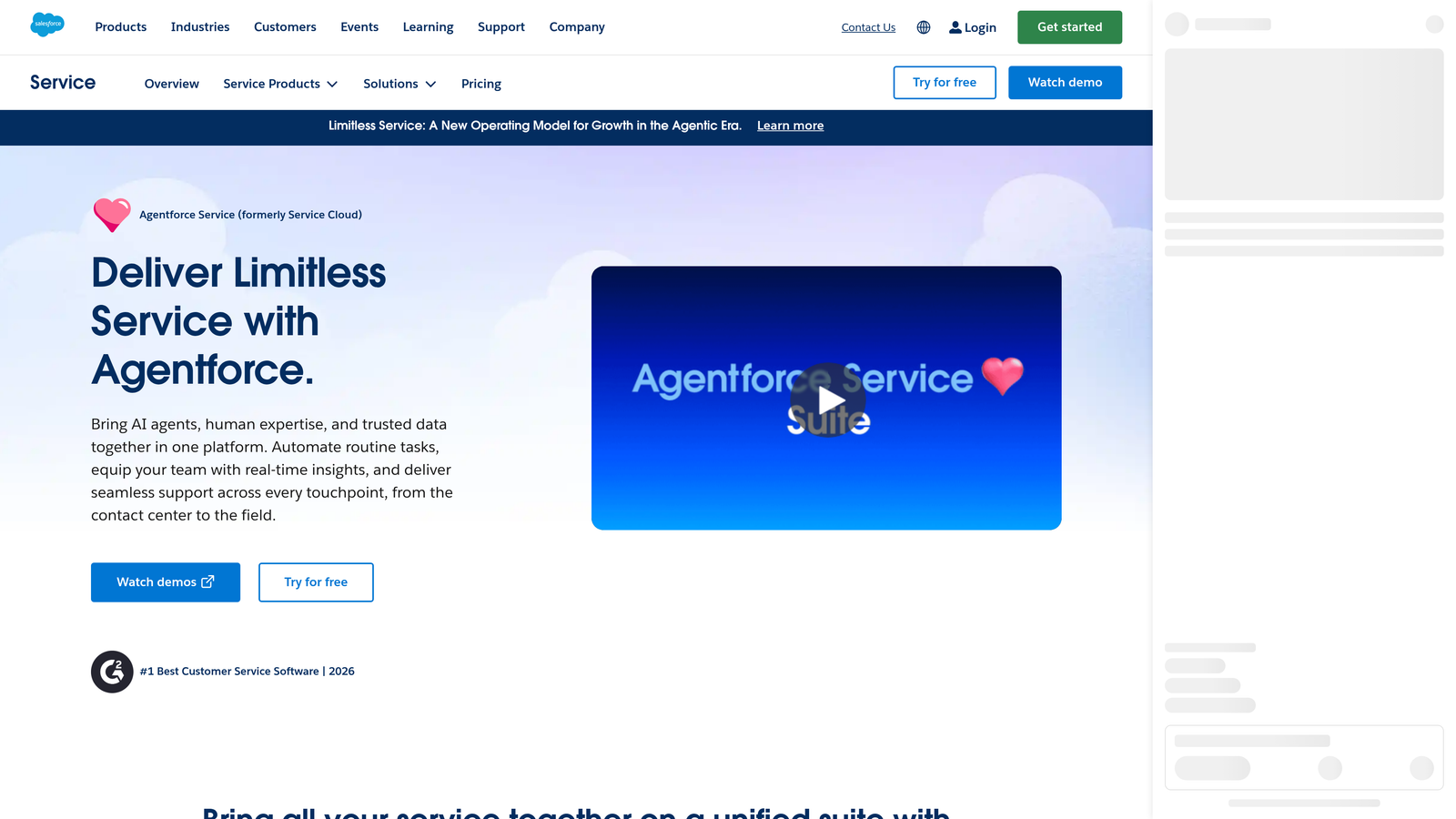
Salesforce Service Cloud is an enterprise support platform with Einstein AI deeply integrated into the Salesforce CRM ecosystem, giving support agents full customer context across sales, service, and billing.
Where This Tool Shines
For organizations where support agents need to see a complete customer picture — deal history, contract value, open opportunities, billing status — Service Cloud's native Salesforce integration is genuinely powerful. Einstein AI adds automation across case classification, routing, and next-best-action recommendations with that full customer context baked in.
The honest caveat: Service Cloud is complex. It typically requires dedicated Salesforce admin resources to configure and maintain. Teams without existing Salesforce investment will find the onboarding cost and learning curve substantial compared to purpose-built support platforms.
Key Features
Einstein AI: Case classification, intelligent routing, and next-best-action recommendations powered by the full Salesforce data model.
360-Degree Customer View: Combines support history with CRM data including sales, contracts, and billing in a single agent view.
Omnichannel Routing: Distributes work across voice, chat, email, and social based on agent capacity and skill.
Knowledge Base with AI Recommendations: Surfaces relevant articles to agents mid-conversation to speed resolution.
Flow Builder Automation: Advanced workflow automation for complex business rules without custom code.
Best For
Enterprise B2B companies already running Salesforce as their CRM, where support and sales context overlap significantly and a unified platform justifies the investment in configuration and administration.
Pricing
Starter Suite at $25/user/month; Enterprise at $165/user/month, billed annually. Advanced AI and automation features sit in higher tiers.
6. Tidio
Best for: Smaller teams and early-stage companies that need quick deployment without enterprise overhead
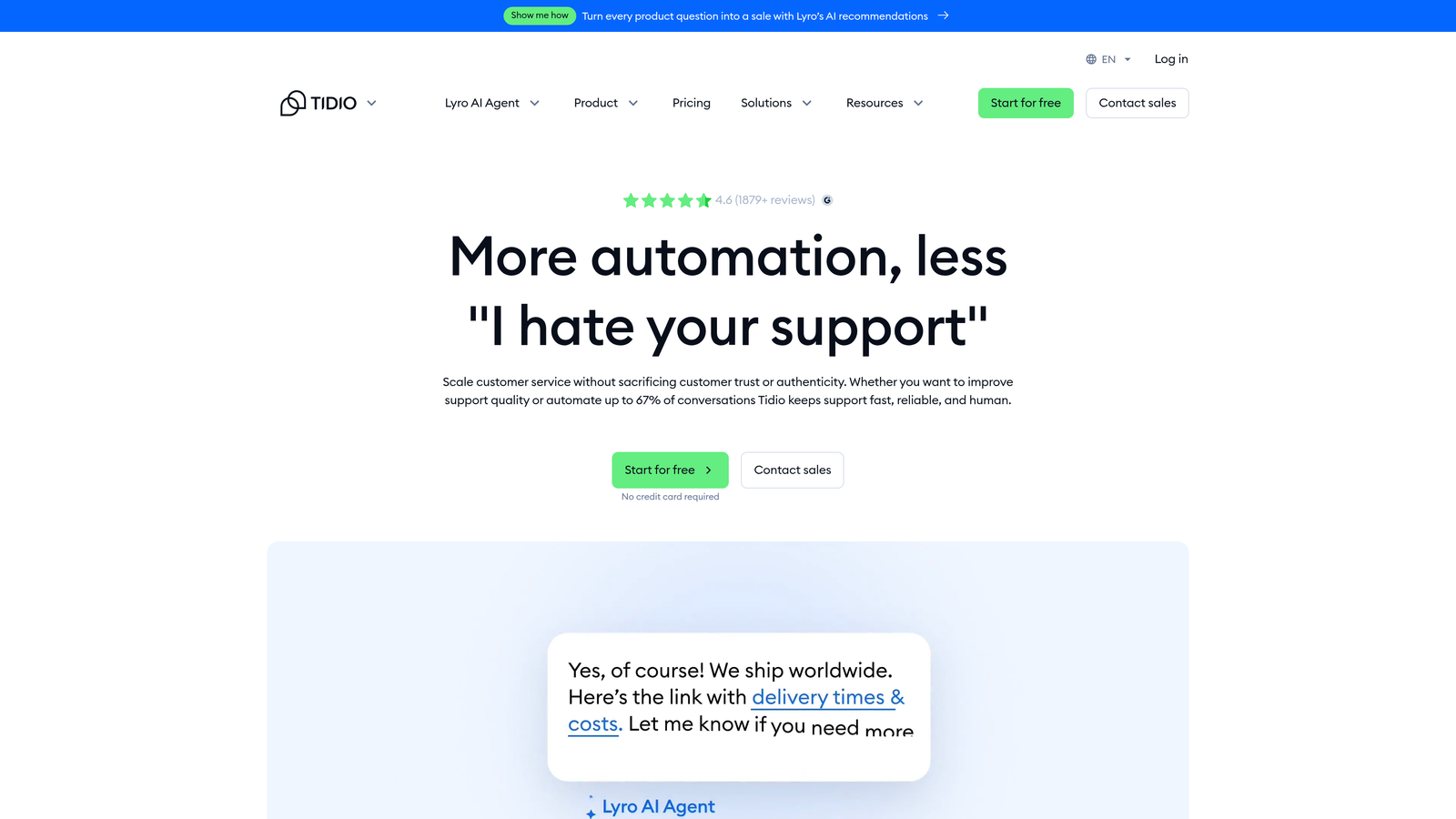
Tidio is an accessible live chat and automation platform with Lyro AI for conversational support, designed for smaller teams that need quick deployment without enterprise complexity.
Where This Tool Shines
Tidio's appeal is speed and accessibility. The visual chatbot builder uses pre-built templates that get teams live quickly, and Lyro AI handles conversational responses without requiring extensive training data or configuration. For smaller teams that need something working in days rather than weeks, that matters.
The platform's e-commerce integrations with Shopify and WooCommerce make it a natural fit for online retail. For complex B2B SaaS environments, however, the feature depth may feel limiting as support volume and complexity grow.
Key Features
Lyro AI: Conversational AI that handles context-aware responses to common customer questions without manual scripting.
Visual Chatbot Builder: Template-based workflow creation that lowers the technical barrier for non-developer teams.
Agent Takeover: Smooth handoff from bot to live agent when conversations require human judgment.
E-Commerce Integrations: Native connections to Shopify and WooCommerce for order and customer data context.
Unified Inbox: Manages email, live chat, and Messenger conversations in a single workspace.
Best For
Small businesses, early-stage SaaS teams, and e-commerce companies that need functional automation quickly without a complex implementation process or enterprise-level budget.
Pricing
Free plan available. Starter at $29/month. Lyro AI conversations are billed separately based on volume, so model usage expectations before selecting a plan.
7. Kustomer
Best for: Teams that want support and full customer history unified in a single platform without a separate CRM
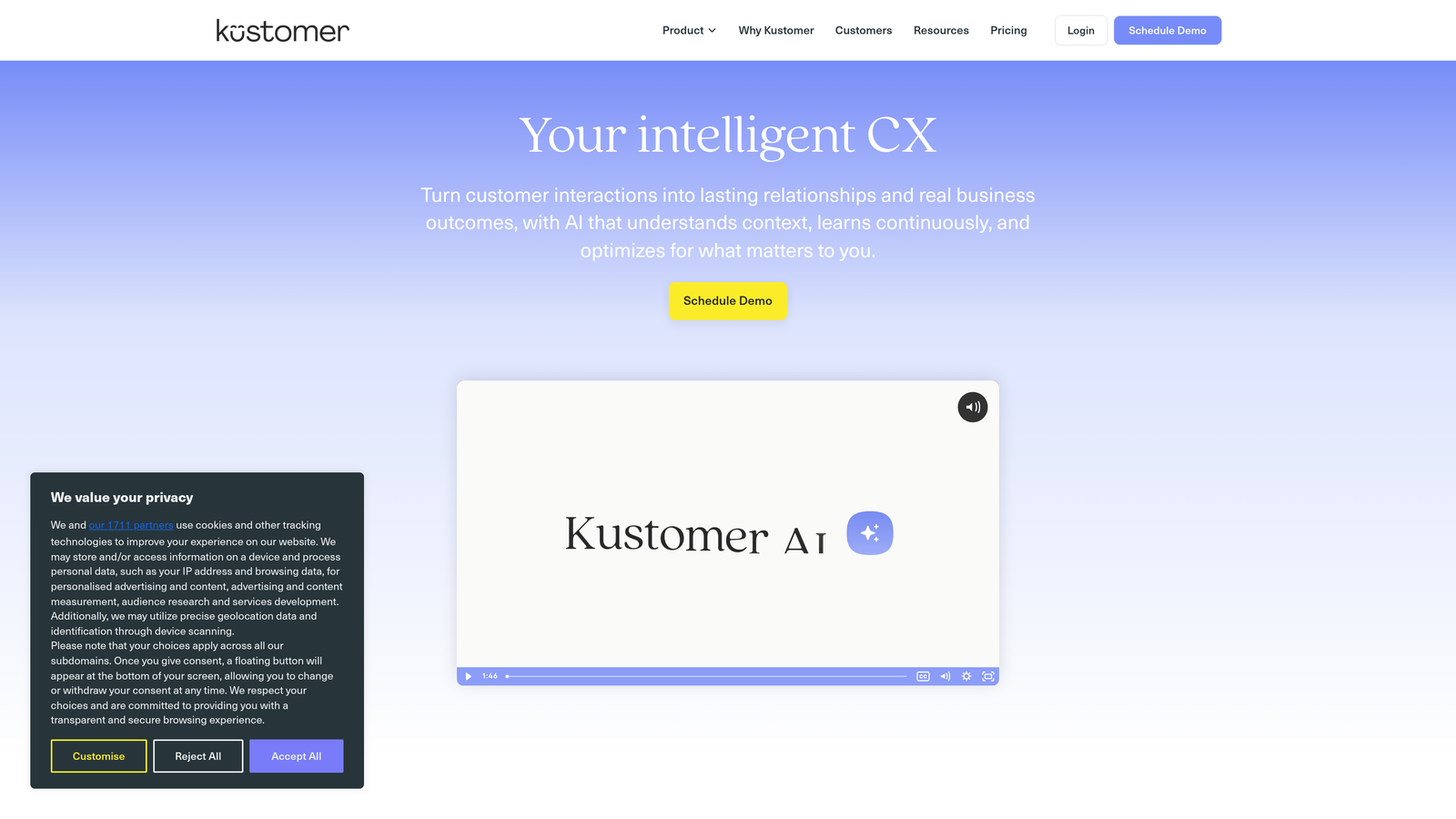
Kustomer is a CRM-native support platform that unifies every customer interaction in a single timeline view, with omnichannel automation and AI-powered routing.
Where This Tool Shines
Kustomer's customer timeline view is its defining feature. Every interaction, regardless of channel, appears in a single chronological view alongside customer data. Agents don't need to switch between a support tool and a CRM to understand who they're talking to and what's happened before. That context speeds resolution and reduces the repetitive "can you tell me your account details" friction that frustrates customers.
The business rules engine handles complex workflow automation well, making it adaptable for teams with non-standard routing logic or multi-tier support structures.
Key Features
Customer Timeline View: All touchpoints, channels, and history unified in a single chronological view per customer.
AI-Powered Routing: Conversation prioritization and assignment based on customer context, intent, and agent skill.
Omnichannel Automation: Consistent workflows across chat, email, social, SMS, and voice from one platform.
Business Rules Engine: Flexible automation logic for complex routing, escalation, and SLA scenarios.
Built-In CRM: Eliminates the need for a separate customer database by storing relationship data natively.
Best For
Support teams that handle high interaction volume across multiple channels and want customer history and support tooling in one place rather than maintaining separate systems that need to stay in sync.
Pricing
Enterprise at $89/user/month; Ultimate at $139/user/month, billed annually. Positioned for teams with sufficient volume to justify the per-seat investment.
8. Help Scout
Best for: Teams where relationship quality is a brand differentiator and human-feeling support is the priority
Help Scout is a support platform focused on human-feeling customer service, with AI tools that assist agents rather than replace them, including AI Summarize, AI Drafts, and AI Answers.
Where This Tool Shines
Help Scout takes a deliberately different philosophy from AI-first platforms: it uses AI to make agents better rather than to replace them. AI Summarize gives agents instant context on long conversation threads. AI Drafts accelerates reply writing. AI Answers handles common questions automatically. The result is a platform that feels supportive rather than disruptive to existing support workflows.
For companies where the quality of human interaction is a competitive differentiator, this approach is a feature, not a limitation. Help Scout is also simpler and more affordable than enterprise platforms, making it accessible for teams that don't need the overhead of a full-scale helpdesk.
Key Features
AI Answers: Automated responses to common questions using your knowledge base content, reducing repetitive agent workload.
AI Drafts: Suggests complete reply drafts for agents to review and send, accelerating response time without removing human judgment.
AI Summarize: Condenses long conversation threads so agents can get up to speed instantly without reading every message.
Shared Inbox: Collaborative inbox with collision detection and internal notes to keep teams coordinated.
Docs Knowledge Base: Self-service documentation with AI-powered search to help customers find answers independently.
Best For
Companies that prioritize relationship-driven support, smaller and mid-sized teams that want AI assistance without full automation, and organizations where a human touch is central to the brand experience.
Pricing
Standard at $22/user/month; Plus at $44/user/month, billed annually. One of the more affordable options in this comparison for the feature set provided.
9. Forethought
Best for: Teams with existing helpdesk investment who want to add AI without migrating platforms
Forethought is an AI automation layer that sits on top of existing helpdesks like Zendesk, Salesforce, and Freshdesk, adding triage, deflection, and routing intelligence without requiring platform migration.
Where This Tool Shines
Forethought's positioning is clever: rather than asking teams to replace their helpdesk, it enhances it. If you've invested heavily in Zendesk configuration, custom workflows, and agent training, ripping that out to adopt an AI-first platform is a significant undertaking. Forethought lets you layer AI capabilities on top of what you already have.
The Discover AI module is particularly useful for teams that want data-driven insights into where automation can make the most impact before committing to specific workflows. It analyzes your ticket data to surface automation opportunities, which reduces guesswork in planning.
Key Features
Triage AI: Automatic ticket classification and prioritization to route incoming requests without manual sorting.
Solve AI: Deflects tickets before they reach agents by resolving common questions through automated responses.
Assist AI: Surfaces relevant knowledge base content to agents mid-conversation to accelerate resolution.
Discover AI: Analyzes ticket data to identify the highest-value automation opportunities across your support operation.
Native Integrations: Works directly with Zendesk, Salesforce, Freshdesk, and ServiceNow without requiring data migration.
Best For
Organizations with significant existing helpdesk investment that want AI automation benefits without the cost and risk of platform migration. Particularly well-suited for teams on Zendesk or Salesforce with complex configurations they need to preserve.
Pricing
Custom pricing based on ticket volume and modules selected. Contact Forethought directly for a quote tailored to your support operation size.
Finding the Right Fit for Your Team
The vendors in this comparison aren't competing on the same terms. They serve different philosophies, different team sizes, and different definitions of what "support automation" actually means. Matching yourself to the right one starts with being honest about where you are and where you want to go.
If you want AI-first autonomous resolution with business intelligence: Halo AI is built for this from the ground up. Page-aware context, continuous learning, and deep integrations across your business stack make it the strongest fit for B2B SaaS product teams that want support data to drive broader decisions, not just ticket counts.
If you need enterprise scale with a proven ecosystem: Zendesk remains the most mature option with the broadest integration marketplace. Expect to invest in configuration and administration, but the platform handles complexity at scale reliably.
If you're a SaaS team that wants conversational in-product support: Intercom's Fin AI and unified messenger are purpose-built for this use case. Watch your pricing model carefully as volume grows.
If budget efficiency matters most: Freshdesk gives you structured helpdesk capabilities and Freddy AI at price points that are meaningfully more accessible than enterprise alternatives. Help Scout is similarly affordable and a strong choice if human-feeling support is central to your brand.
If you're already deep in Salesforce: Service Cloud's CRM integration is genuinely powerful for enterprise B2B. For everyone else, the configuration overhead likely outweighs the benefits.
If you want AI without a platform migration: Forethought is the cleanest path to adding triage, deflection, and routing intelligence on top of your existing Zendesk or Salesforce investment.
The broader pattern worth noting: the vendors that treat AI as a native capability rather than a feature addition tend to deliver more coherent automation experiences. That distinction matters more as your support volume grows and the cost of half-automated workflows compounds.
Your support team shouldn't scale linearly with your customer base. Let AI agents handle routine tickets, guide users through your product, and surface business intelligence while your team focuses on complex issues that need a human touch. See Halo in action and discover how continuous learning transforms every interaction into smarter, faster support.