Why Support Costs Are Increasing Faster Than Revenue (And What to Do About It)
In B2B SaaS, support costs increasing faster than revenue is one of the most common — and most misdiagnosed — scaling traps founders face. This article explains why the traditional support model is structurally incompatible with nonlinear growth, and what leaders can do to fix it before it consumes the business.
 Grant CooperFounder12 min read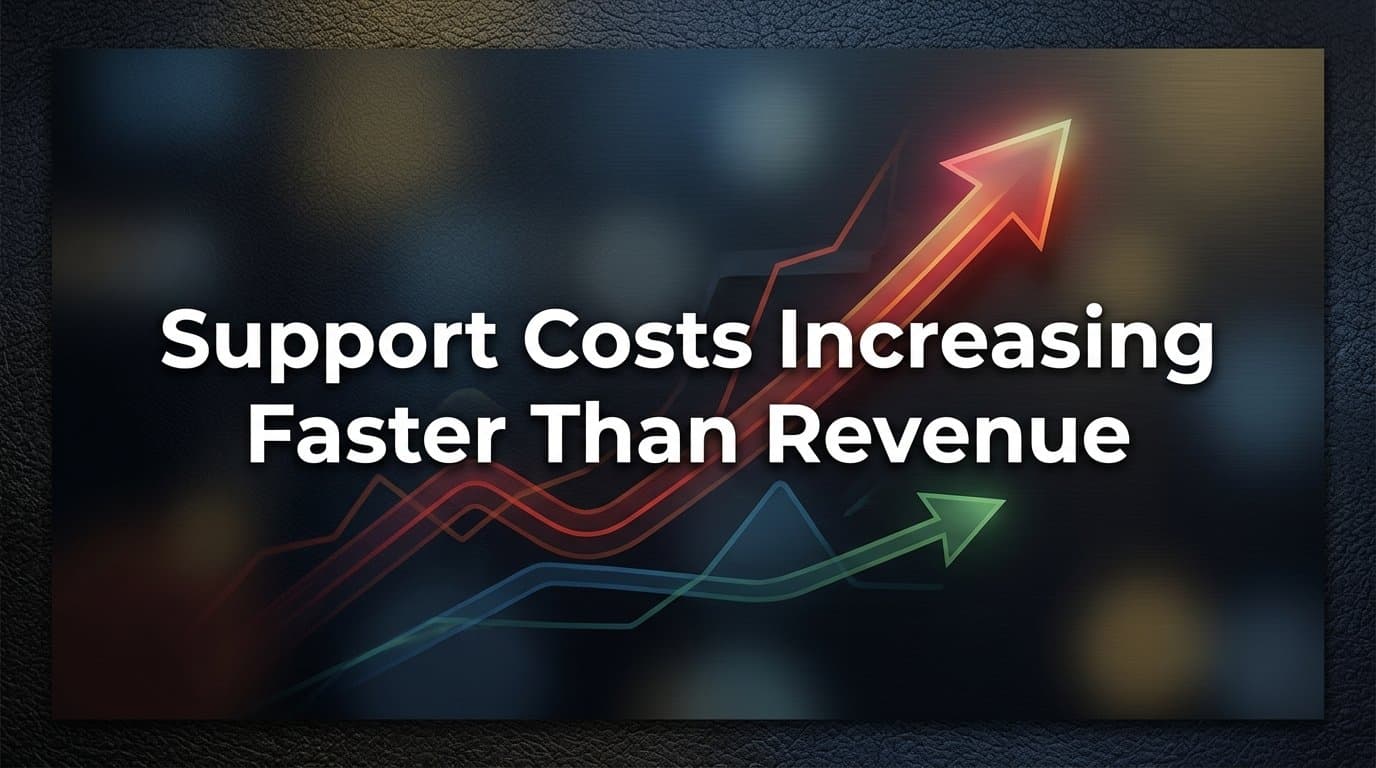
You're reviewing the quarterly financials, and something doesn't add up. Revenue is climbing. The team is celebrating. But when you look at the support line item, it's climbing faster. Not slightly faster. Meaningfully, uncomfortably faster. And you're starting to wonder whether this is a temporary growing pain or something structural you haven't fully reckoned with yet.
This is one of the most common scaling traps in B2B SaaS, and it catches founders and support leaders off guard precisely because it's invisible during the early stages. When you have 50 customers, support feels manageable. At 500, it feels stretched. At 5,000, it can feel like the entire business is being consumed by it.
The instinct is to frame this as a staffing problem: hire more agents, add a manager, build out a tier-two team. But that framing misses the real issue. Support costs outpacing revenue isn't a headcount problem at its core. It's a structural problem with how traditional support is architected. The model was designed for a world that no longer exists, and applying it to a nonlinear growth environment produces predictably painful results.
This article breaks down why the cost curve bends the wrong way, what compounds it over time, and how modern support teams are rebuilding the model from the ground up to scale with revenue rather than against it.
The Scaling Trap: Why Support Costs Grow Faster Than Your Customer Base
Traditional support is built on a linear assumption: more customers produce more tickets, and more tickets require more agents. It's a direct, proportional relationship that made sense when software products were simpler and customer bases were more homogeneous. The problem is that SaaS growth is rarely linear, and the relationship between customer count and support demand almost never is either.
Here's what actually happens as a SaaS company scales. In the early days, your product has a relatively small surface area. Customers are often technical early adopters who can figure things out. Your support team knows every customer by name and can resolve most issues from memory. The headcount-to-customer ratio feels sustainable.
Then the product grows. New features ship. New integrations launch. New pricing tiers attract new customer segments with different technical sophistication and different expectations. Each of these expansions generates a fresh wave of support scenarios that your team has never seen before. And unlike the early days, these scenarios don't get simpler with scale. They get more complex, more varied, and harder to resolve quickly.
This is the first layer of the trap: product complexity grows alongside your customer base, which means ticket complexity grows too. Complex tickets take longer to resolve. They require more senior agents. They often require cross-functional coordination with engineering or product. The cost per ticket rises even as volume rises, creating a compounding effect on your support budget that outpaces the revenue growth funding it.
The second layer involves customer expectations. As your company matures and attracts enterprise customers, those customers arrive with SLA expectations, dedicated support requirements, and executive escalation paths. Serving them well requires a tiered support structure: a frontline team for high-volume, lower-complexity issues, and a specialized team for strategic accounts. Each tier carries its own overhead, and the cost of maintaining that structure doesn't scale down when ticket volume has a slow month.
The result is a support organization that's structurally expensive by design, not by accident. The model was built to absorb volume, and absorbing volume is exactly what it does, at a cost that grows faster than the revenue it's meant to protect.
The Hidden Multipliers That Inflate Your Support Budget
The line items that show up in a support budget are usually headcount, tooling, and maybe some training. But the actual cost of running a support team is significantly higher than what the spreadsheet captures, and the hidden multipliers are often where the real damage happens.
Recruiting and onboarding churn: Support roles, particularly frontline agent positions, tend to have higher turnover than other functions. Every departure triggers a cycle of recruiting costs, onboarding time, and a ramp period during which the new agent is slower and more error-prone than the person they replaced. In a team of any meaningful size, this cycle is almost always running somewhere. The cost is real, it recurs constantly, and it's almost never factored into per-ticket cost calculations.
Tool sprawl and context switching: Most support teams don't operate from a single system. They have a helpdesk for tickets, a CRM for customer history, a project management tool for bug escalation, a communication platform for internal discussion, and sometimes a separate knowledge base. Resolving a single ticket can require switching between three or four of these tools to gather the context needed to give a complete answer. Each switch adds time. At scale, that time adds up to a meaningful fraction of every agent's day, spent on navigation rather than resolution.
The repeat ticket feedback loop: Perhaps the most expensive hidden multiplier is the repeat ticket. In many support organizations, a substantial portion of incoming volume comes from the same underlying issues resurfacing repeatedly. This happens when ticket resolution doesn't feed back into product improvement, documentation updates, or proactive customer outreach. The same question gets asked, answered, and forgotten, then asked again by the next customer who hits the same wall.
Repeat contacts are a direct cost multiplier because they represent work that should have been done once but is being done continuously. Worse, when repeat issues escalate into churn, the cost extends well beyond the support budget. The revenue impact of a churned customer, particularly in B2B SaaS where contract values are significant, can dwarf the original ticket cost by orders of magnitude. The true cost of a support failure compounds over time in ways that a per-ticket metric will never capture.
When Support Costs Become a Revenue Problem
At some point, the support cost conversation stops being a departmental budget discussion and becomes a company-level health signal. That transition happens faster than most leaders expect.
Investors and board members increasingly look at support cost as a percentage of ARR as a proxy for operational maturity. A rising ratio raises questions that go beyond the support team: Is the product generating too much confusion? Are onboarding gaps creating unnecessary ticket volume? Is the team scaling efficiently, or is headcount being added reactively without structural improvement? These are questions that touch product, engineering, and customer success, not just support leadership.
The more immediate danger is the cycle that inflated support costs can trigger internally. Budget pressure leads to decisions about headcount that feel prudent in the moment: slower backfills, tighter hiring standards, reduced training investment. Each of these decisions degrades response time and resolution quality. Slower, lower-quality support increases churn. Churn reduces the revenue base against which support costs are measured, which makes the ratio worse even if absolute spending stays flat. The cycle is self-reinforcing and difficult to interrupt once it starts.
There's also an opportunity cost that rarely appears in the support budget but is very real. When support issues escalate to engineering, when product managers spend time triaging customer complaints instead of building features, when customer success managers are pulled into firefighting rather than expansion conversations, the entire business pays a tax on support inefficiency. The hours spent on support escalations are hours not spent on the growth-driving work that justifies the company's valuation. This second-order cost is invisible on the P&L but shows up eventually in slower product velocity and missed market opportunities.
Understanding this full picture is what separates teams that treat support as a cost center to be minimized from teams that treat it as a system to be engineered. The former approach manages symptoms. The latter addresses the structure that produces them.
How Modern Teams Are Decoupling Support Costs from Growth
The teams breaking the linear cost curve aren't doing it by working harder or hiring more carefully. They're doing it by changing the fundamental architecture of how support works.
The most important shift is from reactive to proactive support. Reactive support waits for customers to submit tickets and then processes them. Proactive support uses data signals, product usage patterns, billing anomalies, and customer health indicators to identify friction before it becomes a ticket. When a customer's usage drops sharply, or when they repeatedly visit a specific help page without finding resolution, or when a payment issue is about to surface, a proactive system can intervene before the customer has to ask for help. This approach doesn't just make support faster. It reduces ticket volume at the source, which is the only way to genuinely decouple support costs from customer growth.
AI-first support architectures are the other major structural change. There's an important distinction worth making here between AI that augments agents (making them faster at resolving tickets) and AI that deflects tickets (resolving issues before a human ever gets involved). Both reduce cost, but deflection has a more dramatic impact on the cost-to-revenue ratio because it breaks the linear relationship between volume and headcount entirely.
Purpose-built AI agents, unlike bolt-on chatbots layered onto existing helpdesks, are designed to resolve tickets autonomously from the start. They learn from every interaction, improving their resolution capability continuously rather than requiring manual retraining. They escalate intelligently to human agents when a situation genuinely requires human judgment, rather than escalating everything that doesn't match a predefined script. This means human agents spend their time on issues where they actually add value, rather than processing high-volume, repetitive requests that a well-trained AI can handle just as well.
Halo AI's approach, for example, includes page-aware context that lets the AI agent see what a user is seeing in real time, reducing the back-and-forth that inflates resolution time and repeat contacts. Auto bug ticket creation connects directly to tools like Linear, eliminating the manual escalation overhead that adds invisible cost to every engineering-bound issue. And integrations with the broader business stack, including HubSpot, Stripe, Slack, and others, give both AI and human agents full customer context in one place, eliminating the tool-switching tax that quietly consumes agent capacity.
The cumulative effect of these changes is a support operation where adding customers doesn't automatically mean adding headcount. The cost curve bends.
Measuring What Actually Matters: Support Cost Metrics That Drive Decisions
If you're managing support costs with the wrong metrics, you'll make the wrong decisions. Most teams default to cost per ticket as their primary efficiency measure. It's useful, but it's incomplete in ways that can be actively misleading.
Cost per resolved issue: This is distinct from cost per ticket because it accounts for repeat contacts. If a ticket is "resolved" but the same customer opens three more tickets about the same underlying issue, the true cost of that resolution is four times what the first ticket suggests. Tracking cost per resolved issue, where resolution means the problem doesn't recur, gives a more honest picture of support efficiency.
Support cost as a percentage of ARR: This is the metric that connects support operations to business health. A rising ratio is a warning signal regardless of whether absolute costs feel manageable. A falling ratio, achieved while maintaining or improving customer satisfaction, is evidence that the support model is scaling correctly.
Deflection rate: This is arguably the most direct measure of whether automation is working. Deflection rate tracks the percentage of potential tickets that are resolved without agent involvement, either through self-service, in-product guidance, or AI resolution. A rising deflection rate combined with stable or improving customer satisfaction scores is the clearest signal that the support cost trajectory is moving in the right direction.
Ticket volume growth rate versus customer growth rate: This comparison is a leading indicator that most teams underutilize. When tickets grow faster than customers, the cost problem is accelerating even if the absolute numbers still look manageable. Catching this divergence early, before it shows up painfully in the quarterly financials, is the difference between a proactive adjustment and a reactive crisis.
Agent utilization rate rounds out the picture by revealing whether the team's capacity is being used effectively or whether structural inefficiencies are creating idle time alongside overload, which is more common than it sounds in fragmented support environments.
Building a Support Operation That Scales With Revenue
The goal isn't to eliminate human support. It's to make sure human agents are spending their time on the work that genuinely requires human judgment, while everything else is handled more efficiently.
This means designing a clear division of labor. High-volume, repeatable issues, the password resets, the billing questions, the how-do-I-use-this-feature requests, are exactly the cases where AI agents perform well and where human involvement adds little incremental value. Complex, emotionally charged, or strategically significant issues are where human agents make a real difference. A well-designed support architecture routes automatically based on this distinction, ensuring that the expensive resource (human attention) is deployed where it actually matters.
Continuous improvement loops are what make this architecture compound over time rather than plateau. Every AI interaction, every escalation, every resolved ticket should feed back into the system to improve future performance. An AI agent that learns from thousands of resolutions becomes meaningfully better at handling novel situations than one that was trained once and left static. This means the cost curve doesn't just bend at the point of AI adoption. It continues to bend downward as the system accumulates experience. That's a fundamentally different cost dynamic than the linear headcount model, where adding experience means adding salary.
Organizational alignment is the final piece that most support improvement efforts underinvest in. When support data flows to product and engineering teams, it creates a feedback loop that addresses ticket-generating product gaps at the source. When customer success teams have visibility into support patterns, they can intervene proactively with at-risk accounts before churn becomes likely. When support insights connect to revenue data, leadership can see the true cost of support failures and make investment decisions accordingly.
This kind of alignment requires integration across the business stack, not just within the support function. It's the difference between a support team that processes tickets and a support operation that generates intelligence the entire business can act on.
The Bottom Line
Back to that financial review where this started. Support costs climbing faster than revenue isn't an accident, and it isn't inevitable. It's the predictable result of a linear, reactive support model applied to a nonlinear growth environment. The model was designed for a simpler time, and it produces predictably painful results when you push it past its design limits.
The teams breaking this pattern share a common approach: they treat support as a system to be engineered, not a headcount problem to be managed. They invest in proactive capabilities that reduce ticket volume rather than just processing it faster. They deploy AI that learns and improves continuously rather than bolting automation onto a fundamentally manual process. They connect support data to the rest of the business so that every resolved ticket makes the product, the documentation, and the customer experience incrementally better.
The result is a support operation where the cost curve bends in the right direction as the company grows, rather than accelerating away from the revenue line it's supposed to serve.
Your support team shouldn't scale linearly with your customer base. Let AI agents handle routine tickets, guide users through your product, and surface business intelligence while your team focuses on complex issues that need a human touch. See Halo in action and discover how continuous learning transforms every interaction into smarter, faster support.