9 Best Support Team Augmentation Tools in 2026
Discover the 9 best support team augmentation tools in 2026, evaluated on AI capability, integration depth, and scalability. These solutions help support teams resolve routine tickets autonomously, route complex issues intelligently, and give agents the context they need to work faster—without increasing headcount.
 Grant CooperFounder15 min read
Support teams are under more pressure than ever. Ticket volumes climb, customer expectations rise, and headcount budgets stay flat. The answer isn't always hiring more agents — it's giving your existing team smarter tools that handle the repetitive, automate the predictable, and surface the insights that actually move the needle.
Support team augmentation tools sit in the space between pure automation and human support. They don't replace your agents; they make them dramatically more effective. We're talking about resolving routine tickets autonomously, routing complex issues to the right person, and giving agents the context they need to close issues faster without scrambling across five different tabs.
This list covers the top tools in this category as of 2026, evaluated on AI capability, integration depth, ease of deployment, and how well they scale with growing teams. Whether you're running a lean two-person support operation or managing a 50-agent team across multiple products, there's a fit here. We've also included resources on customer support AI benefits and customer support automation strategy if you want to go deeper on the strategic side.
1. Halo AI
Best for: AI-first SaaS teams that want autonomous resolution, visual product guidance, and business intelligence in one platform.
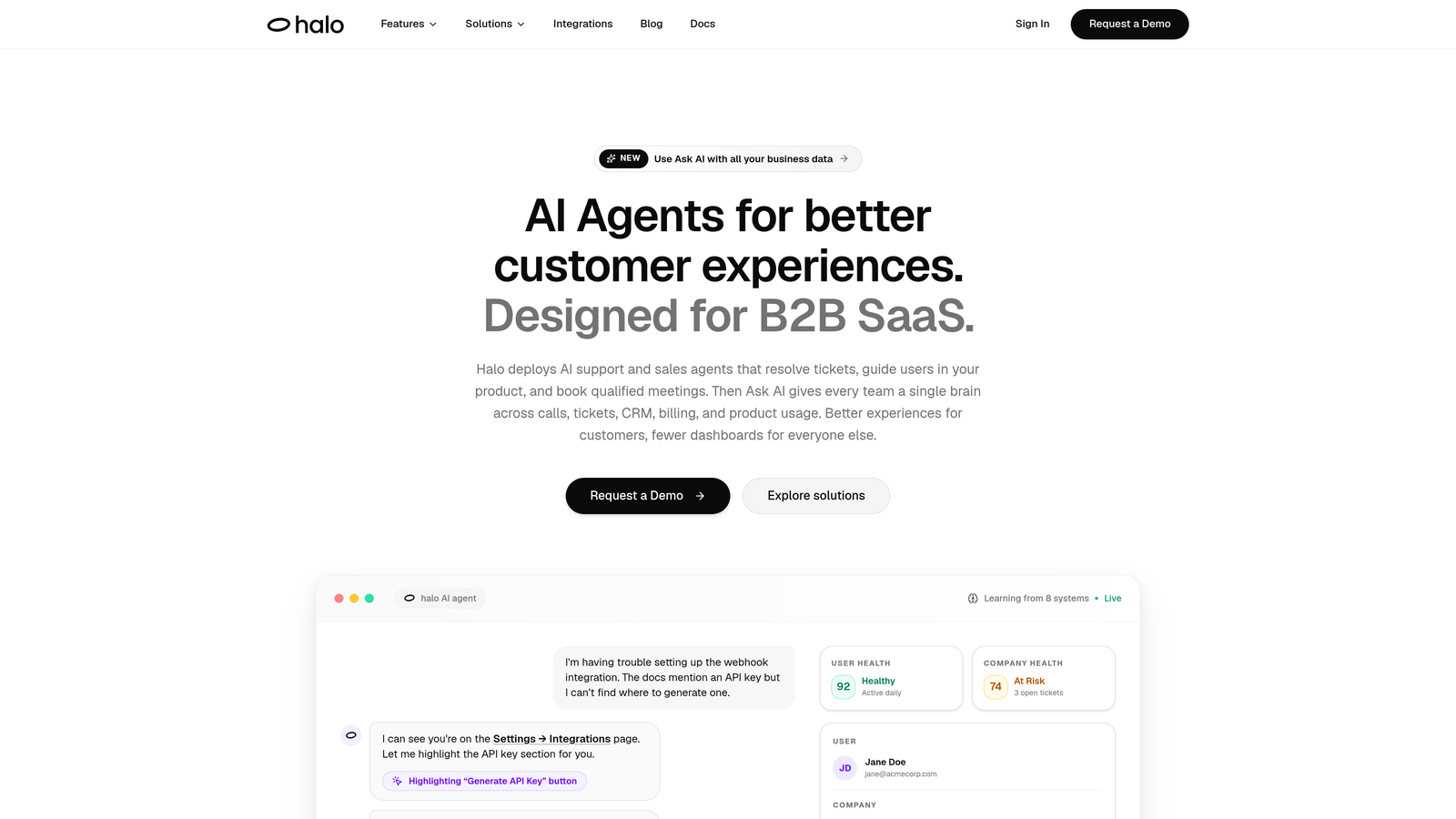
Halo AI is an AI-first customer support platform that deploys intelligent agents to resolve tickets, guide users visually through your product, and generate business intelligence — all while learning continuously from every interaction.
Where This Tool Shines
Unlike AI features bolted onto legacy helpdesks, Halo was built from the ground up around AI agents. That architectural difference matters. The platform doesn't just answer questions — it understands the page a user is on, sees the UI state they're looking at, and provides contextual visual guidance rather than generic text responses.
The Smart Inbox goes beyond ticket management. It surfaces customer health signals, revenue intelligence, and anomaly detection, turning your support queue into a source of business intelligence that product and revenue teams actually want to read. That's a meaningfully different value proposition from most tools in this category.
Key Features
Page-Aware AI Agents: The AI sees what your user sees — current page, UI state, context — and delivers guidance that's specific to their exact situation rather than pulling from a generic knowledge base.
Smart Inbox with Business Intelligence: Surfaces customer health signals, revenue intelligence, and anomaly detection directly from support interactions, giving leadership a real-time view of what's happening across the customer base.
Auto Bug Ticket Creation: Automatically generates structured bug reports from user-reported issues and routes them directly to Linear or Jira, closing the loop between support and engineering without manual handoff.
Live Agent Handoff: When a conversation needs a human, the full context transfers seamlessly — no agent starts from scratch, and no customer has to repeat themselves.
Deep Integration Stack: Connects to Linear, Slack, HubSpot, Intercom, Stripe, Zoom, PandaDoc, and Fathom, meaning your support agents and AI work inside the tools your entire business already runs on.
Continuous Learning: Every resolved interaction feeds back into the model, so the AI gets measurably smarter over time rather than staying static after initial setup.
Best For
Halo AI is an excellent fit for B2B SaaS companies and product teams that want AI-first architecture rather than AI as an afterthought. It's particularly strong for teams where support is closely tied to product adoption — the page-aware guidance and bug auto-routing create tight feedback loops between support, product, and engineering.
Pricing
Contact Halo AI directly for pricing. Given the depth of the platform and the business intelligence layer, it's positioned for growth-stage and scaling SaaS teams rather than individual freelancers or very early startups.
2. Intercom
Best for: Teams that want a mature, multi-channel AI agent with a strong workflow builder and broad ecosystem.
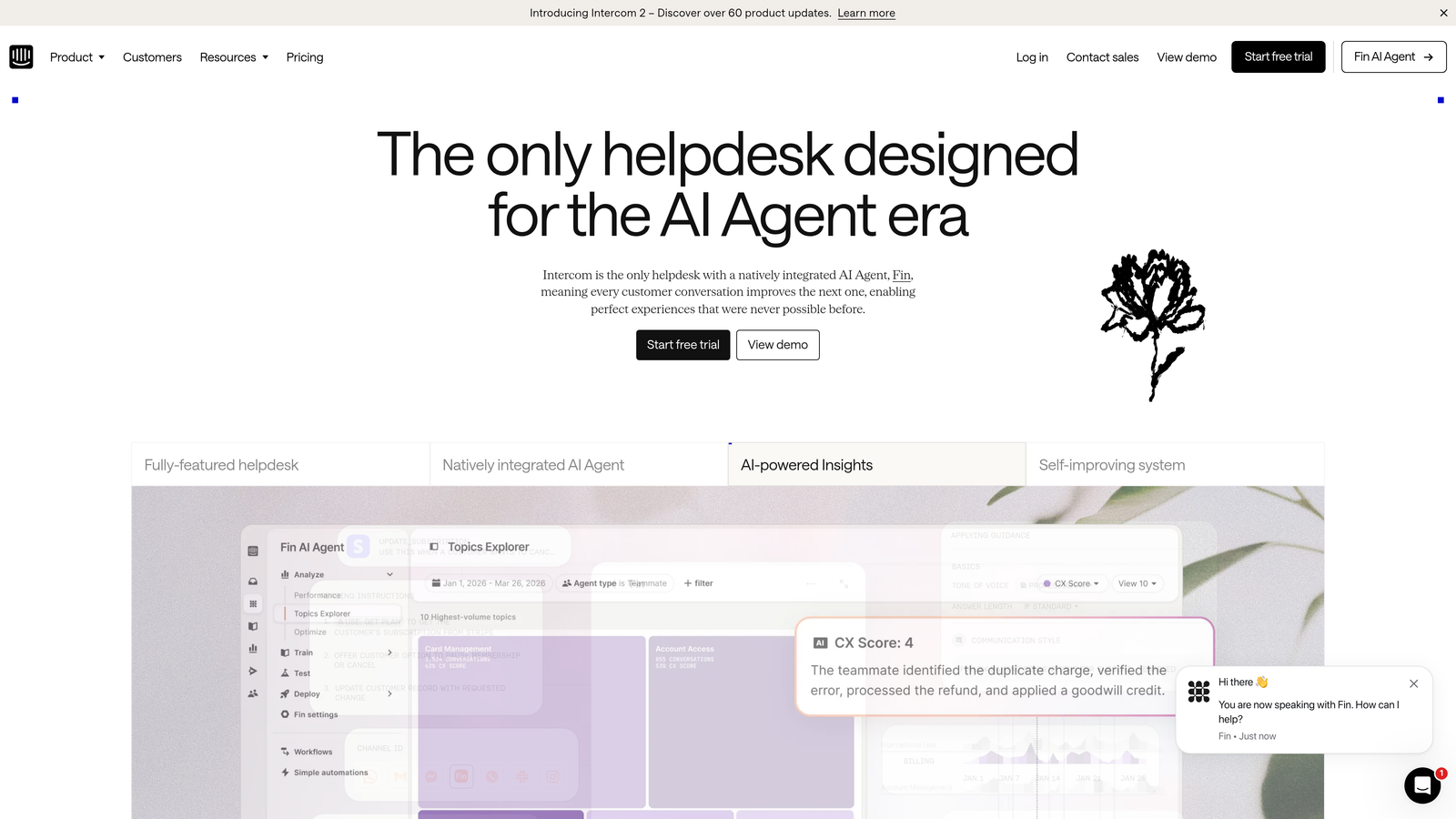
Intercom is a leading customer messaging platform whose Fin AI agent handles deflection and resolution across chat, email, SMS, and social channels.
Where This Tool Shines
Fin, Intercom's AI agent, is trained directly on your knowledge base and can resolve a significant portion of incoming queries without human intervention. The quality of responses tends to be strong when the underlying knowledge base is well-maintained, making documentation hygiene an important factor in how well Fin performs for your team.
Intercom's workflow builder is one of the more mature in the category, letting teams design complex automation sequences that blend AI responses, routing logic, and human handoff in a visual, no-code environment. Teams with sophisticated support workflows will appreciate the flexibility.
Key Features
Fin AI Agent: Trained on your own knowledge base for autonomous resolution across multiple channels, with configurable escalation thresholds for when to hand off to a human.
Multi-Channel Coverage: Handles chat, email, SMS, and social from a unified inbox, reducing the context-switching that fragments agent attention across separate tools.
Workflow Builder: Visual, no-code automation sequences for complex routing, escalation, and response logic that go well beyond simple if/then rules.
AI-Generated Reply Suggestions: Live agents get real-time AI suggestions in their inbox, helping them respond faster without losing the human touch on conversations that need it.
Best For
Intercom works well for SaaS companies of various sizes that want a polished, multi-channel platform with a strong ecosystem. It's a natural fit for teams already using Intercom for product messaging who want to extend it into AI-driven support.
Pricing
Starts at $39 per seat per month for the base platform. Fin AI usage is priced separately on a consumption basis, so costs can scale meaningfully with volume. Factor both into your budget planning.
3. Zendesk AI
Best for: Enterprise teams that need compliance, deep reporting, and AI augmentation within an established Zendesk environment.
Zendesk AI is enterprise-grade AI augmentation built natively into the Zendesk Suite, covering triage, routing, and agent copilot capabilities across the platform.
Where This Tool Shines
For teams already running on Zendesk, the native AI integration means no additional vendor, no data sync headaches, and no workflow disruption. Intelligent triage uses intent, sentiment, and language detection to route tickets accurately from the moment they arrive, reducing the manual sorting that eats into agent capacity.
The Agent Copilot is the standout feature for augmentation specifically. It provides real-time reply suggestions, auto-summarizes long ticket threads, and recommends next-best actions — all without the agent leaving their current view. For high-volume teams handling complex tickets, that time savings compounds quickly.
Key Features
Intelligent Triage and Routing: Automatically classifies incoming tickets by intent, sentiment, and language, then routes them to the right team or individual without manual intervention.
Agent Copilot: Real-time reply suggestions, auto-summarization of ticket history, and next-best-action recommendations surfaced directly in the agent workspace.
Advanced Bots: Self-service deflection bots that handle common queries before they reach the queue, configurable without engineering involvement.
Enterprise Reporting and Compliance: Deep analytics, SLA tracking, and compliance features that matter to regulated industries and large organizations with strict governance requirements.
Best For
Zendesk AI is the right choice for enterprise teams already invested in the Zendesk ecosystem who want AI augmentation without platform migration. It's also strong for compliance-sensitive industries where staying within a well-documented, enterprise-grade platform is a requirement.
Pricing
AI features are available from the Suite Professional tier at $115 per agent per month. An Advanced AI add-on is available for teams that need the full copilot and automation feature set on top of that.
4. Freshdesk Freddy AI
Best for: SMB and mid-market teams that want meaningful AI augmentation without enterprise-level pricing.
Freshdesk's Freddy AI spans self-service deflection, agent assist, and support analytics at price points that make it accessible for smaller teams watching their per-seat costs carefully.
Where This Tool Shines
Freddy's three-layer structure covers the full augmentation stack: deflection before tickets are created, assist while agents work tickets, and insights after the fact. That breadth at SMB-accessible pricing is genuinely uncommon in this category, where most comprehensive AI platforms sit at enterprise price points.
Freddy Insights deserves particular attention. The AI-powered analytics layer includes anomaly detection that flags unusual spikes or drops in ticket patterns, giving support managers early warning signals without requiring them to build custom dashboards or run manual reports.
Key Features
Freddy Self Service: A no-code bot builder for deflecting common tickets before they reach the queue, configurable by non-technical team members.
Freddy Copilot: Suggested replies, conversation summarization, and next-step recommendations surfaced in the agent workspace during active tickets.
Freddy Insights: AI-powered analytics with anomaly detection, giving managers visibility into support trends and unexpected volume changes without manual analysis.
Accessible Pricing Tiers: Available at lower price points than enterprise-focused competitors, making the AI augmentation layer accessible to teams that can't justify Zendesk AI's per-seat costs.
Best For
Freshdesk Freddy AI is a strong fit for SMB and mid-market teams already on Freshdesk who want to add AI augmentation incrementally. It's also worth evaluating for teams that have been priced out of Zendesk AI and need a comparable feature set at a lower cost basis.
Pricing
Freddy Copilot is available as an add-on from approximately $29 per agent per month, layered on top of existing Freshdesk plan costs. One of the more accessible entry points in the category.
5. Forethought
Best for: Mid-market and enterprise teams that want AI augmentation without switching their existing helpdesk platform.
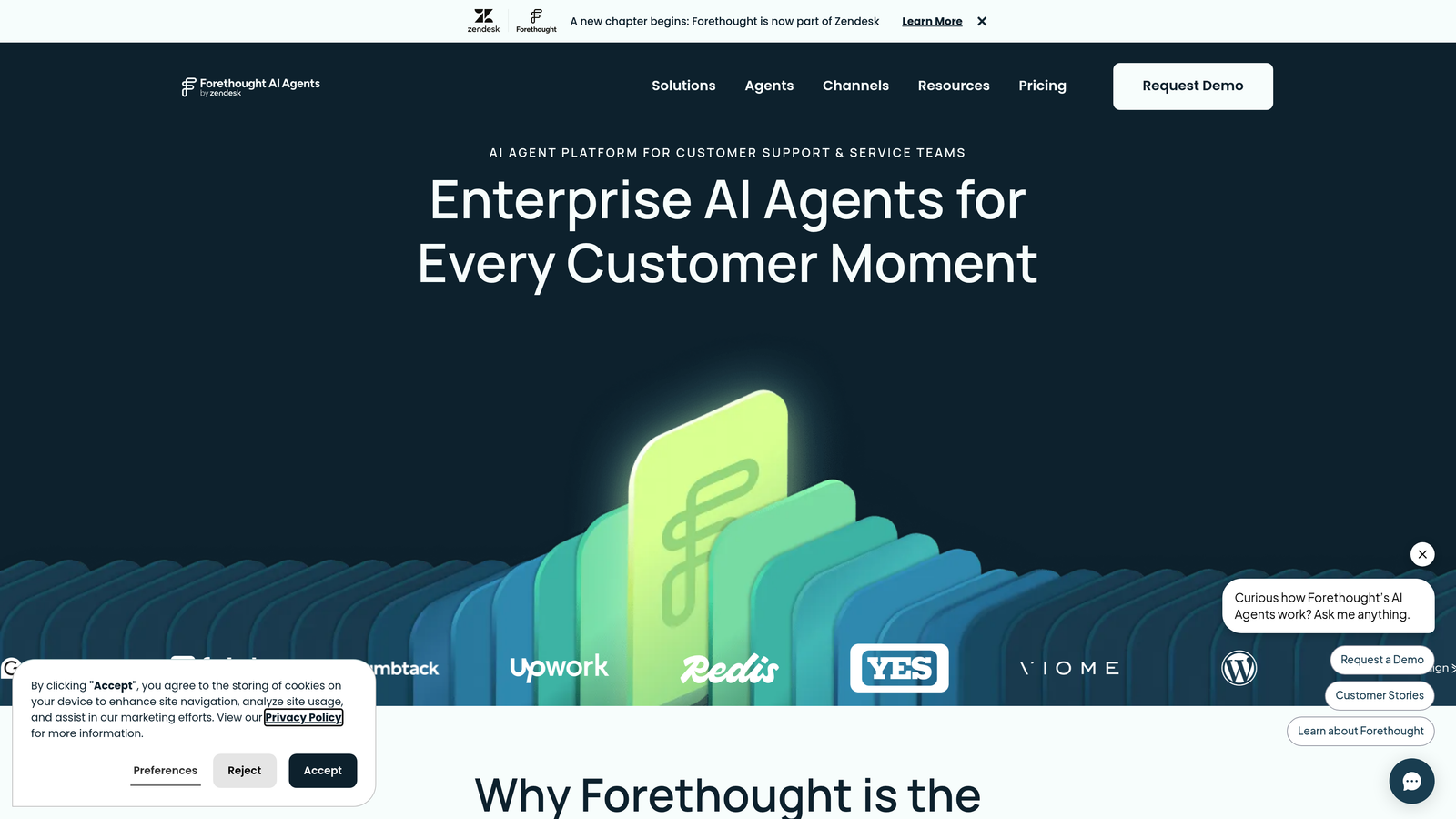
Forethought is an AI augmentation layer that sits on top of existing helpdesks, adding intelligent triage, deflection, and agent assist without requiring a platform migration.
Where This Tool Shines
The core value proposition here is additive intelligence. If your team is deeply embedded in Zendesk, Salesforce Service Cloud, or ServiceNow and a full migration isn't realistic, Forethought gives you meaningful AI capabilities without touching your existing infrastructure. That's a significant advantage for teams where platform lock-in is a real constraint.
The three-module structure (Triage, Solve, Assist) maps cleanly to different stages of the ticket lifecycle, letting teams adopt the modules that address their specific bottlenecks rather than committing to a full platform overhaul from day one.
Key Features
Triage AI: Automatically tags, routes, and prioritizes incoming tickets based on content analysis, reducing the manual sorting burden on team leads and senior agents.
Solve AI: Deflects routine tickets with AI-generated answers before they reach the queue, drawing on your existing knowledge base and historical ticket data.
Assist AI: Surfaces relevant knowledge articles and suggested responses to agents in real time while they're working a ticket, reducing time spent searching for answers.
Broad Helpdesk Compatibility: Integrates with Zendesk, Salesforce Service Cloud, ServiceNow, and Freshdesk, covering the majority of enterprise helpdesk environments.
Best For
Forethought is ideal for teams that want AI augmentation now but can't justify the disruption or cost of a full platform migration. It's particularly strong for organizations running on Salesforce Service Cloud or ServiceNow, where native AI augmentation options are more limited than in the Zendesk ecosystem.
Pricing
Custom pricing; contact sales directly. Positioned at mid-market and enterprise, so expect pricing to reflect that segment rather than SMB budgets.
6. Assembled
Best for: Support operations teams that need AI-powered workforce management, forecasting, and scheduling across channels and time zones.
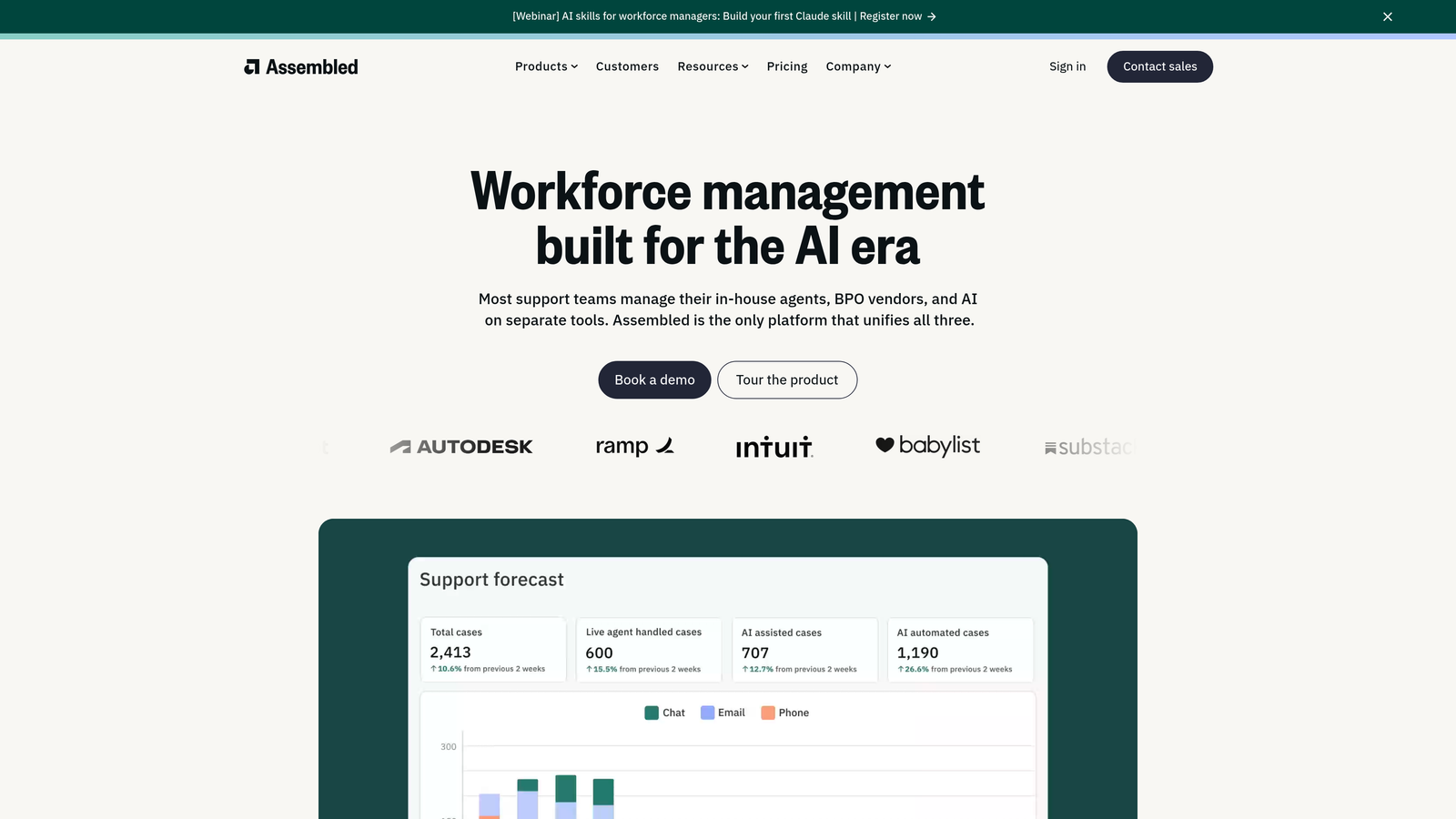
Assembled is a workforce management platform that uses AI-powered forecasting and scheduling to ensure support teams are staffed optimally — a different angle on augmentation that's often overlooked.
Where This Tool Shines
Most augmentation tools focus on what happens during a ticket. Assembled focuses on who's available to handle tickets in the first place. AI-powered volume forecasting predicts when demand will spike across channels, and the scheduling engine translates those forecasts into optimized shift plans that match staffing to anticipated load.
For teams managing agents across multiple time zones or channels, the real-time adherence monitoring adds another layer of operational visibility — flagging when actual coverage is drifting from the plan before it creates a queue backlog.
Key Features
AI-Powered Volume Forecasting: Predicts incoming ticket volume across channels using historical patterns and trend data, giving operations teams a reliable basis for staffing decisions.
Automated Schedule Optimization: Translates forecasts into shift plans that balance coverage requirements, agent availability, and business rules without manual spreadsheet work.
Real-Time Adherence Monitoring: Tracks whether agents are working as scheduled and flags deviations before they compound into coverage gaps.
Helpdesk Integrations: Connects with Zendesk, Salesforce, Intercom, and Gorgias to pull ticket volume data directly into the forecasting engine.
Best For
Assembled is the right tool for support operations managers at mid-market and enterprise companies where scheduling complexity — multiple channels, multiple time zones, variable demand — is a meaningful operational challenge. It complements ticket-resolution AI rather than competing with it.
Pricing
Custom pricing; contact sales. Targets mid-market and enterprise support operations teams, so pricing reflects that positioning.
7. Guru
Best for: Teams where knowledge fragmentation is the primary drag on agent performance and resolution speed.
Guru is an AI-powered knowledge management platform that surfaces the right answers to agents in real time, directly inside their existing helpdesk workflow.
Where This Tool Shines
The browser extension model is Guru's most practical differentiator. Because it works inside any helpdesk or CRM via a browser extension, there's no platform dependency — agents get AI-powered knowledge surfacing regardless of whether they're in Zendesk, Salesforce, Freshdesk, or something more niche.
Knowledge triggers are particularly useful for augmentation: when an agent opens a ticket, Guru proactively suggests relevant knowledge cards based on the ticket content, rather than waiting for the agent to search. That shift from reactive to proactive knowledge delivery meaningfully reduces the time agents spend hunting for answers.
Key Features
AI Search: Searches across all connected knowledge sources simultaneously, returning the most relevant content rather than requiring agents to know which system to search.
Knowledge Triggers: Proactively surfaces relevant cards when agents open tickets, based on ticket content analysis — no manual search required.
Browser Extension: Works inside any helpdesk, CRM, or web application, making it platform-agnostic and easy to layer on top of existing workflows.
Verification Workflows: Keeps knowledge accurate over time by routing content to subject matter experts for periodic review, preventing agents from surfacing outdated answers.
Best For
Guru is a strong fit for teams where knowledge is scattered across multiple systems — wikis, Slack, Google Docs, helpdesk macros — and agents waste significant time searching rather than resolving. It's also a practical choice for teams that can't migrate their helpdesk but still need better knowledge infrastructure.
Pricing
Free tier available for small teams. Paid plans start at approximately $10 per user per month, making it one of the more accessible tools on this list for budget-conscious teams.
8. Gorgias
Best for: E-commerce brands on Shopify, WooCommerce, or BigCommerce that need AI automation for order-related support at scale.
Gorgias is a support helpdesk built specifically for e-commerce brands, with deep native integrations into major commerce platforms and AI automation designed around order-related inquiries.
Where This Tool Shines
The native Shopify, WooCommerce, and BigCommerce integrations are the foundation of Gorgias's value. Because the platform pulls live order data directly into the agent workspace, the AI agent can handle order status, returns, and shipping inquiries with real customer data rather than generic scripted responses. That specificity is what separates it from general-purpose support tools in an e-commerce context.
The revenue dashboard is a genuinely useful addition for e-commerce support teams that need to justify their budget internally. Showing support's direct impact on conversions and revenue — rather than just ticket volume and CSAT — changes the conversation about what the support function is worth to the business.
Key Features
Native Commerce Integrations: Direct integrations with Shopify, WooCommerce, and BigCommerce pull live order data into every support interaction, enabling accurate automated responses to order-related queries.
AI Agent for Order Inquiries: Handles order status, returns, and shipping questions autonomously using actual customer order data, without requiring agent involvement for routine cases.
Revenue Dashboard: Tracks support's impact on conversions and revenue, providing the business case data that e-commerce support managers need when reporting to leadership.
Macros and Rules Engine: High-volume automation for repetitive scenarios, configurable without engineering involvement.
Best For
Gorgias is purpose-built for e-commerce and doesn't try to be anything else. It's the right choice for DTC brands and e-commerce retailers with significant order-related support volume. B2B SaaS teams should look elsewhere on this list.
Pricing
Starts at $10 per month on the Starter plan. Pricing scales with ticket volume rather than seat count, which works well for e-commerce brands with seasonal demand spikes.
9. Kustomer
Best for: High-volume B2C teams that need CRM-native support with AI routing, deflection, and a unified customer timeline.
Kustomer is a CRM-native support platform that combines a unified customer timeline with AI-powered routing, deflection, and agent assist for teams handling complex, high-volume customer relationships.
Where This Tool Shines
The unified customer timeline is Kustomer's defining feature. Every interaction, order, event, and note for a given customer appears in a single chronological view, meaning agents never start a conversation without full context. For B2C brands where customers contact support repeatedly across their lifecycle, that context is the difference between a frustrating repeat-yourself experience and a genuinely efficient resolution.
The AI routing and intent detection layer works on top of that rich CRM data, which gives it more signal to work with than routing systems that only see the current ticket. That context-aware routing tends to produce better matching between ticket complexity and agent expertise.
Key Features
Unified Customer Timeline: All interactions, orders, and events for each customer in a single view, giving agents complete context before they type a single word.
AI-Powered Routing and Intent Detection: Routes incoming contacts based on intent analysis informed by the customer's full history, not just the current message.
Deflection Bots with CRM Context: Self-service bots that can access and act on real customer data — order status, account details, past interactions — rather than delivering generic scripted responses.
Broad Integration Ecosystem: Connects across e-commerce, payments, and communication tools, making it extensible for brands with complex tech stacks.
Best For
Kustomer is a strong fit for high-volume B2C brands — retail, subscription services, consumer apps — where customer relationships are complex, repeat contact is common, and CRM context directly improves resolution quality. It competes with Zendesk at the enterprise level and is worth evaluating for teams where customer history is central to every support interaction.
Pricing
Starts at $89 per user per month on the Enterprise tier. Positioned at mid-market and enterprise, so it's not the right fit for very small teams or early-stage startups watching per-seat costs carefully.
Which Tool Is Right for Your Team?
The right support team augmentation tool depends almost entirely on where your biggest constraint actually lives. Here's a quick way to think through the decision.
AI-first SaaS teams that want autonomous resolution, page-aware guidance, and business intelligence beyond ticket metrics should start with Halo AI. The architecture is built for this use case, and the continuous learning model means the system compounds in value over time rather than plateauing after initial setup.
Enterprise teams already on Zendesk will find Zendesk AI the path of least resistance. The native integration eliminates a vendor layer, and the Agent Copilot is genuinely strong for high-volume, complex-ticket environments. Forethought is the right alternative if you're on Salesforce Service Cloud or ServiceNow and want AI augmentation without a migration.
SMB and mid-market teams watching per-seat costs should evaluate Freshdesk Freddy AI first. The three-layer structure (deflect, assist, analyze) covers the full augmentation stack at a price point that makes the ROI calculation straightforward. Guru is worth adding if knowledge fragmentation is a separate, compounding problem for your agents.
E-commerce brands on Shopify or WooCommerce will find Gorgias hard to beat for order-related automation. Kustomer is the better fit for high-volume B2C teams where CRM context and unified customer timelines are the priority over commerce-specific integrations.
Support operations teams dealing with scheduling complexity, multi-channel staffing, or time zone coverage should look at Assembled alongside whatever ticket-resolution tool they choose. It solves a different problem — staffing optimization rather than ticket automation — but it's often the missing piece in mature support operations.
Your support team shouldn't scale linearly with your customer base. Let AI agents handle routine tickets, guide users through your product, and surface business intelligence while your team focuses on complex issues that need a human touch. See Halo in action and discover how continuous learning transforms every interaction into smarter, faster support.