9 Best Support Ticket Deflection Software Tools in 2026
This guide reviews nine leading support ticket deflection software platforms for 2026, evaluating each on AI sophistication, deflection capability, and integration depth. From AI-first autonomous agents to self-service knowledge bases, these tools help B2B and SaaS support teams reduce ticket volume while simultaneously improving the customer experience.
 Grant CooperFounder13 min read
Every support ticket that reaches a human agent costs time and money, and most teams are drowning in requests that could have been resolved automatically. Support ticket deflection software changes that equation by intercepting common questions before they become tickets, using AI, self-service portals, knowledge bases, and intelligent chat to resolve issues instantly.
The best tools don't just reduce ticket volume. They improve the customer experience at the same time. This list covers nine platforms that genuinely move the needle on deflection rates, from AI-first agents built for autonomous resolution to self-service portals that slot neatly into existing helpdesks. Whether you're a lean SaaS team or scaling a B2B support operation, there's a fit here for your stack.
Selection criteria: deflection capability, AI sophistication, integration depth, ease of deployment, and overall value for B2B product teams.
1. Halo AI
Best for: B2B SaaS teams wanting fully autonomous AI ticket deflection with business intelligence built in
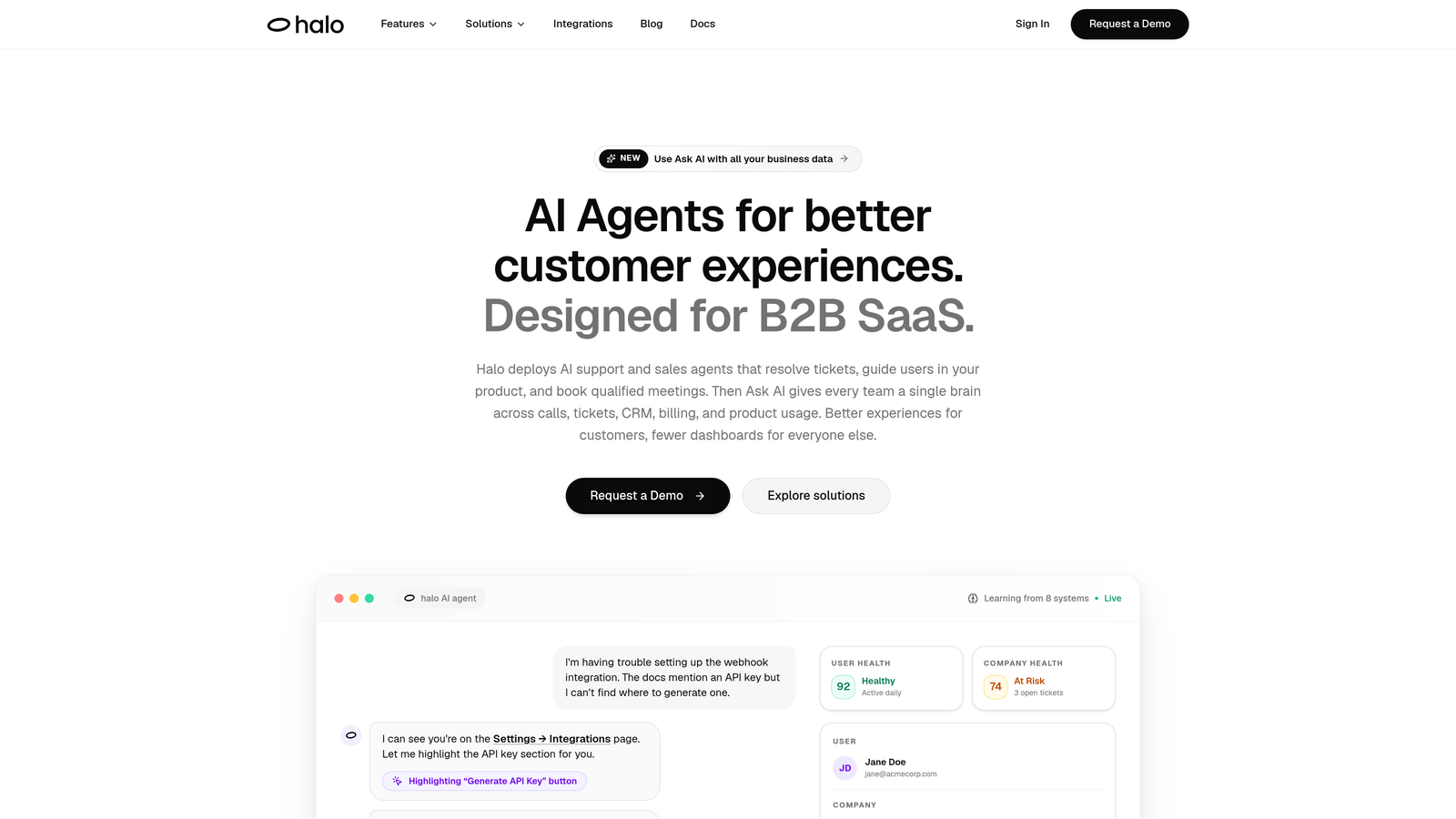
Halo AI is an AI-first customer support platform that deploys autonomous agents to resolve tickets, guide users through your product with page-aware context, and surface business intelligence — all while continuously learning from every interaction.
Where This Tool Shines
What separates Halo from most deflection tools is the architecture underneath it. This isn't a chatbot bolted onto an existing helpdesk. It's a purpose-built AI agent platform designed to resolve tickets end-to-end without human involvement, and to get smarter with every conversation it handles.
The page-aware chat widget is a particularly distinctive capability. Rather than serving generic FAQ responses, Halo's AI sees what the user sees on their screen, enabling contextual guidance that's actually relevant to where they are in your product. For SaaS teams dealing with onboarding questions and feature how-tos, that context makes a significant difference in deflection quality.
Key Features
Page-Aware Chat Widget: The AI understands the user's current page context, delivering visual guidance tailored to exactly where they are in your product rather than generic answers.
Autonomous AI Agents: Agents resolve tickets end-to-end without requiring human involvement, handling everything from account questions to product guidance at scale.
Auto Bug Ticket Creation: When users report product issues, Halo automatically creates bug reports in Linear, closing the loop between support and engineering without manual handoff.
Smart Inbox with Business Intelligence: Goes beyond support metrics to surface customer health signals, revenue intelligence, and anomaly detection directly from support interactions.
Live Agent Handoff: Complex issues escalate gracefully to human agents with full conversation context preserved, so nothing gets lost in the handoff.
Integration Ecosystem: Connects to Linear, Slack, HubSpot, Intercom, Stripe, Zoom, PandaDoc, and Fathom, linking support data to your broader business stack.
Best For
Product teams and B2B SaaS companies that want deflection to do more than reduce ticket volume. If you need support intelligence feeding back into product development, customer success, and revenue operations, Halo's approach is worth a close look. Particularly well-suited to teams that have outgrown bolt-on AI features in their existing helpdesk.
Pricing
Contact for pricing, tailored to team size and usage. Given the platform's scope, it's designed for teams making a serious investment in AI-first support infrastructure.
2. Intercom
Best for: Teams already in the Intercom ecosystem looking to add conversational AI deflection
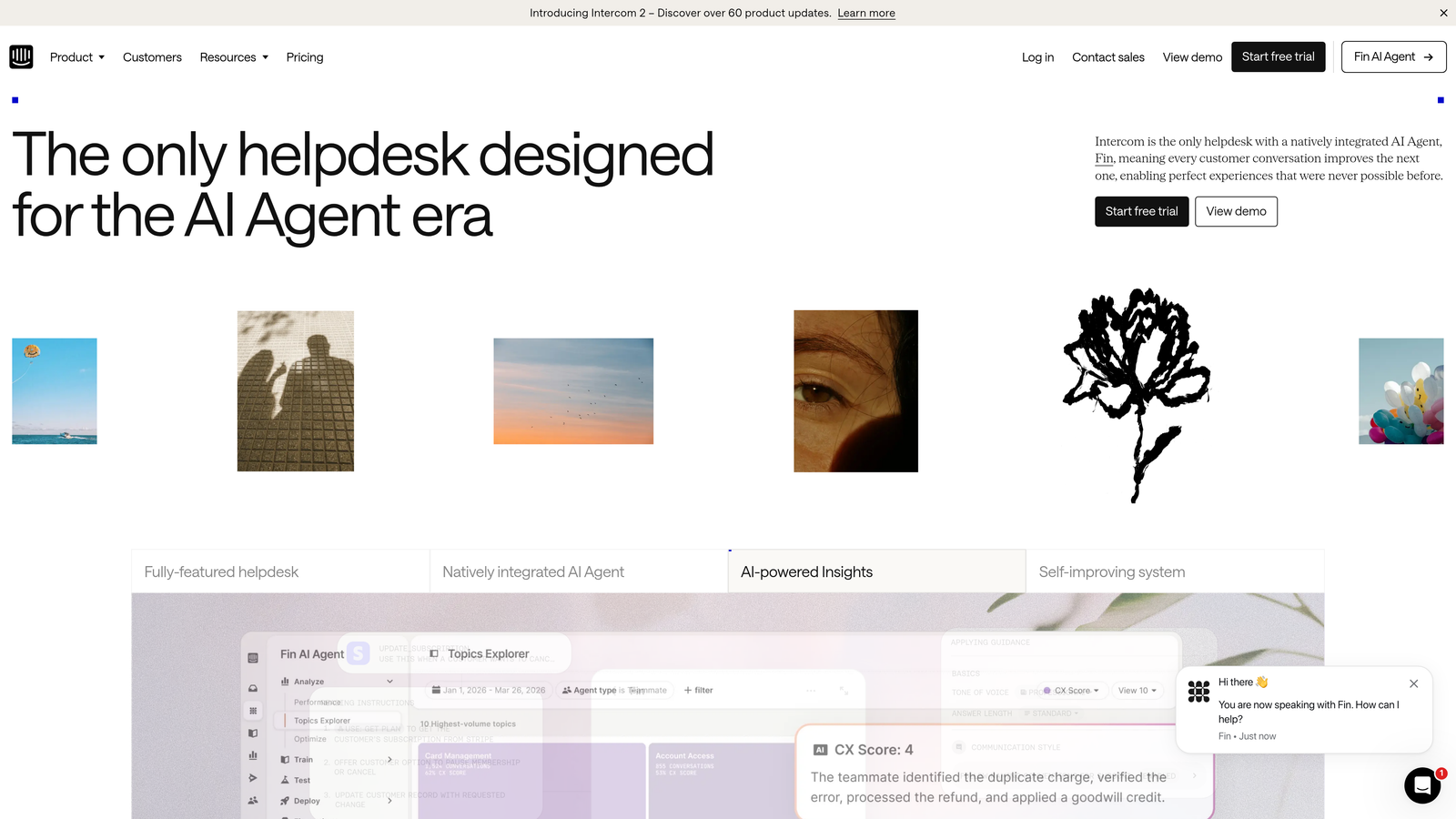
Intercom is a mature conversational support platform with Fin, its AI agent, layered on top for ticket deflection and self-service resolution.
Where This Tool Shines
Fin is Intercom's answer to the deflection challenge, and for teams already using Intercom's messenger and helpdesk, it's a natural extension. Built on large language models, Fin searches across your knowledge base and content to resolve queries conversationally before they escalate to a human agent.
The integrated nature of Intercom's platform is a genuine advantage here. Messenger, inbox, helpdesk, and AI deflection all live in one place, which reduces the integration complexity that comes with stitching together point solutions. The usage-based pricing for Fin (per resolution) is worth modeling carefully at scale, as costs can climb with high conversation volumes.
Key Features
Fin AI Agent: Resolves customer queries by searching your knowledge base and content library, handling common questions without human involvement.
Integrated Platform: Messenger, inbox, and helpdesk are unified in one product, reducing the tool sprawl common in support stacks.
Usage-Based Pricing for Fin: Pay per resolution rather than a flat seat fee, which aligns cost with actual deflection value delivered.
Omnichannel Coverage: Deflection works across chat, email, and messaging channels from a single configuration.
Best For
Companies already running Intercom as their primary support platform who want to layer in AI deflection without switching tools. Less compelling as a standalone deflection solution if you're not already invested in the Intercom ecosystem.
Pricing
Fin AI agent priced per resolution; base plans start around $39/seat/month. Total cost depends heavily on deflection volume.
3. Zendesk
Best for: Enterprise teams running Zendesk as their core helpdesk who need deflection built into existing workflows
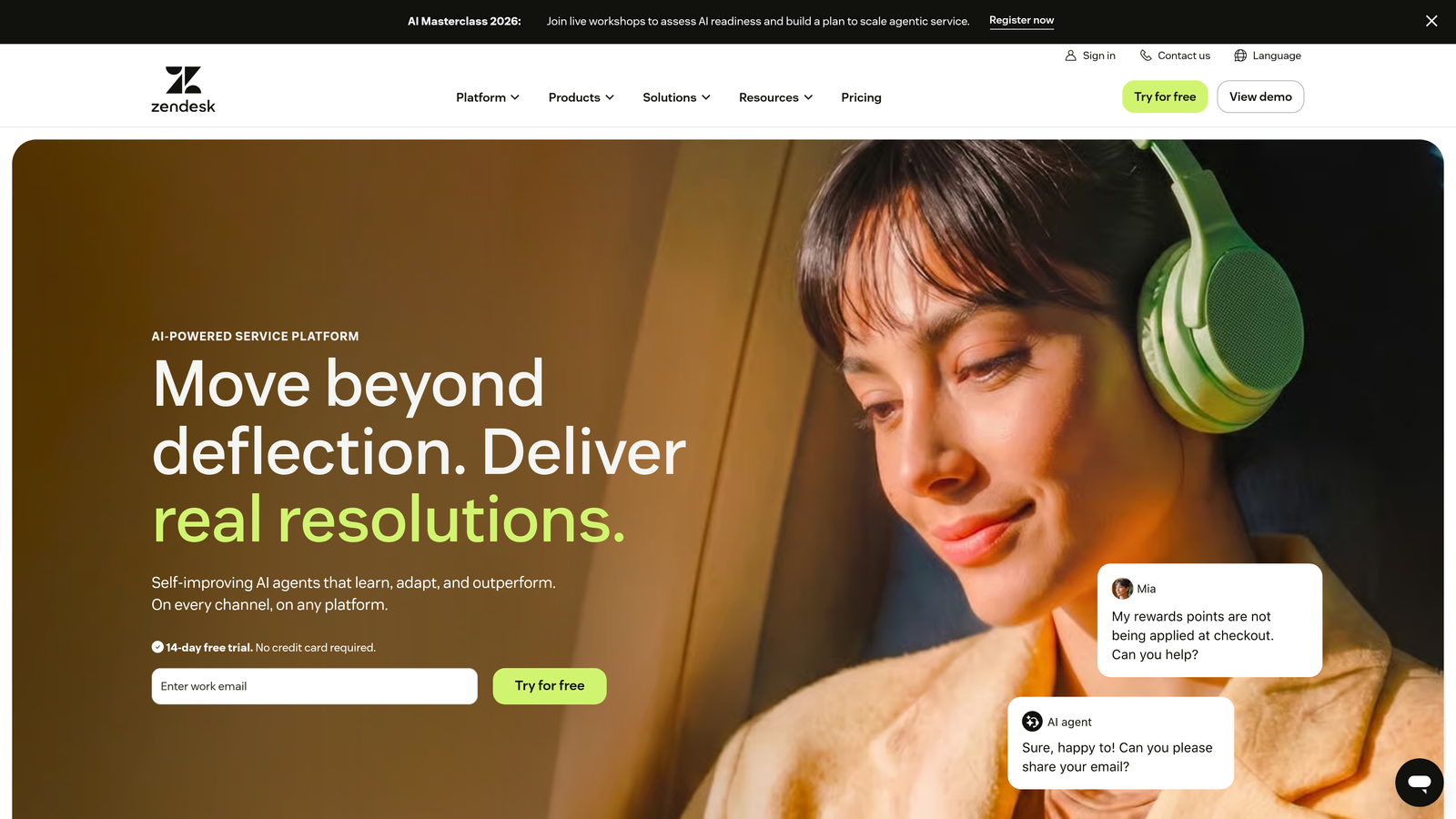
Zendesk is the dominant enterprise helpdesk platform, with built-in AI Agents and Answer Bot for deflecting tickets across channels.
Where This Tool Shines
Zendesk's deflection capabilities are deeply embedded in its platform. Answer Bot surfaces relevant knowledge base articles before a ticket is submitted, while AI Agents handle conversational deflection across web, email, and messaging. For organizations already running Zendesk, activating these features is a logical first step rather than a separate procurement decision.
The integration ecosystem is genuinely massive, and Zendesk's compliance and security posture makes it the default choice for regulated industries. The trade-off is cost: AI features are gated behind higher-tier plans, and adding Zendesk purely for deflection without the broader helpdesk context is rarely the right call.
Key Features
AI Agents: Conversational deflection across web widget, email, and messaging channels with natural language understanding.
Answer Bot: Proactively surfaces knowledge base articles before a ticket is submitted, reducing unnecessary escalations.
Enterprise Compliance: SOC 2, GDPR, HIPAA-ready configurations for regulated industries with strict data requirements.
Advanced Analytics: Detailed reporting on deflection rates, resolution quality, and agent performance across channels.
Best For
Enterprise support teams already on Zendesk who want to activate deflection within their existing platform. Also suitable for organizations where compliance requirements narrow the field of viable options.
Pricing
Suite plans from approximately $55/agent/month; AI features available on higher tiers. Enterprise pricing available for large deployments.
4. Freshdesk
Best for: SMB and mid-market teams wanting affordable AI deflection without enterprise complexity
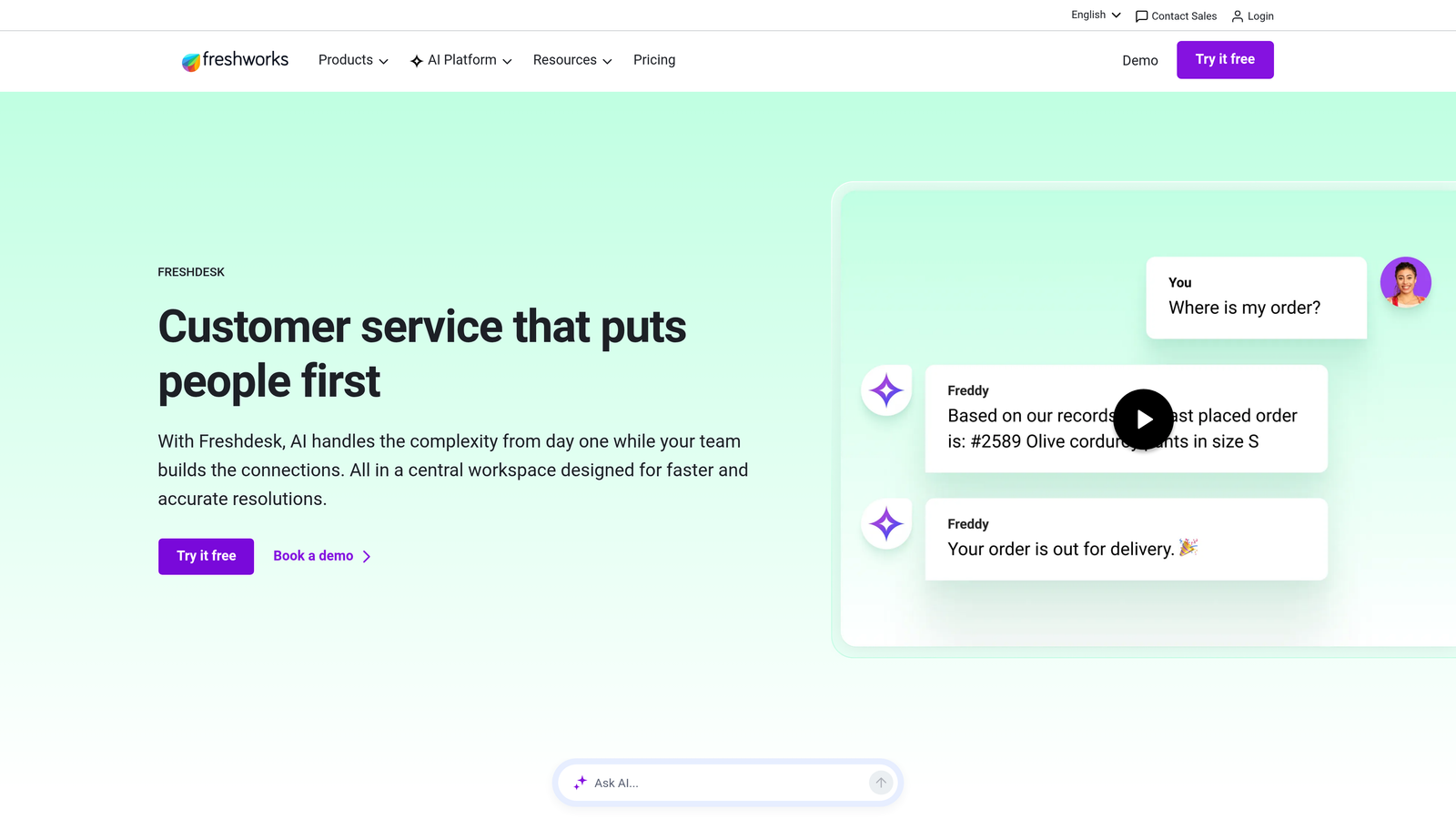
Freshdesk is a budget-friendly helpdesk platform with Freddy AI providing deflection via chatbot and self-service knowledge base.
Where This Tool Shines
Freshdesk's value proposition is straightforward: comparable core deflection capabilities to larger platforms at a price point that works for smaller teams. Freddy Self Service handles customer-facing deflection conversationally, while the knowledge base suggestion feature intercepts tickets before submission by surfacing relevant articles.
For teams that don't need the full weight of an enterprise helpdesk but still want meaningful AI deflection, Freshdesk hits a practical middle ground. The trade-off is AI sophistication: Freddy is capable but operates at a different level than dedicated AI-first platforms for complex B2B support scenarios.
Key Features
Freddy Self Service: Customer-facing chatbot that deflects common queries conversationally before they reach a human agent.
Knowledge Base Suggestions: Surfaces relevant articles automatically as customers begin typing a support request.
Freddy Agent Assist: Supports live agents mid-conversation with suggested responses and relevant knowledge, reducing handle time.
Tiered AI Access: Core helpdesk features are accessible at low price points, with Freddy AI capabilities unlocking at higher tiers.
Best For
SMB and mid-market SaaS teams that need solid deflection capabilities without the cost or complexity of enterprise platforms. Also a strong choice for teams migrating away from email-only support who want to step up gradually.
Pricing
Free plan available; paid plans from approximately $15/agent/month. Freddy AI features unlock on higher-tier plans.
5. Tidio
Best for: Small teams and early-stage companies needing fast, affordable deflection with minimal setup
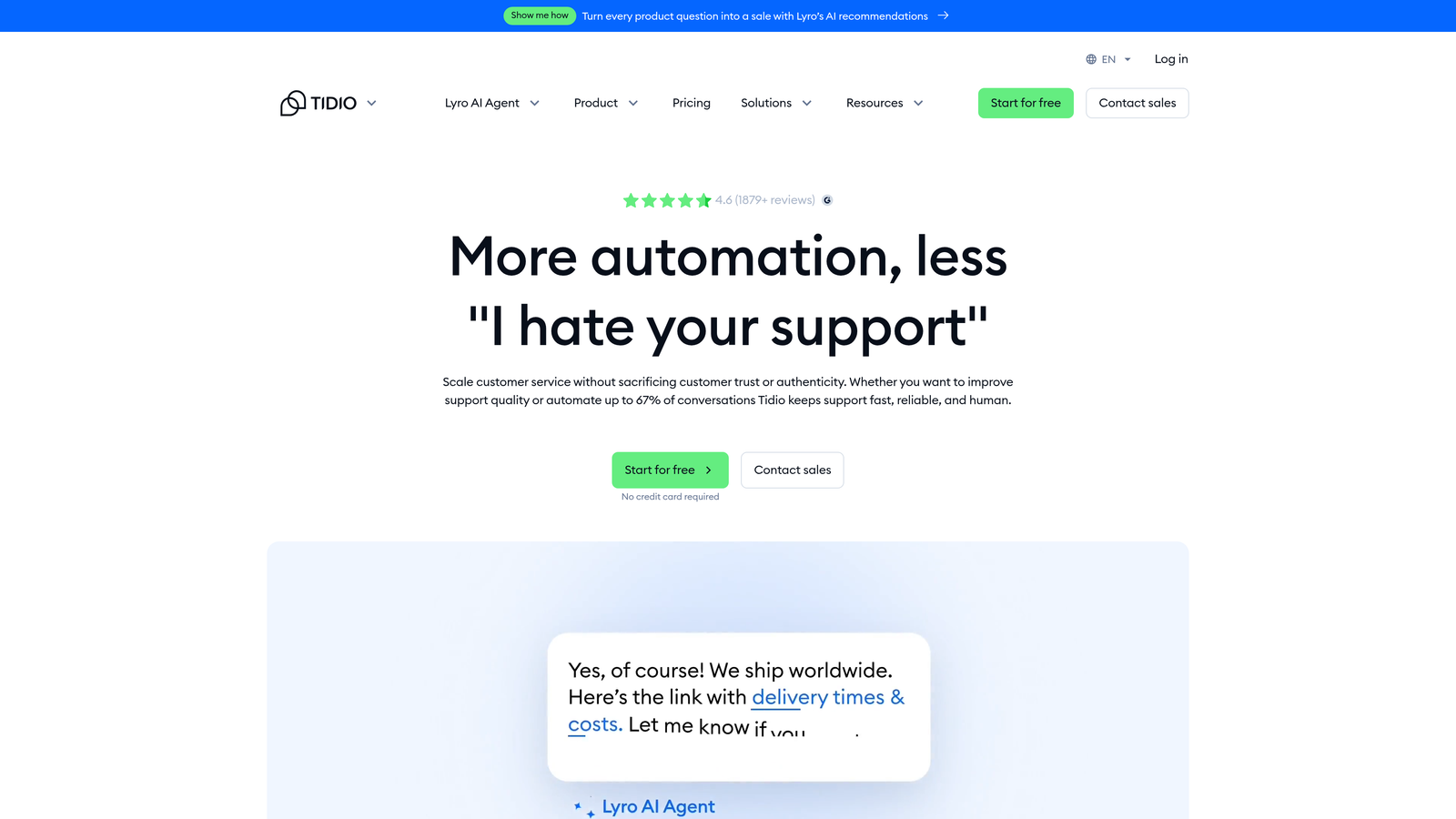
Tidio is a lightweight AI chat platform featuring Lyro, its conversational AI, designed for fast deployment and affordable deflection.
Where This Tool Shines
Tidio's primary advantage is speed to value. Teams can get Lyro up and running quickly without heavy technical configuration, which matters when you're a small team without dedicated engineering resources for support tooling. Lyro handles common queries conversationally, keeping routine questions out of the human queue.
It's worth being clear about the fit here: Tidio is well-suited to smaller operations where deflection needs are relatively straightforward. For complex B2B support environments with nuanced product questions and multi-step troubleshooting, more sophisticated platforms will likely outperform it.
Key Features
Lyro AI Chatbot: Conversational AI that resolves common customer queries without human involvement, trained on your support content.
Fast Setup: Minimal technical configuration required, making it accessible for teams without dedicated engineering support.
Unified Live Chat and AI: Human agents and AI operate within the same interface, making escalation and handoff straightforward.
Affordable Pricing: Volume-based pricing for Lyro keeps costs predictable for smaller conversation volumes.
Best For
Early-stage SaaS teams, small businesses, and e-commerce operations where speed of deployment and cost are the primary constraints. A practical starting point before graduating to more sophisticated deflection infrastructure.
Pricing
Free plan available; Lyro AI from approximately $29/month based on conversation volume.
6. Guru
Best for: Teams where high ticket volume is driven by fragmented, hard-to-find internal knowledge
Guru is an AI-powered knowledge management platform that surfaces answers inside the tools your team already uses, reducing tickets caused by fragmented or hard-to-find information.

Where This Tool Shines
Guru takes a different approach to deflection than most tools on this list. Rather than a customer-facing chat widget, Guru focuses on ensuring the right knowledge is findable at the right moment, whether that's a customer searching for an answer or an agent looking for the right response mid-conversation. AI surfaces relevant knowledge cards proactively inside Slack, Chrome, and connected helpdesks.
For organizations where the root cause of high ticket volume is knowledge fragmentation rather than lack of automation, Guru directly addresses the underlying problem. It also serves internal support use cases alongside customer-facing ones, making it useful across multiple teams.
Key Features
Proactive AI Search: Surfaces relevant knowledge cards automatically inside Slack, Chrome, and helpdesk tools as conversations happen.
Single Source of Truth: Centralizes internal and customer-facing knowledge, reducing the version fragmentation that drives ticket volume.
Helpdesk Integrations: Connects with Zendesk, Intercom, Salesforce, and Slack to embed knowledge where support work actually happens.
Knowledge Gap Analytics: Reports on search queries, content usage, and gaps, helping teams identify what knowledge is missing or underperforming.
Best For
Support and customer success teams dealing with repetitive questions caused by scattered documentation, and organizations wanting to improve both agent efficiency and self-service simultaneously.
Pricing
Starter plan free for small teams; paid plans from approximately $10/user/month.
7. Capacity
Best for: Enterprises needing a single deflection platform across customer support, IT, and HR
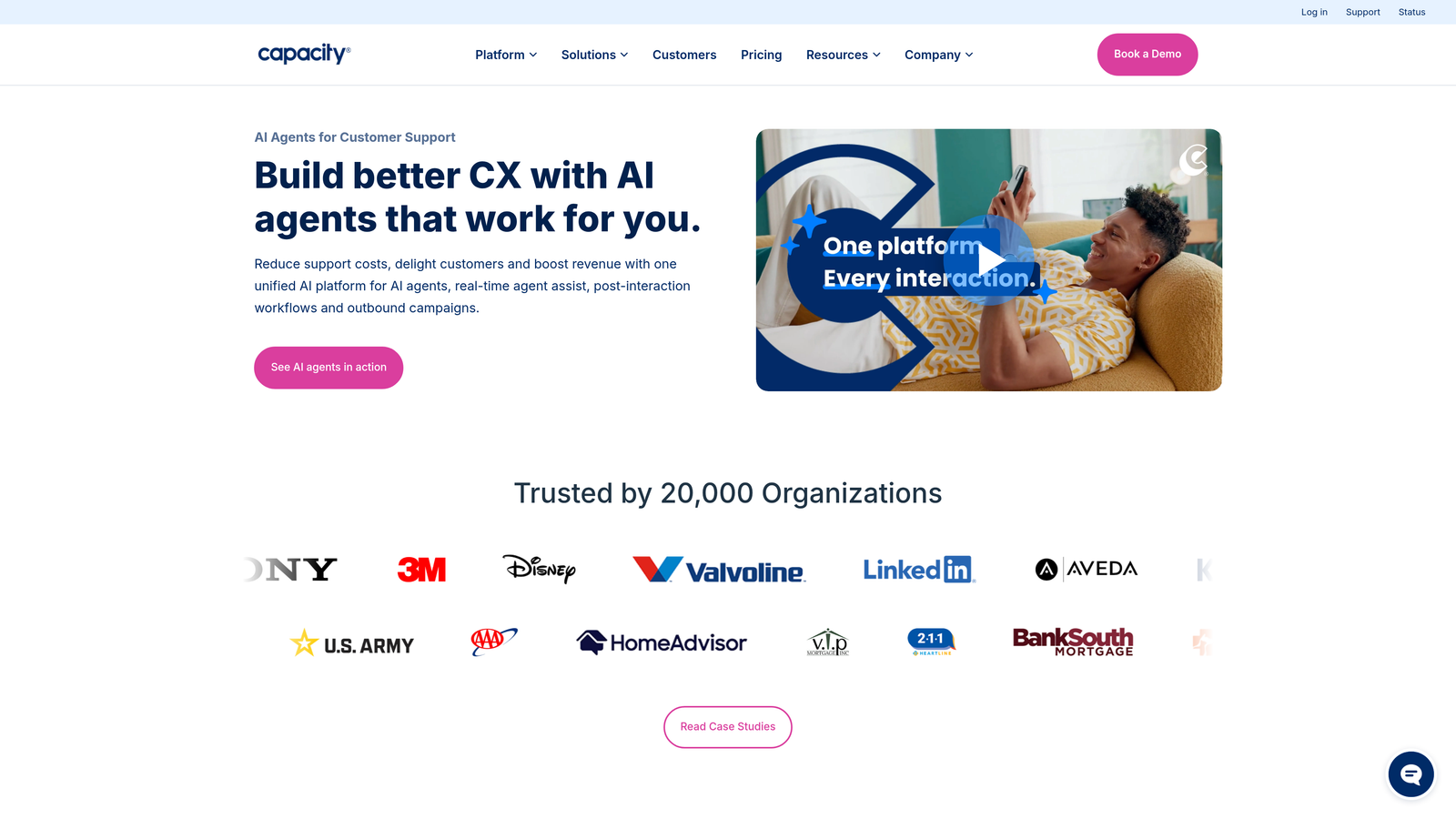
Capacity is a no-code AI helpdesk platform that deflects tickets across customer support, IT, and HR, consolidating multiple deflection use cases in one enterprise platform.
Where This Tool Shines
Capacity's differentiator is breadth. Most deflection tools focus exclusively on customer-facing support, but Capacity covers internal IT helpdesk and HR support simultaneously. For organizations tired of managing separate deflection tools for each department, that consolidation has real operational value.
The no-code workflow builder means support and operations teams can configure deflection paths without engineering involvement, which matters in enterprise environments where developer time is a bottleneck. The trade-off is that the platform's breadth can make initial configuration more complex than point solutions focused on a single use case.
Key Features
Multi-Department Coverage: Handles customer support, IT helpdesk, and HR support deflection from a single platform, reducing tool sprawl.
No-Code Workflow Builder: Business teams can build and modify deflection paths without engineering resources.
AI Chatbot and Knowledge Base: Combines conversational AI with a searchable knowledge base for both customer-facing and internal deflection.
Enterprise Compliance: Security and compliance features suited to regulated enterprise environments.
Best For
Enterprise organizations looking to consolidate deflection across multiple departments under one platform, particularly those with significant internal support volume alongside customer-facing needs.
Pricing
Contact for enterprise pricing; starter options available for smaller deployments.
8. Document360
Best for: Teams whose primary deflection strategy is a well-maintained, searchable self-service knowledge base
Document360 is a purpose-built knowledge base platform with AI-powered search that helps customers find answers before they ever submit a ticket.
Where This Tool Shines
Document360 is purpose-built for one thing: making self-service knowledge work well. The AI-powered search goes beyond keyword matching to surface genuinely relevant answers, and the content management capabilities are sophisticated enough to handle large, frequently updated knowledge bases without becoming unmanageable.
Where many helpdesk-native knowledge bases are functional but limited, Document360 treats the knowledge base as the primary product. For teams that have found their deflection rate constrained by poor search quality or disorganized content rather than lack of chat automation, this is a meaningful distinction.
Key Features
AI-Powered Search: Goes beyond keyword matching to surface contextually relevant answers, improving self-service resolution rates.
Content Management and Versioning: Robust tools for managing large, complex knowledge bases with multiple contributors and frequent updates.
Search Analytics: Reports on failed searches, popular queries, and content gaps, giving teams clear direction on where to invest in new content.
Helpdesk Integrations: Connects with Zendesk, Intercom, Freshdesk, and other platforms to embed knowledge base search within existing support workflows.
Best For
Product and support teams investing seriously in self-service as their primary deflection channel, particularly those with complex products that require detailed, well-organized documentation.
Pricing
Plans from approximately $149/month for small teams; pricing scales with team size and content volume.
9. Forethought
Best for: High-volume enterprise support teams wanting AI deflection that plugs into existing helpdesks
Forethought is an enterprise AI platform built specifically for support, offering deflection, intelligent triage, and agent assist powered by historical ticket data.
Where This Tool Shines
Forethought is one of the few platforms on this list built exclusively for support from the ground up. Its Solve product handles deflection by searching existing knowledge and resolving queries before they reach a human, while the platform's predictive AI continuously learns from historical ticket data to improve accuracy over time.
Crucially, Forethought plugs into existing helpdesks like Zendesk, Salesforce, and Freshdesk rather than replacing them. For enterprise teams with significant investment in their current helpdesk infrastructure, that additive approach reduces switching risk while still delivering meaningful deflection capability. The analytics on deflection rates, resolution quality, and AI confidence are notably detailed.
Key Features
Solve AI Deflection: Searches existing knowledge and resolves customer queries before they reach a human agent, operating across channels.
Historical Learning: Improves deflection accuracy over time by learning from your historical ticket data, not just generic training.
Helpdesk Integration: Plugs into Zendesk, Salesforce, and Freshdesk without replacing existing infrastructure or workflows.
Deflection Analytics: Detailed reporting on deflection rates, resolution quality, and AI confidence scores for ongoing optimization.
Best For
High-volume enterprise support operations that want AI deflection without replacing their existing helpdesk investment, and that have enough historical ticket data to make predictive learning genuinely effective.
Pricing
Enterprise pricing; contact for a quote. Best suited to organizations with the support volume to justify the investment.
Which Tool Is Right for Your Team?
The right deflection tool depends less on feature lists and more on your starting point, your team size, and what's actually driving your ticket volume in the first place.
If you want AI-first autonomous deflection that goes beyond reducing tickets to actively improving your product and revenue intelligence, Halo AI is the standout choice. Its page-aware context, continuous learning architecture, and business intelligence capabilities make it particularly well-suited to B2B SaaS teams that have outgrown bolt-on AI features.
For teams already invested in a major helpdesk platform, the path of least resistance is activating what's already there. Zendesk and Intercom both offer solid deflection within their ecosystems, with Zendesk stronger on enterprise compliance and Intercom stronger on conversational quality. Freshdesk and Tidio serve similar needs at more accessible price points for smaller teams.
If your ticket volume is driven by knowledge fragmentation rather than lack of automation, Guru and Document360 address the root cause directly. Guru is better when the knowledge problem is internal and distributed across agents; Document360 is better when you need a polished, customer-facing self-service portal with serious content management capabilities.
For enterprises wanting to consolidate deflection across departments, Capacity reduces tool sprawl without sacrificing capability. And for high-volume operations that want enterprise-grade AI deflection layered onto an existing helpdesk investment, Forethought delivers without requiring a rip-and-replace.
Your support team shouldn't scale linearly with your customer base. Let AI agents handle routine tickets, guide users through your product, and surface business intelligence while your team focuses on complex issues that need a human touch. See Halo in action and discover how continuous learning transforms every interaction into smarter, faster support.