9 Best Support Ticket Management Software Tools in 2026
This comprehensive guide evaluates the 9 best support ticket management software tools for 2026, comparing AI-native platforms and traditional helpdesks across resolution capabilities, integrations, analytics, and scalability. Whether you're a small startup or a growing SaaS company, it helps you identify the right solution to streamline ticket triage, routing, and resolution across multiple channels.
 Matt PattoliFounder13 min read
Support ticket management has moved well beyond simple inbox organization. Today's B2B teams need platforms that can triage, route, resolve, and learn — often without a human touching every ticket. Whether you're a 10-person startup drowning in Slack messages or a 200-person SaaS company managing thousands of monthly tickets across multiple channels, the right software changes everything.
This list covers nine tools that represent the current best of the market: from AI-native platforms that autonomously resolve tickets to traditional helpdesks with strong workflow automation. We evaluated each tool on resolution capabilities, integration depth, analytics quality, scalability, and how well they handle the reality of modern B2B support. Whether you're replacing an existing system or building your support stack from scratch, this guide will help you find the right fit.
1. Halo AI
Best for: B2B SaaS teams that want AI agents to resolve tickets autonomously and surface business intelligence
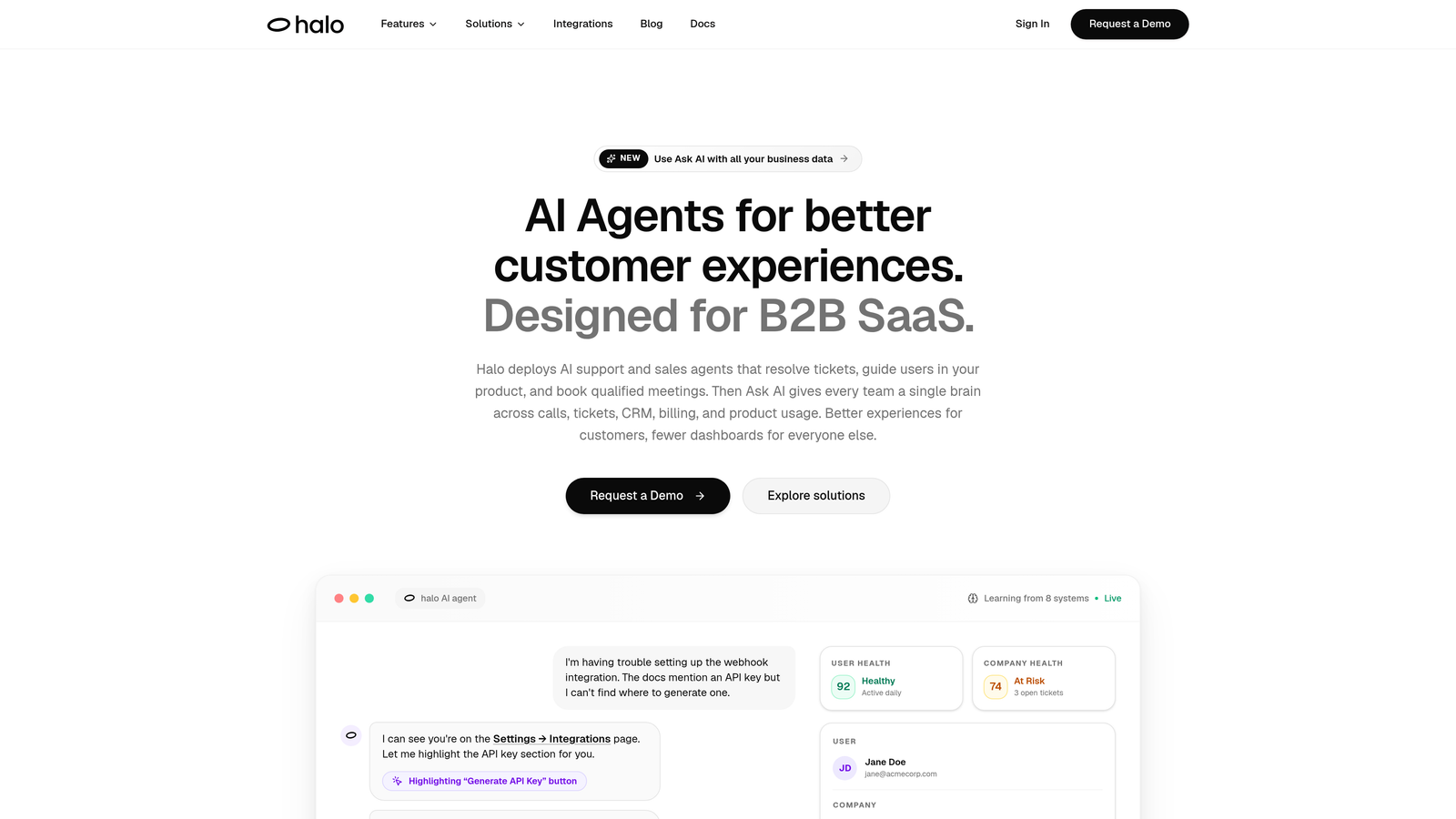
Halo AI is an AI-native customer support platform that deploys autonomous agents to resolve tickets, guide users through your product with page-aware context, and surface business intelligence signals — all while continuously learning from every interaction.
Where This Tool Shines
Most platforms add AI as a layer on top of an existing helpdesk. Halo AI is built AI-first, which means the agents aren't just suggesting responses for a human to approve — they're resolving tickets end-to-end. That distinction matters enormously when your goal is to handle volume growth without proportional headcount increases.
The page-aware chat widget is a standout capability: it sees what the user sees in your product, enabling genuinely contextual guidance rather than generic knowledge base lookups. Pair that with a smart inbox that surfaces customer health signals and revenue anomalies, and you have a support platform that doubles as a business intelligence layer.
Key Features
Autonomous ticket resolution: AI agents handle tickets end-to-end without requiring human approval for every response, enabling true scale without headcount growth.
Page-aware chat widget: The AI understands which page or feature a user is on, delivering contextual in-product guidance that generic chatbots can't match.
Smart inbox with business intelligence: Surfaces customer health signals, revenue anomalies, and trend detection beyond standard ticket metrics.
Auto bug ticket creation: Automatically identifies and routes bug reports directly to engineering via a native Linear integration, closing the loop between support and product.
Live agent handoff: Complex cases escalate to human agents with full conversation context preserved, so customers never have to repeat themselves.
Full business stack integrations: Connects to Slack, HubSpot, Intercom, Stripe, Zoom, PandaDoc, and Fathom for a unified operational picture.
Best For
B2B SaaS companies and product teams that need genuine ticket resolution (not just routing), want their support platform to inform product and revenue decisions, and are ready to move beyond traditional helpdesk architecture. Particularly strong for teams where support volume is growing faster than hiring budgets allow.
Pricing
Contact for pricing. Visit haloagents.ai to learn more or request a demo.
2. Zendesk
Best for: Mid-market and enterprise teams needing deep customization, SLA management, and a mature integration ecosystem
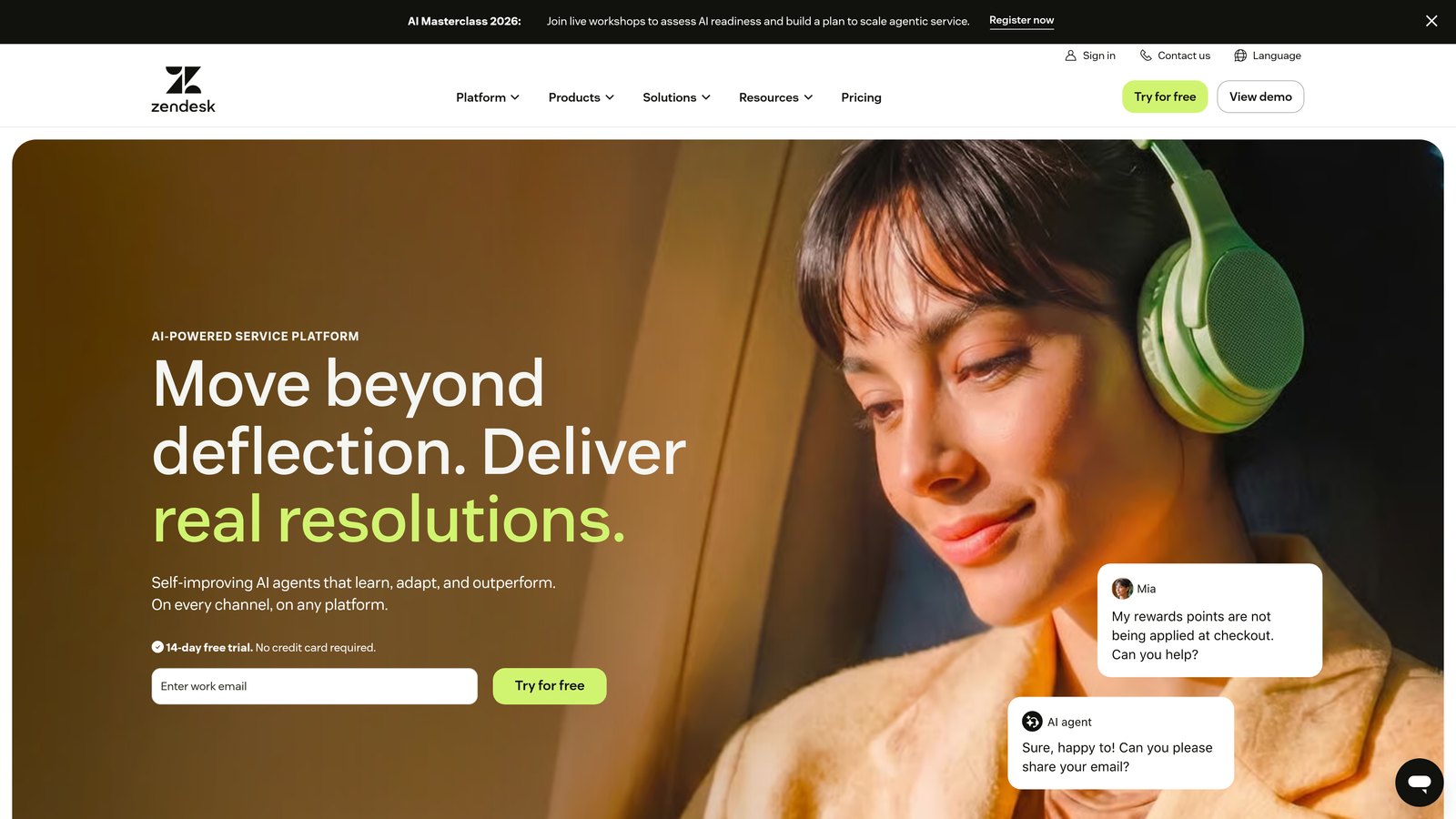
Zendesk is one of the most established helpdesk platforms on the market, offering robust SLA management, advanced ticket routing, and a large ecosystem of integrations for teams with complex support operations.
Where This Tool Shines
Zendesk's strength is its configurability. Custom triggers, automations, and SLA policies give operations-minded teams precise control over how tickets move through the system. For organizations with dedicated support ops resources, that depth pays off in finely tuned workflows.
The marketplace of 1,000-plus pre-built integrations means Zendesk connects to nearly any tool in your stack. Zendesk AI adds intelligent triage, suggested replies, and an agent copilot layer — though these are AI features added to a mature platform rather than an AI-first architecture.
Key Features
Advanced ticket routing: Custom triggers, automations, and SLA policies give granular control over how tickets are assigned and escalated.
Omnichannel support: Handles email, chat, voice, social, and messaging apps from a unified workspace.
Zendesk AI: Offers suggested replies, intelligent triage, and an agent copilot to improve agent efficiency.
Integration marketplace: Over 1,000 pre-built integrations covering CRM, analytics, billing, and dev tools.
Reporting and analytics: Customizable dashboards with detailed ticket and team performance metrics.
Best For
Mid-market and enterprise support teams with dedicated admin resources to configure and maintain the platform. Less ideal for small teams that need fast time-to-value or want AI resolution rather than AI assistance.
Pricing
Suite Team starts at $55/agent/month (billed annually). Enterprise plans are available at higher tiers. Pricing scales significantly for advanced features.
3. Freshdesk
Best for: Growing teams that want omnichannel coverage and AI automation at a more accessible price point than enterprise alternatives
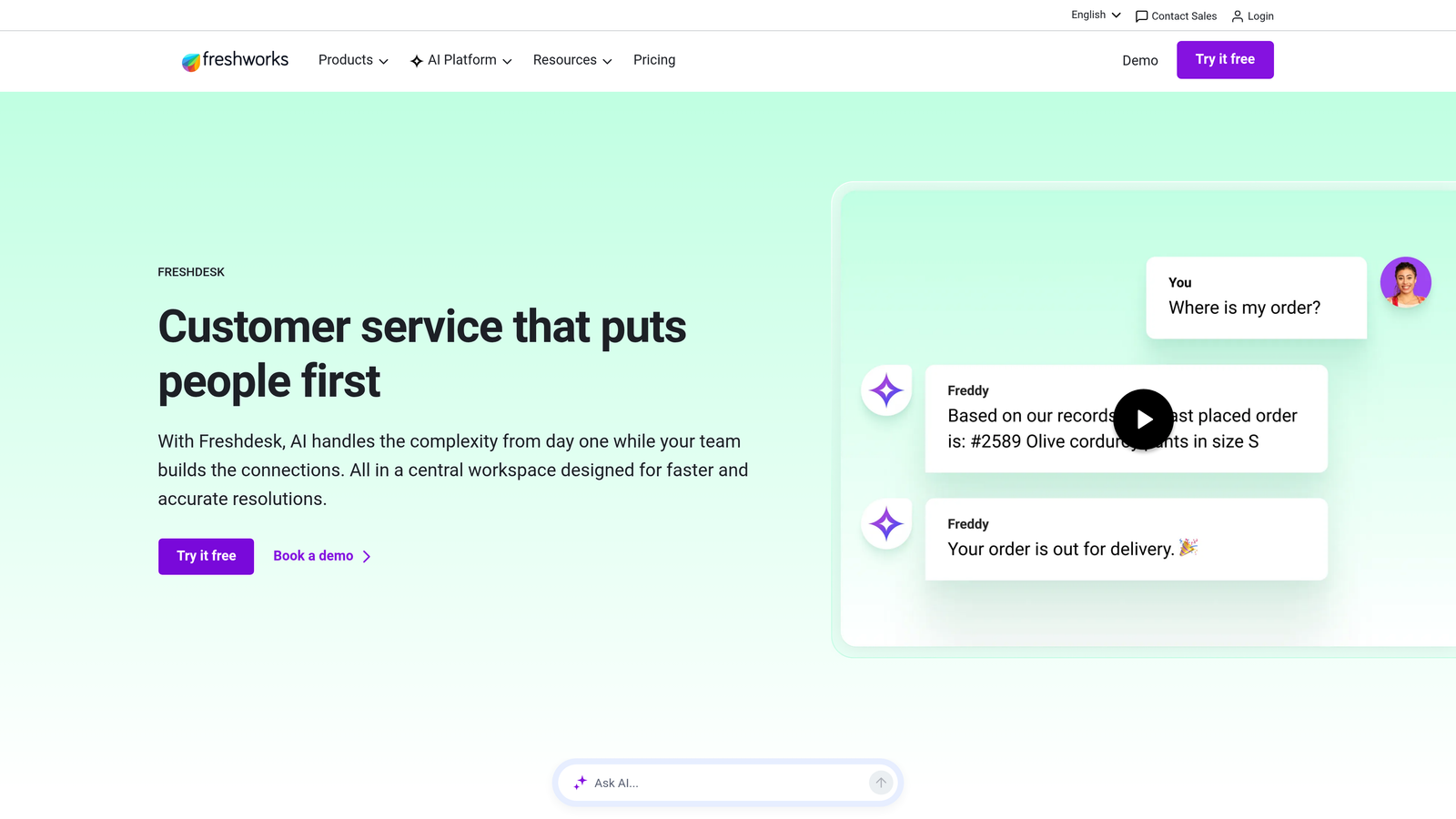
Freshdesk is a full-featured omnichannel helpdesk from Freshworks that delivers strong automation and AI capabilities without the pricing complexity of larger enterprise platforms.
Where This Tool Shines
Freshdesk positions itself as the practical alternative to Zendesk — similar feature breadth, lower cost, and a reputation for being easier to set up and maintain. For teams that find enterprise helpdesks over-engineered for their actual needs, Freshdesk often hits the right balance.
Freddy AI handles ticket classification, response suggestions, and self-service deflection. Collision detection is a particularly useful operational feature, preventing two agents from simultaneously working the same ticket — a surprisingly common problem in busy shared inboxes.
Key Features
Omnichannel ticketing: Covers email, chat, phone, social media, and WhatsApp in a unified inbox.
Freddy AI: Automates ticket classification, suggests responses, and powers self-service to deflect routine queries.
Collision detection: Alerts agents when another team member is already working a ticket, preventing duplicated effort.
Canned responses and scenario automations: Speed up repetitive workflows with pre-built reply templates and multi-step automation sequences.
Free tier: Available for teams of up to 10 agents, making it accessible for early-stage companies.
Best For
Small to mid-sized teams that need solid omnichannel support and AI-assisted automation without a large per-agent investment. Also a strong option for teams graduating from a basic shared inbox setup.
Pricing
Free plan available for up to 10 agents. Growth plan starts at $15/agent/month (billed annually). Higher tiers unlock advanced automation and analytics.
4. Intercom
Best for: SaaS teams that want support, in-app engagement, and user onboarding handled in one platform
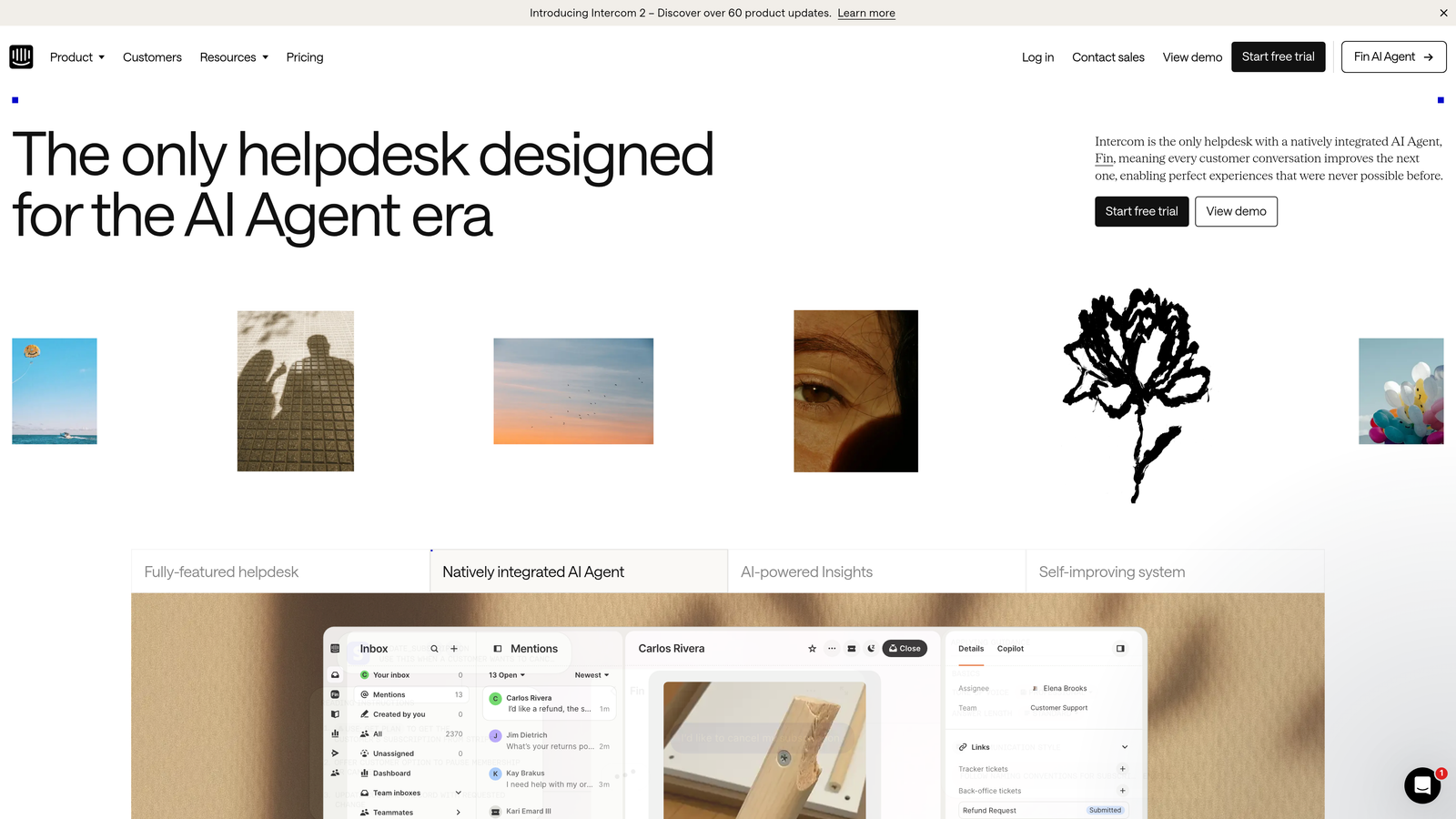
Intercom is a messenger-first customer platform that combines ticket management with in-app engagement, product tours, and the Fin AI agent — blurring the line between support and user activation.
Where This Tool Shines
Intercom's differentiator is the combination of support and engagement in a single platform. Beyond resolving tickets, it handles onboarding checklists, proactive messaging, and behavioral targeting — making it particularly valuable for SaaS companies that want to reduce churn and increase activation alongside managing support volume.
The Fin AI agent handles autonomous ticket resolution across chat and email. It's worth noting that Halo AI offers a native Intercom integration, so teams using Intercom for engagement can layer Halo's AI resolution capabilities on top rather than treating the two as purely competing options.
Key Features
Fin AI agent: Autonomously resolves tickets across chat and email channels using your knowledge base and conversation history.
In-app messenger with product tours: Delivers onboarding checklists, proactive messages, and feature announcements directly inside your product.
Unified inbox: Aggregates conversations from all channels in one workspace.
Customer data platform: Behavioral targeting enables proactive support based on what users are doing in your product.
Async ticketing: Handles complex, multi-touch issues that can't be resolved in a single conversation.
Best For
SaaS companies that want to unify support and user engagement, particularly those investing in in-app onboarding and proactive messaging alongside reactive ticket handling.
Pricing
Essential plan starts at $29/seat/month. Fin AI agent usage is billed per resolution, so costs scale with AI usage volume.
5. Help Scout
Best for: Teams that prioritize simplicity and a human-feeling support experience over complex workflow automation
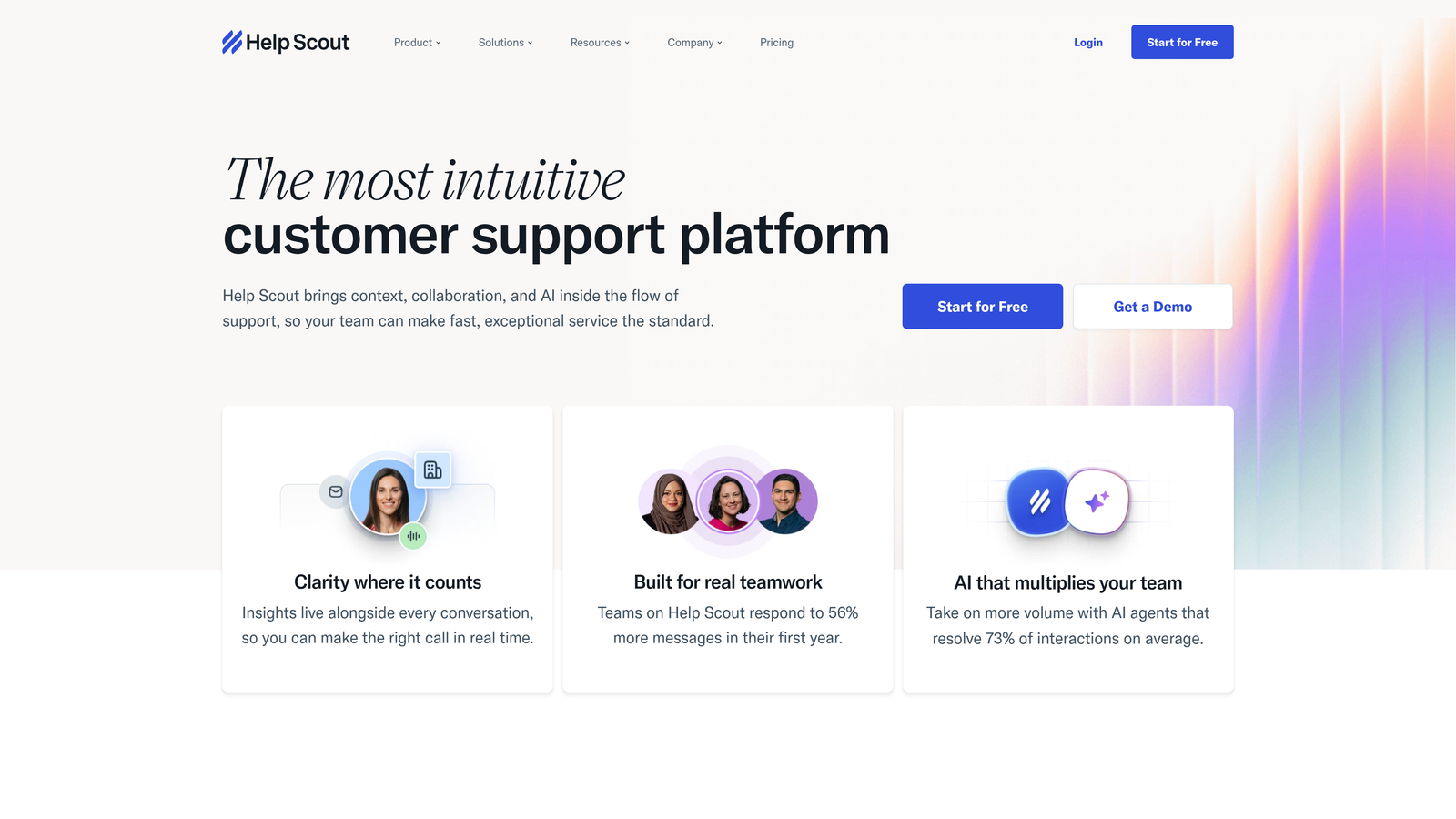
Help Scout is a deliberately simple shared inbox platform designed to make support feel like a conversation, not a ticket queue — with no ticket numbers shown to customers and an email-style interface that agents can learn in minutes.
Where This Tool Shines
Help Scout's philosophy is that support should feel human. The email-like UI removes the clinical feel of traditional helpdesks, and hiding ticket numbers from customers preserves a conversational tone that many brands actively want. For teams that find Zendesk or Freshdesk over-complex, Help Scout offers a refreshing reduction in friction.
The Beacon widget, built-in Docs knowledge base, and customer profiles with conversation history give small teams everything they need without requiring third-party integrations for core functionality. AI Summarize and AI Assist features add productivity tools without turning the platform into something it isn't.
Key Features
Email-style shared inbox: Familiar interface that agents adopt quickly, with no ticket numbers exposed to customers.
Beacon widget: Embeds knowledge base search and chat directly in your product or website.
Docs knowledge base: Built into all plans, no separate tool required for self-service content.
Customer profiles: Conversation history and company data surfaced alongside every support thread.
AI Summarize and AI Assist: Helps agents quickly understand long threads and draft responses faster.
Best For
Small to mid-sized teams that value simplicity, a human-feeling support experience, and fast onboarding. Less suited for high-volume operations that need complex routing logic or deep workflow automation.
Pricing
Standard plan starts at $22/user/month (billed annually). All plans include the Docs knowledge base and Beacon widget.
6. Jira Service Management
Best for: Engineering-led companies that need support tickets to flow directly into development workflows
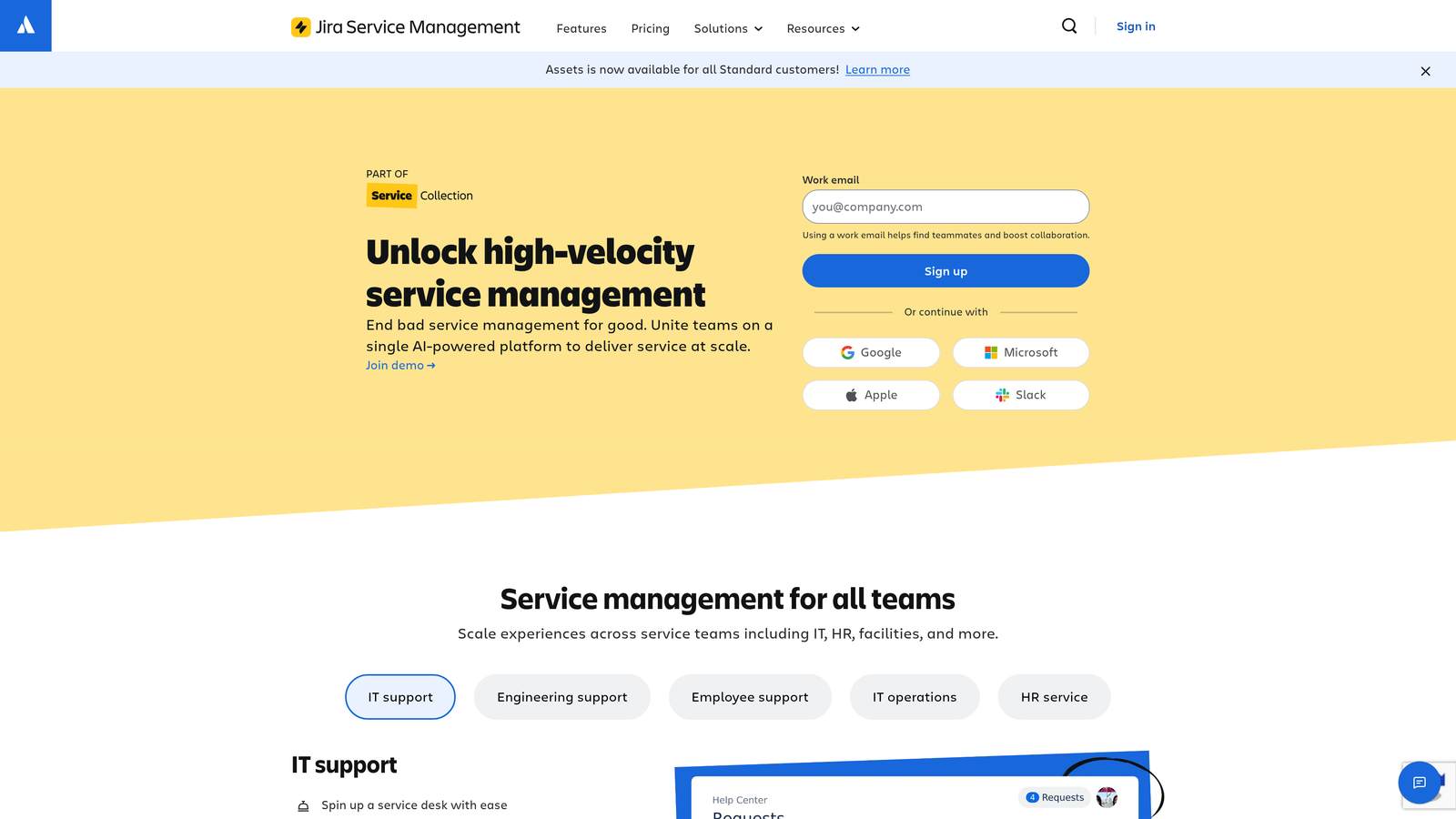
Jira Service Management is Atlassian's ITSM and customer support platform that bridges external support tickets with internal engineering workflows, making it the natural choice for technical teams already operating in the Atlassian ecosystem.
Where This Tool Shines
The native two-way sync with Jira Software is what sets this platform apart. When a customer reports a bug, that ticket can escalate directly into an engineering sprint without anyone copying and pasting between systems. For product and engineering teams, that closed loop is genuinely valuable and hard to replicate with other helpdesks.
Jira Service Management also brings ITSM-grade capabilities: change management, incident management, and asset tracking. That makes it a strong option for internal IT service desks as well as external customer support, though the platform can feel heavy if you only need the latter.
Key Features
Native Jira Software sync: Two-way integration allows support tickets to escalate directly into engineering sprints for bug resolution.
ITSM features: Change management, incident management, and asset tracking for teams with formal service delivery processes.
Queues, SLAs, and approval workflows: Structured ticket handling for organizations with defined support processes.
Confluence integration: Connects your knowledge base and documentation directly to the support workflow.
AI-powered virtual service agent: Handles self-service deflection for common questions before they reach the queue.
Best For
Technical teams and engineering-led organizations already using Jira Software, as well as companies that need both external customer support and internal IT service management in one platform.
Pricing
Free for up to 3 agents. Standard plan starts at $17.65/agent/month. Higher tiers include advanced ITSM features and increased automation limits.
7. HubSpot Service Hub
Best for: Revenue-focused teams that want full CRM context alongside every support conversation
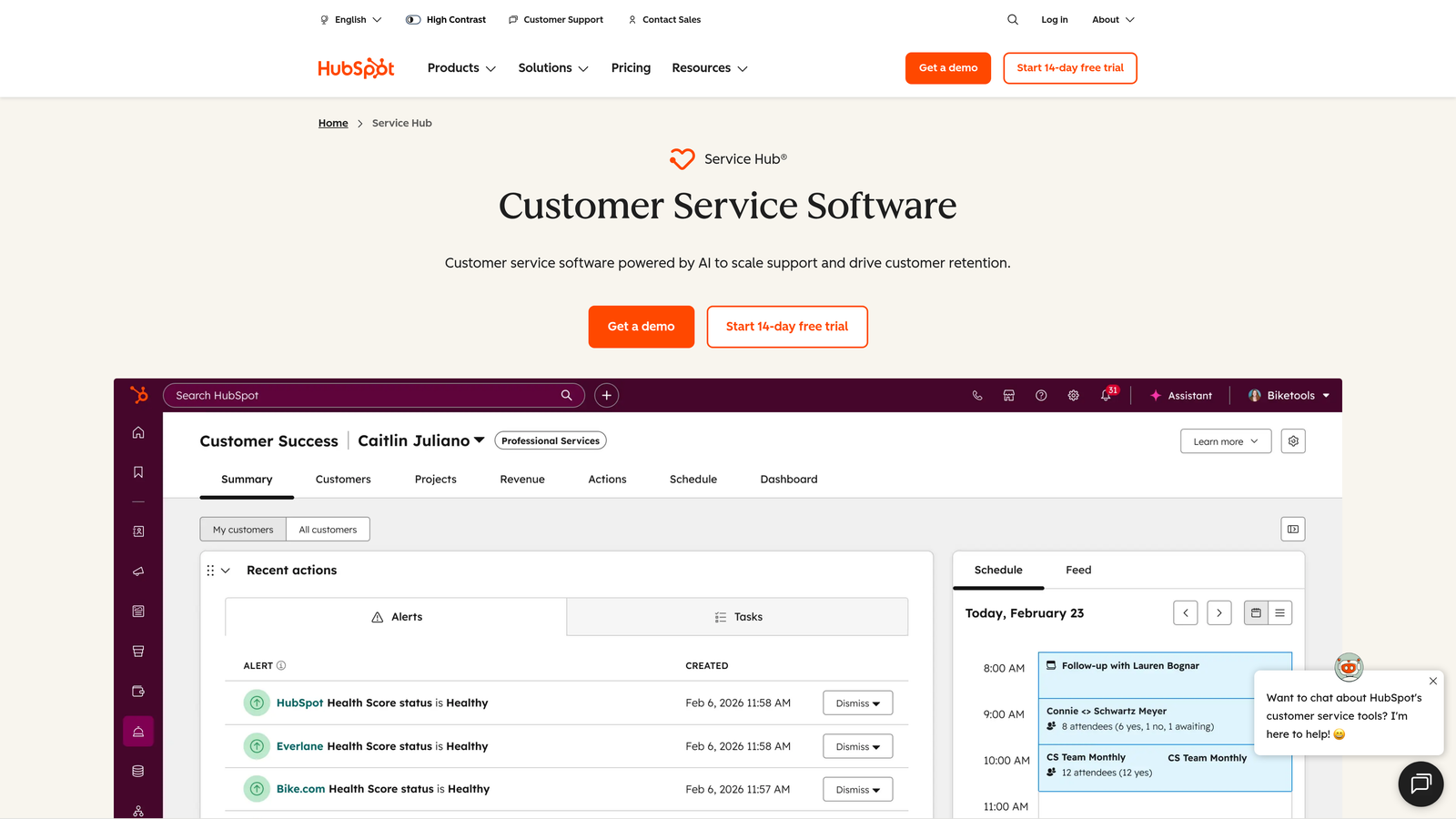
HubSpot Service Hub places support tickets directly inside the HubSpot CRM, giving teams complete customer context — deals, contacts, marketing history, and billing data — alongside every support thread.
Where This Tool Shines
If your team already lives in HubSpot, Service Hub removes the context-switching tax entirely. Agents can see a customer's deal stage, recent marketing interactions, and open tickets in one view without toggling between tools. For companies where support directly influences retention and expansion revenue, that visibility changes how agents prioritize and respond.
The inclusion of customer feedback surveys (NPS, CSAT) and a customer portal for self-service ticket tracking rounds out the offering. It's a coherent package for teams that view support as a revenue function rather than a cost center.
Key Features
CRM-native ticketing: Tickets live alongside contact and deal records, giving agents full customer context without switching tools.
Conversation inbox: Aggregates email, chat, and messaging channels in one workspace.
Knowledge base and feedback surveys: NPS and CSAT surveys built in alongside self-service documentation tools.
AI reply suggestions and summaries: Helps agents draft faster responses and quickly understand long conversation threads.
Customer portal: Lets customers track their own tickets and access self-service resources.
Best For
Teams already using HubSpot CRM for sales and marketing who want to extend that platform to support. Also strong for companies where customer success and support functions overlap significantly.
Pricing
Starter plan starts at $15/seat/month. Professional plan at $90/seat/month, which unlocks automation, custom reporting, and advanced feedback tools.
8. Zoho Desk
Best for: Cost-conscious teams that want enterprise-level AI features and deep process automation without enterprise pricing
Zoho Desk is a feature-rich helpdesk with strong AI augmentation via its Zia assistant and deep integration with the broader Zoho ecosystem, delivering capabilities that punch above its price point.
Where This Tool Shines
Zia, Zoho's AI assistant, goes beyond basic response suggestions. It performs sentiment analysis on incoming tickets, flags anomalies in ticket volume or response times, and surfaces agent response recommendations — giving support managers operational visibility that many pricier tools don't offer.
Blueprint workflow automation is another standout. It allows teams to map out their support processes visually and enforce them systematically, ensuring tickets follow the right steps rather than relying on agents to remember procedures. For process-heavy support organizations, that structure is genuinely useful.
Key Features
Zia AI: Provides sentiment analysis, ticket anomaly detection, and agent response suggestions to improve both efficiency and quality.
Blueprint workflow automation: Visually maps support processes and enforces them systematically across the team.
Omnichannel support: Covers email, chat, phone, social media, and web forms from a unified interface.
Zoho ecosystem integration: Deep native connections to Zoho CRM, Zoho One, and 200-plus third-party applications.
ASAP contextual widget: Embeds self-service help directly into web and mobile applications for in-product support.
Best For
Teams already in the Zoho ecosystem, as well as cost-conscious organizations that need AI-assisted support and strong process automation without paying enterprise-tier prices. Also well-suited for teams with formal, structured support workflows.
Pricing
Free for up to 3 agents. Standard plan starts at $14/agent/month (billed annually). Higher tiers unlock advanced AI features and Blueprint automation.
9. Gorgias
Best for: E-commerce brands that need deep Shopify integration and revenue attribution tied to support activity
Gorgias is a support helpdesk purpose-built for e-commerce brands, with native Shopify, WooCommerce, and Magento integration that allows agents to view and modify orders directly within tickets.
Where This Tool Shines
Gorgias solves a specific problem exceptionally well: e-commerce support agents spend most of their time answering order status questions, processing returns, and looking up tracking information. By pulling that data directly into the ticket view and enabling actions (like issuing refunds or updating orders) without leaving the helpdesk, Gorgias eliminates the constant tab-switching that slows e-commerce support teams down.
The revenue statistics feature is genuinely differentiated. It links support interactions to conversion and retention outcomes, making it possible to demonstrate the revenue impact of support quality — a compelling argument for support teams trying to justify investment in tooling and headcount.
Key Features
Native e-commerce integrations: Deep connections to Shopify, WooCommerce, and Magento with order actions available directly inside tickets.
Revenue attribution: Links support interactions to sales outcomes, showing the business impact of support quality.
E-commerce automation rules: Pre-built automations for common scenarios like order status inquiries, returns, and tracking updates.
Omnichannel inbox: Covers email, chat, social media, and SMS in a unified workspace.
AI agent: Handles autonomous resolution of repetitive e-commerce queries to reduce manual workload.
Best For
Direct-to-consumer and e-commerce brands, particularly those running on Shopify. Less relevant for pure B2B SaaS companies, where the e-commerce-specific features don't apply and a more general-purpose helpdesk will serve better.
Pricing
Starter plan starts at $10/month for up to 3 agents. Pricing scales by ticket volume rather than purely by agent count, which benefits teams with variable support loads.
Which Tool Is Right for Your Team?
The honest answer is that the right choice depends on two things: where you are today and where you're trying to go. If you're evaluating these tools, you're probably asking whether you need a traditional helpdesk with AI features added on, or an AI-native platform built to resolve tickets autonomously from day one.
For B2B SaaS teams where support volume is outpacing headcount capacity, Halo AI is the strongest option. The autonomous resolution architecture, page-aware context, and business intelligence signals make it a fundamentally different category of tool compared to the others on this list. It's not just a better helpdesk — it's a different approach to support entirely.
If you're deeply embedded in the Atlassian ecosystem, Jira Service Management is the practical choice for keeping support and engineering workflows connected. If your team already runs on HubSpot, Service Hub removes the need for another tool entirely. For e-commerce brands, Gorgias is the clear specialist. And for teams that want simplicity above all else, Help Scout delivers without the complexity tax.
Zendesk and Freshdesk remain solid choices for teams that need mature, well-documented platforms with large integration ecosystems — particularly if you have dedicated support operations resources to configure and maintain them. Zoho Desk is the smart pick for cost-conscious teams that don't want to sacrifice AI capability. Intercom works best when you want support and user engagement unified in one place.
Your support team shouldn't scale linearly with your customer base. Let AI agents handle routine tickets, guide users through your product, and surface business intelligence while your team focuses on complex issues that need a human touch. See Halo in action and discover how continuous learning transforms every interaction into smarter, faster support.