9 Best Technical Support Automation Software Tools in 2026
This guide reviews the 9 best technical support automation software tools for 2026, evaluating each platform on AI capabilities, integrations, deployment ease, and B2B suitability to help support teams resolve more tickets faster without expanding headcount. Whether you're upgrading a legacy helpdesk or building from scratch, the breakdown includes pricing, standout features, and honest assessments of which solution fits your team best.
 Matt PattoliFounder14 min read
Technical support teams are under more pressure than ever: resolve more tickets, respond faster, and do it all without proportionally growing headcount. The good news is that modern technical support automation software has moved well beyond simple chatbots and canned responses. Today's platforms use AI to triage issues, guide users through complex workflows, auto-generate bug reports, and escalate intelligently to human agents, all without sacrificing the quality your customers expect.
This list covers the top tools for automating technical support in 2026, evaluated on depth of AI capability, integration ecosystem, ease of deployment, and suitability for B2B and SaaS environments. Whether you're replacing a legacy helpdesk, layering AI on top of an existing stack, or building a support infrastructure from scratch, there's a fit here for your team. We've included pricing tiers, standout features, and honest assessments of who each tool serves best.
1. Halo AI
Best for: B2B and SaaS teams that want AI-first autonomous support with business intelligence built in.
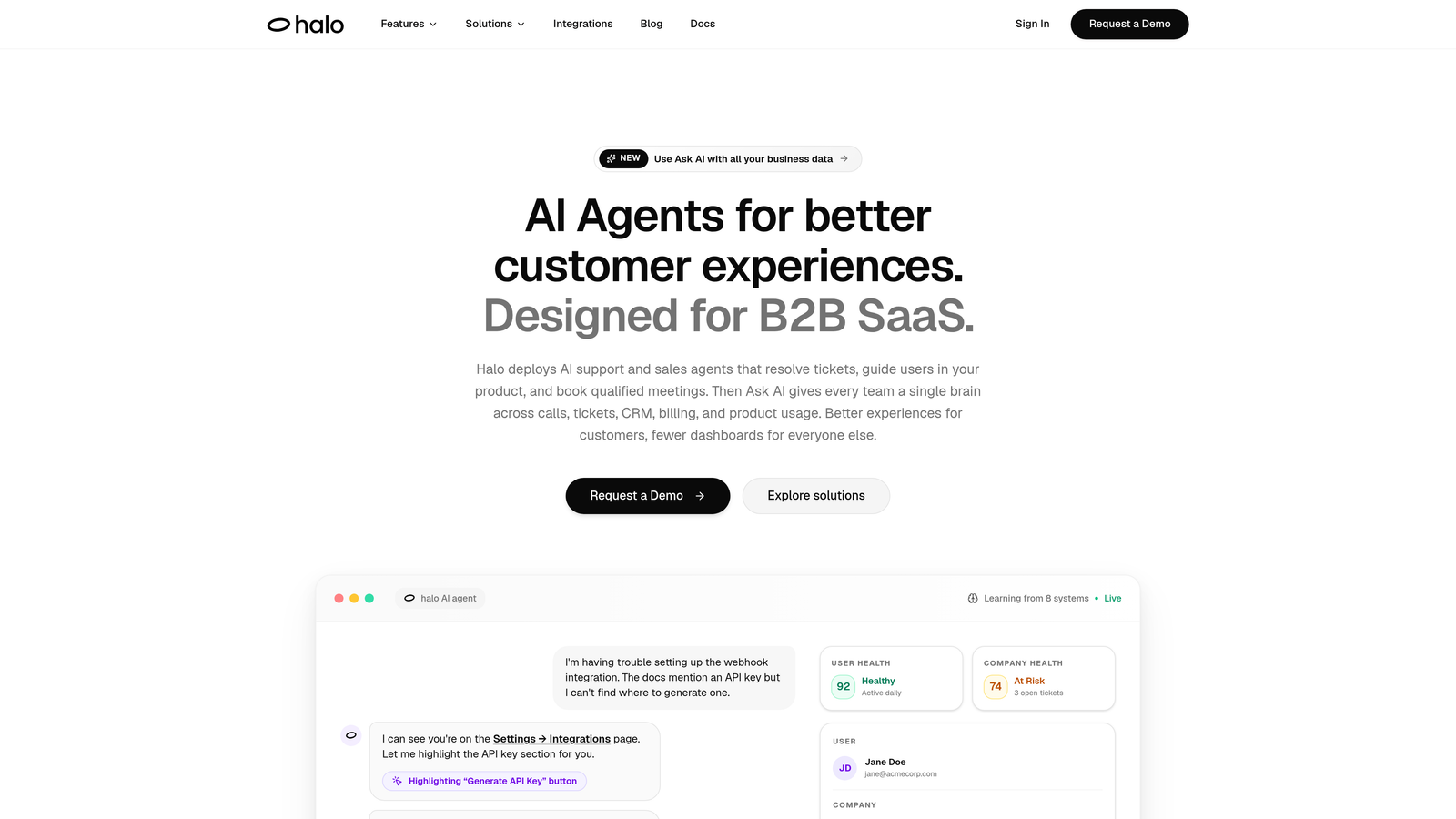
Halo AI is an AI-first customer support platform built specifically for B2B and SaaS teams, not a traditional helpdesk with AI bolted on.
Where This Tool Shines
What separates Halo from most tools on this list is its architecture. Rather than layering AI features onto an existing ticketing system, Halo is built from the ground up around autonomous resolution. Its page-aware agents understand what a user is actually seeing inside your product at the moment they ask for help, which means guidance is contextual rather than generic.
The business intelligence layer is genuinely unusual in this category. Most support tools tell you how many tickets were resolved. Halo surfaces customer health signals, revenue anomalies, and trend patterns from support interactions, turning your support inbox into a source of strategic insight rather than just operational data.
Key Features
Page-Aware AI Agents: Agents understand the user's in-product context at the moment of the request, enabling precise, relevant guidance without requiring users to describe where they are.
Autonomous Ticket Resolution: AI handles routine and moderate-complexity tickets end-to-end, with smart escalation to human agents when the situation genuinely warrants it.
Auto Bug Ticket Creation: Detected issues are automatically routed to engineering tools like Linear, reducing the manual handoff between support and development.
Smart Inbox with Business Intelligence: The inbox surfaces customer health signals, revenue anomalies, and support trend detection alongside standard ticket management.
Deep Integration Ecosystem: Native connections to Slack, HubSpot, Intercom, Stripe, Zoom, PandaDoc, and Fathom keep Halo embedded in your existing business stack.
Continuous Learning: Every resolved interaction feeds back into the model, improving resolution quality over time without manual retraining.
Best For
Halo is best suited to B2B SaaS companies that want AI to be the primary resolution layer, not a supplemental feature. Teams that have outgrown basic helpdesk tooling, or those building support infrastructure from scratch and want to avoid legacy complexity, will find Halo's architecture a strong fit. It's particularly well-suited to product-led companies where in-app guidance is critical.
Pricing
Visit haloagents.ai for current pricing tiers. Pricing is not publicly listed on a standard per-agent model, reflecting the platform's AI-first, usage-oriented approach.
2. Zendesk
Best for: Enterprise teams that need a proven, scalable helpdesk with broad omnichannel coverage.
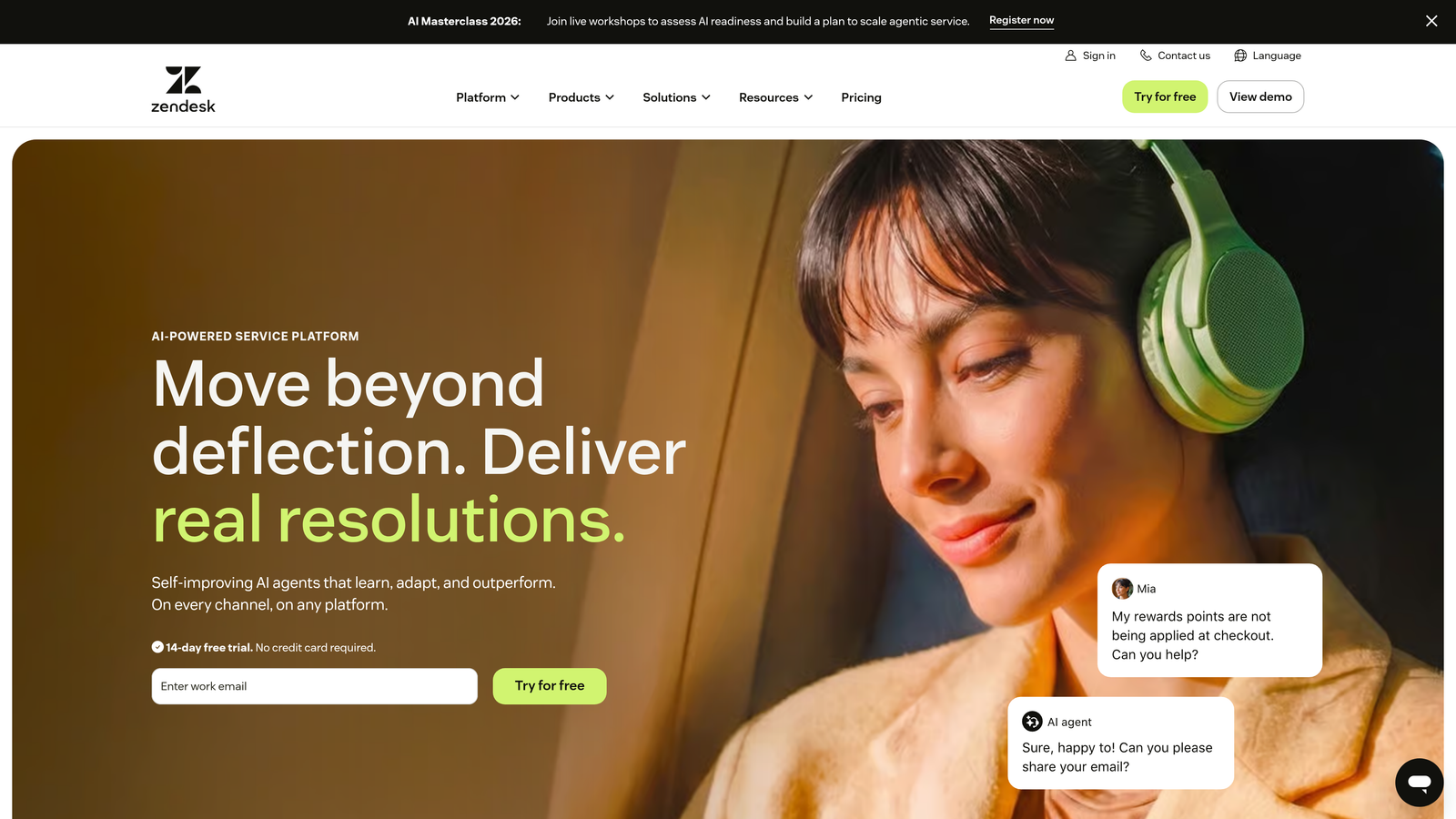
Zendesk is one of the most widely deployed helpdesk platforms in the enterprise market, with AI capabilities layered onto a mature ticketing and workflow engine.
Where This Tool Shines
Zendesk's strength is its depth and reliability. The platform has handled enterprise-scale support operations for years, and its workflow engine, covering triggers, macros, routing rules, and SLA management, is among the most configurable available. For organizations that need to manage complex, multi-tier support across multiple channels, Zendesk delivers.
The Zendesk AI layer adds intelligent triage, intent detection, and sentiment analysis. These features work well within the existing ticketing framework, though they function more as enhancements to human workflows than as a fully autonomous resolution layer.
Key Features
Zendesk AI: Automated triage, intent detection, and sentiment analysis that help route and prioritize incoming tickets more accurately.
Workflow Automation: Triggers, macros, and routing rules give ops teams granular control over how tickets move through the system.
App Marketplace: Over 1,000 integrations available, covering CRM, analytics, communication, and engineering tools.
Omnichannel Support: Unified handling across email, live chat, voice, and social channels from a single interface.
Advanced Reporting and SLA Management: Detailed analytics and configurable SLA policies suited to enterprise accountability requirements.
Best For
Zendesk is a strong choice for enterprise teams with established support operations that need reliability, configurability, and broad integration support. Teams already invested in the Zendesk ecosystem will find the AI additions useful, though teams seeking AI-first autonomous resolution may find the approach more agent-assist than fully autonomous.
Pricing
Suite Team starts at approximately $55 per agent per month billed annually. Pricing scales significantly with AI features and enterprise plans. Verify current pricing at zendesk.com before making decisions.
3. Intercom
Best for: SaaS teams that want conversational in-app support powered by a native AI agent.
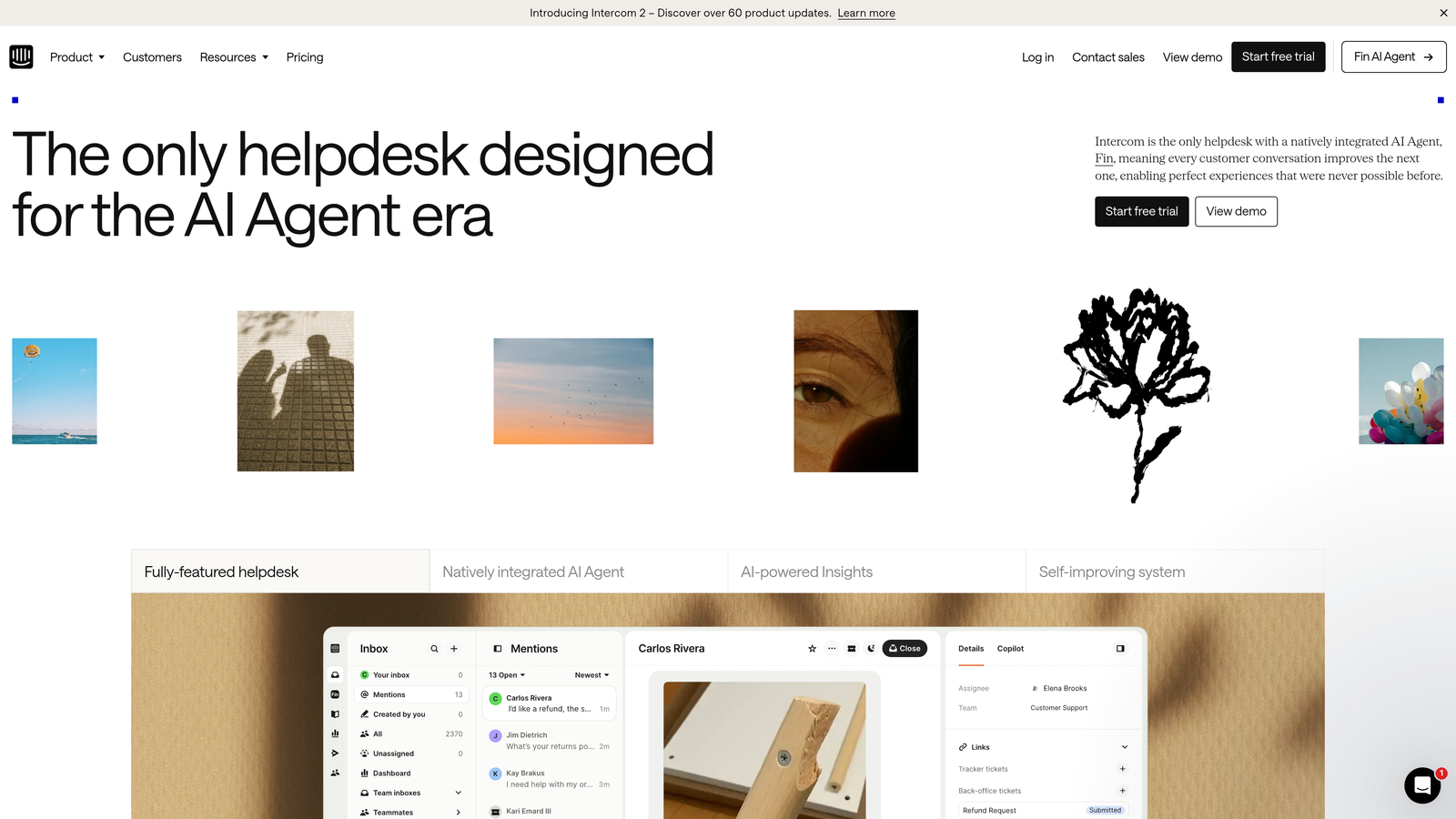
Intercom is a customer communications platform with a native AI agent called Fin, built on large language model technology and designed to resolve queries using your existing knowledge base.
Where This Tool Shines
Fin is one of the more capable AI agents in the mainstream helpdesk category. It reads your knowledge base and support content, then generates conversational responses rather than returning static article links. For teams with well-maintained documentation, Fin can meaningfully deflect a large proportion of repetitive queries without requiring additional configuration.
Intercom's in-app messenger is also mature and widely adopted. Proactive messaging, product tours, and contextual triggers give support and product teams tools to address issues before users even submit a ticket.
Key Features
Fin AI Agent: Autonomous resolution using your knowledge base, with natural conversational responses rather than static article suggestions.
In-App Messenger: Proactive messaging and product tours that allow teams to reach users in-context before issues escalate.
AI-Assisted Inbox: Suggested replies and conversation summaries that reduce agent handling time on complex escalations.
Tickets and Escalation Workflows: Structured ticket management for issues that require multi-step resolution or cross-team coordination.
Usage-Based AI Pricing: Fin is priced per resolution, which can be cost-efficient for lower-volume teams but requires careful monitoring at scale.
Best For
Intercom works well for SaaS companies with a strong knowledge base that want to automate conversational support inside their product. Teams already using Intercom for lifecycle messaging will find the support layer integrates naturally. The usage-based Fin pricing is worth modeling carefully for high-volume environments.
Pricing
Tiered and usage-based. Fin charges per resolution in addition to base platform fees. Verify current pricing at intercom.com, as the model has evolved frequently.
4. Freshdesk
Best for: Mid-market teams that need a capable helpdesk with AI assist at a competitive price point.
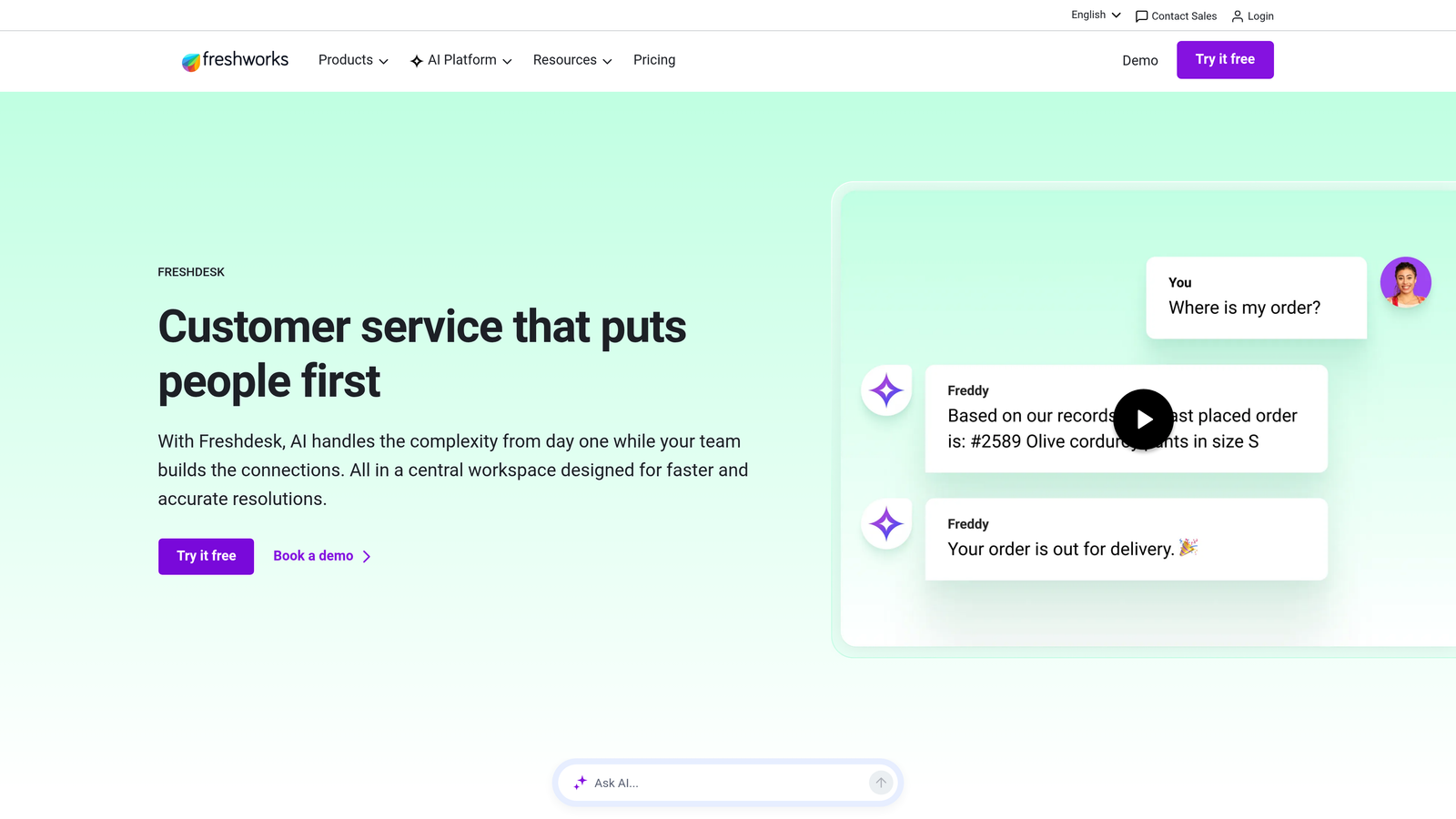
Freshdesk is a mid-market helpdesk from Freshworks with a growing AI layer called Freddy that covers triage, agent assist, and self-service automation.
Where This Tool Shines
Freshdesk's value proposition is breadth at a reasonable price. The Freddy AI suite handles ticket categorization, auto-triage, canned response suggestions, and a chatbot builder, covering the core automation needs of most mid-market support teams without requiring enterprise-level investment.
The platform's self-service capabilities, including a customer portal and knowledge base, are solid out of the box. Combined with Freddy Self Service for chatbot deflection, teams can reduce inbound volume without heavy engineering involvement.
Key Features
Freddy AI: Auto-triage, ticket categorization, and agent assist suggestions that accelerate resolution without replacing human judgment.
Freddy Self Service: A chatbot builder for deflecting common queries before they reach the agent queue.
Automation Rules: Configurable routing, escalation, and SLA management rules that handle operational complexity without custom development.
Knowledge Base and Customer Portal: Built-in self-service infrastructure that reduces repetitive inbound queries.
Free Tier: A functional free plan makes Freshdesk accessible for small teams evaluating automation before committing to paid tiers.
Best For
Freshdesk is a strong fit for mid-market teams that need a reliable, full-featured helpdesk with AI assist capabilities and don't want to pay enterprise pricing to get there. The free tier is also genuinely useful for small teams or early-stage companies testing the waters.
Pricing
Free plan available for small teams. Growth plan starts at approximately $15 per agent per month. Verify current pricing at freshworks.com, as Freddy AI features are distributed across tiers.
5. Tidio
Best for: SMBs and e-commerce businesses that need automation deployed quickly with minimal setup.
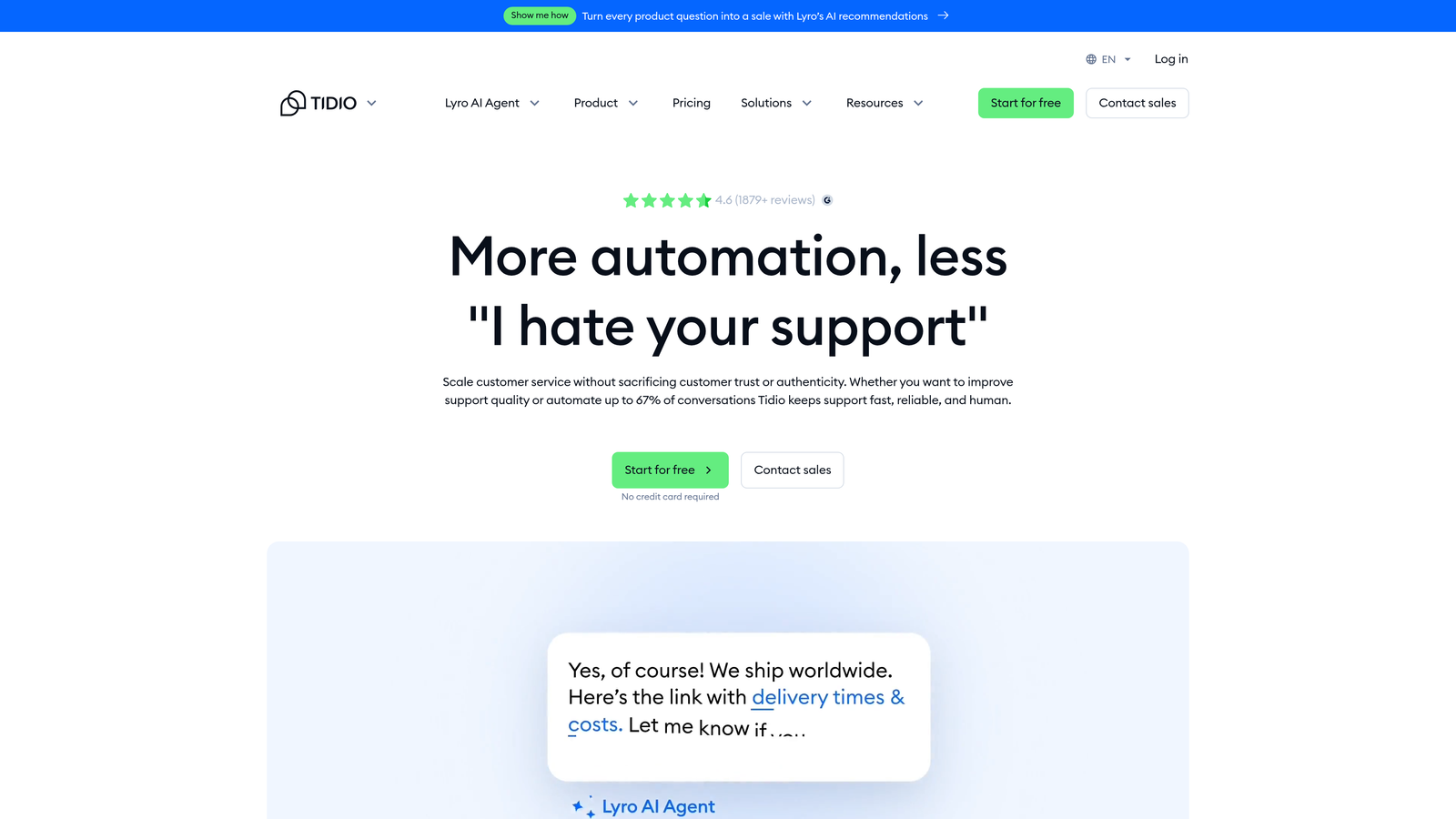
Tidio is a lightweight customer service platform known for fast deployment and an accessible AI chatbot called Lyro that handles conversational self-service without requiring extensive configuration.
Where This Tool Shines
Speed of deployment is Tidio's most compelling differentiator. Most teams can have Lyro running and handling basic queries within hours rather than days. For businesses that need automation working quickly, without a dedicated implementation team or complex integration work, Tidio removes most of the friction.
The visual flow builder also makes it easy to create custom automation paths without writing code. This is particularly useful for smaller teams where the person managing support is not necessarily technical.
Key Features
Lyro AI Chatbot: Conversational AI that handles self-service queries using your content, with natural language understanding rather than rigid decision trees.
Visual Flow Builder: No-code automation builder for creating custom conversation flows and routing logic.
Live Chat with Agent Takeover: Seamless handoff from AI to human agents when conversations require a personal touch.
Multi-Channel Integration: Email and Facebook Messenger integration alongside the core live chat widget.
Simple Onboarding: Minimal technical setup required, making it accessible for non-technical teams.
Best For
Tidio is best suited to SMBs and e-commerce businesses that prioritize speed of deployment and ease of use over deep AI capability or enterprise-grade configurability. Teams with straightforward automation needs and limited technical resources will find Tidio a practical starting point.
Pricing
Free plan available. Lyro AI is available as a paid add-on. Verify current pricing at tidio.com, as Lyro pricing has been updated as the product has matured.
6. Gorgias
Best for: E-commerce brands running on Shopify, WooCommerce, or BigCommerce that need order-aware support automation.
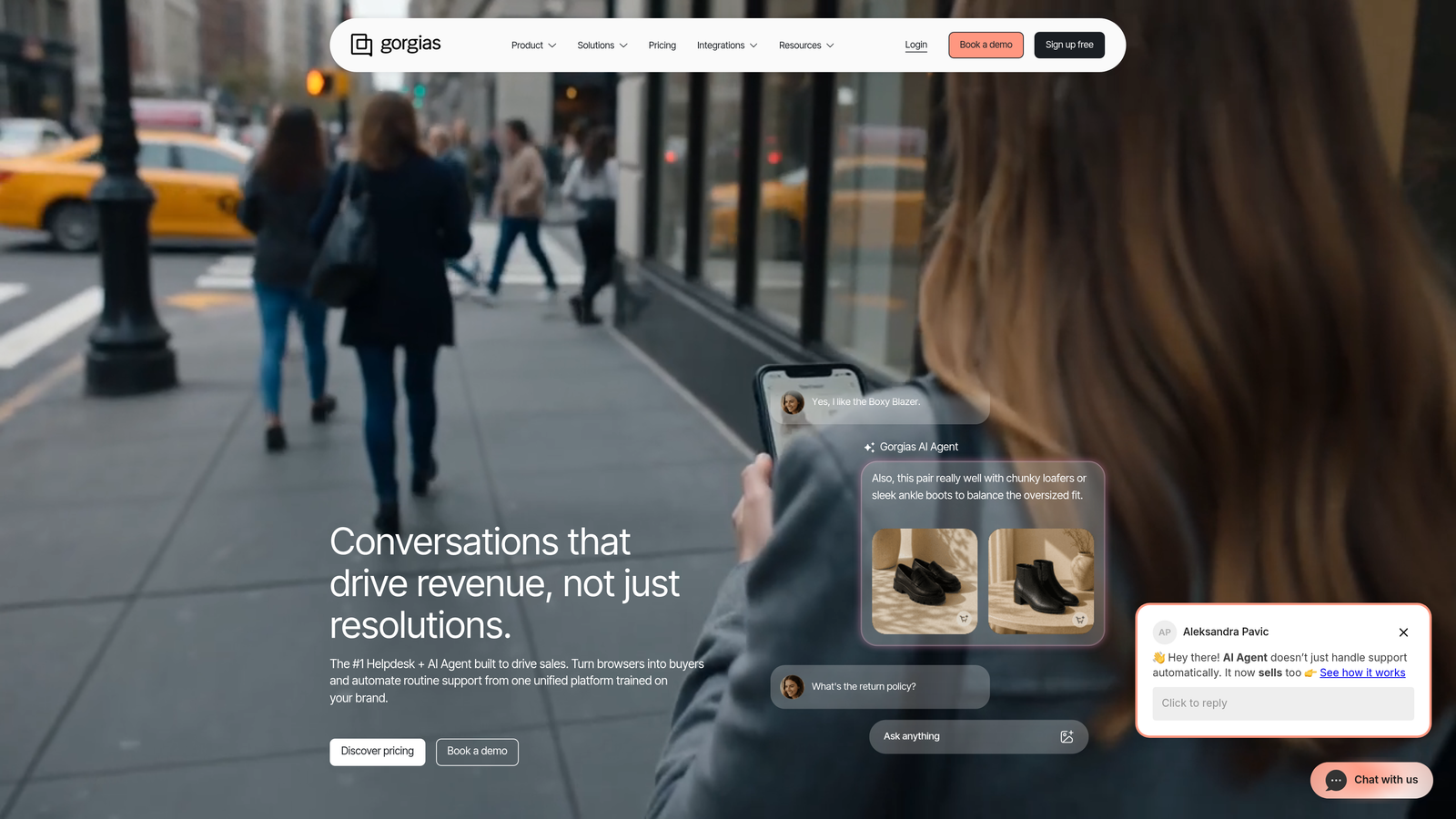
Gorgias is a helpdesk built specifically for e-commerce brands, automating order-related support by connecting directly to your commerce platform and enabling agents and AI to take actions on orders from within the support interface.
Where This Tool Shines
Gorgias's deep commerce integrations set it apart from general-purpose helpdesks. When a customer asks about an order status, refund, or shipping delay, Gorgias can pull live order data and trigger actions, like initiating a refund or updating shipping details, without the agent leaving the support interface. This dramatically reduces handling time for the most common e-commerce support queries.
The ticket-based pricing model is also worth noting. For businesses with variable support volumes, paying per ticket rather than per agent can be more economical during slower periods.
Key Features
Commerce Platform Integrations: Native connections to Shopify, WooCommerce, and BigCommerce with live order data surfaced directly in the support view.
Automated Order Responses: Rules triggered by order status, shipping events, and refund requests that resolve common queries without agent involvement.
Macros and Rules: High-volume repetitive query deflection through configurable automation rules and response templates.
Revenue Statistics: Support interaction data tied to revenue impact, helping teams understand the commercial value of support quality.
Ticket-Based Pricing: A pricing model that scales with support volume rather than team size.
Best For
Gorgias is the clear choice for e-commerce brands with high volumes of order-related queries. It's less well-suited to B2B technical support environments where queries are more complex and less transactional in nature.
Pricing
Ticket-based pricing model. Verify current plans and ticket bundle pricing at gorgias.com, as tiers are structured around monthly ticket volumes.
7. Salesforce Service Cloud
Best for: Large enterprises already invested in the Salesforce ecosystem that need deeply integrated service operations.
Salesforce Service Cloud is the enterprise-grade service platform from Salesforce, tightly integrated with Sales Cloud and the broader Salesforce ecosystem, with Einstein AI adding intelligent case management capabilities.
Where This Tool Shines
Service Cloud's primary advantage is its integration with the rest of Salesforce. For organizations where sales, service, and account management data all live in Salesforce, agents get a unified view of the customer that most standalone helpdesks cannot match. Einstein AI adds case classification, knowledge article suggestions, and next-best-action recommendations on top of that unified data layer.
The platform's customization depth is also substantial. Salesforce Flow, custom objects, and the AppExchange marketplace give large enterprises the flexibility to build highly specific support workflows, though this flexibility comes with meaningful implementation complexity and cost.
Key Features
Einstein AI: Case classification, intelligent routing, and agent recommendations powered by the full Salesforce data model.
Unified Customer View: Sales, service, and account data in a single record, giving agents complete context without switching tools.
Omni-Channel Routing: Intelligent case assignment across email, chat, voice, and social based on agent capacity and skill.
Knowledge Management: AI-suggested knowledge articles that surface relevant content during case resolution.
Extensive Customization: Salesforce Flow, custom objects, and AppExchange integrations for building tailored support workflows.
Best For
Service Cloud is the right choice for large enterprises that are already running Salesforce and need service operations tightly coupled with CRM data. Teams without existing Salesforce investment will find the implementation cost and complexity hard to justify compared to purpose-built alternatives.
Pricing
Enterprise pricing, typically starting at $75 or more per user per month. Full platform costs escalate significantly with add-ons and customization. Verify current pricing at salesforce.com.
8. Help Scout
Best for: Teams that want clean, human-feeling support tooling with AI assist features and a low learning curve.
Help Scout is a clean, human-centered support platform that has added AI features including AI Drafts, AI Summarize, and an in-app help widget called Beacon, designed for teams that want straightforward tooling without a steep learning curve.
Where This Tool Shines
Help Scout's design philosophy prioritizes simplicity and a human tone. The shared inbox is easy to navigate, collision detection prevents agents from doubling up on the same conversation, and the overall experience feels less like enterprise software and more like a tool built for people who actually use it daily.
The AI features are practical rather than ambitious. AI Drafts generates reply suggestions from conversation context, and AI Summarize condenses long threads for agents picking up mid-conversation. These are genuinely useful quality-of-life improvements rather than autonomous resolution capabilities.
Key Features
AI Drafts: Suggested reply generation based on conversation context, reducing the time agents spend composing responses from scratch.
AI Summarize: Quick conversation summaries that help agents get up to speed during handoffs without reading entire threads.
Beacon Widget: An in-app help widget that surfaces knowledge base articles and enables proactive self-service before users submit tickets.
Shared Inbox with Collision Detection: Prevents two agents from responding to the same conversation simultaneously, reducing duplicate effort.
Docs Knowledge Base: Built-in knowledge base with search and article suggestions integrated into the Beacon widget.
Best For
Help Scout suits teams that value simplicity and a human support experience over deep automation capability. It's a particularly good fit for companies where support quality and tone matter as much as efficiency, and where the team doesn't have bandwidth for complex platform configuration.
Pricing
Standard plan starts at approximately $20 per user per month. Verify current pricing at helpscout.com, as AI features may be distributed across plan tiers.
9. Kustomer
Best for: High-volume B2C support teams that need a CRM-native helpdesk with omnichannel coverage.
Kustomer is a CRM-native helpdesk designed for high-volume consumer support, with a unified customer timeline that gives agents full interaction history across every touchpoint and an AI layer for routing, intent detection, and automated responses at scale.
Where This Tool Shines
Kustomer's unified customer timeline is its most distinctive feature. Rather than viewing support as a series of disconnected tickets, Kustomer presents every customer interaction, across every channel, in a single chronological view. For high-volume consumer support teams where context is critical to resolution quality, this reduces the time agents spend reconstructing history before they can help.
The built-in CRM also reduces dependency on external customer data tools. For teams that don't want to maintain a separate CRM alongside their helpdesk, Kustomer offers meaningful consolidation.
Key Features
Unified Customer Timeline: All interactions across every channel aggregated in one chronological view, giving agents immediate context without switching tools.
AI-Powered Routing and Intent Detection: Accurate queue management based on customer intent, reducing misrouted tickets and handling time.
Automated Workflows: Triggers based on customer attributes and behavior that handle repetitive actions without agent involvement.
Omnichannel Support: Email, chat, SMS, social, and voice handled from a single interface.
Built-In CRM: Customer data management that reduces reliance on external CRM tools for support context.
Best For
Kustomer is well-suited to high-volume B2C support operations where agent context and omnichannel coverage are priorities. It's less optimized for B2B technical support environments where ticket complexity and integrations with engineering tools matter more than consumer interaction history.
Pricing
Enterprise pricing. Verify current plans and per-user costs at kustomer.com before evaluating against alternatives.
Which Tool Is Right for Your Team?
The right technical support automation software depends heavily on your environment, your team's technical capacity, and what you actually need AI to do.
If you're a B2B or SaaS company that wants AI to be the primary resolution layer, not just an assistant to human agents, Halo AI is the strongest option on this list. Its page-aware agents, continuous learning architecture, auto bug ticket creation, and business intelligence layer address problems that most helpdesks don't even recognize as part of the support function.
For enterprise teams already in the Salesforce ecosystem: Salesforce Service Cloud offers the deepest CRM integration, though implementation complexity is real and the cost reflects it.
For enterprise teams that need proven omnichannel scale: Zendesk remains a reliable choice with a mature AI layer, though AI capabilities are more agent-assist than autonomous.
For SaaS teams prioritizing in-app conversational support: Intercom's Fin agent is genuinely capable when backed by solid documentation. Model the usage-based pricing carefully at volume.
For mid-market teams on a budget: Freshdesk offers solid AI assist features at a price point that's hard to beat, with a free tier to test before committing.
For e-commerce brands: Gorgias is purpose-built for order-related automation and integrates more deeply with commerce platforms than any general-purpose tool.
For teams that value simplicity: Help Scout's clean UX and practical AI features make it the most approachable option for teams without dedicated support ops resources.
Your support team shouldn't scale linearly with your customer base. Let AI agents handle routine tickets, guide users through your product, and surface business intelligence while your team focuses on complex issues that need a human touch. See Halo in action and discover how continuous learning transforms every interaction into smarter, faster support.