9 Top AI Customer Service Platforms Transforming Support in 2026
Discover the top AI customer service platforms transforming support in 2026, from AI-first solutions that autonomously resolve tickets and handle complex workflows to legacy helpdesks with layered AI capabilities. This guide evaluates nine leading platforms across autonomy depth, integration breadth, and deployment ease to help SaaS startups and enterprise teams reduce resolution times without expanding headcount.
 Matt PattoliFounder13 min read
AI customer service platforms have moved well beyond simple chatbots. Today's leading solutions autonomously resolve tickets, guide users through complex workflows, detect anomalies, and hand off seamlessly to human agents — all while getting smarter with every interaction.
Whether you're a lean SaaS startup drowning in support volume or an enterprise team looking to reduce resolution times without growing headcount, the right platform can fundamentally change how your team operates. The key distinction to understand before evaluating any tool: there's a meaningful difference between platforms built AI-first from the ground up and legacy helpdesks that have layered AI on top of existing architecture. That distinction shapes everything from resolution quality to integration depth to long-term flexibility.
This guide covers nine of the strongest AI customer service platforms available in 2026, evaluated on autonomy depth, integration breadth, ease of deployment, and how well they move beyond reactive support into proactive intelligence. We've included platforms suited to different team sizes, tech stacks, and support philosophies — so you can find the right fit rather than just the most popular name.
1. Halo AI
Best for: B2B SaaS teams that want AI-first support with business intelligence built in
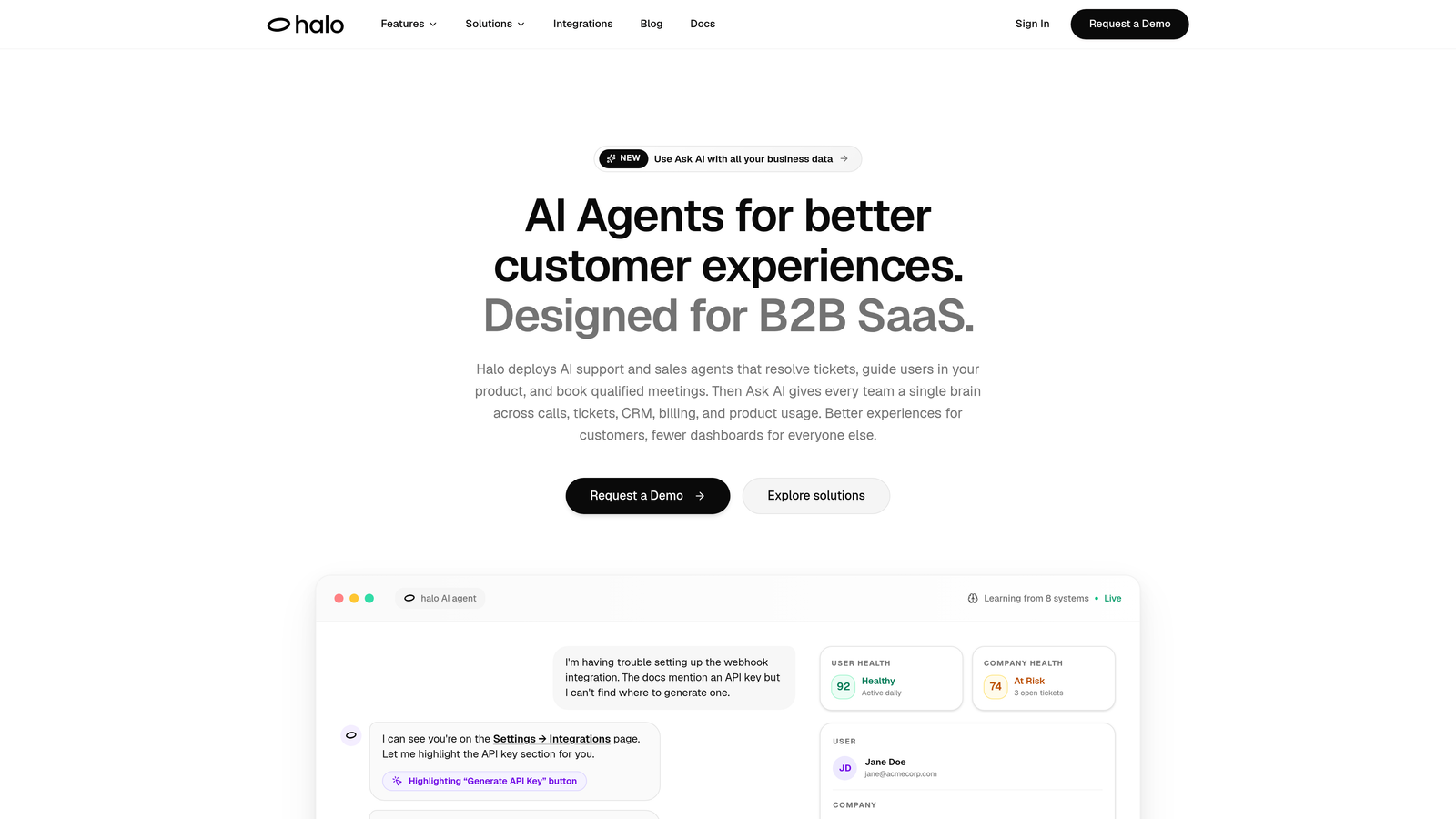
Halo AI is an AI-first customer support platform built specifically for B2B SaaS teams who need more than ticket deflection.
Where This Tool Shines
What separates Halo from most platforms on this list is its architectural philosophy. Rather than bolting AI onto an existing helpdesk, Halo was built from the ground up with autonomous resolution as the core design principle. That means the AI isn't a feature — it's the foundation.
The platform's page-aware context is a particularly compelling differentiator. Halo's chat widget actually sees what your user sees inside your product at the moment they ask for help. That contextual awareness enables guidance that feels genuinely relevant rather than keyword-matched. Combine that with continuous learning from every resolved interaction, and the system compounds in value over time rather than plateauing.
Key Features
Page-Aware Chat Widget: The AI understands where a user is in your product when they ask a question, enabling contextual guidance rather than generic answers.
Continuous Learning AI Agents: Every resolved ticket feeds back into the model, so the system gets measurably smarter with usage rather than requiring manual retraining.
Auto Bug Ticket Creation: Support signals are automatically converted into structured engineering tasks in Linear or GitHub, closing the loop between customer issues and product fixes.
Smart Inbox with Business Intelligence: The inbox surfaces customer health signals, revenue anomalies, and churn indicators derived from support interactions — turning support data into strategic insight.
Live Agent Handoff: Complex issues escalate to human agents with full conversation context preserved, so customers never have to repeat themselves.
Broad Integration Stack: Connects to Linear, Slack, HubSpot, Intercom, Stripe, Zoom, PandaDoc, and Fathom — giving the AI access to business context beyond the support channel.
Best For
Halo is best suited for B2B SaaS companies and product teams that want AI-first support architecture rather than an AI add-on. It's particularly strong for teams where support interactions carry business intelligence value — churn signals, revenue anomalies, product friction patterns — and who want that intelligence surfaced automatically rather than buried in ticket data.
Pricing
Contact for pricing. Visit haloagents.ai to request a demo and discuss plans based on your team's needs.
2. Intercom
Best for: Mid-market SaaS companies wanting mature AI with a rich integration ecosystem
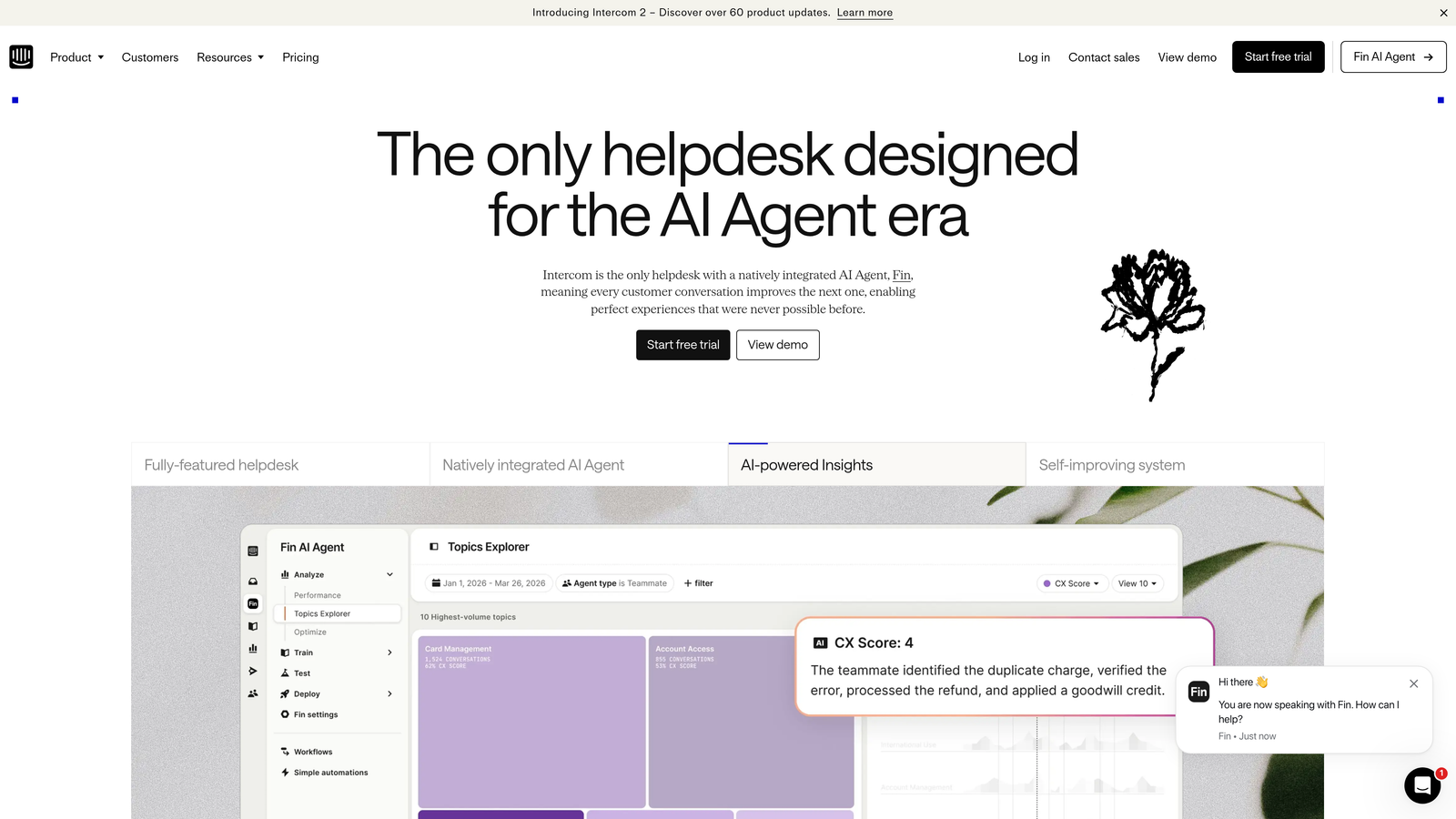
Intercom is a mature customer messaging platform with Fin, its AI agent product, handling autonomous ticket resolution for mid-market and enterprise SaaS companies.
Where This Tool Shines
Intercom has been building toward AI-autonomous support for years, and Fin represents the most polished version of that vision. It sits inside Intercom's existing messenger infrastructure, which means teams already using Intercom for customer communication can activate Fin without a platform migration.
The ecosystem is a genuine strength. Intercom's app marketplace and developer documentation are among the best in the category, making it a natural choice for teams that need to connect support to a wide range of third-party tools. The unified inbox — combining AI responses, automation rules, and live agent workflows — gives support managers a coherent operational view.
Key Features
Fin AI Agent: Handles autonomous resolution of customer queries using your knowledge base and conversation history.
Unified Inbox: Combines AI-handled conversations, automated workflows, and live agent queues in a single interface.
App Marketplace: Extensive ecosystem of integrations built by Intercom and third-party developers.
Built-in Reporting and CSAT: Native analytics covering resolution rates, response times, and customer satisfaction scores.
Help Center Tooling: Strong knowledge base and self-service portal capabilities that feed directly into Fin's resolution logic.
Best For
Mid-market SaaS companies already using Intercom for customer communication, or teams that want a well-established platform with strong developer support and a mature integration ecosystem. Less ideal for teams seeking AI-first architecture from scratch.
Pricing
Starts at approximately $39 per seat per month; Fin AI usage is priced separately on top of base plans. Pricing scales with seat count and conversation volume.
3. Zendesk AI
Best for: Existing Zendesk customers adding autonomous AI to high-volume support operations
Zendesk AI is the AI capability layer built natively into the Zendesk Suite, covering autonomous agents, intelligent triage, and an agent copilot for teams managing significant ticket volumes.
Where This Tool Shines
For teams already embedded in the Zendesk ecosystem, the AI layer is the path of least resistance to autonomous support. There's no migration, no new vendor relationship, and no need to rebuild existing workflows. The AI integrates directly with existing macros, routing rules, and ticket data.
Intelligent triage is a standout capability — the system detects intent, sentiment, and language to route tickets accurately before a human ever touches them. The Agent Copilot then supports agents on complex issues with suggested replies and next-best-action guidance, which keeps quality consistent even as ticket volume fluctuates.
Key Features
Zendesk AI Agents: Autonomous self-service resolution drawing on your knowledge base and historical ticket data.
Intelligent Triage: Automated intent, sentiment, and language detection to route tickets accurately from the moment they arrive.
Agent Copilot: In-context suggestions, reply drafts, and next-best-action guidance for human agents handling complex issues.
Native Suite Integration: AI capabilities work across tickets, messaging, voice, and email without additional configuration.
Advanced Analytics: Workforce management and reporting tools built into the Suite for operational visibility.
Best For
Teams already running Zendesk Suite who want to add AI capabilities without switching platforms. The switching costs of leaving Zendesk are high, so this is most compelling for existing customers rather than teams evaluating from scratch.
Pricing
AI features are available on Suite Professional and above; pricing varies by plan tier and usage volume. Contact Zendesk for current quotes.
4. Freshdesk Freddy AI
Best for: Cost-conscious teams in the Freshworks ecosystem wanting AI across support and CRM
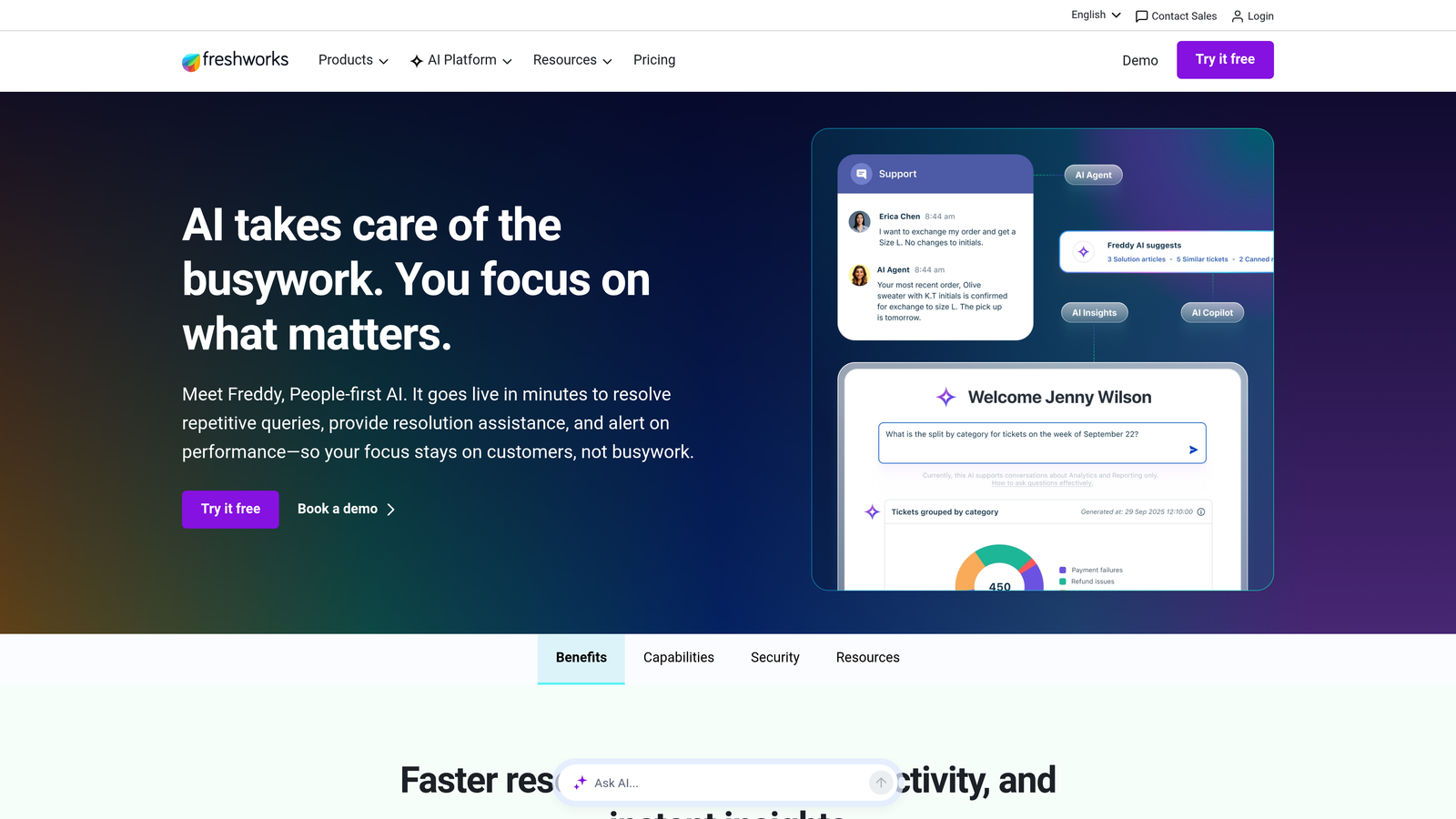
Freshdesk Freddy AI is Freshworks' AI layer spanning the Freshdesk helpdesk, offering self-service bots, agent assist, and analytics under a unified brand.
Where This Tool Shines
Freddy AI's strength lies in its cross-product reach. For teams using Freshdesk alongside Freshsales or Freshservice, Freddy provides AI continuity across the entire Freshworks stack — which reduces the fragmentation that often comes with bolting third-party AI onto a helpdesk.
The pricing is also a genuine differentiator. Freshdesk has historically positioned itself as a more accessible alternative to Zendesk, and Freddy AI continues that pattern. Teams that need capable AI support automation without enterprise-tier pricing often find Freshdesk a compelling middle ground.
Key Features
Freddy Self Service: AI-powered customer-facing resolution bot that handles common queries without agent involvement.
Freddy Copilot: In-context agent suggestions, reply drafts, and conversation summarization for human agents.
Freddy Insights: Anomaly detection and performance analytics that surface trends and issues in support operations.
Cross-Product AI: AI capabilities span Freshdesk, Freshsales, and Freshservice for teams using multiple Freshworks products.
Competitive Pricing: Generally more accessible than Zendesk and Intercom at comparable feature levels.
Best For
Teams already using Freshworks products who want AI support capabilities without switching ecosystems, and cost-conscious organizations that need solid AI automation without enterprise pricing.
Pricing
Freddy AI is available as an add-on on paid Freshdesk plans. Contact Freshworks for current pricing, as it varies by plan and feature tier.
5. Salesforce Agentforce
Best for: Large enterprises running complex support workflows inside the Salesforce ecosystem
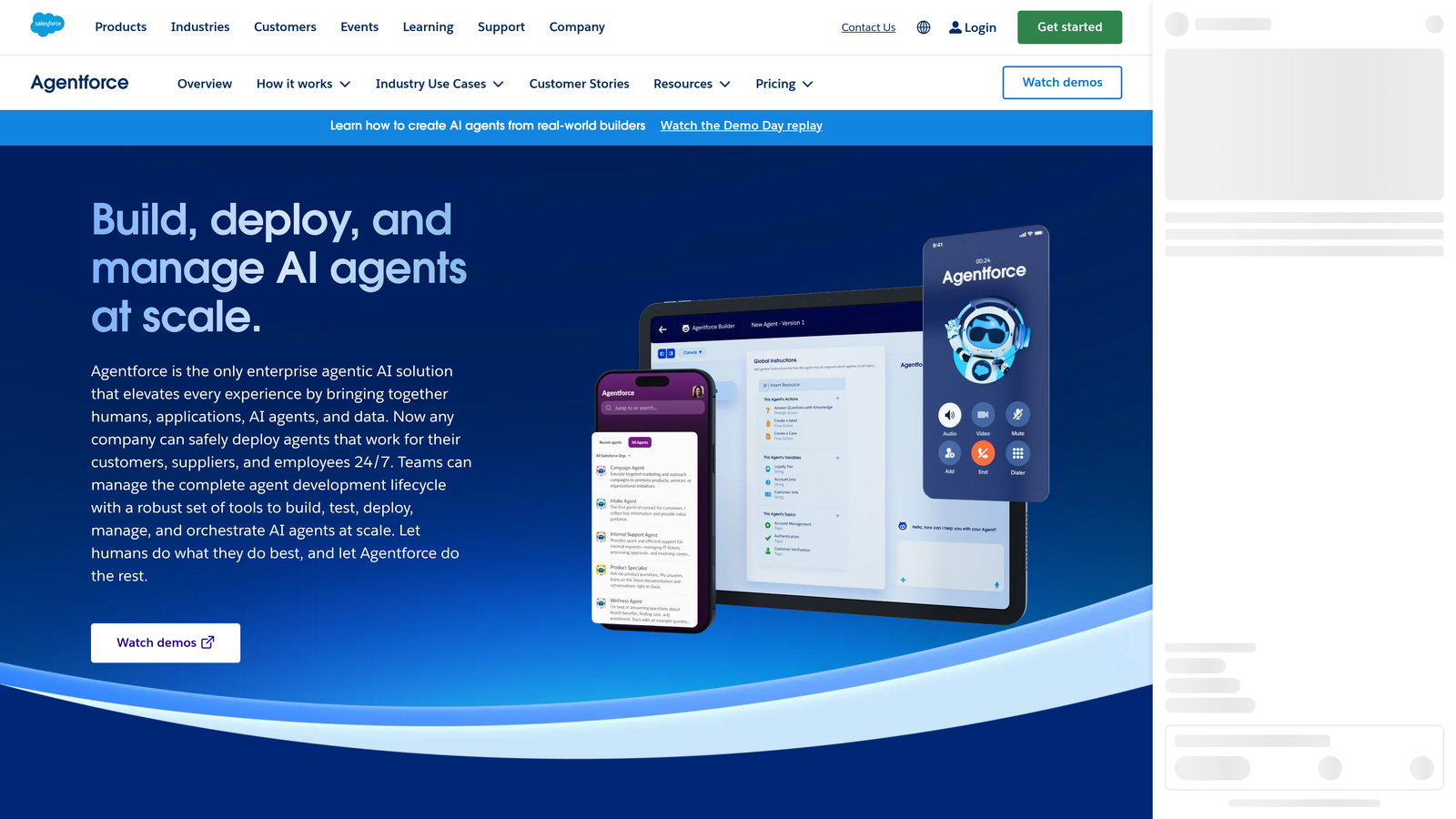
Salesforce Agentforce is Salesforce's autonomous AI agent platform, built on the Salesforce Data Cloud and designed for enterprises managing complex support and sales workflows natively inside Salesforce.
Where This Tool Shines
Agentforce's core advantage is data access. Because it's built directly on the Salesforce Data Cloud, AI agents have native access to the full CRM: case history, contracts, account relationships, billing data, and more. That context depth enables resolution quality that's difficult to replicate when an AI tool is connecting to Salesforce via API from the outside.
For enterprises already invested in Salesforce infrastructure, Agentforce is a natural evolution rather than a new platform decision. The Agent Builder allows teams to customize agent actions and set guardrails without deep technical work, which matters in regulated industries or complex enterprise environments.
Key Features
Native CRM Data Access: AI agents draw on full Salesforce CRM context including case history, contracts, and account data.
Multi-Step Autonomous Workflows: Agents handle complex, multi-channel support interactions without human intervention at each step.
Einstein AI Foundation: Built on Salesforce's Einstein AI and Data Cloud infrastructure.
Agent Builder: Customizable agent actions and guardrails for teams that need tailored behavior and compliance controls.
Deep Suite Integration: Works across Service Cloud, Sales Cloud, and Marketing Cloud for cross-functional workflows.
Best For
Large enterprises already running Salesforce as their primary CRM and service platform. Not practical for teams outside the Salesforce ecosystem given the infrastructure requirements and enterprise pricing.
Pricing
Enterprise pricing; requires existing Salesforce infrastructure. Contact Salesforce directly for quotes based on your configuration.
6. Ada
Best for: Large consumer and B2B brands handling complex, multi-turn support conversations at scale
Ada is a reasoning-based AI agent platform used by large consumer and B2B brands to handle nuanced, multi-turn support conversations without relying on scripted decision trees.
Where This Tool Shines
Ada's reasoning-based approach means the AI can navigate conversations that don't follow predictable paths. Rather than matching keywords to scripted responses, Ada reasons through the context of a conversation to determine the best next action — which makes it more capable on complex, multi-step issues than rule-based alternatives.
The no-code agent builder is a practical strength for teams without dedicated AI engineering resources. Non-technical teams can build, test, and iterate on agent behavior without writing code, and Ada's coaching tools make it easier to improve performance over time based on real conversation data.
Key Features
Reasoning AI Engine: Handles nuanced, multi-turn conversations by reasoning through context rather than following scripted decision trees.
No-Code Agent Builder: Non-technical teams can build and iterate on agent behavior without engineering involvement.
Multilingual Support: Strong coverage across dozens of languages for brands with global customer bases.
Helpdesk and CRM Integrations: Connects to major helpdesks, CRM platforms, and e-commerce systems.
Coaching and Testing Tools: Built-in tools for ongoing performance improvement based on real conversation outcomes.
Best For
Large consumer brands and B2B companies in sectors like telecom, fintech, and e-commerce that handle high volumes of complex, multi-turn conversations and need multilingual capability.
Pricing
Custom pricing based on usage volume. Contact Ada directly for a quote tailored to your conversation volume and feature requirements.
7. Forethought
Best for: Mid-market teams that want AI enhancement without migrating off their existing helpdesk
Forethought is an AI layer designed to sit on top of existing helpdesks, adding intelligent triage, self-service resolution, and agent assist without requiring a platform migration.
Where This Tool Shines
Forethought's positioning is deliberately additive rather than replacement. If your team has significant process investment in Zendesk, Salesforce Service Cloud, or Freshdesk, Forethought enhances those workflows without forcing a migration decision. That's a meaningful practical advantage for teams where switching costs are high.
The three-product structure — Solve for self-service, Triage for routing, Assist for agent support — lets teams adopt incrementally. You can start with intelligent routing, add self-service resolution when you're ready, and layer in agent assist over time rather than committing to a full platform change upfront.
Key Features
Solve: AI agent for autonomous self-service ticket resolution, handling common queries before they reach the queue.
Triage: Intelligent routing based on intent, sentiment, and priority signals extracted from incoming tickets.
Assist: In-context agent copilot with suggested replies and knowledge retrieval for human agents on complex issues.
Helpdesk Compatibility: Works on top of Zendesk, Salesforce, Freshdesk, and other major helpdesks without replacing them.
ROI and Deflection Analytics: Detailed reporting on resolution rates, deflection, and time saved to quantify AI impact.
Best For
Mid-market teams with established helpdesk workflows who want to add AI capabilities incrementally without platform migration. Strong fit for organizations where the cost and disruption of switching helpdesks outweighs the benefits.
Pricing
Custom pricing. Contact Forethought for a demo and quote based on your helpdesk configuration and conversation volume.
8. Tidio
Best for: Small businesses and e-commerce brands that need fast deployment at accessible pricing
Tidio is an accessible AI customer service platform featuring Lyro AI, designed for small businesses and e-commerce brands that prioritize quick setup and affordability.
Where This Tool Shines
Tidio's primary strength is accessibility. The setup time is short, the pricing is transparent, and the integrations with Shopify, WooCommerce, and WordPress mean e-commerce teams can be operational quickly without significant technical overhead.
Lyro AI handles conversational self-service with a live chat fallback built in — so when the AI reaches the edge of its capability, a human agent can step in without the customer experiencing a jarring handoff. For small teams that don't have dedicated support operations, that simplicity is genuinely valuable.
Key Features
Lyro AI Agent: Conversational self-service resolution that handles common customer queries autonomously.
Live Chat Fallback: Seamless human agent takeover when conversations exceed AI capability.
E-Commerce Integrations: Native connections to Shopify, WooCommerce, and WordPress for quick deployment.
Visual Chatbot Builder: Flow-based automation builder for teams that want to customize conversation paths without coding.
Multi-Channel Support: Covers email and Messenger in addition to live chat.
Best For
Small businesses, e-commerce brands, and teams just beginning their AI support automation journey. Less suited to complex B2B SaaS workflows that require deep CRM integration or business intelligence capabilities.
Pricing
Free plan available; Lyro AI starts at approximately $29 per month with paid plans scaling based on conversation volume.
9. Kustomer
Best for: Omnichannel consumer brands that need a unified customer timeline with AI automation
Kustomer is a CRM-native AI customer service platform offering a unified customer timeline and AI automation across email, chat, social, SMS, and voice — well-suited for consumer brands with complex omnichannel support needs.
Where This Tool Shines
Kustomer's unified customer timeline is the feature that defines its value proposition. Rather than treating each channel as a separate queue, Kustomer aggregates every customer interaction — regardless of channel — into a single chronological view. For brands where customers move between email, chat, and social in the same support journey, that unified context changes the quality of every interaction.
The CRM-native architecture means AI automation has access to rich customer history when making routing and resolution decisions. That context depth enables more personalized responses than systems that treat each conversation in isolation.
Key Features
Unified Customer Timeline: All interactions across every channel aggregated into a single customer view for agents and AI alike.
AI-Powered Automation: Automated routing, tagging, and resolution drawing on full customer context.
Omnichannel Coverage: Email, chat, social, SMS, and voice handled within a single platform.
CRM-Native Context: AI responses are informed by customer history, purchase data, and prior interactions.
Workflow Builder: Complex, multi-step support automation for teams with sophisticated routing and escalation requirements.
Best For
Direct-to-consumer and omnichannel brands that handle customer interactions across multiple channels and need unified context to deliver consistent support. Less common in pure B2B SaaS environments where omnichannel complexity is lower.
Pricing
Starts at approximately $89 per agent per month; enterprise plans available for larger teams with more complex requirements.
Finding the Right Fit for Your Team
The nine platforms above cover a wide range of team sizes, use cases, and architectural philosophies. Here's how to think about the decision based on your situation.
If you're a B2B SaaS team building AI-first support: Halo AI is the strongest option for teams that want autonomous resolution, page-aware context, and business intelligence derived from support interactions — without the constraints of a legacy helpdesk architecture. The continuous learning model and smart inbox make it particularly well-suited to product-led companies where support data carries strategic value.
If you're already on a major helpdesk: Zendesk AI, Freshdesk Freddy AI, and Forethought each offer strong paths to AI enhancement without platform migration. Zendesk and Freshdesk are natural choices for teams embedded in those ecosystems; Forethought is the right pick if you want AI capabilities that work across multiple helpdesks without committing to a full switch.
If you're an enterprise on Salesforce: Agentforce is the logical choice given its native data access and deep suite integration. The infrastructure requirement is real, but for teams already running Salesforce, it's a meaningful competitive advantage.
If you need multilingual, high-volume consumer support: Ada's reasoning-based approach and strong multilingual coverage make it a compelling option for global consumer brands handling complex conversations at scale.
If you're a small business or e-commerce brand: Tidio and Kustomer offer accessible entry points — Tidio for teams prioritizing simplicity and affordability, Kustomer for omnichannel brands that need unified customer context.
Your support team shouldn't scale linearly with your customer base. Let AI agents handle routine tickets, guide users through your product, and surface business intelligence while your team focuses on complex issues that need a human touch. See Halo in action and discover how continuous learning transforms every interaction into smarter, faster support.