9 Top AI Customer Support Solutions for B2B Teams in 2026
This guide evaluates nine Top AI Customer Support Solutions for B2B teams in 2026, ranking each across autonomy level, integration depth, learning capability, and scalability. It cuts through the noise between genuine AI-first platforms and traditional helpdesks with AI bolted on, so teams can make a confident, future-proof decision.
 Grant CooperFounder13 min read
Customer support has quietly become one of the highest-leverage areas for AI in B2B software. The old model — a helpdesk, a queue, and a team of agents working through tickets manually — is giving way to something fundamentally different: autonomous agents that resolve issues end-to-end, learn from every interaction, and surface business intelligence that goes well beyond support metrics.
But not all AI customer support tools are built the same way. Some are genuine AI-first platforms. Others are traditional helpdesks with AI bolted on as an afterthought. Choosing the wrong one means paying for AI features you barely use, or migrating your entire support stack only to find the "AI" is just a smarter macro.
This list evaluates tools across four criteria: autonomy level, integration depth, learning capability, and scalability. Whether you're a growing SaaS team looking to explore AI customer support agents, or an enterprise evaluating whether to stay on Zendesk or move to a more AI-native approach (worth reading: Zendesk vs. AI support platforms), this breakdown is built for B2B product and support teams making serious buying decisions.
1. Halo AI
Best for: B2B SaaS teams that want an AI-first support platform with deep business stack integrations and continuous learning.
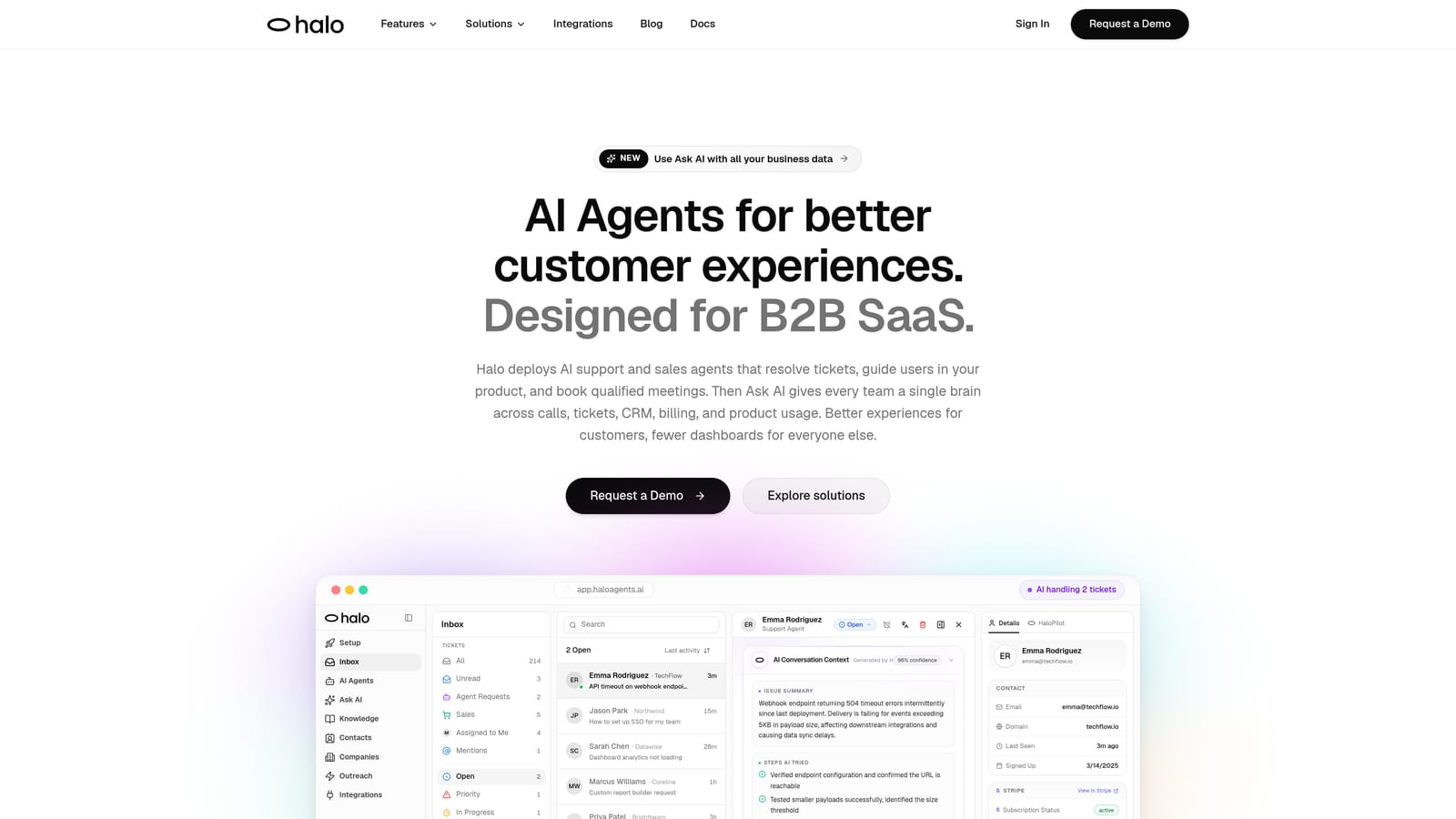
Halo AI is an AI-native customer support platform that deploys autonomous agents to resolve tickets, guide users visually through your product, and surface business intelligence — all while learning from every resolved interaction.
Where This Tool Shines
Halo's most distinctive capability is its page-aware context. Unlike most support tools that only know what a user types, Halo's chat widget can see what the user is looking at in your product and provide visual UI guidance tailored to that exact screen. For SaaS teams supporting complex products, this is a meaningful step beyond generic knowledge base deflection.
The smart inbox is another standout. It doesn't just surface support tickets — it surfaces business intelligence signals like customer health indicators, anomaly detection, and revenue intelligence. That positions Halo less as a support tool and more as an operational intelligence layer for your entire customer-facing operation.
Key Features
Page-Aware Chat Widget: The AI can see what users are viewing in your product and deliver contextual, visual UI guidance in real time.
Autonomous Ticket Resolution: AI agents handle support tickets end-to-end, from first contact through resolution, without requiring human intervention on routine issues.
Smart Inbox with Business Intelligence: Surfaces customer health signals, revenue intelligence, and anomaly detection alongside standard support metrics.
Auto Bug Ticket Creation: Automatically generates and routes bug tickets to Linear when the AI detects a product issue — a notable differentiator for product-led teams.
Live Agent Handoff: Escalates to human agents gracefully, preserving full conversation context so agents never start cold.
Deep Integrations: Connects to Linear, Slack, HubSpot, Intercom, Stripe, Zoom, PandaDoc, and Fathom — not just your helpdesk.
Best For
B2B SaaS companies that want AI to do more than deflect tickets. Particularly well-suited for product-led growth teams where support, product, and revenue data need to flow together. Teams frustrated by AI that's been bolted onto a traditional helpdesk will find Halo's architecture refreshingly deliberate.
Pricing
Contact for pricing. A demo is available at haloagents.ai.
2. Intercom
Best for: Teams that want a mature messaging platform with an AI agent built into an established inbox ecosystem.
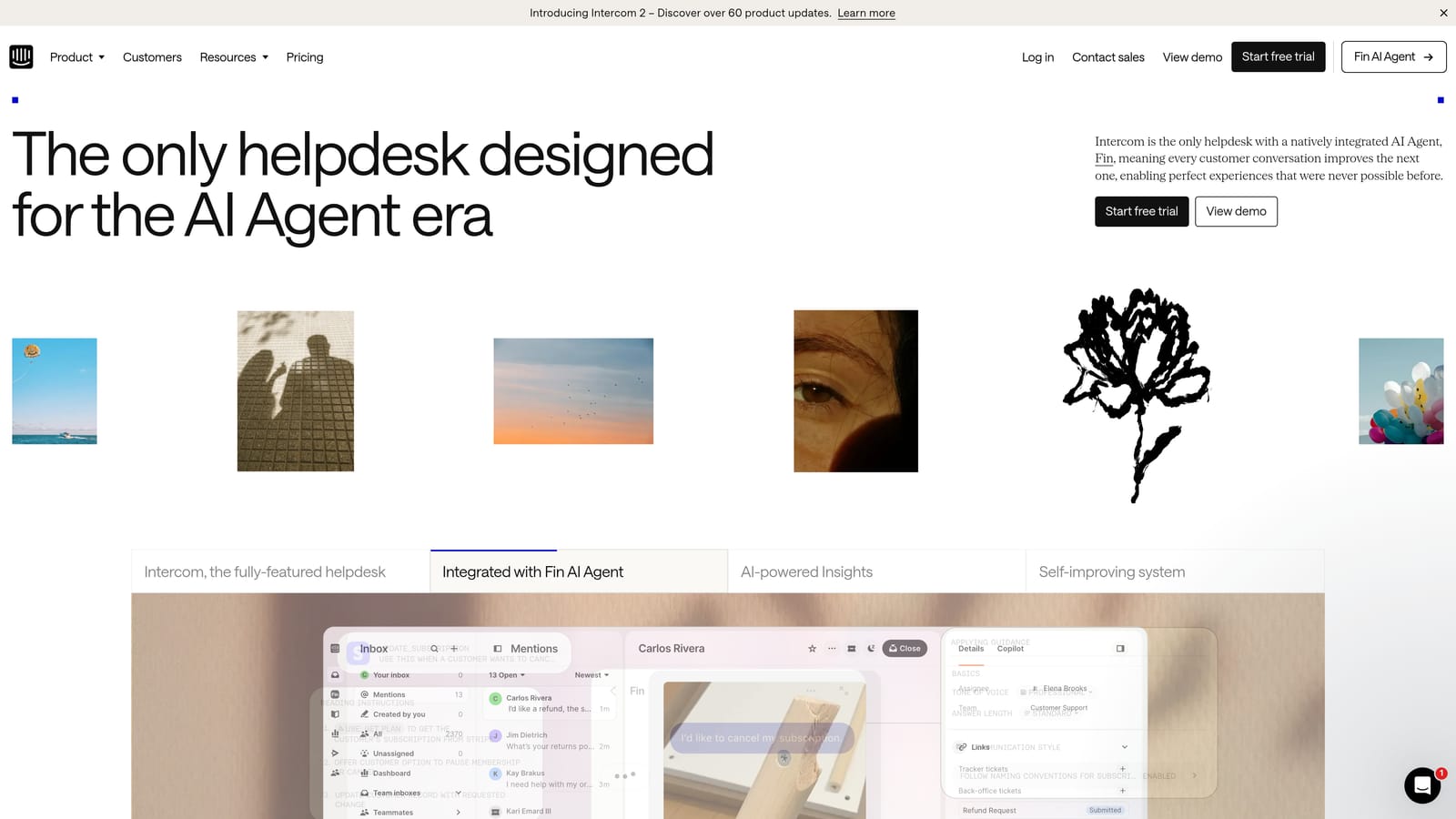
Intercom is one of the most established customer messaging platforms, featuring Fin, its GPT-based AI agent, layered on top of a robust inbox and messenger infrastructure.
Where This Tool Shines
Intercom's strength is its maturity. The messenger UI is polished, the inbox is battle-tested, and the app marketplace is extensive. Fin, Intercom's AI agent, resolves queries by reasoning over your help center content and has improved significantly since its initial launch.
Proactive messaging and product tours give Intercom reach beyond reactive support. If you want to combine support, onboarding, and user engagement in a single platform, Intercom covers a lot of ground.
Key Features
Fin AI Agent: Resolves customer queries using help center content and GPT-based reasoning, with escalation to human agents when needed.
Unified Inbox: Combines chat, email, and in-app messages into a single workspace for support teams.
AI-Powered Conversation Summaries: Automatically summarizes conversations and suggests replies to reduce agent effort.
Extensive App Marketplace: Native integrations with hundreds of tools across CRM, billing, analytics, and communication categories.
Proactive Messaging and Product Tours: Enables outbound engagement and in-product onboarding flows alongside reactive support.
Best For
Teams already invested in Intercom's ecosystem, or those that want a single platform for support, user engagement, and onboarding. Less ideal for teams that need AI to connect deeply into their product or business data stack beyond what Intercom natively supports.
Pricing
Starts at approximately $39 per seat per month. Fin AI usage is billed per resolution, so costs can scale meaningfully at high volumes.
3. Zendesk AI
Best for: Organizations already on Zendesk Suite that want to activate AI without migrating their support infrastructure.
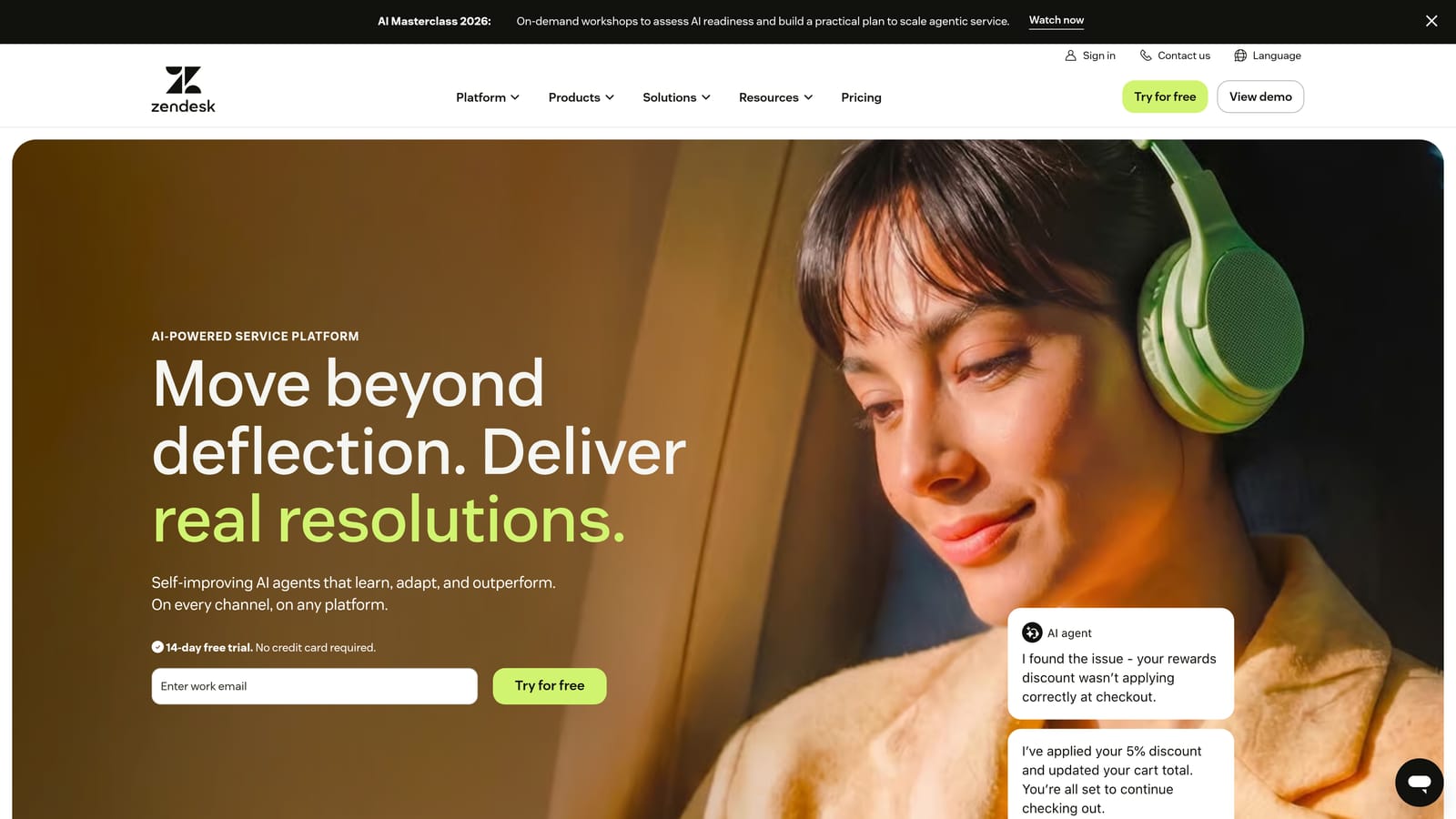
Zendesk AI embeds artificial intelligence across the Zendesk Suite, adding intelligent triage, intent detection, and an autonomous AI agent to a platform that many enterprise support teams already rely on.
Where This Tool Shines
If your team is already running Zendesk, the path to AI is relatively low-friction. Zendesk's AI capabilities — triage, sentiment analysis, AI-generated summaries, and the autonomous agent — activate within your existing workflows without requiring migration or retraining your team on a new system.
The intelligent routing is particularly useful for larger teams. Tickets are automatically assigned based on content, intent, and agent skill sets, reducing the manual triage burden that consumes significant support team time.
Key Features
AI-Powered Triage: Detects intent and sentiment to classify and prioritize incoming tickets automatically.
Autonomous AI Agent: The evolved Answer Bot handles self-service resolution for common queries without agent involvement.
AI-Generated Summaries and Macros: Condenses ticket history and suggests response templates to accelerate agent replies.
Intelligent Routing: Routes tickets based on content analysis and agent skills, improving first-contact resolution rates.
Advanced Reporting and Workforce Management: Comprehensive analytics and scheduling tools for larger support operations.
Best For
Enterprise teams with existing Zendesk deployments who want AI augmentation without platform disruption. Teams evaluating Zendesk from scratch should compare carefully against AI-native alternatives before committing to the Suite.
Pricing
Suite plans start at approximately $55 per agent per month. AI features are available on higher-tier plans, which increases the effective cost per seat.
4. Freshdesk Freddy AI
Best for: SMBs that want an integrated AI-powered support and CRM suite at accessible price points.
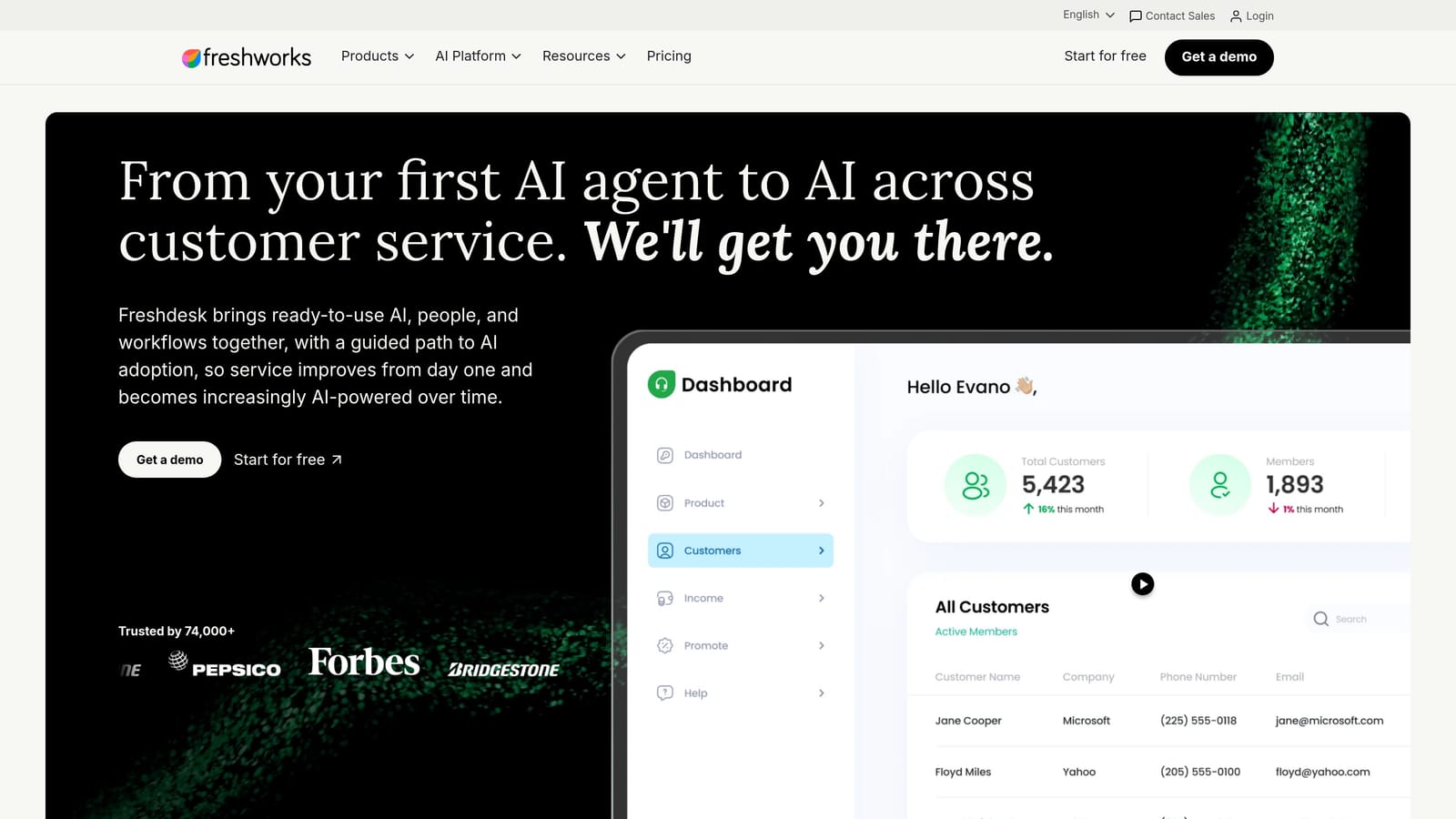
Freshdesk is part of the Freshworks ecosystem, and Freddy AI is the intelligence layer that spans customer support, ITSM, and CRM — giving smaller teams a coherent AI-powered suite without enterprise-level pricing.
Where This Tool Shines
Freddy AI's cross-suite reach is its primary differentiator. The same AI layer that handles support ticket triage in Freshdesk also assists agents in Freshservice (ITSM) and Freshsales (CRM). For SMBs running their business on Freshworks, that coherence reduces the fragmentation that plagues teams using multiple disconnected tools.
The no-code bot builder makes it accessible for teams without technical resources. Custom conversation flows can be configured without engineering involvement, which matters for smaller support teams that need to move quickly.
Key Features
Freddy Self Service Bot: Autonomously resolves common customer queries using your knowledge base and configured conversation flows.
Freddy Assist: Surfaces AI-suggested responses and next-best actions for human agents during live conversations.
Auto-Triage and Ticket Categorization: Automatically classifies incoming tickets to reduce manual sorting and improve routing accuracy.
Cross-Suite AI: The same Freddy AI layer spans Freshdesk, Freshservice, and Freshsales for consistent intelligence across functions.
No-Code Bot Builder: Enables custom conversation flows without requiring developer involvement.
Best For
SMBs and mid-market teams already using or evaluating the Freshworks suite. Less suited for teams with complex integration requirements outside the Freshworks ecosystem.
Pricing
A free plan is available. Paid plans start at approximately $15 per agent per month. Freddy AI capabilities are available on higher-tier plans.
5. Tidio
Best for: Smaller SaaS teams and e-commerce businesses that need quick AI chatbot deployment with minimal setup overhead.
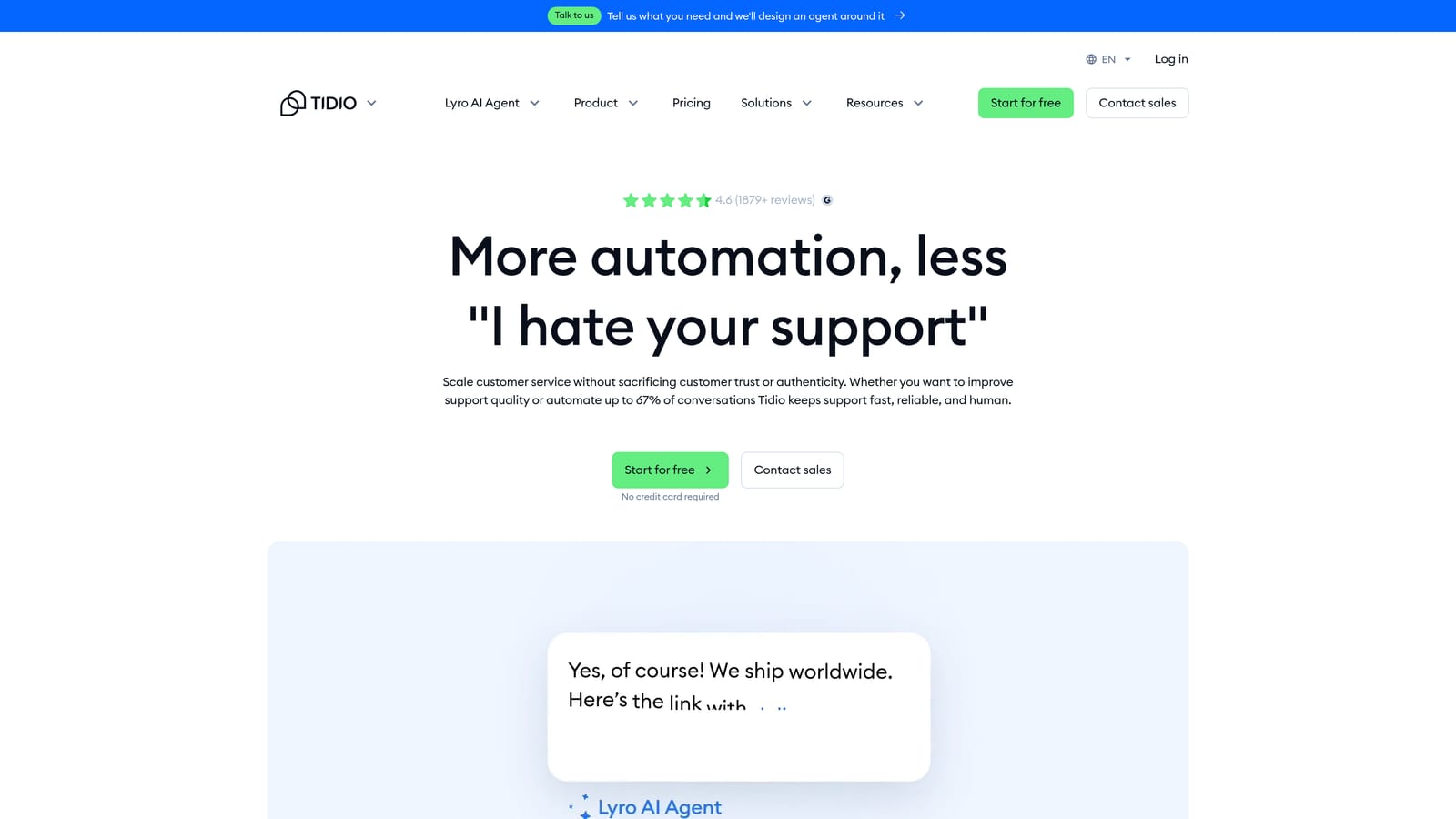
Tidio is a live chat and AI chatbot platform featuring Lyro, an AI agent trained on your support content to handle customer queries autonomously.
Where This Tool Shines
Tidio's strength is speed to value. Lyro can be trained on your existing FAQ and support content with minimal configuration, making it one of the faster AI chatbot deployments available. For teams that need something running quickly without a complex implementation project, Tidio delivers.
The live chat fallback is well-executed. When Lyro reaches the limits of what it can resolve, the handoff to a human agent is smooth, and visitor behavior tracking enables proactive chat triggers based on what users are doing on your site.
Key Features
Lyro AI Chatbot: Trained on your FAQ and support content to autonomously handle common customer queries.
Live Chat Fallback: Seamlessly transfers conversations to human agents when the AI cannot resolve the query.
No-Code Chatbot Builder: Custom conversation flows configurable without technical resources.
E-Commerce Integrations: Native connections to Shopify and WooCommerce for order-related support automation.
Proactive Chat Triggers: Initiates conversations based on visitor behavior and time-on-page rules.
Best For
Smaller teams and e-commerce businesses that want AI chatbot capabilities without a complex enterprise implementation. Less suited for B2B teams with multi-step support workflows or deep integration requirements across a business stack.
Pricing
A free plan is available. Lyro AI starts at approximately $29 per month, with pricing based on conversation volume.
6. Kustomer
Best for: High-volume consumer support teams that need a CRM-first platform with omnichannel AI automation.
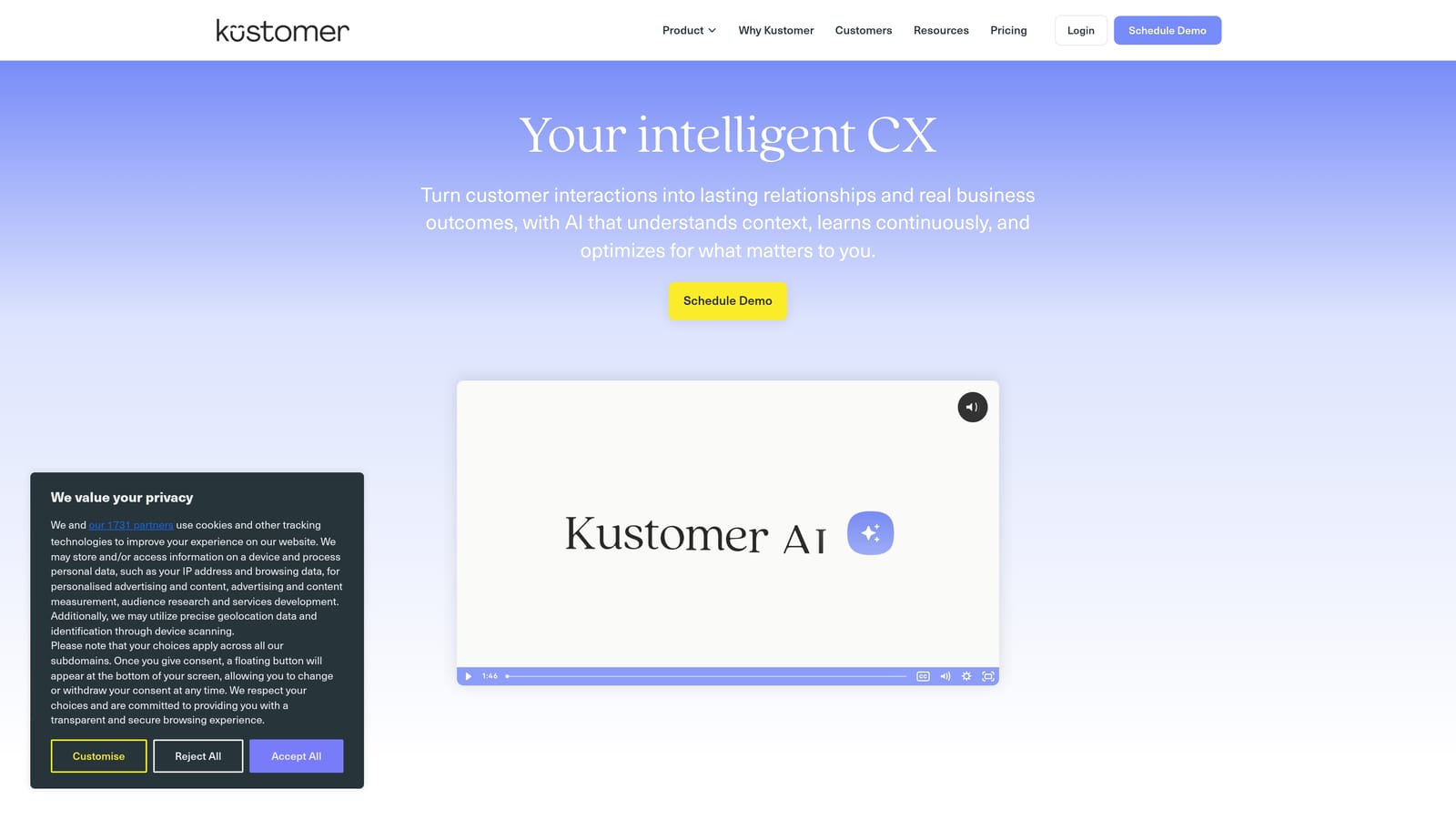
Kustomer is a CRM-first customer support platform with a unified customer timeline view, layered with AI automation designed for teams handling large volumes of consumer interactions across multiple channels.
Where This Tool Shines
The unified customer timeline is Kustomer's most compelling feature. Every touchpoint — email, chat, social, SMS, voice — is consolidated into a single chronological view of the customer relationship. For support teams that need full context before responding, this eliminates the context-switching that slows agents down.
The built-in CRM also reduces the need for a separate customer data tool. AI-powered intent routing and automated workflows trigger based on customer data and behavior, giving high-volume teams the automation depth they need without stitching together multiple platforms.
Key Features
Unified Customer Timeline: Consolidates all customer touchpoints across channels into a single chronological view.
AI-Powered Intent Routing: Automatically classifies and routes tickets based on detected customer intent.
Automated Workflows: Triggers actions based on customer data, behavior, and conversation context.
Omnichannel Support: Handles chat, email, SMS, social, and voice from a unified workspace.
Built-In CRM: Reduces dependency on separate customer data tools by embedding CRM data directly in the support platform.
Best For
Consumer brands and high-volume support operations that need CRM and support unified in one platform. The enterprise-level pricing makes it less accessible for early-stage teams.
Pricing
Starts at approximately $89 per user per month at the Enterprise tier. Best suited for teams where the CRM consolidation justifies the investment.
7. Forethought
Best for: Teams that want AI augmentation layered on top of an existing helpdesk without migrating platforms.
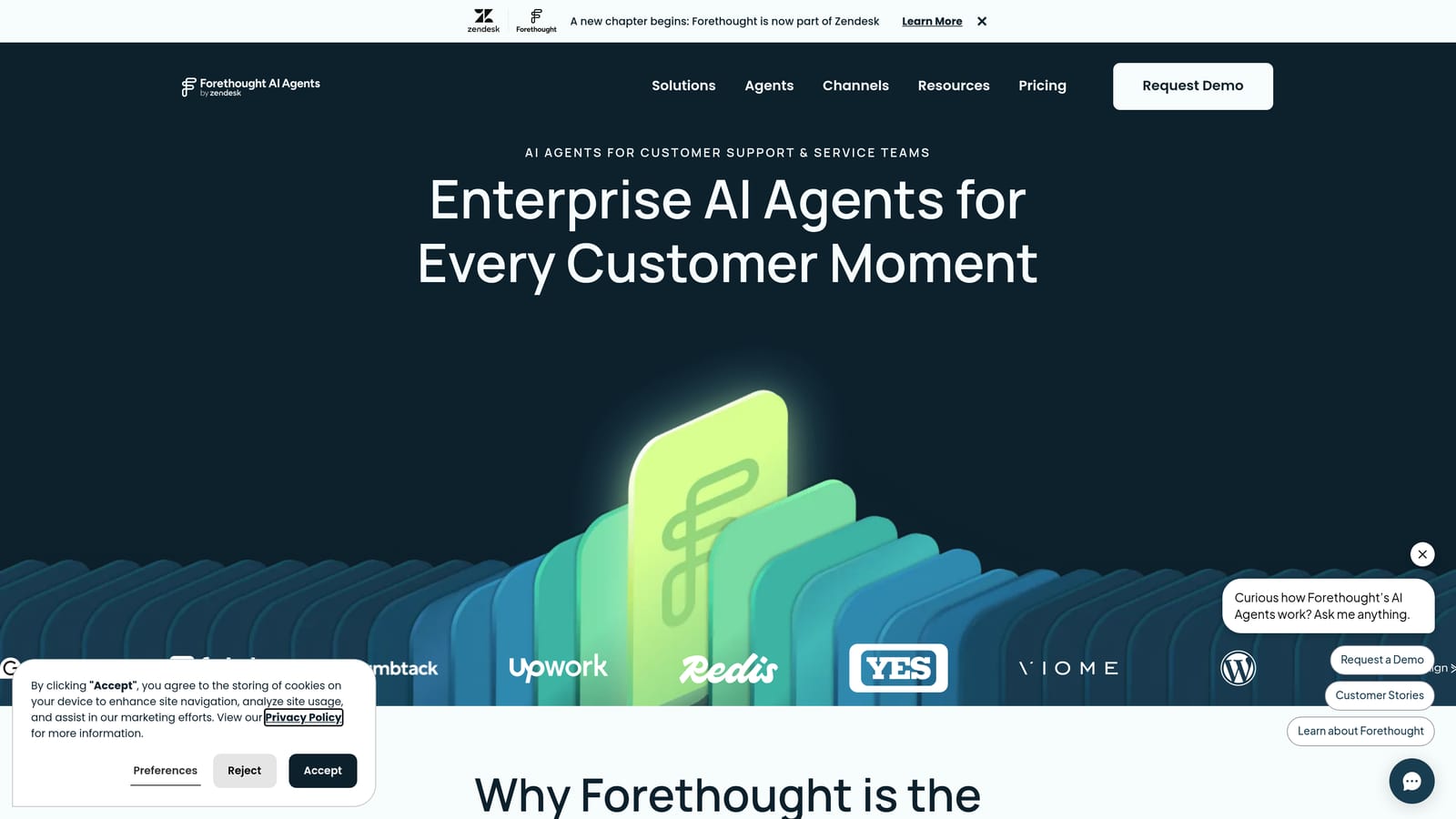
Forethought is an AI layer designed to sit on top of existing helpdesks — including Zendesk, Salesforce Service Cloud, and ServiceNow — adding intelligent triage, agent assistance, and autonomous resolution without requiring a platform switch.
Where This Tool Shines
Forethought's positioning is deliberate: it doesn't ask you to rip and replace your helpdesk. If your team has significant investment in Zendesk or Salesforce workflows, Forethought adds AI capabilities on top of that infrastructure rather than displacing it. That's a genuinely useful approach for enterprises where migration risk is a real concern.
The three-product structure — Triage, Assist, and Solve — allows teams to adopt AI incrementally. Start with routing and agent suggestions, then graduate to autonomous resolution as confidence in the AI builds.
Key Features
Solve: Autonomous AI agent that handles end-to-end ticket resolution without human intervention.
Triage: AI-powered ticket routing and prioritization based on content and intent analysis.
Assist: Surfaces real-time suggested responses and relevant knowledge for agents during live interactions.
Helpdesk Integrations: Native connections to Zendesk, Salesforce, ServiceNow, and other major platforms.
Workflow Builder: Custom AI automation logic configurable for specific support scenarios and escalation paths.
Best For
Enterprise teams with established helpdesk deployments that want AI capabilities without migration risk. Requires an existing helpdesk — Forethought is not a standalone support platform.
Pricing
Custom pricing. Contact Forethought directly for a quote based on volume and feature requirements.
8. Gorgias
Best for: E-commerce brands with high volumes of order-related support queries and deep Shopify integration needs.
Gorgias is a helpdesk built specifically for e-commerce, with native Shopify, WooCommerce, and Magento integrations and AI automation focused on the repetitive, order-centric queries that dominate DTC support queues.
Where This Tool Shines
Gorgias is purpose-built for a specific problem: the overwhelming volume of "where is my order," return, and refund queries that e-commerce brands deal with at scale. Its AI automation handles these end-to-end, pulling live order data from Shopify and acting on it without agent involvement.
The revenue statistics feature is a useful differentiator. It links support interactions to sales impact, giving support teams visibility into how their work affects conversion and retention — a metric that's often invisible in generic helpdesk tools.
Key Features
Native E-Commerce Integrations: Deep connections to Shopify, WooCommerce, and Magento for live order data access.
AI Order Automation: Autonomously handles order status, return, and refund queries using live e-commerce data.
Omnichannel Inbox: Consolidates email, chat, social, and SMS into a single support workspace.
Revenue Statistics: Links support interactions to sales outcomes, surfacing the revenue impact of support activity.
Macros and Rules: High-volume repetitive ticket handling through templated responses and automated routing rules.
Best For
DTC and e-commerce brands with Shopify as their primary commerce platform. Not well-suited for B2B SaaS support, where the ticket types and integration requirements are fundamentally different.
Pricing
Starts at approximately $10 per month on the Starter plan. Pricing scales by ticket volume rather than per seat, which can be advantageous for smaller teams with variable support loads.
9. Help Scout
Best for: Teams that value human-quality support interactions and want AI to reduce agent effort without replacing human judgment.
Help Scout is a human-first customer support platform that uses AI to assist agents through smart drafts and conversation summaries, deliberately stopping short of fully autonomous AI agents.
Where This Tool Shines
Help Scout's philosophy is clear: AI should make human support better, not replace it. AI Drafts generates suggested reply copy from conversation context, giving agents a strong starting point rather than a blank page. AI Summarize condenses long email threads into a brief overview so agents can get up to speed instantly without reading every message.
The Docs knowledge base and Beacon widget handle self-service and in-product help, reducing inbound volume without requiring a fully autonomous AI agent. For teams where the quality of human interaction is a genuine competitive differentiator, Help Scout's approach is coherent and well-executed.
Key Features
AI Drafts: Generates suggested reply copy from conversation context, reducing blank-page friction for agents.
AI Summarize: Condenses long email threads into a concise summary to accelerate agent context-gathering.
Docs Knowledge Base: Customer-facing self-service content organized and searchable without agent involvement.
Beacon Widget: In-product help widget combining knowledge base search and live chat in a single interface.
Shared Inbox: Collaborative inbox with collision detection and internal notes to prevent duplicate responses.
Best For
Teams where human judgment and relationship quality are central to the support experience. A strong fit for professional services, agencies, and SaaS companies where support interactions carry significant relationship weight. Less suited for teams looking to automate ticket resolution at scale.
Pricing
Starts at approximately $20 per user per month on the Standard plan.
Which Tool Is Right for Your Team?
The right AI customer support platform depends less on feature checklists and more on where your team is today and where you need to go.
If you're a B2B SaaS team building AI-native support from scratch: Halo AI is worth exploring first. Its page-aware context, autonomous ticket resolution, auto bug ticket creation, and business intelligence signals are built for product-led teams that want support to be an intelligence layer, not just a cost center. It's an AI-first architecture, not a helpdesk with AI bolted on.
If you're on Zendesk or Salesforce and can't migrate: Forethought is the pragmatic choice. It adds genuine AI capabilities on top of your existing infrastructure without the disruption of a platform switch.
If you're an enterprise already running Zendesk: Zendesk AI activates within your existing workflows. The path of least resistance for teams with significant Zendesk investment and low appetite for migration risk.
If you're an e-commerce or DTC brand: Gorgias is purpose-built for your ticket types. Its Shopify integration and order automation will outperform any general-purpose platform for your specific use case.
If your team values human-first support: Help Scout's AI-assisted approach keeps humans in control while reducing the repetitive effort that burns agents out.
Your support team shouldn't scale linearly with your customer base. Let AI agents handle routine tickets, guide users through your product, and surface business intelligence while your team focuses on complex issues that need a human touch. See Halo in action and discover how continuous learning transforms every interaction into smarter, faster support.