9 Top AI Support Automation Platforms in 2026
This guide ranks nine top AI support automation platforms for 2026, evaluating each on AI capability depth, integration breadth, scalability, and human-agent handoff — so SaaS startups and enterprise teams alike can find the right fit for their support stack.
 Matt PattoliFounder13 min read
The days of routing tickets manually and writing the same macro for the hundredth time are over. AI support automation platforms now handle everything from first-touch triage to complex multi-step resolutions, without adding headcount. But not every platform is built the same way. Some bolt AI onto legacy helpdesk infrastructure; others are architected from the ground up to learn, reason, and act autonomously.
This guide cuts through the noise and ranks nine platforms worth evaluating in 2026, assessed on AI capability depth, integration breadth, scalability, and how well they handle the handoff between automation and human agents. Whether you're running a lean SaaS support team or managing thousands of daily tickets across enterprise accounts, there's a platform here that fits your stack.
1. Halo AI
Best for: SaaS and B2B teams that want AI-native support with deep product and business context.
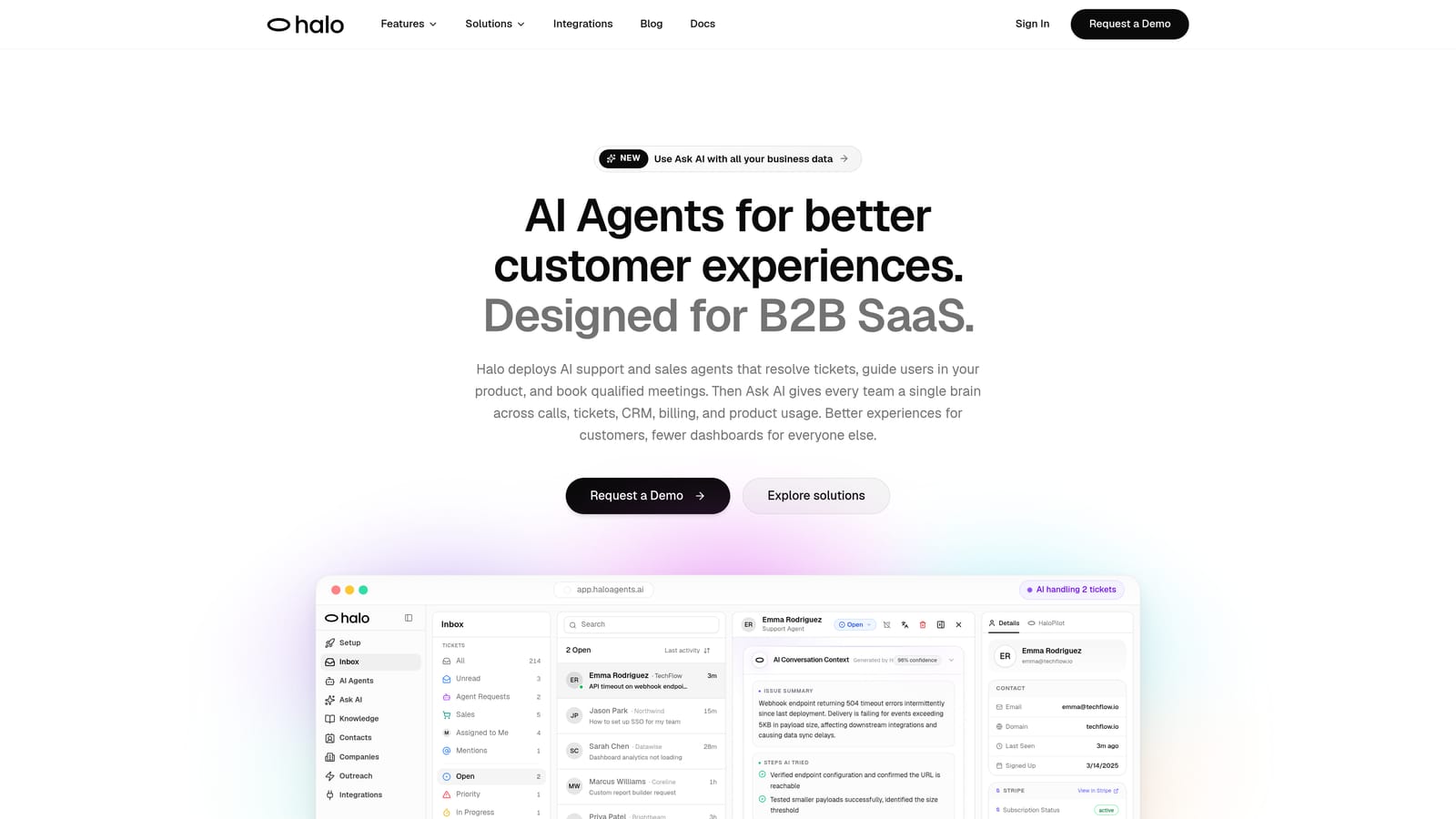
Halo AI is an AI-native customer support platform built to resolve tickets, guide users through your product, and surface business intelligence — all from a single, continuously learning system.
Where This Tool Shines
What separates Halo from most platforms on this list is its architecture. This isn't AI layered on top of a helpdesk. It's a system designed from the ground up to reason, act, and improve with every interaction. The page-aware chat widget is a standout feature: it understands where a user is in your product and provides contextual UI guidance based on that exact location, not just a generic knowledge base lookup.
The smart inbox goes beyond ticket management. It surfaces customer health signals, revenue intelligence, and anomaly detection, giving support and product teams visibility into patterns that would otherwise get buried in ticket volume. For teams that want support to function as a business intelligence layer, not just a cost center, this is a meaningful differentiator.
Key Features
Page-Aware Chat Widget: Sees what the user sees and delivers contextual guidance based on their exact location in the product.
Intelligent AI Agents: Autonomously resolve support tickets end-to-end, with continuous learning from every resolved interaction.
Smart Inbox with Business Intelligence: Surfaces customer health signals, anomaly detection, and revenue intelligence directly in the support workflow.
Auto Bug Ticket Creation: Automatically generates bug reports connected to Linear when issues are detected, closing the loop between support and engineering.
Live Agent Handoff: Escalates complex issues to human agents with full context preserved, so nothing gets repeated.
Integration Stack: Connects with Linear, Slack, HubSpot, Intercom, Stripe, Zoom, PandaDoc, and Fathom for a genuinely connected support operation.
Best For
Halo is best suited for B2B SaaS companies and product-led teams that want AI to do more than deflect tickets. If your support team is also expected to feed insights back to product, flag churn signals, and guide users through complex workflows, Halo's architecture is built for exactly that use case.
Pricing
Contact Halo for pricing. Given the platform's depth and integration scope, expect enterprise-oriented packaging. Visit haloagents.ai to request a demo.
2. Intercom (Fin AI Agent)
Best for: Teams already running Intercom who want AI resolution without switching platforms.
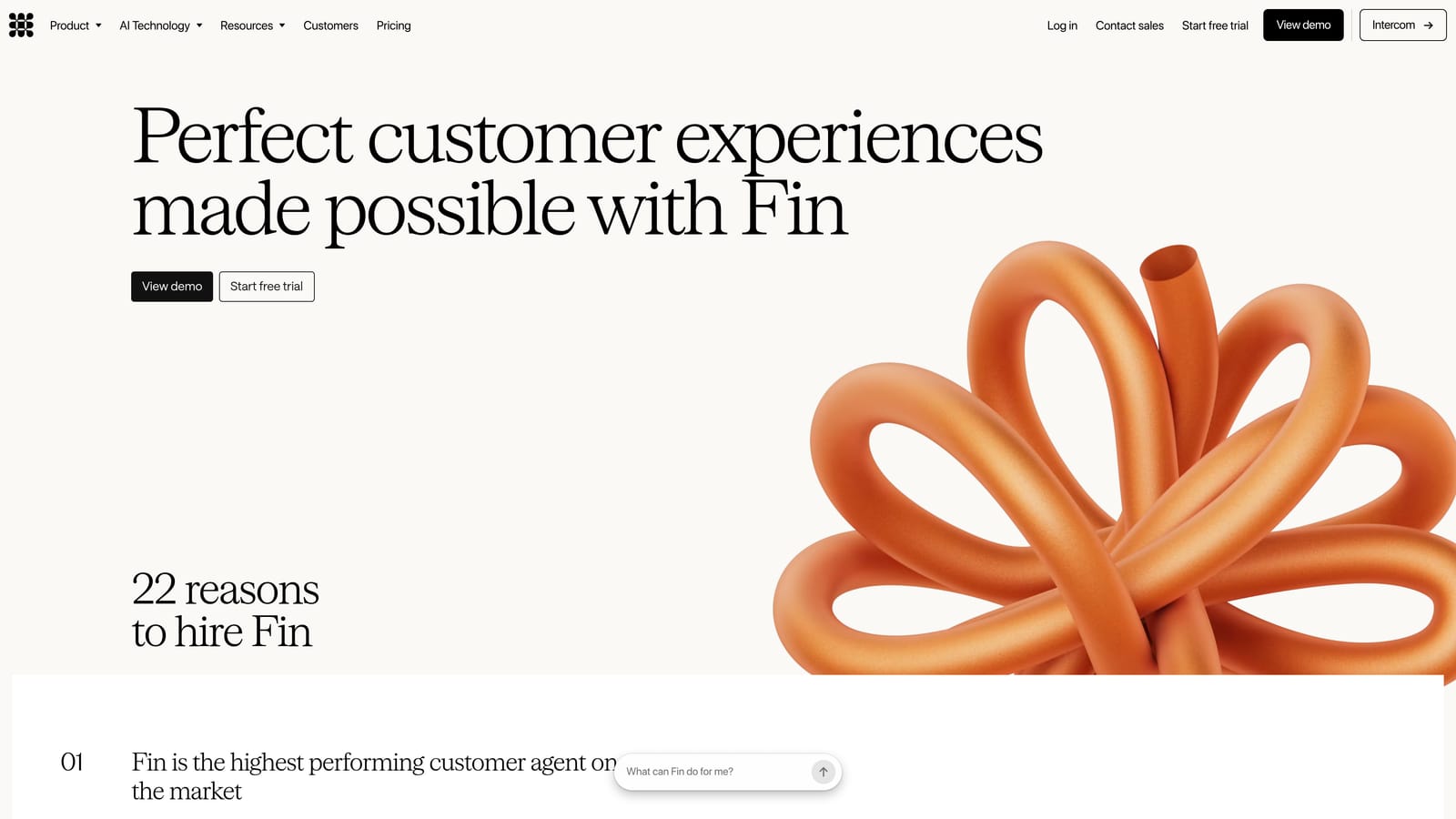
Intercom's Fin AI Agent is a native AI resolution layer built directly into Intercom's messenger and inbox infrastructure.
Where This Tool Shines
Fin's biggest advantage is how seamlessly it fits into the Intercom workflow. If your team already lives in Intercom, there's no migration friction. Fin uses your existing help center content and custom answers to resolve queries before they reach a human agent, and the handoff experience when escalation is needed is smooth and context-preserving.
The per-resolution pricing option is worth noting for teams with variable ticket volumes. Rather than paying a flat platform fee regardless of AI usage, you can align cost more directly with value delivered. That said, Fin's capabilities are tied to the Intercom ecosystem, so teams looking for cross-platform flexibility will find it limiting.
Key Features
Native Messenger Integration: Operates directly within Intercom's messenger and inbox with no additional setup layer required.
Knowledge-Based Resolution: Answers queries using help center content and custom knowledge sources configured by your team.
Smooth Human Handoff: Escalates to live agents within the same Intercom interface, preserving conversation context.
Omnichannel Coverage: Supports chat, email, and additional channels within the Intercom platform.
Per-Resolution Pricing: Flexible pricing option that ties cost to actual AI resolutions rather than flat seat fees.
Best For
Existing Intercom customers who want to add AI resolution without evaluating a new platform. Fin is a natural next step for teams already invested in the Intercom stack.
Pricing
Available as an add-on to Intercom plans, with per-resolution pricing available in some configurations. Check intercom.com for current rates.
3. Zendesk AI
Best for: Enterprise teams running Zendesk Suite who want AI built into their existing workflows.
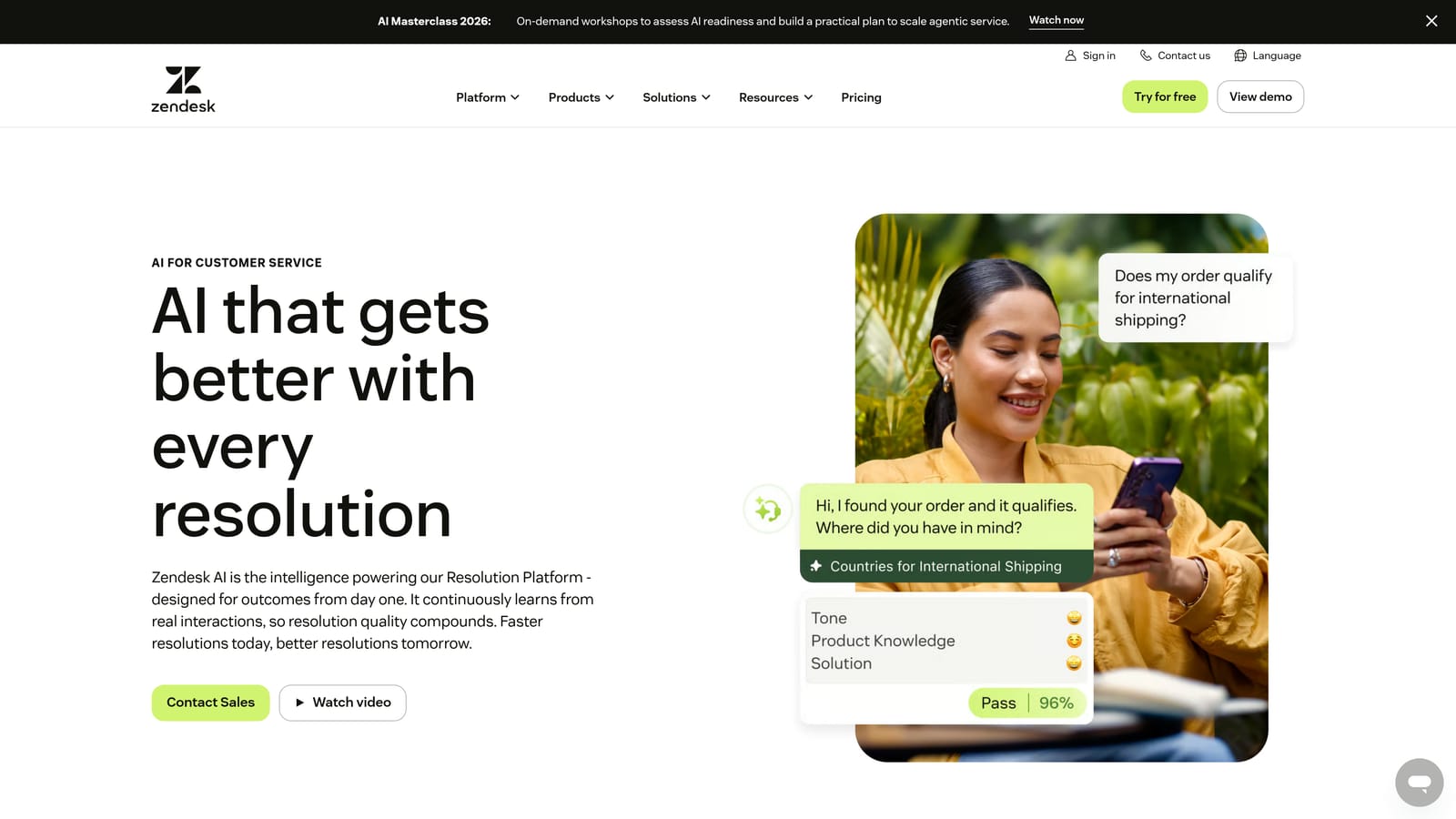
Zendesk AI brings intelligent triage, agent copilot, and automated ticket resolution to teams already operating on Zendesk infrastructure.
Where This Tool Shines
Zendesk's AI benefits enormously from the platform's scale. The intent detection and routing models are trained on one of the largest support datasets in the industry, which means out-of-the-box performance tends to be solid for common support categories. For teams that have spent years building workflows in Zendesk, AI capabilities that slot directly into those workflows are a low-friction upgrade path.
The agent copilot feature is particularly useful for teams that aren't ready to go fully autonomous. Suggested replies and next-best actions help agents move faster without removing them from the loop, which is a sensible middle ground for complex or regulated support environments.
Key Features
Intelligent Triage: Automatically detects intent and routes tickets to the right team or workflow without manual intervention.
Agent Copilot: Provides real-time suggested replies and next-best actions to help human agents resolve tickets faster.
Automated Resolution: Handles common query types end-to-end without agent involvement.
Intent Modeling at Scale: Leverages Zendesk's large proprietary dataset for more accurate out-of-the-box intent detection.
Suite Integration: Available within higher-tier Zendesk Suite plans, keeping the toolchain consolidated.
Best For
Enterprise support teams with significant Zendesk investment who want AI augmentation without platform migration. Less suited for teams looking for AI capabilities outside the Zendesk ecosystem.
Pricing
Included in higher-tier Zendesk Suite plans or available as an add-on. Check zendesk.com for current rates.
4. Freshdesk Freddy AI
Best for: SMBs and growing teams that want AI across self-service, agent assist, and analytics at an accessible price point.
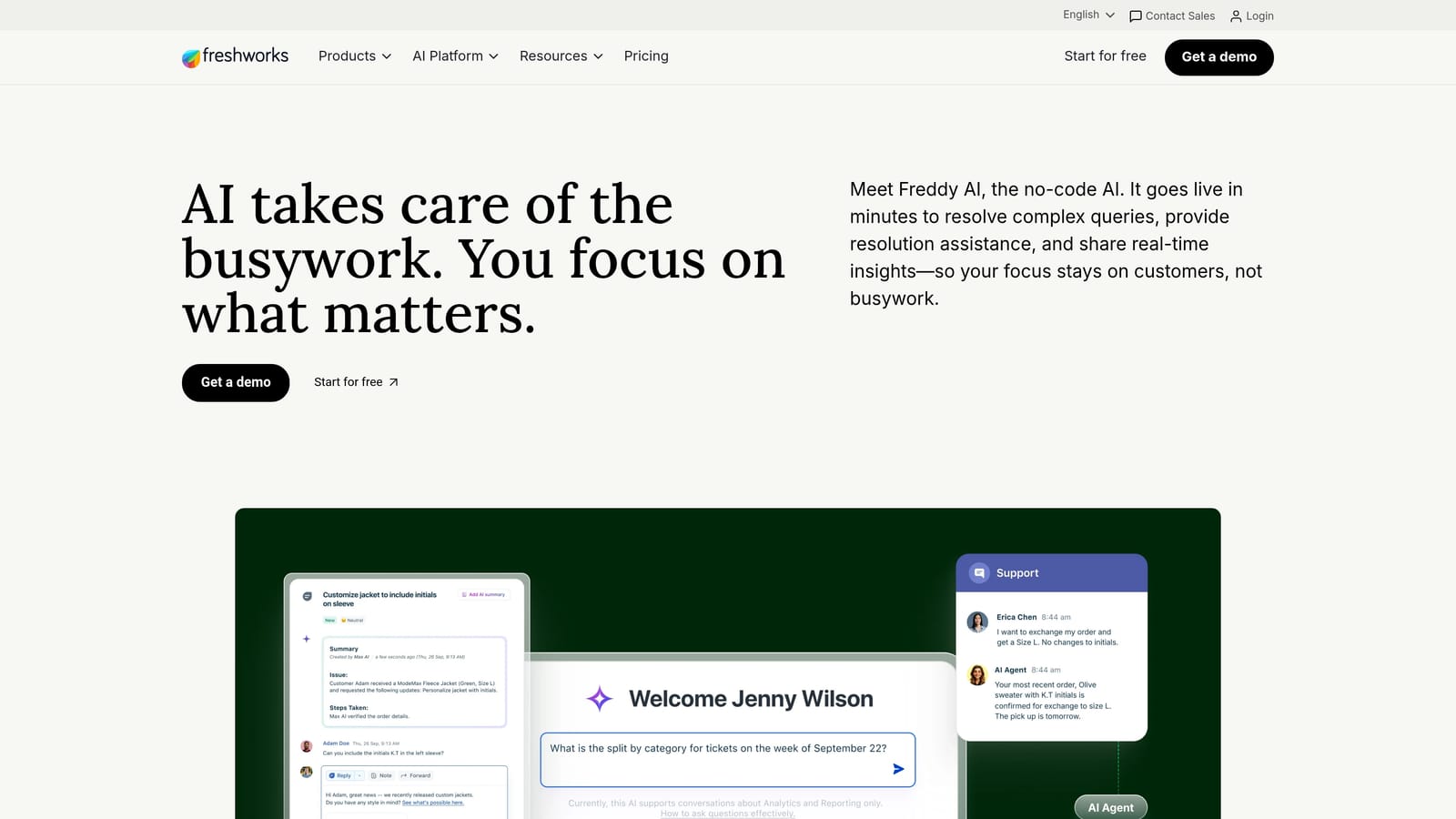
Freshdesk Freddy AI is Freshworks' AI layer spanning self-service bots, real-time agent assist, and analytics insights across the Freshdesk suite.
Where This Tool Shines
Freddy's breadth is its strength. Rather than offering a single AI capability, it covers three distinct layers: self-service deflection (Freddy Self Service), real-time agent assist (Freddy Copilot), and performance analytics (Freddy Insights). For smaller teams, having all three in a single platform at a reasonable add-on price is genuinely valuable.
The no-code bot builder makes Freddy Self Service accessible without dedicated technical resources. Teams can configure common workflows and knowledge-based deflection without engineering involvement, which matters a lot when your support team is also your implementation team.
Key Features
Freddy Self Service: Deploys a bot that deflects common queries using knowledge base content, reducing first-contact volume.
Freddy Copilot: Provides real-time agent assist with suggested replies, ticket summaries, and recommended actions.
Freddy Insights: AI-driven analytics that surface support performance trends and areas for improvement.
No-Code Bot Builder: Enables non-technical teams to configure automation workflows without engineering support.
Accessible Pricing: Add-on pricing positioned as a more affordable alternative to enterprise-tier AI platforms.
Best For
SMBs and mid-market teams already on Freshdesk who want AI across the full support lifecycle without the pricing of enterprise alternatives. Also a good fit for teams that need analytics visibility alongside automation.
Pricing
Available as an add-on to Freshdesk plans. Check freshworks.com for current rates.
5. Salesforce Agentforce
Best for: Enterprises deeply invested in the Salesforce ecosystem that need AI agents with full CRM context.
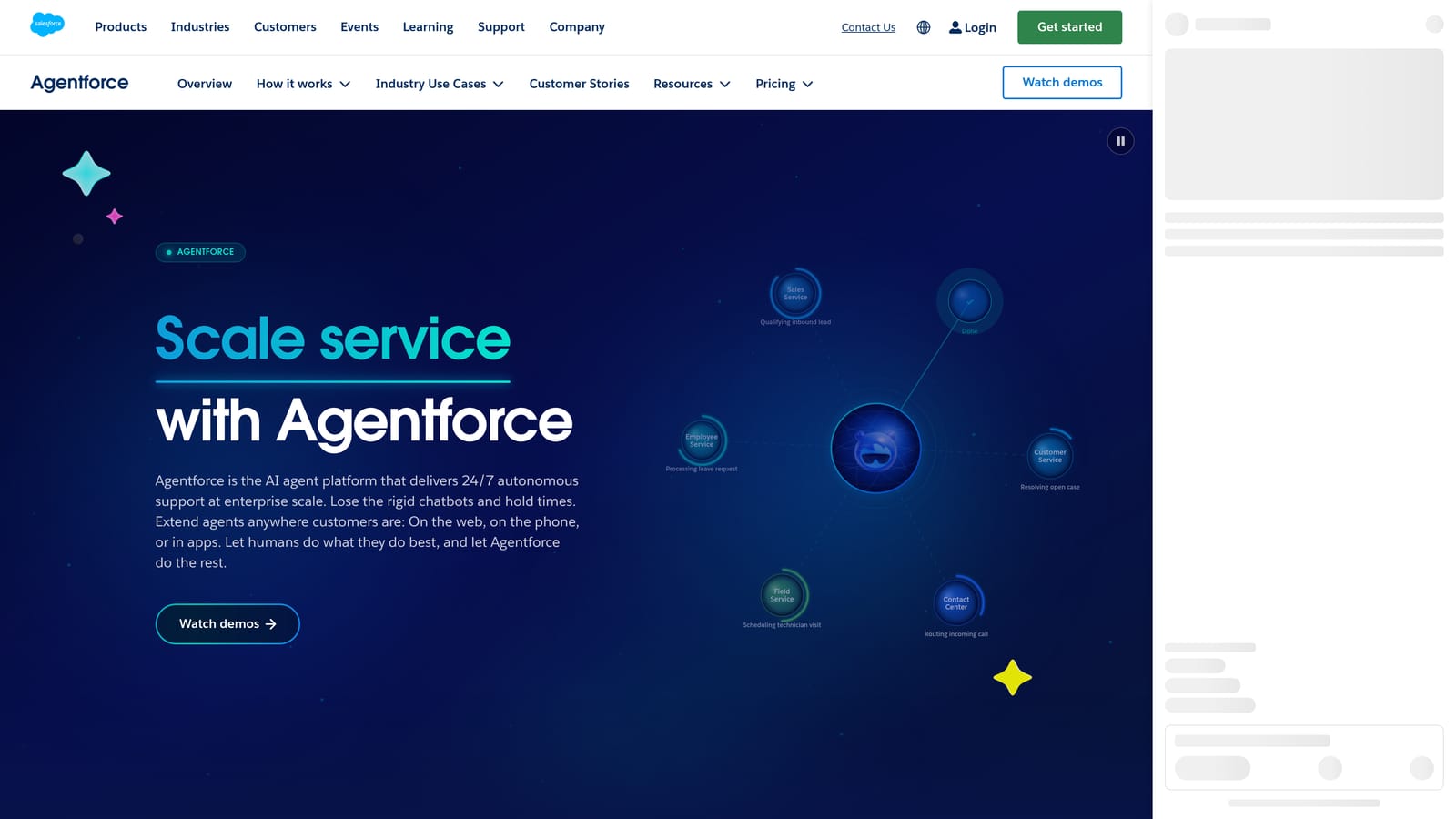
Salesforce Agentforce is Salesforce's AI agent platform, connecting Service Cloud, CRM data, and Einstein AI to enable autonomous support agents with complete customer context.
Where This Tool Shines
Agentforce's core advantage is data depth. Because it operates natively within Salesforce, AI agents have access to the full customer record: purchase history, open opportunities, service history, account status, and more. That context allows for resolution quality that standalone AI tools simply can't match when the query requires understanding the full customer relationship.
The ability for AI agents to take action within Salesforce workflows, not just answer questions, is a significant capability for complex support environments. An agent can update records, trigger workflows, or escalate within Service Cloud without requiring a separate tool layer.
Key Features
Deep CRM Integration: AI agents operate with full access to Salesforce CRM data, Service Cloud records, and customer history.
Action-Capable Agents: Can take actions within Salesforce workflows, not just surface answers.
Einstein AI: Powers intent detection, routing logic, and resolution recommendations across the platform.
Highly Customizable: Configurable for complex enterprise workflows with extensive no-code and low-code options.
Consumption-Based Pricing: Pricing tied to actual agent usage rather than flat per-seat fees.
Best For
Enterprises already running Salesforce as their CRM and Service Cloud as their support platform. The value proposition diminishes significantly outside the Salesforce ecosystem.
Pricing
Consumption-based enterprise pricing. Contact Salesforce directly or visit salesforce.com for a quote.
6. Tidio Lyro AI
Best for: Small businesses and e-commerce brands that want conversational AI without complex setup or enterprise pricing.
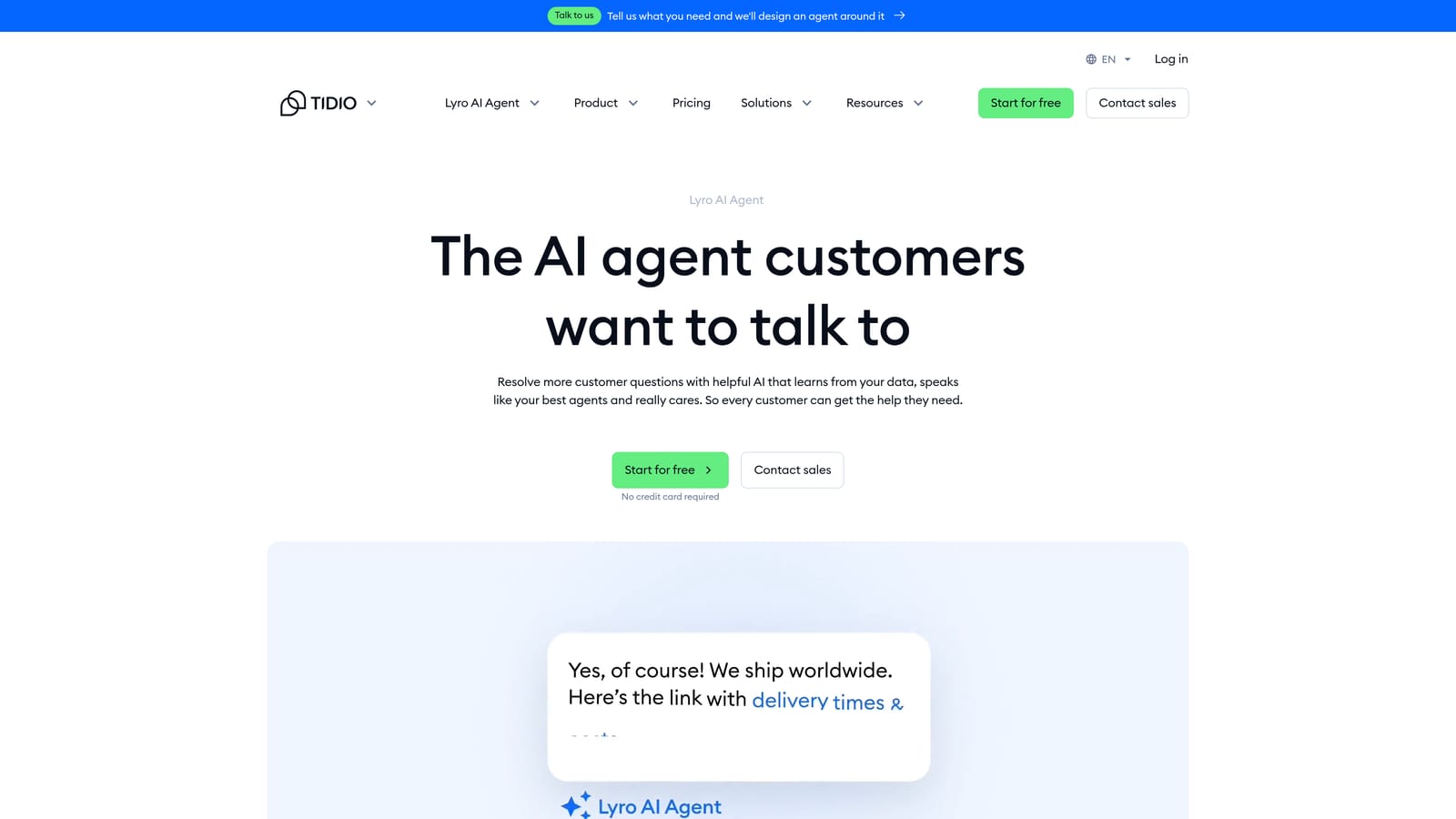
Tidio's Lyro AI is a conversational AI agent trained on your support content to handle FAQs and repetitive queries with minimal configuration overhead.
Where This Tool Shines
Lyro's accessibility is its defining quality. For small businesses that don't have a dedicated support ops team, the no-code setup and content-trained approach means you can get AI deflection running quickly. The combination of live chat and chatbot in a single platform also reduces toolchain complexity for lean teams.
Lyro handles the conversational layer well for common support scenarios. It won't match the reasoning depth of enterprise platforms like Ada or Agentforce, but for e-commerce brands fielding repetitive order, shipping, and product questions, it covers the high-volume use cases effectively.
Key Features
Content-Trained Setup: Trains on your existing help content with no-code configuration, getting to deployment quickly.
Conversational FAQ Handling: Autonomously manages common support queries in a natural conversational format.
Human Escalation: Routes to human agents when queries exceed Lyro's resolution capability.
Live Chat and Bot Combined: Consolidates live chat and AI automation in a single platform.
Free Tier Available: Entry-level access with paid plans unlocking full Lyro AI capabilities.
Best For
Small businesses, e-commerce brands, and early-stage teams that need affordable AI deflection without enterprise complexity. Not the right fit for teams with complex multi-step resolution requirements.
Pricing
Free tier available; Lyro AI included on paid plans. Check tidio.com for current rates.
7. Ada
Best for: Enterprise CX teams that need reasoning-based AI for complex, multi-step resolution processes at scale.
Ada is an enterprise AI agent platform that uses reasoning-based AI rather than scripted flows to handle multi-step resolution across complex support environments.
Where This Tool Shines
Ada's reasoning-based approach is what distinguishes it from script-driven chatbot platforms. Instead of following rigid decision trees, Ada's agents reason through multi-step processes, which makes them more capable of handling queries that don't fit neatly into predefined categories. This matters enormously in enterprise environments where support queries are rarely simple.
Ada has a strong track record in verticals like telecom, fintech, and retail, where support complexity is high and query volume is massive. The no-code builder allows CX teams to configure and iterate on agent behavior without engineering dependency, which is a practical advantage for teams that need to move quickly.
Key Features
Reasoning-Based AI: Follows multi-step resolution processes without rigid scripts, handling complex query types more flexibly.
No-Code Agent Builder: Enables enterprise CX teams to configure agent behavior without engineering involvement.
Broad Integrations: Connects with major helpdesks, CRMs, and backend systems across the enterprise stack.
Multilingual Support: Handles support across multiple languages for global customer bases.
Enterprise Vertical Depth: Proven deployment track record in telecom, fintech, retail, and travel.
Best For
Enterprise organizations with high ticket volume, complex resolution workflows, and global customer bases. Ada is particularly well-suited for teams that have outgrown scripted chatbot approaches and need genuine AI reasoning.
Pricing
Enterprise pricing. Contact Ada directly at ada.cx for a quote.
8. Forethought AI
Best for: Teams that want AI triage and resolution layered on top of their existing helpdesk without platform migration.
Forethought AI is an AI layer designed to sit on top of existing helpdesks like Zendesk and Salesforce, adding intelligent triage, automated resolution, and real-time agent assist.
Where This Tool Shines
Forethought's positioning is deliberately additive. If your team has years of workflow investment in Zendesk or Salesforce and can't justify a full platform migration, Forethought gives you AI augmentation without requiring you to start over. The triage, resolution, and agent assist capabilities operate as an intelligent layer on top of your existing infrastructure.
The Solve product handles automated resolution for common ticket types, while Assist provides real-time recommendations to agents handling more complex queries. Together, they cover both the fully automated and human-assisted resolution scenarios within a single platform.
Key Features
AI Triage: Automatically classifies and routes incoming tickets based on intent and content.
Solve: Automated resolution for common ticket types without agent involvement.
Assist: Real-time agent recommendations and suggested replies for tickets requiring human handling.
Helpdesk Compatibility: Designed to work on top of Zendesk, Salesforce, and other major helpdesks.
No Migration Required: Adds AI capability without requiring teams to leave their existing platform.
Best For
Support teams with significant helpdesk investment who want AI augmentation without the disruption of platform migration. Particularly useful for Zendesk and Salesforce shops looking to add AI resolution without switching systems.
Pricing
Enterprise pricing. Contact Forethought at forethought.ai for a quote.
9. Kustomer
Best for: High-volume consumer brands in DTC, retail, and subscription that need a CRM-native omnichannel support platform.
Kustomer is a CRM-native customer service platform with built-in AI automation and a unified customer timeline across all channels.
Where This Tool Shines
Kustomer's unified timeline is its most distinctive feature. Every customer interaction, across chat, email, voice, social, and SMS, is aggregated into a single chronological view. For high-volume consumer brands where customers frequently reach out across multiple channels about the same issue, that unified context dramatically improves both agent efficiency and customer experience.
The CRM-native architecture means AI routing and suggested replies operate with full customer history embedded, not just the current conversation. For brands where customer lifetime value and order history should inform how support queries are handled, that embedded context is a meaningful advantage over standalone helpdesk tools.
Key Features
Unified Customer Timeline: Aggregates all touchpoints and interaction history across every channel into a single view.
AI-Powered Routing and Replies: Intelligent routing and suggested replies informed by full customer history.
Omnichannel Coverage: Supports chat, email, voice, social, and SMS from a single platform.
Embedded CRM Data: Customer relationship and order data available in every support interaction without switching tools.
Workflow Automation: Automates repetitive support processes and routing logic at scale.
Best For
High-volume consumer brands in DTC, retail, and subscription businesses where omnichannel support and customer history context are critical. Less suited for B2B SaaS teams that don't need the consumer-oriented channel breadth.
Pricing
Per-agent/month pricing. Contact Kustomer at kustomer.com for current rates.
Choosing the Right Platform for Your Team
The right AI support automation platform depends heavily on where you're starting from and what you need AI to actually do. Here's a quick orientation by use case.
AI-native autonomy for SaaS teams: Halo AI is built for exactly this. If you want an AI-first system that learns continuously, understands product context, and surfaces business intelligence beyond ticket deflection, Halo is the strongest fit.
Already running Intercom: Fin AI Agent is the natural next step. No migration required, and per-resolution pricing keeps costs tied to value delivered.
Enterprise Zendesk shops: Zendesk AI slots into your existing workflows with solid out-of-the-box intent detection. It's the lowest-friction AI upgrade for established Zendesk deployments.
SMBs on a budget: Freshdesk Freddy offers the broadest AI coverage at the most accessible price point. Tidio Lyro is the right call for e-commerce and small business teams that need conversational deflection without complexity.
Salesforce-centric organizations: Agentforce is the clear choice. The CRM depth and action-capable agents are only meaningful if you're already in the Salesforce ecosystem.
Complex enterprise workflows without migration: Ada handles multi-step reasoning at scale. Forethought is the right pick if you want AI augmentation layered on top of an existing helpdesk rather than a platform replacement.
Omnichannel CRM-native support: Kustomer's unified timeline and channel breadth make it the strongest option for high-volume consumer brands managing customers across many touchpoints.
Your support team shouldn't scale linearly with your customer base. Let AI agents handle routine tickets, guide users through your product, and surface business intelligence while your team focuses on complex issues that need a human touch. See Halo in action and discover how continuous learning transforms every interaction into smarter, faster support.