9 Top AI Support Platforms Transforming Customer Service in 2026
The top AI support platforms of 2026 are reshaping B2B customer service by moving beyond basic ticket deflection toward autonomous resolution, deep integrations, and scalable intelligence. This guide evaluates nine leading solutions on real-world performance criteria—helping teams identify which platform is genuinely built for AI-first support versus those simply layering automation onto legacy helpdesk infrastructure.
 Grant CooperFounder14 min read
The shift from reactive helpdesks to proactive AI-powered support is well underway. B2B teams are no longer asking whether to adopt AI support platforms — they're asking which one will actually resolve tickets autonomously, integrate with their existing stack, and scale without adding headcount.
The market is crowded, and the differences between tools are significant. Some platforms bolt AI onto legacy helpdesk infrastructure as a secondary layer. Others are built AI-first from the ground up, with autonomous resolution as the core product rather than an afterthought. That architectural distinction matters enormously in practice.
This list cuts through the noise. We evaluated top AI support platforms based on autonomous resolution capability, integration depth, ease of deployment, and the intelligence they surface beyond simple ticket deflection. Each tool is assessed on its own merits, including where it falls short, so you can make a confident, informed decision.
1. Halo AI
Best for: SaaS and B2B product teams that want AI-first autonomous support with deep integration across their business stack.
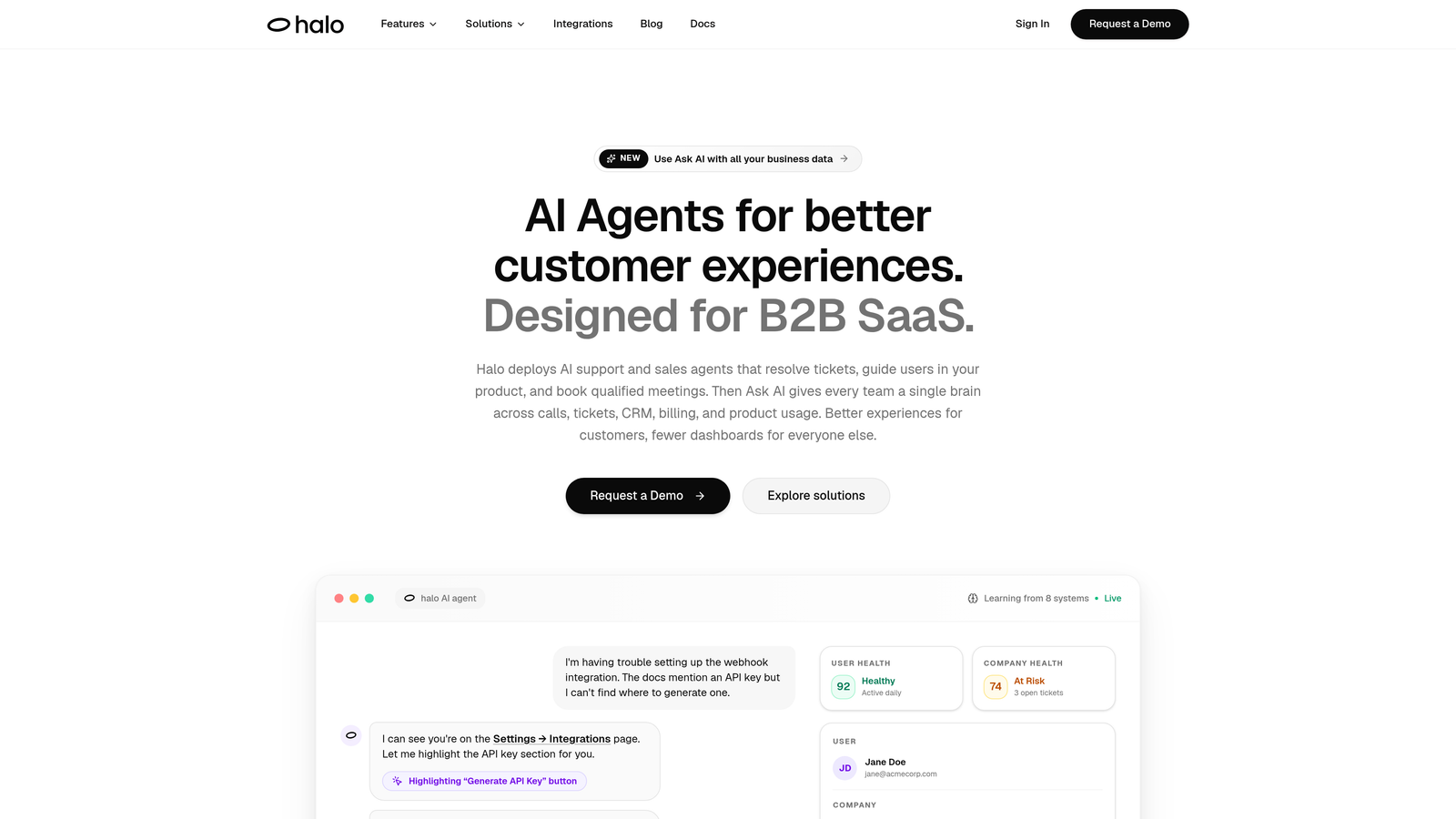
Halo AI is an AI-first customer support platform that deploys autonomous agents to resolve tickets, guide users through your product with page-aware context, and surface business intelligence signals while continuously learning from every interaction.
Where This Tool Shines
What separates Halo from most platforms on this list is the combination of page-aware context and business intelligence output. The chat widget doesn't just know who the user is — it understands what screen or product area they're currently viewing. That context allows the AI agent to deliver guidance that's specific to the user's exact situation, not just a generic knowledge base response.
Beyond ticket resolution, Halo's smart inbox surfaces signals that most support tools completely ignore: customer health trends, revenue anomalies, and behavioral patterns that matter to product and revenue teams, not just support leads. If your support data should be informing your broader business decisions, this is where Halo has a clear edge.
Key Features
Page-Aware Chat Widget: Understands which screen or product area the user is currently viewing, enabling context-specific guidance rather than generic responses.
Autonomous Ticket Resolution: AI agents handle tickets end-to-end, with intelligent live agent handoff for complex issues that genuinely require human judgment.
Auto Bug Ticket Creation: Automatically generates and routes bug reports to Linear directly from support conversations, closing the loop between customer issues and engineering.
Smart Inbox with Business Intelligence: Surfaces customer health signals, revenue anomaly detection, and trend analysis — turning support data into strategic insight.
Deep Integration Stack: Connects natively with Linear, Slack, HubSpot, Intercom, Stripe, Zoom, PandaDoc, and Fathom for a fully connected support workflow.
Continuous Learning: Improves response quality and resolution accuracy with every interaction, compounding value over time.
Best For
Halo is purpose-built for SaaS and B2B product teams managing growing ticket volumes without the headcount to match. It's particularly well-suited for teams where support data should be feeding product decisions, and where engineering, sales, and customer success all need to stay in the loop.
Pricing
Contact for pricing. Halo is designed for SaaS and B2B product teams and is positioned as an enterprise-grade AI-first platform rather than a self-serve tool.
2. Intercom (Fin AI)
Best for: Teams already invested in the Intercom ecosystem who want a native AI agent without platform migration.
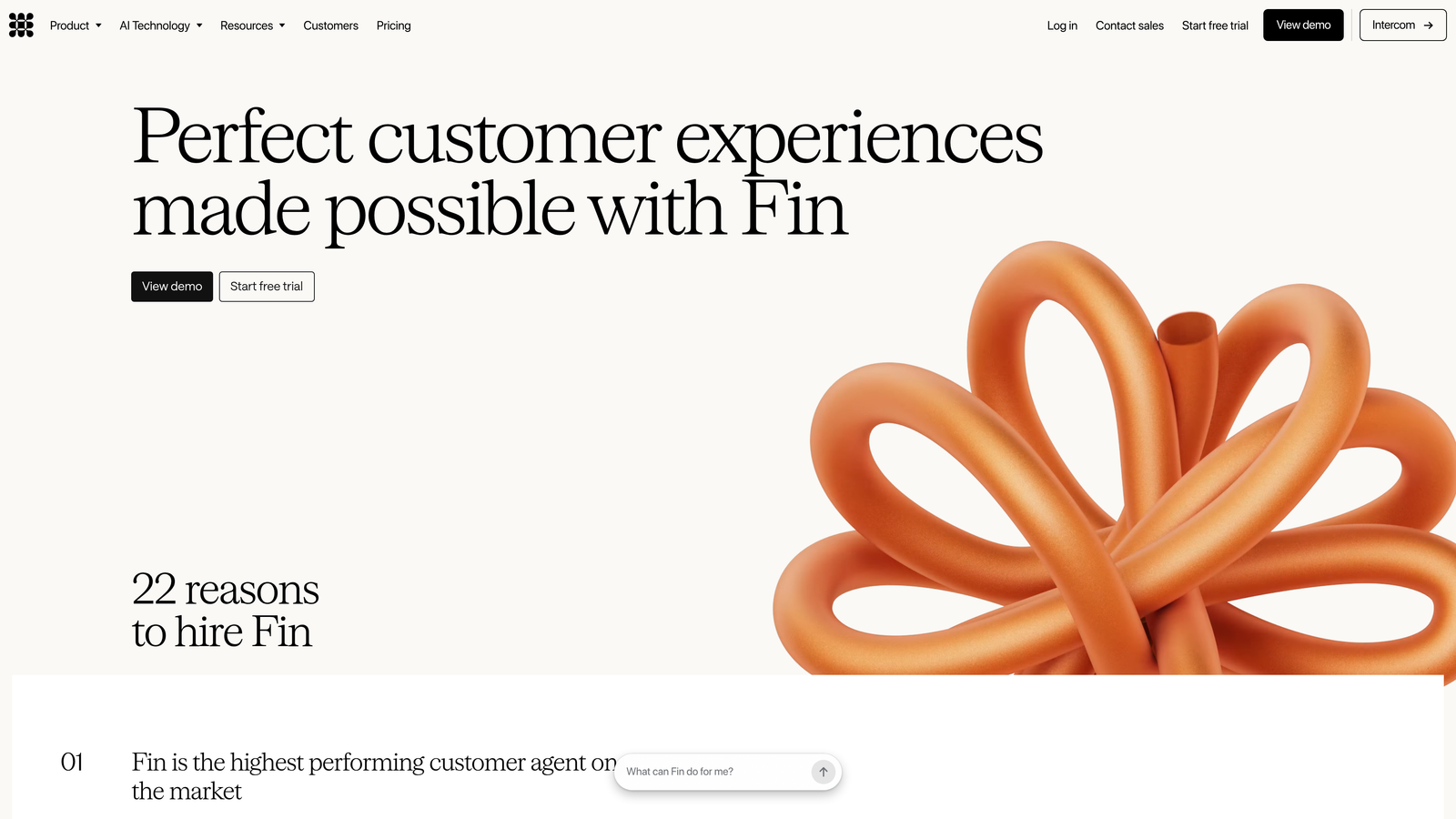
Intercom Fin is Intercom's native AI agent, built on large language models and deeply embedded in the Intercom messenger and CRM ecosystem.
Where This Tool Shines
Fin's biggest strength is how seamlessly it sits inside the Intercom experience. For teams already using Intercom's messenger, inbox, and CRM, Fin requires no migration and minimal configuration. It draws on your existing Help Center content and knowledge base to resolve common queries, and escalates to a human agent within the same conversation thread — no context switching, no dropped context.
The tradeoff is that Fin is most powerful when you're already committed to Intercom. Teams outside the Intercom ecosystem won't find the same seamless experience, and the consumption-based pricing model can become expensive as resolution volume scales.
Key Features
Native Messenger Integration: Fin operates directly within the Intercom conversation thread, preserving context throughout the entire interaction.
Knowledge Base Grounding: Draws on your existing Intercom Help Center content to generate accurate, relevant responses.
Seamless Human Escalation: Hands off to live agents within the same window, with full conversation history intact.
Ecosystem Connectivity: Works alongside Intercom's CRM, outbound messaging, and inbox tools as a unified platform.
Consumption-Based Pricing: Charged per AI resolution, which aligns cost with value but requires careful volume forecasting.
Best For
Teams already running Intercom as their primary support and messaging platform. Less compelling for teams looking to evaluate support infrastructure from scratch, where AI-first alternatives may offer more flexibility.
Pricing
Add-on to existing Intercom plans, priced on a consumption basis per AI resolution. Costs can scale significantly at high ticket volumes.
3. Zendesk AI
Best for: Enterprise teams on Zendesk Suite who want AI capabilities layered onto a mature, compliance-ready helpdesk.
Zendesk AI brings intelligent triage, agent copilot features, and self-service automation to Zendesk's industry-leading helpdesk platform.
Where This Tool Shines
Zendesk AI is the natural choice for teams already operating on Zendesk who want to add AI without disrupting their existing workflows. The intelligent triage and routing capabilities handle ticket classification based on intent, sentiment, and language, reducing manual sorting and ensuring tickets reach the right agent faster.
The agent copilot functionality is well-developed: suggested replies, ticket summarization, and next-step guidance that genuinely reduces agent effort on complex tickets. For enterprise teams with strict compliance and governance requirements, Zendesk's maturity in this area is hard to match.
Key Features
Intelligent Triage and Routing: Classifies and routes tickets based on intent, sentiment, and language detection automatically.
Agent Copilot: Provides suggested replies, ticket summarization, and guidance to reduce resolution time for human agents.
Self-Service AI Bots: Deflects common queries before they reach the queue, reducing overall ticket volume.
Enterprise Compliance: Strong security, governance, and compliance features suited to regulated industries.
Third-Party Integrations: Broad ecosystem of integrations across CRM, billing, and communication tools.
Best For
Enterprise teams already on Zendesk Suite, particularly those in regulated industries where compliance and governance are non-negotiable. Less suited for teams starting fresh who want AI-first architecture rather than AI layered onto a legacy helpdesk.
Pricing
AI features are available as add-ons to Zendesk Suite plans. Enterprise pricing varies significantly by seat count and feature tier.
4. Freshdesk (Freddy AI)
Best for: SMB to mid-market teams wanting AI-enhanced support at more accessible price points than enterprise alternatives.
Freshdesk with Freddy AI delivers self-service automation, agent assist, and AI-generated analytics across the Freshdesk helpdesk suite at pricing designed for growing teams.
Where This Tool Shines
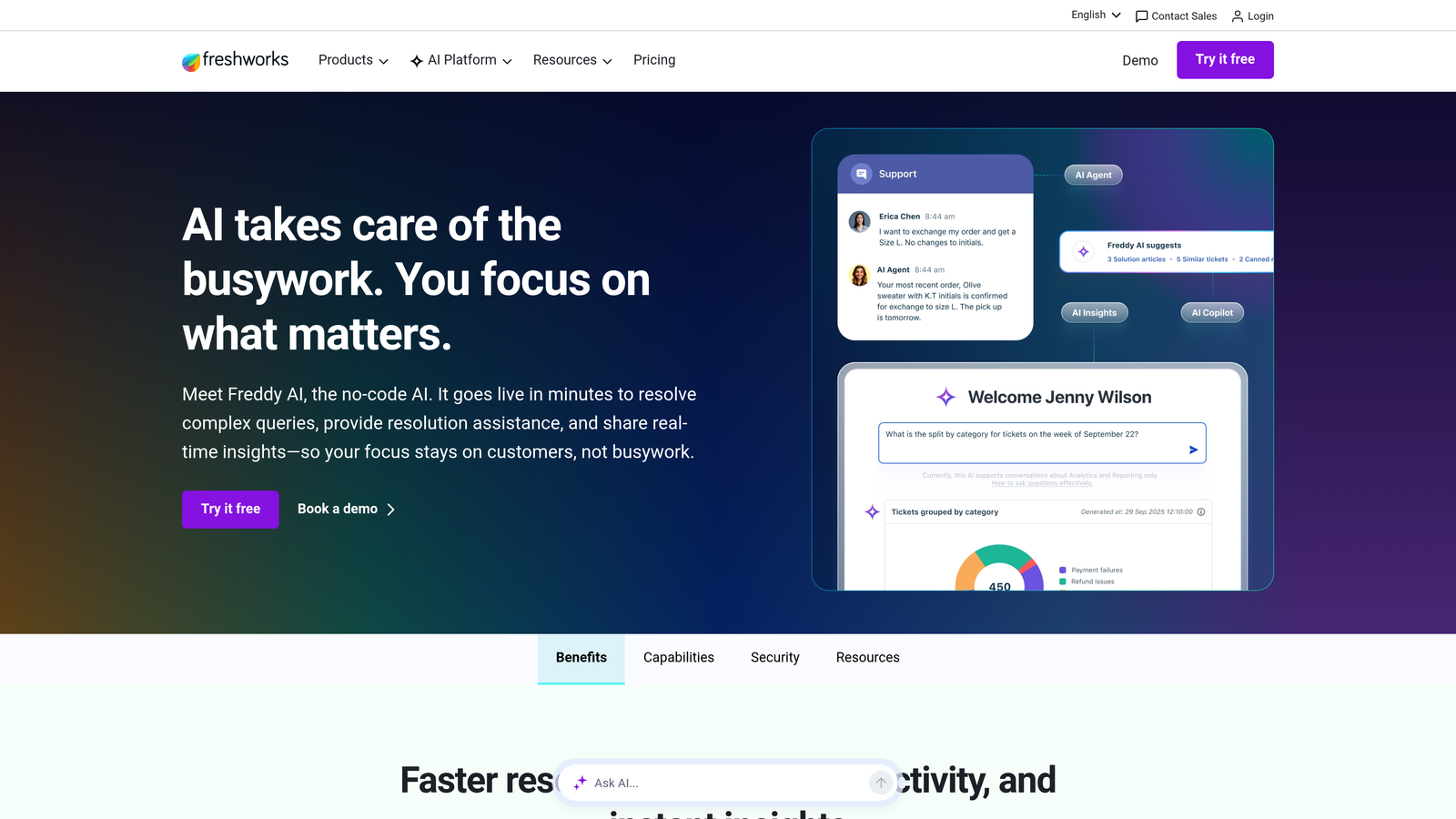
Freddy AI is Freshworks' answer to the full AI support stack: self-service for customers, real-time assistance for agents, and intelligent analytics for managers. The three-layer approach covers the most common support use cases without requiring separate tools or complex integrations. For SMB and mid-market teams comparing Freshdesk to Zendesk, the pricing difference is meaningful and Freddy's capabilities are competitive at most ticket volumes.
Where Freddy falls short is in autonomous resolution depth. Compared to AI-first platforms, Freddy's self-service bot is more of a deflection tool than a true autonomous agent. Teams with complex products and nuanced support queries may hit the ceiling of what Freddy can handle without human escalation.
Key Features
Freddy Self Service: AI-powered chatbot handles common customer-facing queries and deflects tickets before they enter the queue.
Freddy Copilot: Provides agents with real-time suggestions, tone adjustment, and conversation summarization during live interactions.
Freddy Insights: AI-generated analytics surface trends and anomalies across ticket data for support managers.
Multi-Channel Support: Covers email, chat, phone, and social from a single inbox.
Accessible Pricing: Freddy features are bundled into higher Freshdesk tiers at price points competitive with the SMB and mid-market segment.
Best For
SMB to mid-market support teams looking for an all-in-one helpdesk with AI capabilities included, without the cost overhead of enterprise-tier platforms. Teams with high volumes of complex, nuanced queries may need a more capable AI layer.
Pricing
Freddy AI features are included in higher Freshdesk tiers. Plans start at SMB-accessible pricing, with costs scaling by agent seat and feature tier.
5. Kustomer
Best for: Teams where full customer context — purchase history, past interactions, and CRM data — is essential to resolution quality.
Kustomer is a CRM-native customer support platform where AI operates with complete visibility into every past interaction, order, and touchpoint in a unified customer timeline.
Where This Tool Shines
Kustomer's core differentiator is context depth. Where most support platforms see a ticket in isolation, Kustomer's AI sees the entire customer relationship: every previous conversation, purchase, subscription status, and touchpoint in a single timeline. This makes AI-suggested actions significantly more relevant, particularly for teams handling high-value accounts where history determines the right response.
The tradeoff is complexity. Kustomer is a more substantial platform to implement and operate than simpler alternatives. Teams without dedicated CX operations may find the overhead harder to justify unless the CRM-native approach is genuinely central to their support model.
Key Features
Unified Customer Timeline: Combines support history, orders, and CRM data in a single view for every customer interaction.
Context-Aware AI Suggestions: AI recommends actions and responses based on full customer history, not just the current ticket.
Omnichannel Support: Handles email, chat, SMS, social, and voice from a single platform.
Workflow Automation: Automates repetitive resolution paths to reduce manual agent effort on common scenarios.
Best For
Mid-market to enterprise teams where customer history is genuinely central to resolution quality. Particularly well-suited for subscription businesses, e-commerce, and any team where knowing a customer's full relationship changes how support is delivered.
Pricing
Per-agent pricing with mid-market to enterprise positioning. Custom quotes available for larger teams.
6. Ada
Best for: Enterprise CX teams that need multilingual AI support with strict governance controls and no-code conversation design.
Ada is a no-code AI agent platform built for enterprise teams managing complex conversation flows, multilingual support requirements, and rigorous compliance standards.
Where This Tool Shines
Ada's platform is designed for scale and governance. Non-technical CX teams can build and iterate on complex, branching conversation flows without engineering support, which is a significant operational advantage for large enterprises where IT bottlenecks slow down support iteration. The multilingual capability is genuinely strong, covering dozens of languages with consistent quality — a meaningful differentiator for global support operations.
Ada's enterprise compliance and security posture is also well-developed, making it a credible choice for industries with strict data governance requirements. The tradeoff is that Ada is priced and positioned for enterprise, and smaller teams will likely find more accessible options elsewhere on this list.
Key Features
No-Code Conversation Builder: Allows non-technical CX teams to design and deploy complex conversation flows without engineering involvement.
Multilingual Support: Handles customer interactions across dozens of languages with consistent quality.
Enterprise Governance: Strong compliance, security, and data governance features for regulated industries.
Complex Conversation Flows: Manages branching, conditional logic, and multi-step interactions at enterprise scale.
Broad Integrations: Connects with major CRMs, helpdesks, and e-commerce platforms.
Best For
Large enterprises with global support operations, multilingual customer bases, or strict compliance requirements. Teams that need non-technical staff to own conversation design without relying on engineering resources.
Pricing
Custom enterprise pricing. Contact Ada directly for a quote based on conversation volume and feature requirements.
7. Tidio
Best for: Small businesses and early-stage SaaS teams that need AI chat support up and running quickly with minimal technical overhead.
Tidio is an accessible AI chat and support platform featuring Lyro, an AI chatbot built on Claude, designed for teams that need fast deployment and affordable pricing.
Where This Tool Shines
Tidio's primary strength is simplicity and speed. Teams can typically go live within hours, not days or weeks, and the free tier makes it genuinely accessible for early-stage teams testing AI support before committing to a larger platform investment. Lyro, powered by Claude, handles common questions using your existing content without requiring complex configuration or training.
The honest limitation is depth. Tidio is built for straightforward support scenarios. Teams with complex products, high ticket volumes, or needs for business intelligence and deep integrations will outgrow Tidio relatively quickly. It's a strong starting point, not a long-term enterprise solution.
Key Features
Lyro AI Chatbot: Handles common customer questions using your existing content, powered by Claude.
Unified Inbox: Combines live chat, email, and Messenger in a single interface for small team management.
Fast Setup: Minimal technical overhead with most teams live within hours of starting implementation.
Accessible Pricing: Free tier available with paid plans at low monthly per-seat costs.
Basic Analytics: Conversation volume and resolution rate reporting for small team oversight.
Best For
Small businesses, early-stage SaaS, and teams new to AI support that want a low-risk entry point. Not recommended as a long-term solution for teams anticipating significant growth in ticket complexity or volume.
Pricing
Free tier available. Paid plans start at low monthly costs per seat, making it one of the most affordable options on this list.
8. Forethought
Best for: Teams that want smarter AI on top of their existing helpdesk without the cost and disruption of a full platform migration.
Forethought is an AI intelligence layer that sits on top of existing helpdesks like Zendesk, Salesforce Service Cloud, and Freshdesk, adding autonomous resolution, smarter triage, and agent assist without requiring migration.
Where This Tool Shines
Forethought's value proposition is additive rather than replacement. If your team is deeply invested in Zendesk or Salesforce Service Cloud and can't justify migrating, Forethought lets you upgrade the intelligence layer without touching the underlying infrastructure. The three-product structure, covering resolution, triage, and agent assist, addresses the full support workflow rather than just one piece of it.
The natural limitation is that Forethought's ceiling is partly determined by the helpdesk it sits on. Teams looking for AI-first architecture with deep business intelligence output will find more capability in platforms built from the ground up for autonomous resolution.
Key Features
Solve: AI agent that autonomously resolves tickets within your existing helpdesk environment.
Triage: Intelligent routing based on intent, urgency, and topic classification to reduce manual sorting.
Assist: Real-time agent copilot providing suggested responses and relevant knowledge during live interactions.
Helpdesk Compatibility: Designed specifically to layer onto Zendesk, Salesforce Service Cloud, and Freshdesk without requiring migration.
Sentiment Analysis: Built-in ticket prioritization based on customer sentiment and urgency signals.
Best For
Mid-market to enterprise teams already committed to Zendesk, Salesforce, or Freshdesk who want meaningfully better AI capabilities without the disruption and cost of switching platforms entirely.
Pricing
Mid-market to enterprise pricing. Contact Forethought for a custom quote based on helpdesk environment and ticket volume.
9. Drift (Salesloft)
Best for: B2B revenue teams where support conversations and sales pipeline overlap significantly.
Drift, now part of Salesloft, is a revenue-focused conversational AI platform that blends support, qualification, and sales conversations in a single AI-powered interface.
Where This Tool Shines
Drift occupies a different category from the other platforms on this list. It's less a pure support tool and more a revenue AI platform that happens to handle support-adjacent conversations. For B2B teams where a customer inquiry might signal expansion intent or where a support conversation could become a sales conversation, Drift's ability to qualify, route, and schedule meetings within the same flow is genuinely valuable.
That positioning is also its limitation for teams looking for pure support capability. Drift is not optimized for high-volume ticket resolution or deep product support. Teams with a clear separation between support and sales functions will find purpose-built support platforms more effective for their core use case.
Key Features
Revenue-Focused AI Conversations: Designed to qualify, route, and convert — not just resolve support queries.
Buyer Intent Signals: Surfaces real-time signals when high-value accounts are active on your site or in conversation.
Meeting Scheduling: Built-in scheduling and sales handoff within the conversation flow, reducing friction for pipeline-generating interactions.
CRM and MAP Integrations: Connects with Salesforce, HubSpot, Marketo, and major CRM and marketing automation platforms.
Best For
B2B teams — particularly in SaaS and professional services — where support and sales pipeline genuinely overlap and where a customer inquiry is as likely to be an expansion opportunity as a technical issue.
Pricing
Enterprise pricing through Salesloft. Contact directly for a custom quote based on team size and use case.
Choosing the Right Platform for Your Team
The nine platforms on this list cover a wide spectrum of use cases, team sizes, and architectural philosophies. The right choice depends heavily on where you're starting from and what you're optimizing for.
If you're a SaaS or B2B product team that wants AI-first architecture, deep integrations across your business stack, and support data that feeds product and revenue decisions, Halo AI is the strongest fit. The page-aware context, auto bug ticket creation, and smart inbox intelligence address problems that most support platforms don't even recognize as support problems.
If you're already running Intercom or Zendesk and want to add AI without migrating, Fin AI and Zendesk AI are the natural paths of least resistance. They're not AI-first, but they're capable and familiar for teams already embedded in those ecosystems.
For teams that want to upgrade the intelligence of their existing Zendesk or Salesforce setup without replacing it, Forethought is the most practical option. For enterprise teams with multilingual needs and strict governance requirements, Ada is purpose-built for that challenge.
Freshdesk with Freddy AI offers the best balance of capability and affordability for SMB and mid-market teams. Tidio is the right entry point for small businesses testing AI support for the first time. Kustomer wins when customer history and full CRM context drive resolution quality. And Drift makes sense only when support and sales pipeline are genuinely intertwined.
Your support team shouldn't scale linearly with your customer base. Let AI agents handle routine tickets, guide users through your product, and surface business intelligence while your team focuses on complex issues that need a human touch. See Halo in action and discover how continuous learning transforms every interaction into smarter, faster support.