9 Best AI Support Ticket Systems for B2B Teams in 2026
This guide evaluates the top AI support ticket systems for B2B SaaS teams in 2026, comparing platforms on autonomous resolution capability, integration depth, and real-world enterprise performance. It cuts through the noise to highlight tools that genuinely reduce ticket volume and support costs without expanding headcount.
 Matt PattoliFounder13 min read
AI support ticket systems have moved well beyond basic auto-routing and canned responses. Today's platforms can autonomously resolve tickets, detect bugs, surface customer health signals, and hand off complex issues to human agents—all without expanding headcount. But not every tool is built the same way. Some bolt AI onto legacy helpdesks; others are architected AI-first from the ground up.
This list cuts through the noise and focuses on platforms that genuinely move the needle for B2B SaaS teams. We evaluated each tool on autonomous resolution capability, integration depth, learning over time, and how well it handles the messy reality of enterprise support queues. For context on what separates a modern AI helpdesk from a traditional one, see our breakdown of what an AI helpdesk actually is and how ticket deflection works in practice.
1. Halo AI
Best for: B2B SaaS teams that want AI-first ticket resolution with business intelligence built in
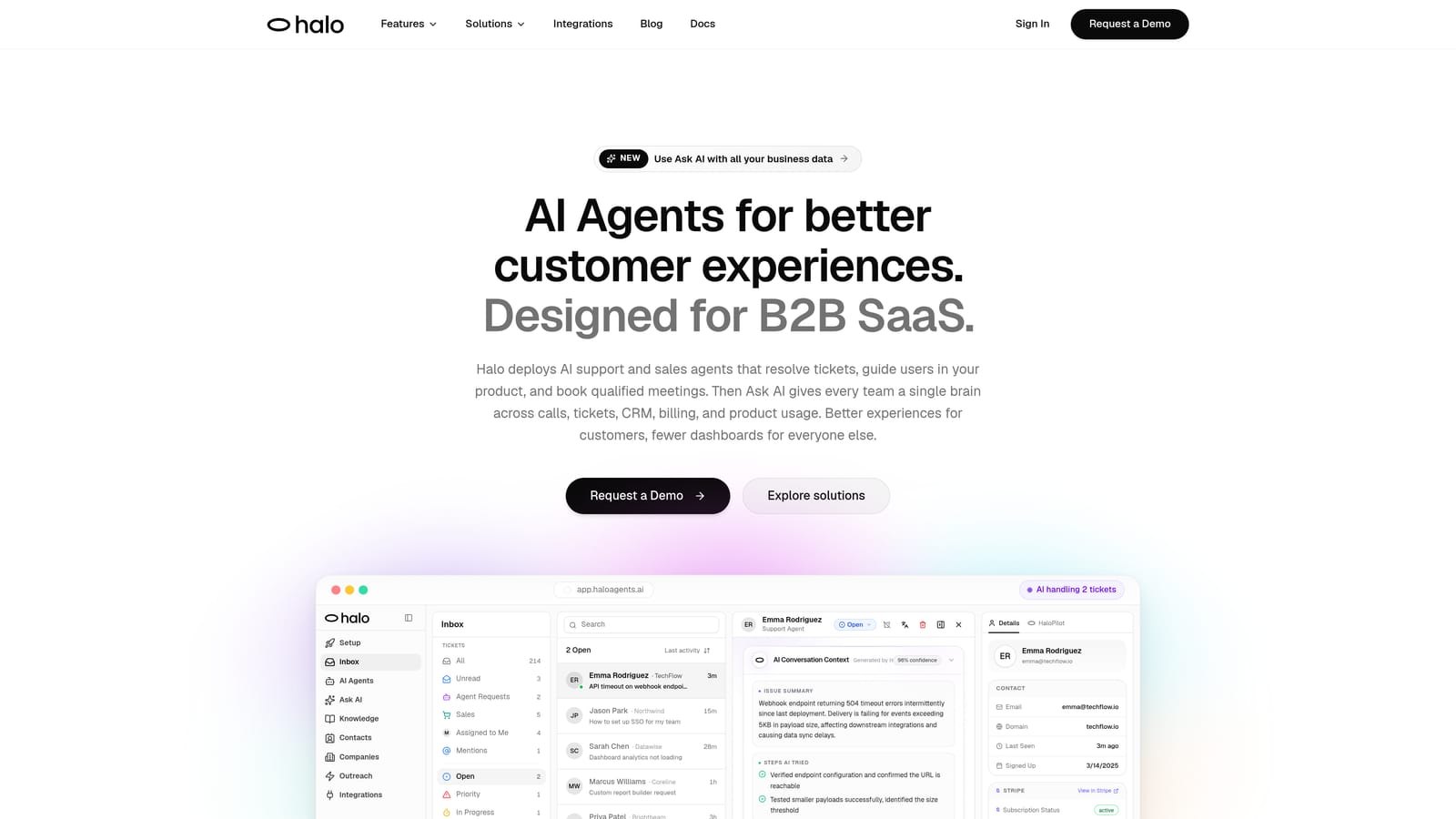
Halo AI is an AI-first customer support platform that autonomously resolves tickets, guides users with page-aware context, and surfaces business intelligence signals from every interaction.
Where This Tool Shines
Most AI support tools are helpdesks with AI features layered on top. Halo is built the other way around: the AI is the foundation, and everything else serves it. That architectural difference shows up in how the product behaves. Instead of suggesting replies for agents to approve, Halo resolves tickets end-to-end and learns continuously from every interaction it handles.
The page-aware chat widget is a standout capability. The AI agent sees exactly what the user sees on screen, which means it can provide contextual, visual guidance rather than generic troubleshooting steps. For SaaS products with complex UIs or multi-step workflows, this is a meaningful upgrade over traditional chat support.
Key Features
Page-Aware Chat Widget: The AI agent sees the user's current screen context, enabling step-by-step visual guidance tailored to exactly where they are in your product.
Autonomous Ticket Resolution: Resolves support tickets end-to-end with continuous learning from every interaction, improving accuracy over time without manual retraining.
Auto Bug Ticket Creation: Detects bugs surfaced in support conversations and automatically creates structured tickets routed to Linear or equivalent tools.
Smart Inbox with Business Intelligence: Surfaces customer health signals, revenue risk indicators, and anomaly detection from support data—turning your ticket queue into a source of strategic insight.
Live Agent Handoff: Escalates complex issues to human agents with full context preserved, so agents never start from scratch.
Deep Integrations: Connects with Linear, Slack, HubSpot, Intercom, Stripe, Zoom, PandaDoc, and Fathom for a unified support and business stack.
Best For
Halo is best suited for B2B SaaS companies that want more than ticket deflection. If your team needs AI that resolves issues autonomously, flags bugs before they become incidents, and surfaces customer health signals alongside support data, Halo is built for that use case. Particularly strong for product-led teams managing complex onboarding and in-product support.
Pricing
Contact for pricing. Halo is positioned for B2B SaaS teams and enterprise buyers. Visit haloagents.ai for details.
2. Zendesk AI
Best for: Large enterprises already invested in the Zendesk ecosystem
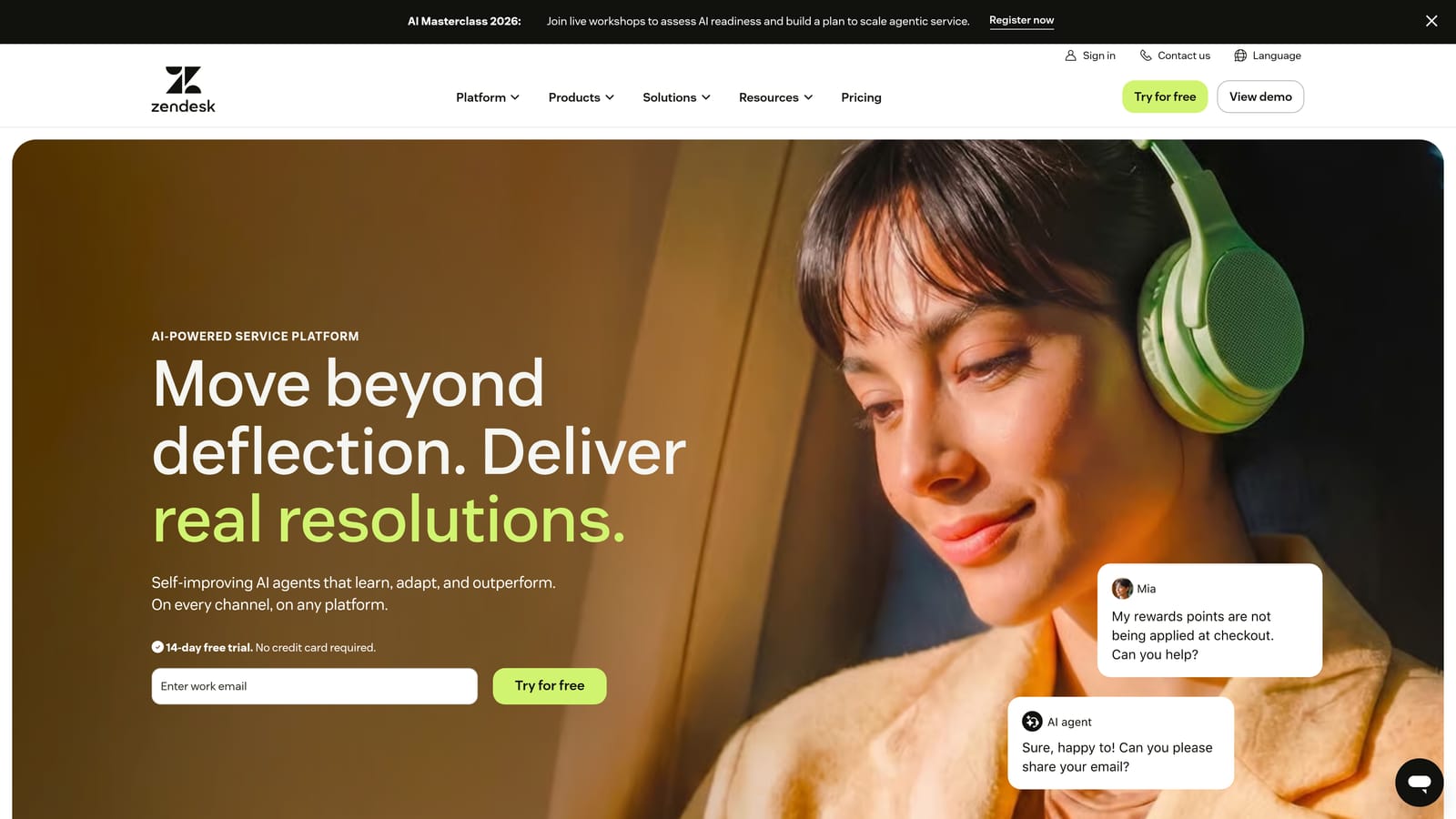
Zendesk AI is an AI capability layer built on top of Zendesk's mature enterprise helpdesk, covering intelligent triage, AI-generated replies, and advanced workflow automation.
Where This Tool Shines
Zendesk's strength is its ecosystem depth. Decades of helpdesk infrastructure, a large marketplace of integrations, and enterprise-grade workflow automation make it a defensible choice for large support organizations that are already on the platform. The AI features slot into existing workflows rather than requiring teams to rethink how they operate.
The trade-off is that the AI feels additive rather than foundational. Teams that want AI-first resolution often find themselves working around legacy structures. But for enterprises that need stability, compliance, and a familiar interface, Zendesk AI delivers solid incremental value.
Key Features
Intelligent Triage and Routing: Routes tickets based on intent and sentiment analysis, reducing manual sorting for high-volume queues.
AI-Generated Reply Suggestions: Surfaces draft replies and macro recommendations for agents to review and send.
Advanced Workflow Automation: Automates complex multi-step workflows across channels including email, chat, and voice.
Large Integration Marketplace: Hundreds of third-party integrations available through the Zendesk marketplace.
Robust Reporting Suite: Detailed analytics and custom dashboards for tracking support performance at scale.
Best For
Enterprises already running on Zendesk that want to add AI capabilities without a platform migration. Less suited to teams starting fresh who want an AI-first architecture from day one. For a direct comparison, see Halo's Zendesk alternative comparison.
Pricing
Suite plans start at approximately $55/agent/month. AI features are available on higher tiers. Verify current pricing at zendesk.com.
3. Intercom Fin
Best for: SaaS companies with strong help content libraries that want conversational AI resolution
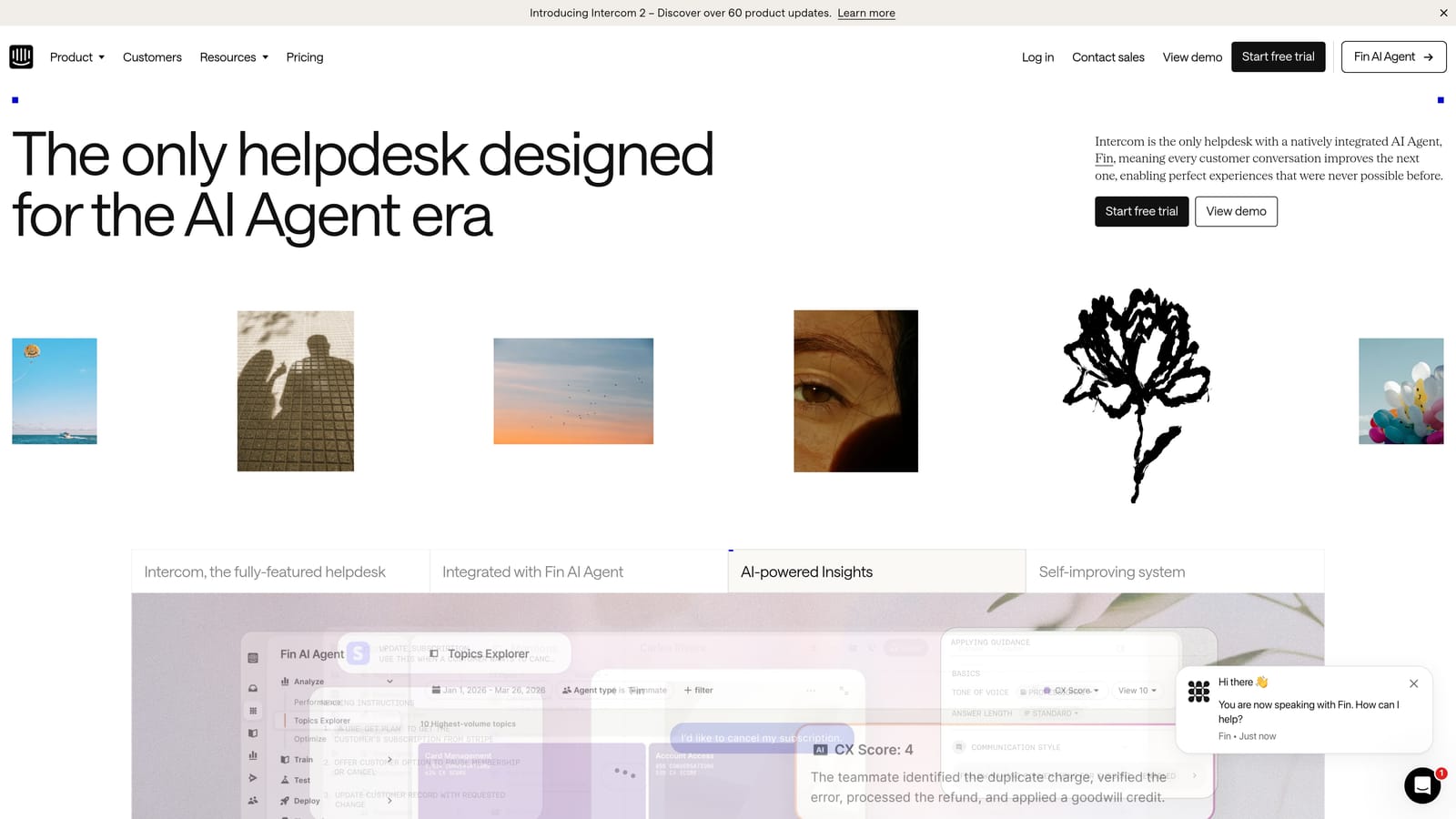
Intercom Fin is Intercom's LLM-powered AI agent that resolves support queries conversationally, trained on your help content and capable of multi-step actions.
Where This Tool Shines
Fin's resolution quality is genuinely strong when a team has well-maintained help center content. The LLM foundation means it handles nuanced, conversational queries rather than just matching keywords to FAQ entries. The current generation, Fin 2, goes beyond simple Q&A: it can take multi-step actions within a conversation, which meaningfully expands what it can resolve autonomously.
Intercom's in-product messaging experience is also a differentiator. If your support strategy is chat-first and deeply embedded in the product interface, Fin fits naturally into that model. The seamless handoff to human agents when Fin reaches its limits is well-executed.
Key Features
LLM-Powered Resolution: Trained on your existing help center content to handle conversational, nuanced support queries at scale.
Multi-Step Action Capability: Fin 2 can execute multi-step actions within a conversation, not just answer static questions.
Chat-First In-Product Experience: Strong in-product messaging infrastructure built for SaaS support flows.
Seamless Human Handoff: Escalates to human agents when AI cannot resolve, with conversation context preserved.
Usage-Based Pricing: Pay per resolution rather than per seat, which aligns cost directly with AI output.
Best For
SaaS teams with mature, well-structured help content and a chat-first support model. The usage-based pricing model works well for teams with variable support volumes. Less suited to teams with sparse or unstructured knowledge bases.
Pricing
Usage-based pricing per resolution. Base Intercom plans vary separately. Verify current pricing at intercom.com.
4. Freshdesk Freddy AI
Best for: Mid-market teams that want incremental AI adoption without a full platform overhaul
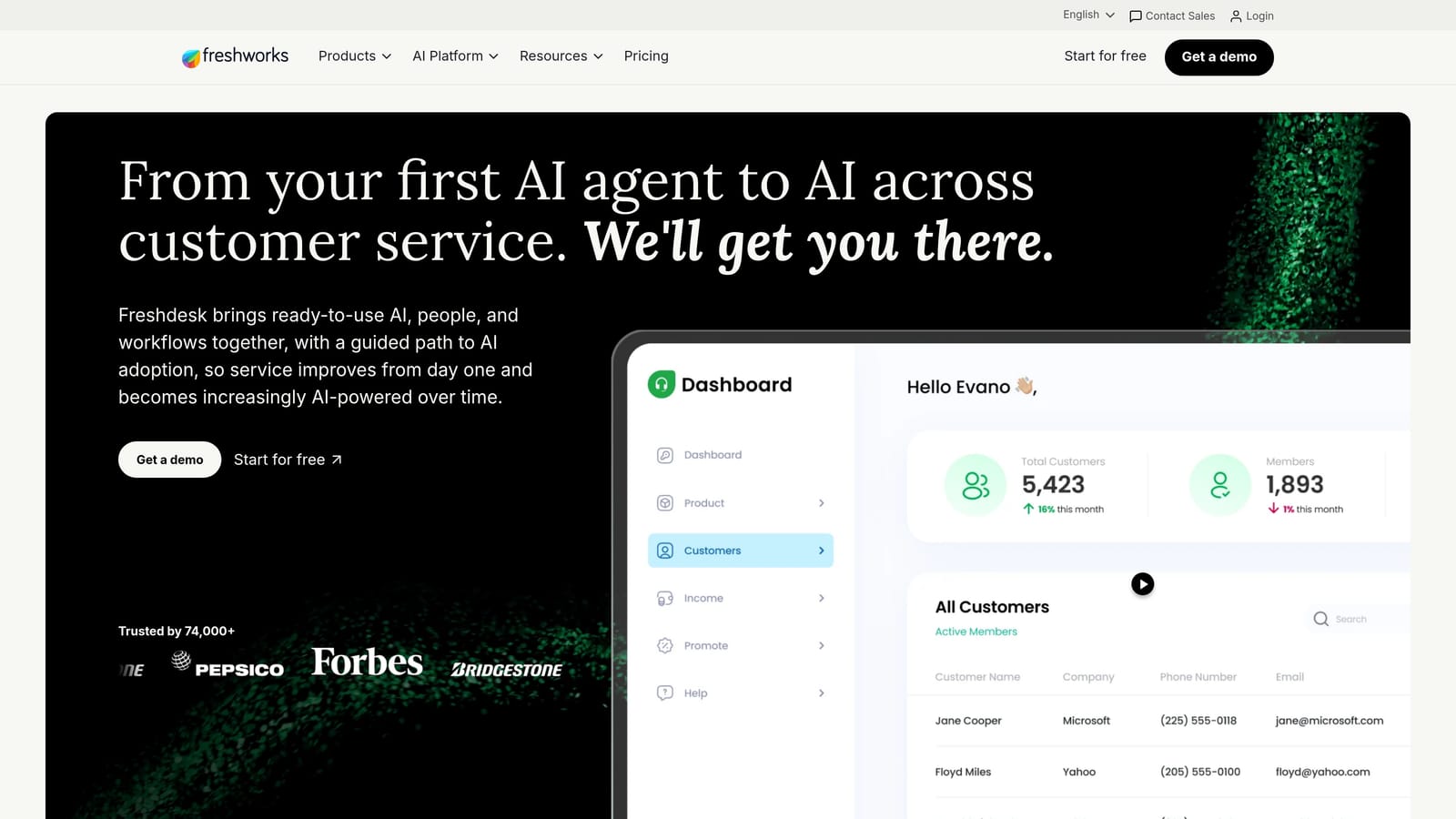
Freshdesk Freddy AI is Freshworks' AI layer across the Freshdesk helpdesk, offering agent copilot features, self-service chatbots, and AI-powered analytics.
Where This Tool Shines
Freddy AI is structured as three distinct capabilities: Copilot for agent assistance, Self Service for deflection, and Insights for analytics. This modular approach lets teams adopt AI incrementally rather than committing to a full autonomous resolution model upfront. For organizations that are AI-curious but not AI-ready, that flexibility has real value.
Freshdesk's pricing is also notably more accessible than enterprise alternatives like Zendesk or Salesforce Service Cloud, making it a practical choice for mid-market teams that need capable AI features without enterprise-tier budgets.
Key Features
Freddy Copilot: Agent assist features including suggested replies, thread summarization, and real-time guidance during ticket handling.
Freddy Self Service: Chatbot for ticket deflection, trained on your knowledge base content.
Freddy Insights: AI-powered analytics including anomaly detection and performance trend identification.
Incremental Adoption Path: Modular AI features that can be enabled progressively without migrating the full platform.
Accessible Mid-Market Pricing: More affordable entry points compared to enterprise-tier alternatives.
Best For
Mid-market SaaS and B2B teams looking for a capable helpdesk with AI features at a reasonable price point. A good fit for teams that want to test AI-assisted support before committing to a fully autonomous model.
Pricing
Freshdesk Growth starts at approximately $15/agent/month. Freddy AI features are available on higher tiers. Verify current pricing at freshworks.com.
5. Salesforce Service Cloud Einstein
Best for: Enterprises running Salesforce CRM that need support and sales data unified
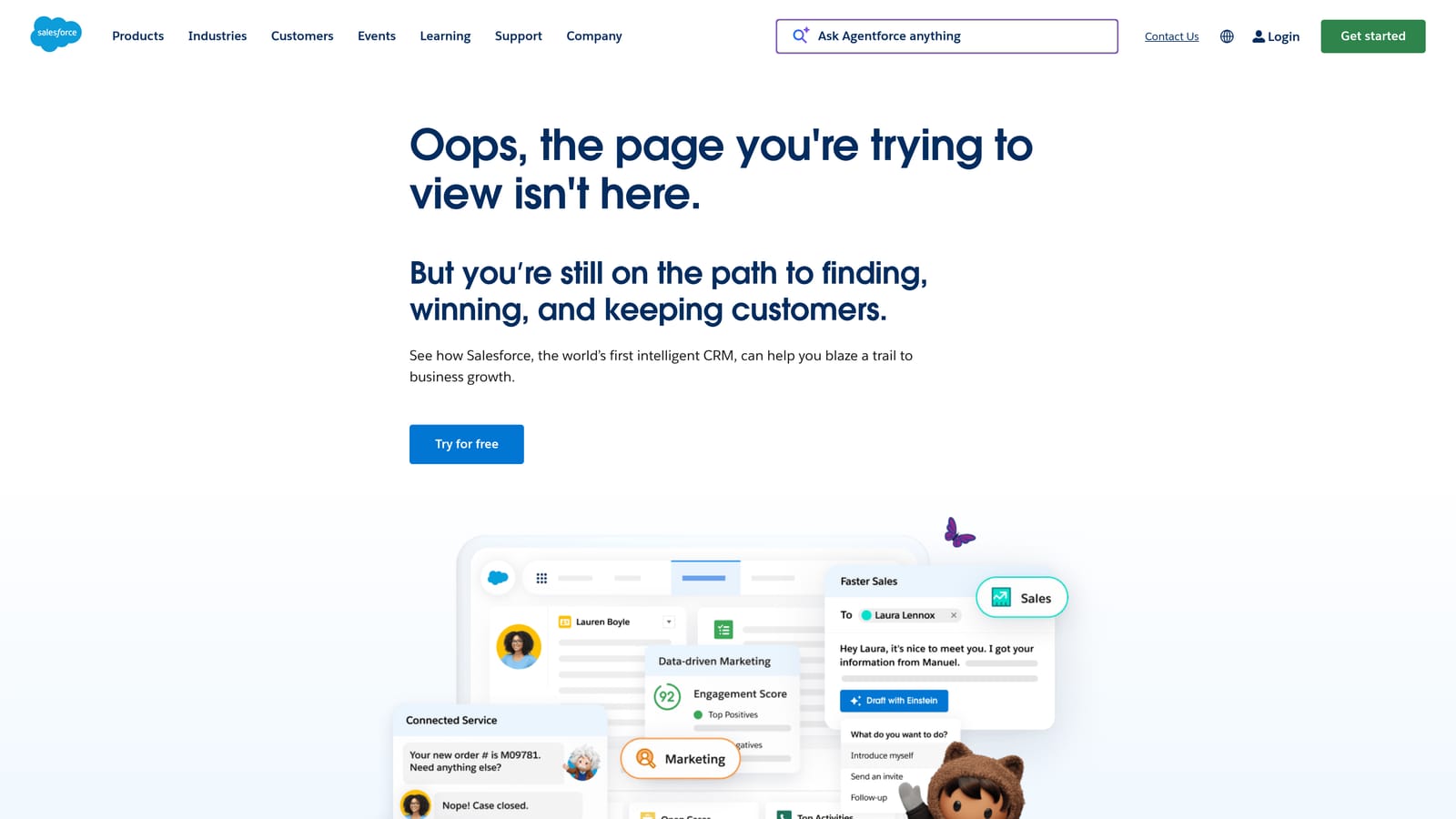
Salesforce Service Cloud Einstein is Einstein AI deeply integrated into Service Cloud, leveraging CRM data for context-rich ticket handling, case classification, and next-best-action recommendations.
Where This Tool Shines
The core advantage of Einstein is CRM-native context. When a support agent handles a ticket, Einstein can surface the customer's full purchase history, open opportunities, account health, and prior interactions in a single view. For B2B teams where support and sales are tightly connected, that unified context changes how agents prioritize and respond.
The trade-off is implementation complexity. Service Cloud Einstein typically requires dedicated Salesforce admin resources to configure well, and the pricing model can escalate quickly as Einstein add-ons are layered on top of base Service Cloud licenses.
Key Features
Case Classification and Routing: Intelligent case classification using CRM context to route tickets to the right team or agent automatically.
Einstein Bots: Self-service chatbots for deflecting common queries before they reach agents.
Next-Best-Action Recommendations: AI-powered suggestions for how agents should respond or escalate based on customer data.
Knowledge Article Recommendations: Surfaces relevant knowledge articles to agents during active ticket handling.
Unified Customer View: Full visibility into sales, support, and account data in a single interface.
Best For
Enterprises already running Salesforce CRM where support and revenue teams need shared context. Significant implementation investment required; best for organizations with Salesforce admin resources in-house or via a partner.
Pricing
Varies significantly by Service Cloud edition and Einstein add-ons. Verify current pricing at salesforce.com.
6. Help Scout AI
Best for: Teams that prioritize human-in-the-loop support with AI acceleration rather than full autonomy
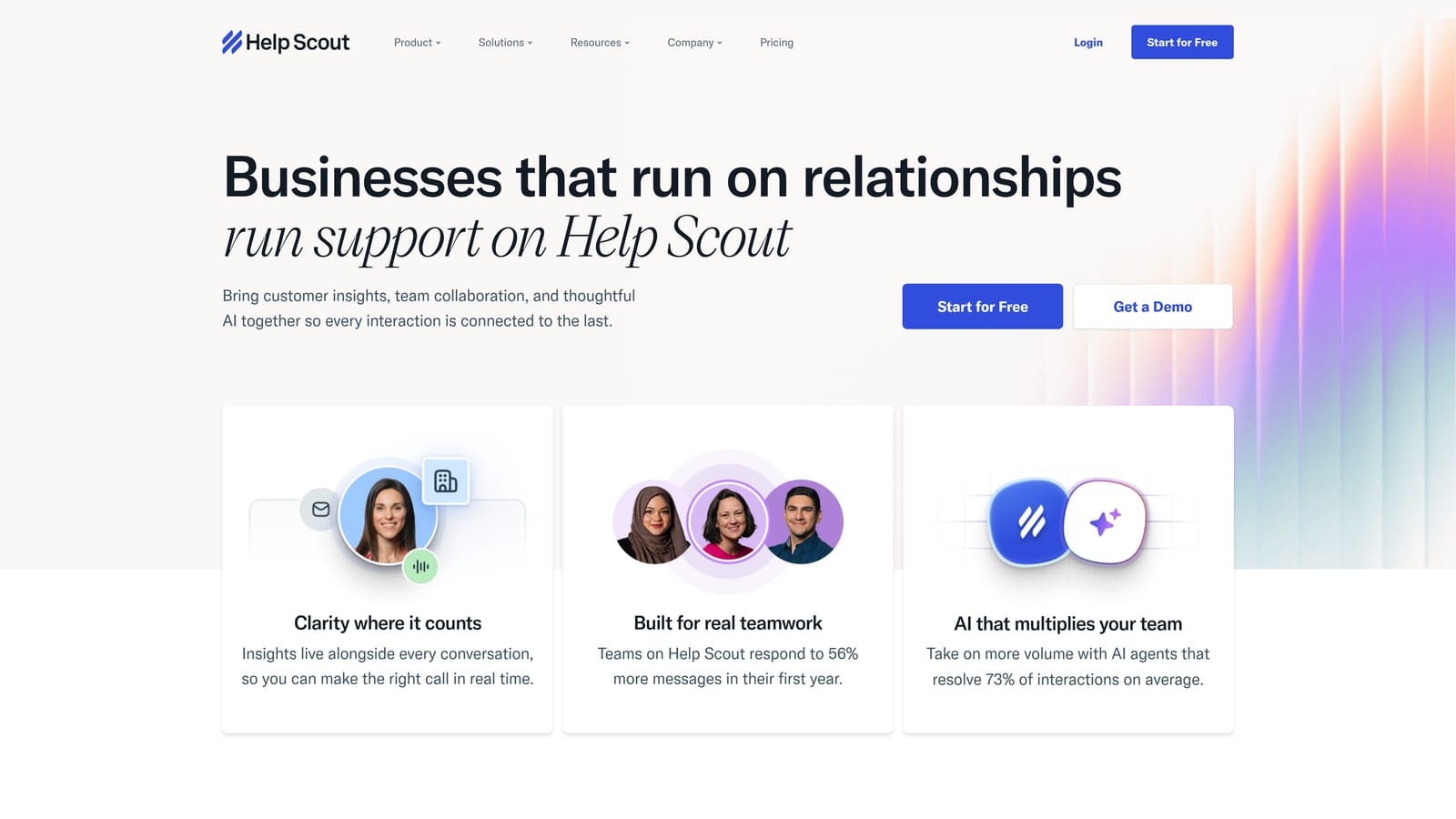
Help Scout is a human-first support platform with AI assist features designed to make agents faster, including AI Summarize, AI Drafts, and AI Answers for self-service.
Where This Tool Shines
Help Scout takes a deliberately different philosophical stance from autonomous AI platforms. Rather than removing agents from the loop, it focuses on making them significantly faster and more effective. AI Summarize condenses long email threads so agents can get up to speed instantly; AI Drafts generates reply suggestions that agents review before sending. The AI is the co-pilot, not the pilot.
This approach resonates with teams that handle sensitive, high-stakes, or relationship-driven support interactions where full autonomy feels like a liability. The interface is clean and minimal, which keeps agent cognitive load low even when handling high volumes.
Key Features
AI Summarize: Condenses long email threads into concise summaries so agents can quickly understand context without reading every message.
AI Drafts: Generates suggested reply drafts that agents can review, edit, and send—keeping humans in control of outbound communication.
AI Answers: Self-service resolution layer that draws on your Docs content to answer customer questions before they reach an agent.
Clean Agent Interface: Minimal, well-designed UI optimized for agent productivity and low distraction.
Human-in-the-Loop Philosophy: Consistent design principle that keeps agents in control while AI handles the heavy lifting.
Best For
Support teams where relationship quality and human judgment matter more than pure deflection volume. Particularly well-suited to B2B companies with high-value accounts where automated responses carry reputational risk.
Pricing
Starts at approximately $20/user/month. Verify current pricing at helpscout.com.
7. Tidio Lyro
Best for: SMBs and early-stage SaaS teams that need fast deployment with minimal setup overhead
Tidio Lyro is a conversational AI agent built for smaller teams, offering fast deployment trained from existing FAQ or help content with a free tier for low-volume use.
Where This Tool Shines
Lyro's primary advantage is speed to value. Teams can get a functional AI agent running in hours by pointing it at existing FAQ content, without dedicated ops resources or lengthy implementation cycles. For early-stage SaaS companies that need AI-assisted support but don't have the headcount or budget for enterprise platforms, Lyro lowers the barrier significantly.
The free tier is a genuine differentiator for very early-stage teams. As conversation volume grows, paid plans scale accordingly, which makes the cost curve predictable and manageable.
Key Features
Fast Deployment: Trains on existing FAQ and help content quickly, enabling a functional AI agent without lengthy setup.
Conversational Query Handling: Handles common support queries conversationally without agent involvement.
Live Chat Fallback: Escalates to live chat when Lyro cannot resolve, keeping customers from hitting dead ends.
Free Tier Available: Genuine free tier for low-volume teams, making it accessible for early-stage companies.
Simple Interface: Designed for teams without dedicated support ops or technical implementation resources.
Best For
SMBs and early-stage SaaS teams with limited setup resources and lower support volumes. Less suited to complex multi-channel enterprise environments or teams that need deep integrations with business systems.
Pricing
Free tier available with limited conversations. Paid plans scale by conversation volume. Verify current pricing at tidio.com.
8. Kustomer AI
Best for: High-volume teams that need AI with full customer timeline context across purchases and interactions
Kustomer AI is a CRM-native support platform with AI features spanning the full customer timeline, including intelligent routing, sentiment analysis, and unified customer records.
Where This Tool Shines
Kustomer's differentiator is the unified customer record. Every ticket is handled with full context: purchase history, past interactions, account value, and sentiment trends are all visible in a single timeline view. The AI features build on that context, which means routing decisions and suggested responses are informed by who the customer is, not just what they're asking right now.
This makes Kustomer particularly strong for high-volume teams handling complex customer histories, including B2B companies with long-term accounts or hybrid B2B/B2C models where customer context varies significantly between contacts.
Key Features
Unified Customer Record: Full purchase and interaction history consolidated into a single timeline, giving AI and agents complete context for every ticket.
AI-Powered Intelligent Routing: Routes tickets based on customer data, issue type, and agent expertise.
Sentiment Analysis: Detects customer sentiment in real time to flag at-risk interactions for priority handling.
Suggested Responses: AI-generated reply suggestions informed by customer history and ticket context.
Full Lifecycle Automation: Automation capabilities that extend across the entire customer relationship, not just individual tickets.
Best For
High-volume support teams where customer history and relationship context are critical to resolution quality. Strong fit for teams managing complex accounts or long customer lifecycles where ticket context alone isn't enough.
Pricing
Enterprise pricing. Verify current pricing at kustomer.com.
9. Forethought Solve
Best for: Enterprises that want autonomous AI resolution without migrating away from their existing helpdesk
Forethought Solve is an AI resolution layer that sits on top of existing helpdesks like Zendesk, Salesforce, and ServiceNow, adding autonomous triage and resolution without replacing your current platform.
Where This Tool Shines
The "AI layer" model is a smart answer to a real enterprise problem: many large organizations have years of workflow, compliance configuration, and institutional knowledge locked into their existing helpdesk. Ripping it out for an AI-first platform isn't realistic. Forethought lets those teams add autonomous resolution capabilities without touching the underlying system.
The practical result is that enterprises can improve resolution rates and reduce ticket volume reaching agents while keeping their Zendesk or Salesforce configuration intact. For risk-averse buyers with locked-in infrastructure, that's a compelling value proposition.
Key Features
AI Layer Over Existing Helpdesks: Works alongside Zendesk, Salesforce, ServiceNow, and others without requiring migration or replacement.
Autonomous Triage and Resolution: Handles common ticket types end-to-end before they reach the agent queue.
Deflection Capabilities: Reduces ticket volume reaching human agents by resolving self-service eligible queries automatically.
Escalation Routing: Routes complex cases to the right human agent when autonomous resolution isn't appropriate.
Enterprise-Focused Architecture: Built for organizations with complex existing helpdesk infrastructure they cannot or will not replace.
Best For
Enterprises with significant investment in existing helpdesk platforms who want to add AI-powered autonomous resolution without a platform migration. A practical middle path for risk-averse buyers who need measurable improvement without operational disruption.
Pricing
Enterprise pricing. Contact for a quote at forethought.ai.
Which Tool Is Right for Your Team?
The right AI support ticket system depends on three things: where you are today, what level of AI autonomy you actually want, and how deeply you need the system to connect with the rest of your business stack.
Here's a quick way to think through the options:
If you want AI-first architecture with business intelligence: Halo AI is the standout choice. It's built for B2B SaaS teams that want autonomous resolution, page-aware guidance, bug detection, and customer health signals in a single platform.
If you're already on Zendesk or Salesforce: Zendesk AI and Salesforce Service Cloud Einstein are the natural paths forward. They add AI without disrupting existing workflows, though the AI experience is additive rather than foundational.
If you want autonomous resolution without a migration: Forethought Solve is designed exactly for this scenario. It layers AI onto your existing helpdesk rather than replacing it.
If your support is chat-first with strong help content: Intercom Fin is a strong contender. The LLM-powered resolution and usage-based pricing model work well for SaaS teams with mature knowledge bases.
If you're mid-market and want incremental adoption: Freshdesk Freddy AI offers the most accessible entry point with modular AI features that can be enabled progressively.
If human judgment matters more than deflection volume: Help Scout AI keeps agents in control while using AI to make them faster. A good fit for high-value B2B accounts where automated responses carry relationship risk.
If you're early-stage and need fast deployment: Tidio Lyro gets you a functional AI agent quickly with minimal overhead and a free tier to start.
Your support team shouldn't scale linearly with your customer base. Let AI agents handle routine tickets, guide users through your product, and surface business intelligence while your team focuses on complex issues that need a human touch. See Halo in action and discover how continuous learning transforms every interaction into smarter, faster support.