9 Best Customer Service Automation Software Platforms in 2026
This guide reviews the nine best customer service automation software platforms of 2026, evaluated on AI capability, integration depth, ease of deployment, and real business impact. Whether you're a lean SaaS team or an enterprise modernizing legacy workflows, it covers the right solution to help you resolve tickets faster and scale support without adding headcount.
 Grant CooperFounder13 min read
Customer service teams are under more pressure than ever: resolve tickets faster, scale without adding headcount, and deliver consistent experiences across every channel. The right automation software doesn't just deflect tickets — it learns, adapts, and surfaces intelligence that makes your entire support operation smarter.
This list covers nine of the best customer service automation platforms available in 2026, evaluated on AI capability, integration depth, ease of deployment, and real business impact. Whether you're a lean SaaS team looking to reduce ticket volume or an enterprise operation modernizing legacy helpdesk workflows, there's a solution here for you.
A quick note on methodology: tools were selected based on feature depth, market presence, and suitability for B2B product and support teams — particularly those already using or evaluating platforms like Zendesk, Freshdesk, and Intercom.
1. Halo AI
Best for: AI-first SaaS teams that want autonomous ticket resolution and business intelligence
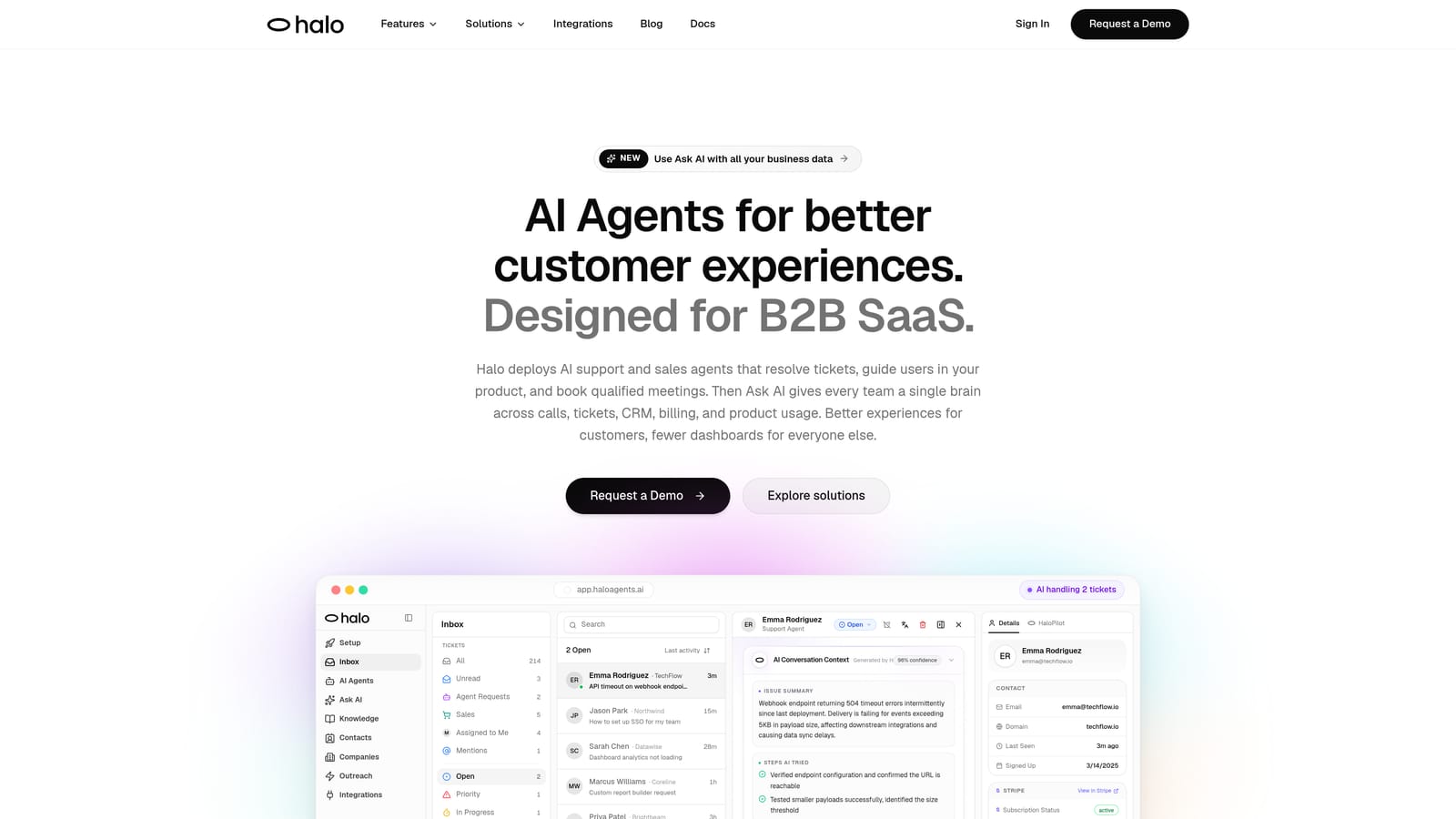
Halo AI is an AI-native customer support platform that deploys intelligent agents to resolve tickets, guide users through your product, and surface business intelligence — all while continuously learning from every interaction.
Where This Tool Shines
What sets Halo apart from most tools on this list is the architecture. Rather than bolting AI onto an existing helpdesk, Halo is built AI-first from the ground up. Every workflow, every resolution, every escalation is designed around autonomous agents that improve over time.
The page-aware context feature is particularly compelling for product teams. Halo's AI agent sees what the user sees inside your product, which means guidance is contextually accurate rather than generic. Combined with auto bug ticket creation routed directly to engineering tools like Linear, it closes the loop between customer issues and product development in a way most helpdesk platforms simply can't.
Key Features
Page-Aware AI Agents: The agent understands which page or feature a user is on, enabling precise in-product guidance rather than generic responses.
Auto Bug Ticket Creation: Automatically generates and routes bug reports to engineering tools like Linear, reducing manual handoffs between support and product teams.
Smart Inbox with Business Intelligence: Surfaces customer health signals, revenue anomalies, and support trends — turning your inbox into a strategic intelligence layer.
Native Integrations: Connects out of the box with Slack, HubSpot, Intercom, Stripe, Zoom, PandaDoc, and Fathom without requiring middleware.
Live Agent Handoff: Escalates complex issues to human agents with full context preserved, so customers never have to repeat themselves.
Continuous Learning Model: Every resolved interaction feeds back into the system, improving resolution quality and accuracy over time.
Best For
SaaS product and support teams that want more than ticket deflection. Halo is particularly well-suited for teams where support data should inform product decisions, and where engineering, customer success, and support need to operate from a shared context.
Pricing
Contact for pricing. Halo is positioned for mid-market and enterprise SaaS teams. Reach out directly at haloagents.ai for a tailored quote.
2. Intercom
Best for: Chat-heavy teams wanting a widely adopted AI agent with strong omnichannel coverage
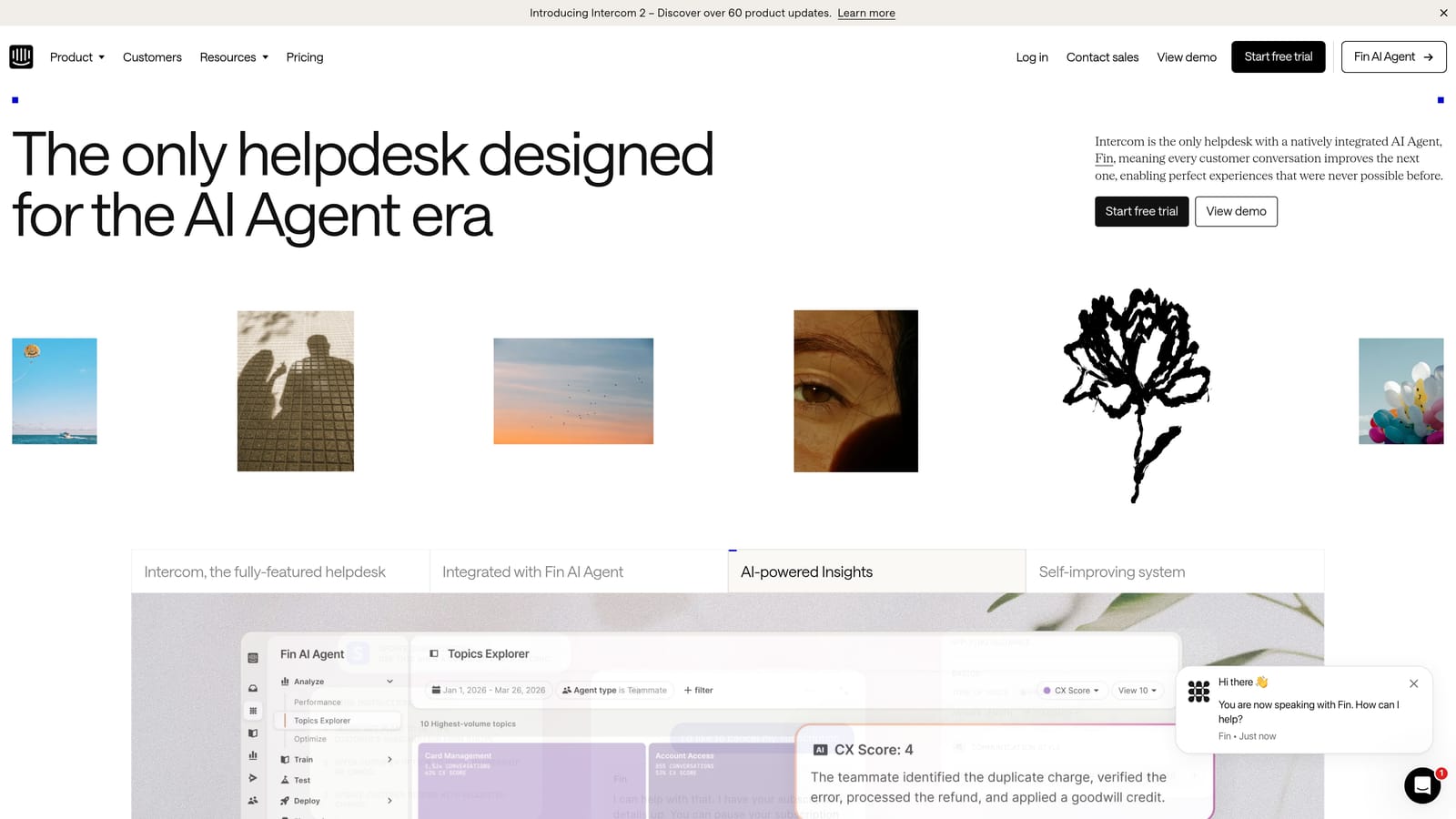
Intercom is a customer messaging platform featuring Fin, an AI agent built on large language model technology that resolves support queries across chat, email, and in-app channels.
Where This Tool Shines
Fin is one of the most widely recognized AI support agents in the market, and for good reason. It handles a broad range of customer queries autonomously, pulling from your help center content to generate accurate, conversational responses. For teams already using Intercom for customer messaging, adding Fin is a natural extension of existing workflows.
Intercom's strength is its messaging-first DNA. The platform excels when customer interactions happen primarily through chat and in-app channels, and the workflow builder makes it reasonably straightforward to configure routing, tagging, and escalation logic without engineering involvement.
Key Features
Fin AI Agent: Resolves support queries autonomously across chat, email, and in-app messaging using LLM technology grounded in your knowledge base.
Omnichannel Support: Covers live chat, email, in-app messaging, and social channels from a single platform.
Workflow Builder: Visual automation builder for routing, tagging, assignment, and escalation logic.
Help Center with AI Suggestions: Knowledge base with AI-assisted content recommendations to keep documentation current.
Conversation Analytics: Rich reporting on resolution rates, response times, and customer satisfaction trends.
Best For
Growth-stage and mid-market SaaS companies with high chat volume. Intercom is especially strong for teams that want a polished customer-facing experience and are already invested in the Intercom ecosystem.
Pricing
Starts around $39/seat/month; Fin AI is priced per resolution. Costs can escalate at scale, so model your volume carefully. Verify current pricing at intercom.com.
3. Zendesk
Best for: Enterprise teams needing mature ticketing infrastructure with AI capabilities layered on top
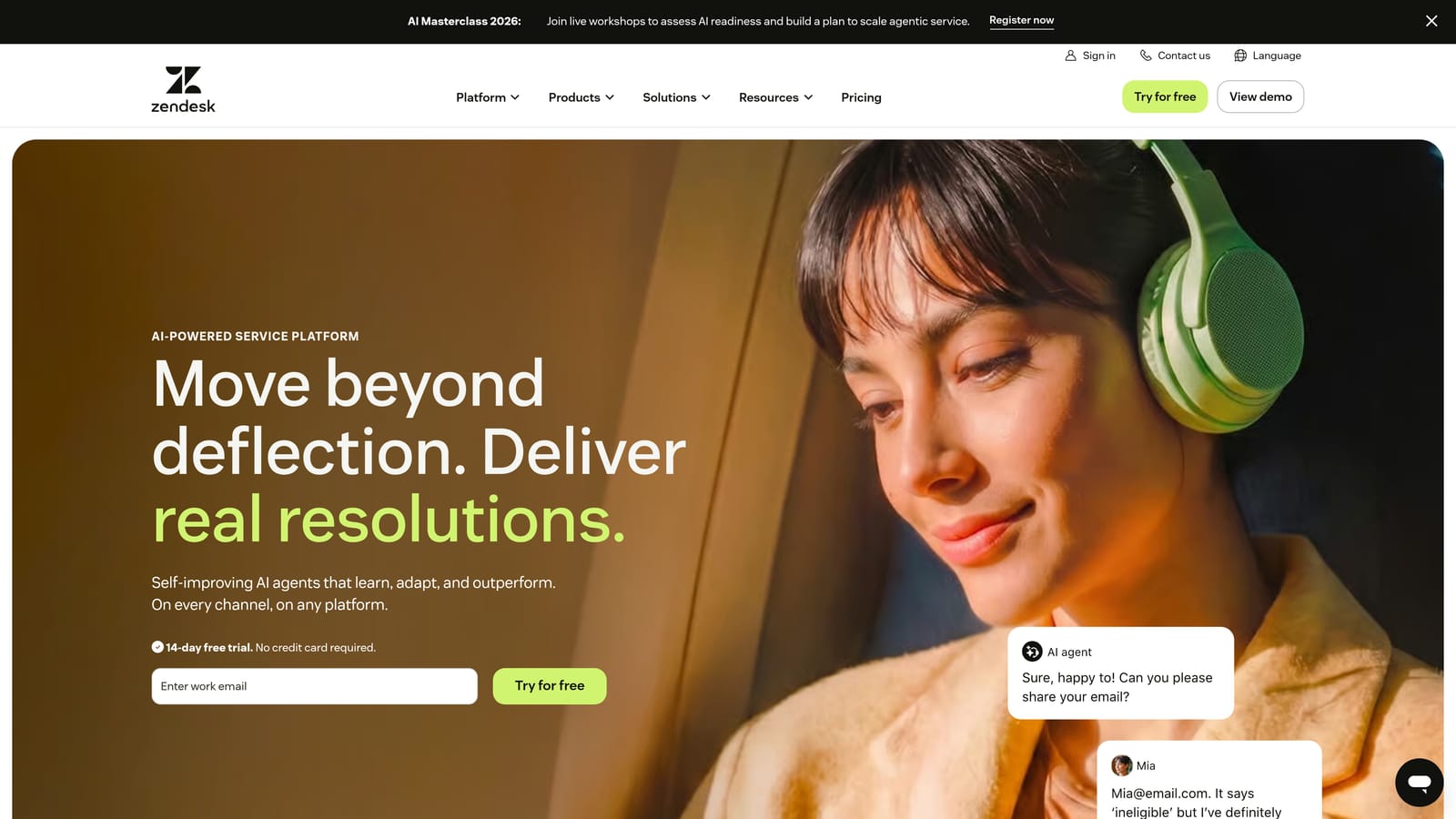
Zendesk is one of the most widely adopted enterprise helpdesk platforms, offering deep ticketing infrastructure with AI capabilities available via the Zendesk AI add-on.
Where This Tool Shines
Zendesk's core strength is its ticketing infrastructure. SLA management, custom views, complex routing rules, and multi-brand support are all mature, battle-tested, and highly configurable. For enterprise teams with complex operational requirements, Zendesk provides the scaffolding that most newer platforms are still building toward.
The Zendesk AI layer adds intelligent triage, suggested replies, and agent assist functionality. It's a meaningful upgrade to the agent experience, though it's worth noting that AI feels more like an add-on to existing workflows than a foundational architecture decision. Teams evaluating Zendesk should factor in the additional cost and implementation effort required to activate AI features fully.
Key Features
Mature Ticketing System: SLA management, custom views, complex routing rules, and multi-brand support built for enterprise scale.
Zendesk AI: Intelligent triage, suggested replies, and agent assist to accelerate resolution times.
Extensive Marketplace: Hundreds of third-party integrations available through the Zendesk marketplace.
Robust Reporting Suite: Deep analytics across ticket volume, resolution time, CSAT, and agent performance.
Multi-Language Support: Localization and multi-language capabilities for global support operations.
Best For
Large enterprise teams with complex support workflows, multiple brands, or global operations. Zendesk is also a strong choice for teams with significant existing investment in the platform who want to layer AI onto proven infrastructure.
Pricing
Suite plans start around $55/agent/month; AI features are available as an add-on at additional cost. Verify current pricing at zendesk.com.
4. Freshdesk
Best for: Growing SMB and mid-market teams wanting AI automation at an accessible price point
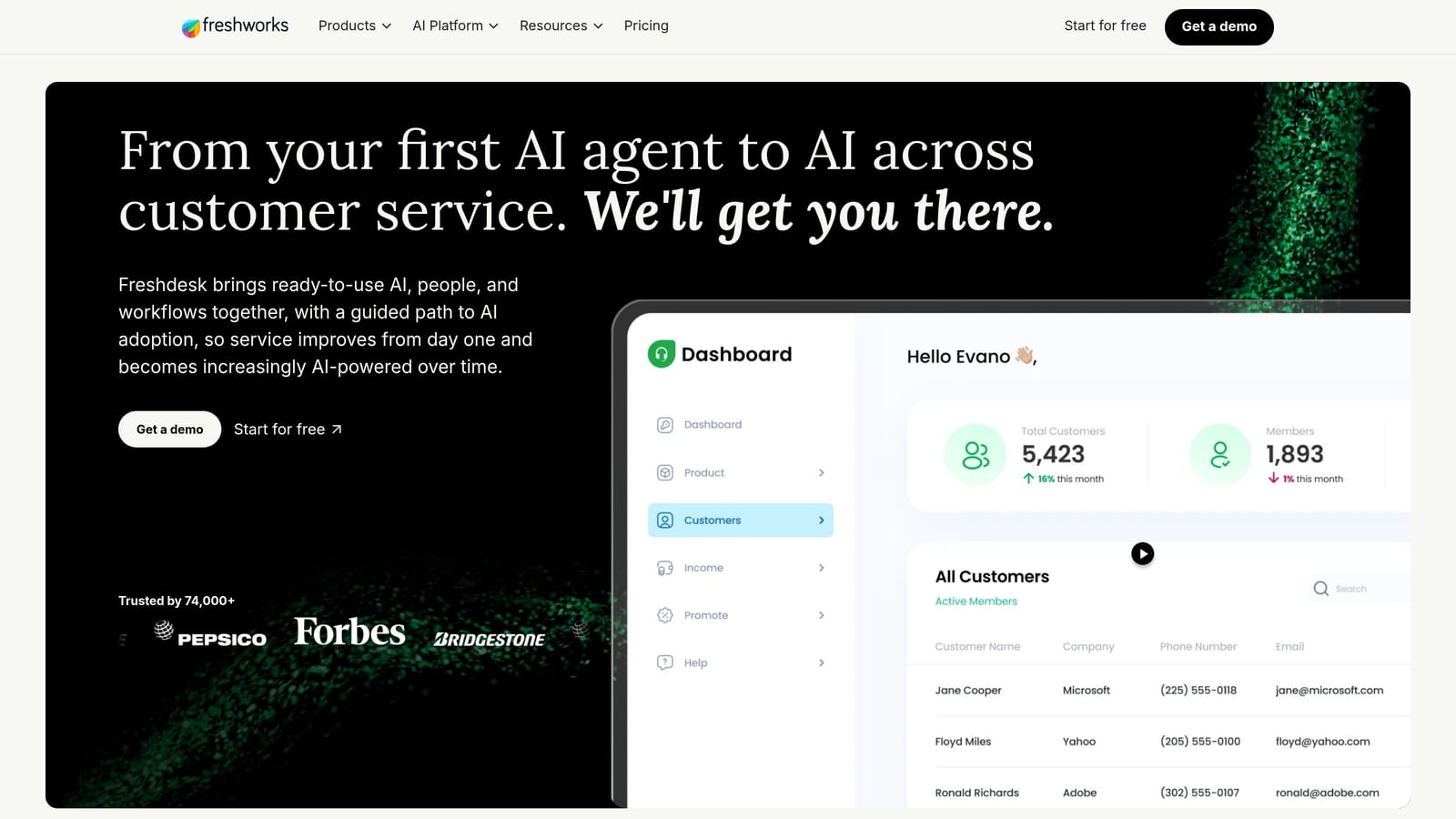
Freshdesk is Freshworks' customer support platform offering Freddy AI for ticket automation, agent assist, and self-service — at a price point accessible to growing teams.
Where This Tool Shines
Freshdesk hits a sweet spot between capability and cost. Freddy AI handles ticket categorization, priority assignment, and suggested responses without requiring a significant implementation investment. For teams that want meaningful automation without enterprise-level pricing, Freshdesk is one of the more competitive options available.
Being part of the broader Freshworks ecosystem is a genuine advantage for teams that also use Freshworks CRM or Freshservice for ITSM. The shared data layer means customer context flows across products, reducing the data silos that often frustrate support and sales teams working from separate tools.
Key Features
Freddy AI: Handles ticket categorization, priority assignment, and suggested responses to reduce manual agent effort.
Freddy Self Service: Deploys AI-powered chatbots for end users, enabling self-service resolution before tickets are created.
Automation Rules Engine: Configurable rules for routing, escalation, and SLA enforcement.
Freshworks Suite Integration: Native connection to Freshworks CRM, Freshservice, and sales tools for a unified customer view.
Free Tier: Available for small teams getting started with structured support workflows.
Best For
SMBs and growing mid-market teams that want solid AI-assisted automation without enterprise pricing. Particularly strong for teams already in the Freshworks ecosystem.
Pricing
Free tier available; Growth plan starts around $15/agent/month. Verify current pricing at freshdesk.com.
5. Tidio
Best for: Small businesses and e-commerce brands wanting fast, no-code chatbot deployment
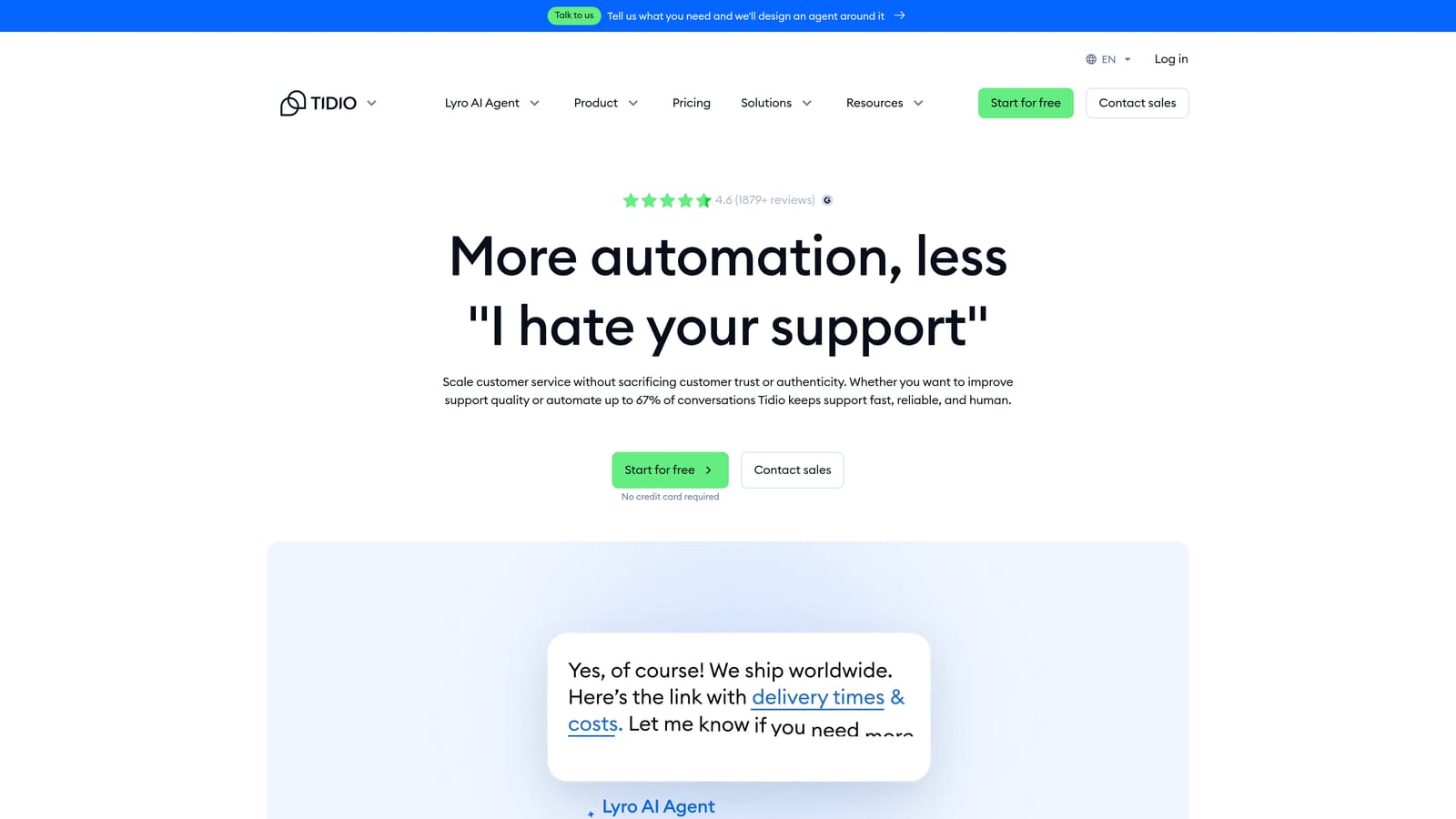
Tidio is a lightweight customer service platform built for small businesses and e-commerce, featuring the Lyro AI chatbot for quick-deploy automated support.
Where This Tool Shines
Tidio's primary advantage is speed to value. Lyro AI can be deployed without technical resources, making it accessible to small teams that don't have dedicated support engineers. The live chat fallback is smooth, and the handoff from bot to human feels natural rather than jarring — which matters when your customers are used to personal service.
For e-commerce brands in particular, Tidio's Shopify and WooCommerce integrations mean the chatbot can answer product and order questions without requiring custom development. It's a practical, low-friction entry point into support automation.
Key Features
Lyro AI Chatbot: No-code setup for fast deployment, trained on your support content to handle common queries automatically.
Live Chat Fallback: Smooth human handoff when queries exceed the chatbot's capability.
E-Commerce Integrations: Native connections to Shopify and WooCommerce for order-aware automated responses.
Email and Messenger Support: Extends coverage beyond live chat to email and Facebook Messenger channels.
Simple Analytics Dashboard: Clean reporting suited to small team needs without overwhelming complexity.
Best For
Small businesses, solo operators, and e-commerce brands that need quick, affordable automation without complex workflows. Not the right fit for enterprise or B2B SaaS teams with sophisticated routing and integration requirements.
Pricing
Free tier available; paid plans from around $29/month. Verify current pricing at tidio.com.
6. Salesforce Service Cloud
Best for: Enterprise organizations already invested in the Salesforce ecosystem
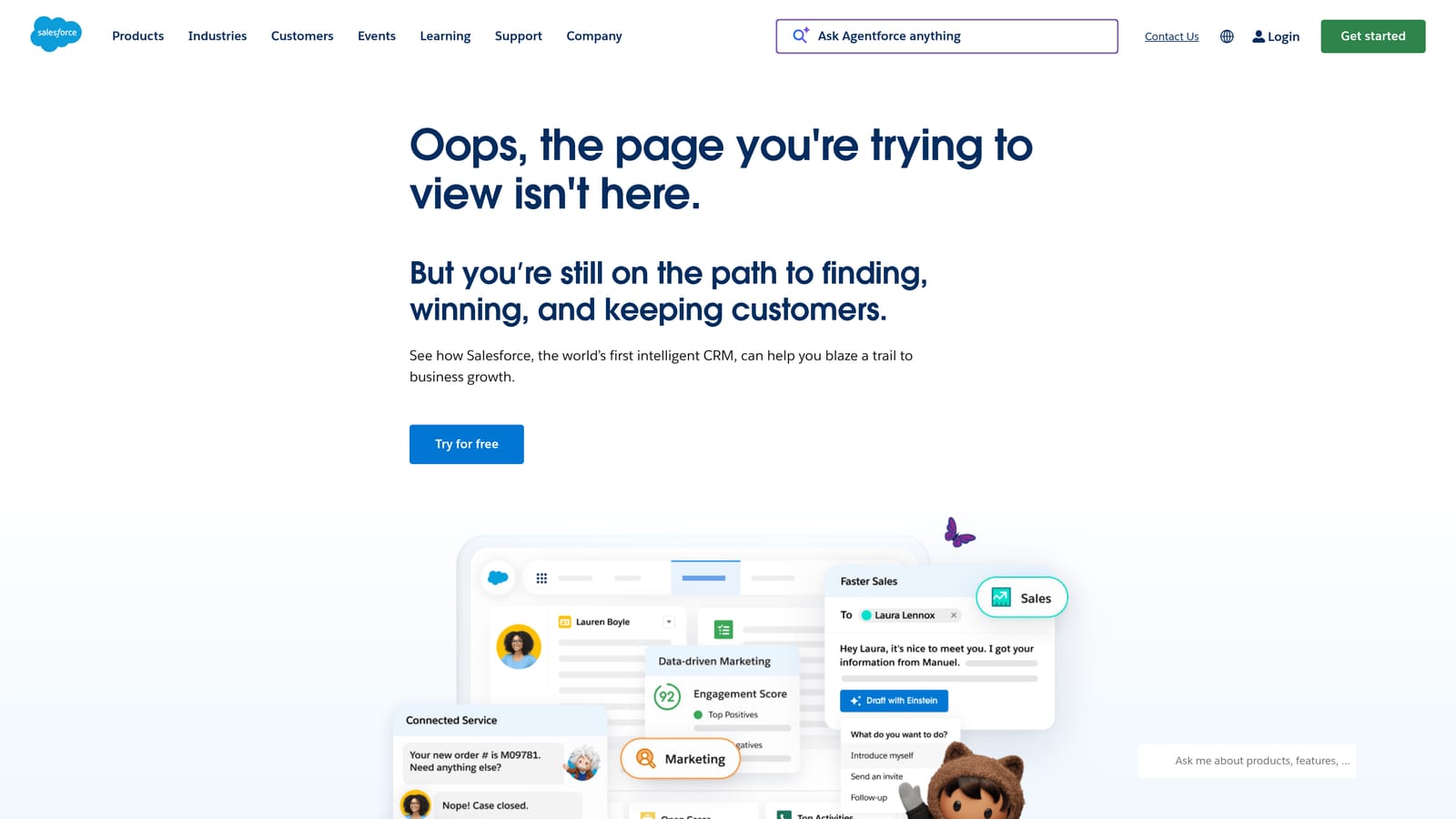
Salesforce Service Cloud is an enterprise-grade support automation platform deeply integrated with Salesforce CRM, powered by Einstein AI for context-rich case management and automation.
Where This Tool Shines
If your organization runs on Salesforce, Service Cloud is a natural extension. The unified customer view — combining CRM data, purchase history, and support interactions in a single record — gives both AI and human agents context that standalone helpdesks simply can't match. Einstein AI leverages this data for case classification, next-best-action recommendations, and automated workflow triggers.
The tradeoff is implementation complexity. Service Cloud requires meaningful investment in configuration, customization, and often Salesforce expertise to unlock its full potential. Teams that aren't already Salesforce-native should weigh that cost carefully against the platform's capabilities.
Key Features
Einstein AI: Case classification, next-best-action recommendations, and automated workflow triggers powered by AI.
Unified Customer View: Combines CRM data, support history, and transaction records in a single agent interface.
Omnichannel Routing: Routes interactions across voice, chat, email, and social from a centralized platform.
Self-Service Portal: Customer-facing portal for case submission, knowledge base access, and community support.
Deep Customization: Apex code and Salesforce Flow enable highly tailored automation for complex enterprise requirements.
Best For
Large enterprises already operating within the Salesforce ecosystem. The platform delivers maximum value when CRM and support data live in the same environment, and when there are dedicated Salesforce administrators to manage configuration.
Pricing
Enterprise pricing typically ranges from $75 to $300+/user/month depending on tier and features. Verify current pricing at salesforce.com.
7. Help Scout
Best for: Teams that prioritize human-feeling customer relationships over aggressive deflection metrics
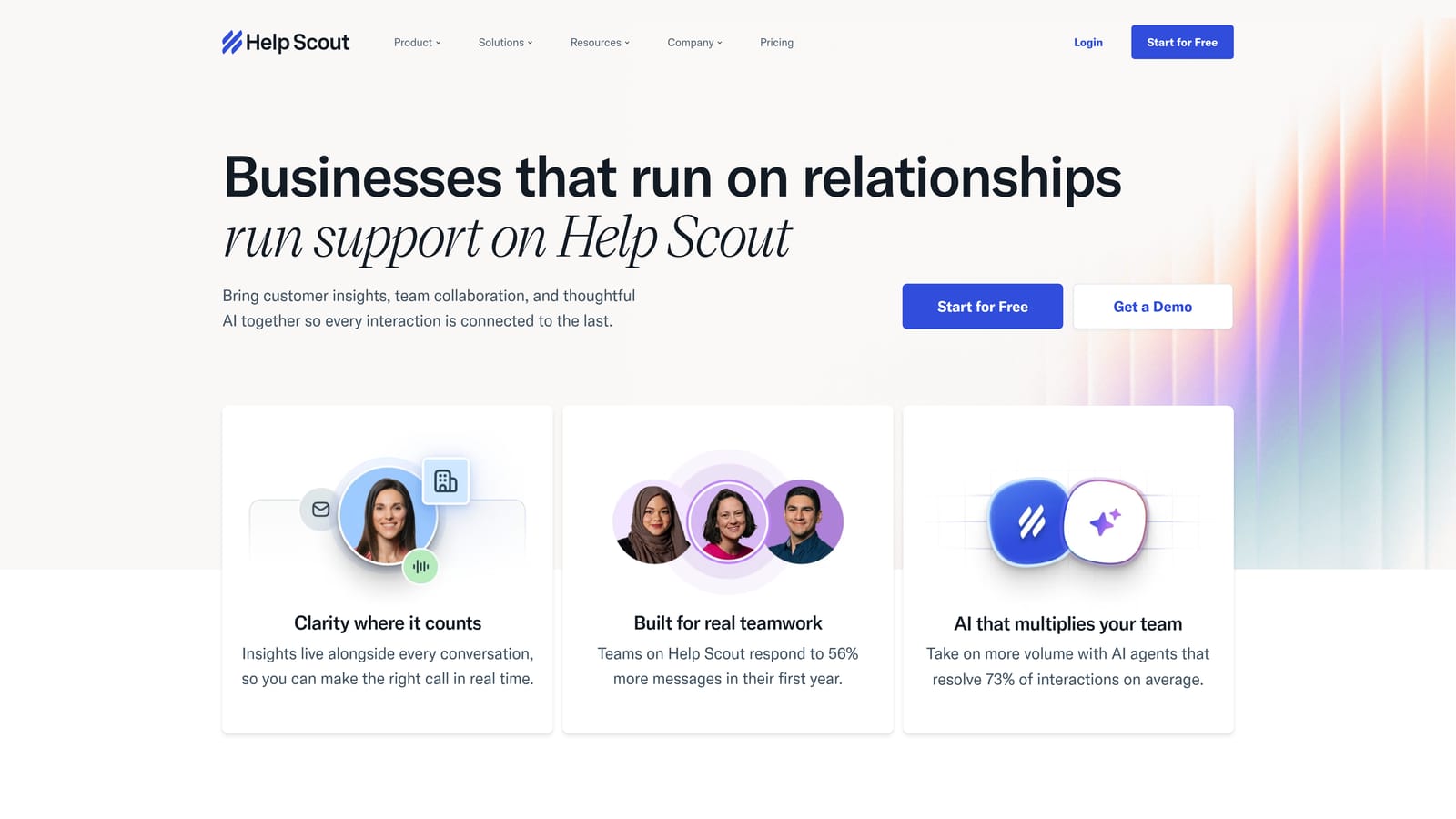
Help Scout is a clean, inbox-style support platform that prioritizes human-feeling customer experiences while offering AI-assisted drafts, summaries, and workflow automation.
Where This Tool Shines
Help Scout occupies a deliberate position in the market: it doesn't try to automate everything. The platform is built around the belief that great support feels human, and the interface reflects that philosophy. Agents work from a shared inbox that minimizes cognitive load, and AI features like AI Drafts and AI Summarize accelerate their work without replacing the human touch.
For teams where relationship quality is a competitive differentiator — think high-touch SaaS, professional services, or brands with passionate customer communities — Help Scout's approach is a genuine strategic fit rather than a compromise.
Key Features
AI Drafts and AI Summarize: Helps agents write faster and get up to speed on conversation history without reading every message.
Workflow Automation: Rules-based automation for tagging, routing, assignment, and follow-up reminders.
Docs Knowledge Base: Built-in knowledge base with AI-powered search to surface relevant articles for agents and customers.
CSAT Tracking: Customer satisfaction measurement built natively into the platform without requiring third-party tools.
Clean Agent Interface: Inbox-style UI designed to reduce context-switching and cognitive overload for support teams.
Best For
Small to mid-sized teams where customer relationship quality matters as much as efficiency. Help Scout is a strong fit for companies that want AI assistance without fully autonomous bot-driven support.
Pricing
Starts around $20/user/month. Verify current pricing at helpscout.com.
8. Kustomer
Best for: High-volume B2C brands where customer lifetime value and order history inform support decisions
Kustomer is a CRM-native helpdesk platform offering a unified customer timeline and AI-powered automation, designed for high-volume B2C support operations.
Where This Tool Shines
Kustomer's defining feature is the unified customer timeline. Every conversation, order, return, and interaction is surfaced in a single chronological view, giving agents immediate context without switching between tools. For high-volume B2C brands where a customer's purchase history directly shapes the support response, this context layer is genuinely valuable.
The AI automation handles routing, classification, and suggested responses, while the no-code workflow builder makes it possible for operations teams to configure complex business processes without engineering support. Revenue and customer lifetime value data surfaced within the support interface is a thoughtful touch for brands where support and retention are closely linked.
Key Features
Unified Customer Timeline: Combines order history, conversations, and CRM data in a single chronological view for agents.
AI Automation: Handles routing, classification, and suggested responses to reduce manual agent effort.
Omnichannel Coverage: Supports chat, email, voice, and social channels from a centralized platform.
No-Code Workflow Builder: Enables operations teams to build complex business process automation without engineering involvement.
Revenue Data in Support Context: Surfaces customer lifetime value and revenue signals directly within the support interface.
Best For
High-volume B2C brands, particularly in retail, subscription commerce, and consumer apps, where customer order history and lifetime value are central to support decision-making.
Pricing
Starts around $89/user/month. Verify current pricing at kustomer.com.
9. Gorgias
Best for: E-commerce brands on Shopify, BigCommerce, or Magento needing deep order-aware automation
Gorgias is a support automation platform purpose-built for e-commerce brands, with deep native integrations for Shopify, BigCommerce, and Magento.
Where This Tool Shines
Gorgias is the most specialized tool on this list, and that specialization is its greatest strength. The native Shopify integration means order data, shipping status, and return eligibility are accessible directly within the ticket interface. Automated responses for WISMO (Where Is My Order) queries and return requests can resolve a significant portion of e-commerce ticket volume without any agent involvement.
The revenue attribution reporting is another standout. Gorgias tracks which support interactions contribute to sales, giving e-commerce brands a clearer picture of support as a revenue function rather than purely a cost center. If your business runs on Shopify and you're dealing with high ticket volume around orders, Gorgias is hard to beat in its category.
Key Features
Native Shopify Integration: Order data, shipping status, and return eligibility accessible directly within ticket views.
WISMO Automation: Automated responses for "Where Is My Order" and return request queries to deflect high-volume repetitive tickets.
Revenue Attribution Reporting: Ties support interactions to sales outcomes, framing support as a revenue function.
Macros and Rules Engine: High-volume ticket automation via pre-built response templates and routing rules.
Social Channel Support: Covers Instagram, Facebook, and SMS alongside traditional email and chat channels.
Best For
E-commerce brands with high ticket volume, particularly those running on Shopify. Less suited for B2B SaaS teams or organizations with complex, non-transactional support workflows.
Pricing
Starts around $10/month with a ticket-based pricing model. Verify current pricing at gorgias.com.
Which Platform Is Right for Your Team?
The honest answer is that the best customer service automation platform depends almost entirely on your business model, team size, and what you want automation to actually do for you.
For AI-first SaaS teams that want more than ticket deflection, Halo AI stands out as the most purpose-built option. The page-aware context, continuous learning model, and business intelligence layer make it a genuinely different kind of tool — one that treats support as a source of product and revenue intelligence, not just a cost to be minimized.
For enterprise teams with complex ticketing requirements, Zendesk and Salesforce Service Cloud offer mature infrastructure that's hard to replicate. If you're already Salesforce-native, Service Cloud is the natural choice. If you're not, Zendesk's broader ecosystem gives you more flexibility.
For SMBs and growing teams watching budget carefully, Freshdesk delivers solid AI-assisted automation at a price point that scales reasonably. And for e-commerce brands dealing with high order-related ticket volume, Gorgias is the clear category leader.
Teams that want AI assistance without fully autonomous support will find Help Scout a thoughtful middle ground. And for messaging-heavy use cases, Intercom's Fin agent remains one of the most widely adopted solutions in the market.
Your support team shouldn't scale linearly with your customer base. Let AI agents handle routine tickets, guide users through your product, and surface business intelligence while your team focuses on complex issues that need a human touch. See Halo in action and discover how continuous learning transforms every interaction into smarter, faster support.