9 Top Rated Support Automation Tools for B2B Teams in 2026
This guide evaluates 9 top rated support automation tools built specifically for B2B SaaS and product teams, comparing each on AI capability, integration depth, and deployment ease. If your support team is managing rising ticket volumes with flat headcount, this breakdown helps you identify the right platform to autonomously resolve tickets while integrating with tools like Zendesk, Freshdesk, or Intercom.
 Grant CooperFounder13 min read
Support teams at B2B companies are under more pressure than ever. Ticket volumes climb, customer expectations rise, and headcount budgets stay flat. The right support automation tool can fundamentally change that equation, letting your team focus on complex, high-value interactions while AI handles the repetitive volume.
But not all automation platforms are built the same. Some bolt AI onto legacy helpdesk infrastructure. Others offer narrow chatbot functionality with little real context. The best tools today resolve tickets autonomously, learn from every interaction, integrate with your existing stack, and surface business intelligence that goes well beyond the support queue.
This list covers top rated support automation tools for B2B SaaS and product teams. We evaluated each based on AI capability depth, integration breadth, ease of deployment, and fit for teams already using platforms like Zendesk, Freshdesk, or Intercom. Whether you're automating your first workflow or replacing a legacy system entirely, there's a strong option here for your team.
1. Halo AI
Best for: B2B SaaS teams that want AI-first autonomous ticket resolution with business intelligence built in.
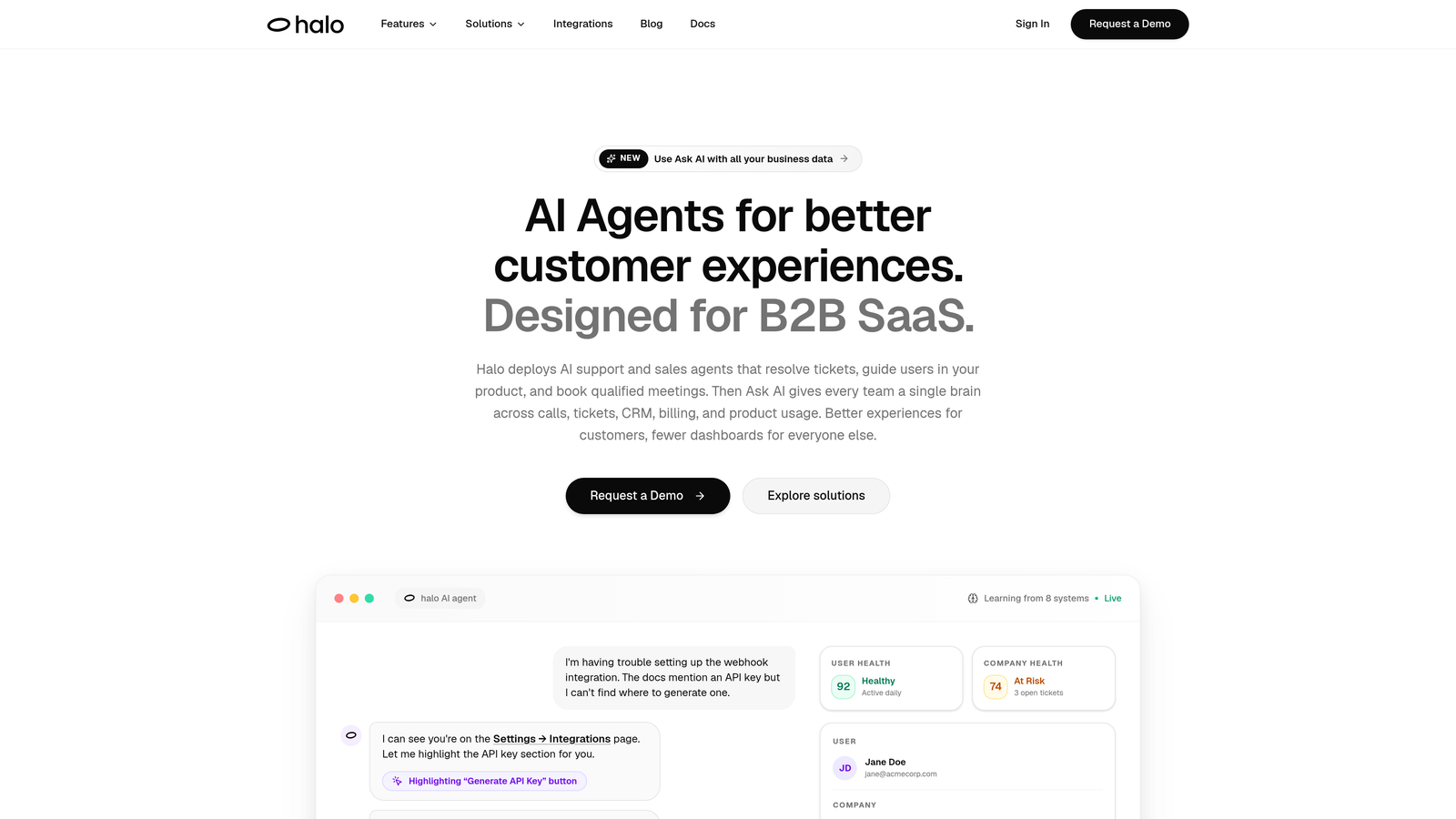
Halo AI is a purpose-built AI support platform that deploys intelligent agents to resolve tickets, guide users through your product with page-aware context, and surface business intelligence across your entire customer base.
Where This Tool Shines
Most support tools start as helpdesks and add AI later. Halo is built the other way around: AI-first architecture means the intelligence isn't a feature layer, it's the foundation. Every interaction trains the system, so resolution quality improves continuously without manual rule updates or constant retraining cycles.
What sets Halo apart from most competitors is the combination of page-aware context and business intelligence output. The chat widget sees what the user sees, enabling visual UI guidance rather than generic responses. And the smart inbox doesn't just track ticket counts: it surfaces customer health signals, revenue flags, and anomaly detection that connect support data to broader business outcomes.
Key Features
Intelligent AI Agents: Autonomous ticket resolution that handles common queries end-to-end without human intervention, learning from every closed ticket.
Page-Aware Chat Widget: The AI understands which page a user is on and can provide contextual, visual guidance, not just text responses.
Smart Inbox with Business Intelligence: Surfaces customer health signals, revenue intelligence, and anomaly detection alongside standard support metrics.
Auto Bug Ticket Creation: Automatically generates structured bug reports and routes them to Linear or similar tools, closing the loop between support and engineering.
Live Agent Handoff: Smooth escalation with full conversation context preserved so human agents aren't starting from scratch.
Deep Integrations: Connects natively with Slack, HubSpot, Intercom, Stripe, Linear, Zoom, PandaDoc, and Fathom.
Best For
B2B SaaS and product teams that want more than ticket deflection. Halo is particularly well-suited for companies where support data should be informing product, sales, and customer success decisions, not sitting in a siloed helpdesk.
Pricing
Contact for pricing at haloagents.ai. Given the platform's AI-first architecture and business intelligence capabilities, it's positioned for teams serious about support as a growth lever.
2. Intercom
Best for: Teams already in the Intercom ecosystem who want an LLM-powered AI agent layered onto existing messaging workflows.
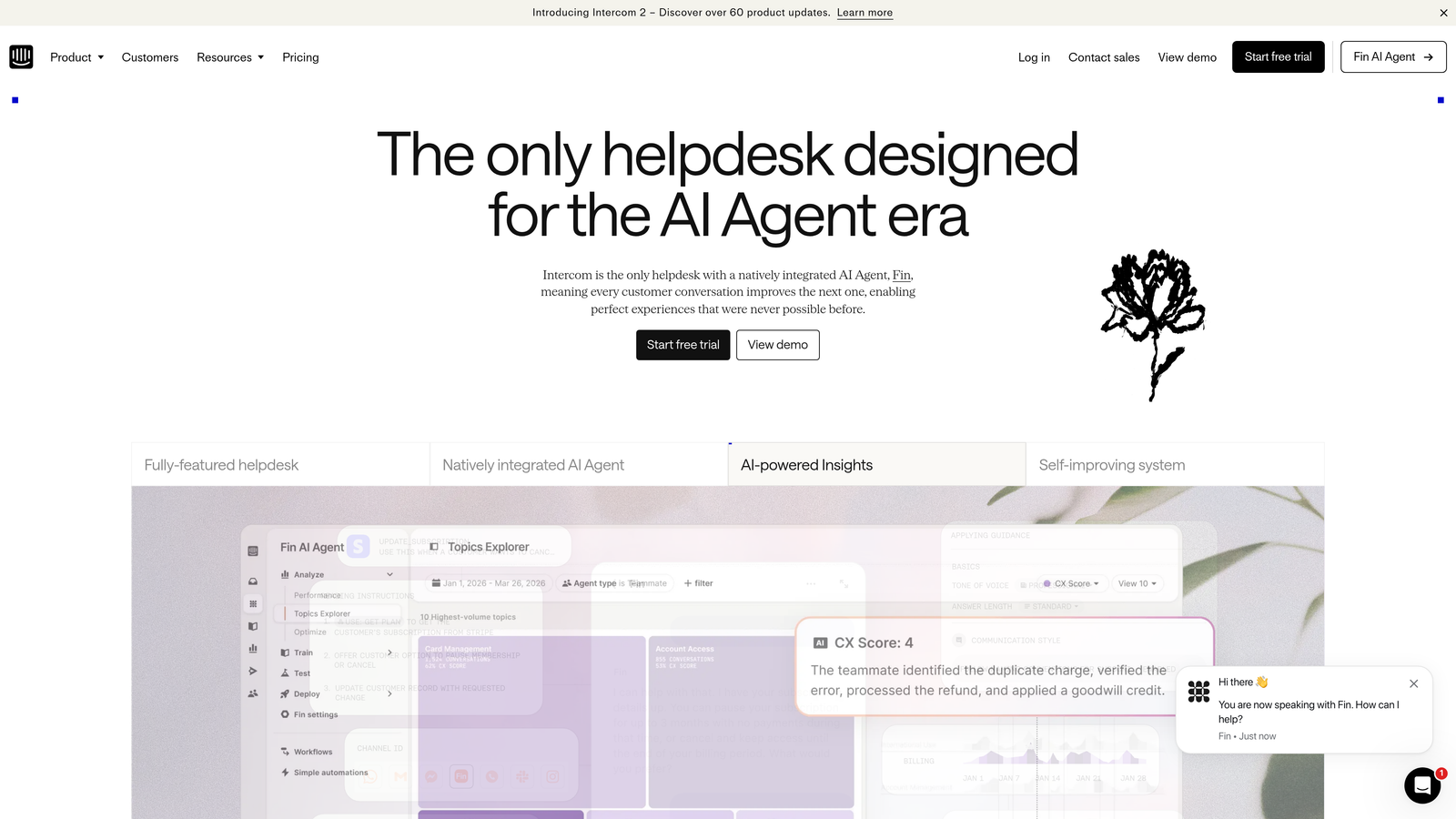
Intercom is a mature customer messaging platform featuring Fin AI, an LLM-powered agent that resolves support queries using your help center content.
Where This Tool Shines
Intercom's Fin AI agent is one of the more capable AI resolution tools available to teams that are already running on the Intercom platform. It's trained on your existing help center content and can handle a meaningful portion of inbound queries without human involvement.
The unified inbox, which combines chat, email, and social channels, makes it easier for teams to manage omnichannel support without juggling multiple tools. The app marketplace is extensive, and for teams already embedded in the Intercom ecosystem, the path to adding AI automation is relatively low-friction.
Key Features
Fin AI Agent: LLM-powered autonomous resolution trained on your help center content for accurate, context-aware responses.
Unified Inbox: Combines chat, email, and social support into a single interface for streamlined agent workflows.
Workflows Automation Builder: Visual builder for creating routing rules, escalation logic, and automated responses.
Large App Marketplace: Extensive ecosystem of integrations covering CRM, billing, analytics, and more.
In-Product Messaging: Proactive support and onboarding messaging triggered by user behavior.
Best For
Teams already using Intercom for customer communication who want to add AI resolution without switching platforms. Less compelling as a net-new purchase for teams evaluating AI-first alternatives from scratch.
Pricing
Starts at $39/seat/month; Fin AI resolution pricing varies by usage. Costs can scale quickly for high-volume teams, so model your expected resolution volume before committing.
3. Zendesk
Best for: Enterprise teams with complex routing, SLA requirements, and compliance needs who want AI layered onto a proven helpdesk foundation.
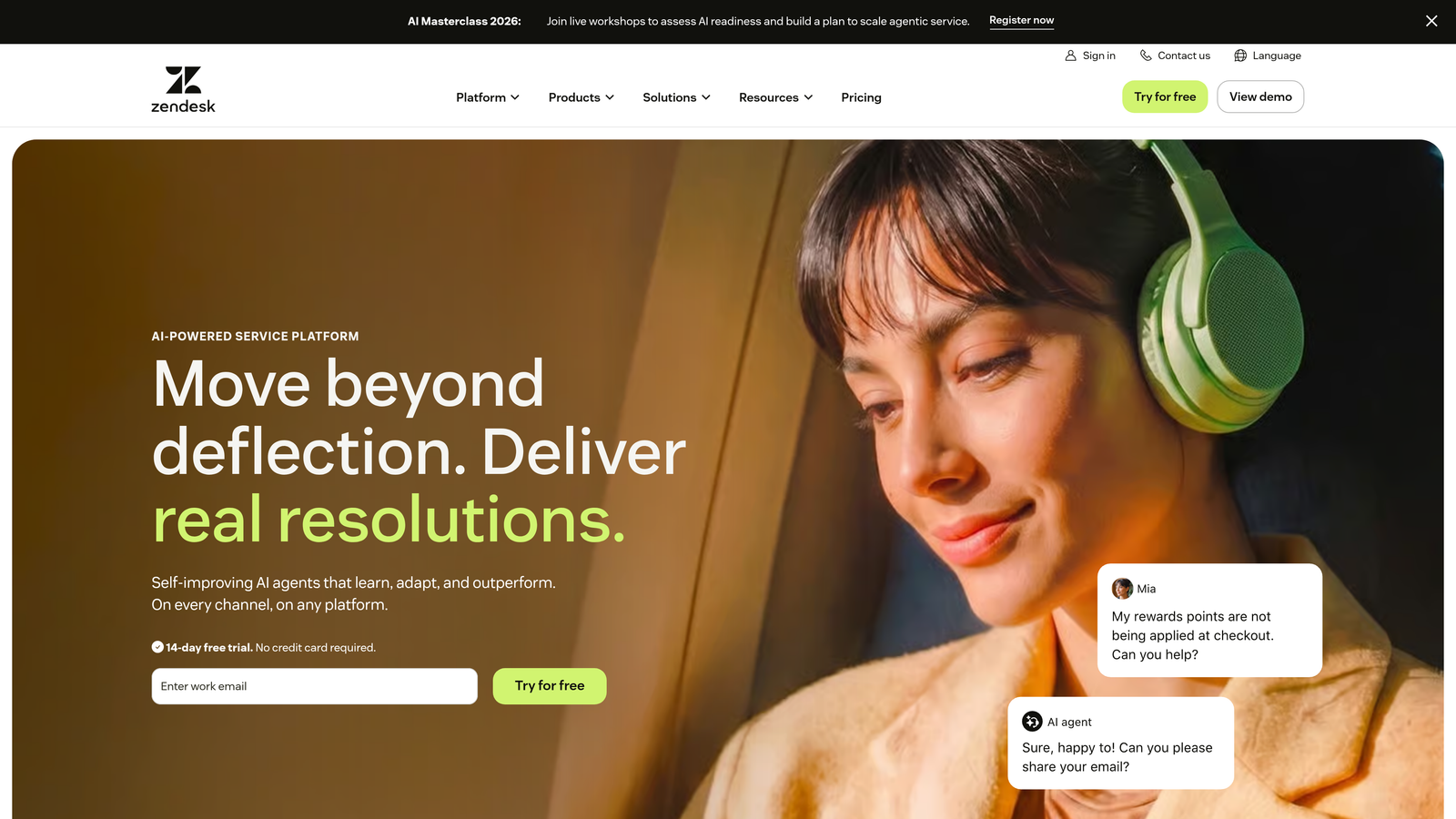
Zendesk is the enterprise-standard helpdesk platform with AI automation features built across ticketing, self-service, and agent workflows.
Where This Tool Shines
Zendesk's strength is its maturity. The platform handles complex enterprise requirements: advanced SLA management, compliance controls, sophisticated routing logic, and a marketplace of over 1,000 integrations. For large organizations with established support operations, it offers infrastructure that's hard to replicate elsewhere.
The AI capabilities, including intelligent triage, ticket summarization, and intent detection, are genuinely useful, though they're layered onto existing infrastructure rather than built from the ground up as AI-native features. Teams that need AI to augment an already robust helpdesk operation will find Zendesk's approach fits well.
Key Features
AI-Powered Triage and Routing: Intelligent ticket classification and routing based on intent, sentiment, and priority signals.
Zendesk AI: Automated ticket summarization, intent detection, and suggested responses to accelerate agent workflows.
Advanced SLA Management: Comprehensive service level controls with compliance reporting for enterprise requirements.
Extensive Marketplace: 1,000+ integrations covering virtually every tool in a modern B2B tech stack.
Self-Service Portal and Knowledge Base: Built-in tools for deflecting tickets through documentation and guided help.
Best For
Larger organizations with established support operations, complex routing requirements, and compliance needs. Can feel heavyweight for smaller teams or those looking for AI-first resolution rather than AI-assisted ticketing.
Pricing
Suite plans start at $55/agent/month billed annually. Enterprise plans with full AI capabilities sit at a higher price point; confirm current pricing directly with Zendesk for your team size.
4. Freshdesk
Best for: SMBs and growth-stage teams looking for an accessible helpdesk with solid AI automation at a competitive price point.
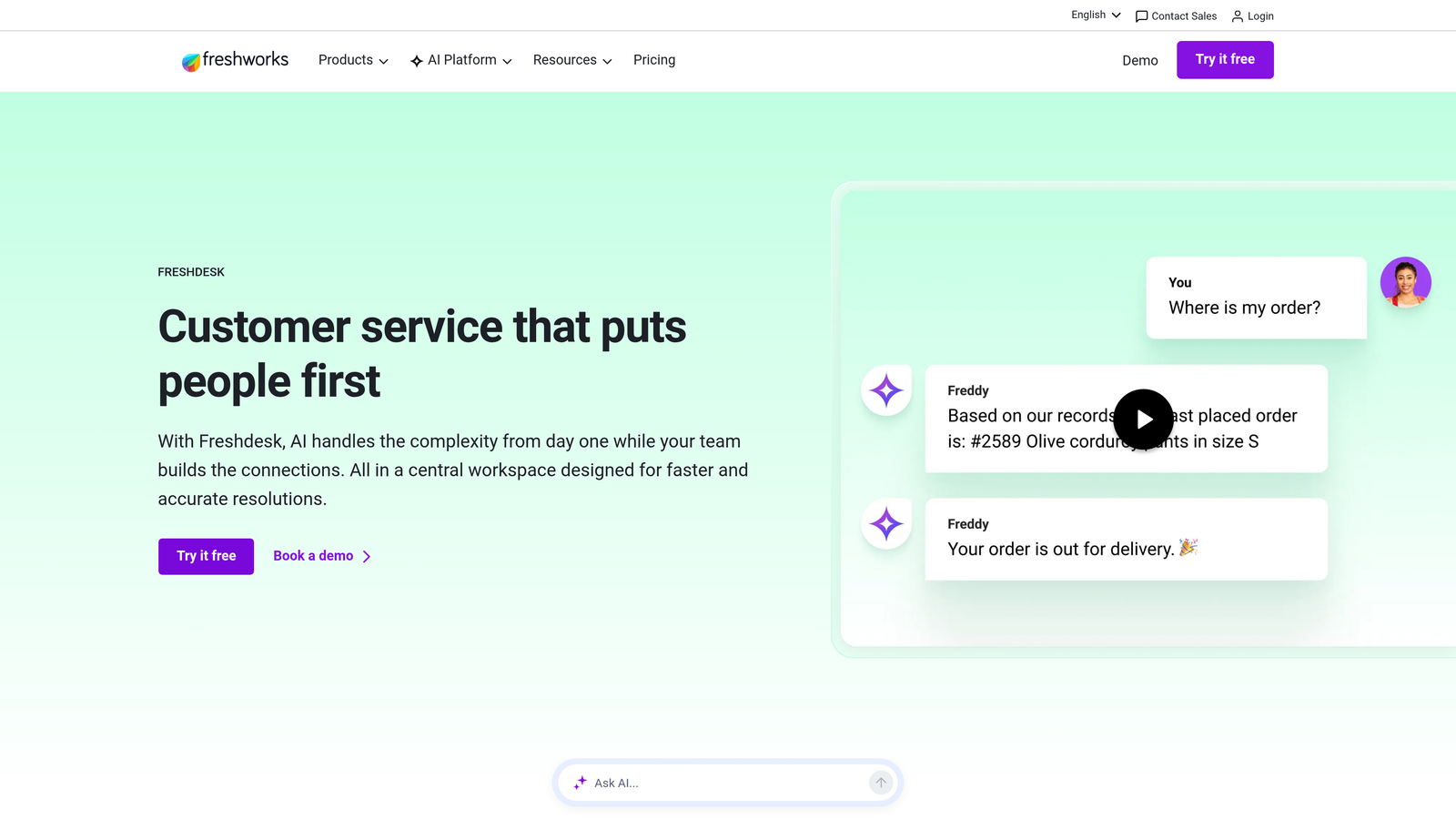
Freshdesk is a helpdesk platform with Freddy AI built in across self-service, triage, and agent assist, positioned as a more accessible alternative to enterprise-tier tools.
Where This Tool Shines
Freshdesk's biggest advantage is value. It delivers meaningful AI automation across the full support workflow at price points well below Zendesk or enterprise-focused alternatives. Freddy AI touches three distinct areas: self-service deflection, automated triage, and agent reply drafting, which gives teams a cohesive automation layer without piecing together multiple tools.
For teams scaling from manual support processes, Freshdesk offers a clear upgrade path. And because it's part of the broader Freshworks ecosystem, companies that also use Freshsales or Freshservice can connect data across functions without heavy integration work.
Key Features
Freddy Self Service: AI-powered deflection that answers common queries before they become tickets.
Freddy Copilot: Agent assist features including reply drafting and conversation summarization.
Automated Ticket Triage: Intelligent priority assignment and routing based on ticket content and context.
Omnichannel Support: Handles email, chat, phone, and social channels from a single platform.
Freshworks Ecosystem: Native connections to Freshsales CRM, Freshservice ITSM, and other Freshworks products.
Best For
SMBs and growth-stage SaaS teams that need solid AI-assisted automation without enterprise pricing. Also a strong fit for companies already using other Freshworks products.
Pricing
Free plan available for small teams; paid plans start at $15/agent/month. Freddy AI features are available on higher tiers, so confirm which plan includes the capabilities you need.
5. Tidio
Best for: Small teams and e-commerce businesses that need fast deployment with minimal technical overhead.
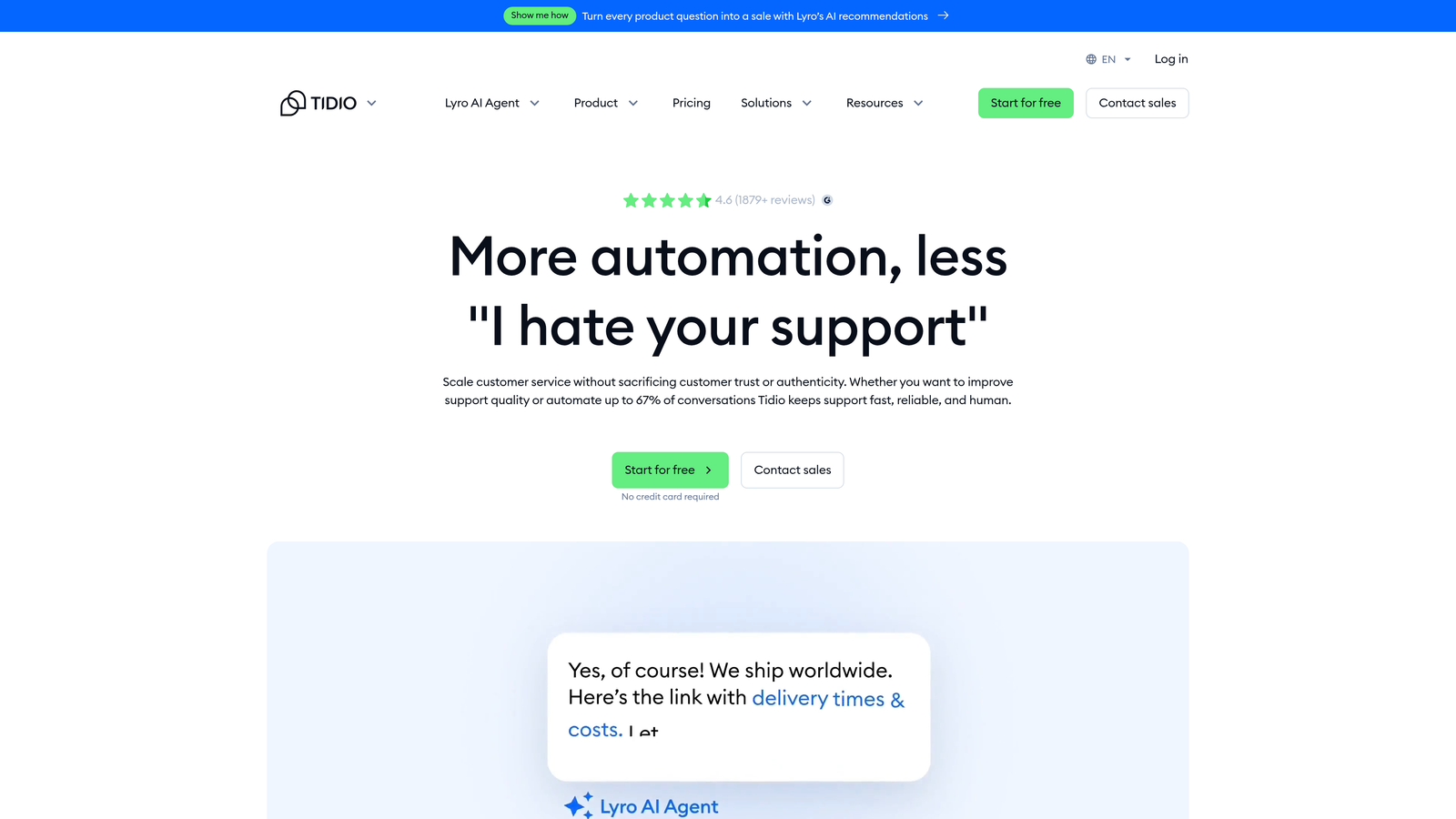
Tidio is a lightweight chat and automation platform featuring Lyro AI, designed for rapid setup with minimal technical complexity.
Where This Tool Shines
Tidio's core strength is speed to value. Teams can be up and running with AI-powered chat automation in a matter of hours, not weeks. The Lyro AI chatbot handles common queries automatically, and the combined live chat and AI interface means agents and automation work within the same tool rather than separate systems.
For e-commerce businesses or small SaaS teams that need basic automation without a complex implementation, Tidio delivers a clean experience. The pre-built templates and straightforward setup process make it accessible to teams without dedicated technical resources.
Key Features
Lyro AI Chatbot: Automated query resolution trained on your support content, handling common questions without agent involvement.
Combined Live Chat and AI: Single interface for both automated and human-assisted conversations.
Pre-Built Automation Templates: Ready-to-use workflow templates for common support scenarios, reducing setup time.
E-Commerce Integrations: Native connections with Shopify and WooCommerce for order and product context.
Visitor Tracking and Proactive Triggers: Behavioral triggers that initiate chat based on user activity on your site.
Best For
Small teams, e-commerce businesses, and early-stage SaaS companies that prioritize ease of deployment. Less suited for complex B2B support workflows with multi-step escalation logic or deep CRM integration requirements.
Pricing
Free plan available; Lyro AI plans start at $29/month. Accessible pricing makes it an easy entry point, though feature depth is limited compared to enterprise-focused platforms.
6. Drift (Salesloft)
Best for: Revenue-focused B2B teams where support automation and sales engagement need to work from the same platform.
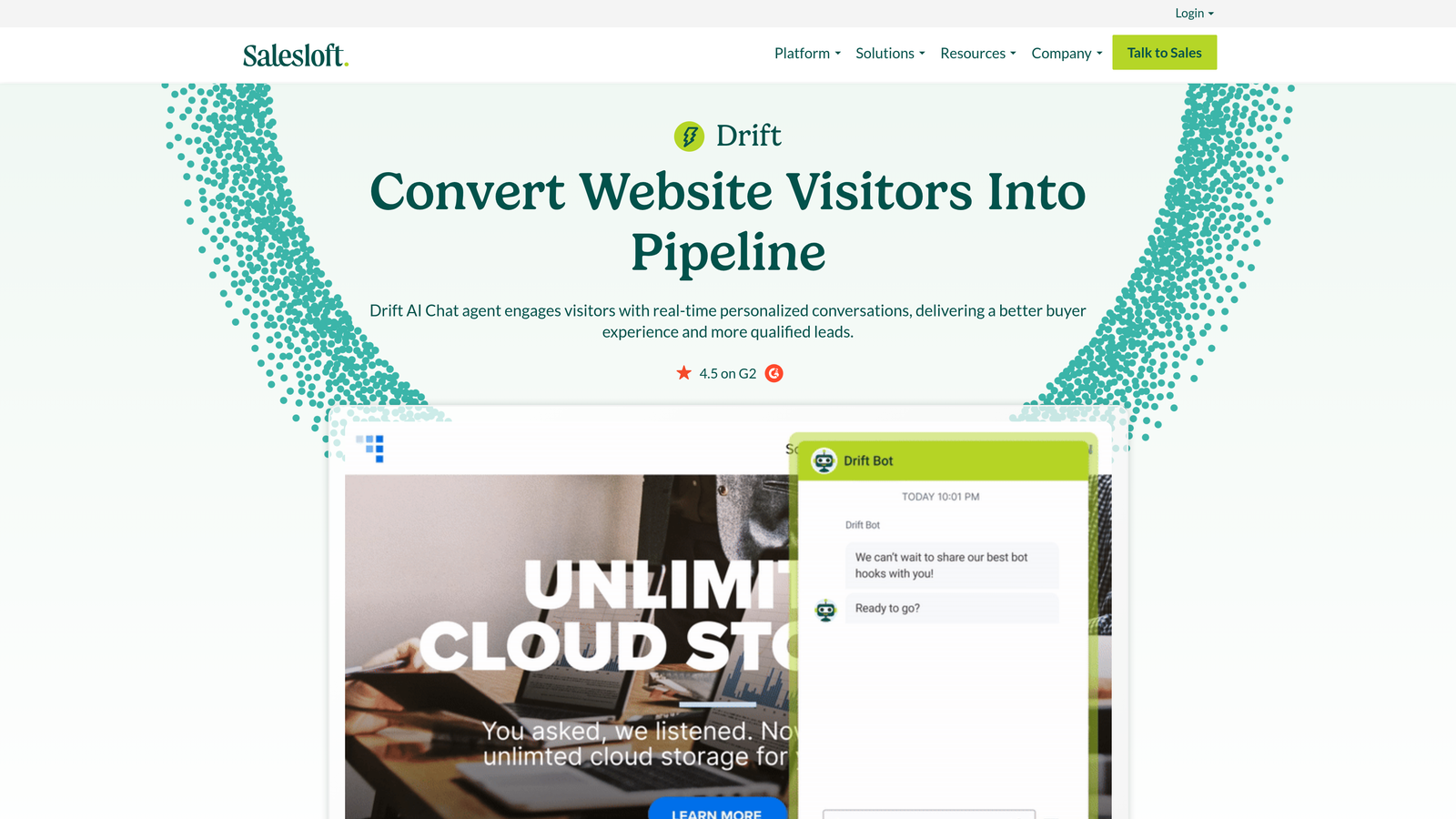
Drift, now part of Salesloft, is a conversational platform that blends support automation with sales engagement for teams where those functions overlap.
Where This Tool Shines
Drift occupies a unique position: it's not a pure support tool, and that's actually the point. For B2B companies where inbound conversations can be either support requests or sales opportunities, Drift's ability to qualify, route, and schedule in real time across both functions is genuinely valuable. The buyer intent signals and account-based targeting features are particularly strong for revenue teams.
Since the Salesloft acquisition, Drift sits within a broader revenue platform, which strengthens the case for companies already using Salesloft for sales engagement. The integration between conversation data and sales workflows is tighter than most standalone tools can offer.
Key Features
AI-Powered Chatbots: Handles both support queries and lead qualification within the same conversation flow.
Real-Time Buyer Intent Signals: Identifies high-intent visitors and routes them appropriately based on account data.
Meeting Scheduling Automation: Books sales meetings directly from chat, integrated with calendar and CRM workflows.
CRM and Salesloft Integration: Native connections with Salesforce, HubSpot, and Salesloft for full revenue context.
Conversational Landing Pages: Account-based targeting with personalized messaging for key accounts.
Best For
B2B companies where support and sales functions overlap significantly, particularly those already using Salesloft. Less ideal for teams that need deep, specialized support automation without the sales layer.
Pricing
Contact for pricing; positioning is enterprise-focused. Expect pricing to reflect the broader Salesloft platform context rather than standalone support tool rates.
7. Kustomer
Best for: High-volume support environments where full customer history and CRM context should drive every automated interaction.
Kustomer is a CRM-native support platform that builds a unified customer timeline and uses that context to power smarter automation and AI-assisted responses.
Where This Tool Shines
Kustomer's differentiation is context depth. Rather than treating each ticket as an isolated event, the platform builds a complete customer timeline across every touchpoint, and that history informs every automated decision. For support teams dealing with complex, multi-touch customer relationships, this approach reduces the frustrating experience of customers having to repeat themselves across channels.
The AI features, including intent detection and automated workflow triggers, are more powerful when they have rich customer data to work with. Kustomer's CRM-native architecture means that data is always present, making automation smarter by default.
Key Features
Unified Customer Timeline: Complete interaction history across all channels, available in every support conversation.
AI Intent Detection: Automated identification of query type and urgency to trigger appropriate workflows.
Omnichannel Support with Context: Conversations across email, chat, phone, and social with context preserved across channels.
KustomerIQ: Suggested replies and auto-tagging to accelerate agent response times.
Deep CRM Data Integration: Customer attributes, purchase history, and lifecycle data available for automation logic.
Best For
High-volume support teams in B2C or complex B2B environments where customer relationship history is central to support quality. The enterprise pricing reflects its positioning for larger operations.
Pricing
Starts at $89/agent/month on the Enterprise plan. Verify current pricing directly with Kustomer, as ownership changes (acquired by Meta in 2022, subsequently sold) may have affected packaging.
8. Help Scout
Best for: Customer-centric teams that want AI to assist agents and improve response quality rather than replace human interaction entirely.
Help Scout is a customer support platform focused on human-quality experiences, with AI features designed to make agents faster and more effective.
Where This Tool Shines
Help Scout occupies a deliberate philosophical position: AI should make human support better, not invisible. The interface is clean, the shared inbox is thoughtfully designed, and the AI features, including thread summarization and reply drafting, are built to reduce cognitive load on agents rather than remove agents from the equation.
For teams where relationship quality is a competitive differentiator, Help Scout's approach resonates. The Docs knowledge base and AI-powered Answers widget handle self-service deflection without the impersonal feel that some automation-heavy platforms produce.
Key Features
AI Summarize: Condenses long conversation threads into concise summaries so agents get up to speed instantly.
AI Assist: Drafts reply suggestions based on conversation context, which agents can edit and send.
Docs with AI Answers Widget: Knowledge base tool with an AI-powered widget that surfaces relevant articles before tickets are created.
Shared Inbox with Collision Detection: Clean team inbox that prevents duplicate responses when multiple agents are active.
Customer Data Sidebar: Displays full interaction history alongside each conversation for immediate context.
Best For
Teams that prioritize relationship quality and want AI to augment rather than automate away human interaction. Strong fit for companies where support is a brand differentiator and a purely automated experience would feel off-brand.
Pricing
Starts at $20/user/month on the Standard plan. One of the more accessible price points on this list, making it a strong option for teams that want quality tooling without enterprise-level spend.
9. Forethought
Best for: Enterprise teams that want to add AI resolution and intelligent triage on top of an existing helpdesk like Zendesk or Salesforce Service Cloud.
Forethought is an enterprise AI platform featuring Agatha AI, which predicts ticket intent, automates resolution, and layers intelligently onto existing helpdesk infrastructure.
Where This Tool Shines
Forethought's value proposition is clear: if you're committed to your existing helpdesk and don't want to rip and replace, Forethought adds a sophisticated AI layer on top. Agatha AI handles intent prediction, intelligent routing, and automated resolution for common queries, all without requiring you to migrate away from Zendesk, Salesforce, or ServiceNow.
The Discover module is particularly useful for operations-minded teams. It analyzes your existing ticket data to identify which workflows have the highest automation potential, giving you a data-driven roadmap for where to focus deflection efforts rather than guessing.
Key Features
Agatha AI: Intent prediction and intelligent triage that routes tickets based on content, urgency, and historical patterns.
Solve: Automated resolution for common queries, handling end-to-end ticket closure without agent involvement.
Triage: Smart routing and priority scoring to ensure complex tickets reach the right agent quickly.
Assist: AI-suggested responses for live agents, reducing time-to-reply on tickets that require human handling.
Discover: Workflow analytics that identify automation opportunities across your existing ticket volume.
Best For
Enterprise support operations that want to add AI capabilities to an established helpdesk without platform migration. Particularly strong for teams with large ticket volumes where intelligent triage and deflection have the biggest ROI impact.
Pricing
Contact for pricing; positioning and packaging are enterprise-focused. Best suited for organizations with the ticket volume and budget to justify an enterprise AI layer.
Which Tool Is Right for Your Team?
The right support automation tool depends less on which platform has the most features and more on where your team is today and where you're trying to go.
If you're a B2B SaaS team that wants AI-first autonomous resolution with business intelligence built in, Halo AI is the strongest fit. It's purpose-built for the use case rather than retrofitted onto legacy infrastructure, and the page-aware context and business intelligence output go well beyond what most support tools offer.
For enterprise teams committed to an existing helpdesk, Zendesk remains the infrastructure standard, and Forethought is the cleanest way to add serious AI capability on top of it without a platform migration.
Growth-stage teams working with tighter budgets will find Freshdesk offers the best combination of AI capability and accessible pricing. Tidio is the fastest path to basic automation for small teams or e-commerce businesses that need something running today.
If your support and sales motions overlap significantly, Drift inside the Salesloft platform handles that intersection better than any pure-play support tool. And for teams where the human touch is a deliberate brand choice, Help Scout delivers AI that enhances agents without replacing the relationship quality that makes your support stand out.
The broader principle: match the tool to your current stack, your growth trajectory, and your philosophy about what support should do. Automation that deflects tickets is table stakes in 2026. The better question is whether your support platform is also surfacing customer intelligence, connecting to your product and revenue systems, and getting smarter with every interaction.
Your support team shouldn't scale linearly with your customer base. See Halo in action and discover how continuous learning transforms every interaction into smarter, faster support that scales without scaling headcount.