9 Top-Rated Support Intelligence Tools for B2B Teams in 2026
Discover the top rated support intelligence tools transforming B2B customer support in 2026, from AI-native platforms to enterprise helpdesks with advanced analytics layers. This guide evaluates nine leading solutions on AI capability, integration depth, and fit for SaaS teams—helping support leaders move from reactive ticket management to proactive, insight-driven operations at any scale.
 Grant CooperFounder15 min read
Support intelligence has moved well beyond basic ticket tracking. Today's B2B teams need platforms that don't just log issues — they surface patterns, guide users in real time, flag bugs automatically, and feed insights back into product and revenue decisions. The difference between a reactive support org and a proactive one often comes down to the tools powering it.
This list covers nine of the best support intelligence platforms available in 2026, evaluated on depth of AI capability, integration breadth, analytics quality, and fit for B2B SaaS teams. Whether you're running a lean startup support function or managing a complex enterprise helpdesk, there's a tool here built for your scale. We've included a mix of AI-native platforms, established helpdesk players with intelligence layers, and specialized analytics tools — so you can find the right fit without wading through dozens of options.
1. Halo AI
Best for: Product-led SaaS teams that want support to generate business intelligence, not just close tickets.
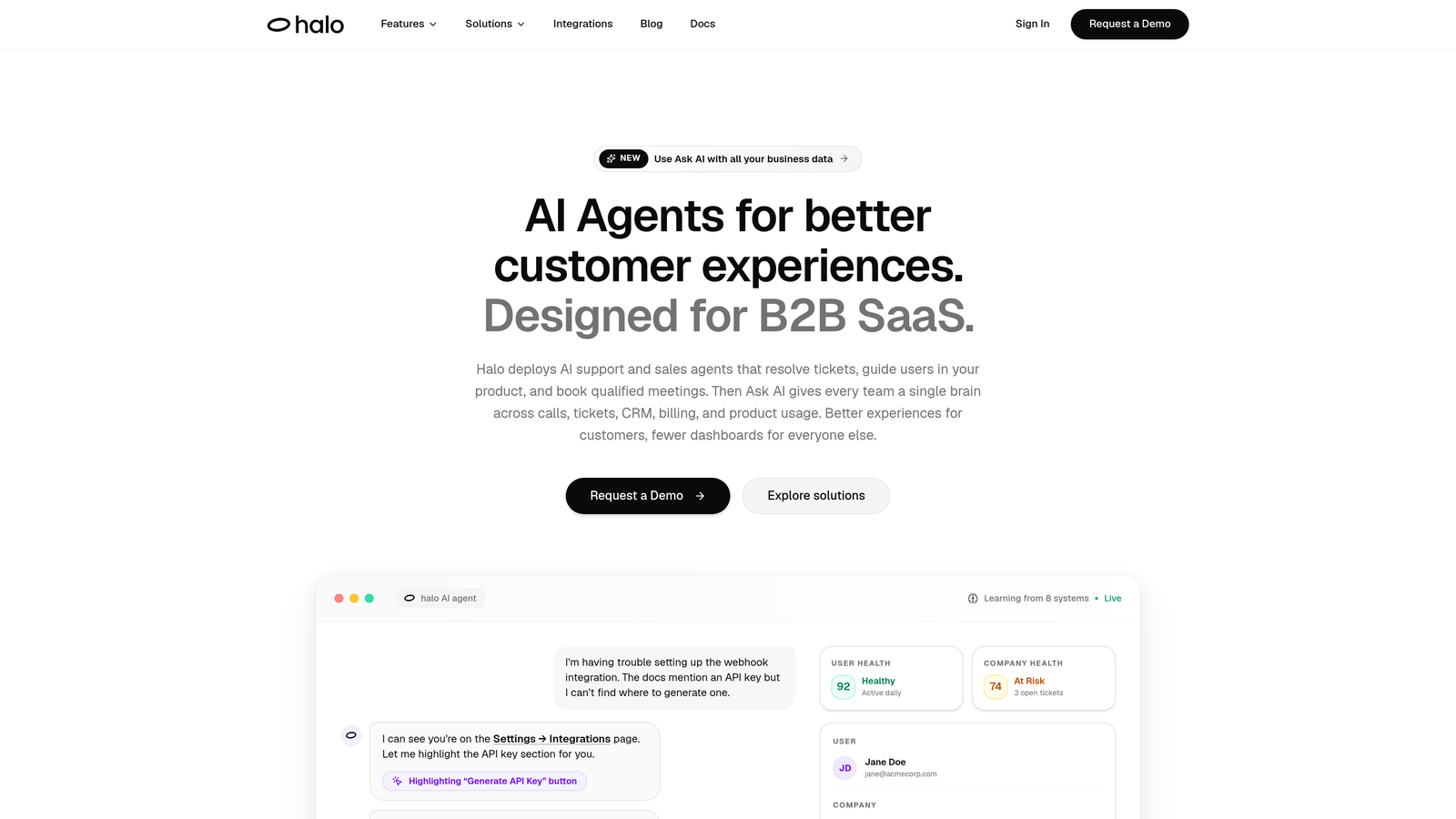
Halo AI is an AI-first customer support platform that resolves tickets autonomously, guides users through your product with page-aware context, and surfaces business intelligence from every support interaction.
Where This Tool Shines
What separates Halo from most support tools is its architecture. It's not a plugin layered onto Zendesk or Freshdesk — it's built from the ground up around AI-autonomous resolution. That distinction matters because it means the intelligence isn't an afterthought; it's the core of how the system operates.
The page-aware chat widget is a genuine differentiator. Instead of serving generic responses, Halo sees what page and product state a user is currently on, then tailors guidance accordingly. Pair that with a continuous learning loop that improves resolution accuracy from every interaction, and you get a system that gets meaningfully smarter over time rather than plateauing.
Key Features
Page-Aware Chat Widget: The AI sees what users see — current page, product state, and context — delivering visual guidance that's relevant to where they actually are in your product.
Smart Inbox with Business Intelligence: Surfaces customer health signals, revenue anomalies, and product usage patterns from support data, turning your inbox into an intelligence layer for the whole business.
Auto Bug Ticket Creation: Detects recurring issues across conversations and automatically files structured bug reports to Linear or your preferred tracker — no agent intervention required.
Live Agent Handoff: Escalates complex issues to human agents with full conversation context preserved, so customers never have to repeat themselves.
Deep Integration Stack: Connects with Linear, Slack, HubSpot, Intercom, Stripe, Zoom, PandaDoc, and Fathom, feeding support intelligence into the tools your product and revenue teams already use.
Best For
Halo is the strongest fit for B2B SaaS companies operating a product-led growth model, where support interactions carry product and revenue signals worth capturing. If your team is tired of support being a cost center that doesn't inform product decisions, Halo is built for exactly that use case. Particularly well-suited for teams scaling headcount concerns who want AI to handle routine volume autonomously.
Pricing
Custom pricing based on your team's needs. Contact Halo AI directly at haloagents.ai for a tailored quote.
2. Zendesk
Best for: Enterprise and mid-market teams wanting AI layered onto a proven, deeply integrated helpdesk infrastructure.
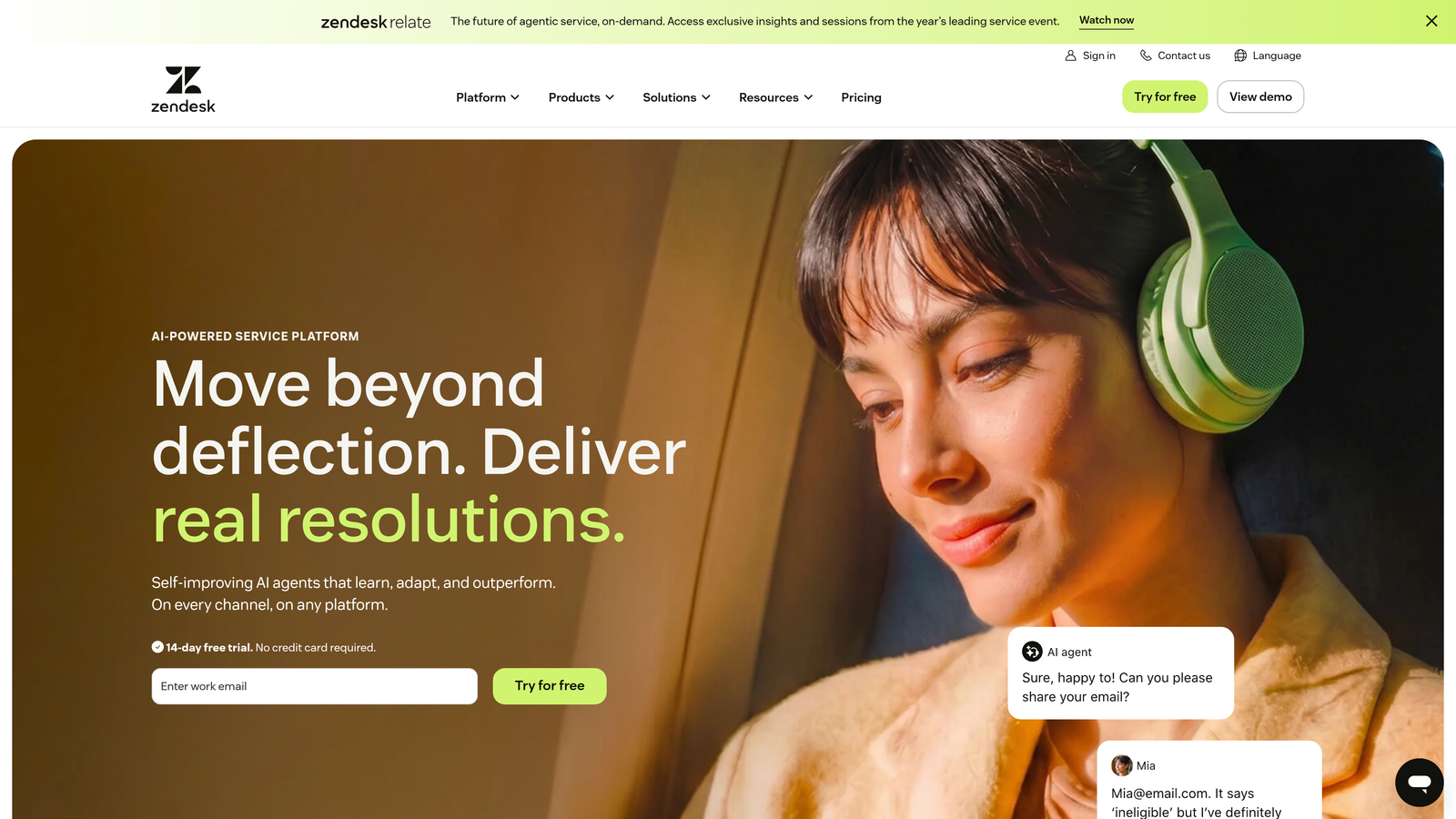
Zendesk is the market-leading helpdesk platform with a mature AI layer covering triage, summarization, and autonomous agent capabilities.
Where This Tool Shines
Zendesk's strength is its maturity. With over a decade of development, a marketplace of more than 1,000 integrations, and an advanced reporting suite, it's the platform that enterprise support orgs have built their operations around. The AI layer added in recent years — through both internal development and acquisitions — brings meaningful intelligence to that foundation.
For teams already invested in the Zendesk ecosystem, the AI capabilities slot in naturally. Ticket summarization, suggested replies, and the Zendesk AI agent for autonomous resolution all work within workflows agents already know, reducing adoption friction considerably.
Key Features
AI-Powered Triage and Routing: Automatically tags, categorizes, and routes incoming tickets based on content and intent, reducing manual sorting overhead.
Zendesk AI Agent: Handles autonomous resolution of common query types without human intervention, escalating complex issues to live agents when needed.
Ticket Summarization and Suggested Replies: Generates concise conversation summaries and draft responses for agents, reducing handle time on complex tickets.
Advanced Reporting Suite: Customizable dashboards covering ticket volume, CSAT, resolution times, and agent performance metrics.
1,000+ Marketplace Integrations: Connects with virtually every tool in a modern support stack, from CRMs to developer tools to workforce management platforms.
Best For
Teams with established support operations who need enterprise-grade reliability, compliance, and integration depth. Zendesk is particularly strong for organizations where support spans multiple channels, regions, or product lines and needs a single unified platform to manage it all.
Pricing
Suite plans start at approximately $55–$115 per agent per month depending on tier. Pricing changes frequently — verify current rates at zendesk.com before budgeting.
3. Intercom
Best for: SaaS companies prioritizing in-app conversational support, onboarding flows, and proactive user engagement.
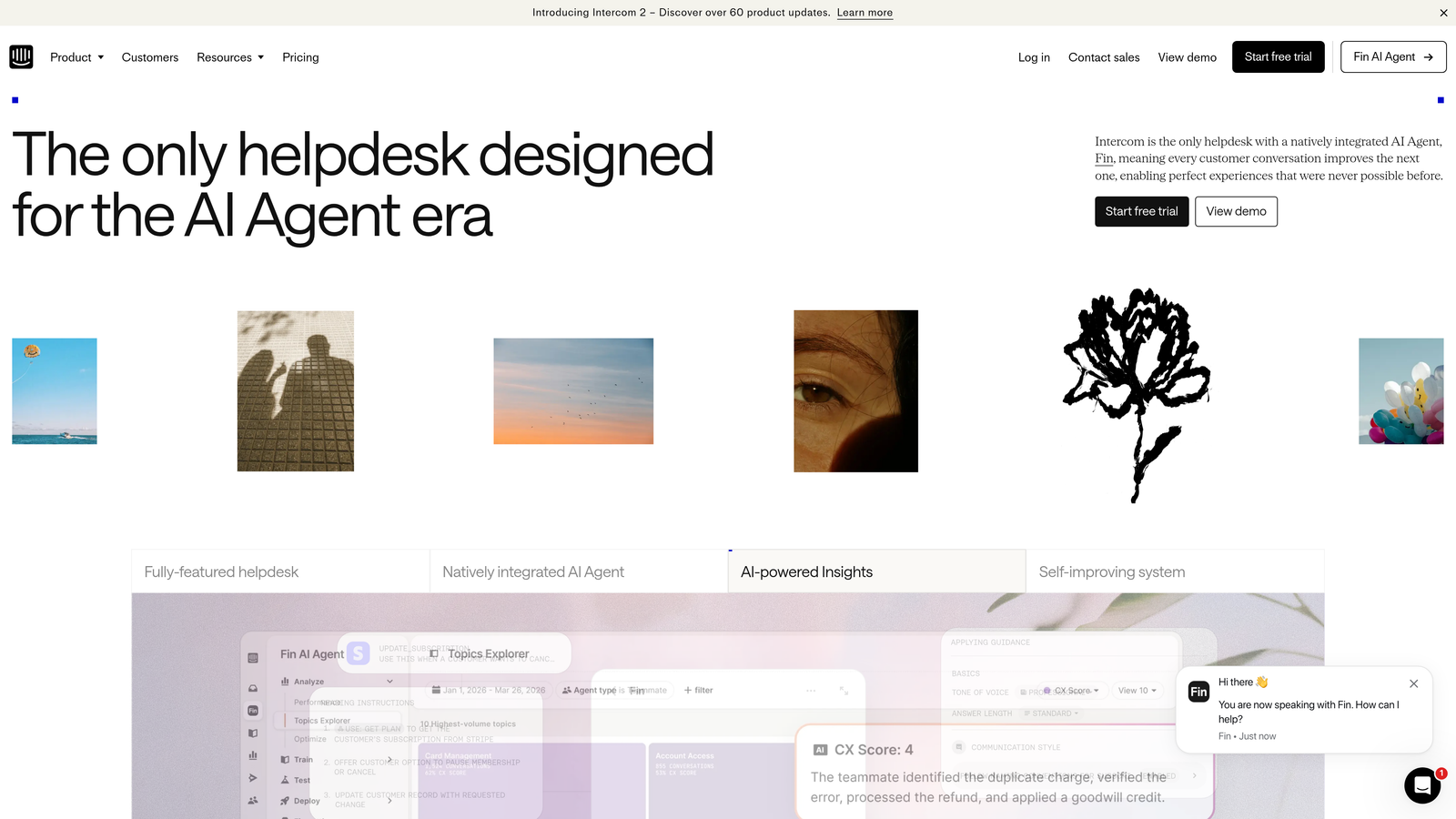
Intercom is a conversational support platform with in-app messaging and Fin, their AI agent built for autonomous customer query resolution.
Where This Tool Shines
Intercom's messenger-first approach makes it uniquely strong for in-product support experiences. If your users need help while actively using your application, Intercom's in-app widget, guided tours, and proactive messaging flows create a support experience that feels native to the product rather than bolted on.
Fin, their AI agent built on GPT-class models, handles autonomous resolution of common queries and integrates naturally with Intercom's broader conversation management layer. The combination of proactive outreach, in-app guidance, and AI resolution makes Intercom particularly compelling for SaaS teams focused on reducing time-to-value for new users.
Key Features
Fin AI Agent: Autonomously resolves common support queries using your knowledge base, escalating to human agents when queries exceed its confidence threshold.
In-Product Messenger: Rich media messaging, guided product tours, and contextual help articles delivered directly within your application.
AI-Powered Inbox: Conversation summaries, suggested next actions, and intelligent assignment to reduce agent cognitive load.
Proactive Messaging and Onboarding Flows: Trigger targeted messages based on user behavior, product usage, or lifecycle stage to preempt support tickets before they're created.
Product Analytics Integration: Connects with product analytics and CRM tools to bring customer context into support conversations.
Best For
SaaS companies where in-app engagement and onboarding quality are as important as ticket resolution speed. Intercom works well when support, success, and product teams share a single platform for user communication. Less ideal for high-volume transactional support environments where cost-per-resolution economics become a concern at scale.
Pricing
Usage-based pricing model; Fin AI agent is priced per resolution. Costs can scale quickly at high volumes — verify current pricing at intercom.com before committing.
4. Freshdesk
Best for: Mid-market teams that need structured helpdesk capabilities with AI intelligence at accessible price points.
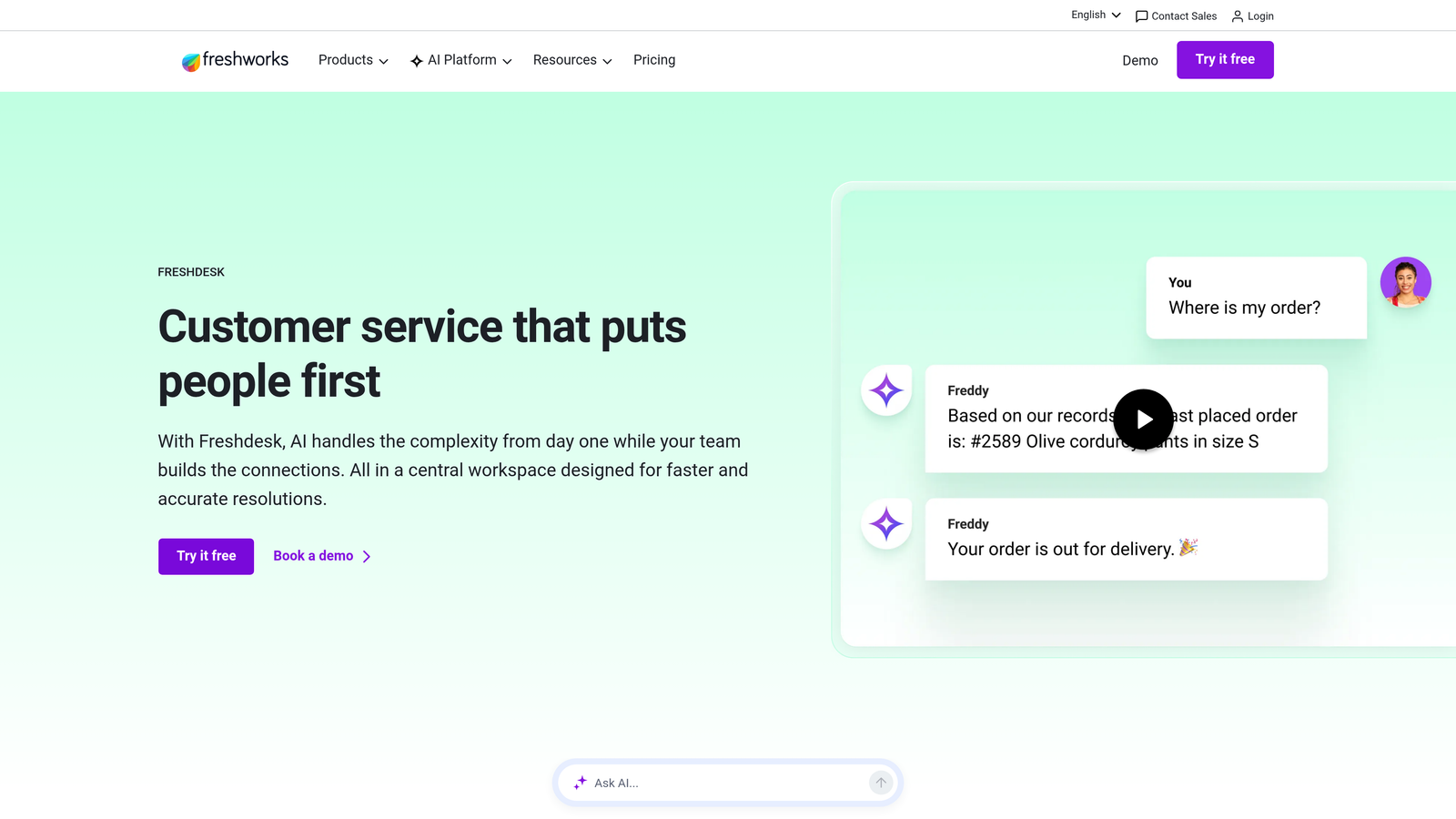
Freshdesk is an omnichannel helpdesk with Freddy AI providing ticket intelligence, sentiment detection, and self-service automation.
Where This Tool Shines
Freshdesk occupies an important position in the market: it delivers many of the AI and omnichannel capabilities that enterprise platforms offer, but at price points that don't require a procurement committee to approve. For growing B2B teams that have outgrown basic email support but aren't ready for Zendesk's complexity or cost, Freshdesk is often the right call.
Freddy AI, Freshdesk's intelligence layer, covers the practical bases well — auto-tagging, sentiment scoring, ticket summarization, and suggested replies all reduce agent workload meaningfully. The self-service deflection capabilities through Freddy Self Service can handle a meaningful share of inbound volume before it ever reaches a human agent.
Key Features
Freddy AI Copilot: Provides real-time agent suggestions, auto-tagging, and ticket summarization to reduce handling time and improve consistency.
Freddy Self Service: AI-powered chatbot and deflection flows that handle common query types before they reach the agent queue.
Omnichannel Support: Unified inbox across email, live chat, phone, and social channels with consistent routing and reporting.
Sentiment Analysis and Priority Scoring: Automatically flags frustrated customers and high-priority tickets so agents can triage by impact rather than just arrival order.
Free Tier Available: Small teams can start with no cost and upgrade as needs grow, making it accessible for early-stage companies.
Best For
Growing B2B teams that need a reliable omnichannel helpdesk with AI capabilities without enterprise pricing. Freshdesk is particularly strong for teams transitioning from email-only support who need structure, reporting, and automation without a steep learning curve or budget commitment.
Pricing
Free tier available for small teams. Paid plans start at accessible rates with AI features available on higher tiers. Check freshdesk.com for current plan details.
5. Gorgias
Best for: B2B teams with commerce-adjacent support workflows that need deep e-commerce platform integrations.
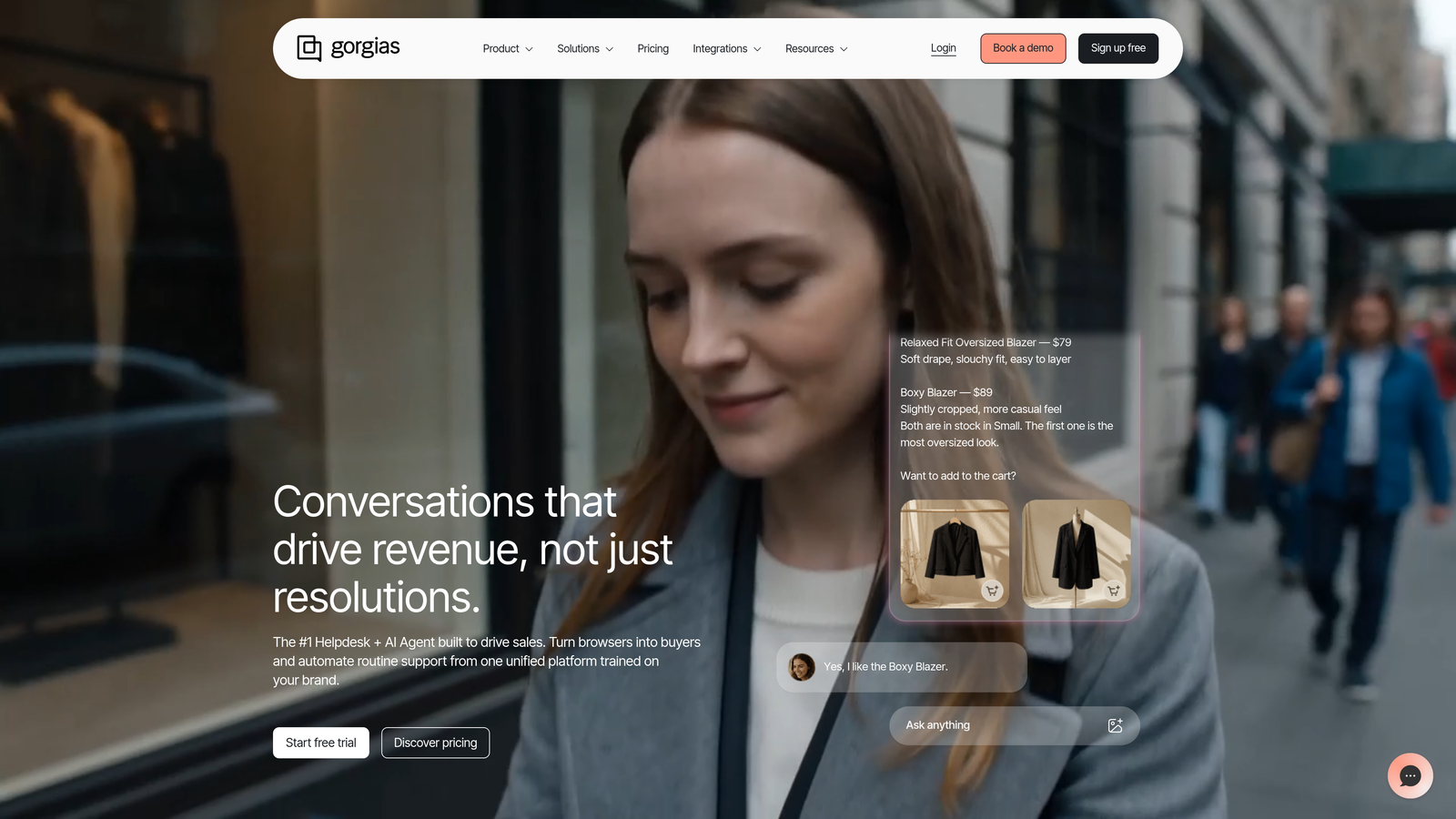
Gorgias is a support platform with deep e-commerce integrations and AI automation, strongest for teams where customer support intersects with order and revenue data.
Where This Tool Shines
Gorgias built its reputation in e-commerce support, and that heritage shows in features that pure-play SaaS helpdesks simply don't have. Revenue-tagged ticket views that link conversations directly to order values, and deep integrations with Shopify, WooCommerce, and BigCommerce, make it uniquely capable for teams where support and revenue are closely connected.
For B2B companies with commerce-adjacent workflows — think software platforms serving retailers, or SaaS companies that also sell physical products — Gorgias bridges the gap between support intelligence and revenue impact in a way that general helpdesks don't. That said, if your support model is purely software-focused without an e-commerce component, other tools on this list will serve you better.
Key Features
AI Macros for High-Frequency Tickets: Automatically responds to repetitive ticket types using AI-generated macros, reducing agent time on routine queries.
Revenue-Tagged Ticket Views: Links support conversations to order values and customer revenue data, making it easy to prioritize high-value customer issues.
Deep Commerce Integrations: Native integrations with Shopify, WooCommerce, and BigCommerce bring order history, shipping status, and account data directly into the support view.
Intent Detection and Routing: Classifies incoming tickets by intent and routes them to the appropriate team or automation flow automatically.
Unified Inbox: Manages email, live chat, social media, and SMS conversations in a single workspace.
Best For
B2B teams operating at the intersection of software and commerce — SaaS platforms serving retailers, marketplace businesses, or companies with both digital and physical product lines. Less suited for pure-play SaaS support without an e-commerce component.
Pricing
Plans start at approximately $10 per month for small ticket volumes and scale based on ticket count. Verify current pricing at gorgias.com.
6. Kustomer
Best for: Teams where full customer lifetime context — purchases, prior tickets, account history — is as critical as resolution speed.
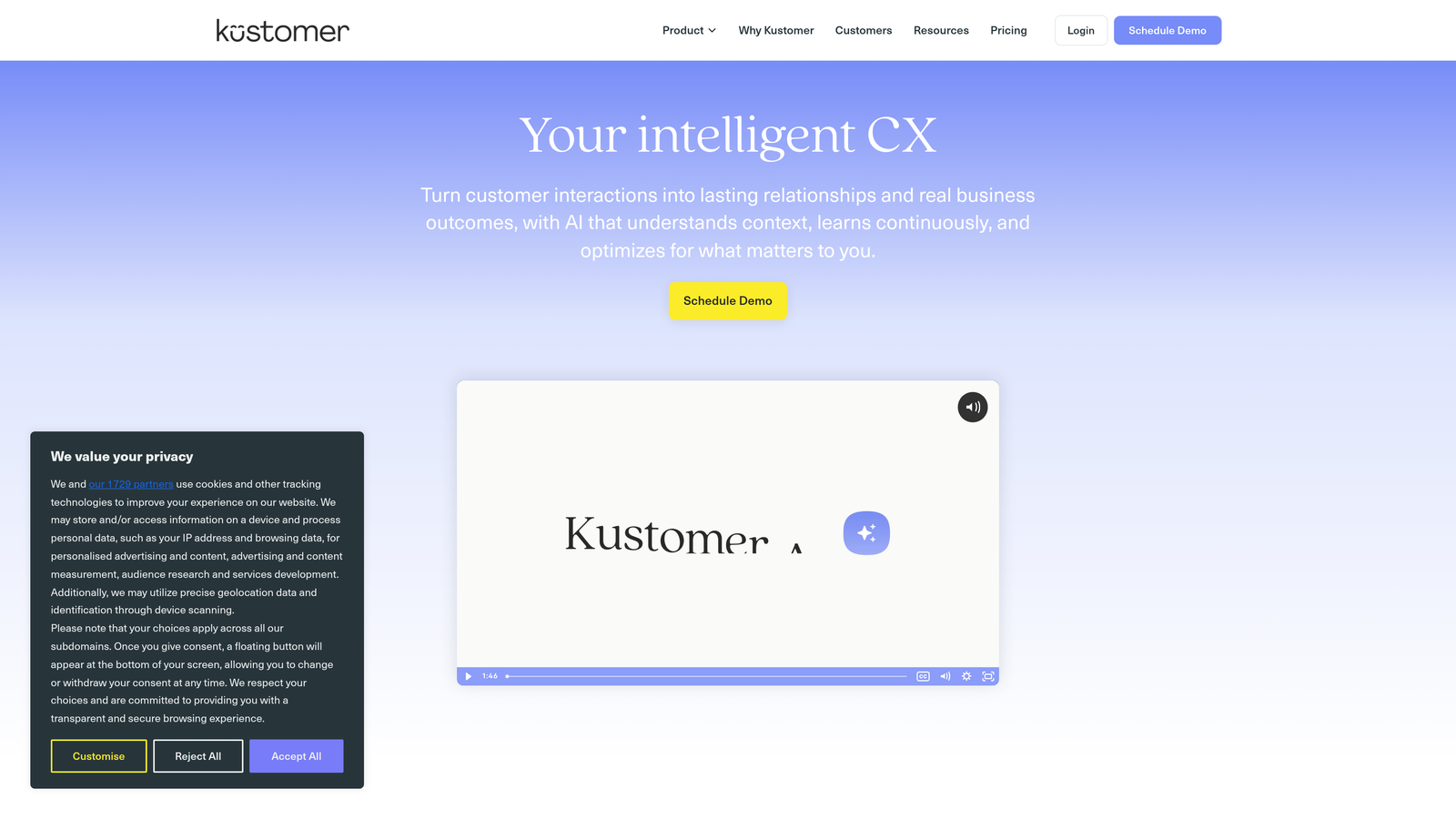
Kustomer is a CRM-meets-helpdesk platform that combines complete customer timeline context with AI-powered conversation intelligence and deflection.
Where This Tool Shines
Kustomer's core insight is that support conversations don't happen in isolation — they happen in the context of a customer's full relationship with your business. Its unified customer timeline brings together every ticket, purchase, account change, and interaction into a single view, giving agents the context they need to resolve issues faster and more personally.
The AI layer adds sentiment analysis, conversation summarization, and deflection bots on top of that rich data foundation. It's worth noting that Kustomer was acquired by Meta in 2022, which introduces some uncertainty around long-term product direction that teams evaluating it for a multi-year commitment should factor into their decision.
Key Features
Unified Customer Timeline: Aggregates all customer touchpoints — tickets, purchases, account history, and prior interactions — into a single chronological view for every agent.
AI Sentiment Analysis and Summarization: Automatically scores conversation sentiment and generates summaries to help agents prioritize and respond more effectively.
Deflection Bots: Handles common query types autonomously before routing to human agents, reducing inbound volume on routine issues.
Intelligent Routing: Routes conversations based on customer attributes, account tier, and interaction history rather than just ticket content.
CRM-Style Customer Profiles: Each customer record functions like a CRM profile, giving support teams account-level visibility without switching to a separate system.
Best For
Support teams where customer lifetime value and account context are central to how issues should be prioritized and handled. Particularly strong for B2B teams with complex customer relationships where a ticket can't be understood without knowing the customer's full history.
Pricing
Custom pricing based on team size and usage. Contact Kustomer directly at kustomer.com for current rates.
7. Forethought
Best for: Enterprise teams with significant helpdesk investment who want AI intelligence without a platform migration.
Forethought is an AI intelligence layer designed to sit on top of existing helpdesks like Zendesk, Salesforce Service Cloud, and Freshdesk — adding triage, resolution, and insight capabilities without requiring migration.
Where This Tool Shines
Forethought solves a real problem that many enterprise support teams face: they've invested heavily in a helpdesk platform, they have years of ticket data and configured workflows, and they're not willing to migrate — but they want AI capabilities that their current platform doesn't provide natively.
Rather than replacing the helpdesk, Forethought augments it. Its Discover product is particularly noteworthy for support intelligence: it performs topic clustering and trend detection across your ticket volume, surfacing patterns that would be invisible to manual analysis. For teams managing thousands of tickets per month, that kind of structured insight into what's actually driving volume is operationally valuable.
Key Features
Triage AI: Intelligent ticket routing and priority scoring that improves on native helpdesk routing logic using ML models trained on your historical data.
Assist AI: Real-time agent suggestions and knowledge base surfacing during active conversations, reducing handle time and improving first-contact resolution.
Solve AI: Autonomous ticket resolution for common query types, deflecting volume before it reaches the agent queue.
Discover: Topic clustering and trend detection across your full ticket volume, identifying emerging issues and high-frequency themes automatically.
Helpdesk Integrations: Native integrations with Zendesk, Salesforce Service Cloud, and Freshdesk, sitting on top of existing workflows without disrupting them.
Best For
Enterprise support orgs with established helpdesk infrastructure who need AI augmentation without the disruption and cost of platform migration. Forethought is particularly well-suited for teams where the helpdesk is deeply integrated with other enterprise systems and a migration is genuinely not feasible.
Pricing
Custom enterprise pricing. Contact Forethought directly at forethought.ai for a quote tailored to your ticket volume and use case.
8. Assembled
Best for: Support orgs with 20+ agents where scheduling efficiency, SLA forecasting, and staffing optimization are material operational concerns.
Assembled is a workforce management and operational intelligence platform built specifically for support teams, covering forecasting, scheduling, and real-time performance analytics.
Where This Tool Shines
Assembled addresses a gap that most AI resolution tools completely ignore: the operational layer of running a support team. Knowing that your AI agent will resolve 60% of tickets autonomously is useful, but you still need to staff and schedule the humans who handle the other 40% — and doing that well requires demand forecasting, skills-based scheduling, and real-time visibility into coverage adherence.
Assembled integrates with your existing helpdesk to pull actual ticket volume data, then uses that to generate staffing forecasts and optimized schedules. For support managers dealing with variable demand, seasonal spikes, or complex multi-team scheduling, this kind of operational intelligence is the difference between hitting SLAs consistently and constantly firefighting.
Key Features
Demand Forecasting: Predicts ticket volume based on historical patterns and business context, enabling proactive staffing decisions rather than reactive ones.
Skills-Based Scheduling: Assigns agents to shifts based on their specific skill sets and the anticipated mix of ticket types, improving first-contact resolution rates.
Real-Time Adherence Tracking: Monitors whether agents are working their scheduled coverage in real time, surfacing gaps before they become SLA misses.
Performance Analytics Dashboards: Provides support managers with visibility into team performance, utilization, and efficiency metrics over time.
Helpdesk Integrations: Connects with Zendesk, Intercom, Salesforce, and other major helpdesks to pull live and historical ticket data for forecasting.
Best For
Support teams of 20 or more agents where workforce planning is a recurring operational challenge. Assembled is most valuable when scheduling inefficiency, SLA forecasting errors, or uneven agent utilization are costing the team meaningful time or money.
Pricing
Custom pricing based on team size. Contact Assembled at assembledhq.com for current rates.
9. Klaus (Zendesk QA)
Best for: Support managers and QA leads who need systematic, scalable conversation quality measurement and structured agent coaching.
Klaus is an AI-powered quality assurance platform that automatically scores support conversations and powers structured agent coaching — now part of the Zendesk suite.
Where This Tool Shines
Quality assurance is one of the most neglected dimensions of support intelligence. Most teams either skip it entirely or rely on manual sampling — reviewing a small percentage of conversations and hoping it's representative. Klaus's Auto-QA feature eliminates that problem by scoring every single conversation automatically using AI, removing sampling bias from the quality measurement process entirely.
The coaching workflows that sit on top of that scoring data are equally valuable. Rather than giving managers a raw score, Klaus surfaces specific improvement areas per agent, making coaching conversations structured and actionable rather than vague. For support managers trying to raise team quality systematically rather than through one-off feedback, this is genuinely useful infrastructure.
Key Features
Auto-QA: AI automatically scores 100% of support conversations against your quality standards, eliminating the sampling limitations of manual review processes.
Customizable QA Scorecards: Build scoring rubrics aligned to your team's specific quality standards, whether that's tone, resolution accuracy, policy adherence, or empathy.
Coaching Workflows: Surfaces specific improvement areas per agent based on QA data, enabling structured coaching sessions grounded in real conversation evidence.
Quality Trend Analysis: Tracks quality scores over time and across teams, making it easy to spot regressions, measure the impact of training, and identify top performers.
Multi-Platform Integration: Works with Zendesk, Intercom, Freshdesk, and other major helpdesks, so teams not on Zendesk can still access Klaus's QA capabilities.
Best For
Support managers, QA leads, and team leads in organizations where conversation quality is a measurable business priority. Klaus is particularly valuable for teams that have resolved the volume problem through AI or staffing and are now focused on raising the quality and consistency of every customer interaction.
Pricing
Available as part of certain Zendesk suite tiers or as a standalone product. Verify current pricing and packaging at klausapp.com, as options have evolved following the Zendesk acquisition.
Which Tool Is Right for Your Team
The most important question to answer before evaluating any of these tools is whether you need an AI-first rebuild or an AI layer on existing infrastructure. Those are fundamentally different paths with different trade-offs, and the right answer depends on how much technical debt you're willing to carry versus how much disruption you're willing to absorb.
Here's a quick orientation by use case to help narrow the field:
AI-native resolution for scaling SaaS teams: Halo AI is built for this specifically — AI-first architecture, page-aware guidance, and business intelligence that makes support a revenue and product asset rather than a cost center.
Enterprise helpdesk with AI layers: Zendesk remains the default for large, complex support operations that need reliability, compliance, and integration depth above all else.
Conversational in-app support: Intercom is the strongest choice when in-product engagement, onboarding flows, and proactive messaging are as important as ticket resolution.
Budget-conscious mid-market teams: Freshdesk delivers solid AI capabilities and omnichannel support at price points that don't require enterprise budget approval.
AI augmentation over existing stack: Forethought is purpose-built for teams that need AI intelligence without migrating off their current helpdesk platform.
QA and coaching intelligence: Klaus fills the quality assurance gap that resolution-focused tools leave open, making it a strong complement to any of the platforms above.
Workforce management and forecasting: Assembled addresses the operational layer — staffing, scheduling, and SLA forecasting — that most AI tools don't touch at all.
For most B2B SaaS teams evaluating this space in 2026, the highest-leverage decision is whether to start from an AI-first foundation or retrofit intelligence onto an existing system. If you're building or rebuilding your support function, starting AI-native tends to compound over time as the system learns from every interaction.
Your support team shouldn't scale linearly with your customer base. Let AI agents handle routine tickets, guide users through your product, and surface business intelligence while your team focuses on complex issues that need a human touch. See Halo in action and discover how continuous learning transforms every interaction into smarter, faster support.