9 Best Support Automation Tools for SaaS in 2026
Discover the top support automation tools for SaaS in 2026, with nine solutions evaluated on AI capability, SaaS-specific features, integrations, and scalability. This guide helps growing SaaS teams move beyond basic ticket deflection toward intelligent resolution that reduces support costs while improving customer experience and surfacing actionable product insights.
 Grant CooperFounder13 min read
Scaling a SaaS product is exciting. Scaling the support that comes with it is a different challenge entirely. As your user base grows, ticket volume compounds, customer expectations rise, and the old playbook of hiring more agents stops making financial sense.
The right support automation tool doesn't just deflect tickets into a knowledge base. It resolves them intelligently, understands the context behind each conversation, and surfaces signals that help your product and revenue teams make better decisions. If you're building a customer support automation strategy, the tool you choose shapes everything downstream.
We evaluated these tools on AI capability depth, SaaS-specific features, integration ecosystems, scalability, and pricing transparency. Here are the top support automation tools worth considering in 2026.
1. Halo AI
Best for: SaaS teams wanting an AI-first platform that resolves tickets, guides users, and surfaces business intelligence.
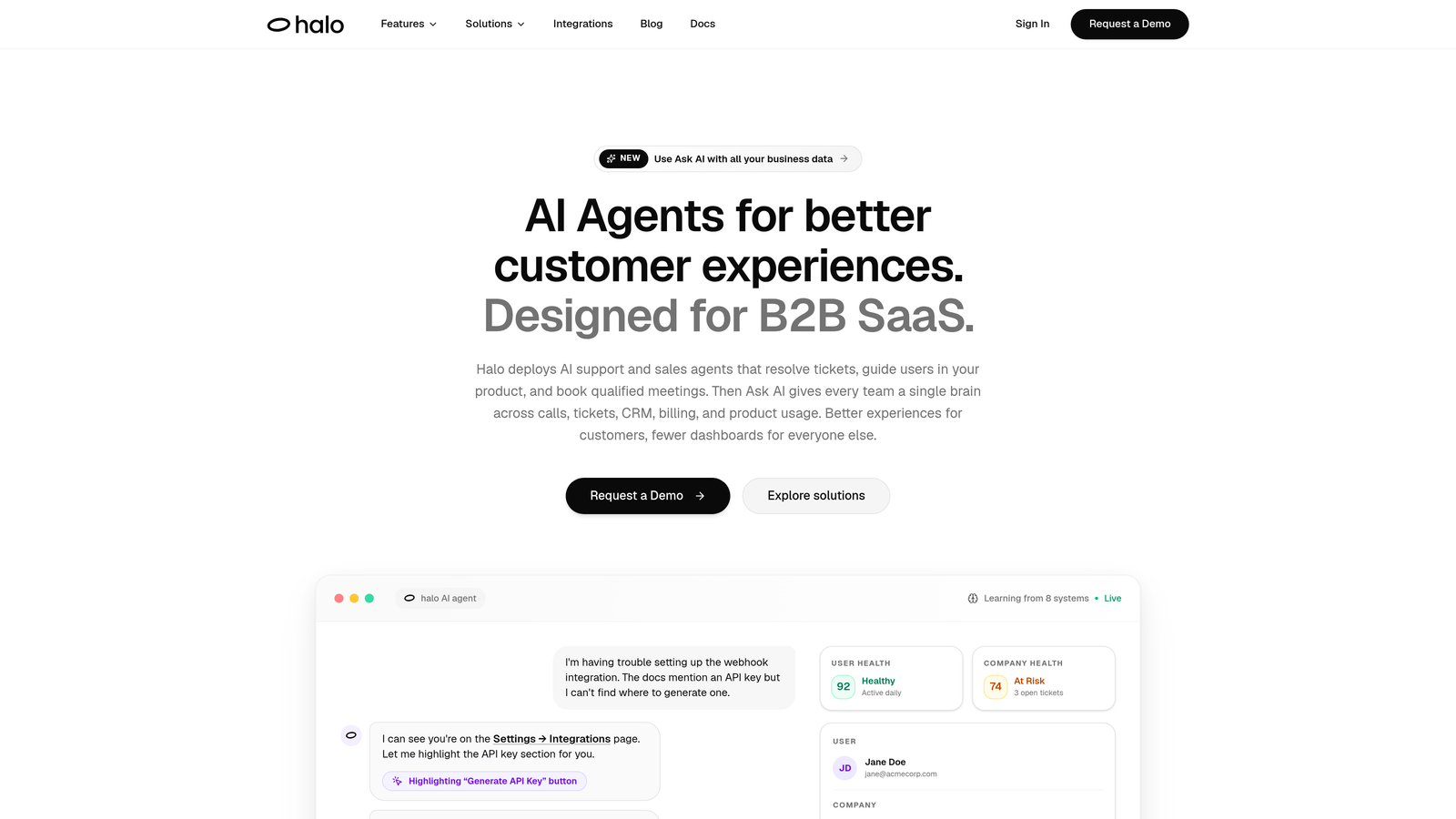
Halo AI is an autonomous support platform built from the ground up for AI-driven ticket resolution and product intelligence.
Where This Tool Shines
Most support tools bolt AI onto an existing helpdesk. Halo takes the opposite approach: it's architected around AI agents from day one. That means the intelligence isn't a feature layer; it's the foundation. Agents resolve tickets end-to-end, learn from every interaction, and get smarter over time without manual retraining.
What genuinely sets Halo apart is its page-aware context. The chat widget knows what page or feature a user is looking at, allowing AI agents to give visually guided, step-by-step help rather than generic answers. Combined with its business intelligence layer, Halo surfaces customer health signals, revenue patterns, and anomalies directly from support data. This is where understanding the customer support AI benefits goes beyond deflection into genuine strategic value.
Key Features
Autonomous AI Agents: Resolve tickets end-to-end without human intervention, continuously learning from each interaction to improve resolution quality.
Page-Aware Chat Widget: Understands what the user is currently viewing and delivers contextual, visual UI guidance rather than generic help content.
Smart Inbox with Business Intelligence: Surfaces customer health signals, revenue intelligence, and anomaly detection directly from support conversations.
Auto Bug Ticket Creation: Automatically generates bug reports and connects them to engineering tools like Linear, closing the loop between support and product teams.
Live Agent Handoff: Escalates complex issues to human agents with full conversation context preserved, so customers never have to repeat themselves.
Best For
Product-led SaaS teams that want more than ticket deflection. Halo is particularly strong for companies that need their support platform to integrate with their engineering and revenue stack, including Linear, Slack, HubSpot, Intercom, Stripe, Zoom, PandaDoc, and Fathom.
Pricing
Contact for pricing. Halo is designed to scale with ticket volume, making it relevant for both growth-stage companies and larger SaaS operations with complex support workflows.
2. Intercom
Best for: SaaS companies wanting a unified communication platform with a mature AI agent and in-app messaging.
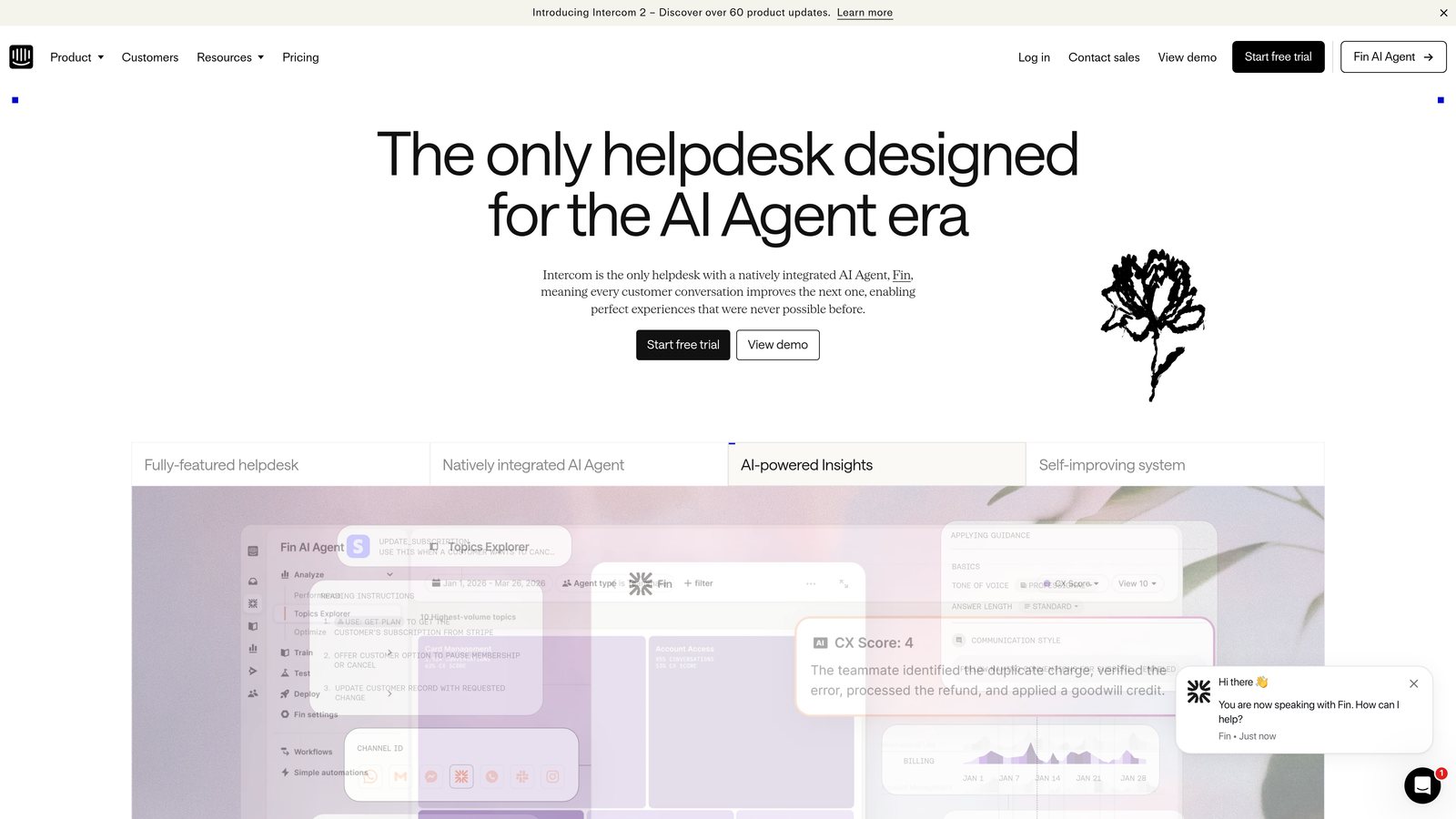
Intercom is a widely adopted customer communication platform combining AI automation, live chat, and product engagement tools in one suite.
Where This Tool Shines
Intercom's Fin AI agent has become one of the most recognized AI resolution tools in the SaaS space. It handles conversations autonomously and draws on your help center content to generate accurate, contextual responses. For teams already using Intercom for onboarding or product tours, the integration between automation and engagement is seamless.
The agent copilot and conversation summarization features genuinely reduce cognitive load for human agents handling escalations. If your team manages high conversation volume across multiple channels, Intercom's workflow builder gives you granular control over routing and automation logic.
Key Features
Fin AI Agent: Handles automated conversation resolution by drawing on help center content and custom knowledge sources.
AI Copilot for Agents: Provides real-time suggested responses and conversation summaries to speed up human agent workflows.
Integrated Help Center and Product Tours: Combines self-service content with guided onboarding experiences in a single platform.
Custom Bots and Workflow Builder: Lets teams design complex automation flows without engineering involvement.
Extensive App Marketplace: Connects to hundreds of tools through native integrations and a broad API.
Best For
Mid-market and enterprise SaaS companies that want a mature, well-supported platform with strong AI capabilities and a large integration ecosystem. Also well-suited for teams that use support and product engagement in tandem.
Pricing
Starts at $39/seat/month. Fin AI usage is billed per resolution, so costs can scale significantly with volume. Factor this into total cost projections for high-traffic teams.
3. Zendesk
Best for: Enterprise SaaS teams needing omnichannel support, advanced SLA management, and a deep integration marketplace.
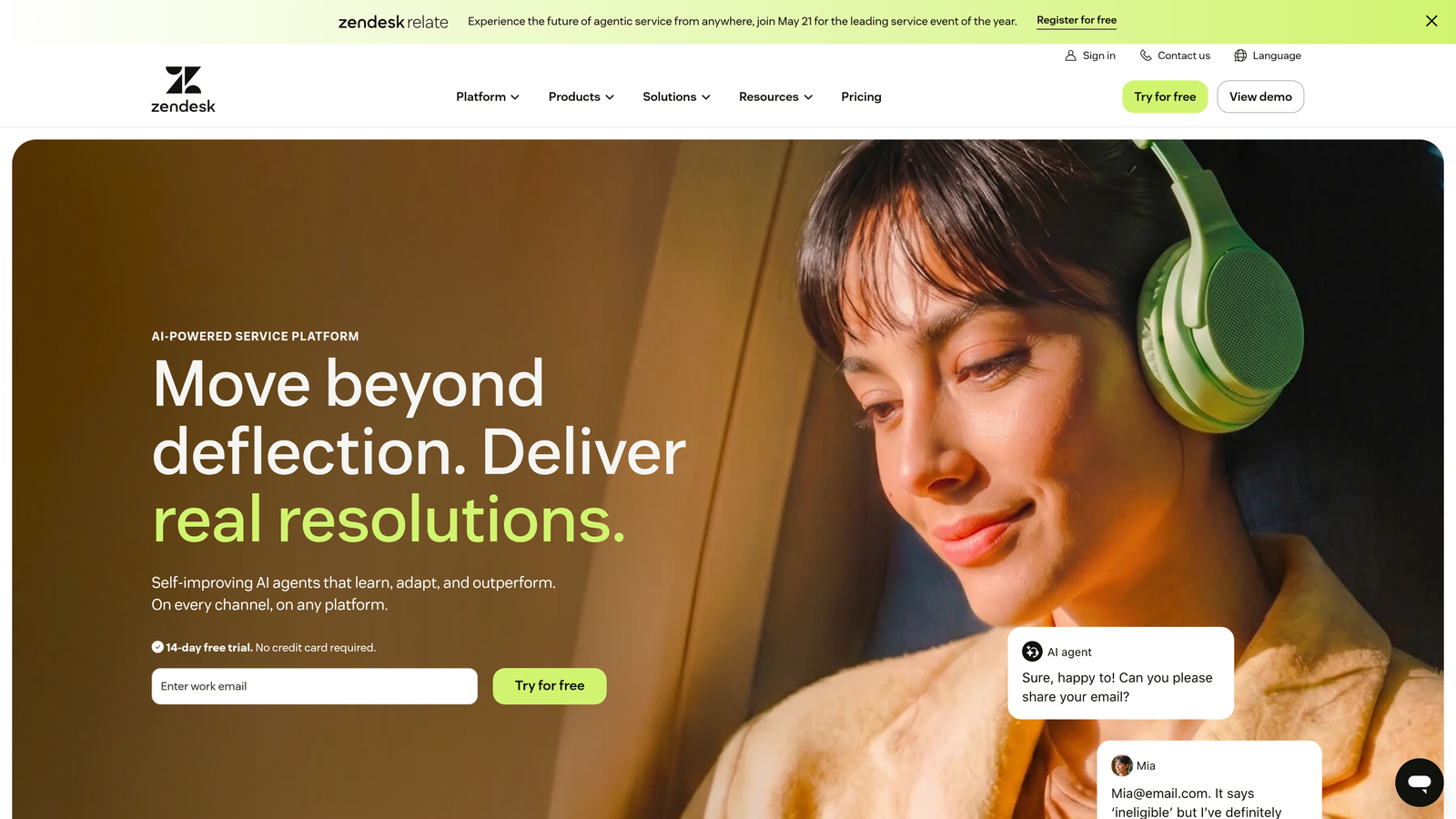
Zendesk is a battle-tested enterprise service platform with AI agents, robust ticketing infrastructure, and one of the largest integration ecosystems available.
Where This Tool Shines
Zendesk's scale is hard to match. With over 1,500 integrations, enterprise-grade SLA controls, and omnichannel coverage across email, chat, phone, social, and messaging, it's built for organizations managing support at significant complexity. The AI agents handle automated ticket resolution, and the analytics dashboards give operations teams detailed visibility into performance.
The tradeoff is configuration overhead. Getting the most out of Zendesk requires meaningful setup investment, and AI features are often priced as add-ons rather than bundled into base plans. For teams with the resources to configure it well, the depth is genuinely impressive.
Key Features
Zendesk AI Agents: Automate ticket resolution for common requests using trained AI models connected to your knowledge base.
Omnichannel Support: Manages customer interactions across email, chat, voice, social media, and messaging apps in one unified inbox.
Advanced SLA Management: Configurable SLA policies and routing rules to meet enterprise compliance and service level requirements.
1,500+ Marketplace Integrations: Connects to virtually every major SaaS tool in the support, CRM, and engineering space.
Custom Reporting Dashboards: Granular analytics for tracking resolution rates, agent performance, and customer satisfaction metrics.
Best For
Larger SaaS organizations with dedicated support operations teams, complex routing needs, and existing investments in the Zendesk ecosystem. Less ideal for lean teams that need fast time-to-value.
Pricing
Suite plans start at $55/agent/month. AI capabilities and advanced analytics are often priced as separate add-ons, so total cost can increase substantially at scale.
4. Freshdesk
Best for: Growing SaaS startups looking for an affordable, capable helpdesk with built-in AI and a free starting point.
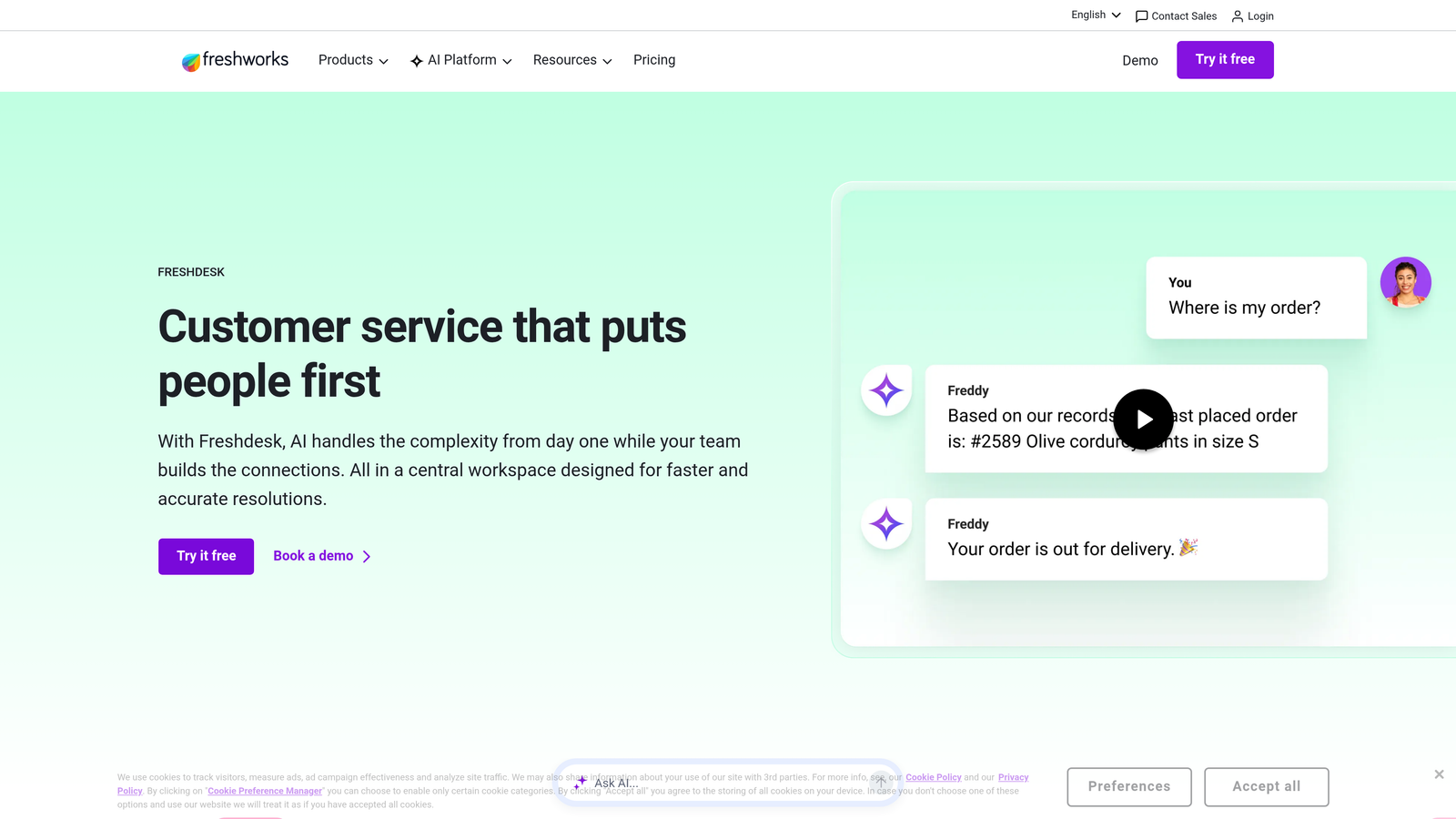
Freshdesk is a full-featured support platform from Freshworks with Freddy AI handling triage, suggested responses, and chatbot automation.
Where This Tool Shines
Freshdesk's biggest strength for early-stage SaaS teams is its accessibility. The free tier supports up to two agents and includes core ticketing features, making it a realistic starting point for companies not yet ready to commit to per-seat pricing. As teams grow, Freddy AI adds meaningful automation without requiring a platform migration.
The collaboration features are genuinely useful for distributed support teams. Shared ownership, team huddles, and internal notes reduce the coordination friction that typically slows down resolution times as ticket volume increases.
Key Features
Freddy AI: Handles auto-triage, suggested responses, and chatbot conversations to reduce manual workload on common ticket types.
Free Tier: Supports up to two agents with core helpdesk functionality, giving startups a no-cost entry point.
Built-in Collaboration Tools: Shared ownership, team huddles, and internal notes keep distributed support teams aligned.
Multichannel Ticketing: Consolidates email, chat, phone, and social conversations into a unified inbox.
SaaS Tool Integrations: Marketplace connections to common tools including Slack, Jira, and CRM platforms.
Best For
Early-stage and growth-stage SaaS startups that need a solid helpdesk foundation with AI capabilities at an accessible price point. Teams that eventually need more advanced AI intelligence may find they outgrow it.
Pricing
Free plan available for up to two agents. Paid plans start at $15/agent/month, making Freshdesk one of the more affordable options in this list for teams scaling headcount.
5. Ada
Best for: High-volume SaaS operations needing autonomous AI resolution with strong multilingual capabilities and no-code deployment.
Ada is an AI-native customer service automation platform designed for deploying autonomous agents at scale without engineering resources.
Where This Tool Shines
Ada is purpose-built for automation volume. Its no-code conversation design interface lets support and product teams train and update AI agents without writing code, which significantly reduces the time between identifying a support gap and deploying a resolution path. For SaaS companies with global user bases, Ada's multilingual capabilities across many languages are a practical differentiator.
The platform's focus is squarely on autonomous resolution rather than augmenting human agents. If your primary goal is maximizing the percentage of conversations handled without human involvement, Ada's architecture is optimized for exactly that outcome.
Key Features
Autonomous AI Agent: Resolves customer conversations end-to-end without human intervention, trained on your content and connected systems.
No-Code Conversation Design: Visual interface for building, training, and updating AI conversation flows without engineering involvement.
Multilingual Support: Handles customer conversations across a broad range of languages, supporting global SaaS deployments.
CRM and Helpdesk Integrations: Connects to major platforms including Salesforce, Zendesk, and Intercom for seamless data flow.
Automation Analytics Dashboard: Tracks resolution rates, conversation outcomes, and automation performance over time.
Best For
Mid-market and enterprise SaaS companies with high inbound conversation volume and a global customer base. Particularly strong for teams that want non-technical staff to own and iterate on automation without developer support.
Pricing
Custom pricing. Contact Ada directly for a quote based on your conversation volume and deployment requirements.
6. Help Scout
Best for: SaaS teams that want intelligent automation while preserving a personal, human tone in customer interactions.
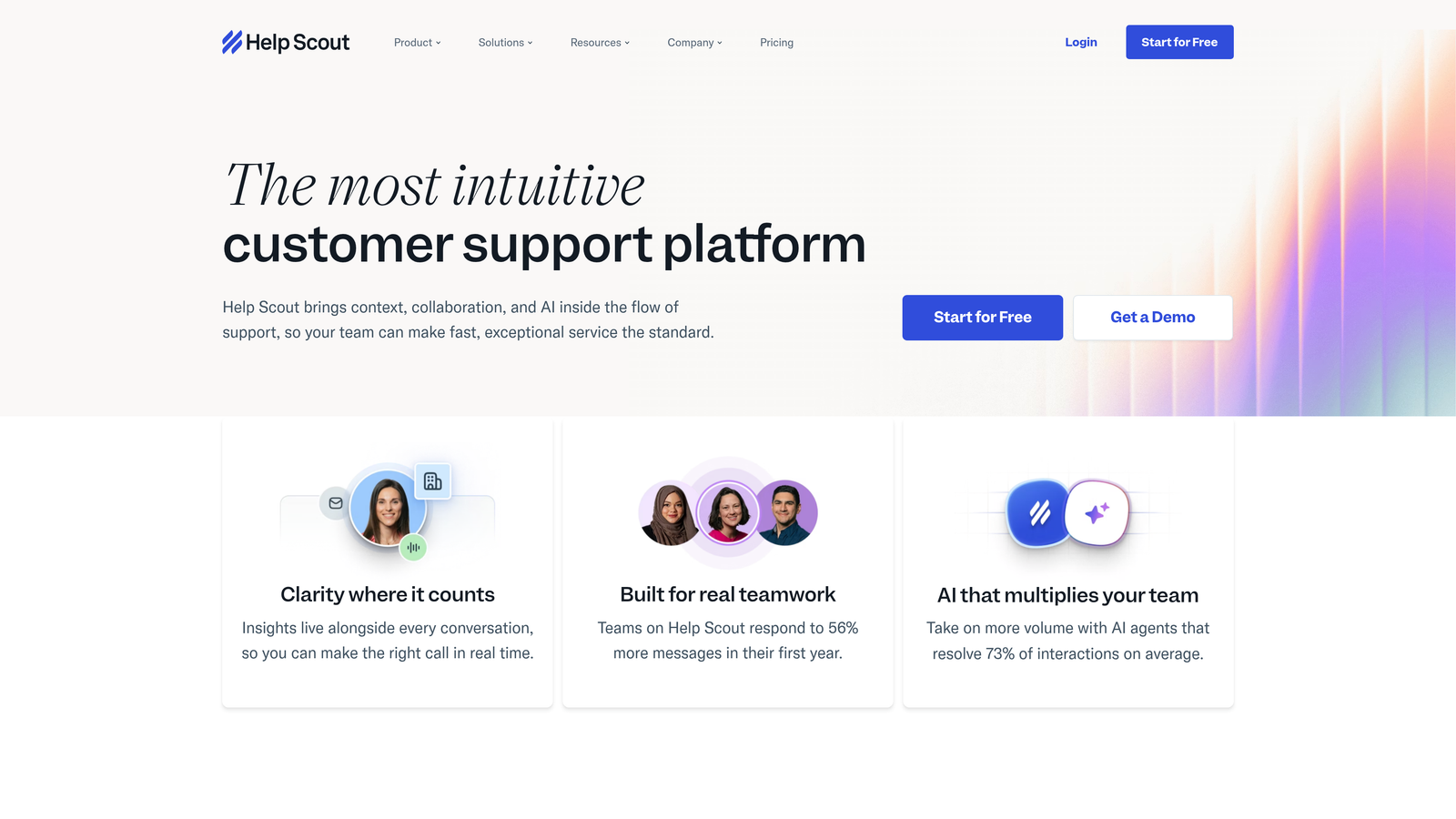
Help Scout is a customer-first support platform combining shared inbox, knowledge base, and AI assistance with a design philosophy centered on genuine human connection.
Where This Tool Shines
Help Scout occupies a distinct position in this list. Where most tools optimize for automation rate, Help Scout optimizes for customer experience quality. Its AI features, including draft generation and conversation summarization, are designed to make human agents faster and more effective rather than replace them entirely.
The Beacon widget enables proactive in-app help, surfacing relevant knowledge base articles before customers even open a ticket. For SaaS products where user trust and relationship quality matter as much as resolution speed, Help Scout's approach is a genuine differentiator.
Key Features
AI Drafts and Summarization: Generates response drafts and summarizes long conversations to help agents reply faster with less cognitive load.
Beacon Widget: Delivers in-app help and proactive messaging based on where users are in your product.
Docs Knowledge Base: Built-in self-service content hub with strong search functionality to reduce inbound ticket volume.
Collision Detection: Prevents two agents from working on the same conversation simultaneously, reducing duplicate effort and customer confusion.
Fast Onboarding: Clean, intuitive interface that new agents can learn quickly, reducing training overhead.
Best For
SaaS teams at any stage that prioritize customer relationship quality and want AI to enhance human agents rather than replace them. Particularly well-suited for B2B SaaS companies where account relationships carry significant value.
Pricing
Starts at $25/user/month. A free plan is available for small teams, making it accessible for early-stage companies evaluating their options.
7. Tidio
Best for: SaaS startups and SMBs needing fast, affordable live chat and AI chatbot deployment with minimal setup complexity.
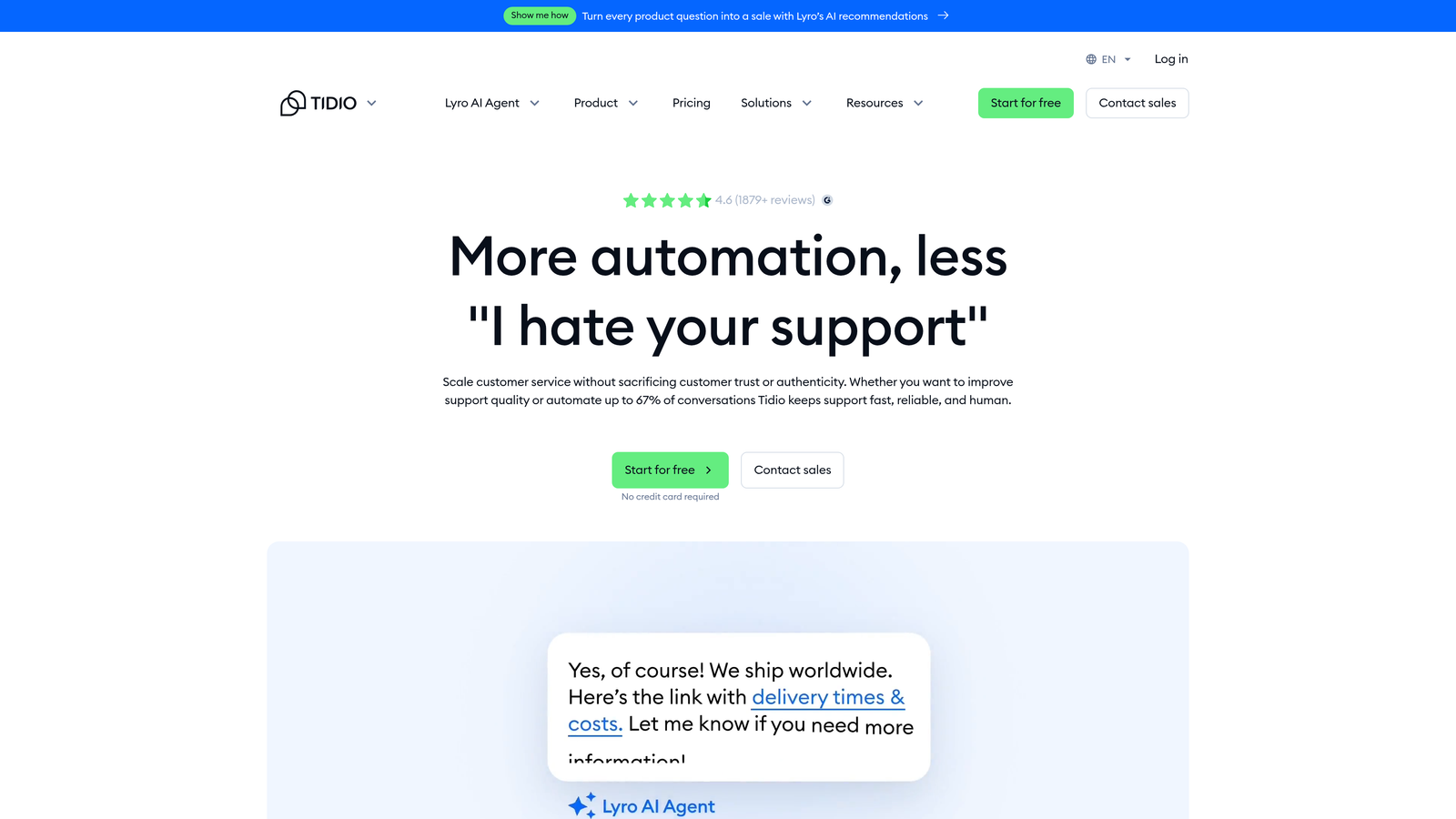
Tidio is a lightweight live chat and AI chatbot platform built for quick deployment and accessible pricing, with a free tier that makes it a natural starting point for early-stage teams.
Where This Tool Shines
Tidio's Lyro AI chatbot learns from your existing FAQ content and help documentation, which means you're not starting from scratch with conversation design. For teams without dedicated support operations resources, this dramatically lowers the barrier to getting AI-assisted support running quickly.
The visual chatbot flow builder lets non-technical team members customize automation logic, and real-time visitor monitoring gives support agents useful context about what users are doing before they initiate a conversation. It's not the deepest platform on this list, but for the price point, the value-to-complexity ratio is hard to beat.
Key Features
Lyro AI Chatbot: Learns from your FAQ and help content to handle common customer questions autonomously.
Visual Flow Builder: Drag-and-drop interface for creating custom chatbot automations without writing code.
Live Chat with Visitor Monitoring: Real-time visibility into what users are doing on your site before and during support conversations.
Multichannel Coverage: Handles conversations from your website, email, Facebook Messenger, and Instagram in one place.
Affordable Free Tier: Meaningful functionality available at no cost, with paid plans that remain accessible as teams grow.
Best For
Early-stage SaaS startups and SMBs that need live chat and basic AI automation without a large budget or dedicated implementation resources. Teams expecting enterprise-scale AI intelligence will likely need to graduate to a more advanced platform.
Pricing
Free plan available. Paid plans start at $29/month, making Tidio one of the most cost-accessible options for teams in the early stages of building out support automation.
8. Forethought
Best for: Enterprise SaaS teams needing AI-powered triage, automated resolution, and agent assistance layered on top of existing helpdesks.
Forethought is an enterprise AI platform for support automation that enhances existing helpdesk infrastructure with intelligent triage, resolution, and copilot capabilities.
Where This Tool Shines
Forethought's architecture is designed to work alongside your existing helpdesk rather than replace it. This makes it a practical choice for enterprise teams with established Zendesk or Salesforce deployments that want to layer in more sophisticated AI without a full platform migration. Its three-product structure, covering triage, resolution, and agent assistance, lets teams adopt capabilities incrementally.
The analytics layer is particularly strong for operations leaders. Forethought provides detailed measurement of automation impact, resolution rates by category, and agent performance benchmarks, which helps justify automation investment internally and identify where additional training is needed.
Key Features
Triage: AI-powered ticket classification and routing that ensures conversations reach the right team or automation path immediately.
Solve: Automated resolution for common and repetitive support requests, reducing manual workload on high-volume ticket categories.
Assist: Agent copilot that surfaces relevant knowledge and suggested responses in real time during live conversations.
Enterprise Helpdesk Integrations: Native connections to Zendesk, Salesforce Service Cloud, and other major enterprise platforms.
Automation Impact Analytics: Detailed reporting on resolution rates, deflection performance, and agent productivity improvements.
Best For
Enterprise SaaS organizations with existing helpdesk investments that want to significantly increase automation without replacing their current infrastructure. Strong fit for teams where measuring and reporting on AI ROI is a business requirement.
Pricing
Custom enterprise pricing. Contact Forethought directly for a quote based on your ticket volume and integration requirements.
9. DevRev
Best for: Product-led SaaS teams that want to close the loop between customer support and product development in a single workspace.
DevRev is a unified platform that connects customer conversations directly to product development workflows, purpose-built for teams where support and engineering need to operate as one.
Where This Tool Shines
DevRev solves a problem that most support tools ignore: the gap between what customers report and what engineers actually fix. By automatically linking support tickets to product issues and features, it creates a continuous feedback loop that makes prioritization decisions more data-driven and less dependent on manual aggregation.
The customer clustering capability is particularly useful for product teams. Rather than reading through individual tickets, teams can see patterns across similar complaints and use that data to inform sprint planning. For product-led growth companies where the product team is directly accountable for retention, this kind of visibility is genuinely valuable.
Key Features
Automatic Ticket-to-Issue Linking: Connects support conversations directly to product issues and feature requests without manual tagging.
PLuG AI Chatbot: AI-powered in-app support widget that handles customer questions with product context awareness.
Unified Workspace: Single environment for support, product, and engineering teams to collaborate on customer issues and product decisions.
Built-in Sprint and Issue Tracking: Native development workflow tools eliminate the need for a separate project management system for smaller engineering teams.
Customer Clustering: Groups similar support conversations to surface common product pain points and prioritize fixes by customer impact.
Best For
Product-led SaaS companies where the support and engineering teams are tightly coupled and need shared visibility into customer issues. Particularly valuable for teams where product managers use support data to drive roadmap decisions.
Pricing
Free tier available. Paid plans start at $19.99/user/month, offering a competitive entry point for growing teams that need the support-engineering integration from day one.
Choosing the Right Tool for Your SaaS Stage
The honest answer is that there's no single best tool. The right choice depends on where you are, where you're going, and what you need your support platform to do beyond resolving tickets.
If you're an early-stage startup with limited budget and a small team, Freshdesk or Tidio give you meaningful functionality without upfront cost. Both have free tiers and grow with you as ticket volume increases.
If you're scaling fast and want AI that genuinely resolves tickets end-to-end rather than routing them around, Halo AI and Ada are built for autonomous resolution from the ground up. Halo adds the business intelligence and product-aware context layer that makes it particularly strong for SaaS companies that want support data to inform product and revenue decisions.
If your team values human connection and wants AI to enhance agents rather than replace them, Help Scout strikes that balance well. For teams already invested in enterprise helpdesks, Forethought layers sophisticated AI on top without requiring a migration. And if your support and engineering teams need to operate as one, DevRev is the only platform on this list architected specifically for that use case.
For teams that want a mature, feature-rich platform with broad omnichannel coverage, Zendesk and Intercom remain strong choices, provided you're ready for the configuration investment and per-seat economics.
Your support team shouldn't scale linearly with your customer base. Let AI agents handle routine tickets, guide users through your product, and surface business intelligence while your team focuses on complex issues that need a human touch. See Halo in action and discover how continuous learning transforms every interaction into smarter, faster support.