9 Best Web App Customer Support Solutions in 2026
This guide ranks the 9 best web app customer support solutions of 2026, evaluating each on AI resolution capability, integration depth, deployment speed, and scalability for B2B and SaaS teams. Whether you're choosing your first support platform or upgrading an existing one, it covers AI-native tools and established helpdesks to help you find the right fit for your team's size and stage.
 Matt PattoliFounder14 min read
Scaling a web app is exciting until your support queue starts scaling faster than your team. As your user base grows, the old approach of hiring more agents to handle more tickets quickly becomes unsustainable. Modern B2B and SaaS teams need more than a ticketing system: they need intelligent, integrated support infrastructure that can resolve issues autonomously, connect to their existing business stack, and surface insights beyond ticket counts.
This list covers the top web app customer support solutions available in 2026. The selection criteria focused on AI resolution capability, integration depth with developer and product tools, deployment speed, scalability without proportional headcount growth, and overall value for B2B and SaaS teams. You'll find a mix of AI-native platforms built from the ground up for autonomous operation, and established helpdesk tools that have layered AI capabilities onto proven infrastructure. Whether you're evaluating your first support platform or looking to upgrade, there's something here for every stage and team size.
1. Halo AI
Best for: B2B and SaaS teams wanting AI-native, autonomous support with deep product integration
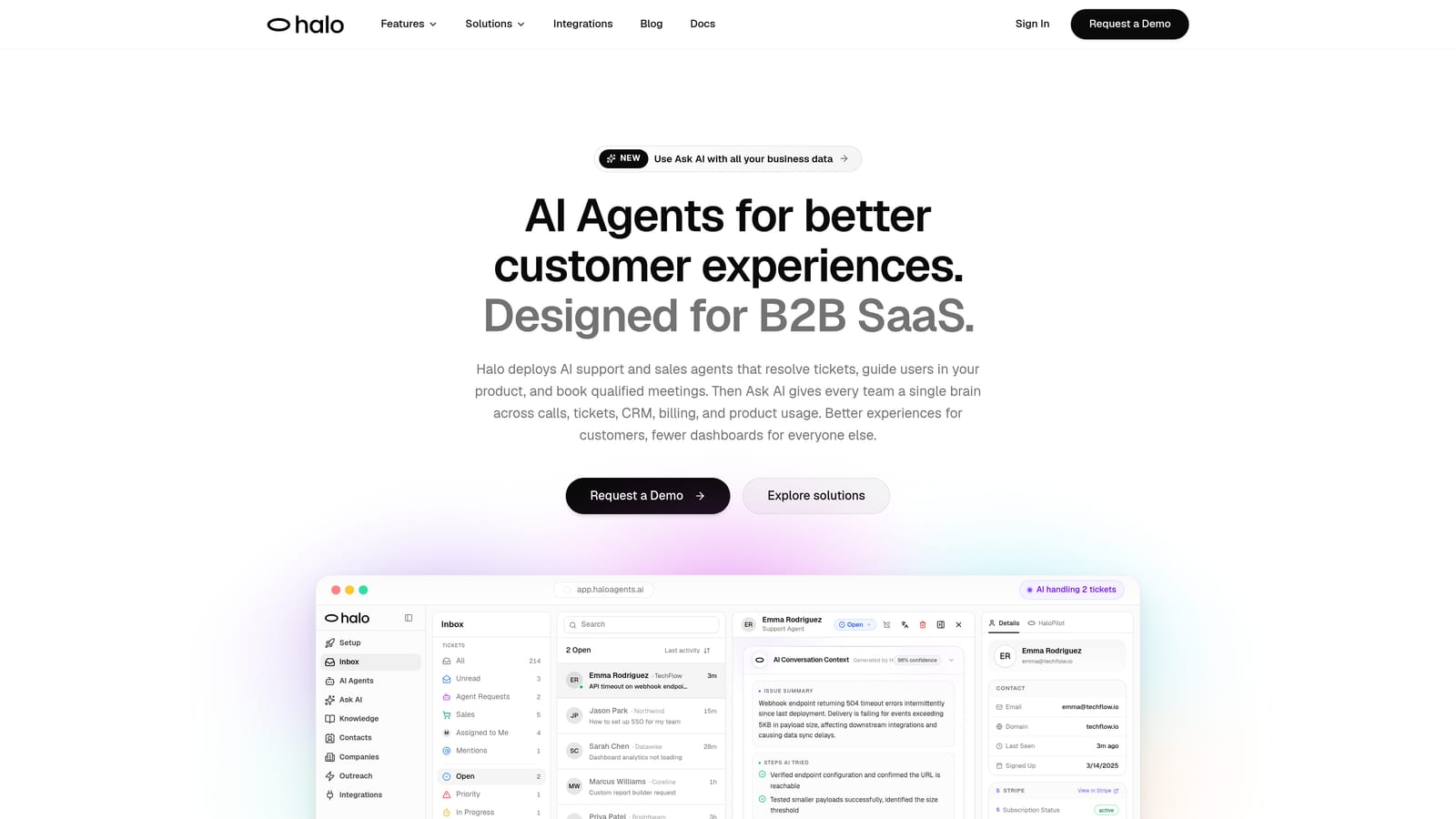
Halo AI is an AI-native customer support platform that deploys intelligent agents to resolve tickets, guide users through your product, and surface business intelligence — all without bolting AI onto an existing helpdesk.
Where This Tool Shines
Most support tools treat AI as a feature added to a ticketing system. Halo was built the other way around: AI is the foundation, and everything else is designed to support autonomous operation. The most distinctive capability is page-aware context. Halo's agents can see what the user sees on screen, which means they can provide visual UI guidance specific to where the user is in your product rather than generic help center responses.
Beyond resolution, Halo continuously learns from every interaction, improving its accuracy over time without manual retraining. It also goes further than support metrics: the Smart Inbox surfaces customer health signals, revenue intelligence, and anomaly detection, turning your support layer into a source of product and business intelligence.
Key Features
Page-Aware AI Agents: Agents understand the user's current page context and deliver visual, in-product guidance rather than generic answers.
Autonomous Ticket Resolution with Live Agent Handoff: Handles routine tickets end-to-end and escalates complex issues to human agents with full conversation context preserved.
Auto Bug Ticket Creation: Automatically generates bug reports and routes them directly to Linear or your engineering workflow when issues are detected.
Smart Inbox with Business Intelligence: Goes beyond ticket metrics to surface customer health signals, revenue intelligence, and volume anomalies in a unified inbox view.
Deep Integration Ecosystem: Connects natively with Slack, HubSpot, Intercom, Stripe, Zoom, PandaDoc, Fathom, and Linear, spanning your entire business stack.
Best For
SaaS and B2B product teams that want support to operate autonomously at scale, surface business intelligence, and integrate deeply with their developer and revenue tooling. Particularly strong for teams that have outgrown bolt-on AI features in traditional helpdesks.
Pricing
Contact for pricing via demo-based onboarding. Visit haloagents.ai to book a demo and explore what fits your team's needs.
2. Intercom
Best for: Teams already using Intercom who want to extend their stack with AI capabilities
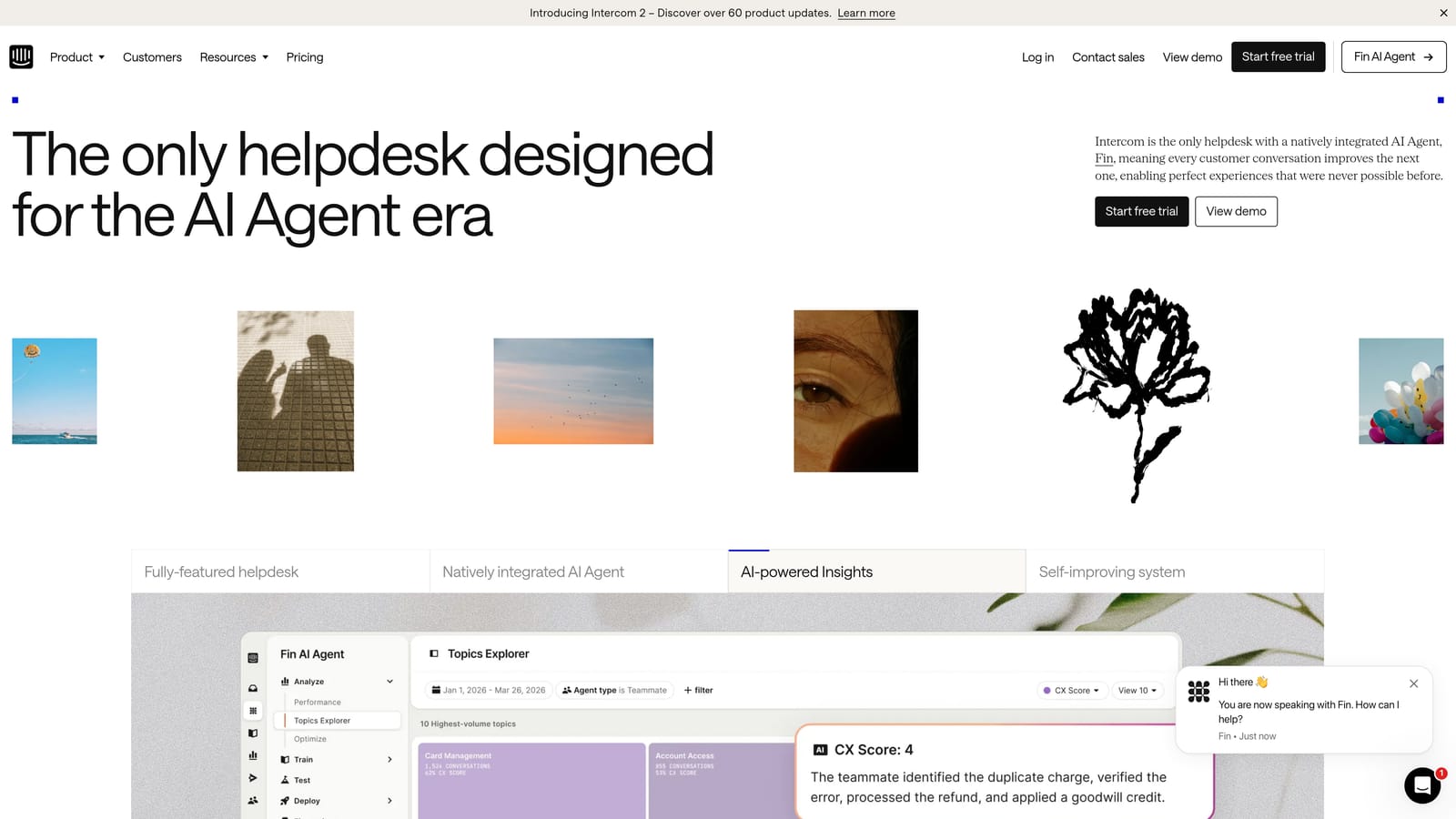
Intercom is a mature conversation platform combining a well-established messenger, shared inbox, and the Fin AI agent for automated support resolution.
Where This Tool Shines
Intercom's strength is its ecosystem maturity. If your team is already using Intercom for in-app messaging and customer communication, adding Fin AI is a natural extension rather than a platform migration. Fin is trained on your help center content and handles a meaningful portion of routine queries without agent involvement.
The platform also covers the full customer lifecycle beyond support, including product tours, in-app onboarding messages, and proactive outreach. For teams that want a single platform spanning support and user engagement, Intercom offers significant breadth. It's worth noting that Halo AI integrates with Intercom, so the two can work together rather than requiring a choice between them.
Key Features
Fin AI Agent: Trained on your help center content to handle automated ticket resolution using GPT-class models.
Omnichannel Inbox: Manages chat, email, and social conversations in a single shared workspace.
Product Tours and In-App Messaging: Supports user onboarding and feature adoption alongside reactive support.
Reporting and CSAT Tracking: Built-in analytics covering resolution rates, response times, and customer satisfaction scores.
Integration Marketplace: Large library of third-party integrations covering CRMs, billing, analytics, and developer tools.
Best For
Teams already invested in the Intercom ecosystem who want to layer in AI resolution without switching platforms. Also a good fit for product-led growth companies that want support and user engagement managed in one place.
Pricing
Starts at approximately $39 per seat per month. Fin AI usage is billed per resolution, so costs scale with automation volume.
3. Zendesk
Best for: Enterprise teams needing deep workflow customization and omnichannel coverage at scale
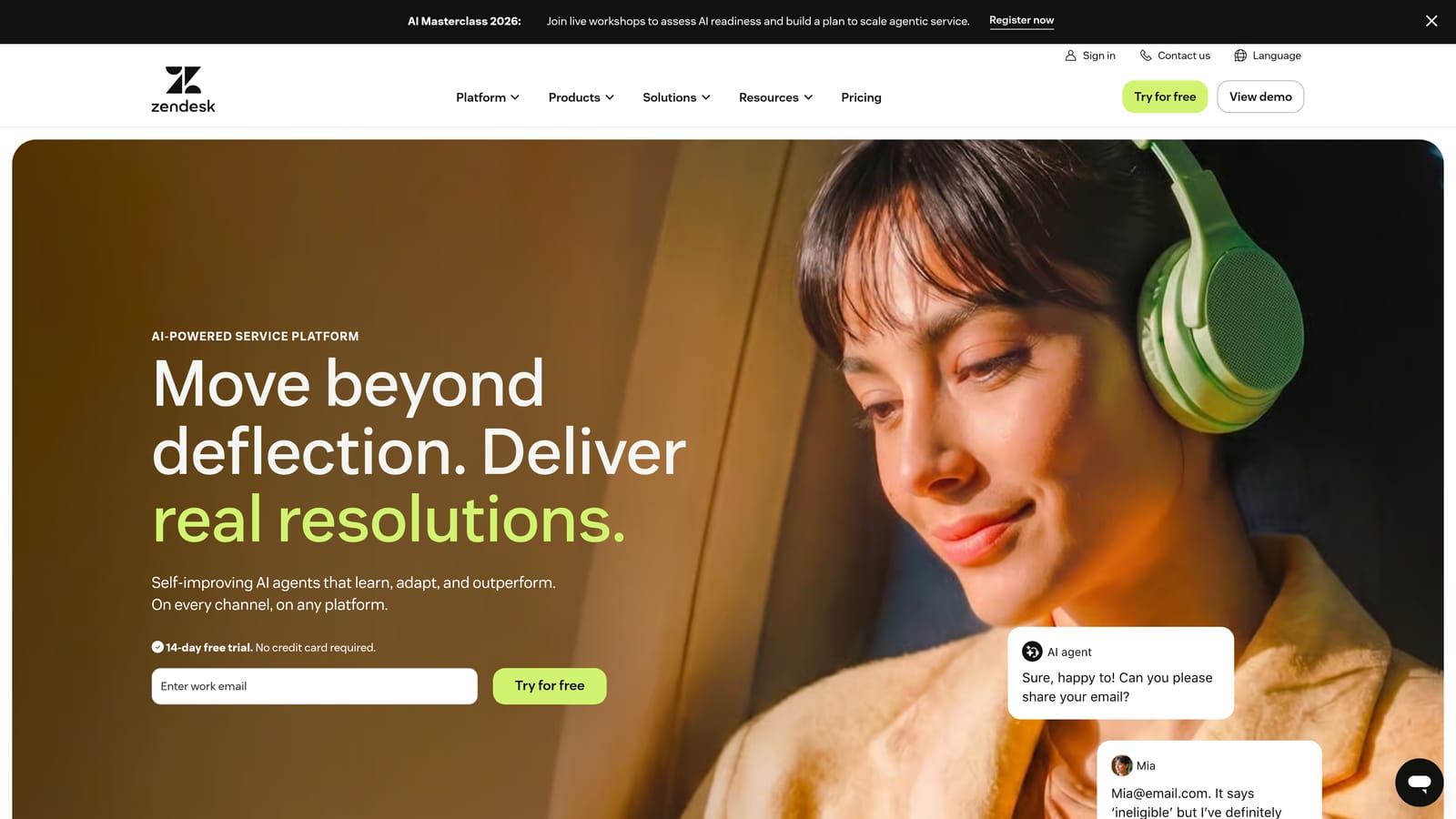
Zendesk is the enterprise-grade helpdesk standard, offering extensive workflow customization, a vast app marketplace, and AI capabilities through the Zendesk AI add-on.
Where This Tool Shines
Zendesk's core advantage is configurability. Complex organizations with multiple support tiers, strict SLA requirements, and highly customized routing logic will find few platforms as capable. The app marketplace offers hundreds of integrations, making it possible to connect Zendesk to nearly any tool in your stack.
The AI add-on, powered through an OpenAI partnership, adds intelligent triage, agent assist, and automated responses to the existing infrastructure. The tradeoff is that this AI layer sits on top of a legacy ticketing architecture rather than being built into it from the start, which can mean more admin overhead to configure and maintain effectively.
Key Features
Advanced Ticket Routing and SLA Management: Highly configurable routing rules, escalation paths, and service level tracking for complex support operations.
Zendesk AI Add-On: Adds intelligent triage, agent assist suggestions, and automated responses to the core helpdesk platform.
Extensive App Marketplace: Hundreds of integrations covering CRMs, developer tools, analytics, and communication platforms.
Omnichannel Coverage: Handles email, chat, voice, social, and self-service from a unified agent workspace.
Enterprise Reporting and Analytics: Detailed dashboards covering team performance, ticket trends, and customer satisfaction metrics.
Best For
Large enterprise teams or high-growth companies with complex support workflows, multiple teams or regions, and dedicated resources to manage and customize the platform.
Pricing
Suite plans start at approximately $55 per agent per month. The AI add-on is priced separately, so total cost can increase significantly for teams wanting full AI capabilities.
4. Freshdesk
Best for: Budget-conscious SMBs and growing SaaS teams wanting omnichannel support with AI assist
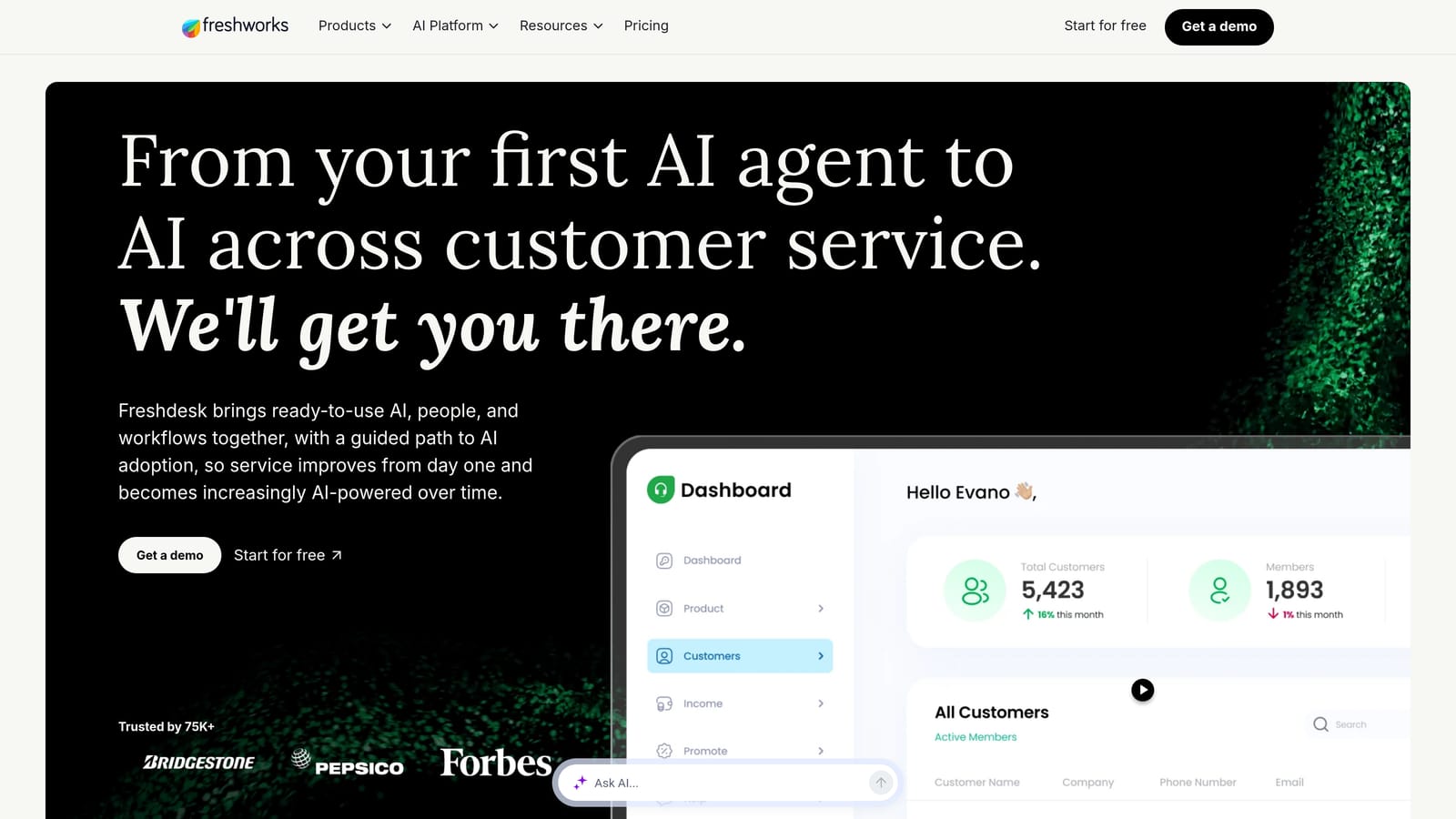
Freshdesk is a feature-rich, cost-competitive helpdesk from Freshworks, with Freddy AI providing automated responses, agent suggestions, and predictive support capabilities.
Where This Tool Shines
Freshdesk consistently punches above its price point. Teams that find Zendesk's complexity and cost prohibitive often land on Freshdesk as a capable alternative that covers the core helpdesk requirements without the administrative overhead. The onboarding experience is generally considered faster and more straightforward.
Freddy AI adds meaningful automation without requiring a separate add-on purchase at higher tiers, handling common ticket responses and surfacing suggestions to agents in real time. The availability of a free tier also makes Freshdesk a practical starting point for early-stage teams that want to grow into paid features gradually.
Key Features
Freddy AI: Automates ticket responses for common queries and provides agents with contextual suggestions to resolve issues faster.
Omnichannel Support: Covers email, chat, phone, and social channels from a unified agent workspace.
Collision Detection: Prevents multiple agents from working on the same ticket simultaneously, reducing duplicate effort.
Self-Service Portal and Knowledge Base: Built-in tools for creating and managing help content that reduces incoming ticket volume.
Free Tier Available: Entry-level access for small teams to get started without upfront cost commitment.
Best For
SMBs, early-stage SaaS teams, and growing companies that need solid omnichannel helpdesk functionality with AI assist at a price that doesn't require enterprise-level budget.
Pricing
Free plan available for small teams. Paid plans start at approximately $15 per agent per month, making it one of the more accessible options on this list.
5. Help Scout
Best for: Smaller SaaS teams prioritizing customer relationship quality over ticket volume automation
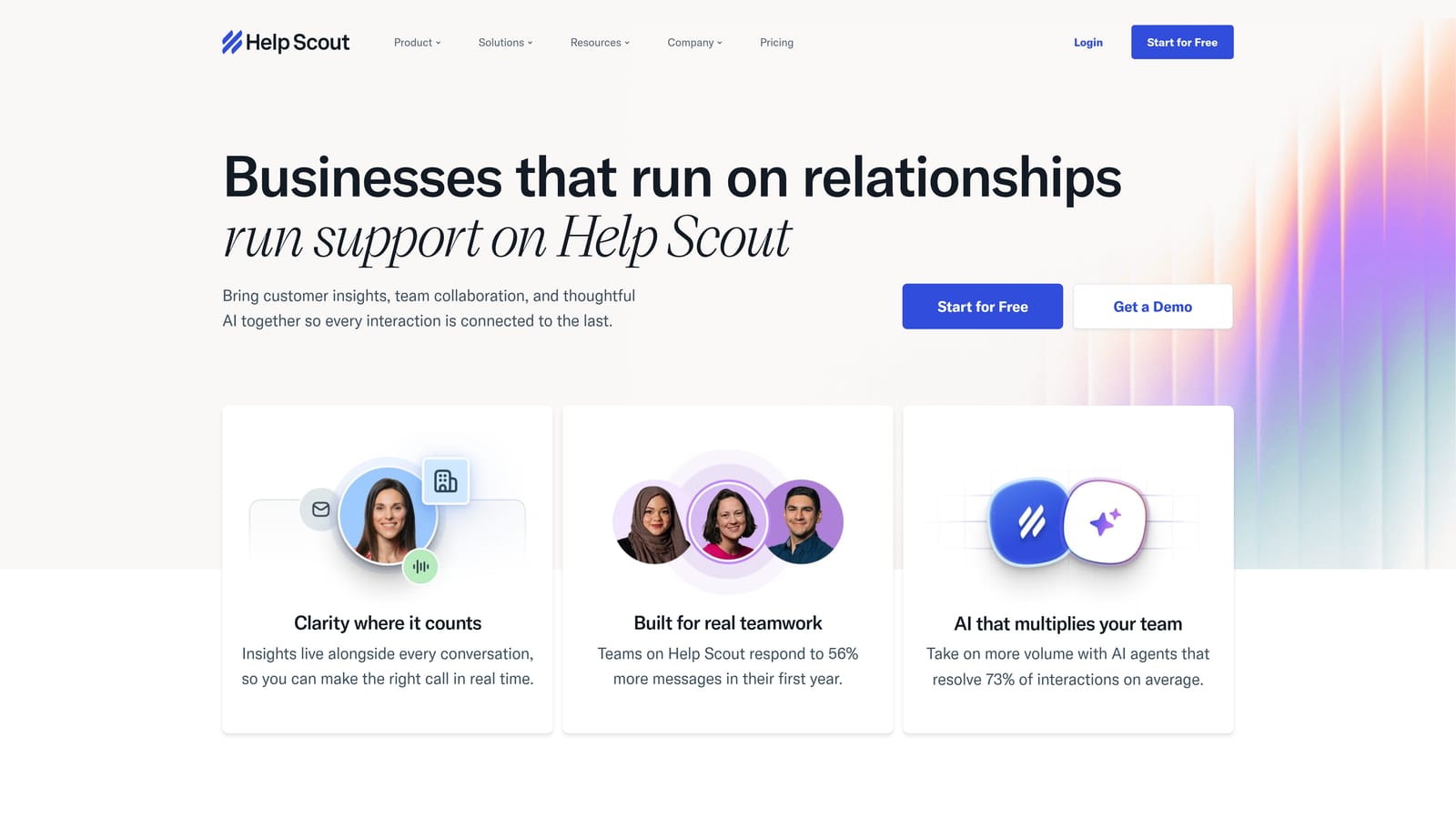
Help Scout is a human-first support platform combining a shared inbox, embeddable Beacon widget, knowledge base, and AI Assist features designed for teams that value relationship quality alongside efficiency.
Where This Tool Shines
Help Scout occupies a specific niche: teams that find traditional helpdesks overly complex and impersonal but still need structured support tooling. The interface is deliberately clean and fast to learn, which reduces the time between signing up and being genuinely productive. Agents work in an environment that feels more like a thoughtful email client than a ticket factory.
The AI features added in recent iterations, including AI Summarize and AI Assist, are designed to help agents respond faster without replacing the human voice that Help Scout's audience tends to value. The Beacon widget also makes it easy to surface in-app help and chat without significant engineering effort.
Key Features
Shared Inbox (Mailbox): Collaborative inbox with collision detection, internal notes, and conversation history for team-based email support.
Beacon Widget: Embeddable in-app widget providing chat access and knowledge base search directly within your product.
AI Summarize and AI Assist: Helps agents quickly understand long conversation threads and draft faster responses.
Docs Knowledge Base: SEO-friendly help center builder for creating self-service content that reduces incoming support volume.
Simple Onboarding: Clean UI and fast setup make it accessible for teams without dedicated support operations staff.
Best For
Smaller SaaS teams, startups, and companies where support quality and personal relationships matter more than high-volume automation. Less suited for teams expecting to deflect the majority of tickets with AI.
Pricing
Starts at approximately $22 per user per month, positioning it as a mid-range option relative to the full list.
6. Tidio
Best for: Early-stage web apps and SMBs wanting fast, accessible AI chatbot deployment
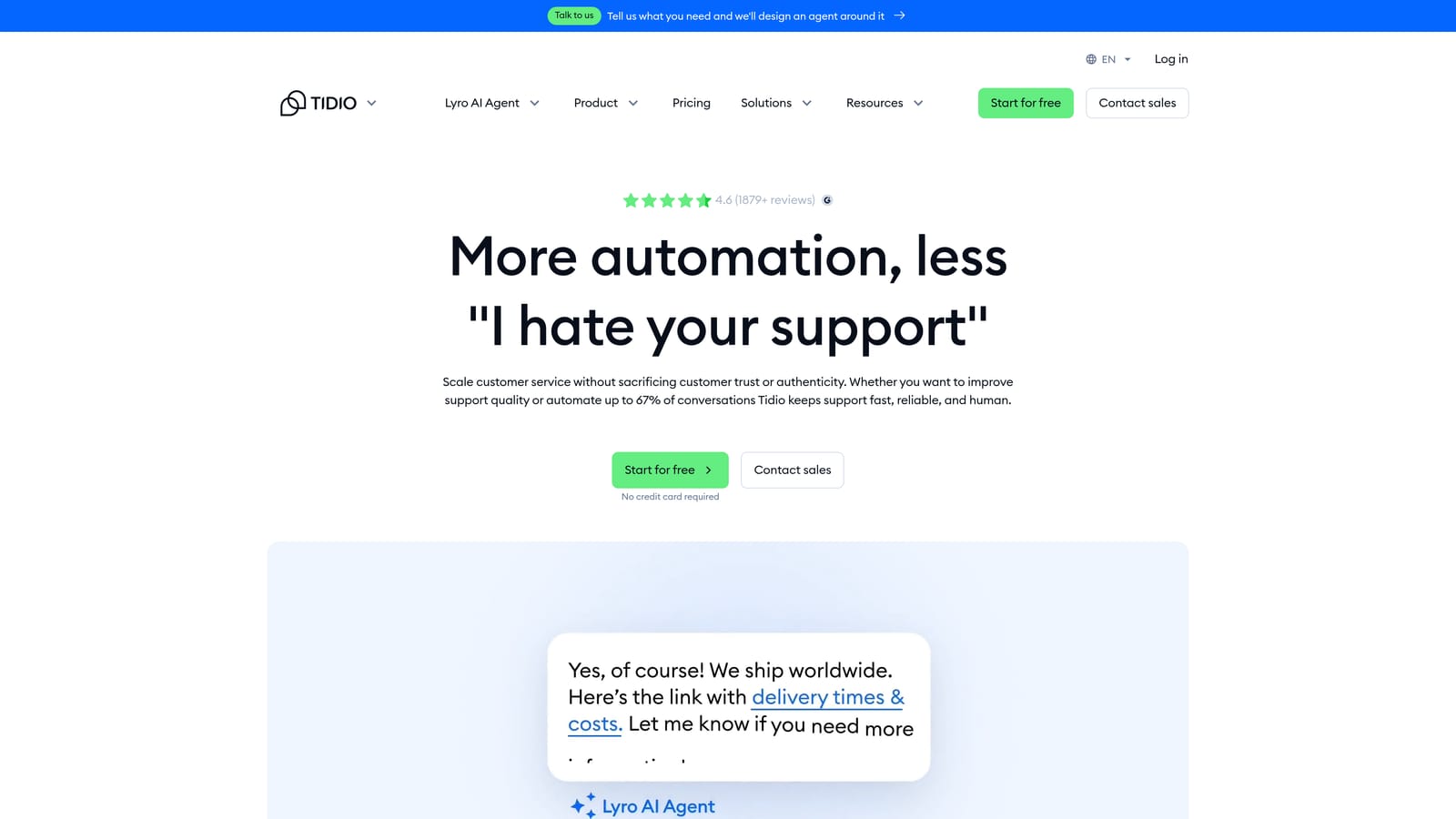
Tidio is a live chat and AI chatbot platform featuring Lyro AI for automated customer conversations, built for quick deployment at an accessible price point.
Where This Tool Shines
Tidio's defining characteristic is speed to value. The embed setup is straightforward enough that most teams are live within minutes rather than days. For early-stage web apps that need a visible support presence quickly without complex configuration, Tidio removes most of the friction.
Lyro AI powers automated conversations using your knowledge base content, handling common questions without agent involvement. When Lyro reaches the limits of what it can resolve, the live agent takeover is smooth and preserves conversation context. The visual chatbot flow builder also gives non-technical team members control over automation paths without requiring developer involvement.
Key Features
Lyro AI Chatbot: Handles automated, knowledge-base-powered conversations to deflect common queries without agent involvement.
Live Chat with Agent Takeover: Seamlessly transitions conversations to human agents when automation reaches its limits.
Visual Chatbot Flow Builder: Drag-and-drop builder for creating custom automation paths without writing code.
Email and Social Integration: Extends coverage beyond live chat to email and social channels.
Quick Embed Setup: Designed to go live in minutes, with minimal technical configuration required.
Best For
Early-stage web apps, SMBs, and teams that need a fast, affordable way to add AI-powered chat and basic automation. Less suited for complex enterprise workflows or teams needing deep integration with developer tooling.
Pricing
Free plan available. Lyro AI plans start at approximately $29 per month, making it one of the most accessible AI-powered options on this list.
7. Drift (Salesloft)
Best for: B2B SaaS teams where support and sales conversations overlap significantly
Drift, now part of Salesloft, is a conversational AI platform that blends support deflection with sales qualification, designed for B2B environments where the line between customer support and revenue conversations is often blurry.
Where This Tool Shines
Drift occupies a unique position on this list because it was never purely a support tool. Its strength is handling conversations that could go either direction: a visitor asking a product question might be a support case or a sales opportunity, and Drift's AI routing is built to make that determination intelligently. For B2B SaaS teams where sales and support share a pipeline, this dual capability has real operational value.
The account-based targeting feature allows teams to personalize chat experiences based on visitor segment, company size, or CRM data, which creates a more relevant experience for high-value accounts. The Salesloft integration has also deepened the platform's sales acceleration capabilities since the acquisition.
Key Features
AI-Powered Chat for Support and Sales: Handles both support deflection and lead qualification in a unified conversation layer.
Intelligent Routing: Routes conversations to sales reps or support agents based on visitor intent and behavior signals.
Meeting Scheduling Built In: Allows visitors to book demos or calls directly within the chat flow without leaving the page.
Account-Based Targeting: Personalizes chat experiences based on visitor segment, company, or CRM data.
CRM and Sales Tool Integrations: Native connections with Salesforce, HubSpot, and the broader Salesloft ecosystem.
Best For
B2B SaaS companies where support and sales share responsibility for the customer conversation, particularly teams already using Salesloft or prioritizing pipeline acceleration alongside support deflection.
Pricing
Enterprise pricing model. Contact Salesloft directly for a quote, as pricing is customized based on team size and use case.
8. Zoho Desk
Best for: Teams already in the Zoho ecosystem wanting tightly integrated helpdesk and CRM
Zoho Desk is a full-featured helpdesk tightly integrated with the broader Zoho suite, featuring Zia AI for sentiment analysis, ticket tagging, and anomaly detection.
Where This Tool Shines
Zoho Desk's clearest advantage is its native integration with Zoho CRM. For teams already running their business on the Zoho suite, the unified customer context across support and sales is a significant operational benefit that third-party integrations rarely replicate as cleanly. Agent views surface CRM data alongside ticket history without switching platforms.
Zia, Zoho's AI assistant, adds practical intelligence to the helpdesk layer: it suggests responses, analyzes sentiment on incoming tickets, auto-tags conversations, and flags unusual spikes in ticket volume. These capabilities are available at price points well below what comparable features cost in enterprise-tier alternatives.
Key Features
Zia AI Assistant: Provides response suggestions, sentiment analysis, and automatic ticket tagging to speed up agent workflows.
Native Zoho CRM Integration: Surfaces unified customer context from CRM data directly within the helpdesk agent view.
Omnichannel Support: Covers email, chat, phone, social, and web form channels from a single workspace.
Blueprint Workflow Automation: Visual workflow builder for modeling complex, multi-step support processes.
Competitive Pricing: Delivers strong feature depth at price points that work for SMBs and mid-market teams.
Best For
Teams already using Zoho CRM, Zoho Analytics, or other Zoho products who want a helpdesk that integrates natively rather than requiring custom connectors. Also a strong value pick for budget-conscious teams wanting AI features without enterprise pricing.
Pricing
Free plan available for up to 3 agents. Paid plans start at approximately $14 per agent per month, making it among the most affordable full-featured options on this list.
9. Gorgias
Best for: Web apps with subscription billing, commerce components, or Shopify integrations
Gorgias is a support platform with deep e-commerce integrations and revenue-tied metrics, increasingly relevant for web apps that include a commerce or subscription billing layer.
Where This Tool Shines
Gorgias was originally built for Shopify merchants, and that origin shows in its depth of commerce-specific automation. Order status queries, return requests, refund workflows, and shipping questions can all be handled automatically without agent involvement, which dramatically reduces the volume of routine tickets for commerce-heavy teams.
The revenue-per-ticket metric is a genuine differentiator. Rather than measuring support purely by resolution time or CSAT, Gorgias ties support activity to business outcomes, showing which conversations influenced purchases or prevented churn. For web apps with a commerce component, this changes how support is evaluated and resourced. Teams without a commerce element, however, may find the platform's specialization works against them.
Key Features
Native Shopify, BigCommerce, and Magento Integrations: Deep order data access enables automated responses to commerce-specific queries without agent involvement.
Revenue-Per-Ticket Metrics: Links support conversations to business outcomes, showing the revenue impact of support activity.
AI-Powered Macros and Auto-Responses: Handles common commerce queries like order status and return eligibility automatically.
Omnichannel Inbox: Manages email, chat, social, and SMS conversations in a unified workspace.
Automation Rules for Commerce Workflows: Pre-built and customizable rules for order status, returns, and refund processes.
Best For
Web apps with subscription billing, digital commerce components, or Shopify integrations where order-related queries represent a significant share of support volume. Less suited for pure SaaS products without a commerce element.
Pricing
Starts at approximately $10 per month for 50 tickets, with pricing scaling by ticket volume rather than per seat, which can be advantageous for small teams with moderate ticket counts.
Which Tool Is Right for Your Team?
The web app support landscape in 2026 has clearly split into two camps: AI-native platforms built for autonomous operation, and established helpdesks that have added AI as a layer on top of existing infrastructure. Both have their place, but the right choice depends on where your team sits today and where you're headed.
Here's a quick way to think through the decision:
AI-native autonomy and business intelligence: Halo AI is the strongest option for teams that want support to operate independently, surface product insights, and integrate deeply with their developer and revenue stack. The page-aware context and continuous learning architecture set it apart from anything built on legacy helpdesk foundations.
Enterprise complexity and customization: Zendesk remains the benchmark for large organizations with complex routing logic, multiple support tiers, and dedicated admin resources to configure and maintain the platform.
Budget-conscious SMBs: Freshdesk offers strong omnichannel coverage and AI assist at a price point that works for growing teams. Tidio is the right call if speed of deployment and accessible pricing matter most.
Zoho ecosystem teams: Zoho Desk's native CRM integration and competitive pricing make it the obvious choice if you're already running on Zoho.
Commerce-heavy web apps: Gorgias is built for teams where order-related queries drive ticket volume and where revenue impact matters as much as resolution speed.
Your support team shouldn't scale linearly with your customer base. Let AI agents handle routine tickets, guide users through your product, and surface business intelligence while your team focuses on complex issues that need a human touch. See Halo in action and discover how continuous learning transforms every interaction into smarter, faster support.