9 Best Zendesk AI Integration Tools in 2026
This guide ranks the 9 best Zendesk AI integration tools in 2026, evaluating each on AI capability, integration quality, ease of deployment, and fit for B2B SaaS teams. From autonomous ticket resolution to business intelligence, it covers purpose-built solutions that transform Zendesk from a reactive helpdesk into a proactive, intelligent support engine.
 Matt PattoliFounder13 min read
Zendesk is a powerful helpdesk platform, but out of the box, it's reactive. Tickets pile up, agents context-switch constantly, and customers wait. The right AI integration changes that equation entirely, turning Zendesk into a proactive, intelligent support engine that resolves issues faster and surfaces insights your team can actually act on.
This list covers the top AI tools that integrate with or complement Zendesk in 2026. Whether you're looking to automate ticket resolution, add a smart chat layer, or extract business intelligence from your support data, there's a purpose-built solution here. We've evaluated each tool on depth of AI capability, integration quality, ease of deployment, and fit for B2B SaaS teams. One note: Halo AI is featured first because it's the most AI-native option on this list, built from the ground up for autonomous resolution rather than as a bolt-on to an existing workflow.
1. Halo AI
Best for: B2B SaaS teams that want AI-native autonomous ticket resolution and business intelligence
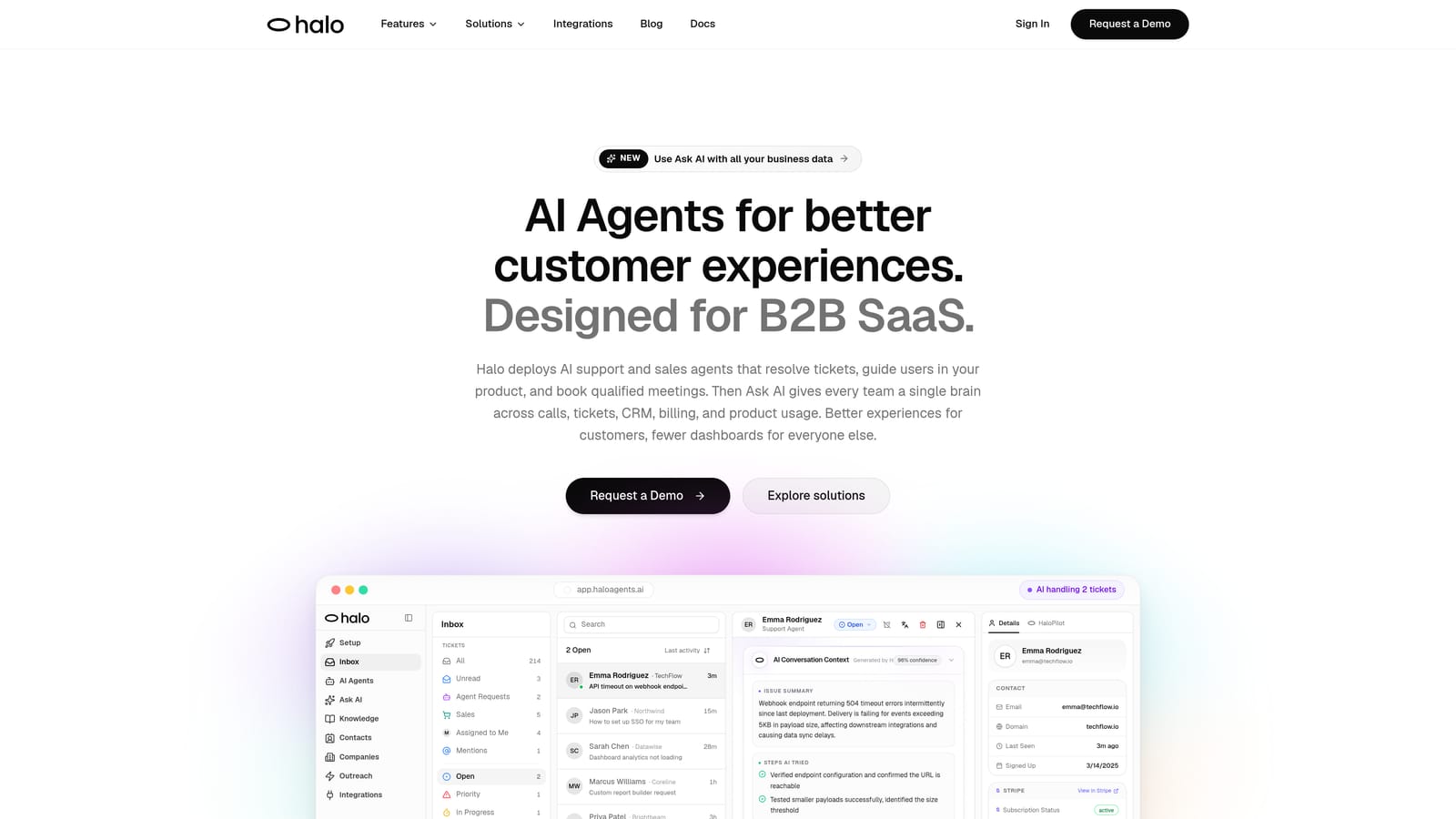
Halo AI is an AI-native customer support platform built for autonomous ticket resolution, page-aware chat, and deep integrations across the modern SaaS stack.
Where This Tool Shines
Most AI tools layer onto an existing helpdesk. Halo was built differently: the AI is the core, not an add-on. That architectural difference matters when you're trying to move beyond deflection and into actual resolution. The platform learns continuously from every interaction, which means it gets smarter over time without requiring manual retraining from your team.
The page-aware chat widget is a standout feature. It understands what a user is currently looking at inside your product, which means the AI can provide contextually relevant guidance rather than generic FAQ responses. Combined with the smart inbox's business intelligence layer, Halo surfaces signals that most support tools simply don't capture: customer health trends, revenue anomalies, and early churn indicators.
Key Features
Autonomous AI Agents: Resolve tickets end-to-end without human intervention, handling the full resolution flow rather than just suggesting replies.
Page-Aware Chat Widget: Understands the user's current context inside your product, delivering guidance that's specific to where they are and what they're doing.
Smart Inbox with Business Intelligence: Surfaces customer health signals, anomaly detection, and revenue intelligence directly from support interactions.
Auto Bug Ticket Creation: Automatically generates bug reports in Linear when issues are detected, closing the loop between support and engineering.
Live Agent Handoff: Escalates complex issues to human agents with full context preserved, so nothing gets lost in the transition.
Broad Integration Stack: Connects to Linear, Slack, HubSpot, Intercom, Stripe, Zoom, PandaDoc, and Fathom, making it a connective tissue layer across your entire business stack.
Best For
B2B SaaS companies and product teams that want to move beyond reactive ticket handling. Particularly strong for teams already using tools like Linear, HubSpot, or Intercom who want AI that connects the support layer to the rest of the business rather than operating in isolation.
Pricing
Pricing is not publicly listed. Contact the Halo team directly for a quote tailored to your team size and support volume.
2. Zendesk AI (Native)
Best for: Teams already on Zendesk Suite who want AI features with zero integration complexity
Zendesk AI is the suite of AI capabilities built directly into Zendesk, including intelligent triage, an agent copilot, suggested replies, and a self-service bot builder.
Where This Tool Shines
The biggest advantage here is simplicity. There's no integration to configure, no new vendor to onboard, and no change management required. Your agents are already in Zendesk, and the AI surfaces directly inside the workflows they use every day. For teams that want to add AI without disrupting their current setup, this is the lowest-friction path available.
The agent copilot is genuinely useful for reducing handle time. It surfaces suggested replies and next-best-action prompts in real time, helping agents respond faster without having to hunt through knowledge bases manually.
Key Features
Intelligent Triage: Automatically detects intent, sentiment, and language on incoming tickets to route and prioritize them appropriately.
Agent Copilot: Surfaces suggested replies and next-best-action prompts directly in the agent view during live ticket handling.
Zendesk Bot Builder: A no-code tool for creating self-service bots that deflect common queries before they reach a human agent.
AI-Powered Reporting: Provides CSAT prediction and performance insights to help teams identify trends and coaching opportunities.
Native Platform Integration: No separate integration layer required; everything runs inside the Zendesk environment agents already know.
Best For
Teams deeply committed to the Zendesk ecosystem who want to incrementally add AI without introducing new vendors or integration complexity. Less ideal for teams that need AI to connect across a broader business stack.
Pricing
AI features are included in higher Suite tiers or available as an add-on. Suite Professional starts at approximately $115 per agent per month. Verify current pricing at zendesk.com.
3. Intercom Fin
Best for: Front-line chat deflection powered by large language models
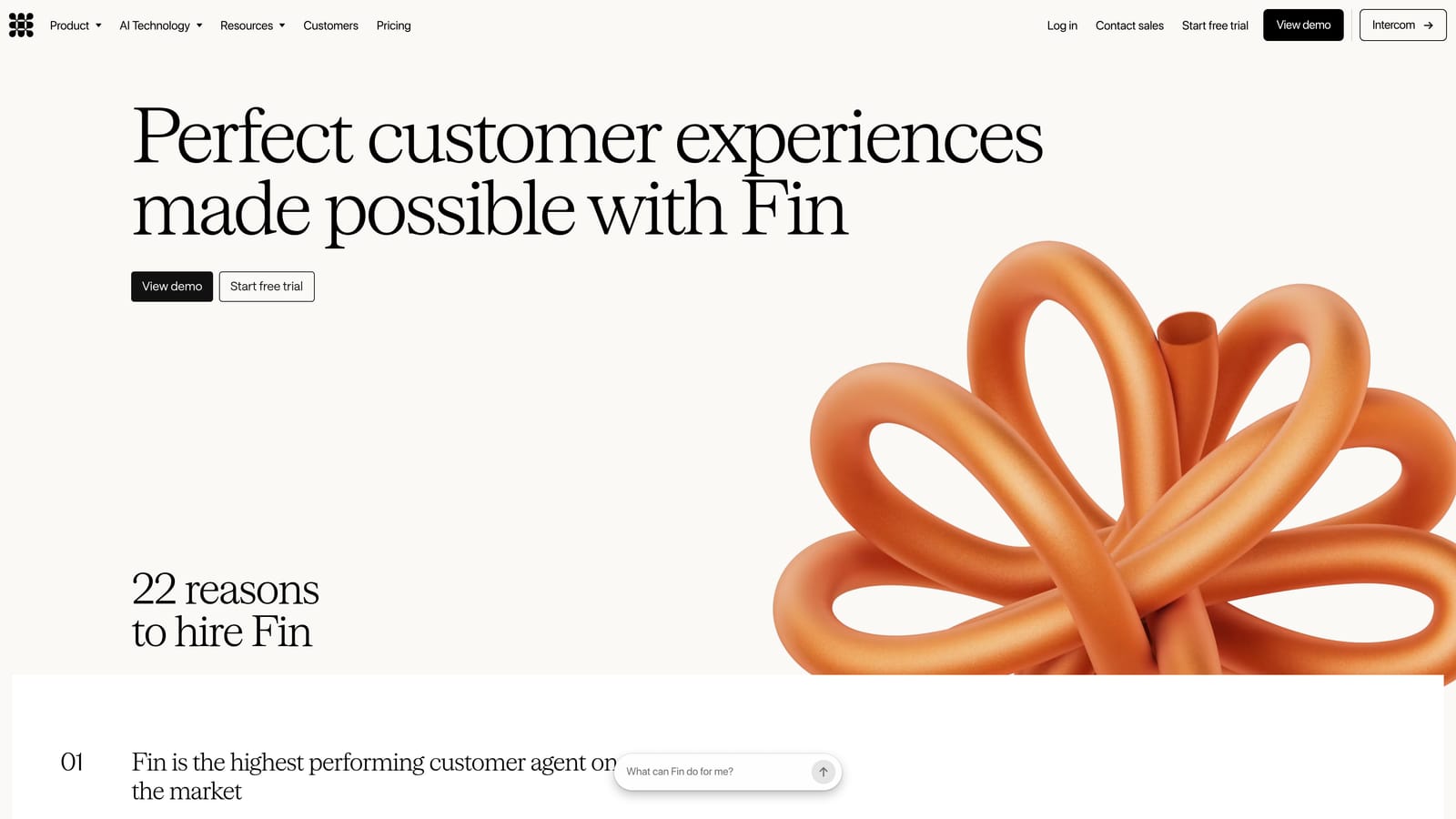
Intercom Fin is a GPT-powered AI resolution agent designed to handle customer queries before they reach a human agent, drawing answers from your help center content.
Where This Tool Shines
Fin excels at containment. It reads your existing help center documentation and uses it to answer customer questions in a conversational, natural way. For teams with well-maintained knowledge bases, Fin can handle a meaningful portion of incoming queries without any agent involvement.
The handoff experience is polished. When Fin can't resolve something, it transitions the conversation to a human agent smoothly, with full context intact. The conversational UI is one of the better-looking implementations in the category.
Key Features
LLM-Powered Resolution Agent: Handles customer queries conversationally using large language model reasoning rather than rigid decision trees.
Help Center Integration: Pulls answers directly from your existing documentation, reducing the need to build separate bot content.
Smooth Human Handoff: Escalates to live agents with full conversation context when resolution fails.
Polished Conversational UI: Delivers a high-quality chat experience that reflects well on the brands using it.
Usage-Based Pricing: Charges per resolution, which aligns cost directly with value delivered.
Best For
Teams with strong help center content looking to deflect front-line queries. Works best within Intercom's native messenger; teams using Zendesk as their primary helpdesk will find the integration less seamless than using Intercom's full suite.
Pricing
Priced per resolution on a usage-based model. Check intercom.com for current rates, as pricing varies by volume.
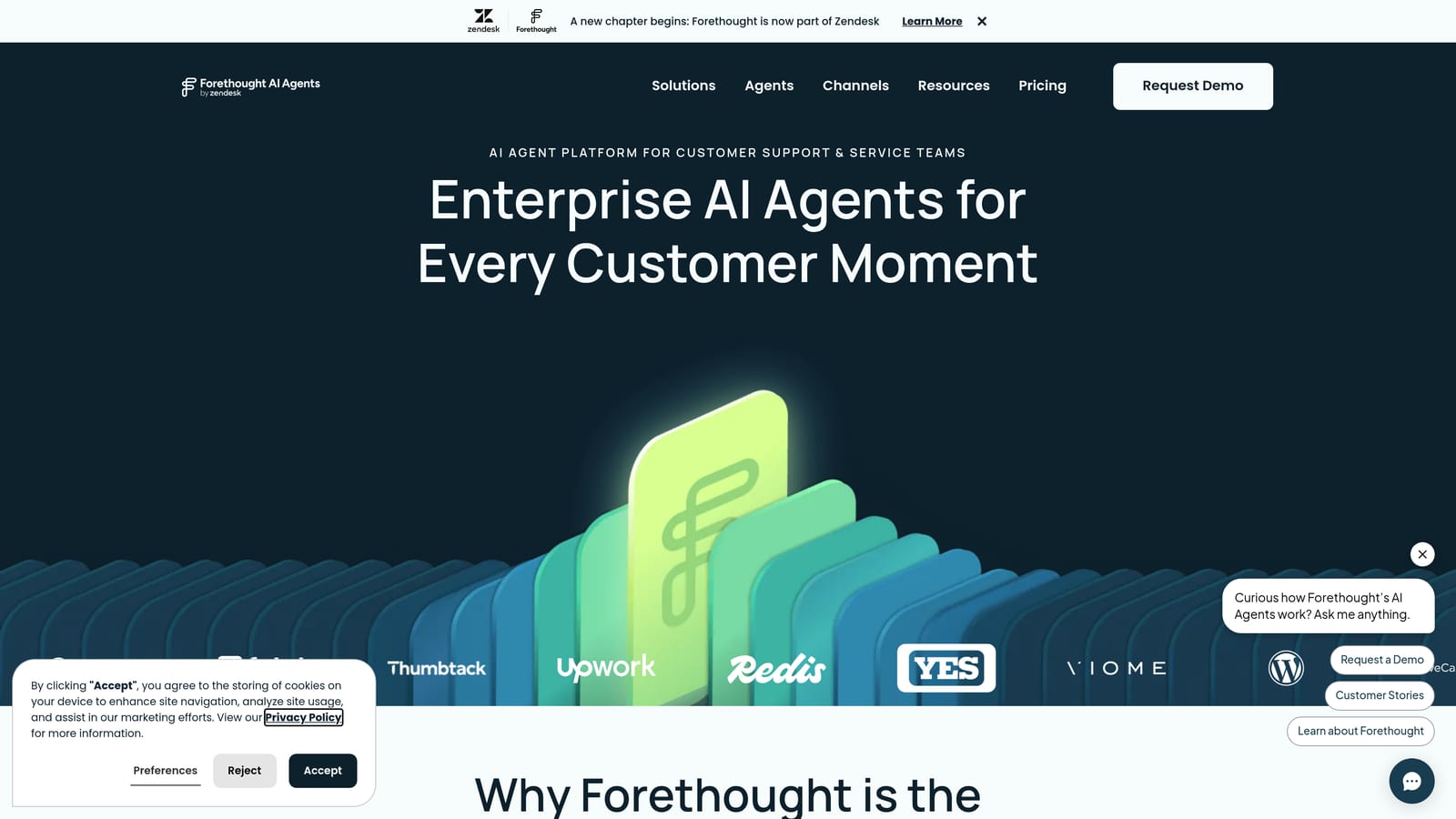
4. Forethought AI
Best for: High-volume support teams focused on agent efficiency and intelligent ticket routing inside Zendesk
Forethought AI is an enterprise support AI platform purpose-built for triage, intelligent routing, agent assist, and auto-resolution, with native Zendesk integration.
Where This Tool Shines
Forethought is designed specifically for the support use case, which shows in how deeply it integrates with the Zendesk agent view. Rather than requiring agents to switch context, AI-suggested responses and ticket metadata surface directly where agents are already working. That in-workflow placement is a meaningful advantage for adoption.
Predictive routing is another strong point. Forethought analyzes ticket content and intent to send each ticket to the right queue or agent, reducing misroutes and the back-and-forth that comes with them.
Key Features
Predictive Ticket Routing: Analyzes content and intent to route tickets to the right queue or agent automatically.
AI-Suggested Responses: Surfaces reply recommendations directly inside the Zendesk agent view without requiring context switching.
Auto-Resolution: Handles high-confidence, repetitive ticket types end-to-end without agent involvement.
Sentiment and Urgency Detection: Flags tickets that need immediate attention based on tone and content analysis.
AI Performance Analytics: Tracks resolution rates, deflection, and agent assist metrics in a dedicated dashboard.
Best For
Enterprise support teams with high ticket volumes where agent efficiency and accurate routing are the primary bottlenecks. Strong fit for organizations already on Zendesk that want AI layered into existing workflows rather than a platform change.
Pricing
Enterprise pricing; contact Forethought directly for a quote at forethought.ai.
5. Assembled
Best for: Support operations teams optimizing staffing, scheduling, and workforce planning using Zendesk data
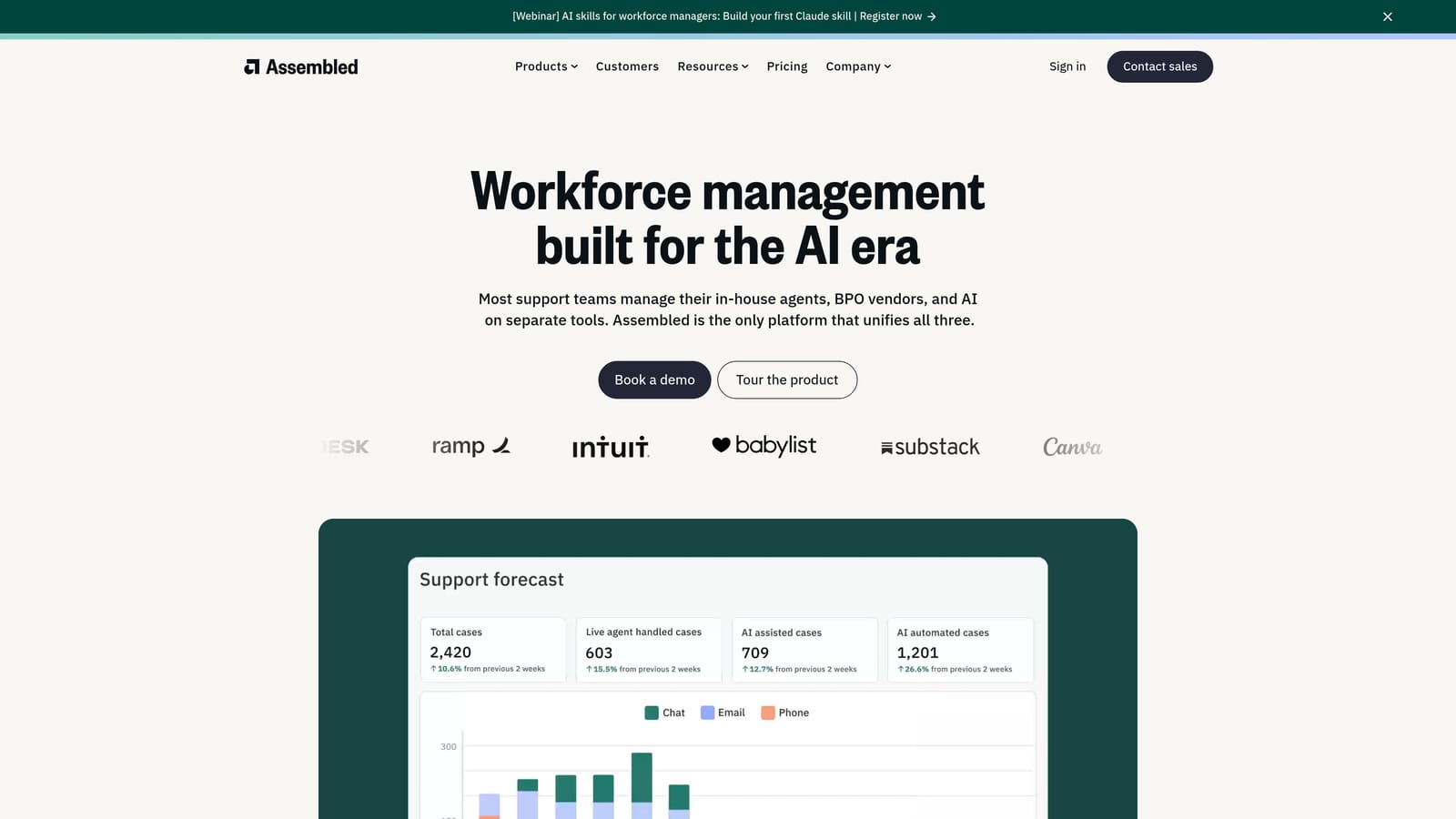
Assembled is an AI-powered workforce management platform that uses Zendesk ticket data to forecast volume and optimize support team scheduling.
Where This Tool Shines
Assembled solves a different problem than most tools on this list. It's not about resolving tickets faster; it's about making sure you have the right number of human agents available at the right times. By pulling historical data from Zendesk, Assembled builds forecasts that are grounded in actual ticket patterns rather than rough estimates.
For support operations leaders managing large teams, this kind of data-driven scheduling can reduce both overstaffing costs and the customer experience damage that comes from being understaffed during peak periods. It pairs well with resolution AI tools: let the AI handle deflection, then use Assembled to right-size the human team for what remains.
Key Features
AI-Driven Volume Forecasting: Predicts ticket volume using historical Zendesk data to inform staffing decisions.
Automated Scheduling: Generates staffing recommendations based on forecasted demand and team availability.
Real-Time Adherence Tracking: Monitors whether agents are following their scheduled assignments throughout the day.
Scenario Planning: Models the impact of team changes, peak periods, or new product launches on support capacity.
Multi-Helpdesk Integration: Connects to Zendesk, Salesforce, and other helpdesk platforms for data consolidation.
Best For
Support operations managers and workforce planners at mid-market to enterprise companies where scheduling inefficiency is a measurable cost. Less relevant for small teams where scheduling complexity is low.
Pricing
Contact Assembled directly for pricing at assembled.com. No public pricing is listed.
6. Gorgias
Best for: E-commerce brands automating order, return, and refund support tickets
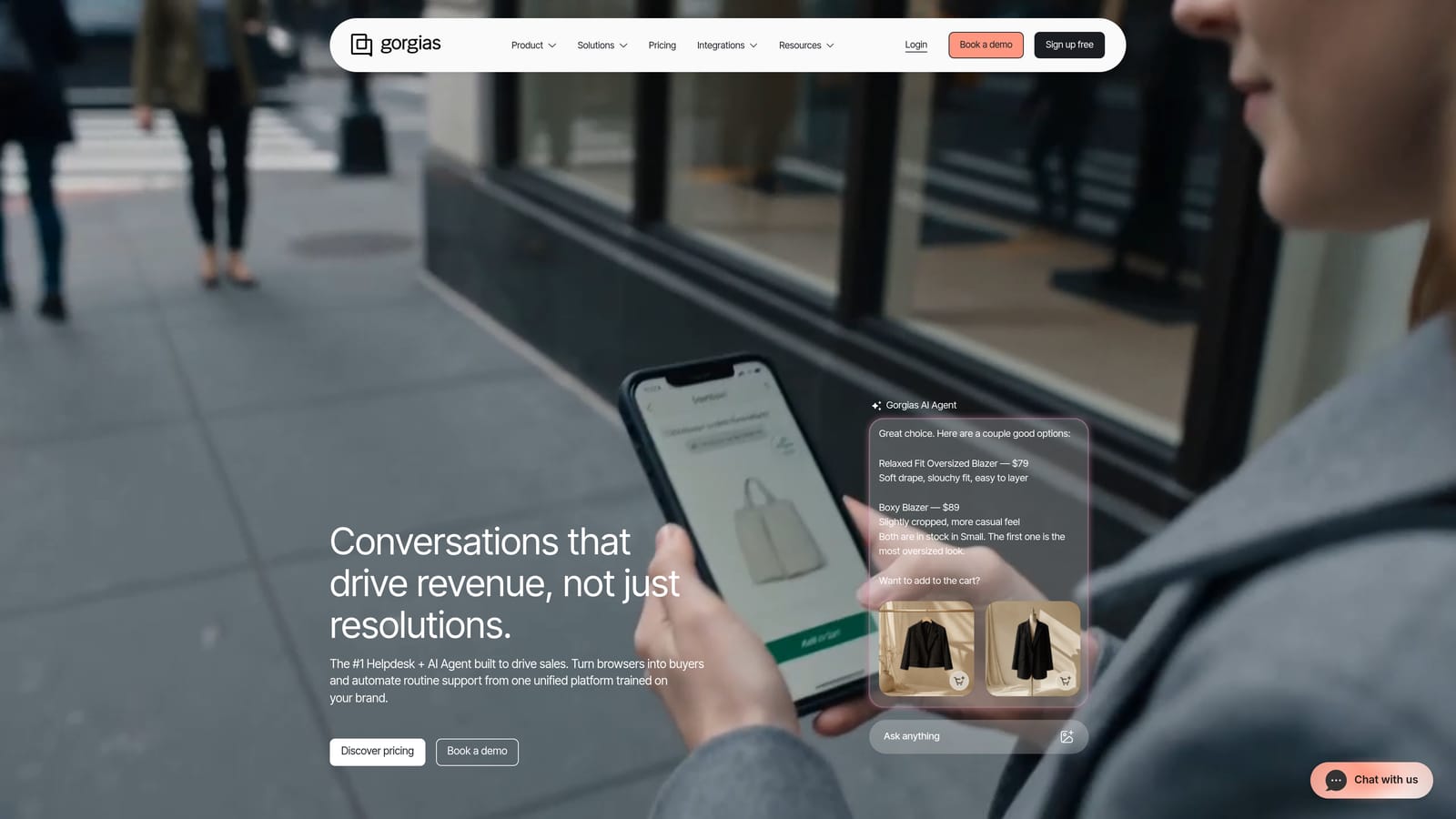
Gorgias is an e-commerce-focused helpdesk with AI automation built around the most common retail support ticket types, including order status, returns, and refunds.
Where This Tool Shines
If your support queue is dominated by "where's my order" and return requests, Gorgias is purpose-built for exactly that. Its deep integrations with Shopify, Magento, and BigCommerce allow the AI to pull live order data and resolve those tickets automatically, without an agent ever touching them.
The revenue statistics feature is a nice differentiator: it connects support interactions to sales outcomes, helping teams understand how support quality influences conversion and retention. For e-commerce brands, that linkage between support and revenue is genuinely useful context.
Key Features
AI Auto-Replies for E-Commerce Tickets: Automatically handles order status, return, and refund queries using live order data from connected platforms.
Deep Commerce Integrations: Native connections to Shopify, Magento, and BigCommerce for real-time order context.
Ticket Automation Rules: Builds automation logic based on order data, customer tags, and ticket content.
Omnichannel Support: Handles email, chat, social, and SMS from a single inbox.
Revenue Statistics: Links support interactions to sales data to show the business impact of support quality.
Best For
E-commerce brands on Shopify or similar platforms where the majority of support tickets are transactional. Less suited for B2B SaaS teams whose support queries are more technical and varied.
Pricing
Plans start at approximately $10 per month for small teams, scaling by ticket volume. Verify current pricing at gorgias.com.
7. Tidio
Best for: Small and mid-sized teams testing AI deflection on a budget
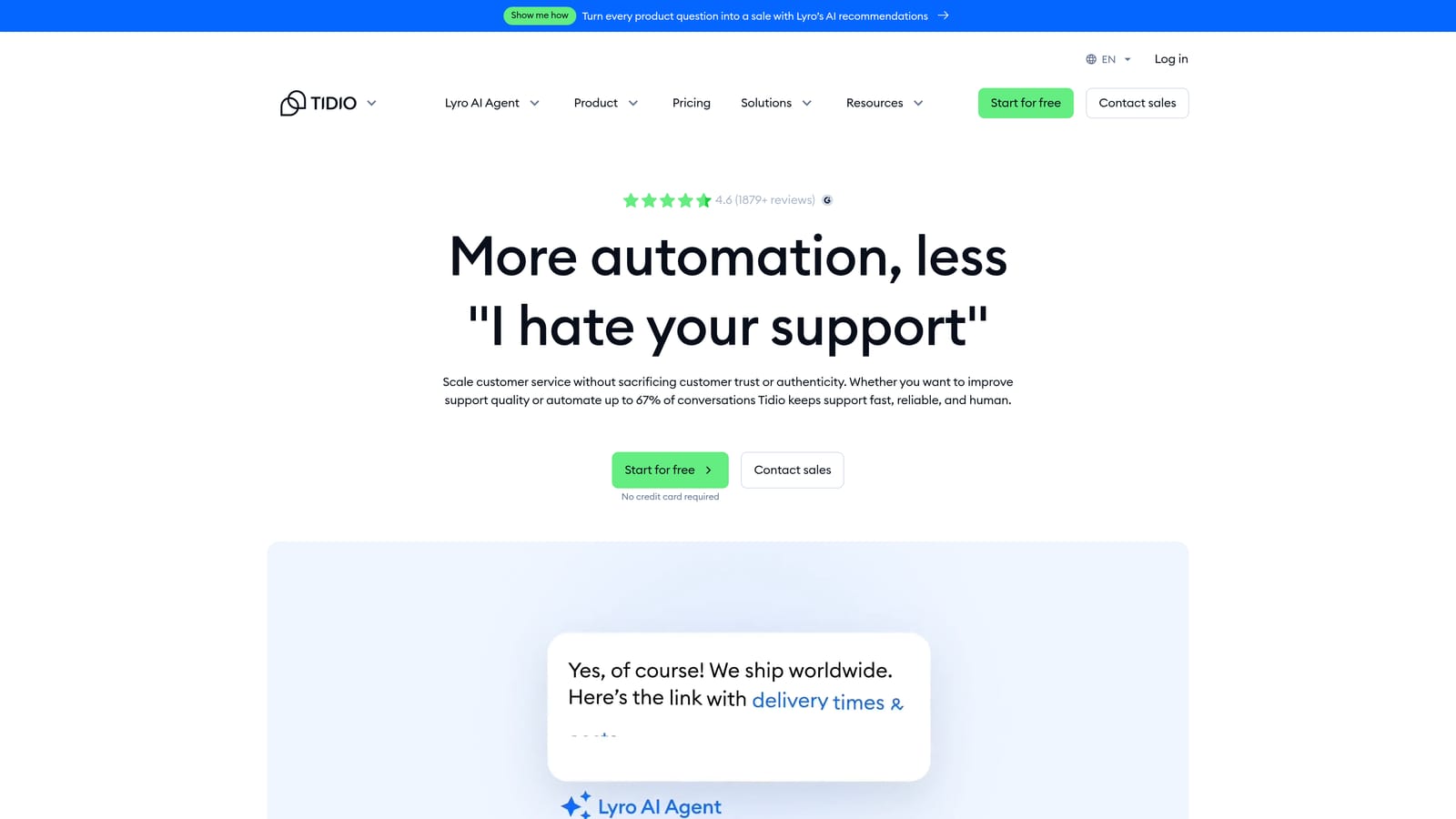
Tidio is an SMB-friendly live chat and AI chatbot platform featuring Lyro AI for conversational query resolution, with a Zendesk integration that syncs conversations as tickets.
Where This Tool Shines
Tidio's main advantage is accessibility. The pricing is approachable for smaller teams, the setup is straightforward, and the visual chatbot builder doesn't require technical resources to configure. For teams just starting to explore AI deflection, it's a low-risk entry point.
Lyro AI handles common conversational queries and passes more complex issues to live agents. The Zendesk integration ensures that conversations handled through Tidio flow into the existing helpdesk workflow as tickets, keeping the support record centralized.
Key Features
Lyro AI Chatbot: Handles conversational queries using AI, reducing the volume reaching live agents for common question types.
Zendesk Ticket Sync: Automatically creates Zendesk tickets from Tidio chat conversations to keep support records centralized.
Live Chat with Agent Takeover: Allows human agents to step into AI-handled conversations when needed.
Visual Flow Builder: Enables non-technical teams to build chatbot conversation flows without writing code.
Free Tier Available: Provides a starting point for small teams exploring AI chat without upfront cost commitment.
Best For
Small to mid-sized teams looking for an affordable way to add AI chat deflection to their Zendesk setup. Less suited for enterprise teams with complex resolution requirements or high technical query volume.
Pricing
Free tier available. Lyro AI is priced by conversation volume. Verify current rates at tidio.com.
8. Kustomer
Best for: Teams that need full customer context powering every AI interaction
Kustomer is a CRM-native support platform with AI-assisted responses, built around a unified customer timeline that gives AI complete context on every interaction.
Where This Tool Shines
The core differentiator is context. Most support AI tools see the current ticket in isolation. Kustomer's AI operates with visibility into the full customer timeline: every previous interaction, purchase history, and touchpoint across channels. That context produces meaningfully better AI suggestions because the system understands who the customer is, not just what they're asking right now.
For teams where personalization and relationship continuity matter, that difference is significant. Agents spend less time pulling up customer history manually, and AI suggestions are more likely to be relevant on the first pass.
Key Features
Unified Customer Timeline: Aggregates every interaction, purchase, and touchpoint into a single view that AI and agents both reference.
AI-Suggested Replies with Full Context: Generates reply recommendations informed by complete customer history rather than just the current ticket.
Sentiment Analysis: Detects customer sentiment across conversations to flag at-risk interactions for prioritization.
Omnichannel Coverage: Handles email, chat, voice, social, and SMS from a unified platform.
Workflow Automation: Automates multi-step processes across the customer journey based on triggers and conditions.
Best For
Support teams where customer relationship context is critical to resolution quality. Strong fit for brands with repeat customers and complex purchase histories. Can integrate with Zendesk data or serve as a full replacement depending on team needs.
Pricing
Plans start at approximately $89 per agent per month. Verify current pricing at kustomer.com.
9. Zapier (AI-Powered Automations)
Best for: Teams that need flexible, no-code workflows connecting Zendesk to the rest of their tech stack
Zapier is a no-code workflow automation platform with AI-assisted Zap building, connecting Zendesk to thousands of other apps through intelligent trigger-action workflows.
Where This Tool Shines
Zapier isn't a resolution AI; it's the connective tissue that makes your other tools work together. For Zendesk specifically, it opens up automation possibilities that would otherwise require engineering resources: routing tickets to Slack channels, creating records in HubSpot when a ticket is tagged, or updating Linear when a bug is reported. The AI-assisted Zap builder means you can describe what you want in plain language and Zapier will build the workflow structure for you.
The breadth of integrations is genuinely hard to match. With connections to thousands of apps, Zapier can automate almost any workflow that involves Zendesk data flowing in or out of another system.
Key Features
AI-Assisted Zap Builder: Describe your automation goal in plain language and Zapier generates the workflow structure automatically.
Zendesk Triggers: Fires automations on new tickets, ticket updates, tag changes, status changes, and more.
Broad App Connectivity: Connects Zendesk to Slack, HubSpot, Linear, Salesforce, and thousands of other tools without custom code.
Multi-Step Workflows with Conditional Logic: Builds complex automation sequences that branch based on ticket data or other conditions.
No Engineering Required: Most automations can be built and maintained by operations or support teams without developer involvement.
Best For
Operations-minded teams that want to extend Zendesk's reach across their tech stack without engineering resources. Works well as a complement to other tools on this list rather than a standalone support AI solution.
Pricing
Free tier available. Paid plans start at approximately $19.99 per month. Verify current pricing at zapier.com.
Which Tool Is Right for Your Team?
The right choice depends on where your biggest support bottleneck actually lives, and whether you want AI layered onto your current helpdesk or a platform built AI-first from day one.
Here's a quick way to think through it. If you want true AI-native support that learns and scales autonomously, Halo AI is built for exactly that. If you're staying fully within the Zendesk ecosystem and want the lowest-friction path, Zendesk AI native makes sense. For front-line chat deflection powered by large language models, Intercom Fin leads on containment. For agent efficiency inside the ticket view at scale, Forethought is purpose-built. Workforce planning and scheduling? Assembled. E-commerce automation for order and return tickets? Gorgias. Budget-conscious SMBs testing AI for the first time? Tidio. Full customer context informing every AI suggestion? Kustomer. Flexible no-code workflows connecting Zendesk to the rest of your stack? Zapier.
A few of these tools are designed to work together rather than compete. Assembled pairs naturally with any resolution AI: let the AI handle deflection, then use Assembled to right-size the human team for what remains. Zapier extends whichever primary tool you choose by automating data flows across your broader stack.
The deeper question is whether you want to keep adding capabilities to a reactive helpdesk or shift toward a platform where AI is the foundation. Your support team shouldn't scale linearly with your customer base. Let AI agents handle routine tickets, guide users through your product, and surface business intelligence while your team focuses on complex issues that need a human touch. See Halo in action and discover how continuous learning transforms every interaction into smarter, faster support.