8 Best AI Customer Support Platforms: Zendesk Automation vs. Dedicated AI in 2026
This guide compares Zendesk automation vs dedicated AI platform options across 8 leading tools, evaluating each on autonomy depth, integration breadth, and learning capability to help B2B SaaS support leaders reduce ticket volume and scale efficiently in 2026.
 Matt PattoliFounder13 min read
If you're running support on Zendesk today, you've probably asked the question: should we push further into Zendesk's own automation features, or move to a dedicated AI platform built specifically for autonomous support? It's not a trivial decision. Zendesk's automation suite has matured significantly, but purpose-built AI platforms offer a fundamentally different architecture, one designed from the ground up to learn, reason, and resolve, rather than route and escalate.
This guide breaks down platforms across both categories, from Zendesk's native AI tools to dedicated AI agents that operate independently of your helpdesk. We've evaluated each based on autonomy depth, integration breadth, learning capability, and fit for B2B SaaS teams. Whether you're a support leader looking to reduce ticket volume or a founder trying to scale without headcount, this comparison will help you find the right fit. For a deeper architectural look at how these categories differ, see our Zendesk vs. AI support platform breakdown.
1. Halo AI
Best for: B2B SaaS teams wanting autonomous AI support with business intelligence built in
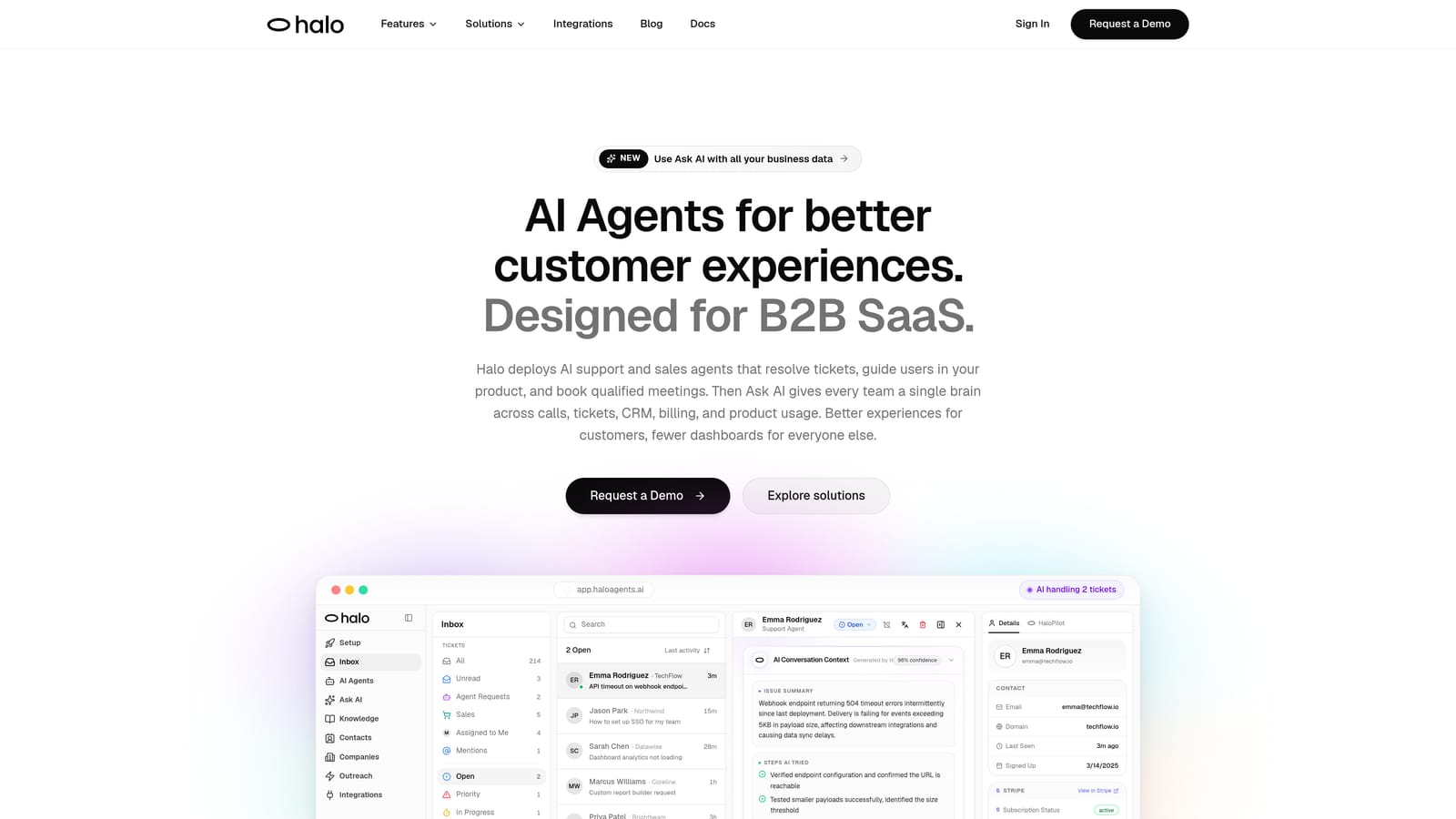
Halo AI is an AI-first customer support platform that deploys autonomous agents to resolve tickets, guide users through your product with page-aware context, and surface business intelligence, all while learning continuously from every interaction.
Where This Tool Shines
Halo AI isn't a feature added on top of an existing helpdesk. It's built from the ground up with autonomous resolution as the core design principle. The platform's page-aware chat widget is a standout capability: the AI sees exactly what a user sees in your product UI, which means it can deliver contextual, visual guidance rather than generic help center responses. That's a meaningful difference when your users are stuck inside a complex workflow.
Beyond support, Halo surfaces business intelligence that most support tools ignore entirely. Customer health signals, revenue anomalies, and product friction patterns emerge from support conversations and get routed to the right teams, turning your support channel into a strategic data source rather than a cost center.
Key Features
Page-Aware Chat Widget: The AI understands the specific page and UI state a user is on, enabling contextual guidance that's far more precise than static knowledge base lookups.
Autonomous Ticket Resolution: AI agents handle routine tickets end-to-end, with intelligent handoff to live agents when complexity warrants human judgment, preserving full conversation context.
Auto Bug Ticket Creation: Recurring support patterns are automatically converted into Linear or Jira tickets, closing the loop between customer pain and engineering action without manual triage.
Smart Inbox with Business Intelligence: The inbox surfaces customer health signals, revenue anomalies, and product friction detection, giving support leaders and product teams visibility they wouldn't otherwise have.
Broad Integration Stack: Connects natively with Slack, HubSpot, Intercom, Stripe, Zoom, PandaDoc, Fathom, and Linear, making it a connective layer across your entire business stack.
Best For
Halo AI is best suited for B2B SaaS teams that have outgrown reactive, ticket-centric support and want an AI layer that resolves independently, learns continuously, and feeds intelligence back into the business. Particularly strong for product-led growth companies where support and product experience are tightly linked.
Pricing
Custom pricing based on your team's needs. Request a demo and get specific pricing details directly at haloagents.ai.
2. Zendesk AI
Best for: Teams already on Zendesk Suite who want AI without migrating their stack
Zendesk AI is the native AI layer built into Zendesk Suite, offering intelligent triage, an agent copilot, AI agents for self-service deflection, and macro suggestions, all within the familiar Zendesk environment.
Where This Tool Shines
The biggest advantage Zendesk AI has is zero migration friction. If your team lives in Zendesk, the AI features slot directly into existing workflows, reporting, and channel configurations. There's no new platform to onboard, no data migration to manage, and no retraining your agents on a different interface. For teams where stability and familiarity matter, that's a genuine advantage.
Zendesk's AI roadmap has accelerated considerably, and the agent copilot features, including suggested replies, conversation summarization, and next-best-action prompts, are genuinely useful for teams handling high volumes with lean staff. The limitation is architectural: Zendesk's core data model is ticket-centric and routing-first, which means AI capabilities are additive rather than foundational.
Key Features
AI Agents: Evolved from Answer Bot, these handle self-service deflection using your knowledge base before a ticket is created.
Intelligent Triage: Auto-tagging, intent detection, and priority scoring route tickets to the right queue without manual intervention.
Agent Copilot: In-ticket suggestions, reply drafts, summarization, and next-best-action prompts accelerate agent response time.
Native Suite Integration: All AI features connect directly to Zendesk's channels, reporting, and workflow tools with no configuration overhead.
Advanced AI Add-On: Additional AI capabilities are available as a paid add-on for teams that need deeper automation beyond the base Suite tier.
Best For
Teams with significant Zendesk investment who want to extend their existing setup rather than replace it. Works well for companies where the primary goal is incremental efficiency improvement rather than full autonomous resolution.
Pricing
AI features are included across Suite plans at varying tiers; Advanced AI is a paid add-on. Confirm current pricing and tier details at zendesk.com.
3. Intercom Fin AI
Best for: Teams using Intercom as their primary support channel who want fast AI deployment
Intercom Fin is Intercom's purpose-built AI agent that resolves customer conversations using your help content and custom answers, operating natively within Intercom's messenger experience.
Where This Tool Shines
Fin's strength is speed to value. If your team is already on Intercom, deploying Fin requires pointing it at your existing help center content and setting a few configuration options. The LLM-powered resolution means Fin can synthesize answers from multiple knowledge sources rather than relying on rigid decision trees, which produces more natural, accurate responses.
The confidence-based handoff model is well-designed: when Fin isn't certain it can resolve a conversation, it escalates to a human agent with full context intact. That's a sensible safety net that keeps CSAT from suffering during the AI's learning curve.
Key Features
LLM-Powered Resolution: Fin generates answers from your help center content, custom answers, and ingested documents rather than following scripted flows.
Multi-Source Knowledge Ingestion: Accepts URLs, PDFs, and custom-written answers, giving you flexibility in how you train the AI.
Customizable AI Persona: Set tone, name, and response style to match your brand voice.
Confidence-Based Handoff: Fin escalates to human agents when resolution certainty falls below a threshold, reducing the risk of low-quality automated responses.
Per-Resolution Pricing: You pay for conversations Fin actually resolves, which aligns costs directly with value delivered.
Best For
Teams already using Intercom as their primary support messenger. Less suited for organizations that don't use Intercom as their main channel, since Fin's capabilities are tightly coupled to the Intercom platform.
Pricing
Per-resolved-conversation pricing on top of your existing Intercom plan. Confirm current rates at intercom.com.
4. Freshdesk Freddy AI
Best for: SMB and mid-market teams on Freshdesk looking for cost-effective AI across the support lifecycle
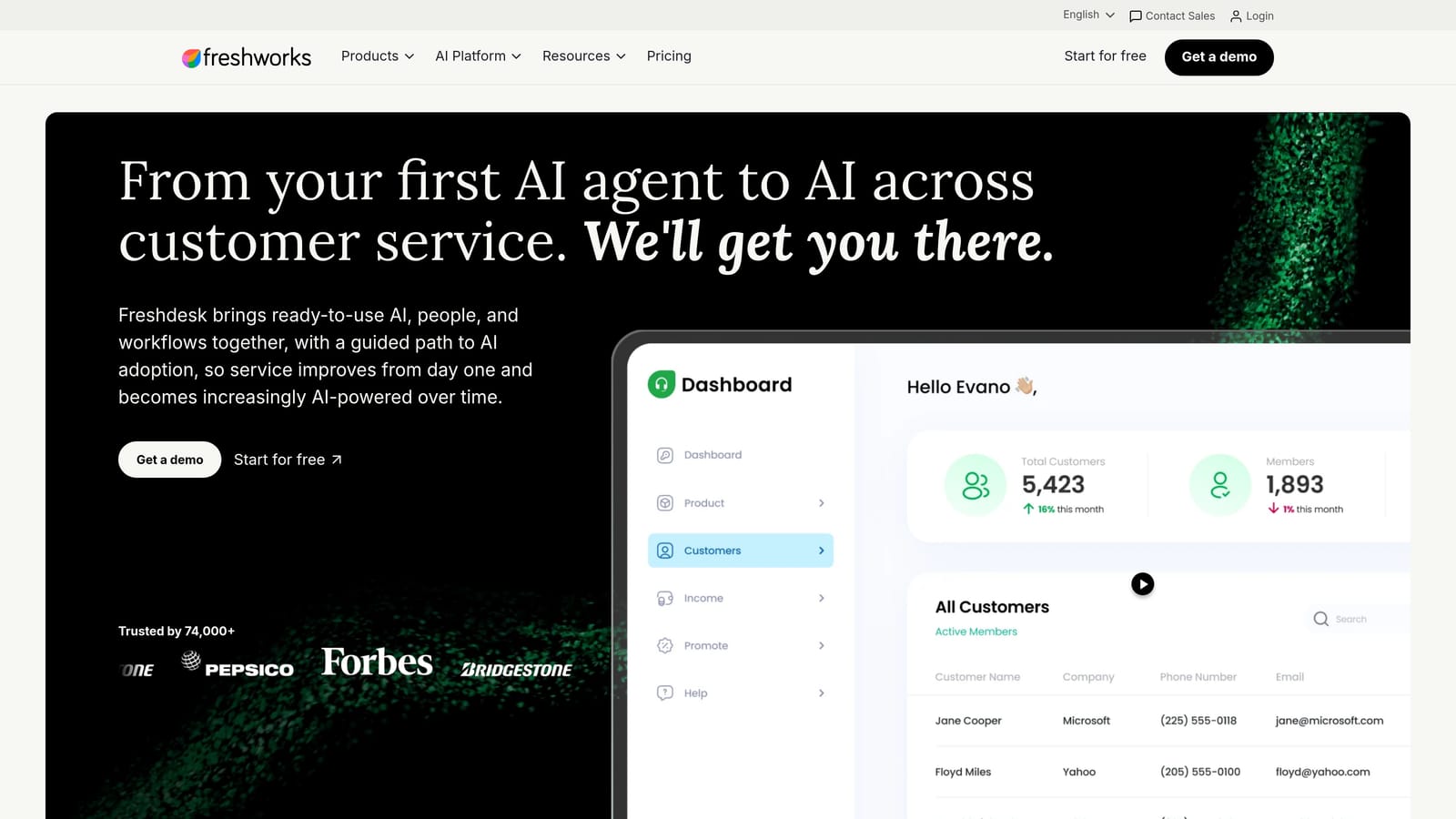
Freshdesk Freddy AI is Freshworks' AI layer embedded across Freshdesk, spanning self-service bots, agent assist, and analytics, making it a solid choice for teams already in the Freshdesk ecosystem.
Where This Tool Shines
Freddy AI covers the full support lifecycle in a way that feels coherent rather than bolted together. The three-layer model, self-service bot, agent copilot, and analytics, means teams get AI assistance at every stage of the support workflow without needing separate tools for each function. For SMB and mid-market teams watching budget closely, this bundled approach delivers meaningful value.
Freddy Insights, the analytics layer, is worth highlighting specifically. It surfaces anomalies and trends across support operations automatically, which helps support leaders spot problems before they become escalations without building custom reports.
Key Features
Freddy Self Service: AI-powered bot handles ticket deflection and FAQ resolution before tickets reach the queue.
Freddy Copilot: In-ticket suggestions, reply drafting, and summarization help agents respond faster and more consistently.
Freddy Insights: AI-driven analytics layer detects anomalies and surfaces trends across support operations automatically.
Omnichannel Coverage: Email, chat, phone, and social channels are all supported within the Freshdesk environment.
Tiered Availability: Freddy features are distributed across Freshdesk Growth, Pro, and Enterprise plans, so capability access scales with your plan level.
Best For
SMB to mid-market teams already using Freshdesk who want AI features without switching platforms. A strong Zendesk alternative for cost-conscious buyers who want comparable AI functionality at a lower price point.
Pricing
Freddy features are included at higher Freshdesk tiers. Confirm current plan structure and feature availability at freshworks.com.
5. Salesforce Agentforce
Best for: Enterprise organizations with Salesforce as their system of record needing autonomous agents at scale
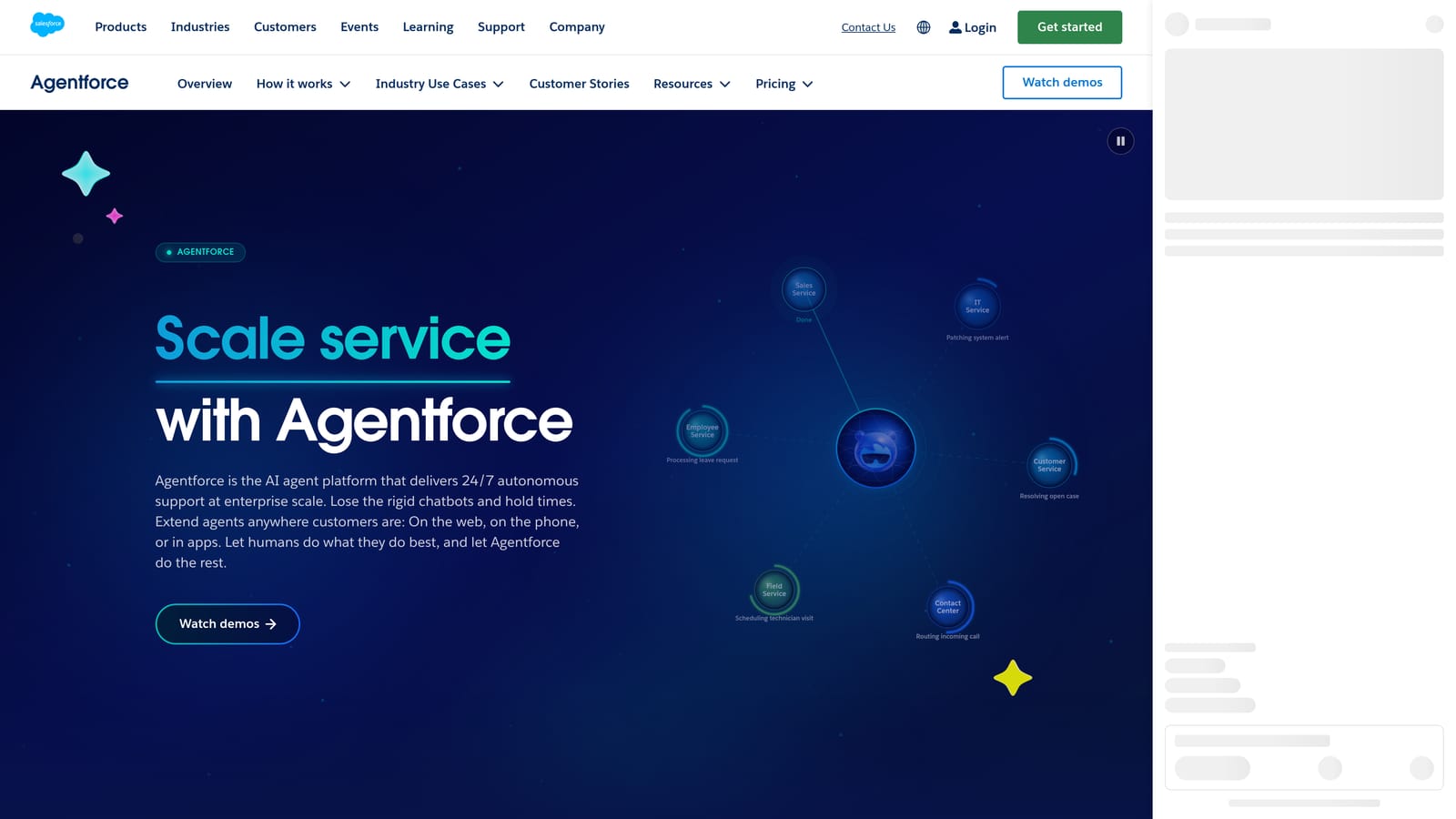
Salesforce Agentforce is Salesforce's enterprise autonomous AI agent platform, deeply integrated with Service Cloud and CRM data to handle complex support and service workflows at scale.
Where This Tool Shines
Agentforce's core advantage is CRM-native intelligence. Because agents have direct access to Salesforce customer data, case history, entitlements, and service contracts, they can make context-aware decisions that most support AI tools simply can't replicate without a separate data sync. For enterprises where customer history is complex and support decisions depend on contract terms or account status, this is a meaningful differentiator.
The Einstein AI reasoning layer enables multi-step decision making, which means Agentforce can handle workflows that go beyond simple Q&A deflection. The tradeoff is implementation complexity: deploying Agentforce typically requires Salesforce admin expertise or a partner, and the configuration investment is substantial.
Key Features
CRM-Native AI Agents: Full access to Salesforce customer data, case history, and account context enables highly personalized, context-aware resolution.
Pre-Built Agent Templates: Ready-to-deploy templates for service, sales, and HR use cases accelerate initial setup.
Einstein AI Reasoning: Multi-step decision-making capability for complex workflows that require more than single-turn responses.
Deep Service Cloud Integration: Cases, knowledge articles, entitlements, and SLAs are all natively accessible to agents.
Customizable Workflows: Salesforce Flow and Apex allow deep customization for organizations with unique process requirements.
Best For
Enterprise organizations already running Salesforce as their primary CRM and Service Cloud as their support platform. Not well-suited for teams without existing Salesforce infrastructure given the implementation overhead.
Pricing
Enterprise-tier pricing. Confirm current Agentforce tiers and packaging at salesforce.com.
6. Ada
Best for: High-volume support teams wanting a dedicated AI agent layer independent of any single helpdesk
Ada is a dedicated AI agent platform built for high-volume support teams, offering a no-code builder for deploying autonomous AI agents across web, mobile, and voice channels, independent of any single helpdesk.
Where This Tool Shines
Ada's platform-agnostic architecture is its defining characteristic. Rather than being tied to Zendesk, Intercom, or Salesforce, Ada sits as an intelligent layer on top of whatever helpdesk you're using. That means you can deploy AI agents without replacing your existing ticketing infrastructure, which is a compelling option for teams that want to add autonomous resolution without a full migration.
The no-code builder lowers the barrier to deployment significantly. Support operations teams can build and iterate on AI agent flows without engineering involvement, which compresses time-to-value and keeps ongoing maintenance manageable for non-technical teams.
Key Features
No-Code AI Agent Builder: Deploy and iterate on AI agent conversations without requiring engineering resources.
Multi-Channel Support: Web chat, mobile, voice, email, and social channels are all covered from a single platform.
Helpdesk-Agnostic Integration: Connects with Zendesk, Salesforce, and other CRM and helpdesk backends as an overlay layer.
Generative AI Responses: AI answers are grounded in your knowledge base, reducing hallucination risk while maintaining conversational quality.
Resolution Analytics: Dashboard tracking resolution rates, containment, and CSAT gives clear visibility into AI performance over time.
Best For
High-volume support teams that want AI agent capabilities without committing to a new helpdesk platform. Particularly useful for organizations with multi-channel support needs or those running multiple helpdesk systems simultaneously.
Pricing
Custom and enterprise pricing. Confirm current packaging at ada.cx.
7. Forethought
Best for: Teams wanting AI triage and deflection on top of an existing enterprise helpdesk without replacing it
Forethought is an AI platform designed to sit on top of existing helpdesks like Zendesk, Salesforce, and ServiceNow, focusing on intelligent triage, ticket deflection, and agent assist rather than replacing your current stack.
Where This Tool Shines
Forethought's value proposition is clear: add AI intelligence to your existing helpdesk without a migration. The three-product structure, Solve for deflection, Triage for routing, and Assist for agent support, maps directly to the three stages where AI can reduce load on human agents. For teams with complex routing logic or specialized queues, the intent prediction in Triage is particularly strong.
Because Forethought is designed as an overlay rather than a replacement, it tends to be faster to deploy than full-platform alternatives. Teams can start with one module and expand, which makes the initial business case easier to build internally.
Key Features
Solve: AI-powered deflection bot handles common questions before a ticket is created, reducing inbound volume at the source.
Triage: Intent prediction and intelligent routing direct tickets to the right team or queue without manual intervention.
Assist: In-ticket AI surfaces relevant knowledge articles and suggests responses to help agents resolve faster.
Broad Helpdesk Compatibility: Works as an overlay on Zendesk, Salesforce, ServiceNow, and other enterprise platforms.
Deflection-Focused Analytics: Reporting centers on deflection rate, routing accuracy, and agent efficiency rather than general support metrics.
Best For
Enterprise teams on Zendesk, Salesforce, or ServiceNow that want to add AI intelligence incrementally without displacing their existing platform investment. Strong fit for organizations where IT governance makes full platform migrations difficult.
Pricing
Custom and enterprise pricing. Confirm current rates and packaging at forethought.ai.
8. Kustomer AI
Best for: Support teams where rich customer history and context are central to every resolution decision
Kustomer is a CRM-native helpdesk that combines a unified customer timeline with AI-assisted resolution, giving support teams rich customer context alongside automation, suited for teams where customer history drives support decisions.
Where This Tool Shines
Kustomer's customer-centric data model is what sets it apart from ticket-centric platforms. Instead of organizing around individual tickets, Kustomer organizes around the customer, surfacing their full history across every channel in a single timeline view. When AI-suggested replies and sentiment analysis are layered on top of that rich context, agents can respond with a level of personalization that ticket-centric tools struggle to match.
The workflow automation layer is flexible and handles routing, tagging, and SLA management without requiring complex configuration. For teams managing high-value customers where context matters as much as speed, Kustomer's model is a genuinely different approach to support tooling. Note: Kustomer was acquired by Meta and subsequently returned to private ownership, which is worth factoring into long-term platform decisions.
Key Features
Unified Customer Timeline: Full interaction history across all channels displayed in a single view, giving agents immediate context before responding.
AI-Suggested Replies: AI drafts responses based on conversation context and customer history, accelerating agent response time.
Sentiment Analysis: Real-time sentiment detection helps agents and managers identify at-risk conversations before they escalate.
Workflow Automation: Handles routing, tagging, and SLA management automatically based on configurable rules.
Omnichannel Support: Email, chat, SMS, voice, and social channels are unified within the customer timeline model.
Best For
Support teams handling complex, relationship-driven customer interactions where history and context are as important as resolution speed. Strong fit for subscription businesses, high-touch B2B teams, and companies where customer lifetime value makes personalized support a priority.
Pricing
Per-user monthly pricing. Confirm current tiers and plan details at kustomer.com.
Which Tool Is Right for Your Team
The right choice here comes down to one core question: are you extending your existing helpdesk, or rethinking the model entirely?
If you're committed to Zendesk and want incremental AI improvement, Zendesk AI is the lowest-friction path forward. If you're on Freshdesk or Intercom, Freddy AI and Fin respectively offer tight native integration with solid AI capabilities. For enterprise teams running Salesforce, Agentforce is the obvious choice given the CRM depth it unlocks.
If you want to add an AI layer without replacing your helpdesk, Ada and Forethought are both strong options, with Ada leaning toward multi-channel autonomous resolution and Forethought focusing on triage and deflection. Kustomer is worth serious consideration for teams where customer history is the primary driver of support quality.
For B2B SaaS teams ready to move beyond the ticket-centric model entirely, Halo AI offers something the others don't: an AI-first architecture that resolves autonomously, learns continuously, and feeds business intelligence back into your product and revenue teams. It's not just about deflecting tickets; it's about making every support interaction a source of organizational intelligence.
Your support team shouldn't scale linearly with your customer base. Let AI agents handle routine tickets, guide users through your product, and surface business intelligence while your team focuses on complex issues that need a human touch. See Halo in action and discover how continuous learning transforms every interaction into smarter, faster support.