9 Best AI Support Platforms to Replace or Supercharge Zendesk in 2026
This guide compares the top AI support platforms against Zendesk, helping B2B teams understand the key differences between legacy ticketing systems with bolted-on AI versus purpose-built AI-first alternatives. In the zendesk vs ai support platforms debate, the nine tools evaluated are ranked across resolution capabilities, integrations, pricing transparency, and B2B suitability to help teams decide whether to replace or augment their current setup.
 Grant CooperFounder14 min read
The way B2B teams think about customer support software is changing fast. For years, the default choice was simple: pick a helpdesk, hire agents, and bolt on automation where you could. Zendesk became the dominant answer to that question, and for good reason. But in 2026, a growing number of product teams are asking a harder question: is a legacy ticketing system with AI layered on top actually the same thing as an AI-first support platform?
The honest answer is no. And the gap between the two architectures is widening.
This list is designed to help you evaluate your options clearly. Whether you're looking to replace Zendesk entirely, augment it with smarter AI, or find a purpose-built alternative, the tools below represent the strongest contenders across different use cases and team sizes.
Selection criteria for this list: AI resolution capabilities, depth of integrations, learning and improvement loops, pricing transparency, and suitability for B2B product teams. Here are the top AI support platforms worth evaluating in 2026.
1. Halo AI
Best for: B2B product teams wanting AI-first support that learns, guides, and surfaces business intelligence.
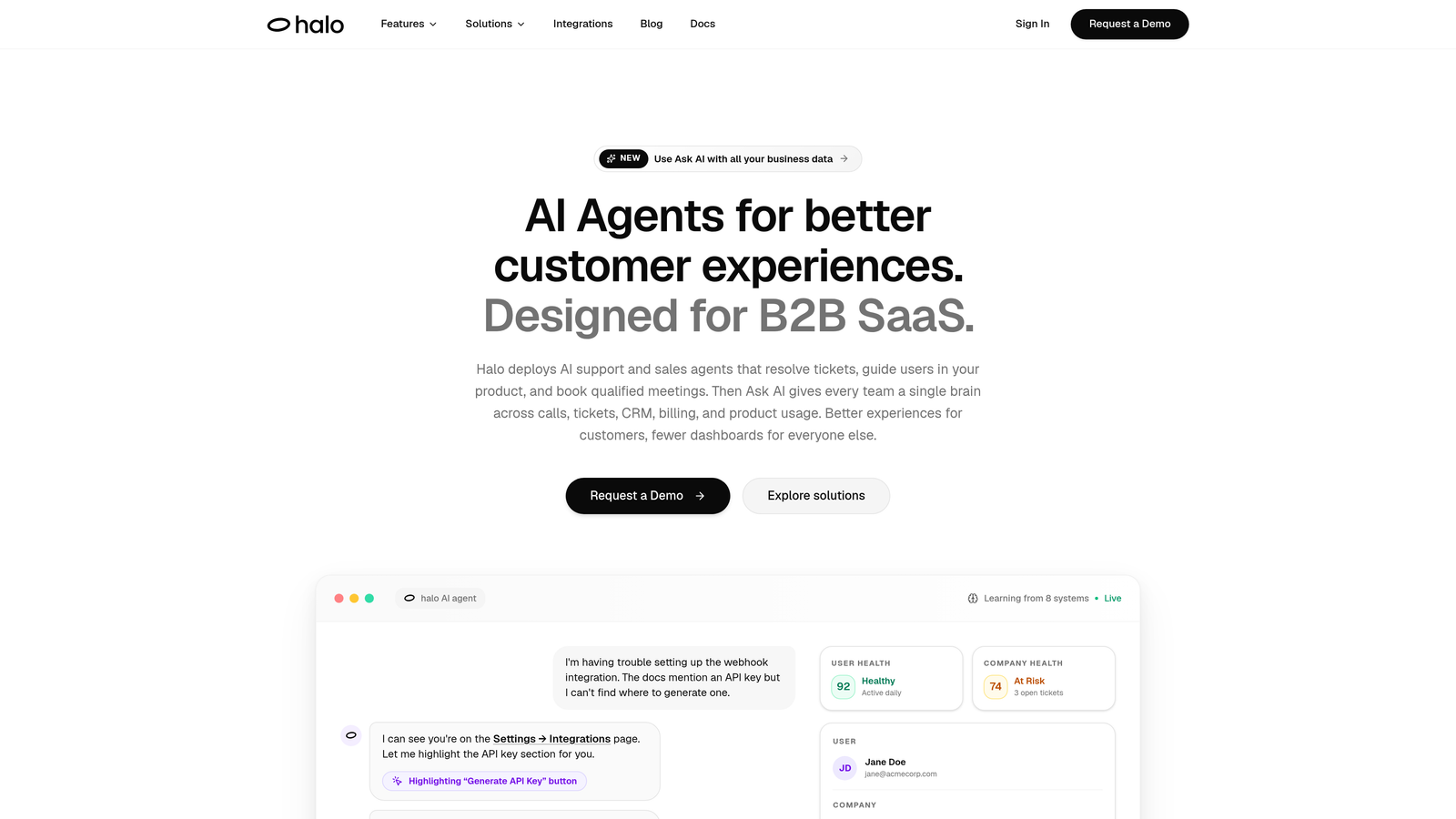
Halo AI is an AI-native customer support platform where intelligent agents resolve tickets, guide users visually through your product, and surface business intelligence from every interaction.
Where This Tool Shines
What separates Halo from most tools on this list is the architectural starting point. It wasn't built as a ticketing system that later added AI. The entire platform is designed around AI agents as the primary resolution layer, with human escalation as the exception rather than the rule.
The page-aware capability is particularly notable for SaaS teams. Halo's agents can see what a user is looking at inside your product and provide contextual, visual guidance in real time. That's a fundamentally different experience from a chatbot that asks "how can I help?" without any awareness of where the user is or what they're trying to do.
Key Features
Page-Aware AI Agents: Agents understand the user's current page context and deliver visual, in-product guidance rather than generic responses.
Continuous Learning Loops: Every resolved interaction feeds back into the model, improving resolution quality over time without manual retraining.
Smart Inbox with Business Intelligence: Goes beyond support metrics to surface customer health signals, revenue intelligence, and anomaly detection across your customer base.
Auto Bug Ticket Creation and Live Agent Handoff: Automatically creates bug reports in connected systems like Linear and escalates complex issues to human agents with full context preserved.
Deep Integration Stack: Connects natively with Linear, Slack, HubSpot, Intercom, Stripe, Zoom, PandaDoc, and Fathom, making it a connective layer across your entire business stack.
Best For
Halo is best suited for B2B SaaS companies and product teams who want support that scales without scaling headcount. If you're currently using Zendesk or Intercom and feel like AI was bolted on rather than built in, Halo is worth a close look. It's particularly strong for teams where support data should be informing product and revenue decisions, not just closing tickets.
Pricing
Contact for pricing. Current plan details are available at haloagents.ai.
2. Zendesk (with AI Add-Ons)
Best for: Enterprises already deeply embedded in the Zendesk ecosystem wanting to layer AI onto existing workflows.
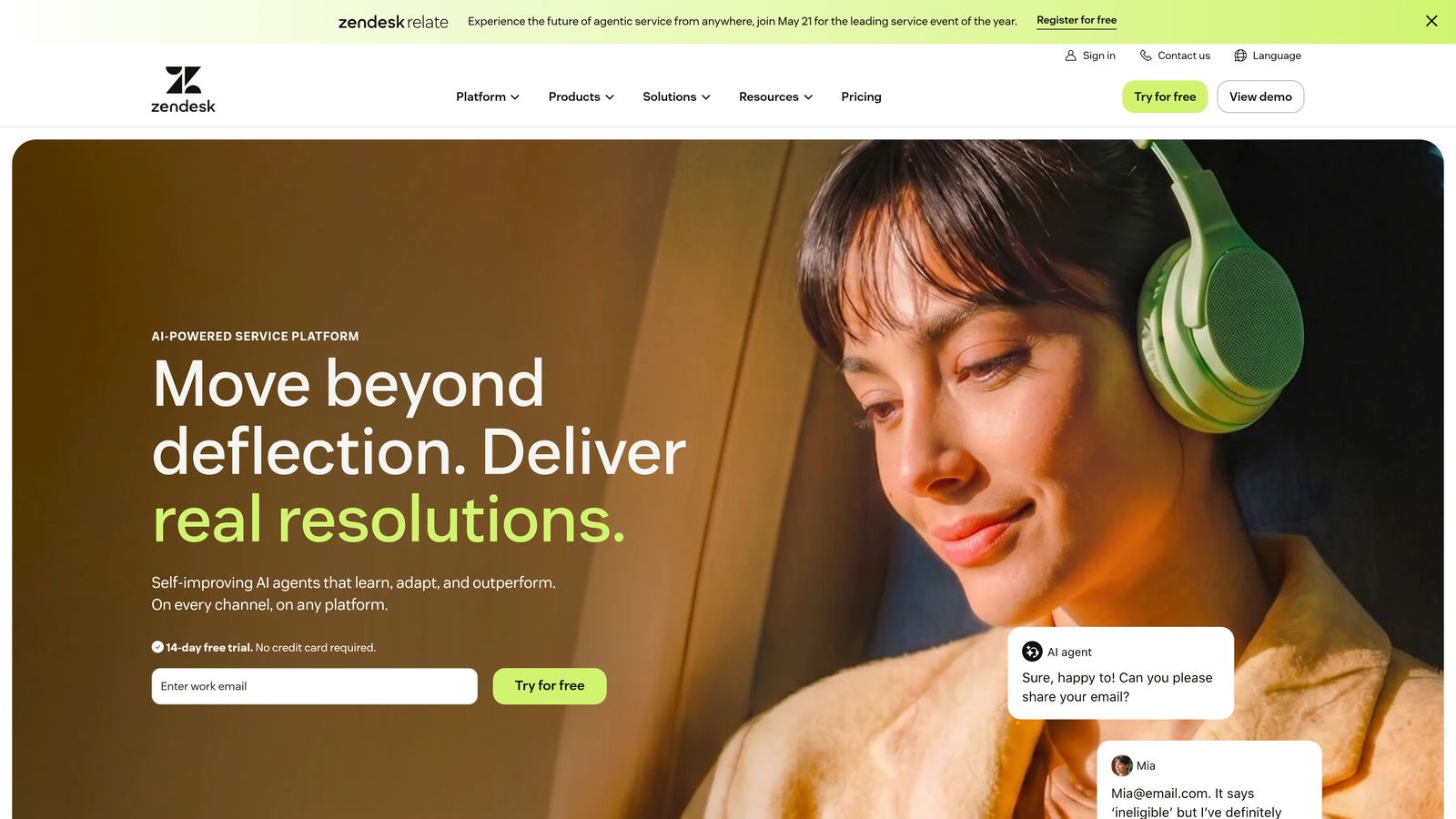
Zendesk is the industry-standard helpdesk platform, now augmented with AI agents, agent copilots, and intelligent triage across its product suite.
Where This Tool Shines
Zendesk's biggest strength is also its most obvious one: ubiquity. If your team already runs on Zendesk, the prospect of migrating to a new platform carries real switching costs in data, workflows, and agent retraining. For those teams, Zendesk's AI additions may be the path of least resistance.
The platform has invested meaningfully in AI since acquiring Cleverly in 2022, and its AI agents and copilot features are genuinely capable. The challenge is that these capabilities often feel layered onto a ticketing architecture that was designed for human agents first. Teams evaluating Zendesk's AI should budget carefully, as advanced AI features typically require higher-tier plans or additional add-on costs.
Key Features
AI Agents: Automated resolution across email, chat, and messaging channels using trained AI agents.
Agent Copilot: AI-assisted response drafting, ticket summarization, and suggested next actions for human agents.
Intelligent Triage: Automatic ticket classification and routing based on intent, sentiment, and priority.
App Marketplace: Over 1,500 integrations covering a wide range of business tools and platforms.
Mature Multi-Channel Support: Handles email, chat, phone, social, and messaging from a single platform with decades of refinement.
Best For
Enterprise teams with significant existing investment in Zendesk configurations, workflows, and integrations. Also suitable for organizations where multi-channel voice and phone support is a hard requirement, as Zendesk's telephony capabilities remain among the most mature in the market.
Pricing
Suite plans start at $55 per agent per month. Advanced AI features may require an additional add-on at extra cost. Check Zendesk's pricing page for current tier breakdowns.
3. Intercom Fin
Best for: Product-led SaaS companies wanting conversational AI embedded directly inside their product experience.
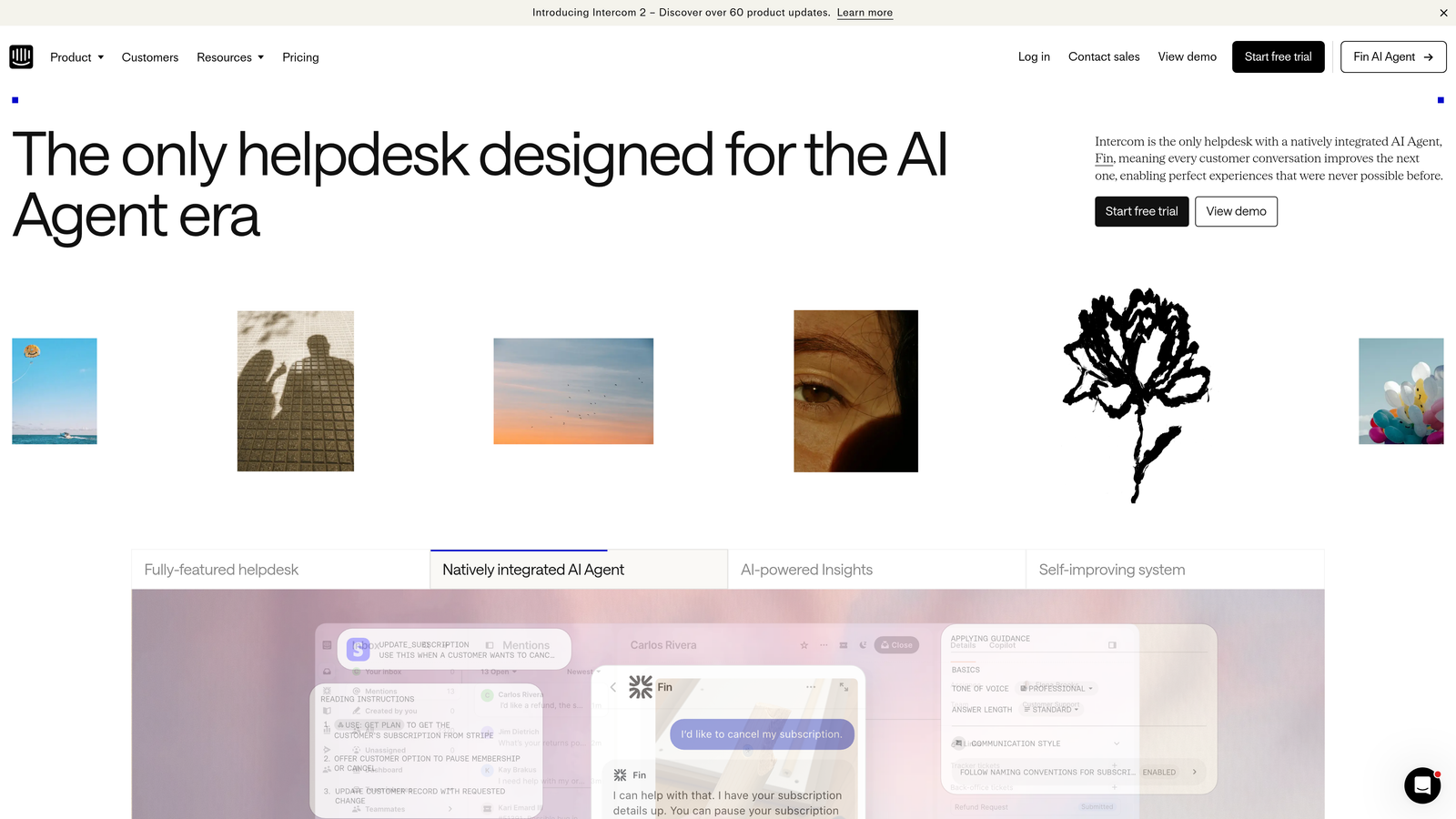
Intercom Fin is an AI support agent built into Intercom's product messaging platform, trained on your help center content and custom knowledge sources.
Where This Tool Shines
Intercom has a significant structural advantage for product-led companies: the messenger is already inside the product. Fin inherits that context, which means the AI agent can engage users at the right moment in the product journey rather than routing them to a separate support portal.
The per-resolution pricing model is worth understanding before you commit. It aligns Intercom's incentives with yours in theory, but teams with high ticket volumes should model costs carefully before assuming it's cheaper than seat-based alternatives.
Key Features
Fin AI Agent: Trained on your help center articles and custom content sources for accurate, context-aware responses.
In-App Messenger: Native product messaging with product tours and onboarding flows built in alongside support.
AI Copilot for Human Agents: Conversation summarization and suggested responses to accelerate human agent workflows.
Workflow Automation Builder: Visual builder for complex routing logic, escalations, and multi-step automations.
Per-Resolution Pricing for Fin: AI agent costs are tied to resolved conversations rather than seat counts.
Best For
SaaS companies with a product-led growth motion where in-app support and onboarding are tightly connected. Teams already using Intercom for user messaging will find the least friction here, as Fin extends existing infrastructure rather than replacing it.
Pricing
Essential plan starts at $29 per seat per month. Fin AI is charged per resolution. Check Intercom's pricing page for current rates, as per-resolution costs vary by plan.
4. Ada
Best for: Enterprise teams needing multilingual AI automation at scale with no-code configurability.
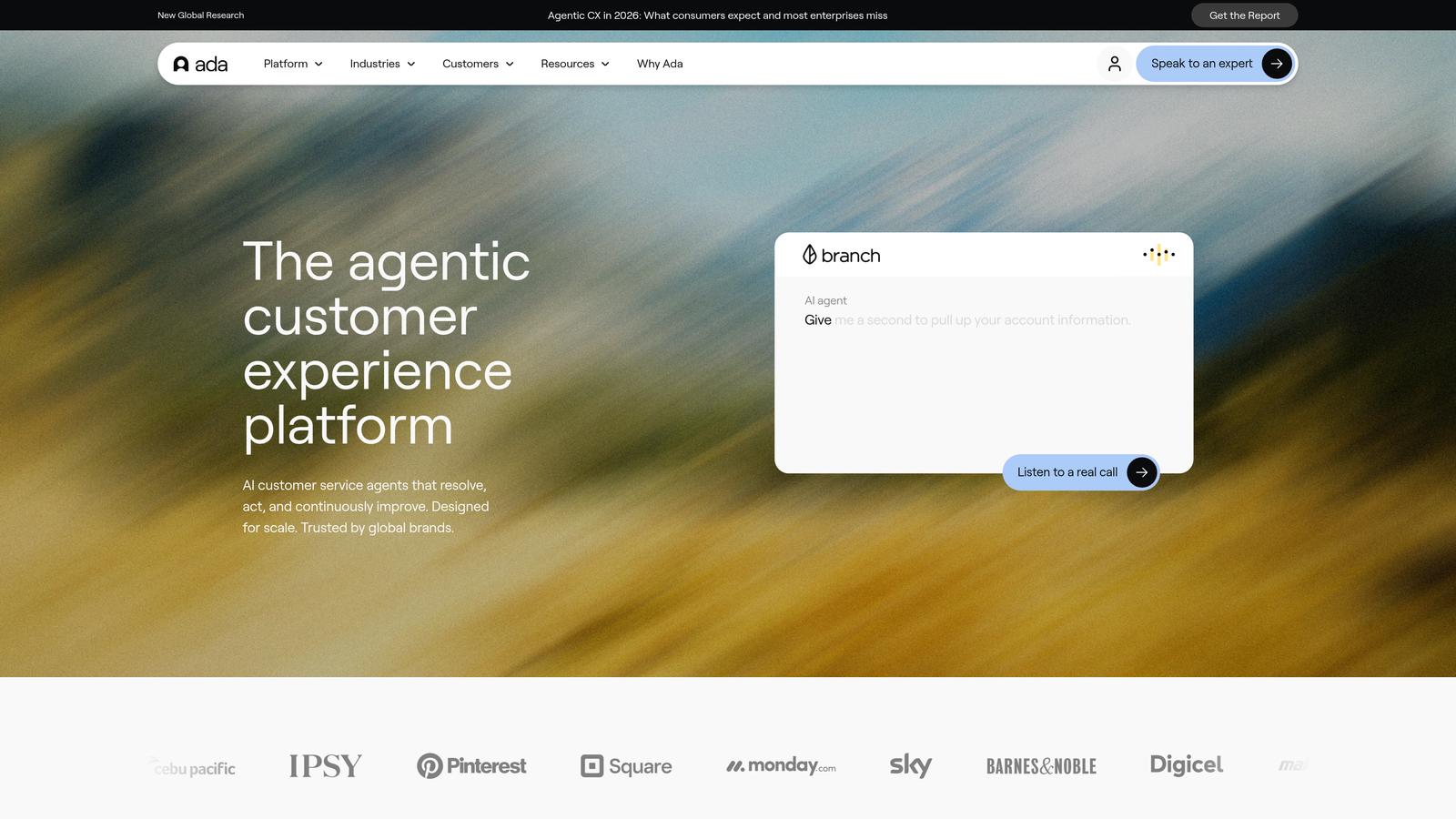
Ada is an enterprise-grade AI agent platform purpose-built for automated customer service, with strong multilingual support and a reasoning engine for multi-step resolution.
Where This Tool Shines
Ada is one of the few platforms on this list designed explicitly for global enterprise deployments. Support for over 50 languages out of the box is a genuine differentiator for companies operating across multiple markets where building and maintaining separate localized workflows would be prohibitively complex.
The no-code configuration layer also matters for enterprise teams where the people who understand support workflows aren't always the people with engineering access. Ada lets non-technical teams define and adjust AI behavior without requiring developer involvement for every change.
Key Features
Reasoning Engine: AI agent capable of multi-step resolution logic rather than simple FAQ matching.
50+ Language Support: Multilingual AI out of the box, covering a broad range of global markets.
No-Code Builder: Non-technical teams can configure AI behavior, responses, and escalation logic without engineering resources.
Helpdesk Integrations: Connects with Zendesk, Salesforce, and other major helpdesks, making it a strong overlay option for existing stacks.
Analytics Dashboard: Resolution tracking, AI performance metrics, and deflection rate reporting.
Best For
Enterprise companies with global customer bases requiring multilingual support at scale. Also well-suited for organizations that want to layer AI automation on top of existing helpdesk infrastructure without a full platform migration.
Pricing
Custom enterprise pricing. Contact Ada directly for quotes based on volume and configuration requirements.
5. Freshdesk (with Freddy AI)
Best for: Budget-conscious teams wanting a full-featured helpdesk with built-in AI at a lower price point than Zendesk.
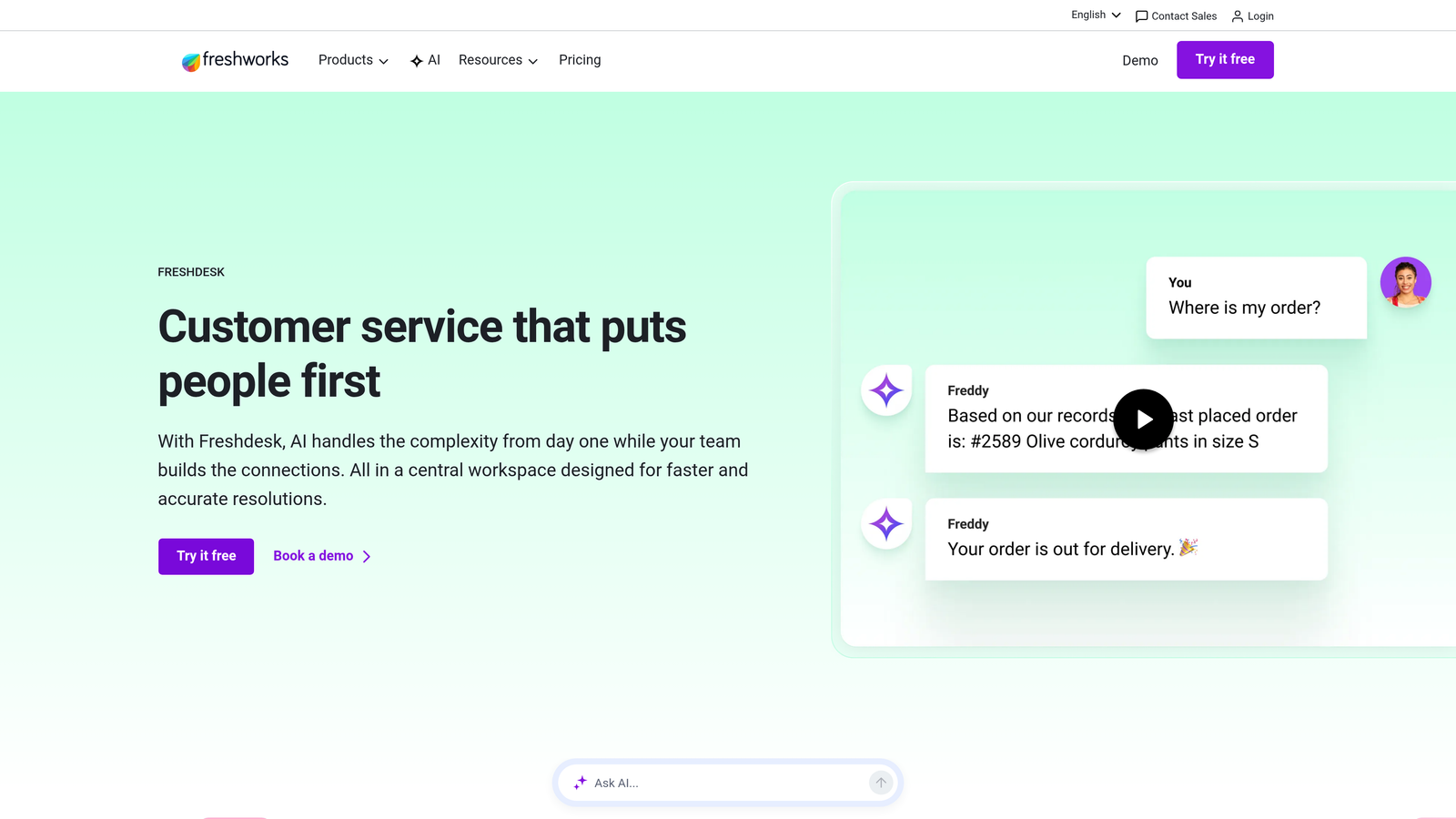
Freshdesk is a helpdesk alternative to Zendesk with built-in Freddy AI for ticket triage, response suggestions, and agent assistance.
Where This Tool Shines
Freshdesk's primary competitive advantage is price. For teams that need a capable omnichannel helpdesk with AI features and can't justify Zendesk's per-agent costs, Freshdesk offers a meaningful alternative without requiring a leap to a fully AI-native platform.
Freddy AI covers the core use cases well: auto-triage, response drafting, and ticket summarization. It won't win a head-to-head comparison with purpose-built AI platforms on resolution sophistication, but for teams where human agents are still the primary resolution layer and AI is a productivity tool, it's a practical choice.
Key Features
Freddy AI Copilot: Response drafting assistance and ticket summarization for human agents.
Auto-Triage and Routing: Intelligent ticket classification and routing based on content and priority signals.
Omnichannel Support: Email, chat, phone, social, and messaging handled from a unified agent workspace.
Free Tier: A free plan supporting up to two agents, making it accessible for very small teams getting started.
Integration Marketplace: Connections to common business tools covering CRM, billing, and collaboration platforms.
Best For
Small to mid-market teams looking for a cost-effective Zendesk alternative with solid helpdesk fundamentals and AI features included. Particularly strong for teams where budget is a primary constraint and full AI autonomy is not yet a requirement.
Pricing
Free tier available for up to two agents. Paid plans start at $15 per agent per month. Freddy AI features are available in higher-tier plans.
6. Forethought
Best for: Teams wanting to add AI intelligence to their existing Zendesk or Salesforce setup without migrating platforms.
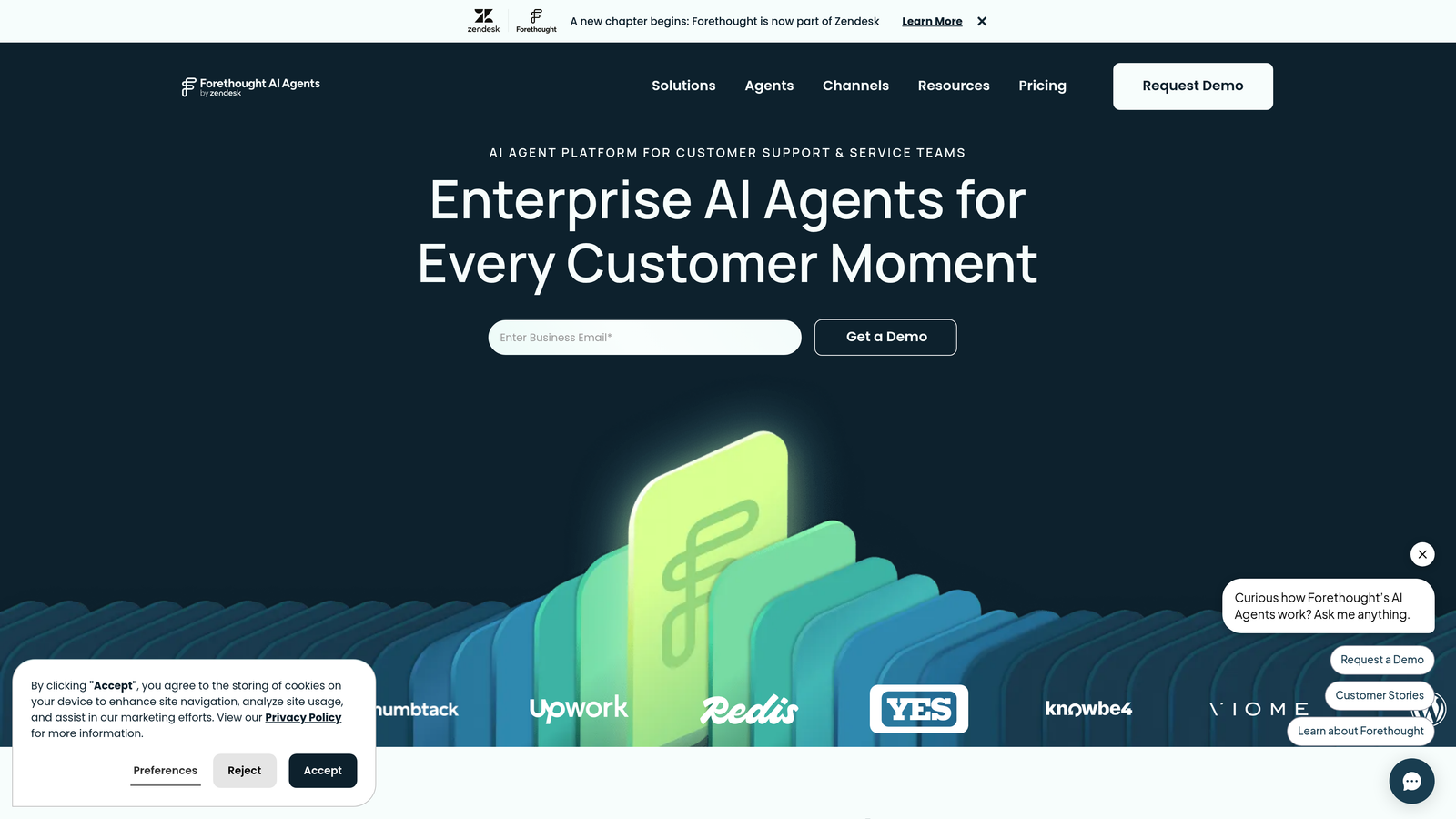
Forethought is an AI overlay platform powered by SupportGPT that layers intelligent triage, agent assist, and automated resolution on top of existing helpdesks.
Where This Tool Shines
Forethought's overlay architecture is its defining characteristic. Rather than replacing your helpdesk, it sits on top of it, adding AI capabilities to Zendesk, Salesforce, and ServiceNow without requiring a platform migration. For teams with significant existing investments in helpdesk configuration, this is a meaningful advantage.
The SupportGPT-powered resolution engine handles autonomous ticket resolution for straightforward cases while the triage system classifies and routes more complex tickets to the right agents with relevant context already surfaced. It's a practical middle path for teams that want AI capabilities without the disruption of a full platform change.
Key Features
SupportGPT Resolution Engine: Autonomous ticket resolution for common support requests using large language model capabilities.
Intent-Based Triage: Classifies tickets by intent and urgency to route them to the right team or agent.
Real-Time Agent Assist: Surfaces suggested responses and relevant knowledge articles to agents during live conversations.
Overlay Architecture: Integrates with Zendesk, Salesforce, and ServiceNow as an enhancement layer rather than a replacement.
Deflection and Productivity Analytics: Tracks AI deflection rates and agent productivity improvements over time.
Best For
Mid-market and enterprise teams already running on Zendesk or Salesforce who want to add AI resolution and triage capabilities without the cost and complexity of migrating to a new platform. Also strong for teams evaluating AI before committing to a full architectural change.
Pricing
Custom pricing based on ticket volume. Contact Forethought directly for quotes.
7. Tidio
Best for: Small businesses and e-commerce teams wanting quick, affordable AI chat deployment with minimal setup.
Tidio is a simple, affordable AI chatbot and live chat platform designed for small businesses wanting fast-to-deploy customer support automation.
Where This Tool Shines
Tidio's strongest quality is its low barrier to entry. For small teams that need a working AI chatbot without a lengthy implementation process or enterprise pricing, Tidio gets you operational quickly. The visual drag-and-drop builder makes it accessible to non-technical users, and the e-commerce integrations with Shopify, WooCommerce, and BigCommerce make it a natural fit for online retail teams.
The Lyro AI chatbot handles FAQ-level automation competently. It won't replace a purpose-built AI support platform for complex B2B use cases, but for straightforward customer inquiries and basic deflection, it delivers solid value at its price point.
Key Features
Lyro AI Chatbot: Automated FAQ handling and conversational support using AI trained on your content.
Visual Chatbot Builder: Drag-and-drop flow builder for non-technical teams to create custom conversation paths.
Live Chat with Visitor Monitoring: Real-time visitor tracking and live chat for human agent takeover when needed.
E-Commerce Integrations: Native connections to Shopify, WooCommerce, and BigCommerce for order and product context.
Free Plan: Entry-level access with limited AI conversations to test the platform before committing.
Best For
Small businesses, e-commerce stores, and early-stage teams needing an affordable, fast-to-deploy chat and AI solution. Not the right fit for B2B SaaS teams with complex support workflows or enterprise compliance requirements.
Pricing
Free plan available. Paid plans start at approximately $29 per month. Lyro AI is priced as a separate add-on. Check Tidio's pricing page for current rates.
8. Cognigy
Best for: Enterprise contact centers needing agentic AI across both voice and digital channels with deep customization.
Cognigy is an enterprise agentic AI platform for contact centers, handling voice and digital channels in a unified platform with low-code conversation design and enterprise-grade compliance.
Where This Tool Shines
Cognigy occupies a distinct position on this list: it's the strongest option for organizations where voice support is as important as digital. Most AI support platforms are built around text-first interactions. Cognigy's unified voice and digital architecture means enterprises don't have to run separate systems for phone and chat automation.
The enterprise compliance posture, including SOC 2 and GDPR certifications, and the integrations with major contact center platforms like Genesys, NICE, and Avaya make it a natural fit for large organizations with strict security requirements and existing contact center infrastructure.
Key Features
Unified Voice and Digital AI: Agentic AI handling both phone and digital channels from a single platform.
Low-Code Conversation Studio: Design complex conversation workflows and escalation logic without heavy engineering involvement.
Enterprise Compliance: SOC 2 and GDPR certified, with enterprise-grade security controls.
Contact Center Integrations: Native integrations with Genesys, NICE, Avaya, and other major contact center platforms.
Real-Time Agent Assist: Knowledge surfacing and AI assistance for human agents during live interactions.
Best For
Large enterprises and contact centers with significant voice support volume, strict compliance requirements, and existing investments in platforms like Genesys or NICE. Overkill for small teams or companies without a voice channel.
Pricing
Enterprise pricing with custom quotes. Contact Cognigy directly for pricing based on channel volume and configuration requirements.
9. Help Scout (with AI Features)
Best for: Small to mid-market teams prioritizing a clean, human-first support experience with AI as a productivity layer.
Help Scout is a human-first support platform with a clean, simple interface, now enhanced with AI drafts, conversation summarization, and smart suggestions.
Where This Tool Shines
Help Scout's philosophy is different from most tools on this list. Where others are racing toward maximum AI autonomy, Help Scout has stayed deliberately focused on the human agent experience. The AI features here are designed to make agents faster and more effective, not to replace them.
For teams where the personal, human quality of support is a brand differentiator, that's a meaningful distinction. The interface is genuinely clean and distraction-free in a way that most enterprise helpdesks aren't, and the Docs knowledge base with AI-powered search gives customers a strong self-service option before they ever reach an agent.
Key Features
AI Drafts: Generates reply suggestions based on conversation context to accelerate human agent response times.
Conversation Summarization: Automatically summarizes ticket history so agents can get up to speed quickly without reading entire threads.
Beacon Widget: Embedded help center and chat widget for in-product self-service and support access.
Clean Agent Interface: Deliberately minimal, distraction-free workspace designed for agent focus and efficiency.
Docs Knowledge Base: Built-in knowledge base with AI-powered search for customer self-service.
Best For
Small to mid-market teams, particularly in B2B services or SaaS, where the human quality of support matters and AI is a tool for agent efficiency rather than full autonomy. Teams that find Zendesk's interface overly complex often find Help Scout a significant quality-of-life improvement.
Pricing
Standard plan starts at $25 per user per month. AI features are available in higher-tier plans. Check Help Scout's pricing page for current plan details.
Which Tool Is Right for Your Team?
The right choice here depends less on feature checklists and more on a fundamental architectural question: do you want AI built into the foundation of your support platform, or layered on top of an existing helpdesk?
Here's a quick breakdown by use case to help orient your decision:
AI-first autonomy and business intelligence: Halo AI is the strongest choice for B2B product teams that want AI as the primary resolution layer, continuous learning from every interaction, and support data that informs product and revenue decisions, not just ticket counts.
Enterprise ecosystem lock-in: If your team is deeply embedded in Zendesk and migration costs are prohibitive, Zendesk's AI add-ons are the pragmatic path. Just model the total cost carefully before assuming it's cheaper than switching.
Product-led SaaS messaging: Intercom Fin is the natural choice for companies already using Intercom's messenger, where in-app support and onboarding are tightly connected.
Multilingual enterprise scale: Ada is the strongest option for global deployments requiring 50+ language support with no-code configurability.
Budget-friendly helpdesk: Freshdesk offers the best value for cost-conscious teams that need solid helpdesk fundamentals with AI productivity features. Tidio fills a similar role for small businesses and e-commerce teams.
AI overlay on existing helpdesk: Forethought is purpose-built for teams that want AI resolution and triage without migrating away from Zendesk or Salesforce.
Voice plus digital enterprise: Cognigy is the only platform here built for unified voice and digital AI at enterprise scale with major contact center integrations.
Human-first simplicity: Help Scout is the right call for teams where the personal quality of support is a deliberate brand choice and AI should enhance agents, not replace them.
The underlying principle worth keeping in mind: a helpdesk with AI added is not the same thing as a platform built around AI from the start. The former optimizes a human workflow. The latter reimagines what support can do when the AI is the primary actor and the human is the exception.
Your support team shouldn't scale linearly with your customer base. Let AI agents handle routine tickets, guide users through your product, and surface business intelligence while your team focuses on complex issues that need a human touch. See Halo in action and discover how continuous learning transforms every interaction into smarter, faster support.