9 Best AI Chatbots for Customer Service in 2026
This guide evaluates the 9 best AI chatbot for customer service solutions in 2026, comparing platforms on resolution quality, integrations, and scalability for B2B SaaS teams. From autonomous ticket resolution to seamless human handoffs, it helps support leaders find the right tool—whether upgrading a legacy bot, augmenting agents, or building a fully self-serve support layer—without the lengthy vendor discovery process.
 Matt PattoliFounder13 min read
Customer support teams are under more pressure than ever. Ticket volumes keep climbing, customer expectations have risen sharply, and headcount budgets rarely move in the same direction. AI chatbots for customer service have moved well beyond scripted FAQ bots; today's tools can resolve tickets autonomously, guide users through complex workflows, hand off to live agents seamlessly, and even surface business intelligence from support conversations.
This list covers the best AI chatbots for customer service in 2026, evaluated on resolution quality, integration depth, ease of deployment, and scalability for B2B SaaS teams. Whether you're replacing a legacy helpdesk bot, augmenting a human support team, or building a fully autonomous support layer, there's a tool here for your stack. Options range from AI-first platforms built for autonomous resolution to enterprise-grade solutions with deep customization, so you can find the right fit without wading through a dozen demos.
1. Halo AI
Best for: B2B SaaS teams wanting autonomous ticket resolution with business intelligence built in
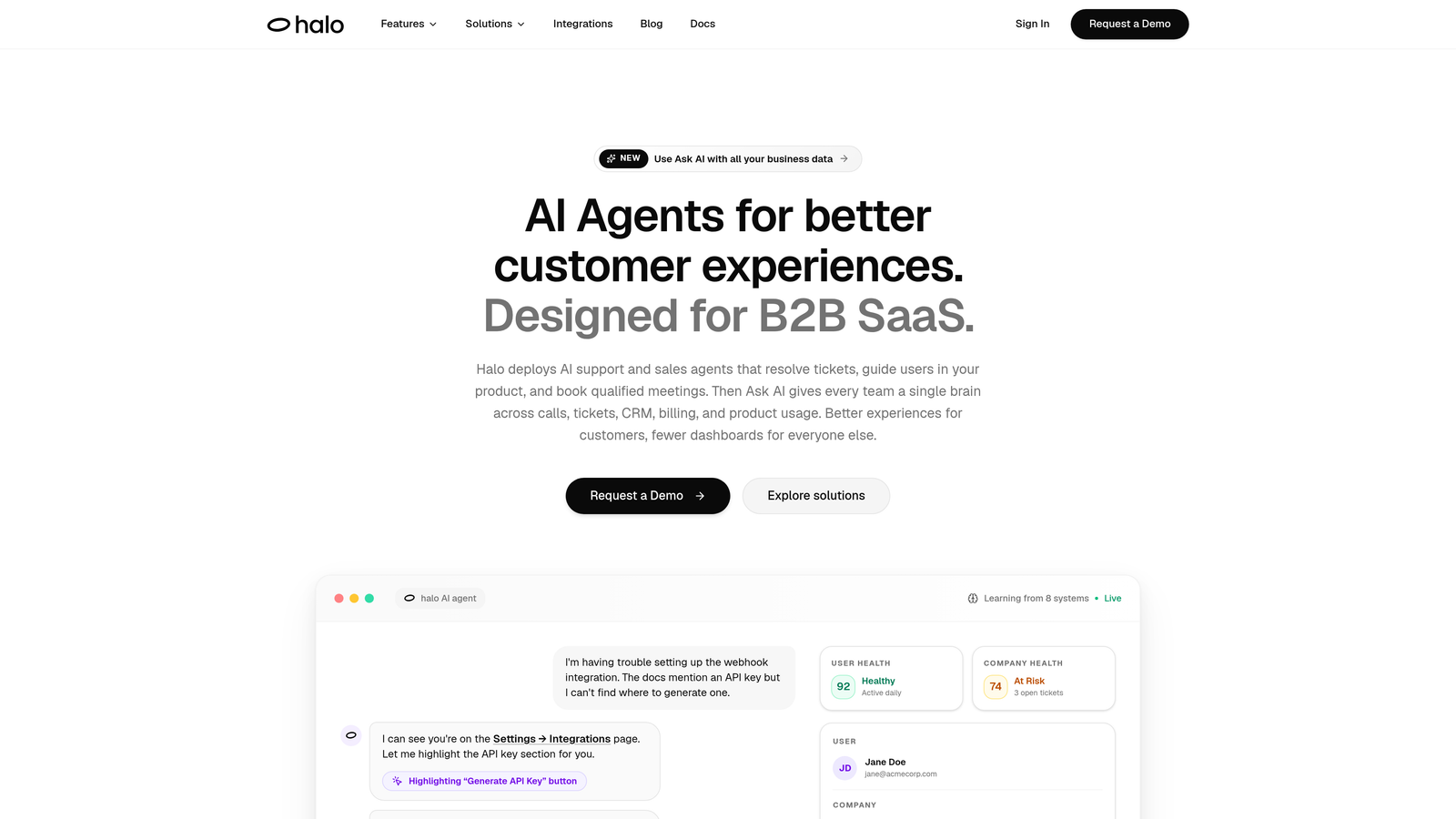
Halo AI is an AI-first customer support platform that deploys intelligent agents to resolve tickets, guide users through your product, and surface actionable business intelligence — all while learning from every interaction.
Where This Tool Shines
What separates Halo AI from most tools on this list is its page-aware architecture. The chat widget doesn't just know what a user typed — it knows what page they're on, what UI elements they're looking at, and can provide contextual visual guidance as a result. For SaaS products with complex workflows, this is a meaningful difference from a generic FAQ bot.
Halo also treats support data as a business asset, not just a cost center. Its smart inbox surfaces customer health signals, revenue intelligence, and anomaly detection, feeding insights back to product and revenue teams rather than letting them disappear into a closed ticket queue.
Key Features
Page-Aware Chat Widget: Sees what the user sees in real time, enabling contextual UI guidance rather than generic help articles.
Autonomous Ticket Resolution: AI agents handle routine tickets end-to-end, with live agent handoff for complex issues that require a human touch.
Auto Bug Ticket Creation: Automatically generates and routes bug reports to Linear or your existing dev workflow directly from support conversations.
Smart Inbox with Business Intelligence: Surfaces customer health signals, revenue intelligence, and anomaly detection alongside standard support metrics.
Deep Integration Stack: Connects natively with Linear, Slack, HubSpot, Intercom, Stripe, Zoom, PandaDoc, and Fathom.
Continuous Learning: Improves from every resolved interaction, so the system gets smarter over time without requiring manual retraining.
Best For
B2B SaaS product teams that want more than deflection. Halo AI is built for teams where support, product, and revenue are interconnected — and where the goal is autonomous resolution with intelligence flowing back into the business, not just tickets closing faster.
Pricing
Contact for pricing. Details and a demo are available at haloagents.ai.
2. Intercom Fin
Best for: Teams already invested in the Intercom ecosystem wanting low-friction AI resolution
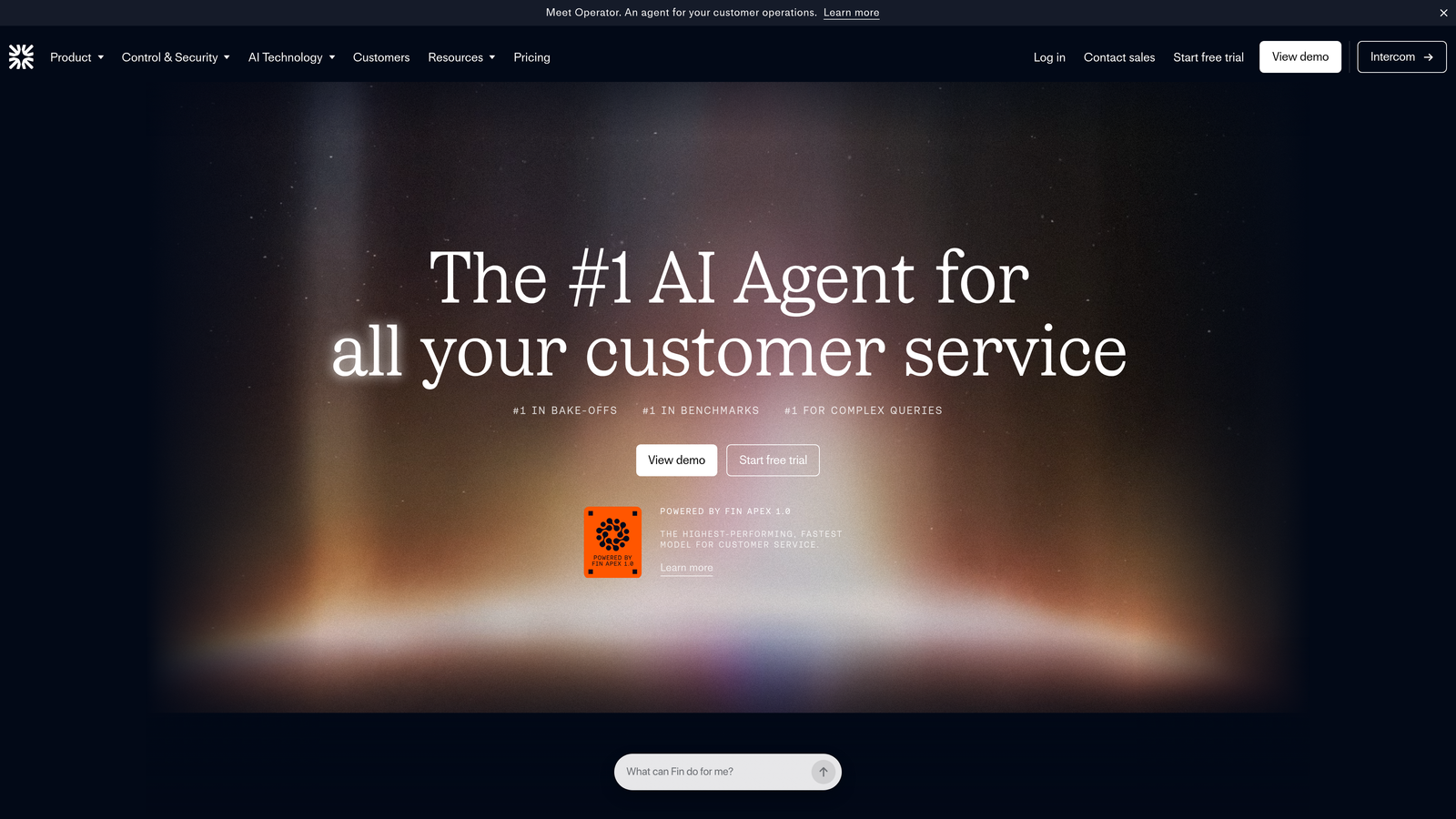
Intercom Fin is Intercom's AI agent built on large language models, trained on your help center content to resolve conversations autonomously within the Intercom platform.
Where This Tool Shines
Fin's biggest advantage is how naturally it sits inside the Intercom workflow. If your team already lives in Intercom's inbox, Fin adds autonomous resolution without requiring a platform migration or complex integration work. It handles a wide range of conversational queries and hands off to human agents when it can't resolve something confidently.
The per-resolution pricing model is worth noting. It aligns costs to value delivered, which works well at moderate volumes. Teams with very high ticket volumes should model this carefully before committing.
Key Features
Help Center Training: Fin is trained on your existing articles and content, so deployment doesn't require building a knowledge base from scratch.
Seamless Handoff: Transitions unresolved conversations to the Intercom inbox without friction for the customer or the agent.
Per-Resolution Pricing: You pay for outcomes rather than seats or message volume.
Workflow Integration: Deep connection to Intercom's routing, reporting, and automation features.
Multilingual Support: Handles conversations in multiple languages out of the box.
Best For
Support teams already running on Intercom who want to add AI resolution without changing platforms. Less compelling if your stack extends significantly beyond Intercom or if you need business intelligence beyond support metrics.
Pricing
Per-resolution pricing model. Verify current rates at intercom.com.
3. Zendesk AI
Best for: Existing Zendesk Suite customers wanting native AI across triage, drafting, and deflection
Zendesk AI is the native AI layer across Zendesk Suite, including intelligent triage, generative reply drafts for agents, and Answer Bot for article-based deflection.
Where This Tool Shines
Zendesk AI's strength is its depth within the Zendesk ecosystem. Intelligent triage routes tickets by intent and sentiment before a human ever touches them. Generative reply drafts speed up agent responses significantly. Answer Bot deflects common questions using your existing knowledge base articles. All of this works without a separate integration because it's built into the platform you're already using.
The admin controls here are mature. SLA management, routing rules, and reporting have been refined over many product cycles, which makes Zendesk AI a stable, predictable choice for teams that value operational reliability alongside AI capabilities.
Key Features
Intelligent Triage: Automatically classifies and routes tickets based on intent and sentiment analysis.
Generative Reply Drafts: Suggests AI-written responses for human agents to review and send, reducing handle time.
Answer Bot: Deflects common queries by surfacing relevant knowledge base articles before a ticket is created.
Native Suite Integration: No separate setup required for teams already on Zendesk Suite.
Mature Admin Controls: Robust SLA management, routing, and reporting built on years of enterprise deployment.
Best For
Teams already paying for Zendesk Suite who want AI capabilities without adding another vendor. Less compelling if your workflows extend beyond Zendesk or if you need AI that learns and adapts autonomously over time.
Pricing
Included in Zendesk Suite plans. Verify current tier details at zendesk.com.
4. Freshdesk Freddy AI
Best for: SMB and mid-market teams wanting bundled AI across support, chat, and analytics
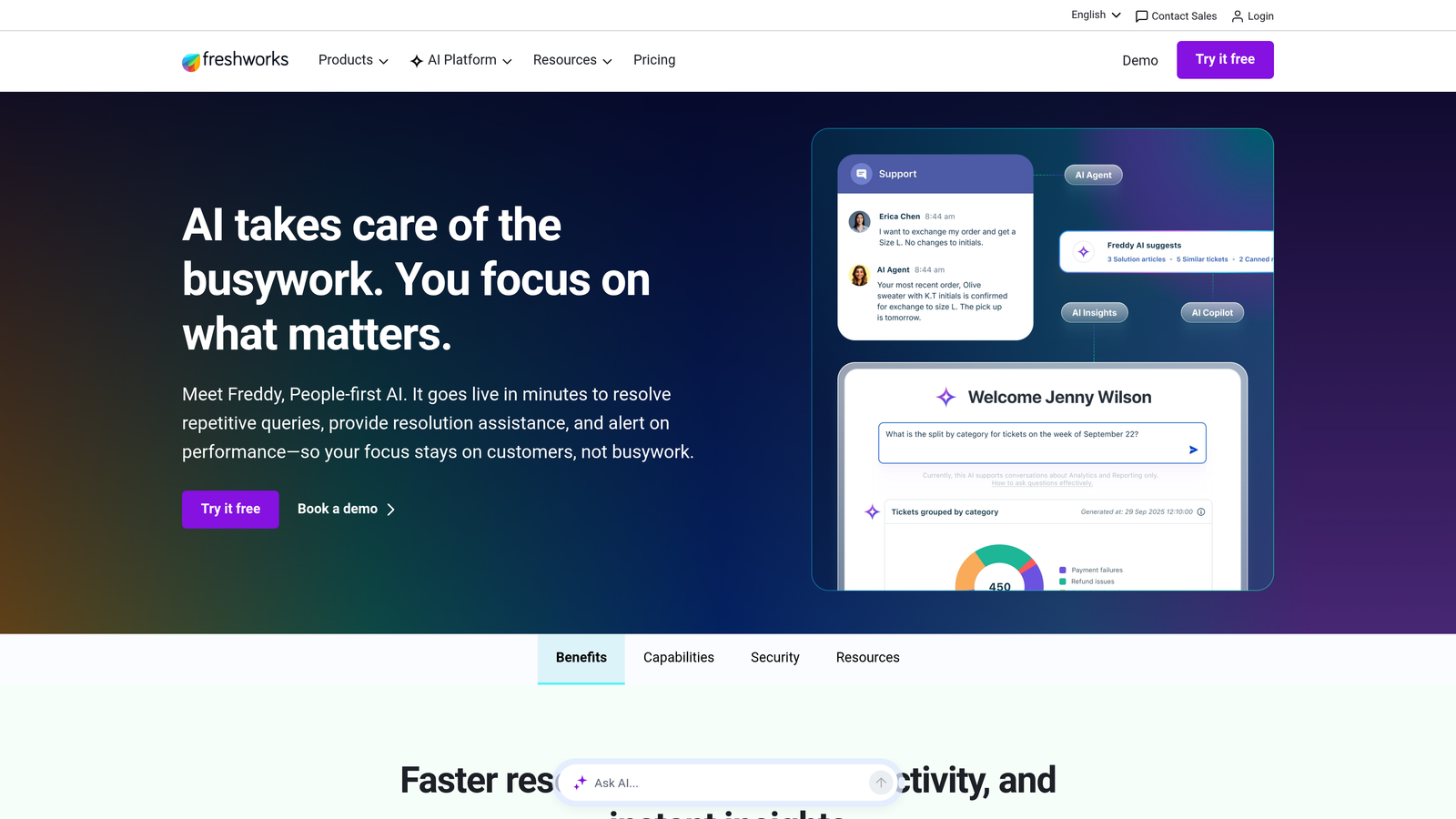
Freshdesk Freddy AI is Freshworks' AI layer across Freshdesk and Freshchat, offering self-service bots, agent copilot features, and analytics under a single brand.
Where This Tool Shines
Freddy AI covers three distinct use cases under one roof: customer-facing automation through Freddy Self Service, agent productivity through Freddy Copilot, and operational visibility through Freddy Insights. For teams that want AI across the full support stack without managing multiple tools, this bundled approach keeps things simple.
The pricing model is also a genuine advantage. Freddy AI is bundled into Freshdesk's paid tiers rather than sold as a separate product, which makes it accessible for teams that can't justify a standalone AI platform budget.
Key Features
Freddy Self Service: Customer-facing bot that handles common queries automatically based on your support content.
Freddy Copilot: Agent assist features including reply suggestions and next-step recommendations.
Freddy Insights: Analytics layer surfacing support trends and operational metrics.
Cross-Product Coverage: Works across Freshdesk, Freshchat, and Freshservice for teams using multiple Freshworks products.
Bundled Pricing: Included in Growth and higher plans rather than priced as an add-on.
Best For
SMB and mid-market teams already on Freshworks who want AI capabilities without a separate vendor. Not the strongest choice for complex B2B SaaS scenarios requiring deep autonomous resolution or developer tool integrations.
Pricing
Bundled into Freshdesk paid tiers. Verify current pricing at freshworks.com.
5. Drift
Best for: Teams where support and sales conversations overlap, particularly around trials and pipeline
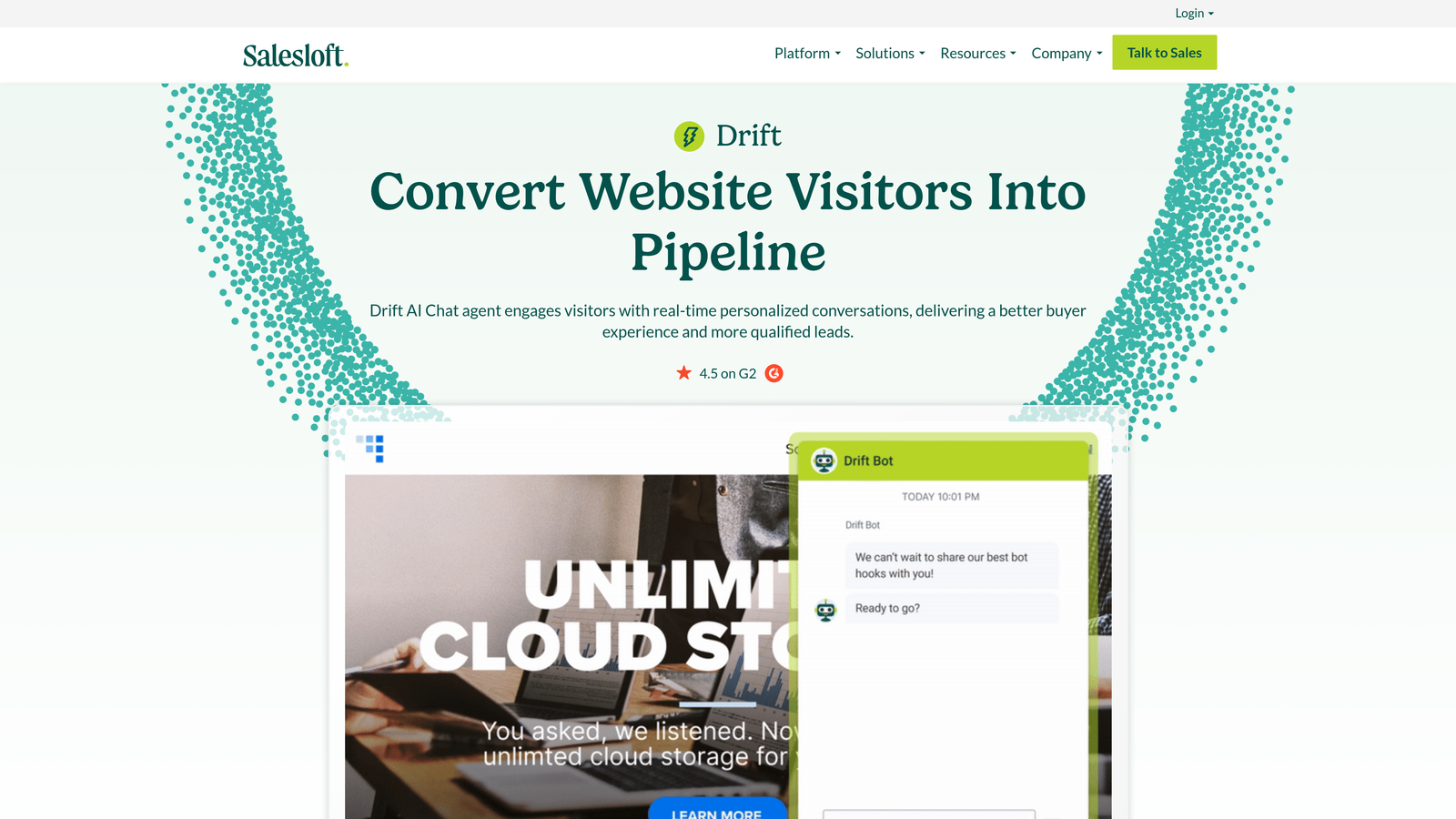
Drift is a conversational platform (now part of Salesloft) designed for revenue-focused conversations, blending support automation with sales qualification and pipeline acceleration.
Where This Tool Shines
Drift occupies a unique position on this list: it's not a pure support tool. It's built for the conversations that sit at the intersection of support and sales, such as trial users asking product questions, prospects qualifying themselves through chat, or inbound leads needing routing to the right rep. If that describes a meaningful portion of your chat volume, Drift handles it more naturally than a support-only platform.
The playbook-based conversation flows give non-technical teams control over routing logic without engineering involvement, and the Salesforce and HubSpot integrations keep pipeline data in sync automatically.
Key Features
AI-Powered Chatbot: Handles FAQ responses and qualifies leads simultaneously within the same conversation flow.
Revenue-Focused Routing: Sends conversations to sales or support based on intent signals and qualification criteria.
CRM Integrations: Deep connections with Salesforce, HubSpot, and Salesloft for pipeline visibility.
Meeting Booking: Lets qualified prospects book directly with sales reps from within the chat experience.
Playbook Flows: Visual, no-code conversation builders for routing and qualification logic.
Best For
B2B teams where the line between support and sales is blurry — particularly SaaS companies with active trials or high inbound chat volume from prospects. Less suited for teams focused purely on post-sale support resolution.
Pricing
Premium and Enterprise tiers. Verify current pricing at drift.com.
6. Tidio
Best for: SMBs and e-commerce teams wanting accessible live chat and AI without a large budget
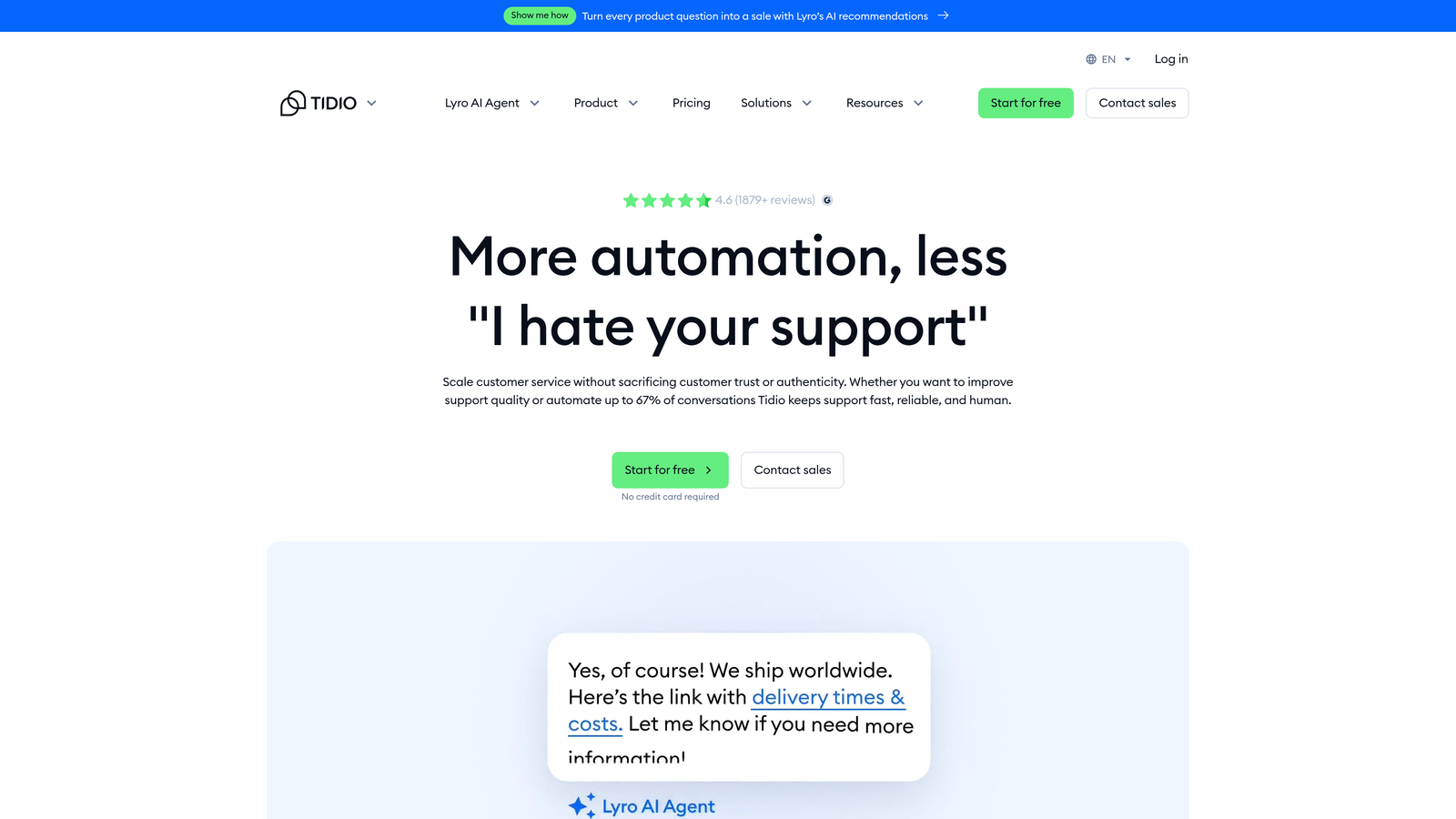
Tidio is an accessible live chat and AI chatbot platform popular with smaller teams, featuring Lyro AI for automated conversational responses based on your support content.
Where This Tool Shines
Tidio's appeal is straightforward: it's fast to set up, genuinely affordable, and doesn't require technical expertise to get running. Lyro AI handles common customer questions by drawing on your existing support content, and the visual chatbot builder lets you create flow-based automations without writing a line of code.
For e-commerce teams in particular, Tidio's Shopify and WordPress integrations make it a natural fit. The free tier also makes it one of the few tools on this list where you can test real AI functionality before spending anything.
Key Features
Lyro AI: Conversational AI that answers common questions based on your existing support content automatically.
Visual Chatbot Builder: Drag-and-drop flow builder for creating automation sequences without code.
Live Chat with Handoff: Transitions AI conversations to human agents when needed.
E-Commerce Integrations: Native connections with Shopify, WordPress, and email platforms.
Free Tier: Functional free plan available for small teams testing the platform.
Best For
Small businesses, e-commerce teams, and early-stage startups that need an accessible entry point into AI-assisted support. Not designed for complex B2B SaaS scenarios, deep developer tool integrations, or enterprise-scale autonomous resolution.
Pricing
Free tier available. Paid plans scale with usage. Verify current pricing at tidio.com.
7. Chatbase
Best for: Startups and developers wanting a custom GPT-powered chatbot trained on their own content
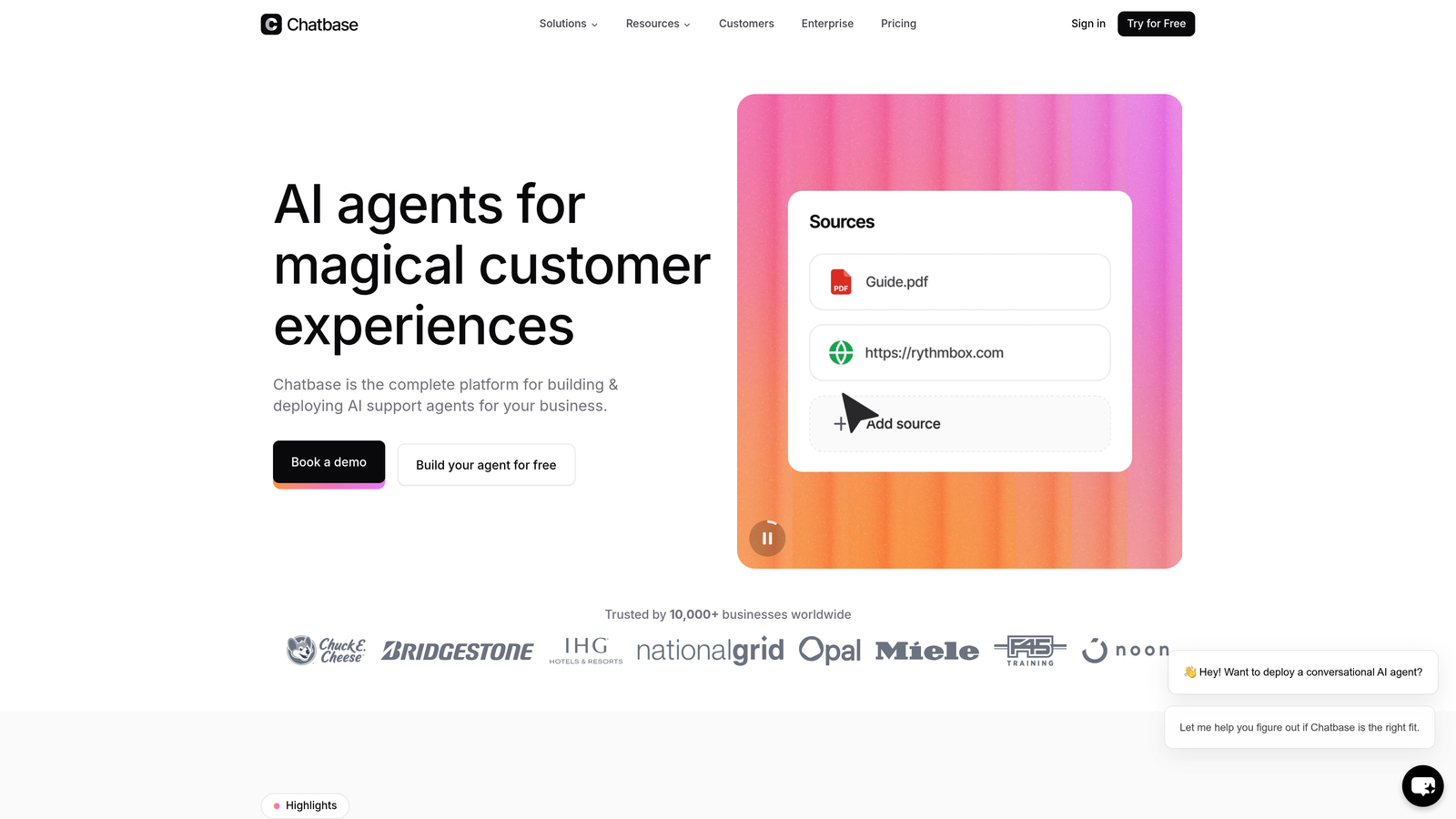
Chatbase is a tool for building custom AI chatbots trained on your own documents, URLs, or knowledge base, deployable as an embeddable widget on any website.
Where This Tool Shines
Chatbase's appeal is its simplicity. You upload your content, whether PDFs, docs, or website URLs, and get a working AI chatbot without any engineering work. For startups that want a custom AI bot quickly and don't have a dedicated support engineering team, this is often the fastest path from zero to deployed.
The white-labeling option on higher plans also makes it viable for agencies or product teams that want to embed a branded AI assistant without building from scratch. If you're evaluating Chatbase but need more analytics depth or business intelligence, it's worth exploring Chatbase alternatives designed for more complex support operations.
Key Features
Content-Based Training: Train a chatbot by uploading PDFs, documents, or pointing to website URLs directly.
Embeddable Widget: Deploy as a chat widget on any website with minimal technical setup.
API Access: Connect to custom integrations for teams that want to extend functionality programmatically.
White-Labeling: Remove Chatbase branding on higher-tier plans for a fully branded experience.
Multi-Bot Dashboard: Manage multiple chatbots from a single interface, useful for agencies or multi-product teams.
Best For
Startups and small teams that want a quick, custom AI chatbot without engineering overhead. Limited analytics and business intelligence make it less suitable for support ops teams that need to measure efficiency or feed insights back into the business.
Pricing
Free tier available. Paid plans scale with message volume. Verify current pricing at chatbase.co.
8. Ada
Best for: Enterprise teams needing no-code AI agents at scale with multilingual and compliance requirements
Ada is an enterprise no-code AI agent platform focused on automated customer service at scale, with strong multilingual support and compliance-grade security controls.
Where This Tool Shines
Ada is built for organizations where volume, compliance, and language coverage are primary constraints. The no-code agent builder means non-technical teams can build and iterate on AI agents without engineering involvement, which is a significant operational advantage at enterprise scale. Its multilingual capabilities span many languages, making it one of the stronger options for global support operations.
Ada is also known for strong deflection rates on high-volume, repetitive queries. For enterprises where a meaningful percentage of tickets are predictable and repetitive, Ada can handle that load reliably while freeing human agents for complex escalations.
Key Features
No-Code Agent Builder: Build and modify AI agents without technical expertise, enabling fast iteration by non-engineering teams.
Multilingual Support: Handles customer conversations across many languages for global support coverage.
Enterprise Security and Compliance: Controls suited to regulated industries and organizations with strict data governance requirements.
CRM and Helpdesk Integrations: Connects with Salesforce, Zendesk, and other major enterprise systems.
High-Volume Deflection: Proven performance on repetitive, high-frequency query categories.
Best For
Enterprise organizations with global customer bases, compliance requirements, and high-volume repetitive query patterns. The price point and complexity make it less suited for smaller teams or startups.
Pricing
Enterprise pricing. Contact Ada directly at ada.cx for details.
9. Forethought
Best for: Mid-to-enterprise support ops teams focused on triage, routing, and resolution analytics
Forethought is an AI platform focused on support operations, handling ticket triage, intelligent routing, autonomous resolution, and support analytics for mid-to-enterprise teams.
Where This Tool Shines
Forethought takes a structured approach to support operations, breaking its functionality into distinct modules: Solve handles autonomous resolution, Triage manages AI-powered classification and sentiment-based routing, and Discover surfaces insights and gaps from support data. This modular design makes it easier to adopt incrementally rather than replacing everything at once.
The analytics layer is a genuine differentiator. For support ops teams that need to measure efficiency, identify knowledge gaps, and report on AI performance, Forethought provides more structured measurement tools than most tools on this list.
Key Features
Solve: AI agent module for autonomous ticket resolution across common query categories.
Triage: AI-powered ticket classification and sentiment-based routing before human agents engage.
Discover: Surfaces insights, knowledge gaps, and patterns from support data to inform ops decisions.
Enterprise Integrations: Deep connections with Zendesk, Salesforce, and ServiceNow.
Support Ops Analytics: Structured measurement layer for teams tracking AI performance and efficiency gains.
Best For
Mid-to-enterprise support operations teams that need structured triage, routing, and analytics alongside resolution. Strong fit for organizations already on Zendesk, Salesforce, or ServiceNow who want AI layered across their existing stack.
Pricing
Mid-to-enterprise pricing. Contact Forethought at forethought.ai for details.
Which AI Chatbot Is Right for Your Team?
The right choice here depends heavily on your stack, your team size, and what you actually need the AI to do.
If you're a B2B SaaS team wanting autonomous resolution with business intelligence built in, Halo AI is the strongest starting point. The page-aware context, continuous learning, and integration depth with developer and revenue tools make it purpose-built for product teams where support data needs to feed back into the business.
For teams deeply embedded in Intercom or Zendesk, Fin and Zendesk AI offer the lowest-friction upgrades. You're not changing platforms; you're adding a capable AI layer to what you already have. SMBs on tighter budgets will find Tidio or Freshdesk Freddy AI the most accessible entry points, with Tidio's free tier being the easiest way to test AI support without any upfront commitment.
Enterprises needing no-code scale, multilingual coverage, and compliance controls should put Ada on the shortlist. Teams where support and revenue conversations overlap, particularly around trials and inbound pipeline, should look at Drift. And support ops teams that need structured triage, routing, and analytics across an existing enterprise stack will find Forethought worth evaluating.
The most important question isn't which tool has the most features. It's which tool fits your existing stack, learns from your specific support patterns, and can grow with your team without requiring constant manual maintenance. AI chatbots that need heavy prompt engineering or frequent retraining become a burden rather than a relief.
Before committing, run a pilot on your most common ticket categories. The tools that resolve those tickets accurately, without escalating unnecessarily, are the ones worth investing in.
Your support team shouldn't scale linearly with your customer base. Let AI agents handle routine tickets, guide users through your product, and surface business intelligence while your team focuses on complex issues that need a human touch. See Halo in action and discover how continuous learning transforms every interaction into smarter, faster support.