10 Best AI Customer Service Automation Tools in 2026
Discover the 10 best AI customer service automation platforms for 2026, evaluated across resolution accuracy, integrations, and deployment complexity. Whether you're a growing startup or enterprise handling millions of tickets, this guide helps you find the right tool to reduce support volume, improve response times, and scale customer service without simply adding headcount.
 Matt PattoliFounder16 min read
Customer support teams are under more pressure than ever. Ticket volumes keep climbing, customers expect instant answers, and hiring more agents doesn't scale the way it used to. AI customer service automation has moved from experimental to essential, with platforms now capable of resolving complex tickets, learning from every interaction, and handing off to humans only when genuinely needed.
But the market is crowded. Choosing the wrong tool can mean months of integration headaches, underwhelming resolution rates, and frustrated teams. We evaluated platforms across resolution accuracy, integration depth, learning capabilities, deployment complexity, and pricing transparency to bring you the top options for 2026. Whether you're a growing SaaS startup or an enterprise managing millions of monthly tickets, this list will help you find the right fit.
1. Halo AI
Best for: B2B SaaS teams that want AI-first autonomous support with deep product and business context.
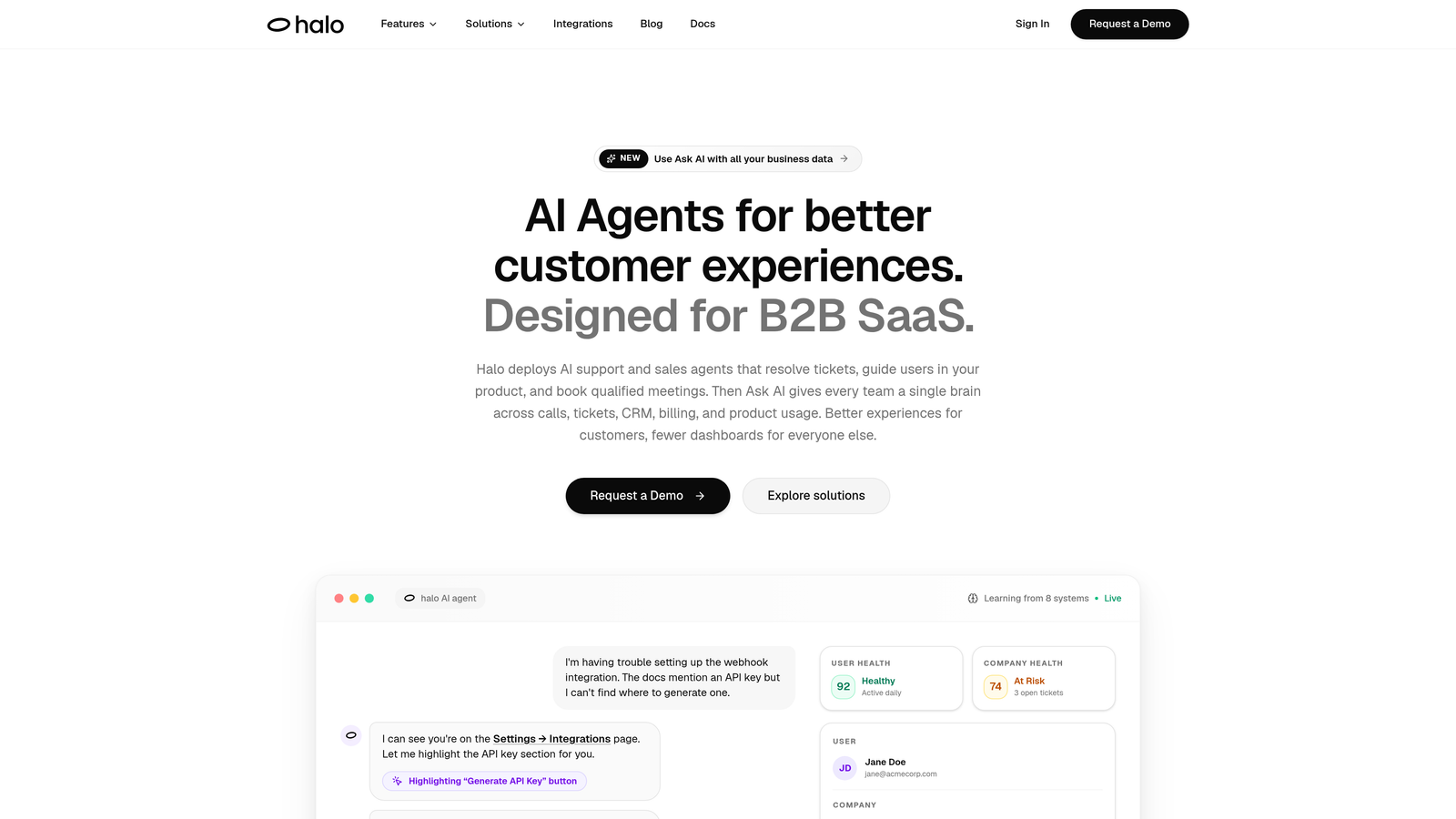
Halo AI is an AI-native customer support platform that deploys autonomous agents to resolve tickets, guide users with page-aware context, and surface business intelligence across every interaction.
Where This Tool Shines
What separates Halo from most tools on this list is that it was built AI-first, not retrofitted. Rather than layering AI onto an existing helpdesk, Halo's architecture treats autonomous resolution as the default and human escalation as the exception. This means the system isn't just deflecting tickets; it's genuinely resolving them with context about what the user is doing in your product right now.
The business intelligence layer is particularly compelling for product and growth teams. Most support platforms stop at ticket resolution metrics. Halo surfaces customer health signals, revenue risk indicators, and product feedback patterns from support conversations, turning your support inbox into a source of strategic insight rather than just a cost center.
Key Features
Page-Aware Chat Widget: The AI sees exactly what the user sees in your product, enabling visual UI guidance and contextually accurate answers rather than generic help center responses.
Autonomous Ticket Resolution with Live Agent Handoff: Handles routine and moderately complex tickets independently, then escalates to human agents intelligently when the situation genuinely warrants it.
Auto Bug Ticket Creation: Detects product issues from support conversations and automatically creates structured bug tickets in Linear and other dev tools, closing the loop between support and engineering.
Smart Inbox with Business Intelligence: Goes beyond support metrics to provide customer health scoring, revenue signals, and anomaly detection directly from support data.
Deep Integration Ecosystem: Connects with Slack, HubSpot, Intercom, Stripe, Zoom, PandaDoc, and Fathom, making it a genuine hub rather than an isolated support tool.
Best For
B2B SaaS companies that want more than deflection metrics from their support AI. Particularly strong for product teams that want support data to inform roadmap decisions, and for companies already using tools like Linear, HubSpot, or Stripe who want their support system connected to the broader business stack.
Pricing
Contact for pricing. Halo is designed for B2B SaaS teams of varying sizes, so pricing is tailored to your team's scale and integration needs.
2. Intercom Fin
Best for: Teams already on Intercom who want native AI resolution without switching platforms.
Intercom Fin is Intercom's native AI agent, resolving customer questions using your existing help center, past conversations, and custom data sources.
Where This Tool Shines
If your team is already invested in Intercom's messenger and inbox, Fin is the path of least resistance to AI-powered resolution. It trains on your existing content without requiring a separate setup process, and its conversation-level controls give you fine-grained control over tone and behavior. The native integration means there's no middleware to manage.
Fin's multi-language support with automatic translation is genuinely useful for companies serving international customers, handling the complexity of multilingual support without requiring separate configurations per language.
Key Features
Content-Trained AI Agent: Learns from your help center articles, past conversations, and custom data sources to provide accurate, on-brand responses.
Native Intercom Integration: Fully embedded in Intercom's messenger, inbox, and workflow tools with no additional integration required.
Customizable Tone and Behavior: Conversation-level controls let you adjust how Fin responds based on context, channel, or customer segment.
Multi-Language Support: Automatic translation enables resolution in 45+ languages without separate configuration.
Built-In Reporting: Resolution rates, AI performance metrics, and handoff patterns are visible directly in the Intercom dashboard.
Best For
Companies already using Intercom as their primary support platform who want to add AI resolution without switching tools or managing a separate vendor relationship. Less ideal if you're not already on Intercom, since the value is tightly coupled to that ecosystem.
Pricing
Usage-based pricing per resolution, layered on top of an active Intercom subscription. Costs can scale quickly at higher volumes, so model your expected resolution rates before committing.
3. Zendesk AI
Best for: Enterprise teams already on Zendesk Suite who want AI resolution and agent assist in one platform.
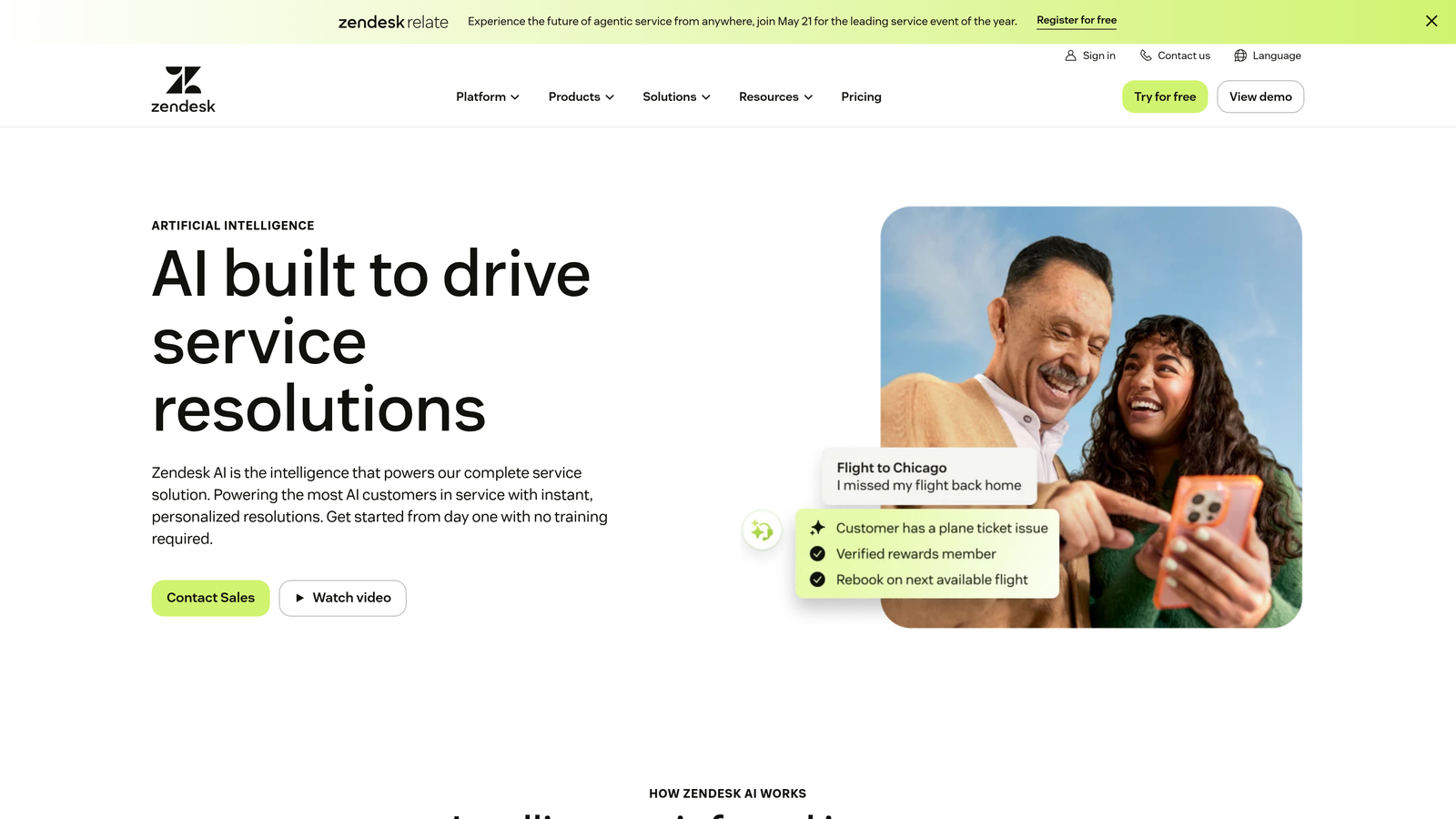
Zendesk AI brings AI agents, intelligent triage, and an agent copilot into the Zendesk Suite, building on the platform's extensive support ecosystem.
Where This Tool Shines
Zendesk's biggest advantage here is the training data advantage. Pre-trained on billions of support interactions across the Zendesk ecosystem, its AI models arrive with a baseline understanding of support patterns that purpose-built tools often take months to develop. For teams already on Zendesk, the transition to AI-assisted workflows is relatively low-friction.
The agent copilot is particularly strong for hybrid teams that aren't ready to go fully autonomous. It surfaces relevant knowledge and suggests responses in real time, helping human agents resolve tickets faster without removing them from the loop entirely.
Key Features
AI Agents for Automated Resolution: Handles tickets autonomously across email, chat, and messaging channels using your existing Zendesk content.
Intelligent Triage: Automatically classifies intent, language, and sentiment to route tickets to the right team or AI agent without manual sorting.
Agent Copilot: Provides real-time response suggestions and knowledge surfacing for human agents handling complex or escalated tickets.
Ecosystem Pre-Training: Models trained on billions of Zendesk interactions provide a strong baseline without extensive custom training.
Generative AI Knowledge Management: AI-powered tools for identifying knowledge gaps and generating or updating help center content.
Best For
Mid-market and enterprise teams with established Zendesk deployments who want to layer AI into existing workflows rather than migrate platforms. The breadth of AI features suits organizations with mixed support needs, from fully automated to heavily human-assisted.
Pricing
AI features are included in Zendesk Suite plans starting around $55 per agent per month, with advanced AI capabilities available as a paid add-on at higher tiers.
4. Ada
Best for: Enterprise brands needing omnichannel AI resolution with no-code configuration and multilingual depth.
Ada is an enterprise-grade AI customer service automation platform built for brands that need to resolve inquiries across chat, email, voice, and social channels at scale.
Where This Tool Shines
Ada's no-code agent builder makes it accessible to customer experience teams who want control over conversation design without depending on engineering resources. The drag-and-drop interface is genuinely capable, handling complex branching logic and backend system connections without requiring custom code.
The CSAT-driven optimization loop is a differentiator worth noting. Rather than requiring manual tuning, Ada uses customer satisfaction signals to identify where AI performance is falling short and adjusts accordingly. Over time, this creates a self-improving system that gets more accurate as it handles more volume.
Key Features
No-Code AI Agent Builder: Drag-and-drop conversation design with enough depth to handle complex, multi-step resolution flows without engineering involvement.
Omnichannel Deployment: Consistent AI resolution across web chat, SMS, social media, email, and voice from a single platform.
50+ Language Support: Nuanced multilingual resolution that goes beyond simple translation to understand regional context and phrasing.
Backend System Connections: Reasoning engine connects to CRM, order management, and other data sources for personalized, action-taking responses.
CSAT-Driven Optimization: AI performance is continuously tuned based on real customer satisfaction feedback, not just internal accuracy metrics.
Best For
Large enterprise brands with diverse channel coverage needs and multilingual customer bases. Also well-suited for CX teams that want to own AI configuration without constant IT or engineering involvement.
Pricing
Custom enterprise pricing. Contact Ada's sales team for quotes, as pricing is tailored to channel volume, language requirements, and integration complexity.
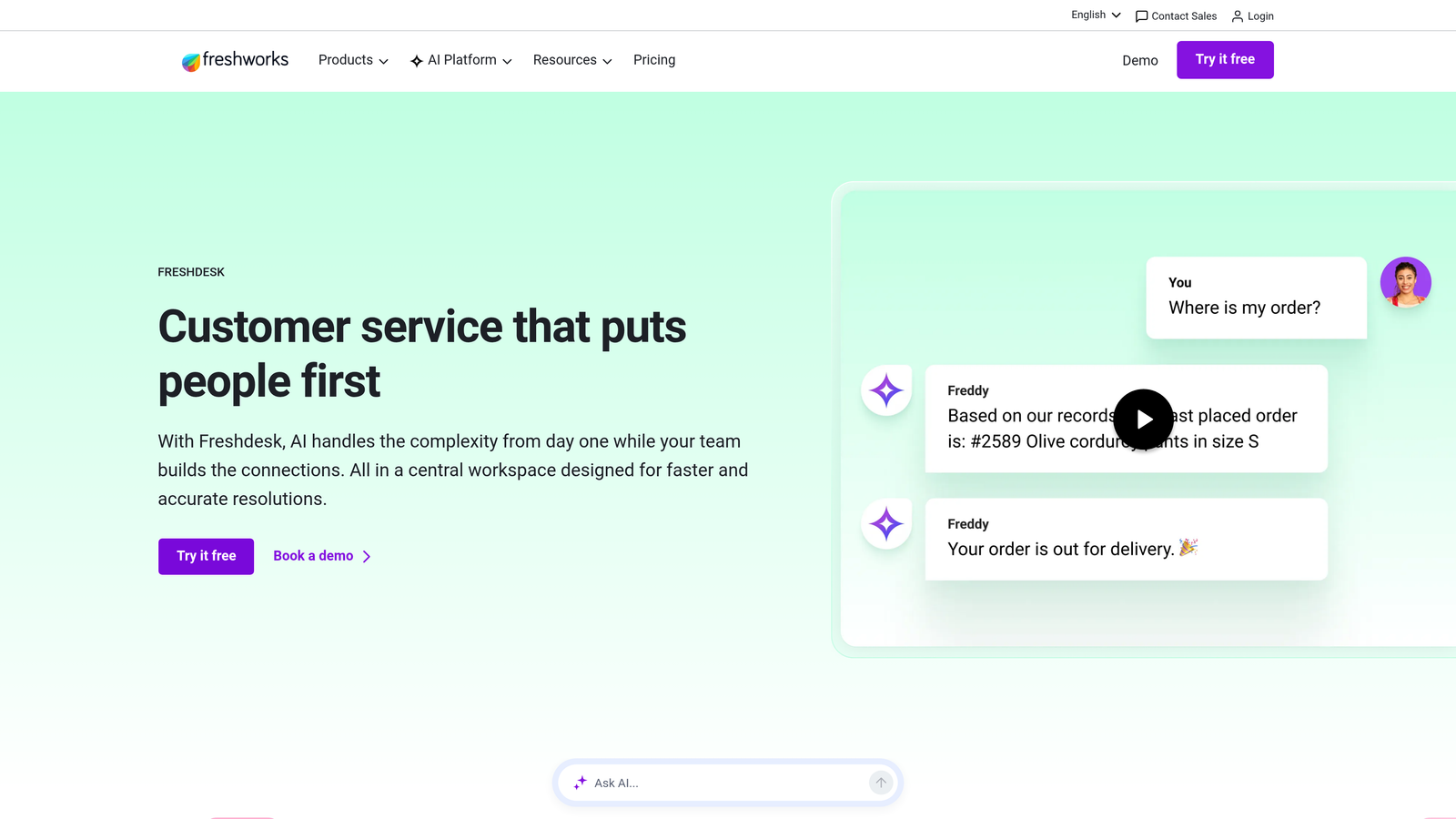
5. Freshdesk Freddy AI
Best for: Growing teams on Freshworks looking for affordable AI-assisted support without enterprise pricing.
Freshdesk Freddy AI is Freshworks' AI layer across Freshdesk and Freshchat, offering automated resolution, agent assist, and intelligent routing as part of a competitively priced support suite.
Where This Tool Shines
Freddy AI's biggest selling point is value relative to cost. Enterprise-grade AI features like automated ticket routing, sentiment detection, and agent response suggestions are available at price points significantly below competitors like Zendesk AI or Cognigy. For teams that are cost-conscious but still want meaningful AI capabilities, Freshdesk offers a compelling middle ground.
The integration across the Freshworks suite is also worth noting. If your team uses Freshdesk, Freshchat, and Freshsales together, Freddy AI can share context across all three, giving agents a more complete picture of the customer without switching between tools.
Key Features
Freddy AI Agent: Automated ticket resolution via chat and email using your knowledge base and historical support data.
Freddy Copilot: Real-time response suggestions, ticket summarization, and knowledge surfacing for human agents during live conversations.
Intelligent Routing and Prioritization: AI-powered ticket assignment based on intent, urgency, and agent skill sets.
Sentiment Detection: Identifies frustrated or at-risk customers and flags tickets for priority human attention.
Cross-Suite Integration: Shared AI context across Freshdesk, Freshchat, and Freshsales for a unified customer view.
Best For
Small to mid-market teams on Freshworks who want AI capabilities without enterprise-level spending. Particularly strong for companies already using multiple Freshworks products who want a unified AI layer across them.
Pricing
AI features available on the Pro plan at $49 per agent per month, with more advanced capabilities on the Enterprise tier. Competitive pricing relative to the feature set offered.
6. Tidio
Best for: Small businesses and e-commerce stores that want fast, affordable AI chat automation.
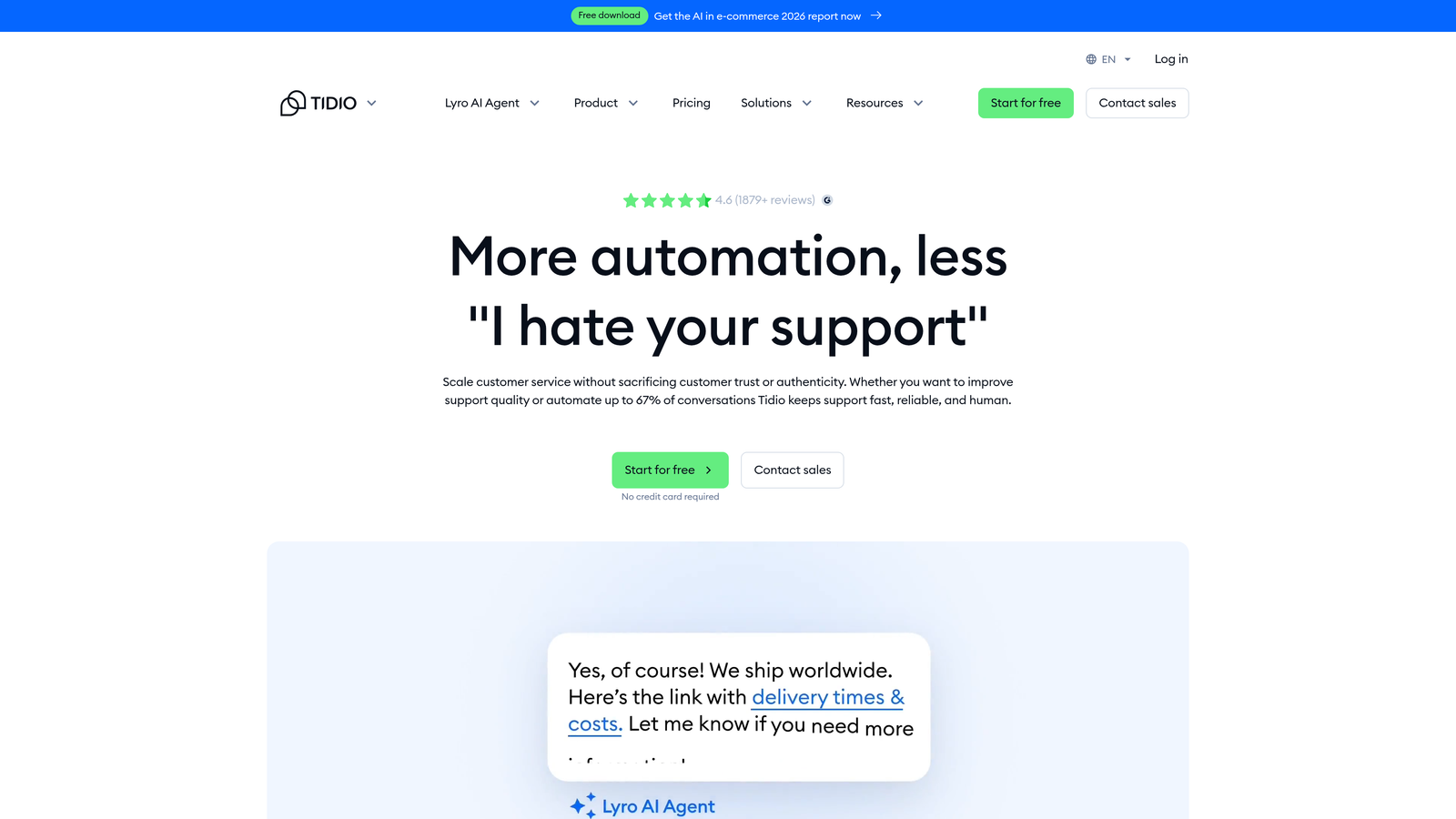
Tidio is a conversational AI platform built for smaller teams, featuring the Lyro AI chatbot alongside live chat tools and a visual flow builder in a single lightweight package.
Where This Tool Shines
Tidio is designed for speed of deployment. E-commerce teams can connect Shopify or WooCommerce, point Lyro at their FAQ content, and have an AI chatbot handling common customer questions within hours rather than weeks. For resource-constrained teams, that time-to-value matters enormously.
The combination of AI chatbot and live chat in a single widget is also practically useful. Customers get AI-assisted answers for routine questions, with a smooth handoff to a live agent when the conversation needs a human. There's no jarring transition between systems because it's all the same platform.
Key Features
Lyro AI Chatbot: Learns from your FAQ and support content to handle conversational customer questions without requiring manual flow design for every scenario.
Visual Flow Builder: Drag-and-drop chatbot builder for creating custom automation flows for specific use cases or campaigns.
E-Commerce Integrations: One-click connections with Shopify, WooCommerce, and WordPress for order status, product questions, and purchase support.
Unified Chat Widget: AI and live chat combined in a single widget, with smooth handoffs between automated and human conversations.
Visitor Tracking and Engagement Triggers: Proactive chat triggers based on visitor behavior, page time, and cart activity.
Best For
Small businesses and e-commerce operators who need a fast, affordable entry point into AI customer service automation. Not designed for enterprise-scale deployments or complex B2B support workflows.
Pricing
Free tier available. Lyro AI starts at around $39 per month, with premium plans scaling based on conversation volume. One of the most accessible price points on this list.
7. Forethought
Best for: Teams that want AI resolution and triage layered on top of their existing helpdesk without migrating platforms.
Forethought is an AI middleware platform that adds intelligent triage, autonomous resolution, and agent assist capabilities on top of existing helpdesks like Zendesk, Salesforce Service Cloud, and ServiceNow.
Where This Tool Shines
Forethought's core value proposition is additive: you don't have to rip out your existing helpdesk to get meaningful AI capabilities. For organizations with significant investment in Zendesk or Salesforce configurations, this is a practical path to AI-powered support without the migration risk and downtime that comes with switching platforms entirely.
The SupportGPT-powered resolution engine handles common ticket types autonomously, while the triage layer ensures that tickets requiring human attention are routed correctly from the start. The combination reduces both resolution time and misrouting, two of the most common sources of support inefficiency.
Key Features
SupportGPT Autonomous Resolution: Handles common, repetitive ticket types end-to-end without human involvement.
Intelligent Triage: Routes tickets by intent, urgency, and predicted complexity before they reach an agent queue.
Agent Assist: Real-time knowledge surfacing and response drafting for human agents handling complex or escalated tickets.
Helpdesk-Agnostic Architecture: Works as a layer on top of Zendesk, Salesforce Service Cloud, and ServiceNow without requiring platform migration.
Analytics Dashboard: Tracks deflection rates, time savings, and AI accuracy to demonstrate ROI and identify improvement opportunities.
Best For
Mid-market and enterprise teams with established Zendesk, Salesforce, or ServiceNow deployments who want to add AI capabilities without committing to a platform migration. Also useful for organizations with complex helpdesk configurations they're not ready to rebuild.
Pricing
Custom pricing based on ticket volume. Contact Forethought's sales team for quotes, as pricing varies significantly with scale and the number of helpdesk integrations involved.
8. Kustomer
Best for: Customer-centric teams that want AI automation grounded in a full CRM timeline of customer history.
Kustomer is a CRM-powered customer service platform that combines a unified customer timeline with AI-driven automation, giving both AI agents and human agents full customer context when resolving issues.
Where This Tool Shines
Most support platforms treat each conversation as isolated. Kustomer's single-thread customer timeline combines conversations, order history, activity data, and CRM records into one view, meaning AI and human agents aren't flying blind when a customer contacts support. This context-awareness enables more personalized, accurate responses and reduces the back-and-forth that frustrates customers.
The proactive support triggers are a genuinely differentiated capability. Rather than waiting for customers to reach out, Kustomer can initiate conversations based on behavioral signals, such as an order that's delayed or a subscription approaching renewal, reducing inbound volume before it becomes a ticket.
Key Features
Unified Customer Timeline: Single-thread view combining all conversations, orders, and activity history for complete context in every interaction.
AI-Powered Chatbots and Workflows: Automated resolution with full CRM context, enabling personalized responses rather than generic answers.
Omnichannel Support: Consistent experience across email, chat, social, SMS, and voice from a single platform.
Proactive Support Triggers: Initiates outreach based on customer behavior and order status to resolve issues before they become inbound tickets.
Sentiment Analysis and CSAT Tracking: Real-time sentiment monitoring and satisfaction tracking built into the core platform.
Best For
Customer service teams in retail, e-commerce, and subscription businesses where full customer history is critical to resolution quality. Less suited for pure B2B SaaS support where CRM-depth matters less than product context.
Pricing
Enterprise plan starts around $89 per user per month. Some advanced AI features may require additional add-ons, so confirm the full cost structure with Kustomer's sales team before committing.
9. Cognigy
Best for: Large enterprise contact centers that need voice AI automation and compliance-grade security.
Cognigy is an enterprise conversational AI platform specializing in voice and chat automation for large contact centers, with deep customization capabilities built for regulated industries.
Where This Tool Shines
Cognigy is built for environments where most tools on this list would struggle: high-volume contact centers with phone and IVR channels, strict regulatory requirements, and the need for enterprise-grade security controls. Its voice AI capabilities are among the most mature in the market, handling complex phone interactions with natural language understanding that goes well beyond basic IVR scripting.
The low-code conversation design studio gives enterprise teams the flexibility to build sophisticated automation without requiring deep AI engineering expertise, while still offering the technical depth that complex, regulated workflows demand.
Key Features
Voice AI Automation: Handles phone and IVR channels alongside digital chat, enabling consistent AI resolution across voice and digital touchpoints.
Low-Code Conversation Design Studio: Advanced NLU and LLM integration in a design environment accessible to non-engineers, with full technical depth available when needed.
Enterprise Security and Compliance: Purpose-built features for regulated industries including banking, healthcare, and insurance.
Agent Assist Mode: Real-time transcription and next-best-action suggestions for human agents during live calls and chats.
100+ Language Support: One of the broadest language coverage options on this list, suitable for global enterprise deployments.
Best For
Large enterprise organizations in regulated industries with significant phone support volume. Cognigy is overkill for most SaaS or e-commerce use cases, but it's purpose-built for the contact center environments where other tools fall short.
Pricing
Enterprise pricing with custom quotes. Given the complexity and scale of typical Cognigy deployments, expect pricing conversations to involve detailed scoping of channel volume, language requirements, and compliance needs.
10. HubSpot Service Hub with Breeze AI
Best for: Teams already in the HubSpot ecosystem who want AI support tightly integrated with marketing and sales data.
HubSpot Service Hub brings Breeze AI capabilities to customer service, offering AI-powered chatbots, ticket automation, and knowledge base management within HubSpot's unified CRM platform.
Where This Tool Shines
The core advantage of Service Hub with Breeze AI is the unified HubSpot CRM context. Support agents and AI alike can see a customer's full history across marketing interactions, sales conversations, and support tickets in one place. For teams where support is closely tied to retention, upsell, or renewal conversations, this cross-functional visibility is genuinely valuable.
The AI-powered knowledge base gap analysis is a practical feature that often gets overlooked. Breeze AI identifies where customers are asking questions that your existing content doesn't answer well, then suggests new articles or updates, keeping your self-service resources current without requiring manual content audits.
Key Features
Breeze AI Agent: Automated customer conversations powered by CRM context, enabling personalized responses based on the customer's full HubSpot history.
AI-Assisted Ticket Management: Intelligent routing, conversation summarization, and suggested responses for human agents.
Knowledge Base with AI Gap Analysis: Identifies content gaps based on customer questions and suggests new articles or updates to improve self-service resolution.
Unified CRM Record: Full visibility into marketing, sales, and service history in a single customer record across the HubSpot platform.
Built-In Feedback and NPS: Customer satisfaction surveys and NPS tracking integrated directly into the service workflow.
Best For
Companies already running on HubSpot for marketing and sales who want to extend that ecosystem into customer service. The value is strongly correlated with HubSpot adoption depth; if you're not already using HubSpot CRM, the switching costs may outweigh the benefits.
Pricing
Service Hub Starter at $20 per seat per month; Professional at $100 per seat per month. AI features expand at higher tiers, so evaluate which Breeze AI capabilities you actually need before choosing a plan level.
Choosing the Right AI Customer Service Automation Platform
The right choice depends less on which tool has the most features and more on where you're starting from and what you're trying to achieve. Here's a quick framework to narrow it down.
If you're a B2B SaaS team that wants AI-first architecture with business intelligence beyond ticket resolution, Halo AI is built for exactly that use case. The page-aware context, continuous learning, and integration with developer and revenue tools make it a strong fit for product-led companies where support data should inform the whole business.
If you're already deeply invested in a specific platform, the native AI option is often the lowest-friction path: Intercom Fin for Intercom users, Zendesk AI for Zendesk deployments, and HubSpot Service Hub with Breeze AI for HubSpot-centric teams. The tradeoff is that your AI capabilities are tied to that platform's roadmap and pricing decisions.
For enterprise contact centers with voice requirements and regulatory constraints, Cognigy is in a category of its own. For teams that want AI capabilities without migrating their helpdesk, Forethought offers a practical middleware approach. And for small businesses or e-commerce operators who need something fast and affordable, Tidio delivers real value without enterprise complexity.
The broader shift worth noting: the best platforms in 2026 aren't just deflecting tickets. They're resolving them, learning from every interaction, and feeding business intelligence back to the teams who need it most.
Your support team shouldn't scale linearly with your customer base. Let AI agents handle routine tickets, guide users through your product, and surface business intelligence while your team focuses on complex issues that need a human touch. See Halo in action and discover how continuous learning transforms every interaction into smarter, faster support.
How Halo helps
Halo is built for B2B SaaS teams that want AI to resolve tickets end to end — not just deflect them — with agents grounded in your real product and customer data. Learn more about how Halo approaches customer support for B2B SaaS.