9 Best AI Customer Service Platforms for Tech Companies in 2026
Tech companies dealing with complex API errors, integration issues, and technical support tickets need more than generic helpdesk software. This guide evaluates the 9 best AI customer service platforms for tech companies in 2026, comparing them on autonomous ticket resolution, developer tool integrations (Jira, GitHub, Linear), technical context handling, and pricing to help engineering-focused teams find the right fit.
 Grant CooperFounder13 min read
Tech companies face a support challenge that most helpdesk software wasn't designed to solve. Your users aren't asking where their order is. They're asking why the API is returning a 403, why the dashboard isn't reflecting their latest sync, or whether a specific integration supports webhook retries. These are technical, product-specific questions that require context, accuracy, and speed.
Traditional helpdesks built for general consumer support often buckle under this kind of complexity. The good news is that a new generation of AI customer service platforms is purpose-built, or well-suited, for exactly this environment. They can resolve tickets autonomously, route bug reports to engineering, and surface product insights from support conversations.
We evaluated the field with a clear set of criteria: depth of AI autonomy, integration with developer and product tools like Linear, Jira, GitHub, and Slack, ability to handle technical context, analytics quality, and pricing transparency. Whether you're a lean startup or a scaling SaaS company, here are the top platforms worth evaluating in 2026.
1. Halo AI
Best for: Tech companies wanting AI-native support with page-aware context and engineering tool integrations
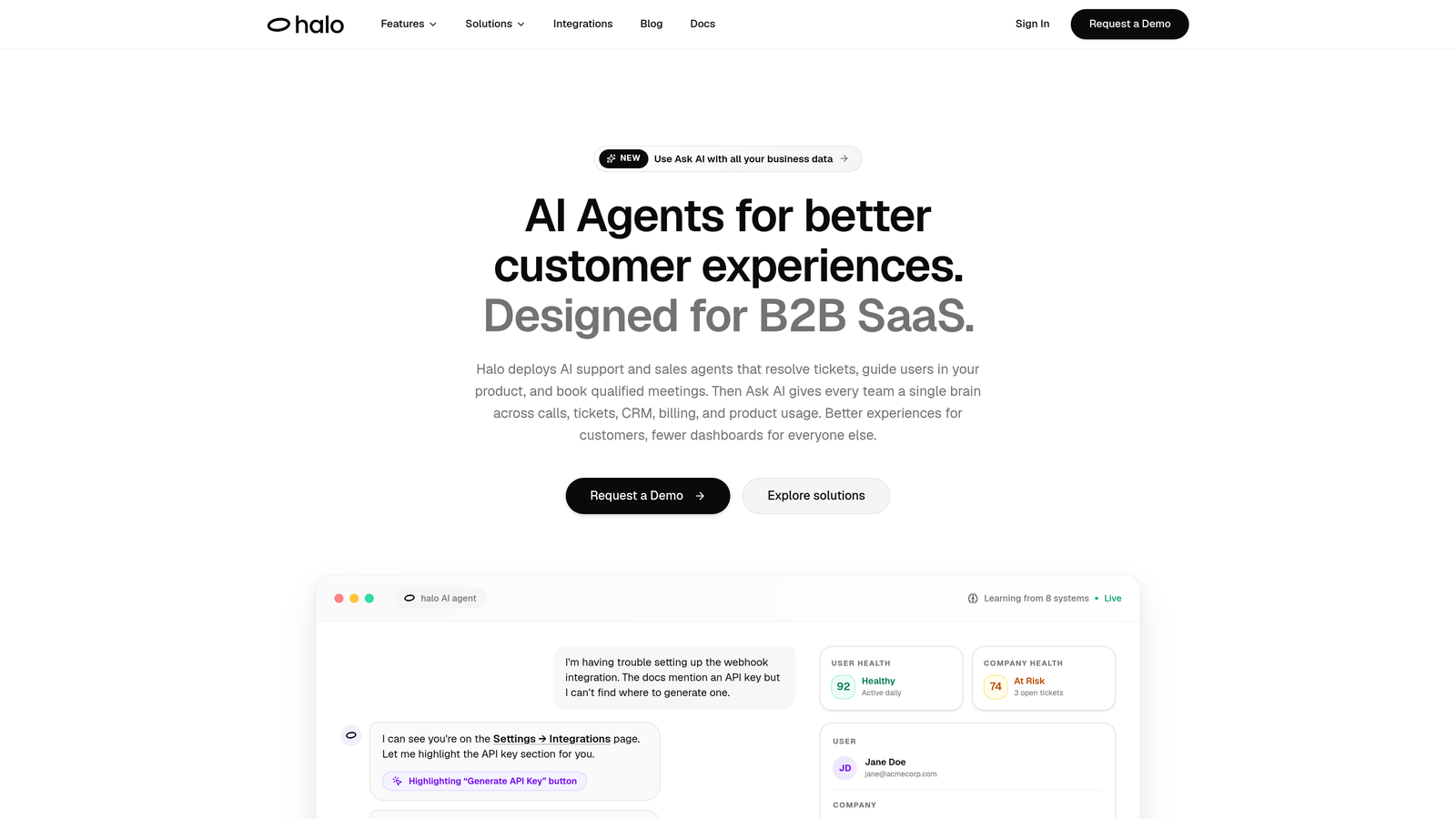
Halo AI is an AI-first customer support platform that deploys autonomous agents to resolve tickets, guide users visually, and surface business intelligence from every interaction.
Where This Tool Shines
What separates Halo from most platforms on this list is that it wasn't built by layering AI onto an existing helpdesk. It was architected from the ground up for AI-native support, which means the intelligence runs deeper than surface-level chatbot deflection. Every resolved ticket feeds the system's continuous learning loop, making the AI more accurate over time.
For tech companies specifically, two capabilities stand out. First, the page-aware chat widget actually understands what screen a user is on and can provide visual UI guidance in context. Second, when a conversation reveals a bug, Halo can automatically create a detailed bug ticket and route it to your engineering tools. That's a workflow that most platforms simply don't offer natively.
Key Features
Page-Aware Chat Widget: The AI sees the user's current screen and delivers contextual guidance, reducing back-and-forth for product navigation questions.
Auto Bug Ticket Creation: Automatically generates structured bug reports and routes them to tools like Linear, keeping engineering informed without manual effort.
Smart Inbox with Business Intelligence: Goes beyond ticket resolution to surface customer health signals, revenue intelligence, and anomaly detection from support data.
Continuous Learning: Every interaction improves resolution accuracy over time, so the platform gets smarter the longer you use it.
Deep Integrations: Connects natively with Linear, Slack, HubSpot, Intercom, Stripe, Zoom, PandaDoc, and Fathom for a fully connected support stack.
Best For
Halo is best suited for B2B SaaS and tech companies that want an AI-first platform rather than a bolt-on. It's particularly well-matched for product teams that want support data to feed back into engineering workflows and leadership that wants business intelligence, not just ticket counts.
Pricing
Contact for pricing. Halo is designed to scale support capacity without scaling headcount, making total cost of ownership a key part of the evaluation conversation.
2. Intercom Fin
Best for: Companies already using Intercom's messenger and customer data platform
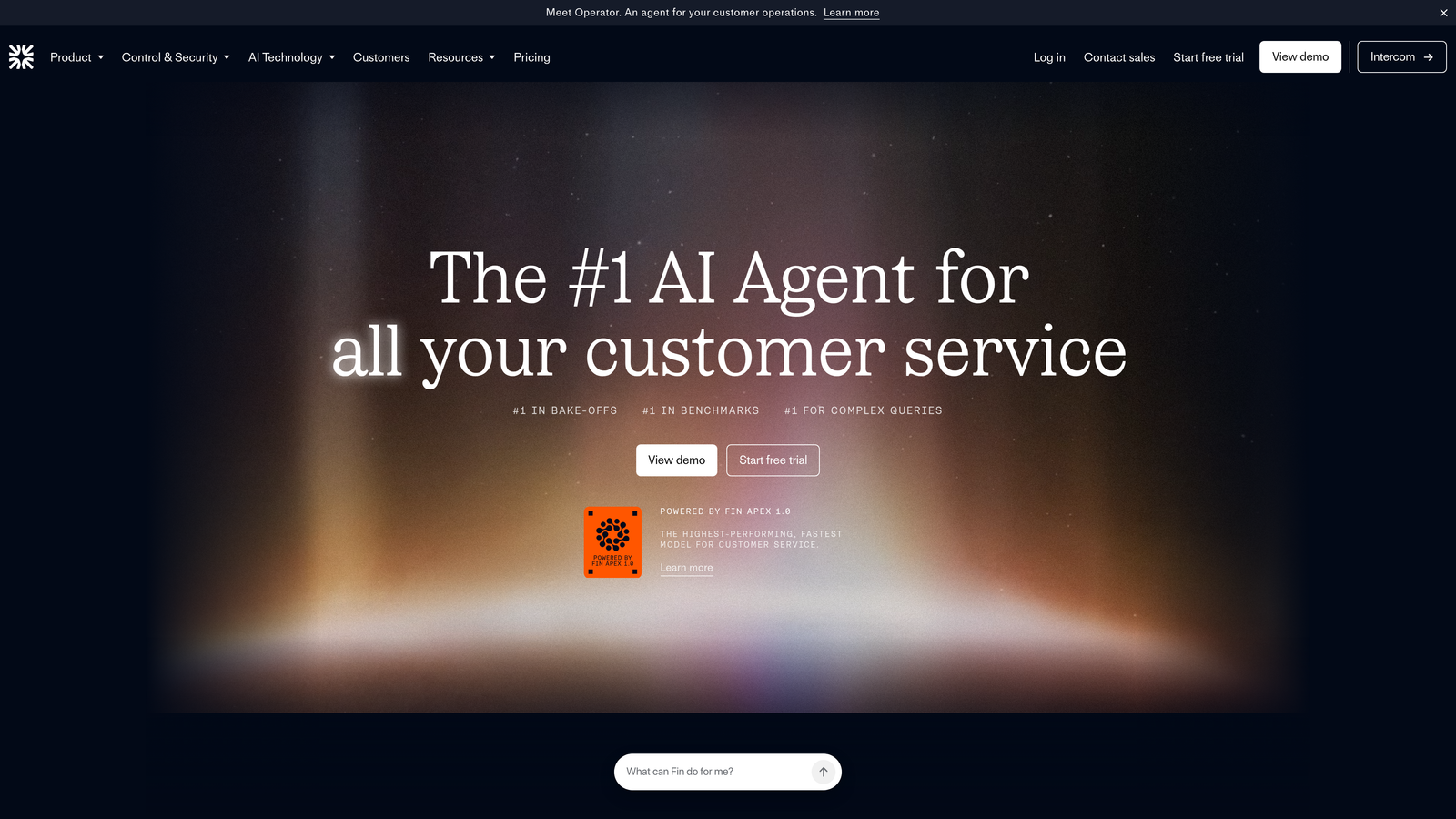
Intercom Fin is Intercom's native AI agent that resolves support questions using your help center, past conversations, and custom data sources.
Where This Tool Shines
If your team is already running on Intercom, Fin is a natural upgrade path. It draws on your existing help center content, historical conversations, and custom data sources to deliver answers without requiring a separate platform migration. The integration with Intercom's product tours and customer data makes it particularly strong for onboarding-related support flows.
Fin's per-resolution pricing model is worth understanding before you commit. It aligns cost with value in theory, but high-volume teams should model out what that looks like at scale compared to seat-based alternatives.
Key Features
Multi-Source Training: Learns from your help center, past conversations, and custom content sources for contextual, accurate responses.
Native Intercom Integration: Works seamlessly with Intercom messenger, product tours, and the full customer data platform.
Customizable AI Personality: Lets you define tone and personality to match your brand voice.
Multilingual Support: Handles customer conversations across dozens of languages without separate configuration.
AI Performance Reporting: Detailed analytics on resolution rates, conversation quality, and AI impact.
Best For
Teams already invested in the Intercom ecosystem who want to add autonomous resolution without switching platforms. Less compelling for companies not already using Intercom, since the value is heavily tied to that existing infrastructure.
Pricing
Intercom plans start at $39/seat/month. Fin charges per resolution as an add-on, so total cost depends on your support volume.
3. Zendesk AI
Best for: Enterprise teams with complex support operations already using Zendesk's helpdesk infrastructure
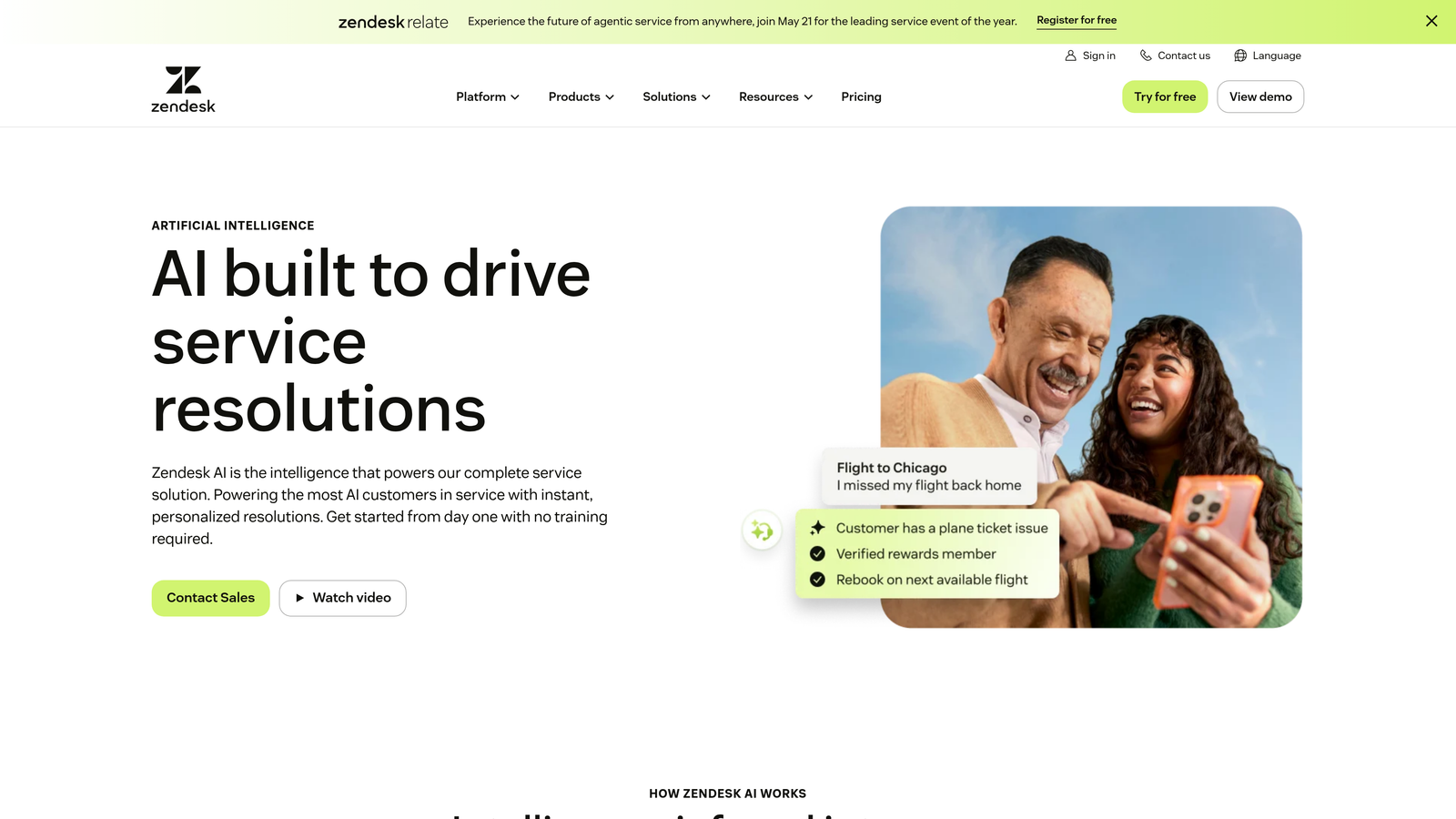
Zendesk AI adds autonomous agents, intelligent triage, and agent-assist capabilities on top of Zendesk's established helpdesk platform.
Where This Tool Shines
Zendesk's core strength is its maturity. The platform has decades of enterprise helpdesk experience behind it, a massive integration marketplace, and deep compliance and security capabilities that enterprise buyers require. For large tech companies with established Zendesk workflows, the AI layer adds meaningful value without requiring a platform switch.
The honest caveat is that Zendesk AI is an addition to a legacy platform rather than an AI-native architecture. Teams that prioritize autonomous resolution over agent-assist may find the AI capabilities feel more like a supplement than a foundation.
Key Features
AI Agents: Autonomous resolution across email, chat, and messaging channels for common support queries.
Intelligent Triage: Automatic intent detection, language detection, and sentiment analysis to route tickets accurately.
Agent-Assist Tools: AI-suggested replies and knowledge base recommendations that speed up human agent responses.
Extensive Marketplace: Thousands of pre-built integrations covering virtually every business tool.
Enterprise Security: Robust compliance, data residency, and security controls for regulated industries.
Best For
Large enterprises and scaling tech companies with existing Zendesk investments who want to add AI capabilities incrementally rather than migrate platforms entirely.
Pricing
Suite plans start at $55/agent/month. Advanced AI is a paid add-on at additional cost, so total spend can climb quickly for larger teams.
4. Ada
Best for: Organizations prioritizing fully autonomous resolution with complex multi-step workflows
Ada is an AI-powered customer service automation platform built around a reasoning engine designed to handle complex queries without human intervention.
Where This Tool Shines
Ada's core differentiator is its focus on full automation rather than agent-assist. The reasoning engine can work through multi-step queries, take actions in connected systems like CRM and billing, and resolve issues end-to-end. For tech companies with complex support flows, this is more useful than a bot that simply retrieves FAQ answers.
Ada also measures resolution quality rather than just deflection rates, which is a meaningful distinction. Deflecting a ticket and actually resolving it are not the same thing, and Ada's approach to measurement reflects that nuance.
Key Features
Reasoning Engine: Handles multi-step queries and complex resolution paths without requiring human handoff.
No-Code Automation Builder: Lets non-technical teams build custom workflows and actions without engineering support.
System Action Capabilities: Connects to CRM, billing, and backend systems to take real actions, not just provide answers.
Omnichannel Coverage: Supports voice, chat, email, and messaging from a single platform.
Resolution Quality Metrics: Tracks whether issues were genuinely resolved, not just whether a conversation ended.
Best For
Mid-to-large tech companies with high support volume and complex resolution workflows where full automation, rather than agent augmentation, is the primary goal.
Pricing
Custom pricing based on resolution volume. Contact Ada's sales team for a quote tailored to your use case.
5. Freshdesk Freddy AI
Best for: Startups and small tech teams needing capable AI support at an accessible price point
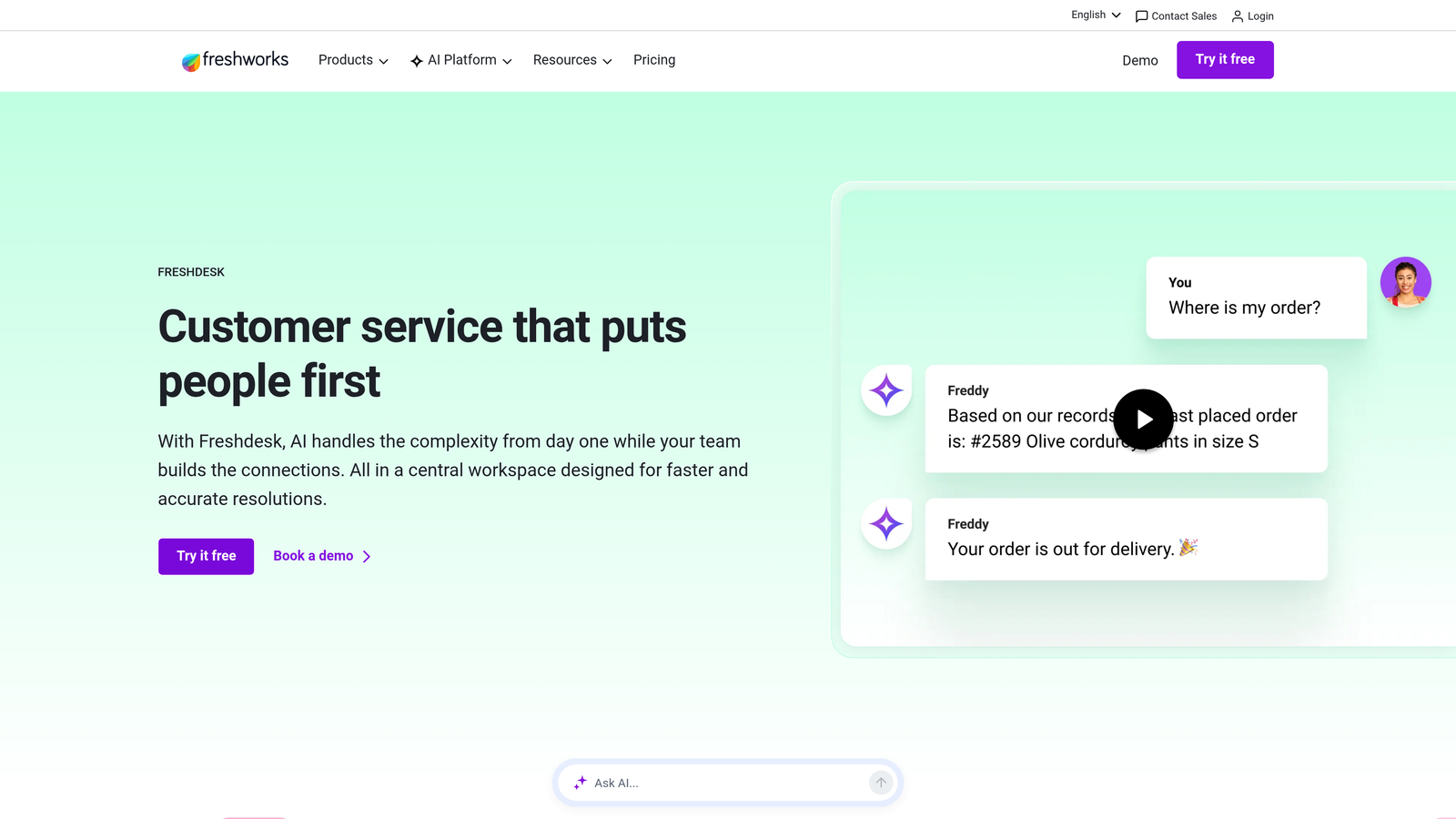
Freshdesk Freddy AI is Freshworks' AI layer for Freshdesk, offering ticket triage, agent assist, and customer-facing bots designed to be affordable for growing teams.
Where This Tool Shines
Freshdesk's biggest advantage is its price-to-capability ratio. The free tier and low-cost paid plans make it genuinely accessible for early-stage startups that need AI-powered support without enterprise-level budgets. Freddy AI handles the core workflows: auto-routing, suggested responses, and basic customer-facing resolution.
For tech companies scaling past their initial support setup, Freshdesk provides a solid foundation with enough AI capability to reduce manual triage significantly. It's not the most powerful platform on this list, but it punches above its weight for the cost.
Key Features
Freddy AI Agent: Customer-facing auto-resolution via chat and email for common support queries.
AI-Powered Routing: Automatic ticket categorization, prioritization, and routing based on content and intent.
Agent Assist: Suggested responses and knowledge base surfacing to speed up human agent handling.
Competitive Pricing Tiers: Free tier plus affordable paid plans make it accessible for teams at any stage.
SLA Management: Built-in SLA tracking and collaboration tools for structured support operations.
Best For
Startups and small-to-mid-size tech companies that need a capable, affordable support platform and aren't yet ready for enterprise-tier pricing or complexity.
Pricing
Free tier available. Paid plans start at $15/agent/month. Freddy AI capabilities are available as an add-on at additional cost.
6. Forethought
Best for: Teams wanting AI triage and resolution layered on top of an existing helpdesk like Zendesk or Salesforce
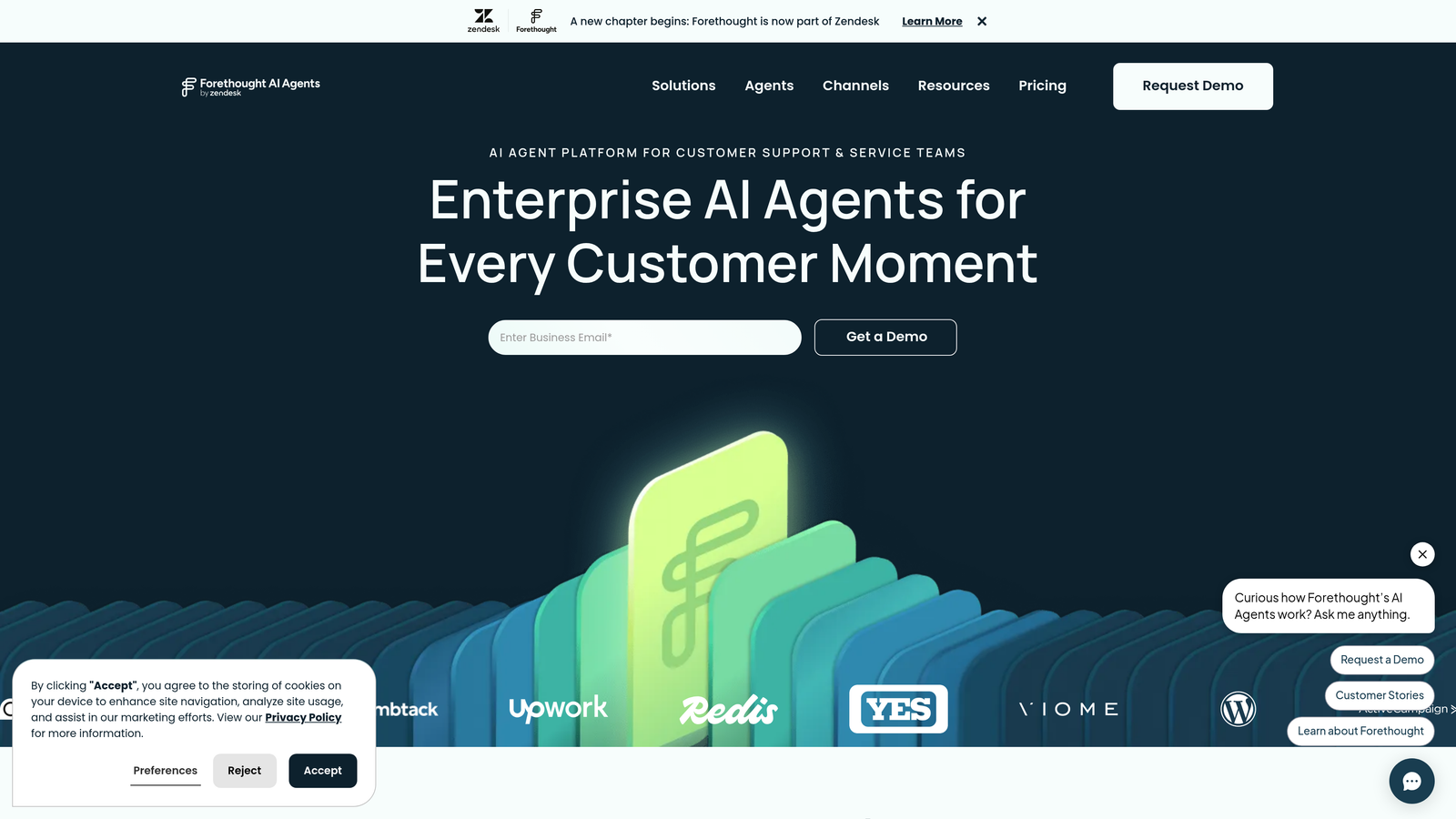
Forethought uses SupportGPT models fine-tuned on your historical ticket data to deliver highly contextual triage and autonomous resolution.
Where This Tool Shines
Forethought's approach is distinctive: rather than asking you to replace your helpdesk, it sits on top of your existing platform and makes it smarter. The SupportGPT models are trained on your company's actual historical support data, which means the AI understands your specific product language, common failure modes, and resolution patterns from day one.
For tech companies with years of ticket history in Zendesk or Salesforce, this is a compelling path to AI-powered support without a full migration. The intelligence is grounded in your own data rather than generic training.
Key Features
SupportGPT Models: Fine-tuned on your company's historical support data for contextually accurate, product-specific responses.
Intelligent Triage: Routes tickets by intent, urgency, and complexity for precise queue management.
Autonomous Resolution: Handles common queries independently with clean escalation paths for edge cases.
Helpdesk Agnostic: Works as a layer on top of Zendesk, Salesforce, and other existing platforms.
Impact Analytics: Dashboard tracking AI's measurable effect on resolution time and CSAT scores.
Best For
Tech companies with established helpdesk infrastructure and substantial ticket history who want to add AI intelligence without migrating to a new platform.
Pricing
Custom pricing based on ticket volume and which modules you use. Contact Forethought's sales team for a tailored quote.
7. Tidio Lyro
Best for: Small teams or early-stage startups needing fast, lightweight AI chat deployment
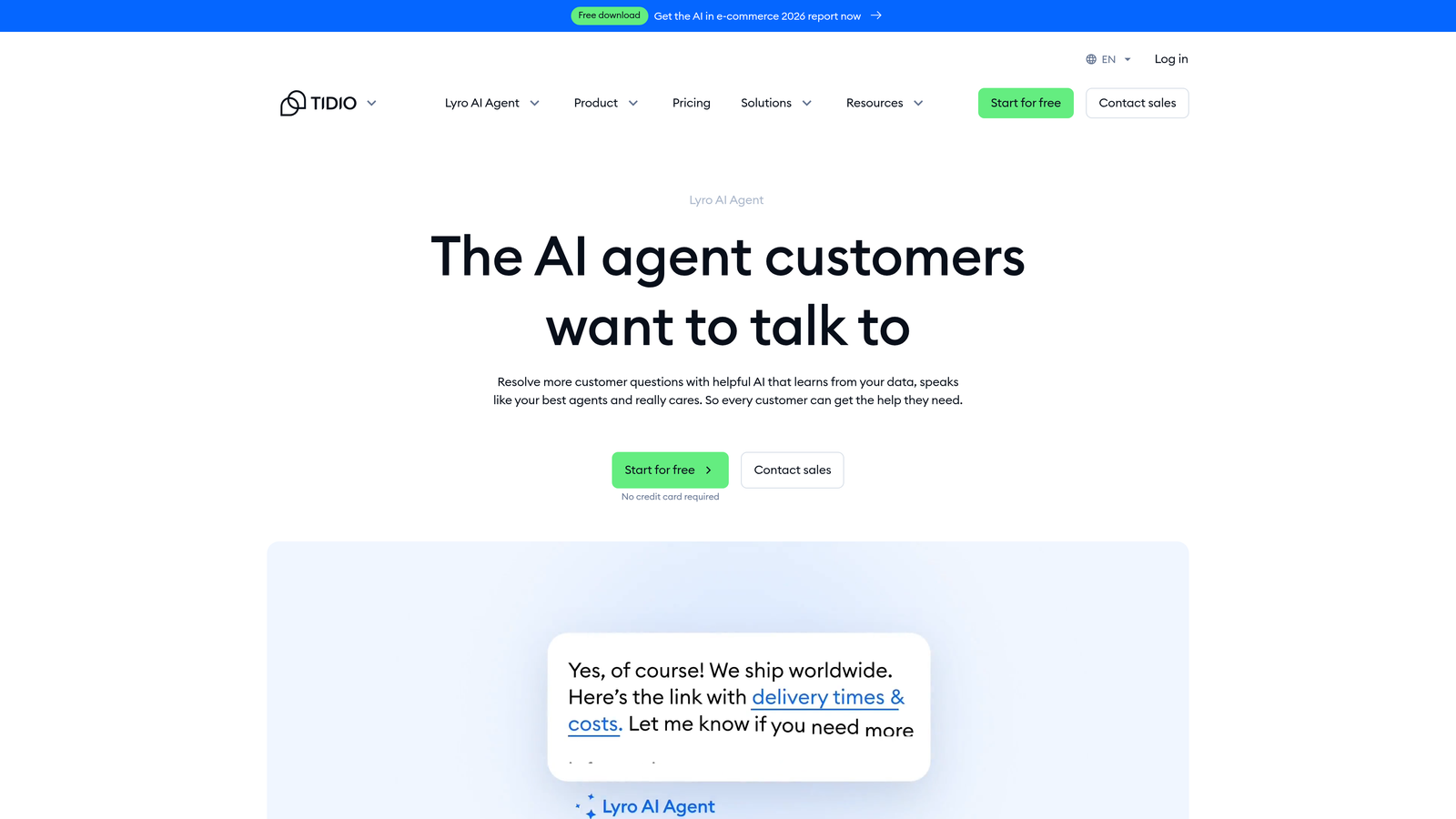
Tidio Lyro is a conversational AI that learns from your FAQ and help center content to deliver instant answers with minimal setup time.
Where This Tool Shines
Lyro's defining characteristic is speed of deployment. While many platforms on this list require weeks of onboarding, configuration, and integration work, Lyro can be live in minutes. It ingests your existing FAQ and help center content and starts answering questions immediately, making it ideal for teams that need something working now rather than next quarter.
The trade-off is depth. Lyro is a capable lightweight solution, but it's not designed for the complex, multi-step technical support workflows that larger tech companies deal with. Think of it as the right tool for a specific stage of company growth.
Key Features
Content-Based Learning: Ingests existing FAQ and help center content with minimal training required.
Fast Deployment: Can be live and handling conversations in minutes rather than weeks.
Combined AI and Live Chat: Blends AI chat with live agent chat and basic helpdesk functionality in one interface.
Human Handoff: Smooth conversation transfer to human agents when the AI reaches its limits.
Accessible Pricing: One of the most affordable AI chat options available for small teams.
Best For
Early-stage startups, small tech teams, or companies that need a quick AI chat deployment without complex integration requirements or large budgets.
Pricing
Free plan available. Lyro AI starts at $39/month for 50 conversations, with higher-volume plans available.
8. Kustomer
Best for: Tech companies with complex customer data needs and omnichannel support operations
Kustomer is a CRM-powered customer service platform that unifies support, product usage, and billing data into a single customer timeline with AI-powered automation.
Where This Tool Shines
Kustomer's core strength is the unified customer timeline. Rather than treating each support ticket as an isolated event, Kustomer pulls together support history, product usage, orders, and billing data into a single view. For tech companies where support context often lives across multiple systems, this consolidated picture meaningfully improves both AI and human agent performance.
The rich customer data model also makes Kustomer's AI interactions more personalized than most. When the system knows a customer's subscription tier, recent product activity, and previous support history, it can tailor responses and routing decisions accordingly.
Key Features
Unified Customer Timeline: Combines support history, product usage, orders, and billing data into a single agent view.
AI Classification and Routing: Automatically classifies incoming conversations and routes them based on intent and customer context.
Omnichannel Coverage: Handles email, chat, social, SMS, and voice from a single platform.
Workflow Automation Engine: Supports complex multi-step automation for sophisticated support operations.
Rich Data Model: Enables highly personalized AI interactions based on comprehensive customer context.
Best For
Mid-to-large tech companies with omnichannel support needs and complex customer data spread across multiple systems who want AI to work with full context rather than partial information.
Pricing
Enterprise plan starts at $89/user/month. Contact sales for AI add-on pricing specific to your use case.
9. DevRev
Best for: Engineering-heavy tech companies that want support and product development on a single platform
DevRev is an AI-native platform that unifies customer support with product development, connecting support tickets directly to engineering backlogs and roadmaps.
Where This Tool Shines
DevRev occupies a unique position on this list: it's less a pure support platform and more a bridge between customer-facing support and engineering. For developer-first companies, the gap between what customers report and what engineers know about is a persistent problem. DevRev closes that gap by linking support conversations directly to code changes, releases, and product backlogs.
The AI-powered clustering of support issues is particularly valuable for product teams. Rather than manually reviewing tickets to identify patterns, DevRev surfaces clusters of related issues automatically, helping product managers and engineers understand what's actually breaking at scale.
Key Features
Unified Support and Product Platform: Connects support tickets directly to engineering backlogs and sprint planning.
AI Issue Clustering: Automatically groups related support issues to surface product trends and recurring bugs.
Engineering-Centric Workflows: Built specifically for developer-first organizations with native engineering tool integrations.
Code Change Linking: Automatically associates customer conversations with relevant code changes and product releases.
Cross-Functional Analytics: Bridges support metrics with product development velocity for unified visibility.
Best For
Engineering-led tech companies, particularly those where the product and support teams are closely aligned and want a single platform rather than separate tools that need to be integrated.
Pricing
Free tier available for small teams. Paid plans start at $19.99/user/month, making it one of the more accessible options on this list for growing teams.
How to Choose the Right AI Support Platform for Your Tech Stack
Nine platforms is still a lot to evaluate, so here's a practical framework for narrowing the field based on where your team actually is.
If you're an early-stage startup with a lean team: Start with Freshdesk Freddy AI or Tidio Lyro. Both offer free tiers, fast deployment, and enough AI capability to meaningfully reduce manual support work without requiring enterprise-level budget or implementation effort.
If you're already running on Intercom or Zendesk: Fin and Zendesk AI are the natural paths forward. You get AI capabilities without a platform migration, and your existing data and integrations carry over. Forethought is also worth evaluating if you have a substantial ticket history you want to leverage.
If full automation is the priority: Ada is the strongest option for teams that want the AI to handle complex multi-step resolution end-to-end, not just assist human agents. It's built specifically for that use case.
If your team is engineering-first and you want support connected to product development: DevRev is the only platform on this list that genuinely unifies these two functions. If closing the loop between customer issues and engineering backlogs is a core requirement, it's worth a close look.
If you want AI-native architecture with page-aware context and business intelligence: Halo AI is the strongest fit. It's not a helpdesk with AI added on top. It's built from scratch for autonomous support, with capabilities like page-aware visual guidance and auto bug ticket creation that most platforms simply don't offer. The continuous learning architecture means the platform gets more accurate over time, and the business intelligence layer surfaces customer health signals and product friction points that go well beyond standard support analytics.
The broader point is this: your support team shouldn't have to scale linearly with your customer base. The right AI platform handles routine tickets autonomously, routes complex issues to the right humans, and turns support conversations into product intelligence. That's a fundamentally different value proposition than a traditional helpdesk, and it's what the best platforms on this list are actually delivering.
See Halo in action and discover how continuous learning transforms every interaction into smarter, faster support that scales without scaling your headcount.