9 Best AI Customer Service Platforms Compared for 2026
This ai customer service platforms comparison evaluates nine leading solutions across five key dimensions—AI capability depth, integrations, scalability, pricing, and B2B suitability—helping teams cut through market noise to find the right platform for their needs, whether AI-native or helpdesk-based with added AI layers.
 Grant CooperFounder14 min read
The AI customer service platform market has never been more crowded, and that's both a good thing and a genuinely difficult problem. More options mean more innovation, but it also means more noise to cut through when your team is trying to make a real purchasing decision.
What makes this comparison particularly tricky is that not all AI customer service platforms are built the same way. Some are AI-native from the ground up, architected entirely around autonomous agents and continuous learning. Others are established helpdesks that have added AI capabilities as a layer on top of their existing infrastructure. That architectural difference matters more than most feature checklists will tell you.
This comparison evaluates platforms across five dimensions: AI capability depth, integration ecosystem, scalability, pricing transparency, and suitability for B2B product teams. Whether you're evaluating your first AI support platform or reconsidering your current stack, here are the top AI customer service platforms worth your attention in 2026.
1. Halo AI
Best for: B2B product teams that want AI-native autonomous support with deep stack integrations and business intelligence
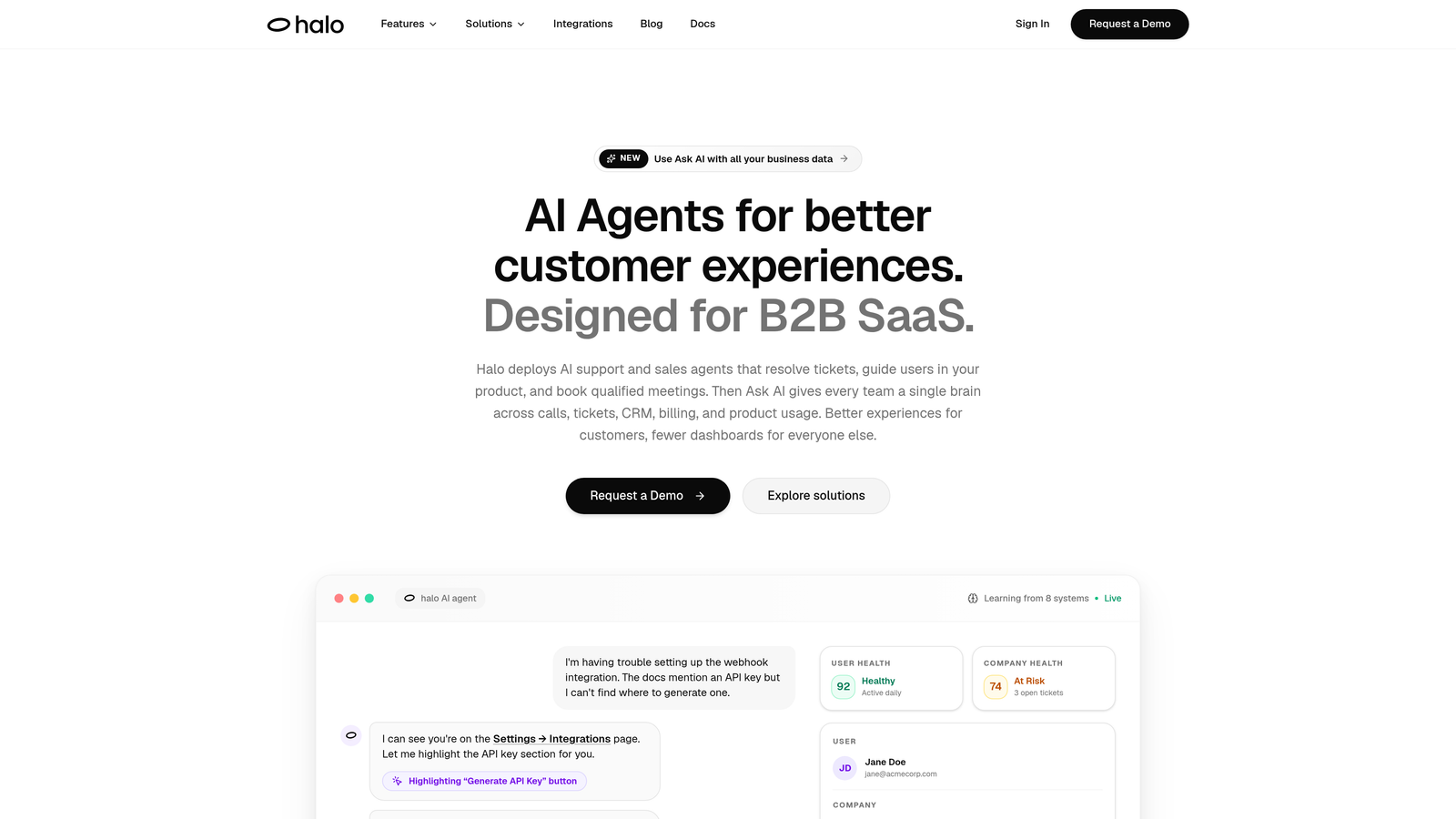
Halo AI is an AI-native customer support platform that deploys autonomous agents to resolve tickets, guide users visually through your product, and surface business intelligence from every support interaction.
Where This Tool Shines
Halo AI's most distinctive capability is its page-aware context engine. Unlike chatbots that respond to text alone, Halo's agents can see what users see on screen, enabling them to provide step-by-step visual UI guidance rather than generic text instructions. This is particularly valuable for SaaS products with complex workflows where "click the settings icon" is less helpful than showing exactly which settings icon, on which page, in which context.
The platform also moves beyond support metrics into genuine business intelligence. Customer health signals, revenue intelligence, and anomaly detection are surfaced from support data, giving product and customer success teams visibility they wouldn't otherwise have. It's the difference between a support tool and a support platform that actively informs your product roadmap.
Key Features
Page-Aware Chat Widget: Visual UI guidance that understands the user's current page context for precise, step-by-step assistance.
Autonomous AI Agents: Resolves tickets independently and escalates to human agents when complexity warrants it, with clean handoff protocols.
Auto Bug Ticket Creation: Automatically generates bug reports integrated directly with Linear and engineering workflows, closing the loop between support and product.
Smart Inbox with Business Intelligence: Goes beyond ticket management to surface customer health signals, revenue intelligence, and support anomalies.
Deep Integrations: Connects to Slack, HubSpot, Intercom, Stripe, Zoom, PandaDoc, and Fathom, giving AI agents full context from across your business stack.
Best For
B2B SaaS companies and product teams that want AI agents with genuine autonomy and contextual depth, not just a chatbot layered over a knowledge base. Particularly strong for teams already using tools like Linear, HubSpot, or Stripe who want their support AI to have real business context.
Pricing
Contact for pricing; usage-based model designed to scale with resolution volume rather than seat count, which changes the economics significantly for growing teams.
2. Zendesk AI
Best for: Enterprise teams that need mature omnichannel infrastructure with AI capabilities built on top
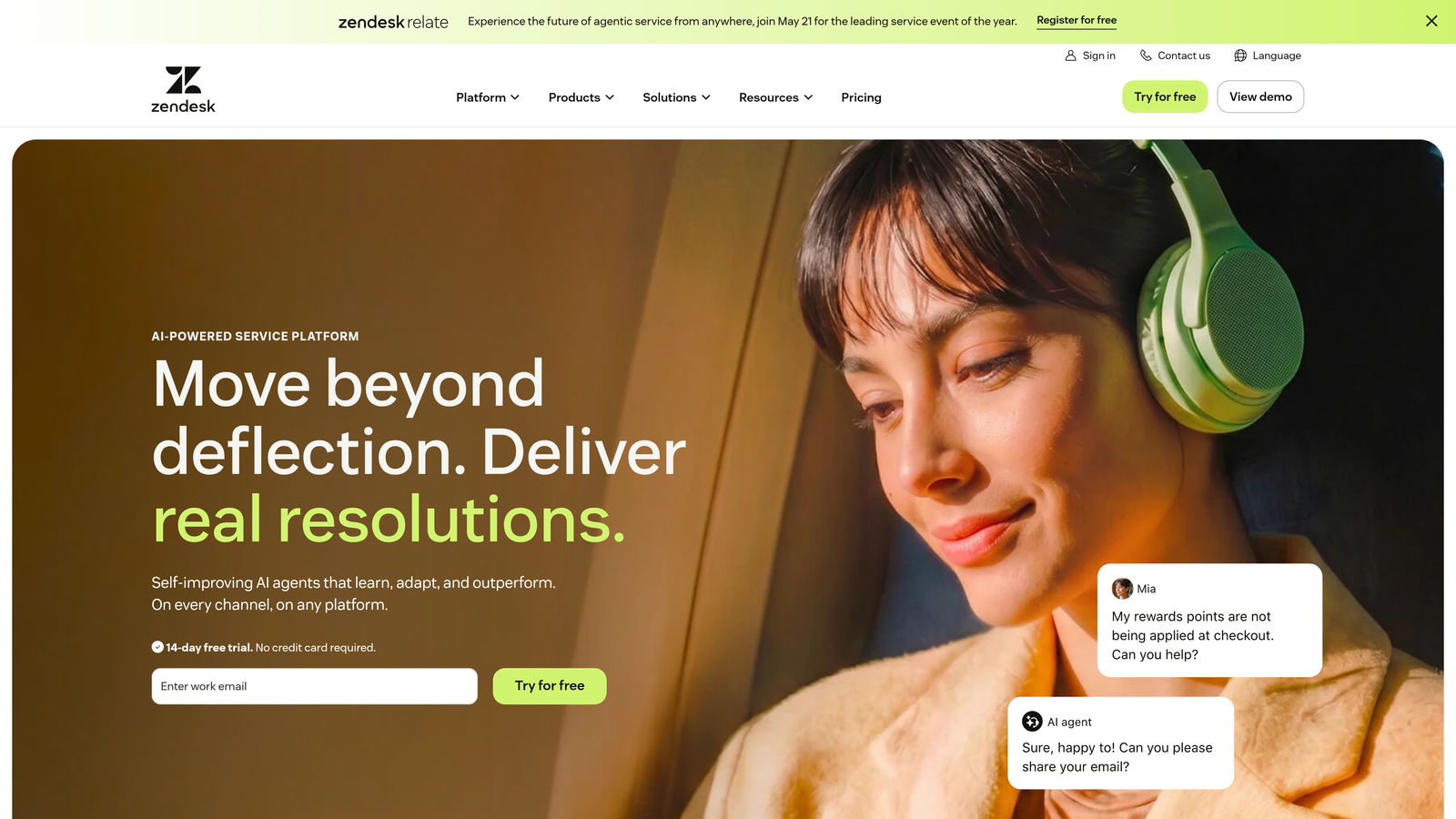
Zendesk AI is the AI layer added to one of the most established helpdesk platforms in the market, combining proven ticketing infrastructure with increasingly capable AI agents and copilot tools.
Where This Tool Shines
Zendesk's strength is its maturity. The platform has been in production at enterprise scale for years, and its AI additions sit on top of that proven foundation. Intent detection, language detection, and sentiment analysis work reliably across high ticket volumes, and the routing logic is sophisticated enough for complex enterprise support organizations.
The integration marketplace is genuinely impressive at 1,500+ apps. For enterprise teams that have already built their support workflows in Zendesk, adding AI capabilities is a lower-friction upgrade than migrating to a new platform entirely.
Key Features
AI Agents: Automated resolution trained on your knowledge base content for common, repeatable queries.
Intelligent Triage: Intent detection, language detection, and sentiment analysis to route tickets accurately from the start.
Agent Copilot: AI-generated response suggestions and ticket summaries to accelerate human agent productivity.
Integration Marketplace: Over 1,500 app integrations covering the full enterprise technology stack.
Omnichannel Support: Unified inbox across email, chat, phone, social, and messaging channels.
Best For
Enterprise support organizations already invested in the Zendesk ecosystem, or teams that need proven omnichannel infrastructure at scale with AI as an enhancement rather than the core architecture.
Pricing
Suite plans start around $55/agent/month; AI add-ons are priced per automated resolution, which can add up quickly at high volumes.
3. Intercom Fin
Best for: Product-led SaaS companies focused on in-app engagement and conversational AI resolution
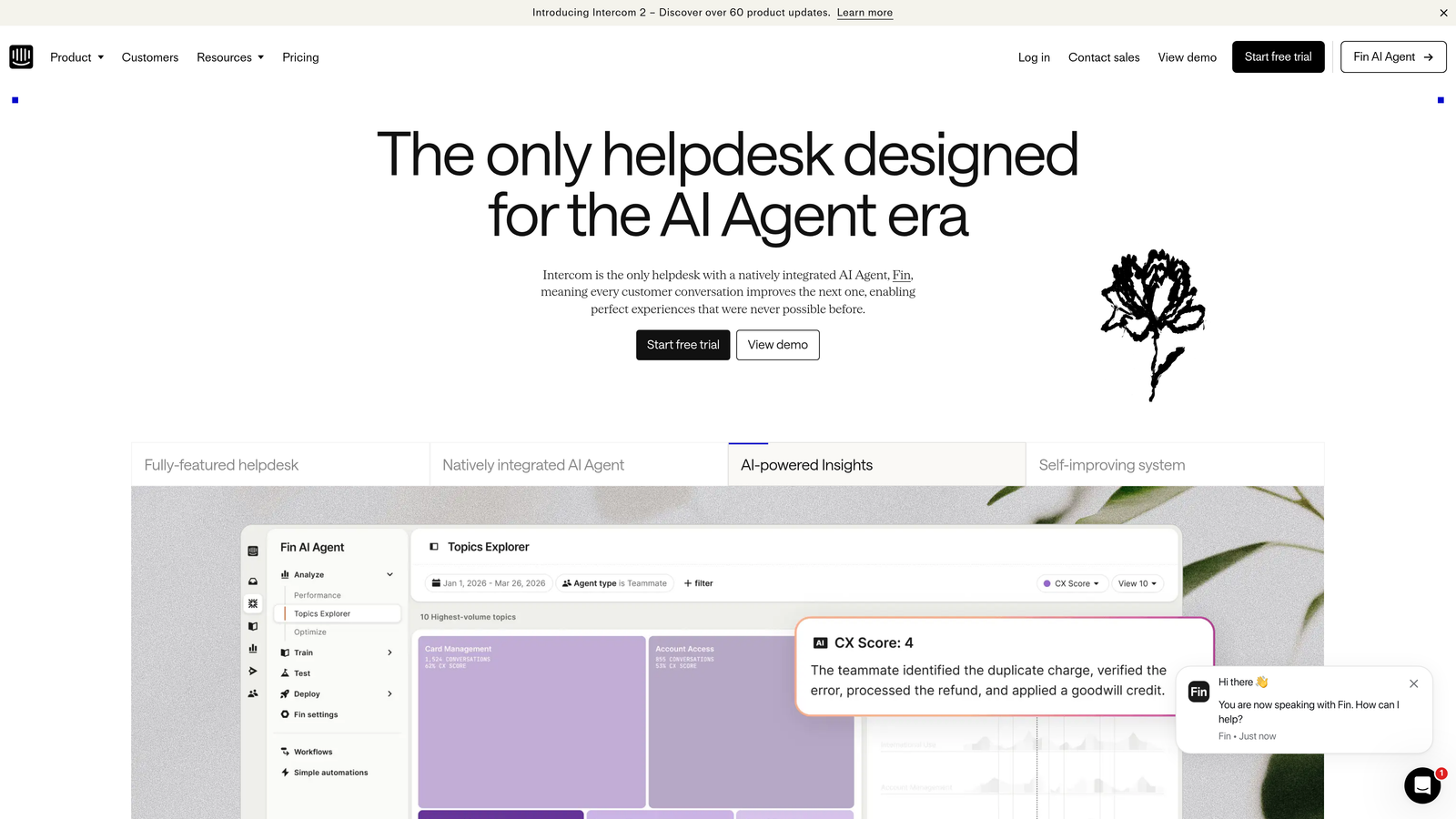
Intercom Fin is a conversational AI agent built into Intercom's messaging platform, with strong in-app engagement capabilities and a per-resolution pricing model that aligns costs with actual AI performance.
Where This Tool Shines
Fin's positioning within Intercom's broader product makes it particularly strong for product-led growth companies. The combination of proactive outreach, product tours, and AI resolution in one platform means you can engage users contextually throughout their journey, not just when they open a support ticket.
The per-resolution pricing model is worth noting. At around $0.99 per resolution, teams pay for outcomes rather than seats, which aligns incentives well. The Fin AI Copilot for live agents also provides contextual suggestions during active conversations, reducing the cognitive load on human agents handling escalations.
Key Features
Fin AI Agent: Trained on your help center and custom content sources for autonomous resolution of common queries.
In-App Messaging: Product tours and proactive outreach alongside reactive support in one unified platform.
Fin AI Copilot: Real-time contextual suggestions for live agents during escalated conversations.
Custom Answer Workflows: Multi-step resolution flows for queries that require more than a single response.
AI Resolution Reporting: Visibility into AI resolution rates and conversation quality metrics.
Best For
SaaS companies with product-led growth motions that want to unify proactive engagement and reactive support in one platform, and who are comfortable with per-resolution pricing.
Pricing
Base plans start at $29/seat/month; Fin AI agent is priced at around $0.99 per resolution, making total cost highly dependent on resolution volume.
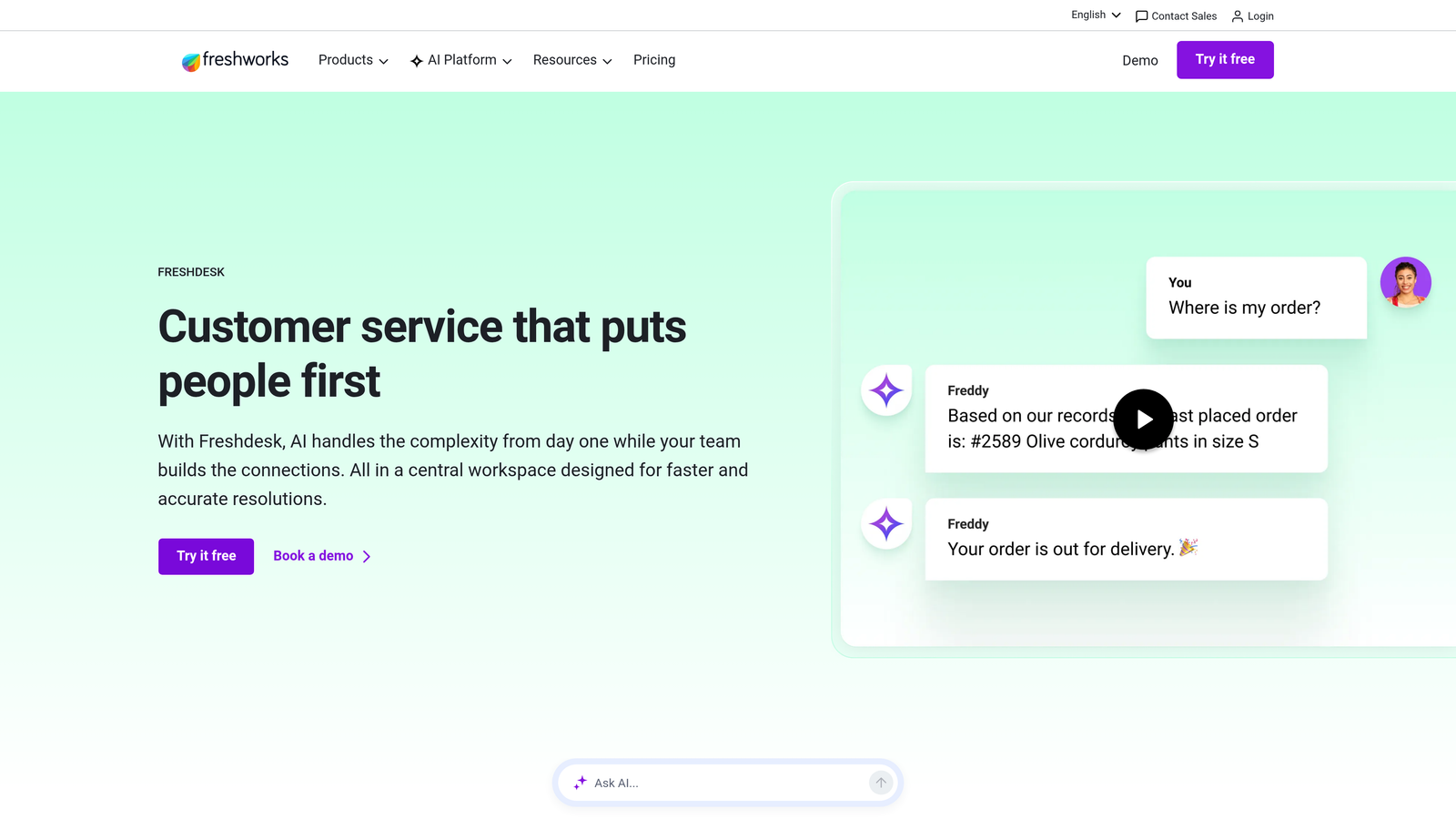
4. Freshdesk Freddy AI
Best for: Mid-market teams that want capable AI support within a broader Freshworks ecosystem at accessible pricing
Freshdesk with Freddy AI is a mid-market-friendly helpdesk platform offering both AI agent and copilot capabilities across the full support workflow, with pricing that makes it accessible to teams not operating at enterprise scale.
Where This Tool Shines
Freshdesk's value proposition centers on breadth at a reasonable price point. Freddy AI handles both customer-facing autonomous resolution and agent-side assistance, and the platform covers omnichannel support including WhatsApp, which is increasingly important for global B2B teams with international customers.
For teams already using or considering Freshworks for CRM, ITSM, or marketing, the ecosystem integration adds meaningful value. Data flows between products without custom connectors, which reduces implementation complexity significantly.
Key Features
Freddy AI Agent: Customer-facing autonomous resolution for common support queries without human intervention.
Freddy Copilot: Agent-assist with response suggestions and ticket summaries to speed up human agent workflows.
Auto-Triage: AI-powered ticket classification and routing to the right agent or team automatically.
Omnichannel Coverage: Unified support across email, chat, phone, social, and WhatsApp.
Freshworks Suite Integration: Native connections to Freshworks CRM, ITSM, and marketing products for cross-functional data sharing.
Best For
Mid-market teams looking for capable AI support without enterprise pricing, especially those already in the Freshworks ecosystem or evaluating it for multiple business functions.
Pricing
Free tier available; paid plans from around $15/agent/month; AI features unlock at higher tiers, so factor that into total cost calculations.
5. Ada
Best for: High-volume support teams that need automation-first AI resolution across multiple languages and channels
Ada is an automation-first AI customer service platform purpose-built for autonomous resolution at scale, with a reasoning engine that handles multi-step queries without relying on scripted conversation flows.
Where This Tool Shines
Ada's approach to multilingual support is architecturally different from many competitors. Rather than maintaining separate bots per language, Ada handles 50+ languages within a single AI agent, which dramatically reduces the operational overhead of managing global support. For B2B companies with international customer bases, this is a meaningful differentiator.
The platform also functions well as an AI layer on top of existing helpdesks like Zendesk or Salesforce, which means teams don't need to rip and replace their current infrastructure. Ada handles the autonomous resolution layer while the underlying helpdesk manages ticket records and reporting.
Key Features
Reasoning Engine: Multi-step resolution without scripted flows, enabling the AI to handle complex queries dynamically.
Multilingual Support: 50+ languages handled by a single AI agent without separate bot configurations per language.
Helpdesk Integration Layer: Works on top of Zendesk, Salesforce, and other platforms without requiring migration.
Coaching and QA Tools: Built-in tools for reviewing AI performance and improving resolution accuracy over time.
Broad Channel Coverage: Deployment across web, mobile, social, SMS, and email from a single configuration.
Best For
Mid-market to enterprise teams with high ticket volumes, multilingual customer bases, or teams that want to add autonomous AI resolution without migrating away from their existing helpdesk.
Pricing
Custom pricing based on resolution volume; typically positioned at mid-market and above. Contact Ada directly for a quote based on your volume.
6. Tidio
Best for: Small to mid-sized businesses that want an affordable, easy-to-deploy AI chatbot with live chat in one package
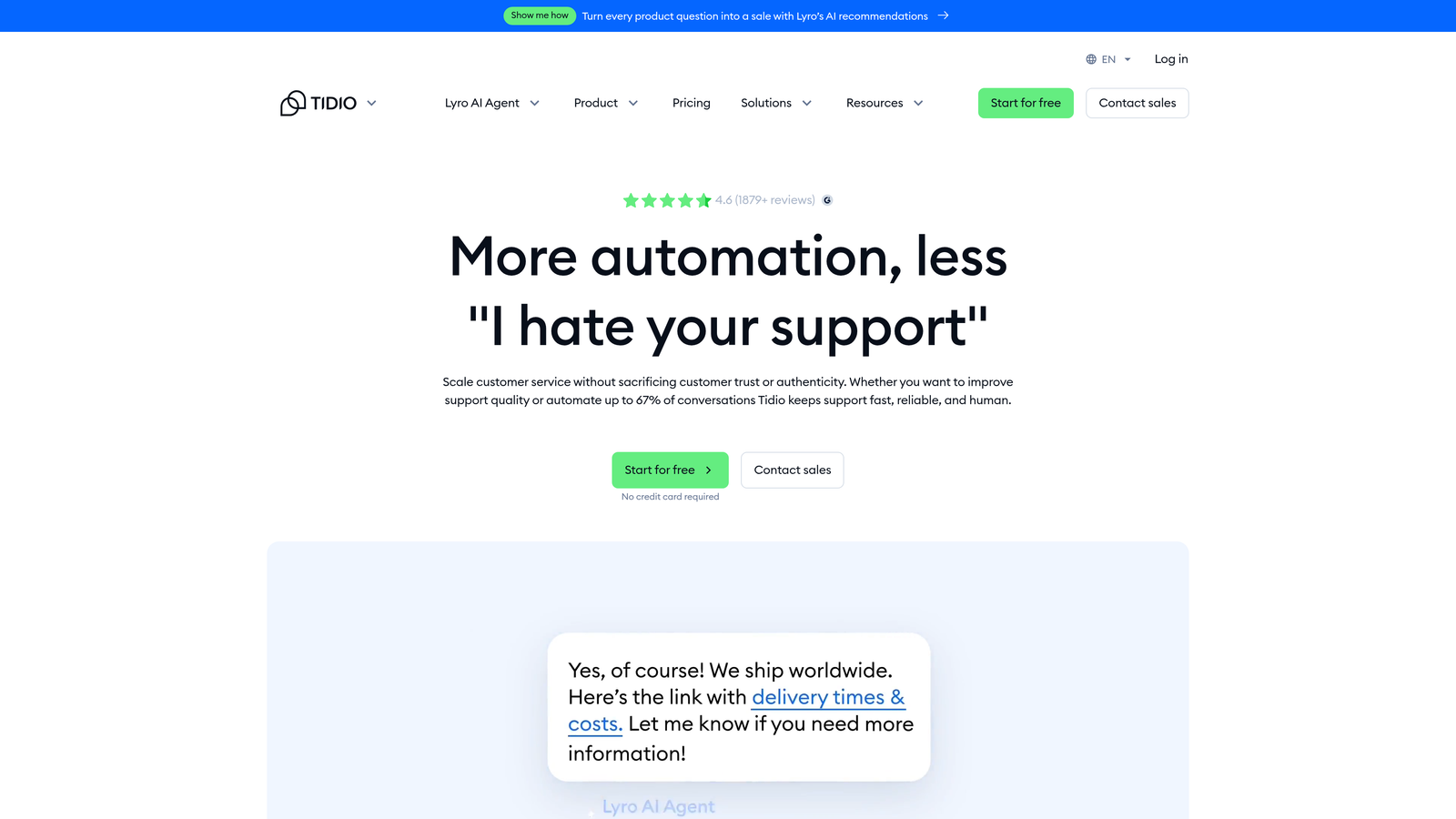
Tidio combines its Lyro AI agent with live chat and ticketing functionality in a single affordable platform, making it one of the more accessible entry points into AI customer service for smaller teams.
Where This Tool Shines
Tidio's strength is accessibility. The no-code setup for Lyro AI means teams without technical resources can have an AI chatbot learning from their FAQ content and running in production quickly. The visual chatbot flow builder gives non-technical users control over automation paths without needing developer involvement.
The e-commerce integrations with Shopify, WooCommerce, and BigCommerce make Tidio particularly relevant for direct-to-consumer brands, though B2B teams with simpler support needs will find the platform capable for their requirements as well.
Key Features
Lyro AI Chatbot: Learns from FAQ and help content with no-code setup, enabling fast deployment without technical resources.
Unified Interface: Live chat, chatbot, and ticketing in a single dashboard without switching between tools.
Visual Flow Builder: Drag-and-drop chatbot flow creation for custom automation paths without coding.
E-Commerce Integrations: Native connections to Shopify, WooCommerce, and BigCommerce for order-aware support.
Visitor Analytics: Tracking and dashboard for understanding visitor behavior and support patterns.
Best For
Small to mid-sized businesses, e-commerce brands, and teams with limited technical resources that need a quick-to-deploy, affordable AI chatbot with live chat fallback.
Pricing
Free plan available; paid plans from around $29/month; Lyro AI conversations are priced separately, so review the full cost structure based on expected conversation volume.
7. Salesforce Einstein Service Cloud
Best for: Enterprise organizations already on the Salesforce platform that need AI support deeply integrated with CRM data
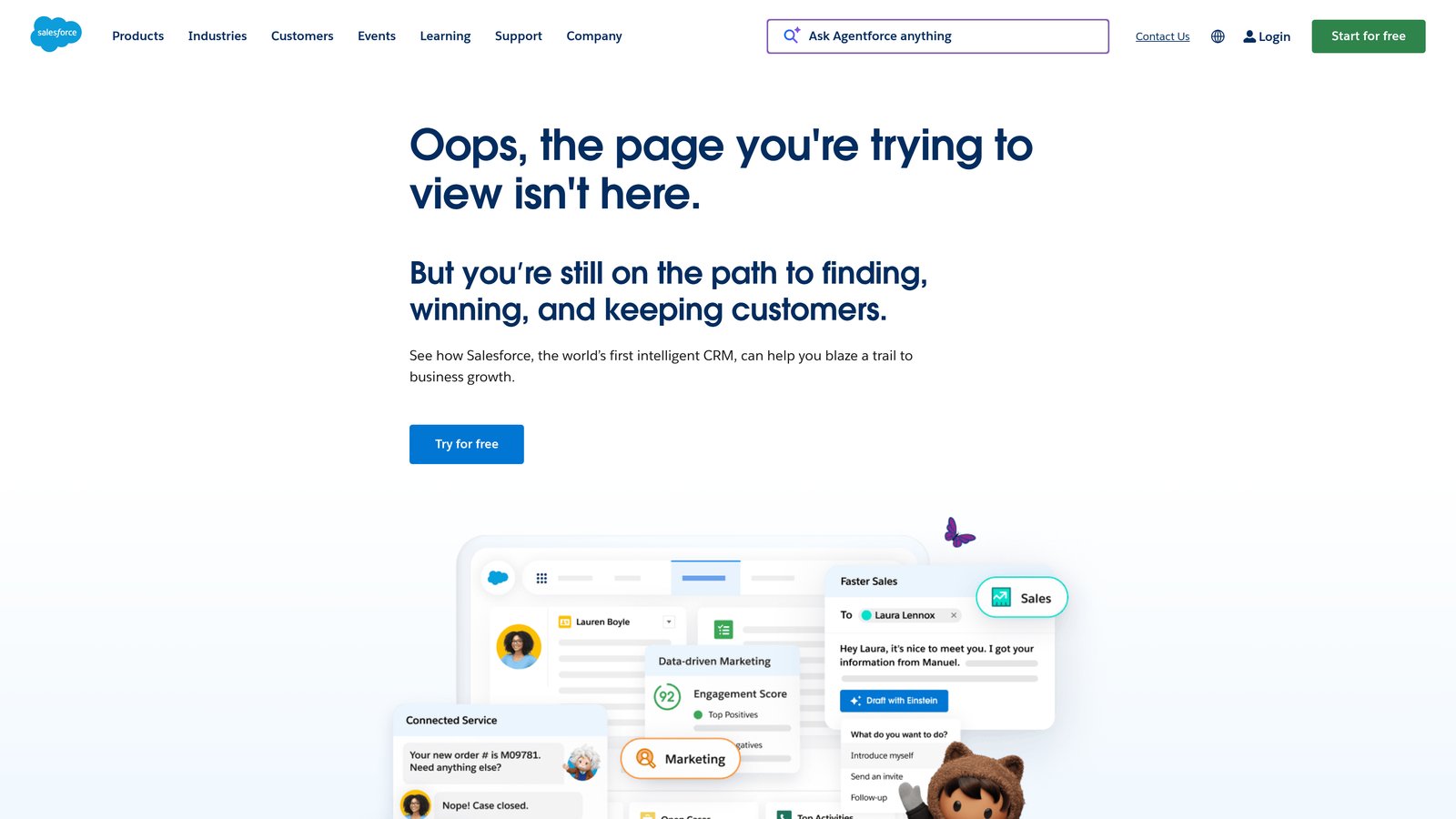
Salesforce Einstein Service Cloud is an AI-powered service platform embedded within the Salesforce ecosystem, using deep CRM data to ground Einstein AI agents and agent assist across the full customer lifecycle.
Where This Tool Shines
The core advantage of Einstein Service Cloud is data depth. Because it sits within Salesforce, AI agents have access to the complete customer record across sales, marketing, and service interactions. A support agent handling an escalation can see the customer's contract value, recent sales activity, and open opportunities without switching systems, and the AI can factor that context into its recommendations.
The Agentforce platform for building custom AI agents is worth attention for enterprise teams with complex, non-standard support workflows. The ability to create purpose-built agents with guardrails gives technical teams significant flexibility while maintaining governance.
Key Features
Einstein AI Agents: Grounded responses drawing from both CRM data and knowledge base content for contextually accurate resolutions.
AI-Powered Case Management: Automated classification, routing, and escalation based on case content and customer data.
Unified Customer Profile: Single view pulling from sales, marketing, and service data across the Salesforce platform.
Einstein Copilot: Real-time recommendations and case summaries for human agents during active interactions.
Agentforce: Custom AI agent builder with configurable guardrails for complex or specialized support workflows.
Best For
Enterprise organizations already running Salesforce as their CRM and business platform, where the value of deep data integration outweighs the premium pricing and implementation complexity.
Pricing
Service Cloud from $25/user/month at entry level; Einstein AI and Agentforce capabilities are available at premium tiers. Total cost at enterprise scale is typically significant.
8. HubSpot Service Hub with Breeze AI
Best for: HubSpot-native teams that want AI support integrated with a unified marketing, sales, and service CRM
HubSpot Service Hub with Breeze AI is a customer service platform natively integrated with HubSpot CRM, offering AI-powered support conversations grounded in full customer journey data from across the HubSpot ecosystem.
Where This Tool Shines
For teams already using HubSpot for marketing and sales, Service Hub's native integration eliminates the data silos that typically exist between support and the rest of the customer journey. Breeze AI agents have access to contact history, deal stage, and marketing engagement data when handling support conversations, which enables more contextually relevant responses without custom integrations.
The knowledge base with AI-powered article suggestions and gap analysis is a practical feature that often goes underappreciated. The system identifies where your knowledge base has coverage gaps based on actual support queries, which helps teams proactively build self-service content rather than reacting to ticket volume.
Key Features
Breeze AI Agent: Automated customer-facing support conversations powered by unified HubSpot CRM data.
Native CRM Integration: Full customer journey context including marketing, sales, and service history available to AI agents.
AI-Powered Knowledge Base: Article suggestions and gap analysis based on actual support query patterns.
Unified Platform: Ticketing, live chat, and customer portal in one interface connected to the broader HubSpot suite.
Cross-Functional Reporting: Visibility across marketing, sales, and service for a complete view of customer experience.
Best For
Teams already on HubSpot for marketing and sales who want to extend that platform into support without adding a separate tool, and who value the unified customer data model over specialized AI capabilities.
Pricing
Free tools available; Service Hub Starter from $20/month/seat; Professional tier from $100/month/seat where more advanced AI features become available.
9. Forethought
Best for: Teams that want to add intelligent AI resolution and triage on top of an existing helpdesk without migrating platforms
Forethought is an AI middleware platform designed to sit on top of existing helpdesks, adding autonomous resolution, intelligent triage, and agent assist without requiring teams to replace their current support infrastructure.
Where This Tool Shines
Forethought's positioning as a middleware layer is its defining characteristic. Rather than asking teams to migrate away from Zendesk, Salesforce, or Freshdesk, Forethought enhances those platforms with AI capabilities that the native tools may not provide at the same depth. This is particularly appealing for teams with significant workflow investment in their current helpdesk.
The Discover module deserves specific mention. It analyzes ticket data to identify automation opportunities, essentially telling you where AI can have the highest impact before you've built anything. For teams trying to build a business case for AI investment, that kind of data-driven prioritization is genuinely useful.
Key Features
Solve AI Agent: Autonomous ticket resolution across channels without requiring human intervention for routine queries.
Triage AI: Intelligent ticket classification and priority routing to ensure tickets reach the right team or agent.
Assist AI Copilot: Suggested responses and knowledge retrieval for human agents handling escalated or complex tickets.
Helpdesk Compatibility: Works as an AI layer on top of Zendesk, Salesforce, Freshdesk, and other major platforms.
Discover Module: Analyzes existing ticket data to identify where automation will have the highest impact.
Best For
Mid-market and enterprise teams with existing helpdesk investments they want to preserve, who need to add AI resolution and triage capabilities without a full platform migration.
Pricing
Custom pricing based on ticket volume and the specific modules selected; typically positioned at mid-market and above. Request a quote based on your current ticket volume.
Which Platform Is Right for Your Team?
The right choice depends less on feature lists and more on where your team sits architecturally. Here's a practical breakdown by use case.
If you want a truly AI-native platform with page-aware context, business intelligence, and deep integrations across your entire stack, Halo AI is built for exactly that. It's particularly strong for B2B SaaS teams that need their support AI to understand the product, the customer's business context, and the engineering workflow simultaneously.
For enterprise teams already deeply invested in Zendesk or Salesforce, the path of least resistance is enhancing those platforms with their native AI capabilities or layering Forethought on top. The migration cost of switching away from mature, workflow-embedded platforms is real, and shouldn't be underestimated.
If your team runs on HubSpot across marketing, sales, and service, Service Hub with Breeze AI gives you unified customer data without additional integration complexity. The trade-off is that it's optimized for HubSpot-native teams rather than teams with diverse stacks.
For product-led SaaS companies focused on in-app engagement alongside support, Intercom Fin remains a strong choice. For mid-market teams with budget constraints, Freshdesk Freddy AI offers solid capability at accessible pricing. And for teams with high-volume multilingual support needs, Ada's single-agent multilingual architecture solves a problem that many other platforms handle awkwardly.
The broader trend worth noting: the market is moving decisively toward per-resolution and usage-based pricing rather than per-seat models. That shift changes the economics of AI support significantly, especially for teams with high ticket volumes and strong AI resolution rates.
Your support team shouldn't scale linearly with your customer base. Let AI agents handle routine tickets, guide users through your product, and surface business intelligence while your team focuses on complex issues that need a human touch. See Halo in action and discover how continuous learning transforms every interaction into smarter, faster support.