9 Best AI Customer Service Software for B2B Teams in 2026
This guide reviews the 9 best AI customer service software for B2B teams in 2026, evaluating platforms specifically designed to handle complex enterprise support needs like multi-stakeholder accounts, SLA obligations, and deep tech stack integrations. Each tool is assessed on B2B-critical criteria including ticket resolution intelligence, escalation handling, and account health insights—helping teams choose a solution that protects renewals and scales with enterprise expectations.
 Matt PattoliFounder11 min read
B2B support is a different beast entirely. Your customers are power users with technical questions, your tickets carry SLA obligations, and a single bad support experience can cost you a renewal worth tens of thousands of dollars. Generic chatbots built for e-commerce FAQs simply don't hold up when you're managing multi-stakeholder accounts, complex integrations, and enterprise expectations.
The good news: a new generation of AI customer service software is purpose-built for this complexity. These platforms go beyond deflection. They resolve tickets autonomously, surface account health signals, integrate with your entire tech stack, and hand off to human agents without losing context.
Below are the top AI customer service tools for B2B teams in 2026. Each has been evaluated on B2B-specific criteria: integration depth, ticket handling intelligence, escalation handling, and business insight capabilities.
1. Halo AI
Best for: B2B SaaS product teams wanting AI-first architecture with business intelligence built in.
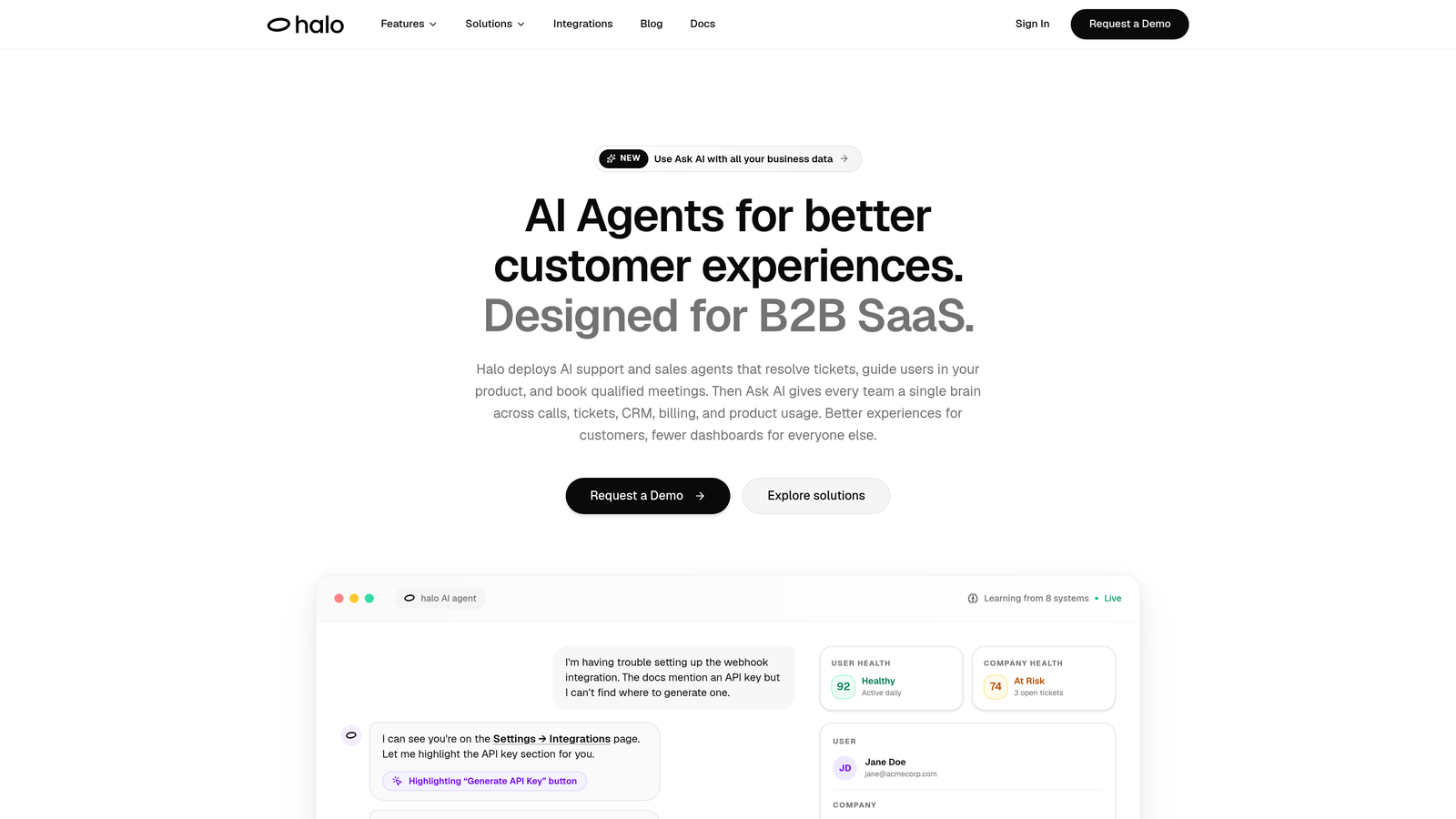
Halo AI is an AI-first customer support platform built specifically for B2B SaaS teams, deploying autonomous agents that resolve tickets, guide users through your product, and surface business intelligence signals.
Where This Tool Shines
What separates Halo from every other tool on this list is its architecture. It wasn't built as a chatbot layer bolted onto a legacy helpdesk. It was designed from the ground up as an AI agent platform, which means the intelligence is structural, not cosmetic.
The page-aware context capability is particularly compelling for SaaS teams. Halo's chat widget sees the exact UI state a user is on, so the AI agent isn't guessing what the user is looking at. It knows. That changes the quality of guidance it can provide, turning reactive support into proactive product assistance.
Key Features
Page-Aware AI Agents: The agent sees the exact page and UI state the user is on, enabling precise, contextual guidance rather than generic answers.
Smart Inbox with Business Intelligence: Goes beyond ticket management to surface customer health scores, revenue intelligence signals, and anomaly detection directly in the support workflow.
Auto Bug Ticket Creation: Automatically generates bug reports from support conversations and routes them to Linear or your engineering workflow, closing the loop between support and product.
Live Agent Handoff: Escalates to human agents with full conversation context preserved, so no customer ever has to repeat themselves.
Deep Integration Stack: Native connections to Linear, Slack, HubSpot, Intercom, Stripe, Zoom, PandaDoc, and Fathom, covering the full B2B SaaS toolchain.
Continuous Learning: Every resolved interaction improves the model, meaning the system gets measurably smarter over time without manual retraining.
Best For
Product-led SaaS companies scaling support without scaling headcount. Particularly strong for teams where support, product, and revenue workflows intersect and where surfacing customer health signals from support data has strategic value.
Pricing
Contact for pricing. Halo is enterprise-oriented with no public pricing listed. Visit haloagents.ai to request a demo.
2. Intercom (Fin AI Agent)
Best for: Teams already embedded in the Intercom ecosystem wanting native AI resolution.
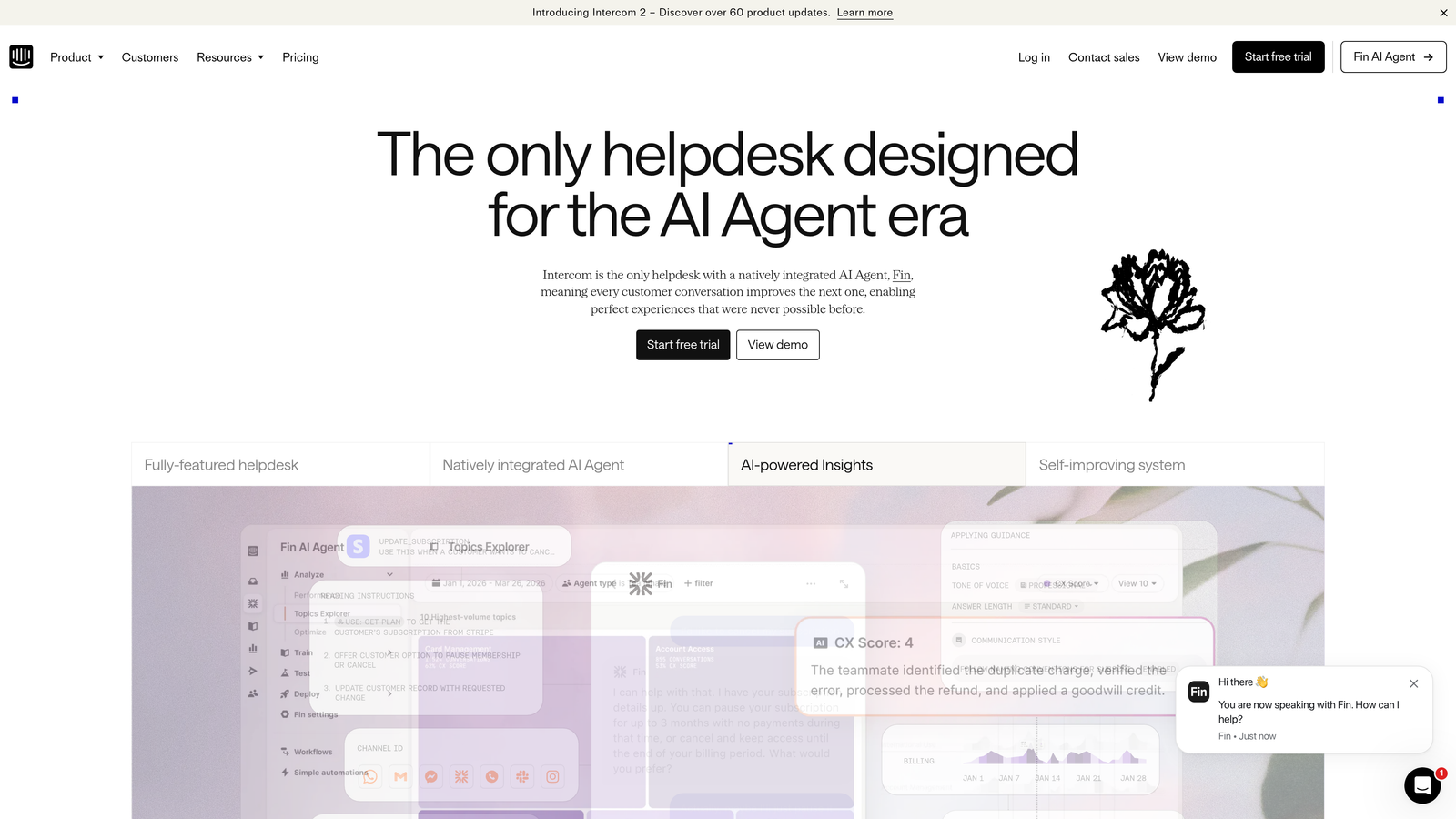
Intercom's Fin AI agent handles multi-step support resolutions within the Intercom messenger ecosystem, drawing on conversation history and CRM context to resolve tickets without human intervention.
Where This Tool Shines
Fin has matured significantly since its 2023 launch. It now handles genuinely complex, multi-step resolutions rather than simple FAQ deflection, and it does so within the same Intercom interface your team already uses. For teams with an existing Intercom investment, the path to AI-powered resolution is relatively frictionless.
The integration between Fin and Intercom's CRM means every AI interaction has access to conversation history, customer attributes, and prior support context. That account awareness makes resolutions more accurate and reduces the back-and-forth that frustrates B2B users.
Key Features
Fin AI Agent: Autonomous ticket resolution with multi-step handling, moving beyond simple knowledge base deflection.
CRM and Conversation History Integration: Full access to Intercom's customer data layer, including prior interactions and account attributes.
Seamless Human Handoff: Escalates to live agents within the same Intercom interface, preserving conversation context throughout.
Usage-Based AI Pricing: Fin's resolution pricing is tied to volume, which can be cost-effective for teams with moderate ticket loads.
Multi-Step Resolution Logic: Handles workflows that require multiple clarifications or actions, not just single-turn answers.
Best For
B2B SaaS teams already using Intercom as their primary support and messaging platform. Less compelling if you're not already in the Intercom ecosystem, since the value is tightly coupled to existing Intercom data and workflows.
Pricing
Plans from approximately $39 per seat per month. Fin AI resolution carries additional usage-based pricing on top of base plan costs.
3. Zendesk AI
Best for: Large B2B support organizations with existing Zendesk infrastructure and complex routing needs.
Zendesk AI layers autonomous agents, agent copilot functionality, intelligent triage, and QA automation on top of its enterprise-grade helpdesk infrastructure.
Where This Tool Shines
Zendesk's strength is its maturity. The underlying helpdesk infrastructure has been refined over years of enterprise deployments, and the AI suite builds on that foundation. For large B2B teams with complex routing rules, multi-channel support, and strict SLA requirements, Zendesk AI offers a comprehensive solution with minimal disruption to existing workflows.
The Agent Copilot feature is particularly valuable for support teams handling technically complex tickets. Rather than replacing human agents on hard issues, it surfaces relevant context, suggests responses, and helps agents resolve faster without sacrificing quality.
Key Features
AI Agents: Autonomous resolution for common ticket types, reducing volume reaching human agents.
Agent Copilot: Real-time in-context assistance for human agents handling complex tickets, including response drafting and knowledge suggestions.
Intelligent Triage: Automatically classifies, prioritizes, and routes tickets based on intent, sentiment, and account context.
AI-Powered QA: Automated conversation scoring and quality assurance across the full support operation.
Advanced Workflow Automation: Handles complex B2B ticket routing logic across multiple channels and teams.
Best For
Enterprise B2B support organizations with established Zendesk deployments that want to layer AI capabilities without migrating platforms. Teams with dedicated support ops resources to configure and maintain the AI workflows will get the most value.
Pricing
Suite Team plans start at approximately $55 per agent per month. Advanced AI capabilities are available as an add-on at additional cost.
4. Freshdesk Freddy AI
Best for: Growing B2B teams that need capable AI support without enterprise helpdesk pricing.
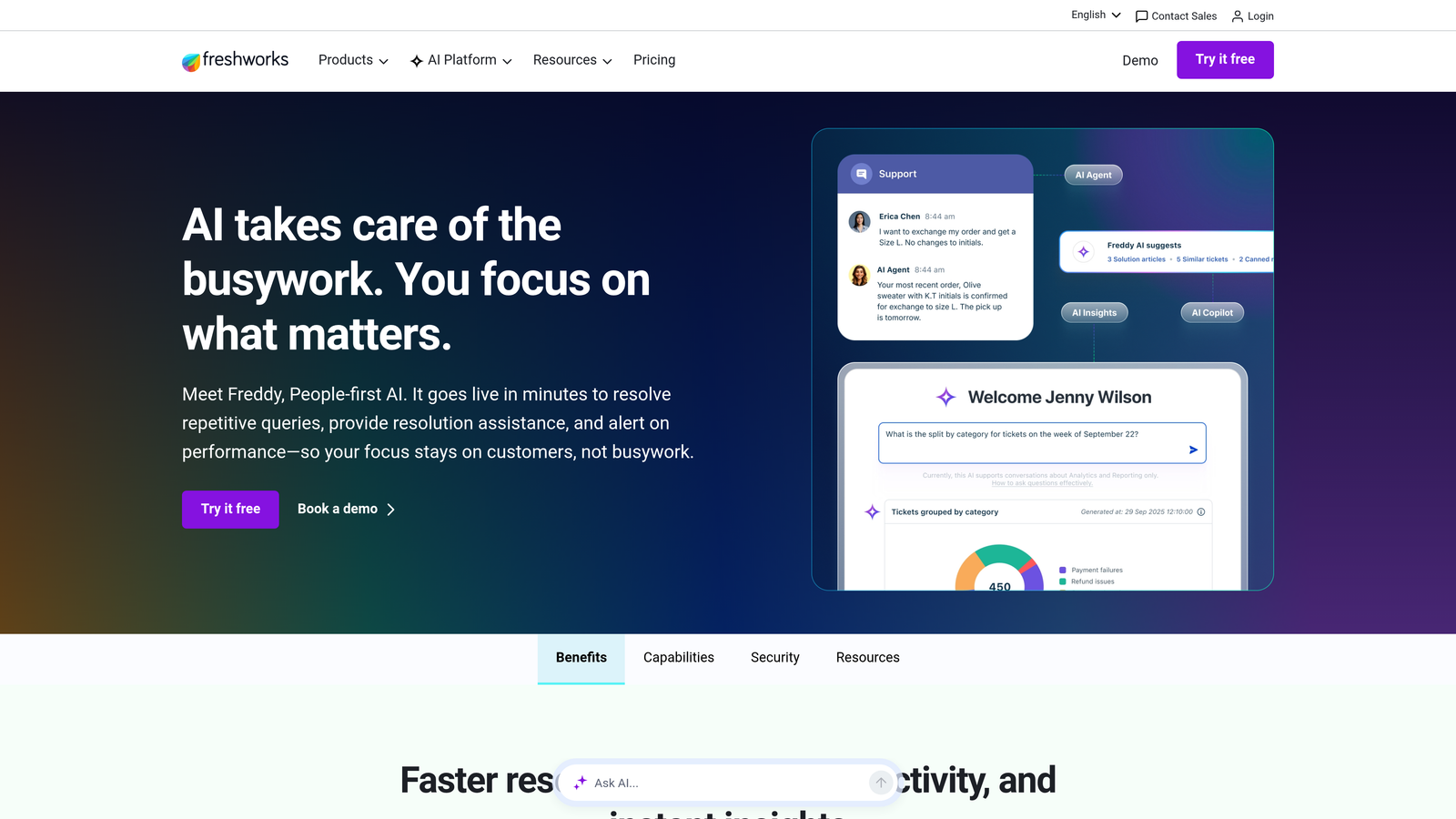
Freshdesk Freddy AI brings self-service bots, agent copilot functionality, and analytics intelligence to Freshdesk at price points accessible to mid-market B2B teams.
Where This Tool Shines
Freshdesk Freddy's primary advantage is its value-to-cost ratio. For teams that can't justify Zendesk or Salesforce pricing but still need AI-powered support automation, Freddy covers the essential use cases at a fraction of the cost. The tiered pricing model also means you can start simple and expand AI capabilities as your team grows.
The three-layer approach, covering self-service resolution, agent assist, and analytics intelligence, gives B2B teams a reasonably complete AI stack without requiring multiple vendors. Freddy Insights in particular helps support managers spot trends and identify systemic issues before they escalate.
Key Features
Freddy Self Service: Customer-facing AI bot for autonomous resolution, handling common queries without agent involvement.
Freddy Copilot: In-context suggestions, response drafts, and knowledge recommendations for human agents during live tickets.
Freddy Insights: Support analytics and trend detection to surface patterns across ticket volume, sentiment, and resolution performance.
Affordable Tiered Pricing: Free entry plan available, with AI features scaling across Growth and higher tiers.
Integration Ecosystem: Solid connectivity with mid-market B2B stacks including CRM, billing, and project management tools.
Best For
SMB to mid-market B2B teams that need AI support capabilities without enterprise-level investment. Also a strong option for teams currently on Freshdesk who want to expand AI features within the existing platform.
Pricing
Free tier available. Growth plans start at approximately $15 per agent per month. AI-specific features are available on higher tiers.
5. Salesforce Agentforce (Service Cloud)
Best for: Enterprise B2B organizations where Salesforce is the system of record for accounts and contracts.
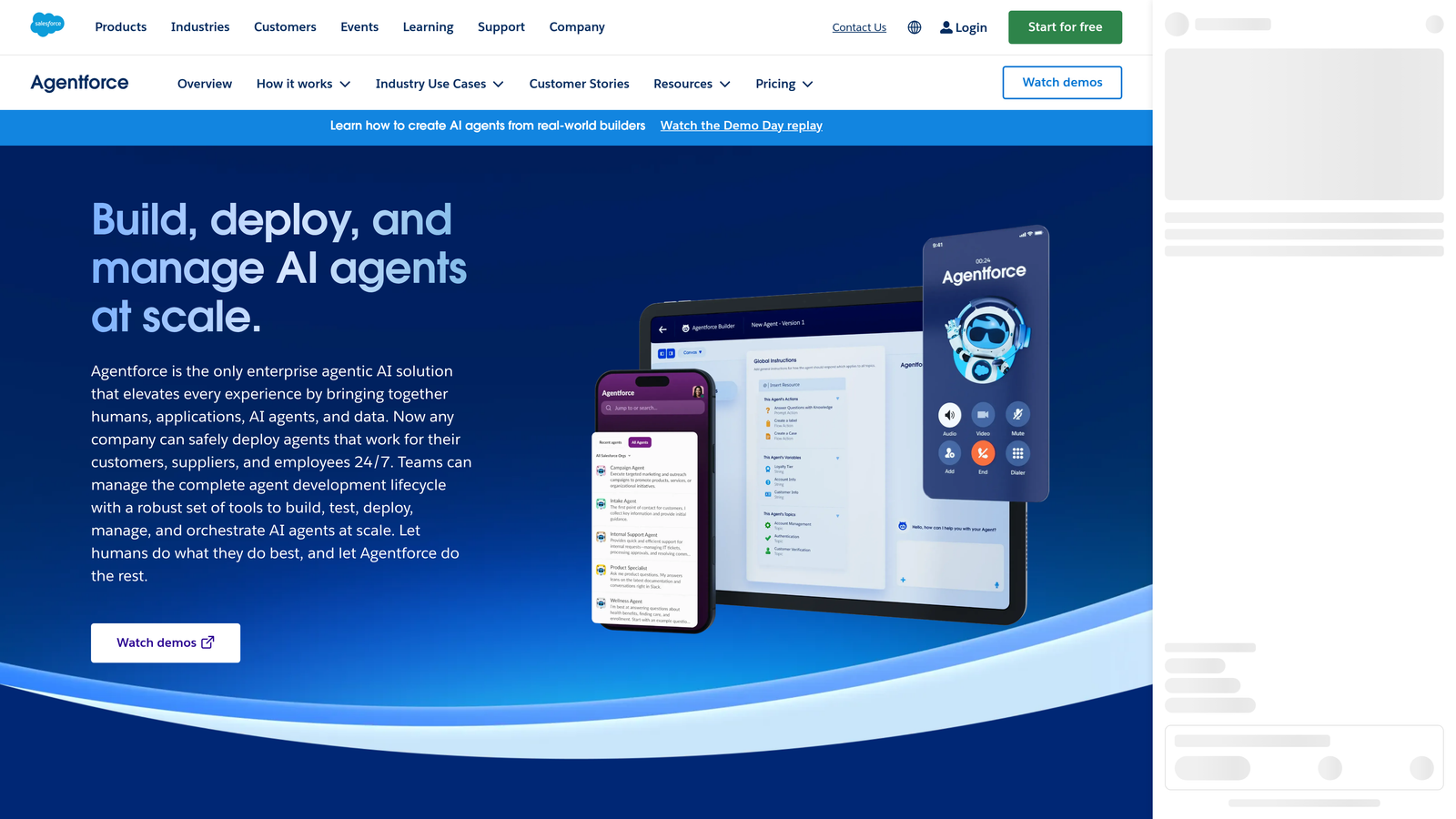
Salesforce Agentforce brings autonomous AI agents to Service Cloud, giving enterprise B2B teams AI-powered support with full CRM context informing every interaction.
Where This Tool Shines
The core differentiator here is data depth. When Salesforce is your CRM, every account, contract, interaction history, and renewal date lives in one place. Agentforce taps into that entire data layer, which means AI interactions are informed by the full account picture rather than just recent support tickets. For enterprise B2B teams, that context is the difference between generic responses and genuinely useful ones.
Agentforce represents Salesforce's most significant move toward autonomous AI agents, building on the earlier Einstein suite with more proactive, multi-step resolution capabilities. For organizations already running Service Cloud, it's a natural evolution rather than a platform change.
Key Features
Agentforce Autonomous Agents: AI agents with full Salesforce CRM context, enabling account-aware resolution and prioritization.
Einstein Case Classification: Intelligent routing that considers account tier, contract status, and issue type when assigning tickets.
AI Article Recommendations: Surfaces relevant knowledge base content for agents during live ticket handling.
Native Cross-Cloud Integration: Works across Sales Cloud, Service Cloud, and Data Cloud for a unified view of each account.
Enterprise Compliance Controls: Security, governance, and compliance features suited for regulated industries and large enterprise deployments.
Best For
Large enterprises where Salesforce is the central system of record and where support context needs to be deeply connected to account, contract, and revenue data. In-house Salesforce expertise is strongly recommended to get full value from the implementation.
Pricing
Service Cloud Starter plans begin at approximately $25 per user per month. AI features including Agentforce are available on Enterprise and higher tiers.
6. Drift by Salesloft
Best for: B2B revenue teams where support conversations and pipeline development overlap in a single workflow.
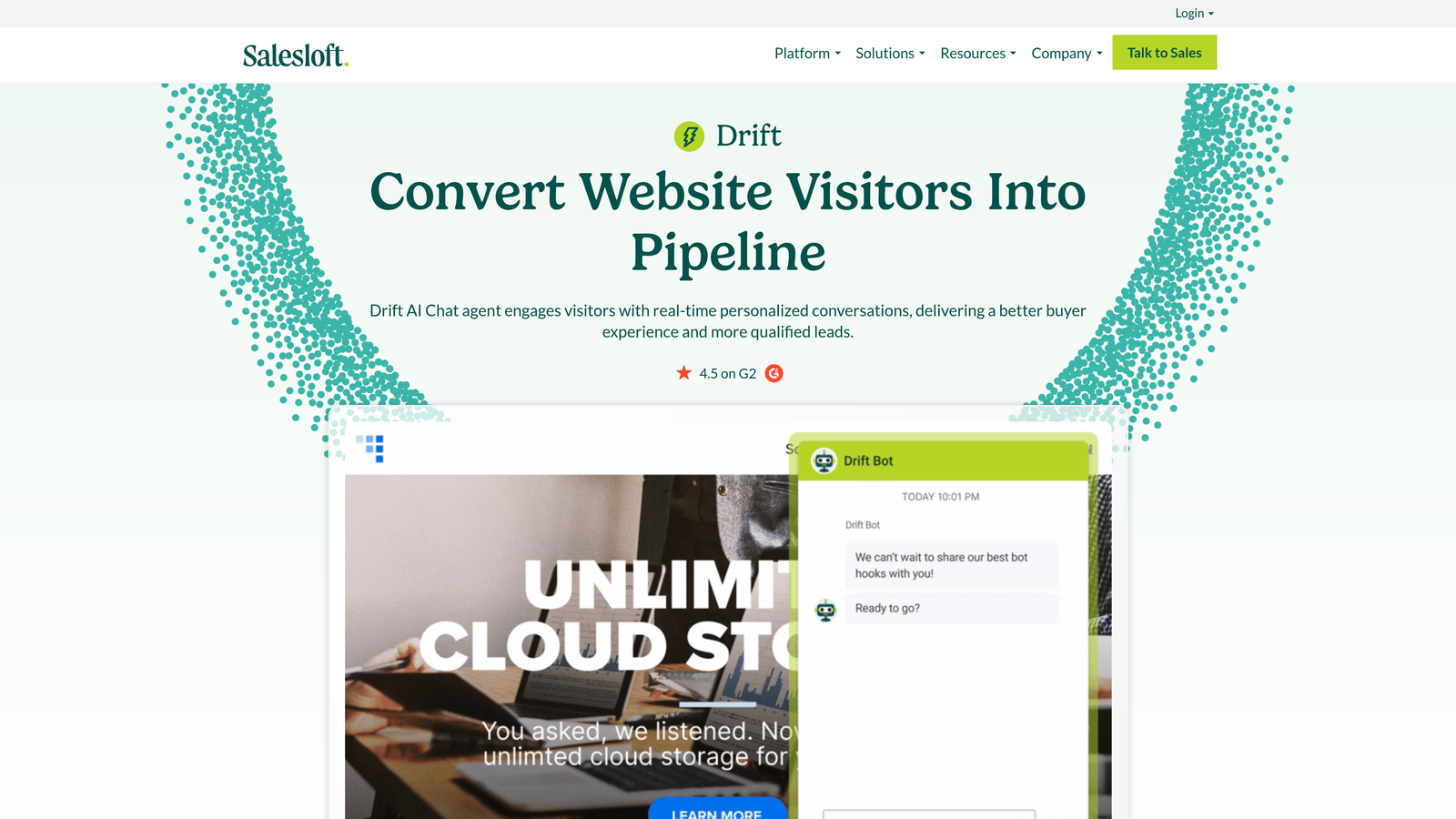
Drift, now part of the Salesloft revenue platform, handles B2B support and account engagement in one conversational AI interface.
Where This Tool Shines
Drift occupies a unique position in this list: it's not purely a support tool. Since its acquisition by Salesloft, Drift has become part of a broader revenue platform where support, sales, and account management workflows converge. For B2B teams where a support conversation can easily become a renewal discussion or an upsell opportunity, that convergence is genuinely valuable.
The account-based targeting capabilities allow teams to personalize conversations based on company size, tier, or pipeline stage. That level of contextual routing is difficult to replicate with pure-play support tools and makes Drift a strong fit for revenue-focused support teams.
Key Features
Conversational AI for Support and Sales: Handles both support resolution and revenue engagement in a single platform, eliminating handoff friction between teams.
AI-Powered Routing and Qualification: Intelligently routes conversations across support and revenue workflows based on visitor and account context.
Salesloft Revenue Platform Integration: Full pipeline and account context available within support conversations.
Real-Time Chat with Bot-to-Human Handoff: Smooth escalation from AI to live agent or account executive when conversations require a human touch.
Account-Based Targeting: Personalizes conversations based on company attributes, enabling differentiated experiences for strategic accounts.
Best For
B2B teams where support and revenue workflows are closely connected, particularly those already using Salesloft for sales engagement. Less suited for teams that want a dedicated, pure-play support platform.
Pricing
Enterprise pricing. No public pricing listed; contact Salesloft for a quote.
7. Tidio Lyro AI
Best for: Early-stage and smaller B2B teams that need fast deployment and affordable AI support.
Tidio Lyro AI is powered by Anthropic's Claude and offers autonomous conversation handling at a price point that makes AI support genuinely accessible for teams earlier in their growth curve.
Where This Tool Shines
Lyro's biggest advantage is speed to value. While enterprise platforms can take weeks or months to fully configure and deploy, Lyro is typically operational in hours. For a small B2B team drowning in repetitive support tickets and without the resources for a long implementation cycle, that matters.
The Claude foundation gives Lyro strong conversational quality out of the box. It handles nuanced questions more naturally than many rule-based or older-generation bots, which helps with the B2B expectation of thoughtful, accurate responses rather than scripted deflection.
Key Features
Claude-Powered Conversations: Anthropic's Claude model provides natural, contextually aware conversation handling with strong language quality.
Fast Deployment: Typically configured and live in hours, not weeks, using existing knowledge base content as the foundation.
Autonomous Knowledge Base Resolution: Resolves common questions directly from your documentation without manual rule-building.
Live Chat Fallback: Smooth handoff to human agents when conversations exceed the AI's resolution capability.
Conversation-Based Pricing: Scales with usage volume rather than per-seat, which can be cost-effective for smaller teams with moderate ticket loads.
Best For
Startups and small B2B teams that need to implement AI support quickly and affordably. Not the right fit for enterprise teams with complex routing requirements, deep integration needs, or high ticket volume across multiple channels.
Pricing
Free tier available. Lyro AI starts at approximately $29 per month for small conversation volumes, scaling with usage.
Which Tool Is Right for Your B2B Team?
The honest answer is that the best tool depends on where you are in your growth trajectory and what your existing stack looks like.
If you're a product-led SaaS company that wants AI-first architecture, business intelligence signals from support data, and deep integration with your product and revenue tools, Halo AI is the only platform on this list built that way from the ground up. It's not a chatbot layer on a legacy helpdesk. It's an AI agent platform designed for exactly the complexity B2B SaaS teams deal with every day.
If you're deeply embedded in Intercom or Zendesk, their native AI layers are the path of least resistance. You'll get meaningful AI capabilities without migrating platforms, and the integration with your existing data is already handled. Freshdesk Freddy follows the same logic for teams on the Freshworks stack, with the added benefit of more accessible pricing for growing teams.
Enterprise organizations where Salesforce is the system of record should evaluate Agentforce seriously. The CRM context advantage is real, and for large accounts where every interaction needs to be informed by contract status, tier, and account history, that depth is hard to replicate elsewhere.
Teams where support and revenue workflows intersect will find Drift's positioning within the Salesloft platform genuinely useful. And for early-stage teams that need to move fast without a long implementation cycle or significant budget, Tidio Lyro offers a credible starting point.
The most important question isn't which tool has the most features. It's which platform will actually resolve tickets autonomously, get smarter over time, and fit into the workflow your team already runs. Look for continuous learning, deep integration with your existing stack, and clear escalation paths to human agents when tickets genuinely need a human.
Your support team shouldn't scale linearly with your customer base. AI agents should handle routine tickets, guide users through your product, and surface business intelligence while your team focuses on the complex issues that need a human touch. See Halo in action and discover how continuous learning transforms every interaction into smarter, faster support.