9 Best AI Customer Service Tools for Enterprises in 2026
Enterprise support teams need more than lightweight chatbots — they need AI customer service tools for enterprises built to handle thousands of tickets, complex integrations, and strict compliance requirements at scale. This guide evaluates 9 leading platforms on enterprise-readiness criteria so you can find the right fit for your organization in 2026.
 Matt PattoliFounder13 min read
Enterprise support teams face a different kind of pressure than small businesses. You're managing thousands of tickets across multiple channels, coordinating large agent teams, and trying to maintain quality at scale — all while leadership wants efficiency gains without ballooning headcount.
AI customer service tools have matured significantly, but not all of them are built for enterprise complexity. Some are lightweight chat widgets dressed up as enterprise solutions. Others require months of implementation before delivering any value.
This list cuts through the noise. We evaluated tools based on enterprise-readiness: integration depth, security and compliance posture, scalability, analytics sophistication, and how well the AI actually performs on real support workloads. Here are the best AI customer service tools enterprises are deploying in 2026.
1. Halo AI
Best for: SaaS and B2B companies wanting AI-first autonomous support with business intelligence built in
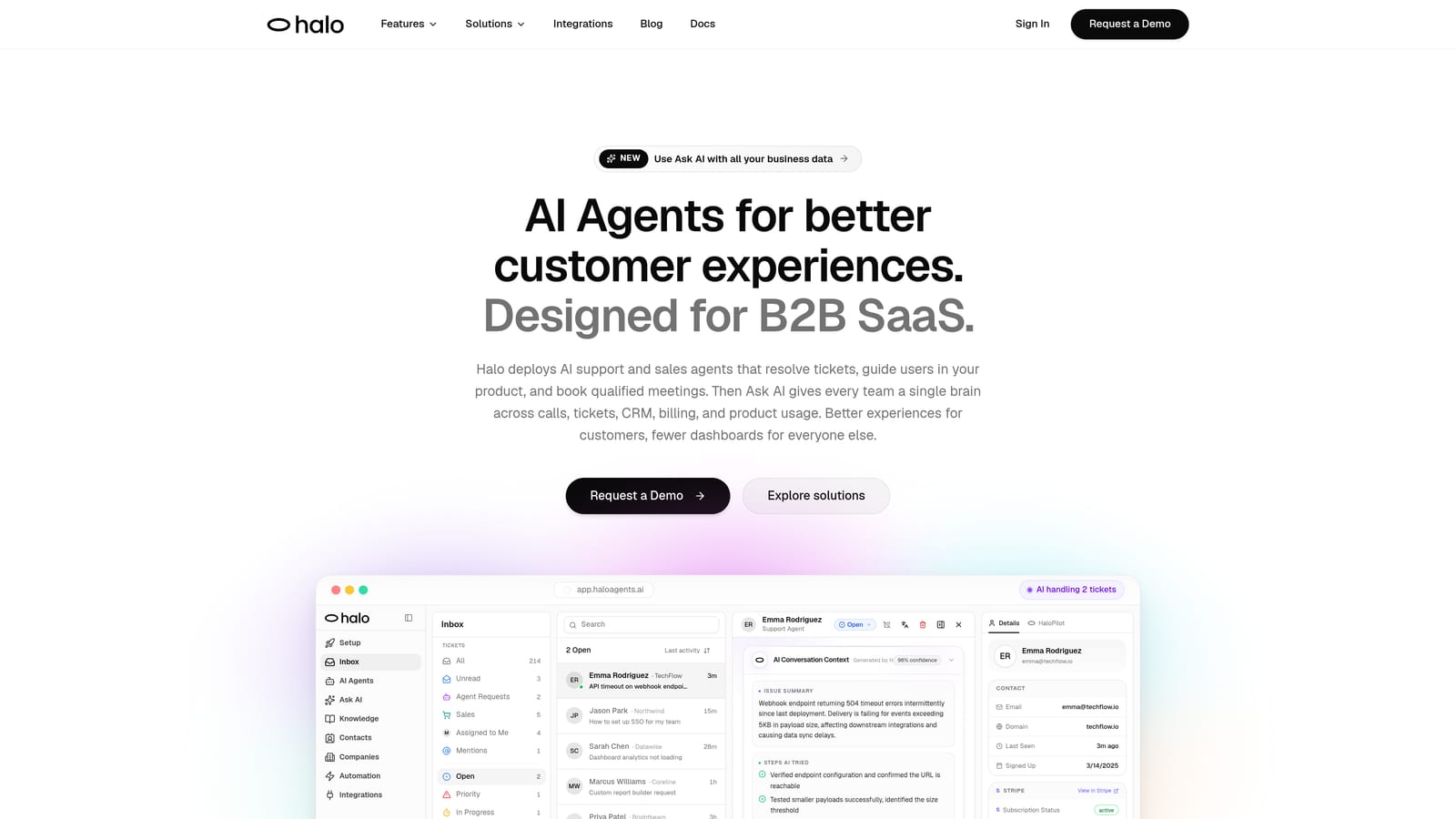
Halo AI is an AI-first customer support platform that deploys autonomous agents to resolve tickets, guide users through your product, and surface business intelligence signals from every interaction.
Where This Tool Shines
Most enterprise tools add AI on top of an existing helpdesk. Halo was built AI-first, which means the architecture is designed around autonomous resolution rather than ticket management with AI features bolted on. That distinction matters when you're evaluating long-term scalability.
The page-aware context engine is a genuine differentiator for SaaS companies. Halo's AI agents can see what users are looking at inside your product and provide visual UI guidance in context, rather than generic help content. Pair that with auto bug ticket creation routed directly to Linear or your engineering tool of choice, and you have a support layer that actually closes the loop between customer issues and product fixes.
Key Features
Page-Aware AI Agents: The AI sees what users see in-product and delivers contextual visual UI guidance, not just static help articles.
Autonomous Ticket Resolution: Handles tier-1 tickets end-to-end with intelligent escalation to live agents when complexity warrants human judgment.
Auto Bug Ticket Creation: Detects product issues from support interactions and automatically creates bug reports routed to Linear or preferred engineering tools.
Smart Inbox with Business Intelligence: Goes beyond CSAT to surface customer health signals, revenue anomalies, and churn indicators from support data.
Deep Business Stack Integrations: Connects to Slack, HubSpot, Intercom, Stripe, Zoom, PandaDoc, and Fathom — not just your helpdesk.
Continuous Learning Architecture: Improves resolution quality with every interaction without requiring manual retraining cycles.
Best For
SaaS companies and B2B product teams that want AI agents handling support autonomously, not just assisting human agents. Particularly strong for teams that need support data to feed back into product development and customer success workflows.
Pricing
Contact for pricing; enterprise plans available. Reach out via haloagents.ai for a demo and custom quote.
2. Salesforce Einstein Service Cloud
Best for: Enterprises already running Sales Cloud and Service Cloud who want AI embedded in their existing Salesforce workflows
Salesforce Einstein Service Cloud is AI-powered customer service embedded within Salesforce's Service Cloud, covering case classification, agent recommendations, and self-service automation.
Where This Tool Shines
If your enterprise is already running Salesforce across sales, marketing, and service, Einstein's AI capabilities are the path of least resistance. The native integration means AI has access to the full customer record: purchase history, open opportunities, prior cases, and marketing interactions — context that most standalone tools have to work hard to replicate.
Einstein Bots handle self-service deflection, while Next-Best-Action surfaces recommendations for human agents during live interactions. The strength here is the ecosystem depth, not just the AI layer itself.
Key Features
Einstein AI Case Classification: Automatically categorizes and routes incoming cases based on content and historical patterns.
Next-Best-Action Recommendations: Surfaces contextual guidance for agents during live customer interactions.
Einstein Bots: Self-service automation for common queries, with handoff to human agents when needed.
Omni-Channel Routing: Distributes work across voice, chat, email, and social based on agent skills and availability.
Native Sales and Marketing Cloud Integration: AI operates with full visibility into the customer relationship across departments.
Best For
Large enterprises with Salesforce as their core CRM and business platform. Less compelling as a standalone choice if you're not already invested in the Salesforce ecosystem, given the implementation complexity and cost.
Pricing
Enterprise pricing; contact Salesforce for quotes. Implementation costs can be substantial depending on configuration requirements.
3. Zendesk AI
Best for: Enterprises already on Zendesk who want to layer AI capabilities onto an established helpdesk infrastructure
Zendesk AI brings intelligent triage, intent detection, automated routing, and an agent copilot to Zendesk's widely adopted helpdesk platform.
Where This Tool Shines
Zendesk has one of the largest enterprise customer bases in the market, and its AI layer benefits from that scale. The intent and sentiment detection has been trained on an enormous volume of real support interactions, which means it tends to perform well out of the box for common support patterns.
The Agent Copilot feature is genuinely useful for large agent teams: suggested replies, next-step guidance, and AI-assisted quality assurance reduce the cognitive load on individual agents and help maintain consistency at scale. If you're running hundreds of agents, those marginal efficiency gains compound quickly.
Key Features
Intelligent Triage: Detects intent, sentiment, and language to route tickets to the right queue automatically.
AI-Powered Ticket Routing: Prioritizes and assigns tickets based on content analysis and agent availability.
Agent Copilot: Provides suggested replies, knowledge base recommendations, and next-step guidance during live interactions.
AI-Powered Bots: Handles self-service resolution for common queries before tickets reach human agents.
AI-Assisted Analytics and QA: Surfaces insights on ticket trends, agent performance, and resolution quality.
Best For
Enterprises already running Zendesk who want to improve efficiency without migrating platforms. Teams evaluating a fresh implementation should compare AI-native alternatives before defaulting to Zendesk's add-on approach.
Pricing
AI capabilities available as an add-on on Suite plans; enterprise pricing available on request.
4. Intercom Fin
Best for: Chat-first support teams that want fast autonomous resolution without extensive AI training
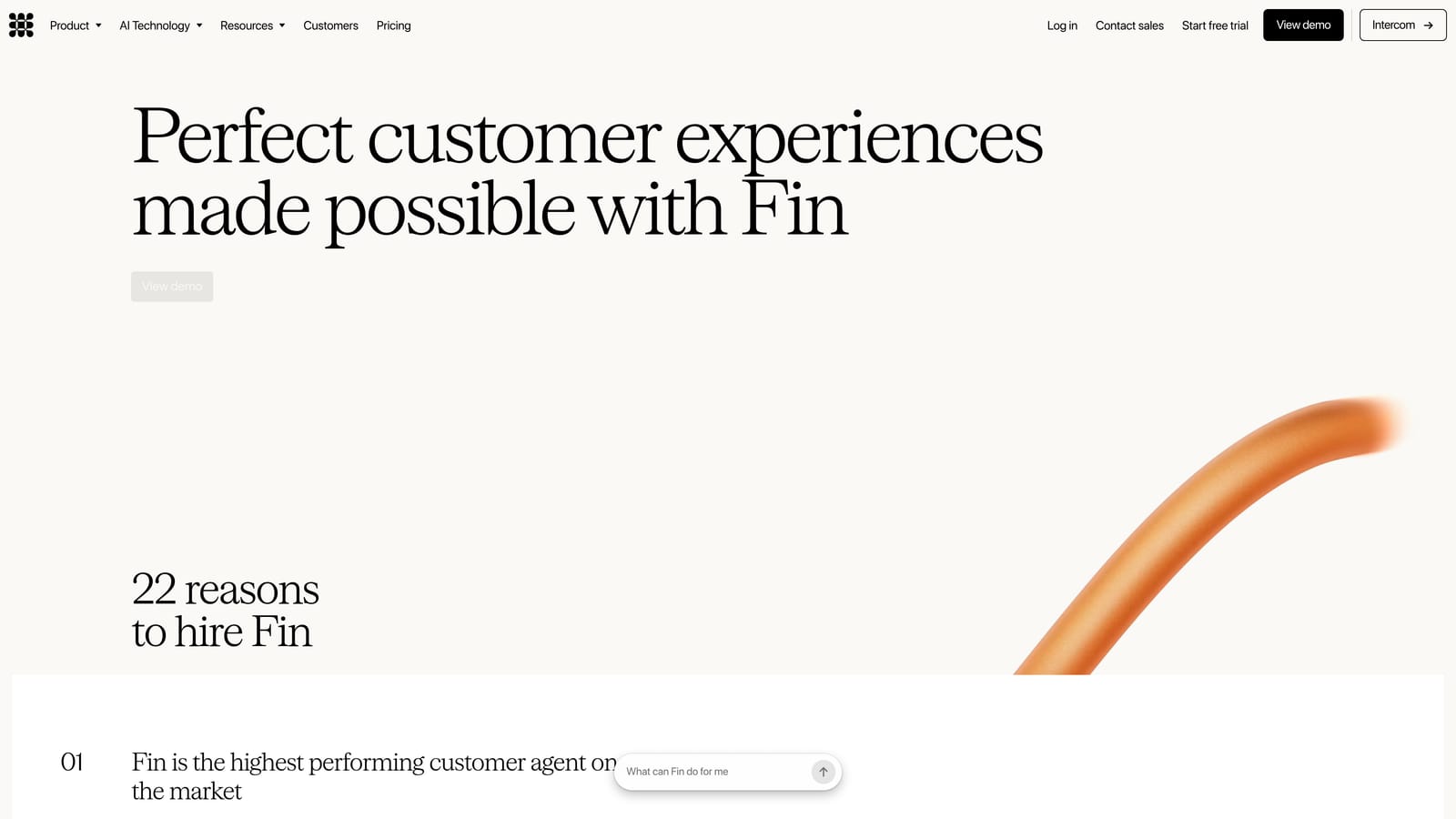
Intercom Fin is Intercom's LLM-powered AI agent that resolves customer queries directly from your existing help content, with no custom model training required.
Where This Tool Shines
Fin's time-to-value is one of its strongest selling points. Because it uses large language models to understand and respond based on your existing help center content, you're not starting from scratch building intent models or training datasets. For enterprises that have invested in comprehensive documentation, Fin can start resolving queries quickly after deployment.
The seamless handoff to human agents is well-implemented. When Fin can't resolve a query, it transfers the conversation with context intact, so agents aren't starting blind. Fin Insights also gives teams visibility into resolution rates and content gaps, which helps continuously improve the self-service layer.
Key Features
LLM-Powered Resolution: Answers queries from existing help center content without requiring custom training or intent mapping.
Seamless Human Handoff: Transfers unresolved conversations to human agents with full context preserved.
Multilingual Support: Handles queries in multiple languages out of the box.
Fin Insights: Analytics on resolution rates, deflection, and help content gaps.
Full Intercom Platform Integration: Operates within Intercom's broader customer messaging and lifecycle platform.
Best For
Enterprises with chat-first support workflows and well-maintained help center content. Strong for product-led growth companies with high inbound query volume. Less suited for teams needing deep telephony or complex back-end system integrations.
Pricing
Usage-based pricing per resolution; contact Intercom for enterprise rates and volume commitments.
5. Freshdesk Freddy AI
Best for: Enterprises running support, IT service management, and CRM on the Freshworks platform
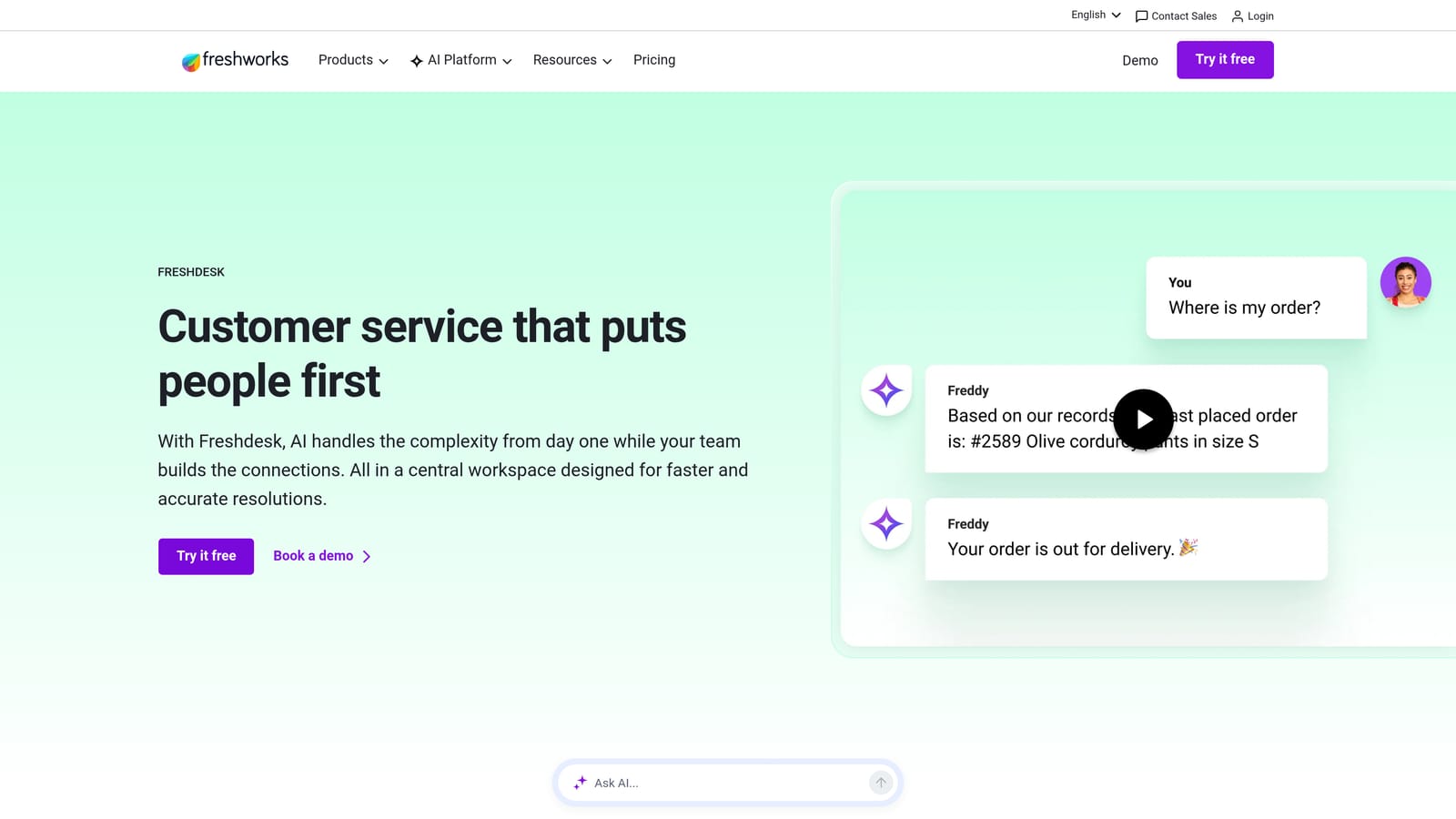
Freshdesk Freddy AI is Freshworks' unified AI layer spanning customer support, IT service management, and CRM — making it a strong fit for enterprises consolidating multiple support functions on one vendor.
Where This Tool Shines
Freddy AI's cross-suite coverage is its primary differentiator. If your enterprise runs Freshdesk for customer support, Freshservice for IT, and Freshsales for CRM, Freddy provides a consistent AI layer across all three rather than requiring separate AI investments for each department. That consolidation can meaningfully simplify vendor management and data sharing.
The no-code bot builder makes it accessible for teams without dedicated AI engineering resources, and Freddy Copilot's agent assistance features — suggested replies, conversation summarization, and tone adjustment — are practical tools that reduce handle time without requiring significant workflow changes.
Key Features
Freddy Copilot: Agent assistance with suggested replies, conversation summarization, and tone adjustment for consistency.
Freddy Self Service: Autonomous resolution for common queries before they reach human agents.
Cross-Suite AI: Consistent AI layer spanning Freshdesk, Freshservice, and Freshsales for multi-department coverage.
AI-Powered Analytics: CSAT prediction, trend detection, and performance insights across the support operation.
No-Code Bot Builder: Custom self-service flows without engineering resources required.
Best For
Enterprises already on the Freshworks platform or actively evaluating it as a consolidated suite. Strong for mid-to-large organizations running customer support and IT service management under the same vendor umbrella.
Pricing
Freddy AI available as an add-on to Freshdesk plans; enterprise pricing available on request.
6. ServiceNow Now Assist
Best for: Large enterprises with complex internal and external support workflows already on the ServiceNow platform
ServiceNow Now Assist embeds generative AI into ServiceNow's enterprise workflow platform, covering case summarization, resolution recommendations, and self-service portals.
Where This Tool Shines
ServiceNow has deep enterprise credibility, particularly in organizations running complex ITSM and customer service workflows on the same platform. Now Assist's generative AI capabilities are designed to work within that workflow context, meaning AI recommendations are aware of the broader process, not just the individual ticket.
The governance and audit trail capabilities are a genuine strength for regulated industries and large enterprises with compliance requirements. Case summarization for agents reduces time spent reading through long interaction histories, which matters when agents are handling high volumes of complex cases.
Key Features
Generative AI Case Summarization: Automatically summarizes case and incident history so agents can get up to speed quickly.
AI Resolution Recommendations: Surfaces relevant knowledge and resolution steps based on case context.
Now Assist for Self-Service: AI-powered self-service portals for both external customers and internal employees.
Workflow Platform Integration: AI operates within ServiceNow's broader workflow automation and process management capabilities.
Governance and Audit Trails: Strong controls for compliance-driven enterprises needing visibility into AI-assisted decisions.
Best For
Large enterprises already invested in ServiceNow for ITSM or customer service management. The implementation investment is significant, so it's best suited for organizations where ServiceNow is already a strategic platform rather than a net-new deployment.
Pricing
Enterprise licensing; contact ServiceNow for pricing. Implementation costs vary significantly based on configuration complexity.
7. Kustomer AI
Best for: High-volume B2C enterprises that need AI operating with full customer context across every channel
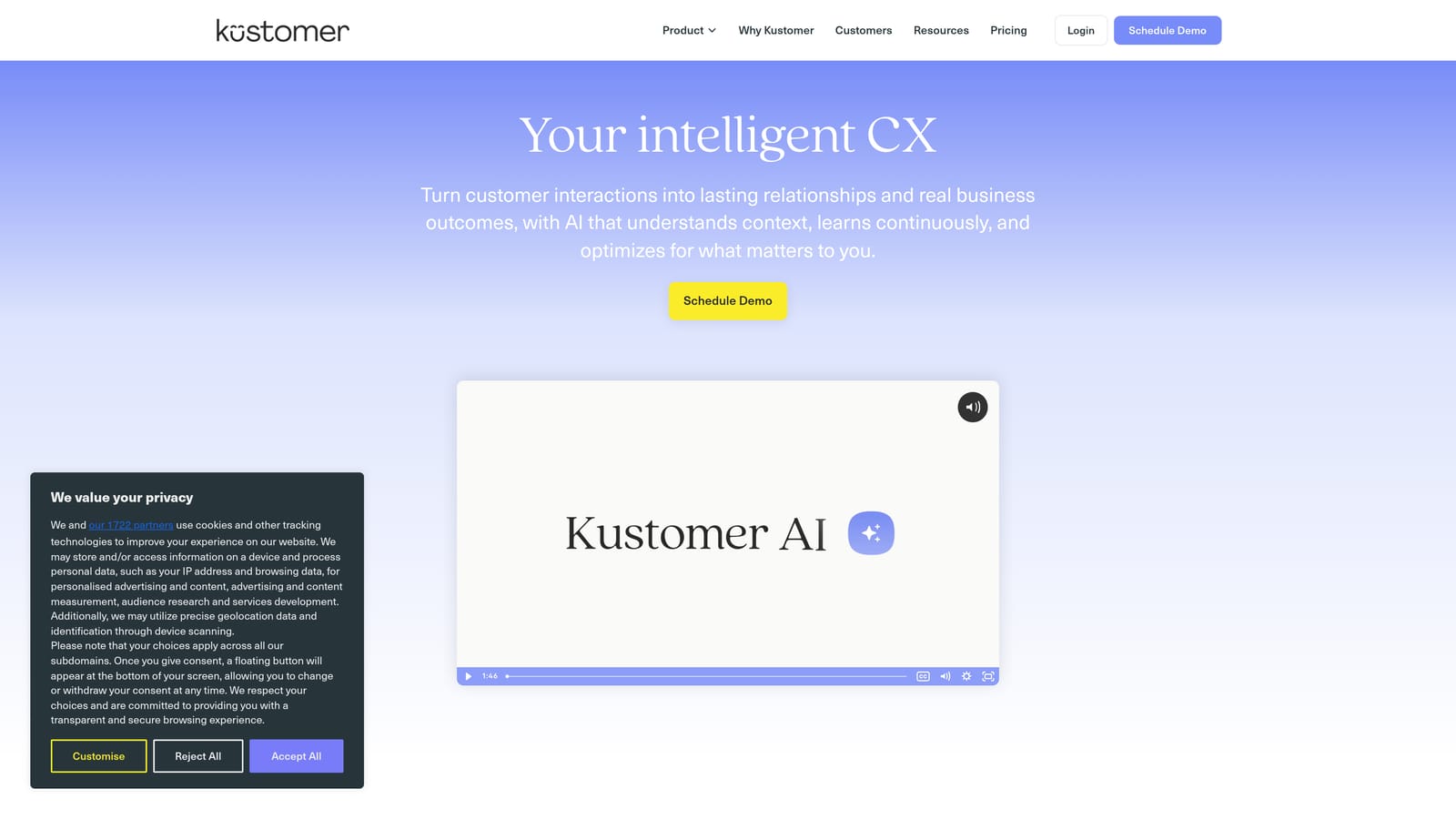
Kustomer AI is built into a CRM-native customer service platform where AI operates with complete customer context — order history, prior conversations, sentiment — across every support channel.
Where This Tool Shines
Kustomer's CRM-native architecture means AI doesn't have to fetch context from external systems — it's already there. When an AI agent or human agent picks up a conversation, they see the customer's full history: what they've purchased, what issues they've had before, their lifetime value, and their current sentiment. That context leads to more relevant, personalized responses.
The omnichannel coverage is strong, spanning chat, email, voice, SMS, and social within a unified conversation view. For high-volume B2C operations where customers might contact you across multiple channels about the same issue, the unified timeline prevents the frustrating experience of customers having to repeat themselves.
Key Features
CRM-Native AI Context: AI operates with full customer history including purchase data, prior interactions, and lifetime value.
Omnichannel Coverage: Unified conversation view across chat, email, voice, SMS, and social channels.
Intelligent Routing: Routes conversations based on customer context, issue type, and agent skills simultaneously.
AI Conversation Summarization: Automatically summarizes long conversation threads for agent handoffs.
Proactive Outreach: AI-detected signals can trigger proactive customer outreach before issues escalate.
Best For
High-volume B2C enterprises in retail, e-commerce, and subscription businesses where customer context is critical to resolution quality. Less suited for B2B SaaS companies where technical product support and engineering integration are higher priorities.
Pricing
Enterprise pricing; contact Kustomer for quotes.
8. Gladly Sidekick
Best for: Retail and DTC brands where customer experience quality is a primary competitive differentiator
Gladly Sidekick operates within a people-based (not ticket-based) support model, giving the AI full conversation history across every channel a customer has ever used.
Where This Tool Shines
Gladly's fundamental architecture is different from most support platforms. Rather than organizing around tickets, it organizes around people. Every interaction a customer has ever had — regardless of channel — lives in a single continuous conversation thread. When Sidekick handles a self-service interaction, it has that full context. When it escalates to a human agent, the agent sees the complete picture without any context loss.
For brands where the quality of the customer experience is itself a differentiator, this model matters. Sidekick isn't just about deflection rates; it's about maintaining a consistent, informed experience across every touchpoint.
Key Features
People-Based Model: AI and agents see the full customer relationship across all channels, not isolated tickets.
Sidekick Self-Service: Handles autonomous resolution with seamless handoff to human agents who see the complete thread.
Omnichannel Unified View: Chat, email, voice, SMS, and social in one continuous conversation timeline.
AI Task Automation: Handles order lookups, return initiations, FAQ resolution, and other structured tasks autonomously.
CX-Focused Design: Built for brands prioritizing relationship quality over pure ticket deflection metrics.
Best For
Retail, DTC, and consumer brand enterprises where customer loyalty and experience quality are strategic priorities. Less suited for B2B technical support environments where engineering integrations and product-specific guidance are more important than omnichannel conversation history.
Pricing
Enterprise pricing; contact Gladly for quotes.
9. IBM watsonx Assistant
Best for: Regulated industries requiring on-premises deployment, data sovereignty, and enterprise-grade compliance controls
IBM watsonx Assistant is an enterprise conversational AI platform offering on-premises deployment options, rigorous compliance controls, and deep integration with enterprise telephony and back-end systems.
Where This Tool Shines
For regulated industries — financial services, healthcare, government — the ability to deploy on-premises or in a private cloud is often non-negotiable. Most SaaS-native AI tools can't offer this. watsonx Assistant can, which makes it the default consideration for enterprises where data sovereignty requirements rule out cloud-only solutions.
The telephony integrations are also a meaningful differentiator. Pre-built connectors for Genesys, NICE, and Avaya mean enterprises running large contact center operations can integrate conversational AI into existing voice infrastructure without building custom connectors from scratch.
Key Features
On-Premises and Private Cloud Deployment: Full data sovereignty options for regulated industries that can't use shared cloud infrastructure.
Enterprise-Grade NLP: Intent and entity recognition with customization for domain-specific terminology.
Telephony Integrations: Pre-built connectors for Genesys, NICE, and Avaya for contact center deployments.
Compliance Posture: Built for financial services, healthcare, and government compliance requirements.
Low-Code Builder with Advanced Customization: Accessible for business teams while offering deep technical customization for engineering teams.
Best For
Enterprises in regulated industries where data residency requirements, compliance controls, and telephony integration are non-negotiable. Teams in less regulated industries will likely find faster time-to-value with SaaS-native alternatives.
Pricing
Lite tier available for evaluation; Plus and Enterprise plans priced on request from IBM.
Which Tool Is Right for Your Enterprise?
The right choice depends less on feature lists and more on where your enterprise is starting from and what you're actually trying to solve.
If you're a SaaS or B2B company that wants AI agents resolving tickets autonomously, connecting to your full business stack, and surfacing intelligence beyond support metrics, Halo AI is purpose-built for that use case. The page-aware context and auto bug ticket creation are particularly valuable for product-led companies where support and product development are tightly linked.
If your enterprise is deeply embedded in Salesforce, Einstein Service Cloud is the natural path. If you're on ServiceNow for ITSM, Now Assist extends that investment into customer service AI. If you're in a regulated industry with on-premises requirements, IBM watsonx Assistant is likely your starting point.
For high-volume B2C operations, Kustomer's CRM-native context and Gladly's people-based model are both worth evaluating depending on whether omnichannel history or full customer data context is your bigger priority. Intercom Fin stands out for fast deployment when you have strong help center content already in place.
Before committing to any vendor, ask these questions: How long is the implementation timeline before the AI is actually resolving tickets? Does the AI require manual retraining, or does it improve continuously? What happens when it can't resolve something — how graceful is the escalation? And does it connect to your full business stack, or just your helpdesk?
Your support team shouldn't scale linearly with your customer base. Let AI agents handle routine tickets, guide users through your product, and surface business intelligence while your team focuses on complex issues that need a human touch. See Halo in action and discover how continuous learning transforms every interaction into smarter, faster support.