9 Best AI Customer Support Tools for Tech Companies in 2026
This guide evaluates the 9 best AI customer support tools for tech companies in 2026, helping engineering-driven teams find platforms capable of handling technically complex tickets, API-level troubleshooting, and high-volume release spikes. From autonomous ticket resolution to intelligent bug report routing, these tools go far beyond basic chatbots to deliver support solutions built for the speed and complexity of modern software products.
 Grant CooperFounder14 min read
Tech companies face a support challenge that most helpdesk vendors weren't originally designed to solve. Your users are technically sophisticated, your product ships fast, and ticket volume can spike overnight with every new release. A support tool that works fine for a retail brand often falls apart when it needs to explain API authentication errors, guide users through a complex onboarding flow, or route a crash report to the right engineering team.
AI-powered support has matured well beyond the chatbot era. Today's best platforms can autonomously resolve tickets, understand what a user is looking at inside your product, auto-generate bug reports, and surface patterns that tell you something is going wrong before it becomes a churn event. The challenge is finding the right fit for your specific stack, team size, and support complexity.
Here are the top AI customer support tools worth evaluating if you're building or scaling support at a tech company in 2026.
1. Halo AI
Best for: Tech companies and SaaS teams that need AI-native support with deep engineering workflow integration
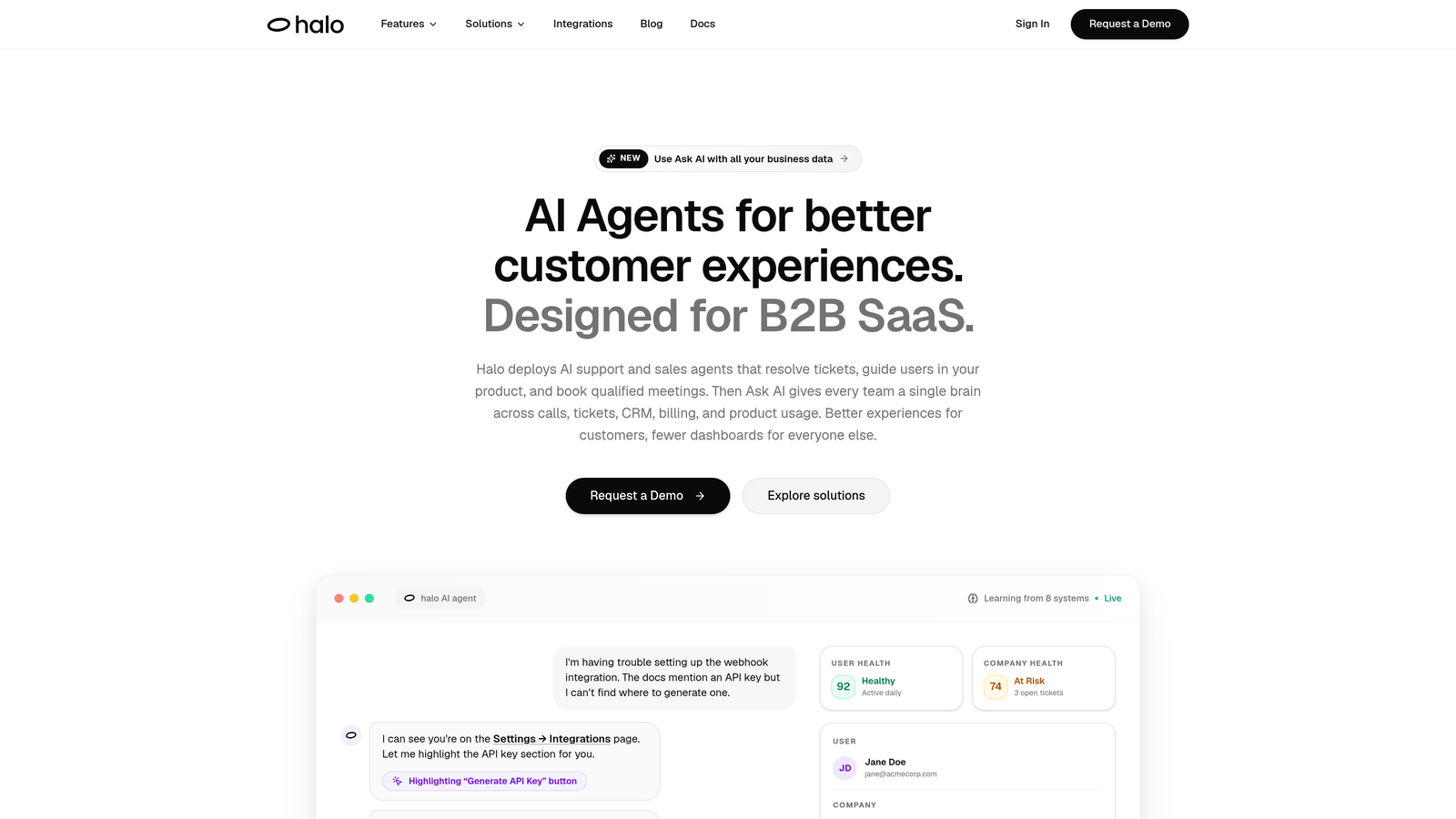
Halo AI is an AI-first customer support platform built specifically for tech companies, featuring autonomous agents that resolve tickets, guide users through products in real time, and generate business intelligence from every support interaction.
Where This Tool Shines
Halo's most distinctive capability is its page-aware AI chat widget. Rather than relying solely on a knowledge base, Halo's agents understand what the user is currently seeing inside your product, which means guidance is contextual and precise rather than generic. This matters enormously in technical support, where the same question asked from two different product states often requires two completely different answers.
Beyond resolution, Halo surfaces business intelligence that most support tools ignore entirely. Its smart inbox includes customer health scoring, anomaly detection, and revenue intelligence signals pulled from support conversations. For product and engineering teams, the auto-creation of bug tickets in Linear with full conversation context is a genuinely useful workflow that eliminates manual handoffs.
Key Features
Page-Aware AI Chat Widget: The AI sees what the user sees inside your product, enabling contextual guidance that goes beyond static knowledge base lookups.
Autonomous Ticket Resolution: AI agents resolve tickets end-to-end with continuous learning, improving accuracy over time without manual retraining.
Auto Bug Ticket Creation: Automatically creates detailed bug tickets in Linear with full conversation context, closing the loop between support and engineering.
Smart Inbox with Business Intelligence: Customer health scoring, anomaly detection, and revenue signals surface directly in the support workflow.
Deep Integration Stack: Native connections to Slack, Linear, Intercom, Stripe, HubSpot, Zoom, PandaDoc, and Fathom for a genuinely connected tech stack.
Best For
SaaS companies and B2B tech teams that want an AI-first platform rather than a bolt-on AI layer over a traditional helpdesk. Particularly valuable for teams where support, product, and engineering need to stay tightly aligned, and where customer health signals matter as much as ticket resolution speed.
Pricing
Contact for pricing. Halo is designed to scale without per-seat costs, making it structurally different from most helpdesk pricing models where support headcount drives the bill.
2. Intercom with Fin AI
Best for: Product-led growth companies that need in-product messaging and AI resolution in one platform
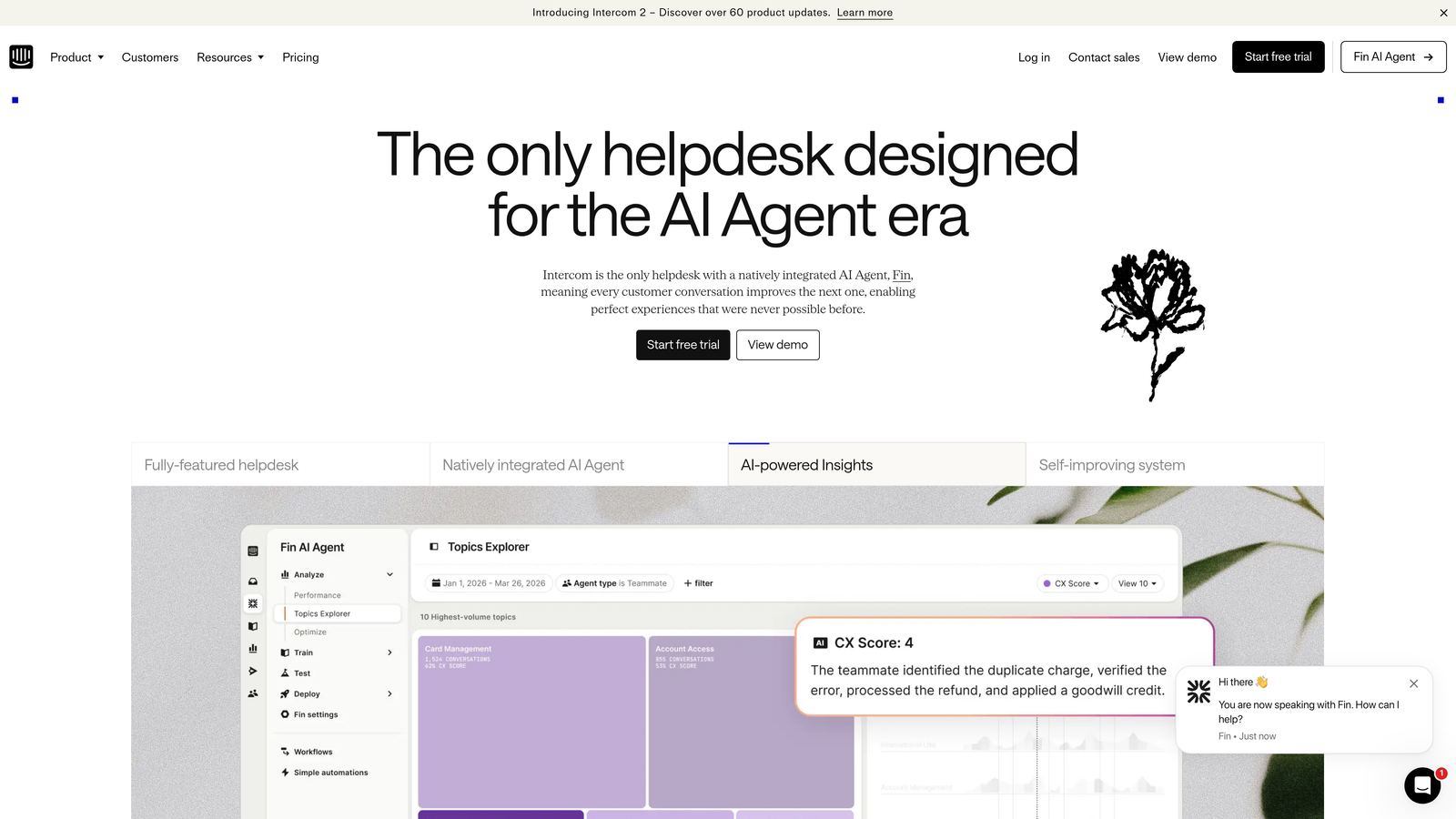
Intercom is a well-established customer messaging platform whose Fin AI agent resolves support questions using help center content and conversation history, deeply embedded in the in-product messaging experience.
Where This Tool Shines
Intercom's strength is the combination of product tours, in-app messaging, and AI resolution in a single platform. For product-led growth companies where the support and onboarding experience are tightly connected, this integration is genuinely valuable. Fin AI draws on your existing help center content and conversation history, which means teams with mature documentation get strong out-of-the-box resolution rates.
The AI copilot for human agents is also well-executed, offering suggested replies and conversation summaries that speed up response time when tickets do reach a person. The platform is mature, well-documented, and widely understood by support teams.
Key Features
Fin AI Agent: Resolves customer questions using help center content and historical conversations, with per-resolution pricing that aligns cost to value.
In-Product Messaging and Tours: Contextual support and onboarding flows triggered by user behavior inside your product.
Customizable Workflows: Automation bots and workflow builders for routing, triage, and escalation without engineering involvement.
AI Copilot for Agents: Suggests replies, summarizes conversations, and surfaces relevant articles for human agents handling escalated tickets.
Product-Led Growth Features: Checklists, banners, and in-app prompts designed to reduce support volume through proactive user education.
Best For
SaaS companies with established help centers and product-led growth motions. Teams that already use Intercom for sales or onboarding messaging will find the most value here, as the platform is most powerful when used across multiple functions.
Pricing
Starts at $39/seat/month. Fin AI is charged per resolution, so costs scale with AI usage. Full-featured plans for larger teams are priced at the enterprise tier.
3. Zendesk AI
Best for: Enterprise tech companies needing a mature, highly extensible support infrastructure with AI layered on top
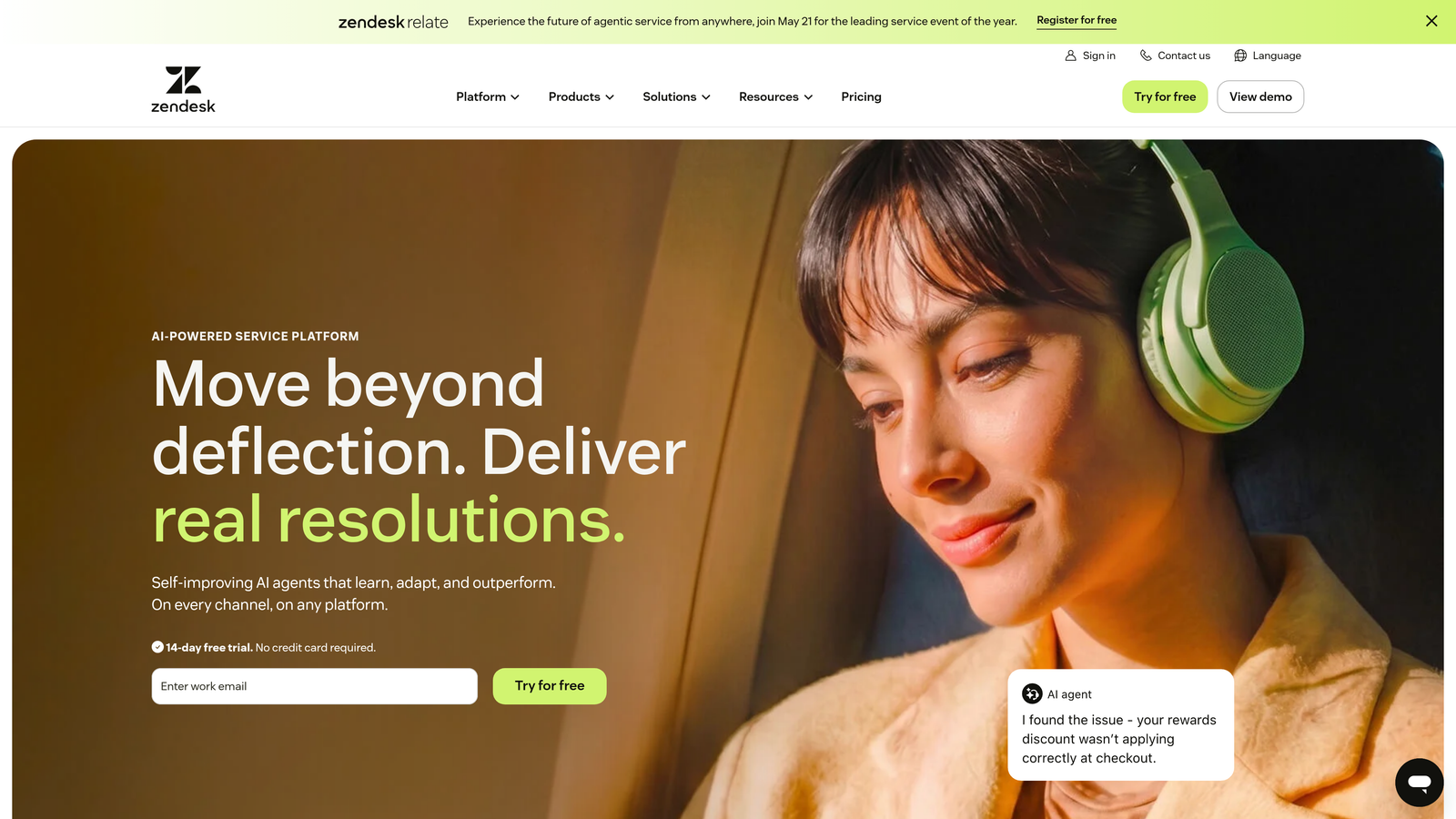
Zendesk is an enterprise-grade helpdesk platform with AI-powered ticket routing, agent assist, and generative AI features built onto one of the most established support infrastructures in the market.
Where This Tool Shines
Zendesk's primary advantage is depth. Its app marketplace, reporting capabilities, and omnichannel coverage are difficult to match. For large tech companies with complex support operations spanning multiple products, regions, and channels, Zendesk provides the infrastructure to manage it all. The AI features, including intelligent triage, generative response drafting, and knowledge base assistance, are solid additions to a platform that was already handling enterprise-scale support before AI became a priority.
The tradeoff is that Zendesk's AI capabilities feel like a layer added to an existing platform rather than a ground-up AI architecture. For teams that need sophisticated automation without heavy configuration, this can require meaningful setup investment.
Key Features
AI-Powered Ticket Routing: Intelligent triage automatically categorizes and routes tickets based on content, intent, and priority signals.
Generative AI for Agents: Drafts responses, summarizes long conversations, and suggests knowledge base articles to speed up agent handling time.
1,500+ App Marketplace Integrations: Extensive third-party connections covering CRM, engineering tools, analytics, and communication platforms.
Advanced Analytics: Custom reporting and dashboards for support performance, SLA tracking, and team productivity.
Omnichannel Support: Unified inbox covering email, live chat, phone, social media, and messaging apps.
Best For
Mid-market to enterprise tech companies with established support teams that need reliable infrastructure, deep reporting, and broad integration coverage. Less suited for teams that want AI-native autonomy out of the box without significant configuration.
Pricing
Starts at $55/agent/month for the Suite Team plan. AI features and advanced capabilities are available at higher tiers and as add-ons, which can make total cost of ownership higher than initial pricing suggests.
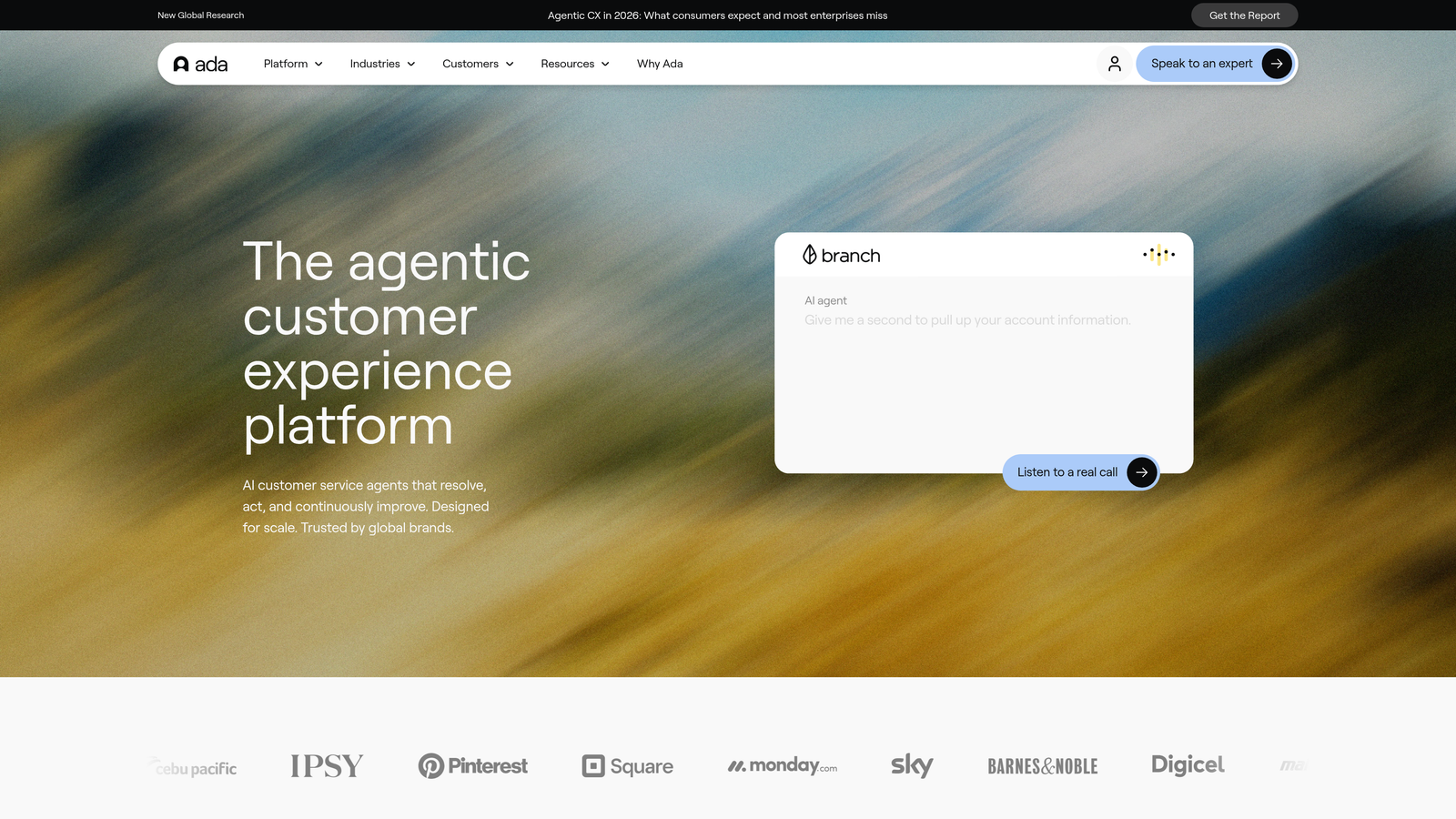
4. Ada
Best for: Tech companies focused on maximizing automated resolution rates with minimal human intervention
Ada is an AI-first automation platform focused on resolving customer inquiries without human intervention, featuring a reasoning engine and no-code builder for complex support workflows.
Where This Tool Shines
Ada's core design philosophy is resolution without escalation. Its reasoning engine handles multi-step conversations where the answer isn't a simple knowledge base lookup, which makes it well-suited for technical products where users often need to be walked through a process rather than handed a link. The no-code conversation builder is genuinely accessible, allowing support teams to build and iterate on automated flows without engineering support.
Multilingual support across more than 50 languages is a meaningful differentiator for tech companies with global user bases. Ada also provides automated measurement of resolution quality, giving teams visibility into where automation is working and where it falls short.
Key Features
AI Reasoning Engine: Handles multi-step conversations and complex resolution paths rather than relying on simple keyword matching or single-turn answers.
No-Code Conversation Builder: Visual workflow builder for creating and updating automated support flows without engineering involvement.
Multilingual Support: Covers 50+ languages natively, enabling consistent automated support across global markets.
Resolution Quality Measurement: Automated tracking of whether conversations were genuinely resolved, not just deflected.
API and CRM Integrations: Connects to Salesforce, Zendesk, and custom APIs for data-aware conversations.
Best For
Tech companies with high ticket volumes and a clear priority on automation rate. Particularly strong for global products where multilingual support is a requirement rather than a nice-to-have.
Pricing
Custom pricing based on resolution volume. Prospective customers should request a quote directly, as pricing varies based on scale and integration complexity.
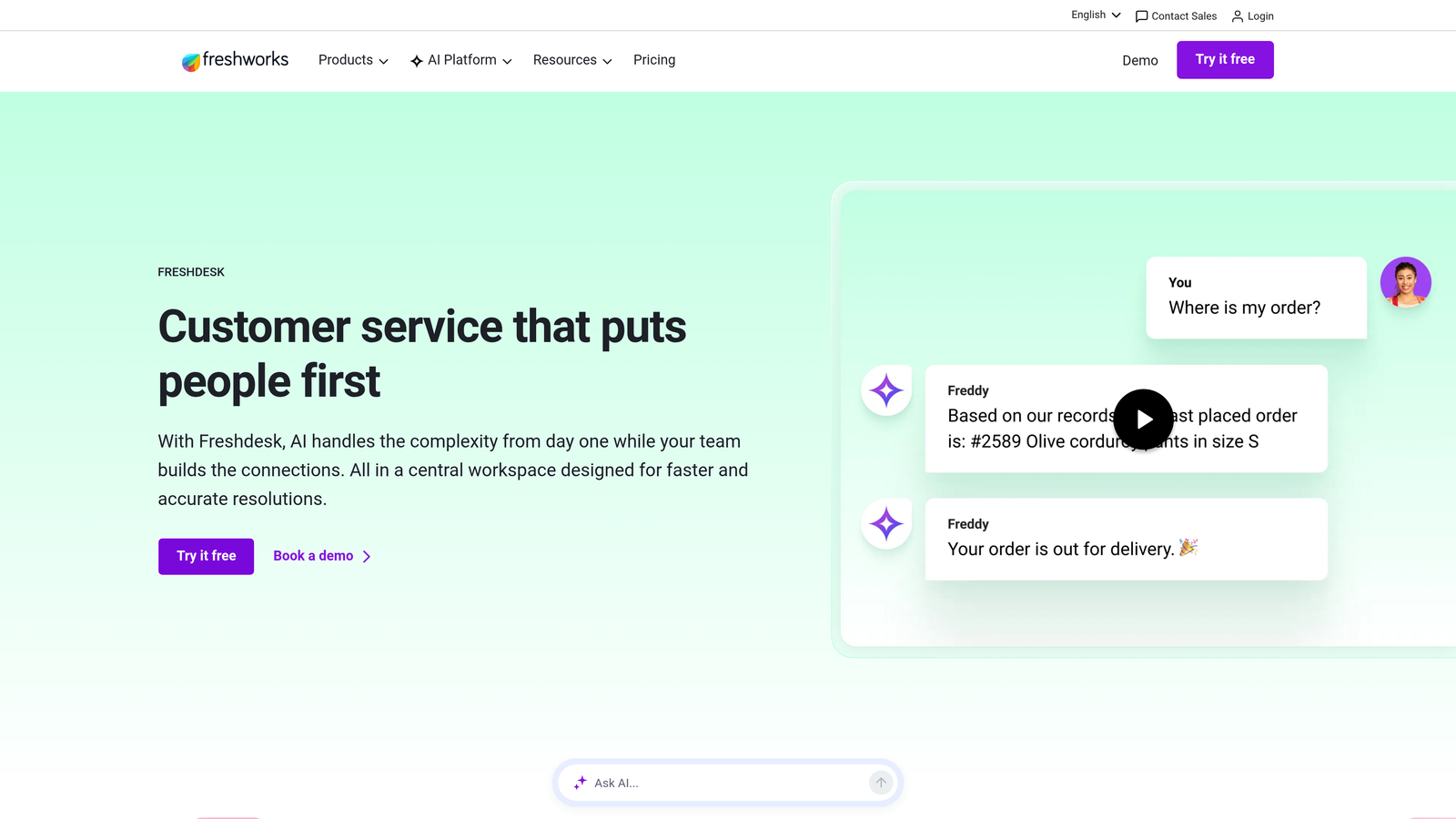
5. Freshdesk with Freddy AI
Best for: Cost-conscious tech teams that need solid AI assist features without enterprise pricing
Freshdesk is a budget-friendly helpdesk with built-in Freddy AI for agent assist, auto-triage, and customer-facing chatbot capabilities, making it one of the more accessible options for growing tech companies.
Where This Tool Shines
Freshdesk's value proposition is strong AI-assisted features at a price point that smaller tech teams can actually afford. Freddy AI handles response suggestions, conversation summaries, and ticket auto-categorization without requiring significant setup. For teams that are still building out their support function, the free tier provides a real starting point rather than a stripped-down trial.
The integration with Jira is particularly relevant for tech companies, enabling basic support-to-engineering handoffs. While not as deep as purpose-built engineering integrations, it covers the most common use case of linking support tickets to development issues.
Key Features
Freddy AI Copilot: Suggests responses, summarizes conversations, and recommends knowledge base articles to help agents respond faster.
Auto-Categorization and Routing: AI automatically tags and routes incoming tickets based on content and intent.
Built-In Knowledge Base: AI-powered search helps customers find answers before submitting tickets.
Free Tier: Functional free plan for small teams with up to 10 agents, including basic ticketing and collaboration features.
Jira and Slack Integrations: Marketplace connections for linking support to engineering and team communication workflows.
Best For
Early-stage and growth-stage tech companies managing support costs carefully. Also a good fit for teams that need a reliable helpdesk foundation with AI assist features before investing in more advanced AI-native platforms.
Pricing
Free tier available for up to 10 agents. Paid plans start at $15/agent/month. Freddy AI features are included in Growth and higher tiers.
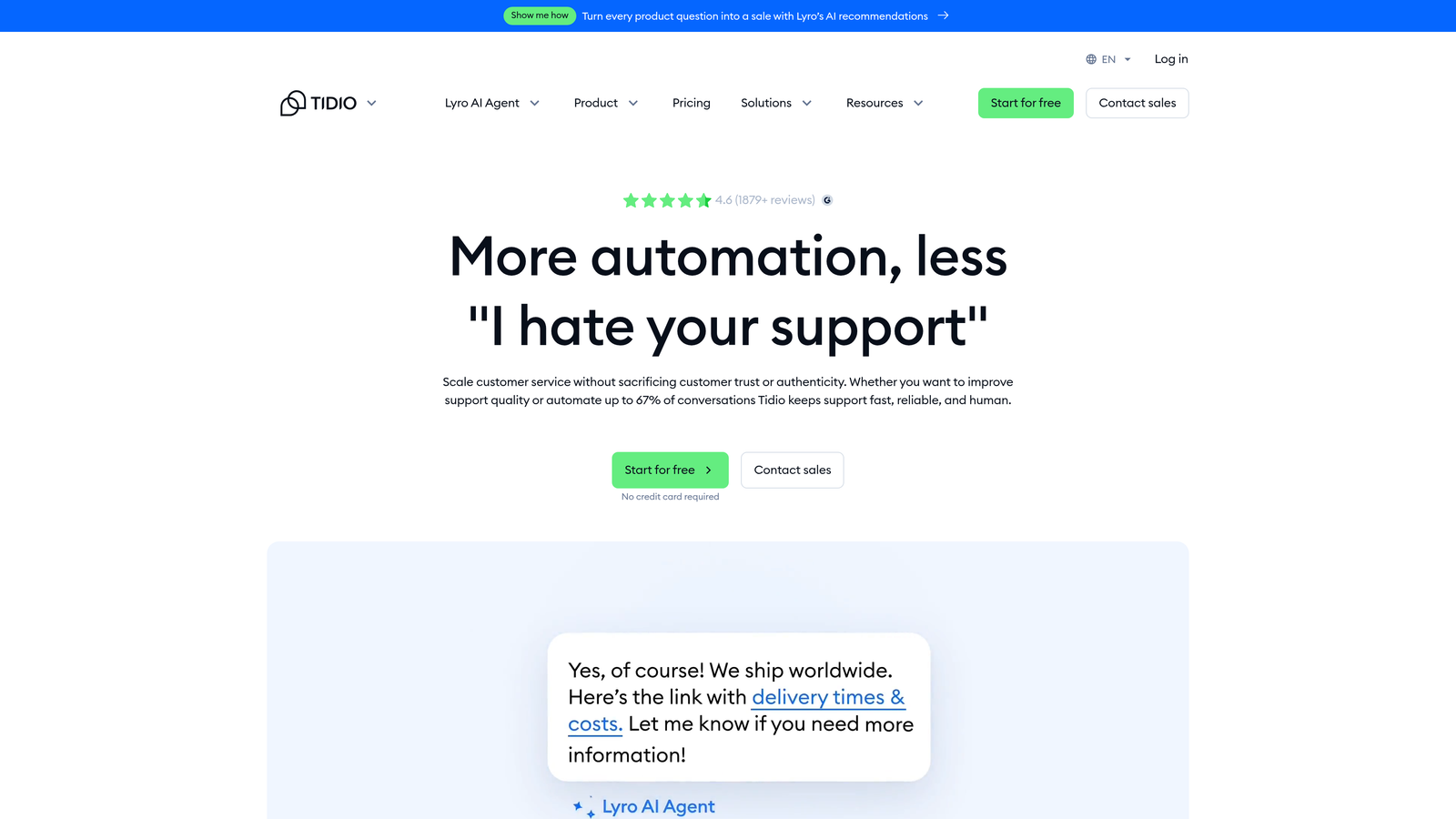
6. Tidio
Best for: Small tech teams that need fast deployment and a lightweight AI chatbot without complex setup
Tidio is a lightweight AI chatbot platform featuring Lyro AI for instant customer responses, designed for fast deployment and ease of use.
Where This Tool Shines
Tidio's primary strength is speed of deployment. Teams can have a functioning AI chatbot live on their site or product in a matter of hours, not weeks. Lyro AI is trained on your existing support content and handles common questions without requiring conversation flow design from scratch. For smaller tech teams that need to deflect basic tickets quickly, this is a meaningful advantage.
The visual conversation flow builder is accessible to non-technical team members, which matters for startups where the founder or a generalist handles support. The platform is lighter than enterprise alternatives, which is both its strength and its ceiling.
Key Features
Lyro AI Chatbot: Trained on your support content to answer common questions automatically, with a conversation limit that scales with your plan.
Visual Flow Builder: Drag-and-drop conversation design for creating custom chatbot paths without coding.
Live Chat with AI Suggestions: Human agents receive AI-assisted reply suggestions during live conversations.
Fast Widget Installation: Simple embed code for website or web app deployment with minimal technical requirements.
API Integrations: Connects to Shopify, WordPress, and custom platforms via API for broader workflow connectivity.
Best For
Small tech teams, early-stage startups, and developer tools with a limited support function that need an AI chatbot running quickly. Less suited for complex technical support scenarios or teams that need deep engineering workflow integration.
Pricing
Free plan available. Lyro AI starts at $39/month for 50 conversations, with higher-volume plans available as needs grow.
7. Forethought
Best for: Support teams that need intelligent triage, routing, and knowledge gap detection to improve both efficiency and documentation quality
Forethought is an AI platform focused on intelligent ticket triage, routing, and knowledge gap detection, helping tech support teams prioritize effectively and identify where documentation falls short.
Where This Tool Shines
Forethought takes a different approach from most AI support tools by focusing heavily on the quality of routing and the health of your knowledge base. Its knowledge gap detection identifies questions that your documentation doesn't answer well, giving content and support teams actionable data on where to invest. This is particularly valuable for fast-moving tech products where documentation often lags behind feature development.
Predictive routing goes beyond simple keyword-based assignment, using AI to match tickets to the agent or team best positioned to resolve them based on historical patterns. For teams with specialized support pods, this can meaningfully reduce handle time.
Key Features
AI Ticket Classification and Priority Scoring: Automatically categorizes incoming tickets and assigns priority scores based on content and urgency signals.
Predictive Routing: Routes tickets to the right agent or team based on AI-predicted match quality, not just keyword rules.
Knowledge Gap Detection: Identifies topics where your help content is insufficient or missing, enabling targeted documentation improvements.
Autoflows: Multi-step automated resolution flows for common ticket types that don't require human intervention.
Helpdesk Integrations: Native connections to Zendesk, Salesforce Service Cloud, and Freshdesk for layering AI onto existing platforms.
Best For
Mid-size tech support teams that already use Zendesk or Salesforce and want to add a sophisticated AI layer for triage, routing, and knowledge management without migrating their entire support stack.
Pricing
Custom pricing based on ticket volume. Contact Forethought directly for a quote tailored to your team's scale and existing helpdesk setup.
8. Kustomer
Best for: Tech companies that need CRM-native support with a unified customer timeline across all channels
Kustomer is a CRM-native support platform offering a unified customer timeline with AI-powered conversation management, giving agents full context across every interaction.
Where This Tool Shines
Kustomer's architecture is fundamentally different from most helpdesks. Rather than organizing around tickets, it organizes around customers. Every interaction, across every channel, appears in a single chronological timeline tied to that customer's record. For tech companies where support, sales, and success teams all touch the same accounts, this unified view prevents the context loss that frustrates both agents and customers.
AI-powered sentiment analysis and conversation classification run continuously, helping teams identify at-risk customers and prioritize accordingly. The CRM-native design means customer data is built into the support workflow rather than pulled from a separate system.
Key Features
Single-Thread Customer Timeline: All interactions across email, chat, social, and SMS appear in one chronological view per customer.
AI Conversation Classification and Sentiment Analysis: Automatically tags conversation topics and monitors sentiment to surface at-risk customers.
CRM-Native Architecture: Customer data, purchase history, and account details are embedded in the support interface without separate CRM integration.
Omnichannel Support: Unified inbox covering chat, email, social media, and SMS with consistent agent experience across channels.
Workflow Automation: Business rules engine for routing, escalation, and automated actions based on customer data and conversation content.
Best For
B2B tech companies and SaaS teams where support, success, and sales share customer relationships and need full context at every touchpoint. Less suited for teams that primarily need autonomous AI resolution over human-assisted support.
Pricing
Starts at $89/user/month on the Enterprise plan. Pricing reflects the CRM-native architecture and is positioned at the higher end of the market.
9. Help Scout
Best for: Developer-focused teams that value a clean interface, strong API, and AI-assisted features without platform complexity
Help Scout is a clean, developer-friendly helpdesk with AI drafts, conversation summaries, and a robust API, making it a natural fit for tech teams that value simplicity and extensibility.
Where This Tool Shines
Help Scout's reputation in the developer community is built on two things: a genuinely clean interface that agents actually enjoy using, and an API that's well-documented and reliable. For tech companies that want to build custom integrations or embed support functionality into their own product, Help Scout's developer experience is notably strong. The Beacon widget enables in-app help and proactive chat without requiring a heavyweight platform.
The AI features, including response drafts and conversation summaries, are practical and well-integrated rather than bolted on. They speed up agent workflows without requiring teams to learn a new system or change how they handle support.
Key Features
AI Drafts and Conversation Summaries: AI generates response drafts and summarizes long threads so agents can respond faster with full context.
Docs Knowledge Base: Built-in documentation platform with AI-powered search that helps customers self-serve before contacting support.
Beacon Widget: In-app help widget combining proactive messaging, live chat, and knowledge base search in a lightweight embed.
Robust API and Developer Documentation: Well-maintained API with comprehensive documentation for building custom integrations and workflows.
Clean Agent Interface: Distraction-free inbox design that prioritizes focus and reduces cognitive load for support teams handling high conversation volume.
Best For
Developer tools, technical SaaS products, and engineering-led teams that want a reliable, extensible helpdesk with solid AI assist features. Not the right choice if autonomous AI resolution at scale is the primary requirement.
Pricing
Starts at $50/user/month. AI features including drafts and summaries are included in the Plus plan and above.
Choosing the Right AI Support Tool for Your Tech Stack
The right choice here depends less on which tool has the longest feature list and more on where your support operation actually breaks down today.
If you're a startup or small team that needs something running quickly without significant setup investment, Tidio or Freshdesk offer accessible entry points with real AI functionality. Freshdesk in particular gives growing teams room to scale without switching platforms early.
If your team is already on Zendesk or Salesforce and wants to add smarter triage and routing without a full migration, Forethought is worth a close look. It layers AI intelligence onto your existing infrastructure rather than replacing it.
For product-led growth companies where support and onboarding are deeply connected, Intercom with Fin AI remains a strong choice, especially for teams that already use Intercom for in-product messaging.
If you need a CRM-native view of your customers across every channel, Kustomer solves a problem that most helpdesks don't address well. And for developer-focused teams that value a clean interface and strong API above all else, Help Scout consistently earns its place on shortlists.
For tech companies that want an AI-native platform built from the ground up for their specific challenges, Halo AI stands apart. Page-aware context, autonomous resolution with continuous learning, automatic bug ticket creation in Linear, and business intelligence derived from support conversations address the full scope of what technical support actually requires. It's not a traditional helpdesk with AI added later; it's a platform designed around the assumption that AI agents should handle the majority of interactions while surfacing insights that make your product and team smarter over time.
Your support team shouldn't scale linearly with your customer base. AI agents can handle routine tickets, guide users through your product, and surface early warning signals while your team focuses on complex issues that genuinely need a human touch. See Halo in action and discover how continuous learning transforms every interaction into smarter, faster support.