8 Best AI-First Customer Support Platforms in 2026
This guide ranks the 8 best AI First Customer Support Platform options in 2026, focusing exclusively on tools built with AI at their architectural core — not legacy helpdesks with a chatbot bolted on. It covers autonomous ticket resolution, continuous learning, and integration depth to help B2B SaaS teams scale support without scaling headcount.
 Matt PattoliFounder11 min read
Traditional helpdesks were built for human agents. AI was bolted on later as an afterthought, squeezed into architectures designed around ticket queues and manual routing. AI-first customer support platforms flip that model entirely: intelligence is the foundation, not a feature.
These platforms autonomously resolve tickets, learn from every interaction, and surface business insights that legacy tools simply can't match. The difference isn't cosmetic. It's architectural.
This list focuses on platforms built with AI at their core, not ticketing systems that added a chatbot. Whether you're a SaaS team outgrowing Zendesk, a product team drowning in repetitive tickets, or a founder looking to scale support without scaling headcount, these tools deserve a serious look. Selection criteria: AI-native architecture, autonomous resolution capabilities, integration depth, continuous learning, and suitability for B2B SaaS teams.
1. Halo AI
Best for: B2B SaaS teams that want AI-native support with business intelligence built in
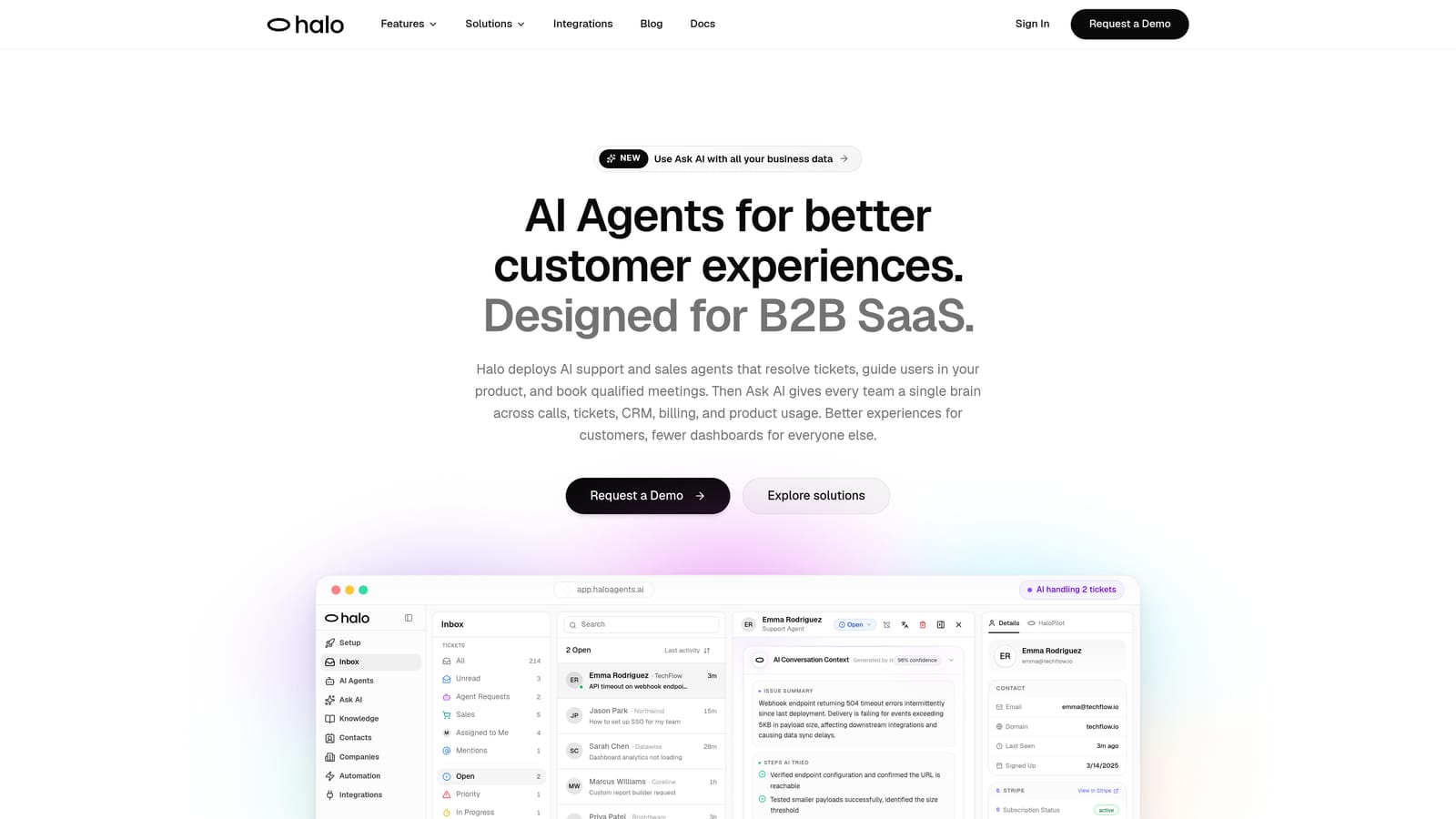
Halo AI is an AI-first customer support platform that deploys intelligent agents to resolve tickets, guide users through your product with page-aware context, auto-create bug reports, and surface business intelligence signals — all while learning from every interaction.
Where This Tool Shines
What separates Halo from AI-enhanced helpdesks is that intelligence isn't a layer on top of the product. It's the operating model. Agents don't just deflect tickets; they understand what page a user is on, what they're trying to accomplish, and can provide visual UI guidance in real time. That page-aware context closes the gap between "here's an article" and "here's exactly what to click."
The smart inbox goes further than support metrics. It surfaces customer health signals, revenue anomalies, and trend detection that give product and success teams visibility they'd normally never get from a helpdesk. Every interaction feeds back into the system, making the AI sharper over time without manual tuning.
Key Features
Page-Aware Chat Widget: Sees what users see in real time and delivers contextual UI guidance based on their current location in your product.
Autonomous Ticket Resolution: AI agents resolve tickets end-to-end and continuously learn from every interaction to improve accuracy over time.
Smart Inbox with Business Intelligence: Surfaces customer health signals, revenue anomalies, and support trend detection beyond standard helpdesk analytics.
Auto Bug Ticket Creation: Automatically generates and routes bug reports directly into engineering workflows, eliminating manual handoff friction.
Live Agent Handoff: Escalates complex issues to human agents with full conversation context preserved, so nothing gets repeated.
Deep Integrations: Connects natively with Linear, Slack, HubSpot, Intercom, Stripe, Zoom, PandaDoc, and Fathom.
Best For
Product-led SaaS companies that want support to do more than close tickets. Particularly strong for teams that need their support layer to feed intelligence back into product, engineering, and customer success workflows. Less suited to teams that need a simple, low-configuration chat widget with no integration requirements.
Pricing
Contact for pricing. A demo is available at haloagents.ai.
2. Intercom (Fin AI Agent)
Best for: Teams already embedded in the Intercom ecosystem wanting autonomous resolution
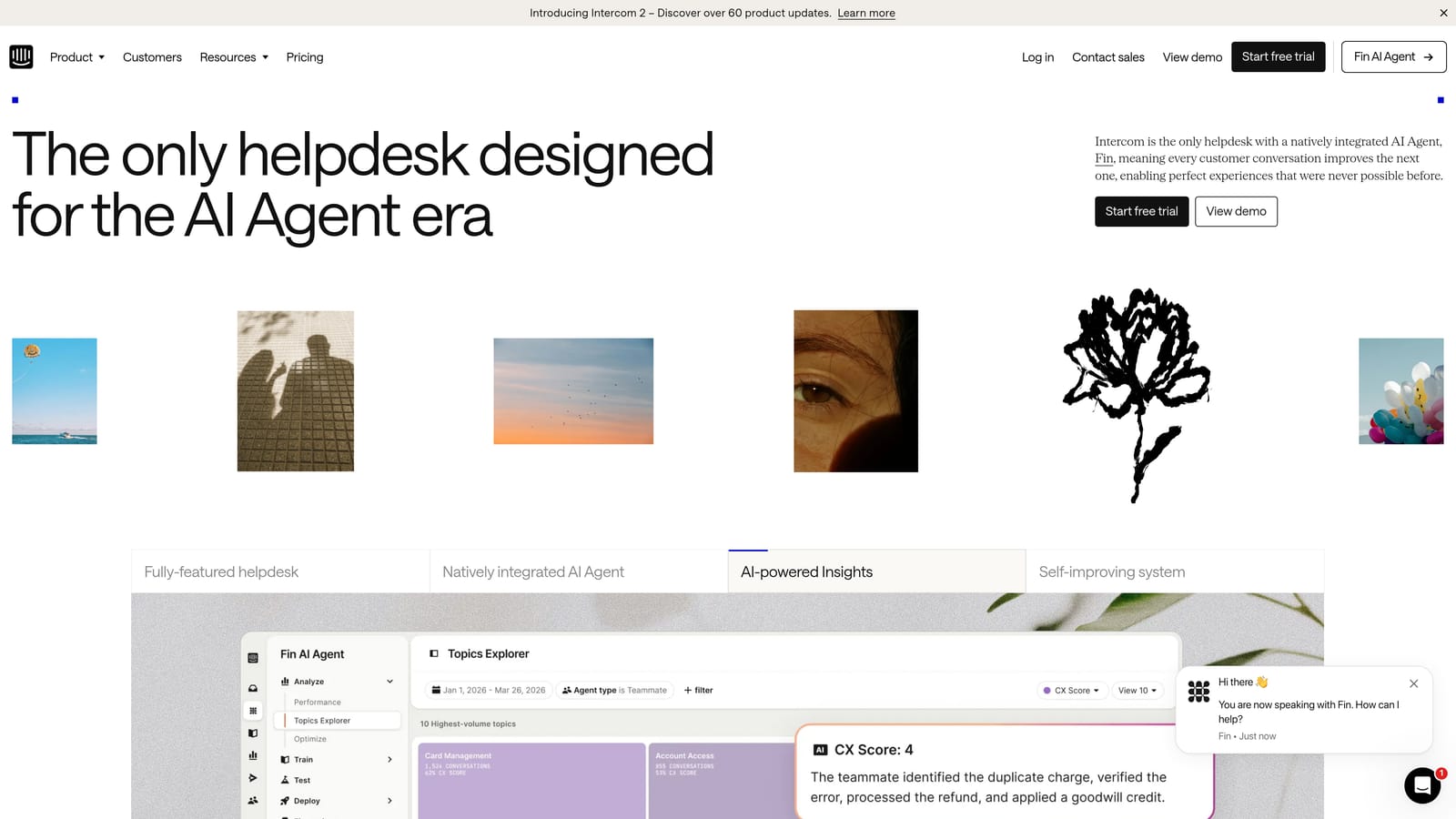
Intercom's Fin AI Agent is a large language model-powered agent that resolves customer queries by drawing on your help content and conversation history, operating within the broader Intercom messenger ecosystem.
Where This Tool Shines
Fin is positioned as a resolution agent, not a routing bot. It draws on your existing help content to handle common queries without human involvement, which means teams with well-maintained knowledge bases can deploy it quickly and see deflection gains without rebuilding their support infrastructure.
The real advantage is ecosystem fit. If your team already lives in Intercom for sales, onboarding, and customer communication, Fin slots in naturally. Handoffs to human agents happen inside the same inbox your team already uses, keeping the workflow tight.
Key Features
Fin AI Agent: Resolves common queries autonomously using your existing help content and conversation history.
Consumption-Based Pricing: AI resolutions are priced per resolution rather than per seat, aligning cost with actual usage.
Seamless Human Handoff: Escalates to live agents within the Intercom inbox when Fin can't resolve an issue.
Multi-Channel Support: Operates across chat, email, and in-app messaging within the Intercom platform.
Conversation Analytics: Strong reporting on conversation volume, resolution rates, and agent performance.
Best For
Companies already using Intercom for customer communication who want to add autonomous resolution without switching platforms. Less compelling if you're not already in the Intercom ecosystem, given the platform dependency and pricing structure.
Pricing
Intercom plans start around $29/seat/month. Fin AI Agent is priced per resolution. Check intercom.com for current rates, as pricing changes frequently.
3. Zendesk AI
Best for: Enterprise teams that need AI capabilities layered onto proven, compliant ticketing infrastructure
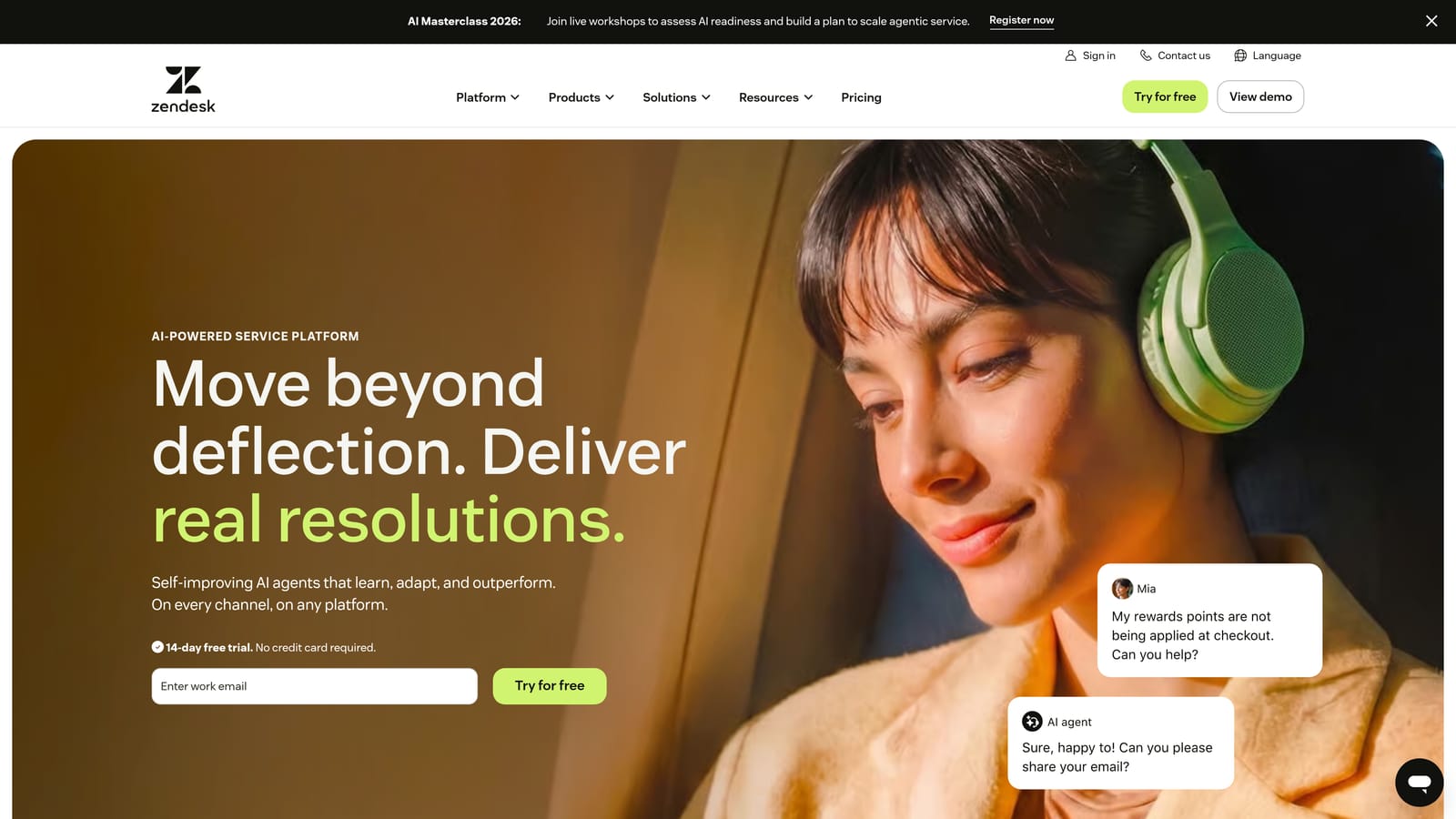
Zendesk AI adds intelligent triage, agent copilot capabilities, and AI-powered self-service on top of its established enterprise ticketing infrastructure.
Where This Tool Shines
Zendesk's strength is its depth. Decades of enterprise deployment mean robust compliance tooling, a massive integration marketplace, and workflow capabilities that cover almost any support scenario. The AI layer, including intelligent triage and Agent Copilot, enhances what teams are already doing rather than requiring them to rethink their operations.
For large organizations with complex routing logic, established agent workflows, and strict compliance requirements, the AI additions provide meaningful efficiency gains without the disruption of a platform migration.
Key Features
AI-Powered Triage: Automatically classifies and routes incoming tickets based on intent, sentiment, and priority.
Agent Copilot: Suggests replies and next-step recommendations to agents in real time during live conversations.
AI Self-Service: Delivers automated answers in the help center to deflect tickets before they reach agents.
Enterprise Compliance Tooling: Advanced reporting, audit logs, and data governance features suited to regulated industries.
Integration Marketplace: Hundreds of pre-built integrations covering CRM, billing, DevOps, and communication tools.
Best For
Enterprise support teams with high ticket volumes, complex workflows, and compliance requirements. The AI capabilities are meaningful but layered onto ticket-centric architecture, which may feel limiting for teams that want AI to be the primary operating model rather than an enhancement.
Pricing
Suite plans start around $55/agent/month. AI features are available on higher tiers. Check zendesk.com for current pricing.
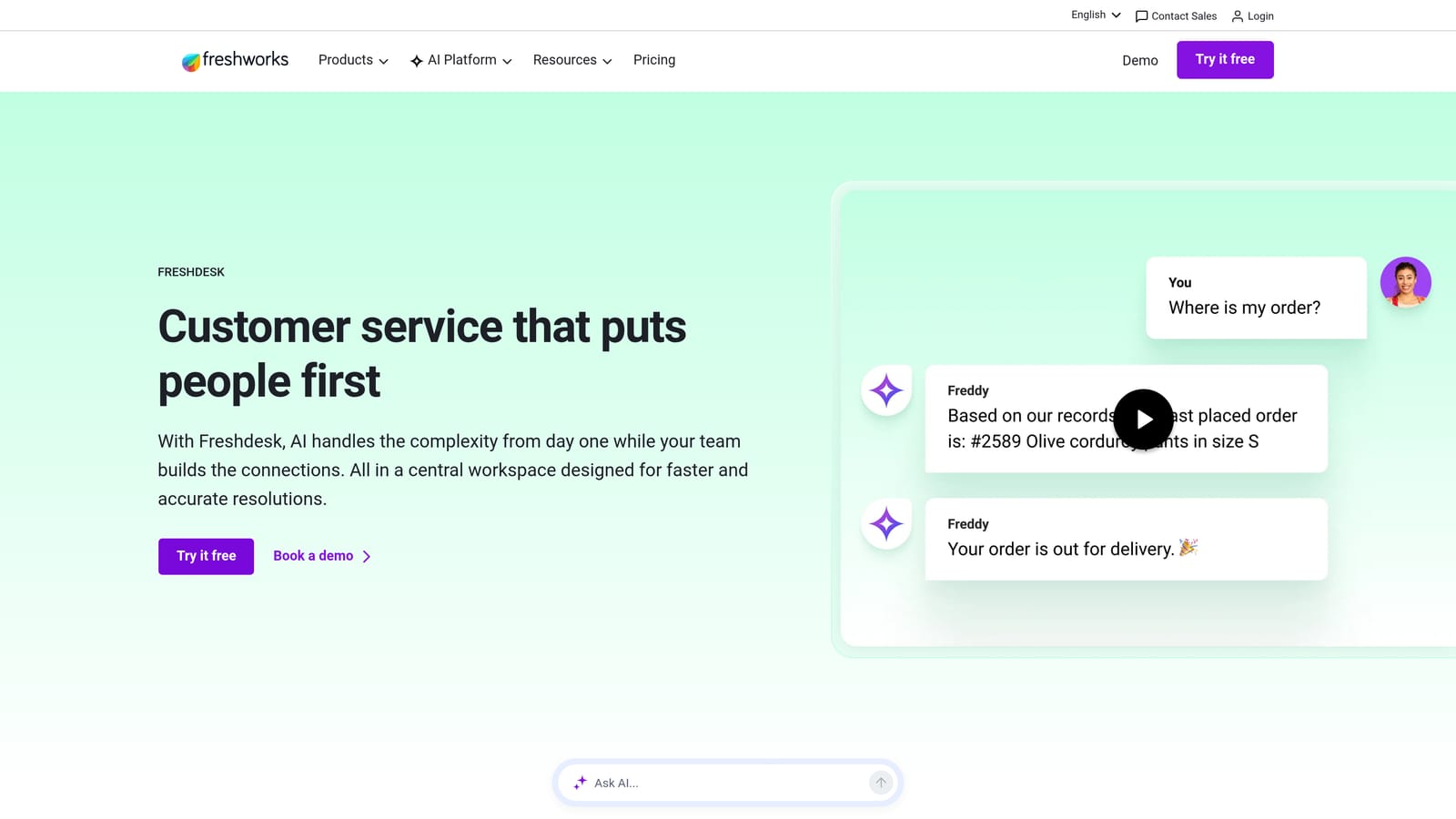
4. Freshdesk (Freddy AI)
Best for: Growing teams that want AI-powered support capabilities without enterprise-level pricing
Freshdesk's Freddy AI suite spans self-service deflection, agent assistance, and analytics across the Freshworks product ecosystem, at pricing accessible to growing teams.
Where This Tool Shines
Freddy AI covers the three layers most support teams care about: deflecting tickets before they're created, helping agents respond faster when tickets do arrive, and surfacing analytics to improve operations over time. The breadth of coverage at Freshdesk's price point is genuinely competitive.
For teams that use multiple Freshworks products, including Freshsales for CRM, Freddy AI creates a shared intelligence layer across the customer lifecycle. That cross-product context is harder to replicate if you're stitching together tools from different vendors.
Key Features
Freddy Self Service: AI-powered chatbot and deflection automation that handles common queries before they reach your team.
Freddy Copilot: Provides in-context agent suggestions and reply drafting to speed up response times.
Freddy Insights: AI-driven analytics that identify trends, anomalies, and improvement opportunities across your support operations.
Multi-Channel Support: Covers email, chat, phone, and social from a single platform.
Accessible Pricing: Competitive tiers compared to enterprise alternatives, with a free plan available for small teams.
Best For
Mid-market and growth-stage teams that want solid AI capabilities without committing to enterprise contracts. Especially strong for Freshworks ecosystem users who want AI to span support and CRM in one environment.
Pricing
Free plan available. Paid plans start around $15/agent/month. Check freshdesk.com for current tiers.
5. Forethought
Best for: Support operations leaders optimizing existing helpdesk infrastructure with AI
Forethought is an AI platform purpose-built for support operations, specializing in ticket triage, routing, summarization, and deflection layered on top of existing helpdesks.
Where This Tool Shines
Forethought's design philosophy is additive rather than replacement. It sits on top of your existing helpdesk, whether that's Zendesk, Salesforce Service Cloud, or another major platform, and applies AI to the operational layer: smarter routing, faster summarization, and deflection workflows that reduce ticket volume before agents ever see them.
For support ops leaders who've invested heavily in their existing infrastructure and don't want to migrate, Forethought is a compelling option. The focus on measurable deflection rates and efficiency metrics makes it easier to build a business case internally.
Key Features
AI Triage and Routing: Automatically classifies incoming tickets and routes them to the right team or queue without manual sorting.
Ticket Summarization: Generates concise ticket summaries so agents can get up to speed instantly without reading full conversation threads.
Deflection Workflows: Resolves common queries before they reach agents, reducing ticket volume at the source.
Helpdesk Integrations: Designed to work alongside Zendesk, Salesforce Service Cloud, and other major platforms rather than replace them.
Deflection Analytics: Focused reporting on deflection rates and operational efficiency gains.
Best For
Support operations teams at mid-market and enterprise companies who want AI efficiency gains without a platform migration. Best suited to organizations with established helpdesk setups and a clear mandate to reduce ticket volume and agent handle time.
Pricing
Custom pricing. Contact Forethought for a quote at forethought.ai.
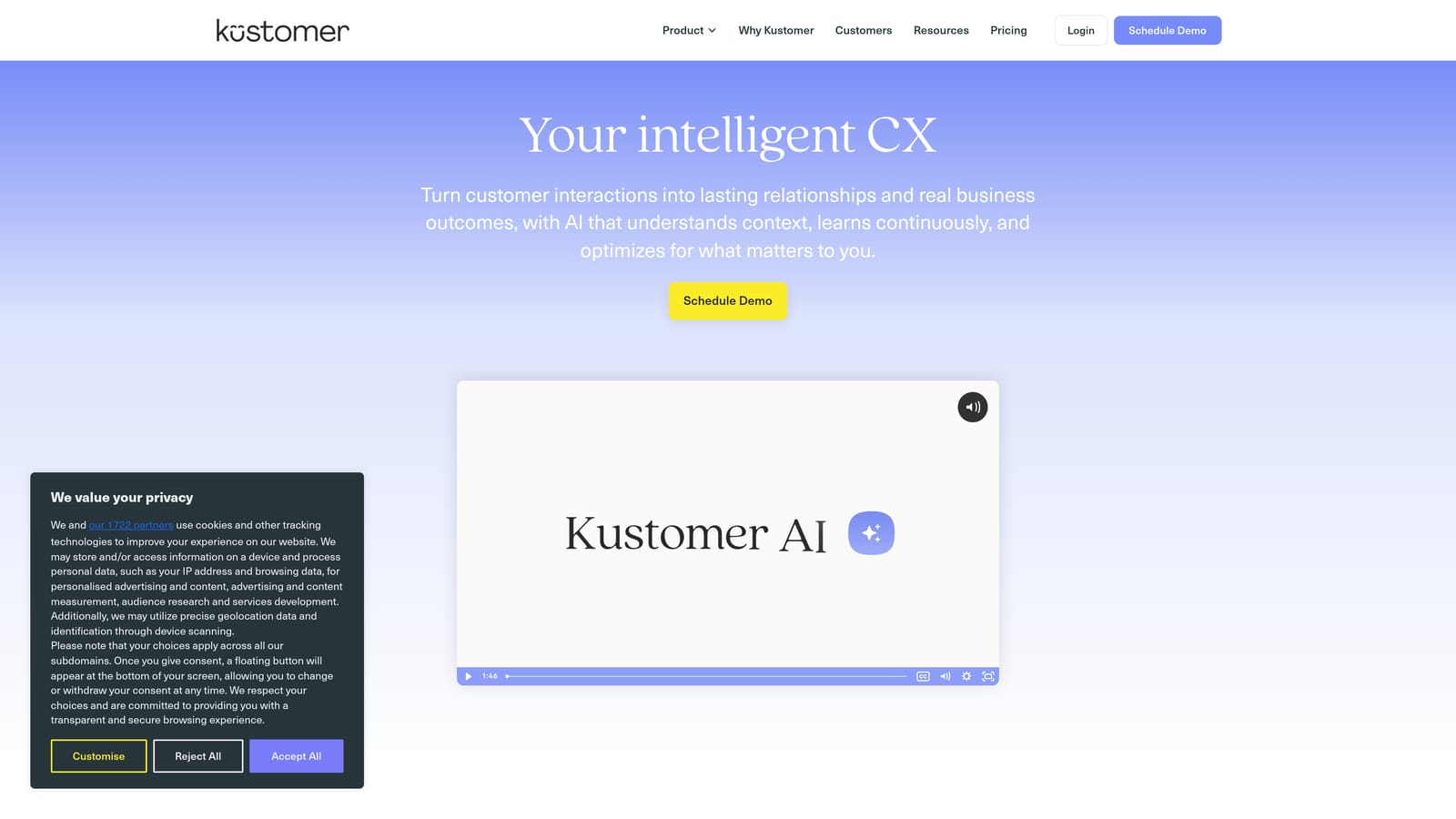
6. Kustomer
Best for: Companies where full customer history context is essential to every support interaction
Kustomer combines CRM and customer support in a single platform, with AI automation built around a unified customer timeline that surfaces full interaction history across every channel.
Where This Tool Shines
The unified customer timeline is Kustomer's core differentiator. Every interaction a customer has ever had, across chat, email, SMS, social, and voice, is visible in one place. AI features like conversation routing and suggested responses are built around that full-context view, which changes how agents approach every conversation.
This CRM-native design is particularly valuable for companies where support agents need to understand purchase history, past escalations, and account status before they respond. That context is central to the platform, not an add-on you have to integrate separately.
Key Features
Unified Customer Timeline: Consolidates all customer interactions across every channel into a single chronological view.
AI Conversation Routing: Intelligently routes conversations based on content, customer history, and agent expertise.
Suggested Responses: AI surfaces relevant reply options based on conversation context and historical resolutions.
Automation Workflows: Handles repetitive support tasks and follow-ups without manual agent intervention.
Omnichannel Coverage: Supports chat, email, SMS, social, and voice from a single unified inbox.
Best For
Customer-centric companies, particularly in retail, e-commerce, and high-touch B2B, where relationship context matters as much as resolution speed. Less suited to teams that need deep product-specific AI capabilities rather than CRM-centric support.
Pricing
Plans start around $89/user/month. Check kustomer.com for current pricing.
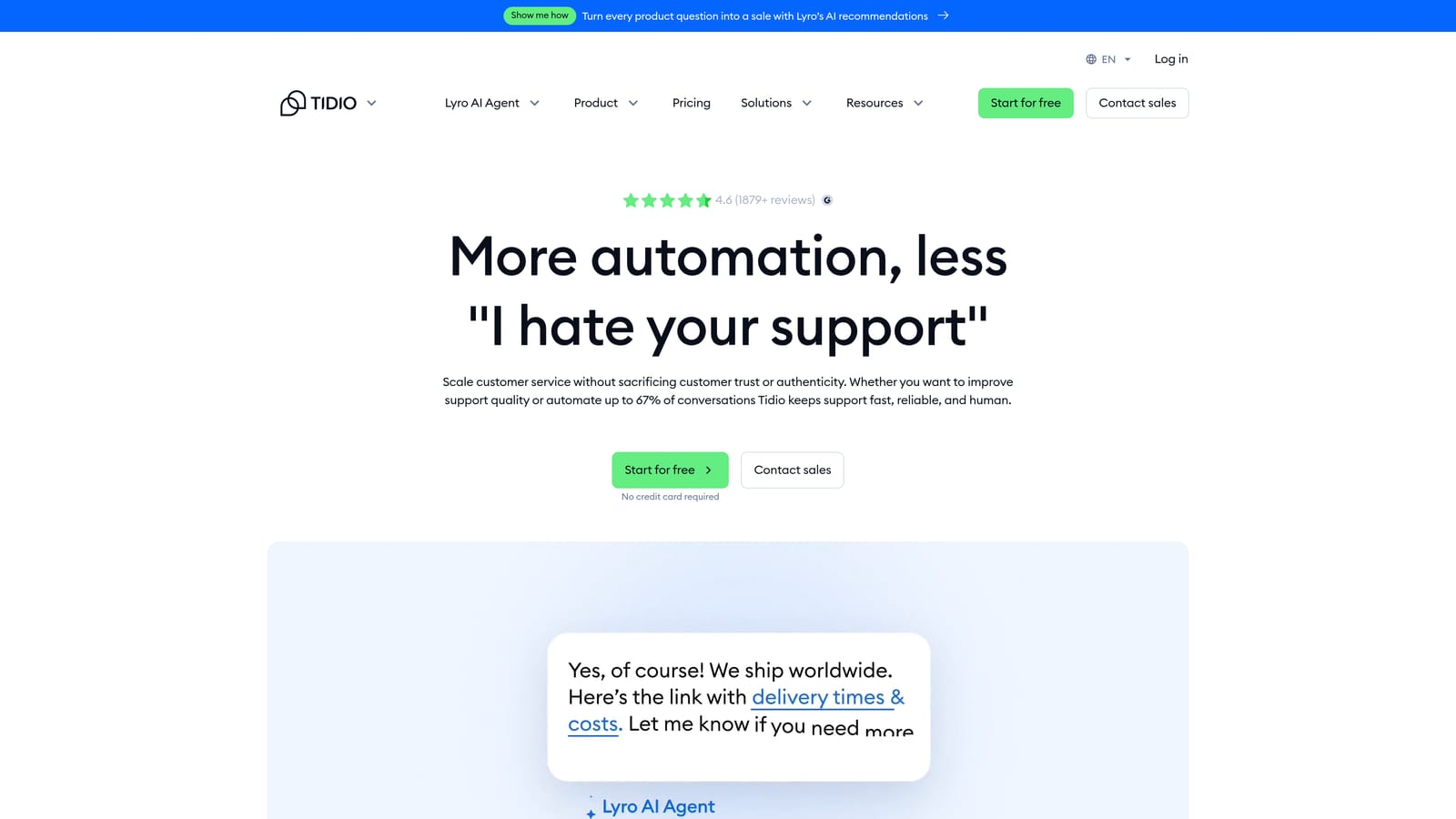
7. Tidio
Best for: Startups and smaller SaaS teams that need AI-powered self-service deployed quickly
Tidio offers Lyro, an AI conversational agent designed for fast deployment and self-service automation, with accessible pricing suited to startups and smaller SaaS teams.
Where This Tool Shines
Speed to value is Tidio's headline advantage. Lyro requires minimal technical configuration and can be handling customer queries in a short time after setup. For founders and small teams without dedicated support ops resources, that low barrier to entry matters enormously.
The platform covers the basics well: autonomous handling of common queries, clean live chat with AI-to-human handoff, and proactive messaging automation. It's not built for complex enterprise support scenarios, but for the right team size and use case, it delivers genuine value without the overhead of a larger platform.
Key Features
Lyro AI Agent: Handles common customer queries autonomously with minimal setup required.
Fast Deployment: Designed to be operational quickly without heavy technical configuration or onboarding.
Live Chat with Handoff: Smooth AI-to-human escalation when queries exceed Lyro's scope.
Proactive Automation: Triggers proactive messages and FAQ deflection flows based on user behavior.
Tool Integrations: Connects with popular e-commerce and SaaS platforms for basic workflow integration.
Best For
Early-stage startups, SMBs, and smaller SaaS teams that want AI-powered self-service without a complex implementation. Teams with enterprise-scale ticket volumes or complex routing requirements will likely outgrow Tidio quickly.
Pricing
Free plan available. Lyro AI starts around $29/month. Check tidio.com for current rates.
8. Gladly
Best for: High-touch brands where relationship continuity matters as much as resolution speed
Gladly takes a ticket-free approach to customer support: every customer has a persistent conversation thread across all channels, with AI features helping agents respond faster and more consistently.
Where This Tool Shines
Gladly's core premise is that tickets are an internal construct that customers never asked for. Instead of opening and closing tickets, every customer has an ongoing conversation thread that persists across channels and agents. That continuity changes the entire feel of the support experience, and it's a fundamentally different philosophy from every other platform on this list.
AI features sit on top of that model, helping agents surface relevant information faster and maintain consistency across interactions. People-match routing connects customers with agents based on expertise and history, reinforcing the relationship-first approach rather than optimizing purely for speed.
Key Features
Persistent Conversation Model: Every customer has a continuous thread across all channels, with no ticket open/close cycle.
AI-Assisted Responses: Surfaces relevant knowledge and suggests responses to help agents reply faster and more accurately.
Omnichannel Continuity: Maintains conversation context across chat, email, phone, SMS, and social without fragmentation.
People-Match Routing: Routes customers to agents based on expertise, customer history, and relationship context.
Built-In Reporting: Tracks customer satisfaction and agent performance with reporting built around relationship metrics, not just ticket closure rates.
Best For
Brands where customer relationships are a competitive advantage, including premium retail, subscription businesses, and high-touch B2B companies. Less suited to teams that need deep AI autonomy or heavy technical integration with product and engineering workflows.
Pricing
Custom pricing. Contact Gladly for a quote at gladly.com.
Which Platform Is Right for Your Team?
The right choice depends less on feature lists and more on where AI fits in your support philosophy. Are you looking for AI to enhance how your agents work, or to handle resolution autonomously while agents focus on the exceptions?
For teams that want AI as the operating foundation, not a bolt-on, Halo AI stands out for its page-aware intelligence, continuous learning, and business intelligence capabilities that extend well beyond support metrics. If you're already deep in the Intercom ecosystem, Fin AI Agent is the natural next step. Zendesk AI suits enterprise teams with established infrastructure they're not ready to replace. Freshdesk Freddy hits the sweet spot for growing teams that want meaningful AI capabilities without enterprise pricing.
If you need AI layered on top of your existing helpdesk without migration, Forethought is purpose-built for that. Kustomer wins when full customer context is central to every interaction. Tidio is the fastest path to AI self-service for startups. And Gladly is the choice for brands that believe relationships matter more than ticket counts.
Your support team shouldn't scale linearly with your customer base. Let AI agents handle routine tickets, guide users through your product, and surface business intelligence while your team focuses on complex issues that need a human touch. See Halo in action and discover how continuous learning transforms every interaction into smarter, faster support.