9 Best AI Help Desk Tools for Tech Companies in 2026
Tech companies face uniquely complex support demands that generic help desk tools weren't built to handle. This guide ranks the 9 best AI help desk platforms for tech companies in 2026, evaluating each on AI capability, developer-friendliness, integration depth, and ability to manage the nuanced technical conversations that define modern SaaS support.
 Grant CooperFounder14 min read
Tech companies face a support challenge unlike any other industry. Your users are technical, your issues are complex, and slow resolution compounds fast: in churn, in engineering time, in reputation damage that's hard to undo. Generic help desk software wasn't designed for this environment. It was built to manage ticket volume, not to understand product context, route bugs to engineering, or detect early signals of customer health deterioration.
AI-native help desk platforms are changing that equation. The best ones handle ticket triage, bug escalation, product guidance, and business intelligence in ways traditional tools simply can't match. Below are the top AI help desk solutions built or well-suited for tech companies in 2026, evaluated on AI capability depth, integration ecosystem, developer-friendliness, and how well each handles the nuanced, technical support conversations that define modern SaaS.
1. Halo AI
Best for: Tech companies and B2B SaaS teams wanting fully autonomous AI support with deep product integration
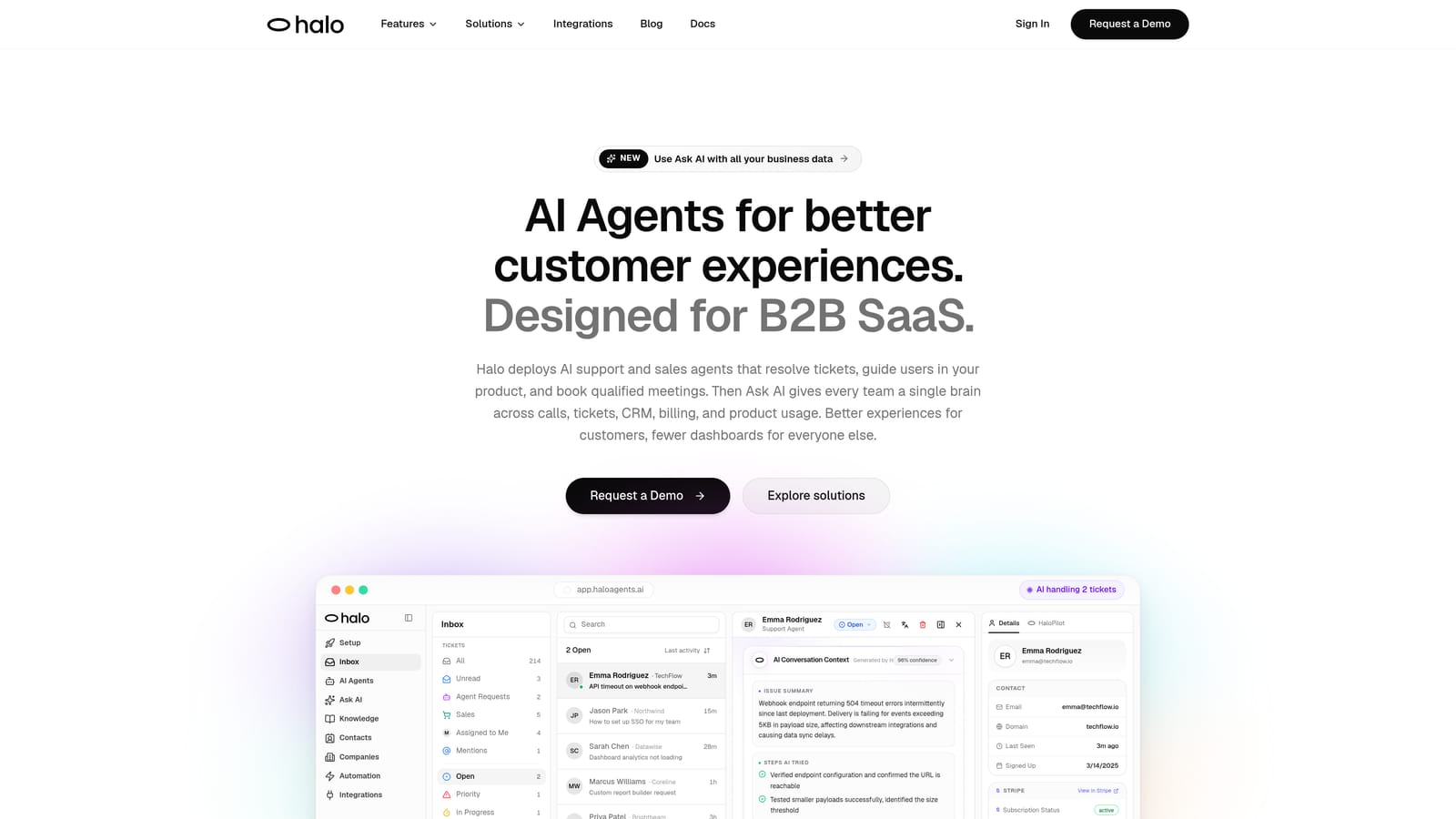
Halo AI is an AI-first customer support platform built specifically for tech companies, deploying autonomous agents that resolve tickets, guide users through your product, and surface business intelligence signals.
Where This Tool Shines
Halo AI wasn't built by adding AI features to an existing helpdesk. It was architected from the ground up around the idea that AI should be the primary resolution layer, with human agents handling escalations rather than the reverse. This distinction matters more than it sounds: most "AI-enhanced" platforms still route everything through human workflows with AI suggestions sprinkled in. Halo's agents close tickets autonomously.
The page-aware chat widget is particularly compelling for SaaS teams. The AI sees the user's current product context, which means it can provide visual UI guidance specific to where someone is in your application. Combined with auto bug ticket creation routed directly to Linear or other engineering tools, Halo bridges the gap between support and engineering in a way most platforms don't attempt.
Key Features
Autonomous AI Agents: Resolve support tickets end-to-end without requiring human input for routine issues.
Page-Aware Chat Widget: The AI understands the user's current product context, enabling precise, contextual guidance rather than generic answers.
Auto Bug Ticket Creation: Automatically identifies and routes bug reports to engineering tools like Linear, reducing the friction between support and development teams.
Smart Inbox with Business Intelligence: Surfaces customer health signals, anomaly detection, and revenue intelligence beyond standard support metrics.
Live Agent Handoff: Seamlessly escalates complex or sensitive issues to human agents with full conversation context preserved.
Integration Ecosystem: Connects to Linear, Slack, HubSpot, Intercom, Stripe, Zoom, PandaDoc, and Fathom, covering the full SaaS operational stack.
Best For
Halo AI is the strongest fit for B2B SaaS companies that want AI to handle the bulk of support autonomously, especially teams that need tight integration between customer support and engineering workflows. Early-stage startups scaling without headcount and growth-stage companies managing increasingly complex product lines will find the most value here.
Pricing
Custom pricing; contact Halo AI directly at haloagents.ai. Enterprise and custom deployments are the primary model.
2. Intercom
Best for: Product-led SaaS companies wanting in-app messaging with strong AI resolution capabilities
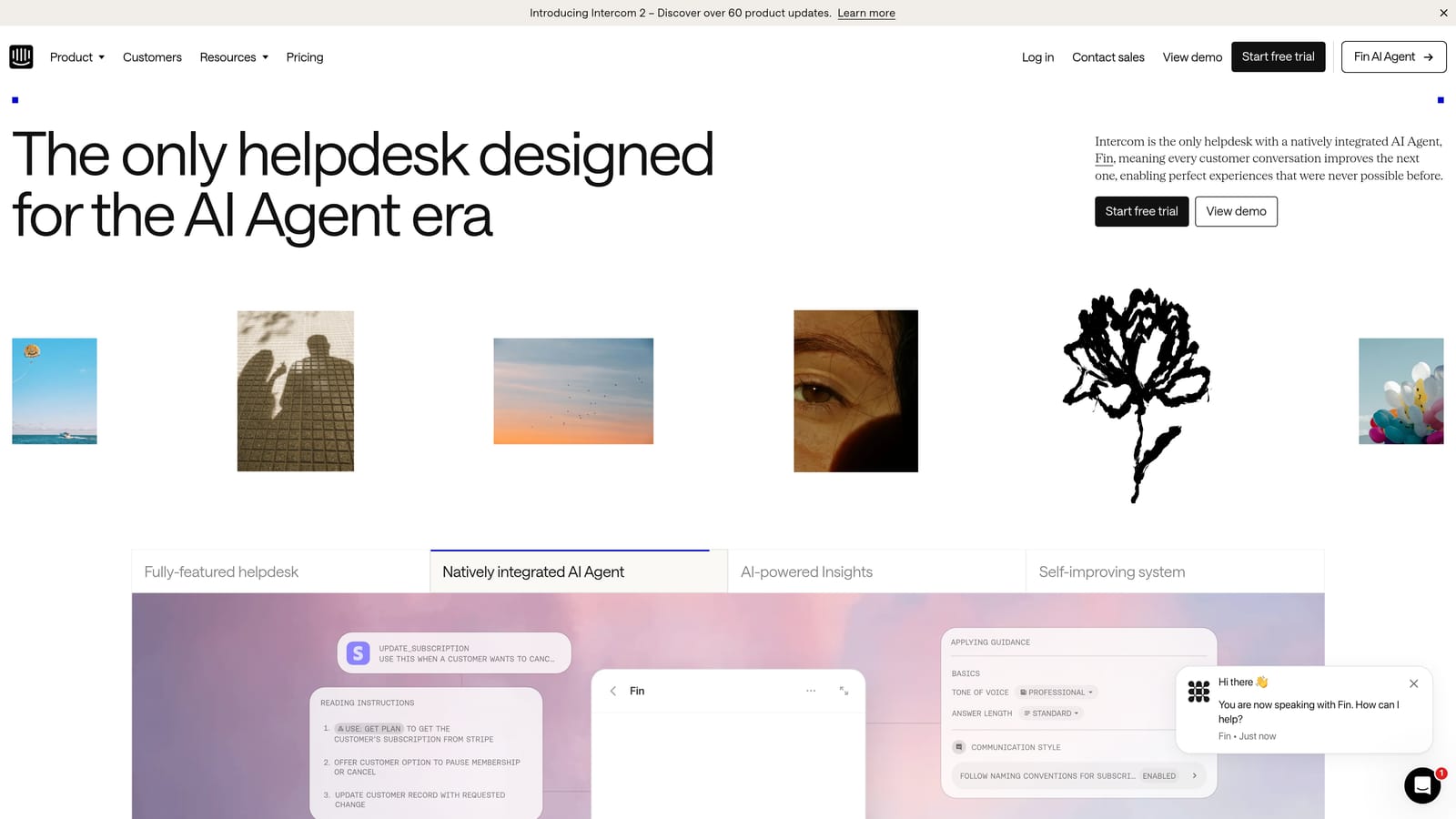
Intercom is a customer messaging platform with Fin AI, an autonomous agent designed to resolve support queries across chat, email, and in-app channels without human intervention.
Where This Tool Shines
Intercom's heritage is in-app messaging, which gives it a natural advantage for product-led growth companies. Fin AI, which has matured significantly through 2025, handles a meaningful portion of incoming queries autonomously and integrates naturally into the in-product experience that SaaS teams rely on. The combination of chat, email, and in-app coverage in a single platform reduces the coordination overhead that comes with stitching together multiple tools.
The AI Copilot feature also gives human agents real-time suggestions on complex tickets, which is useful for teams that want AI assistance without fully autonomous resolution. One thing to keep in mind: Intercom's pricing can escalate quickly at scale, so total cost of ownership deserves careful evaluation as your team and customer base grow.
Key Features
Fin AI Agent: Handles autonomous ticket resolution across chat, email, and in-app channels without requiring human escalation for routine queries.
AI Copilot: Provides real-time response suggestions to human agents on more complex or sensitive conversations.
In-App Messenger: Deep product integration that makes Intercom feel native to the user experience rather than bolted on.
Omnichannel Coverage: Unified support across chat, email, and social channels from a single platform.
Conversation Analytics: Reporting tools that surface patterns in support volume, resolution rates, and customer sentiment.
Best For
Product-led SaaS companies with strong in-app engagement models, particularly those that prioritize the in-product support experience and want a platform with a proven track record in the startup and scale-up ecosystem.
Pricing
Tiered plans available; pricing scales with seat count and usage volume. Contact Intercom or check their pricing page for current rates, as pricing structures have evolved frequently.
3. Zendesk AI
Best for: High-volume enterprise support teams looking to add AI to a mature, established helpdesk infrastructure
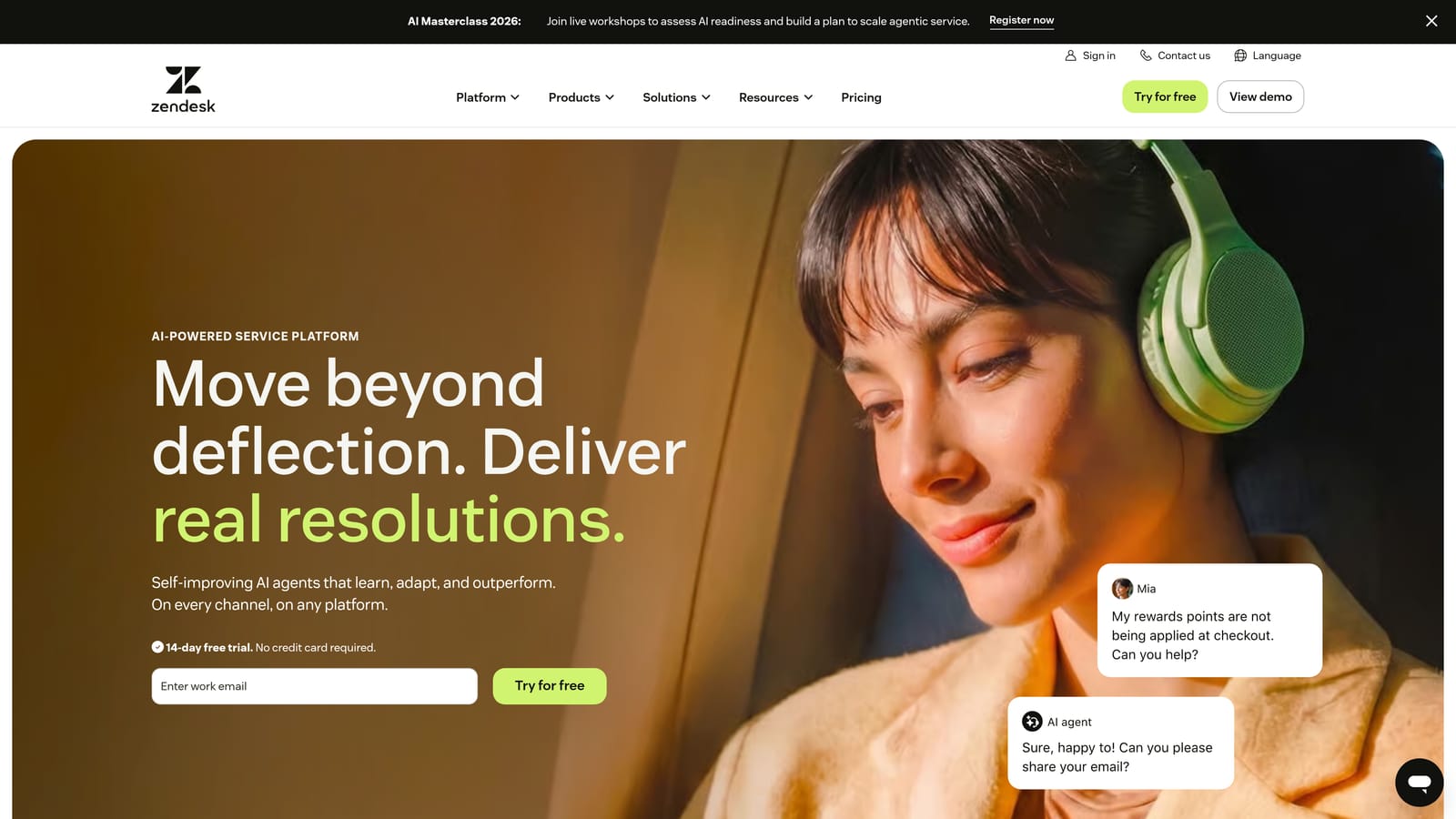
Zendesk AI is the AI-enhanced version of the market-leading helpdesk platform, featuring intelligent triage, an AI Copilot for agents, and automated workflows built on Zendesk's extensive infrastructure.
Where This Tool Shines
Zendesk's core strength is its maturity. The platform has been refined over many years, and its AI features, built through both proprietary development and partnerships, benefit from that foundation. Intelligent triage and routing work well at scale, and the compliance and security posture is robust enough for enterprise tech companies operating in regulated environments.
The honest caveat is that Zendesk's AI capabilities feel like an evolution of a legacy platform rather than a native AI architecture. If your team is already standardized on Zendesk, the AI upgrade path is logical. If you're starting fresh, the AI-first alternatives on this list may offer a more cohesive experience.
Key Features
Intelligent Triage and Routing: Automatically classifies and routes incoming tickets based on content, intent, and priority signals.
AI Copilot for Agents: Suggests responses and next actions for human agents handling complex or escalated conversations.
Generative AI for Self-Service: Powers knowledge base creation and maintenance with AI-assisted content generation.
Advanced Analytics: Comprehensive reporting across ticket volume, resolution time, agent performance, and customer satisfaction.
Enterprise Security and Compliance: Strong data governance features relevant to enterprise and regulated tech environments.
Best For
Large enterprise tech companies with high ticket volumes, existing Zendesk infrastructure, and compliance requirements that make platform migration a significant undertaking.
Pricing
AI features are available on Suite Professional and above. Contact Zendesk for enterprise pricing; the modular structure means costs vary significantly by feature set and scale.
4. Freshdesk (Freddy AI)
Best for: Mid-market SaaS teams seeking a cost-competitive alternative to enterprise helpdesks with solid AI capabilities
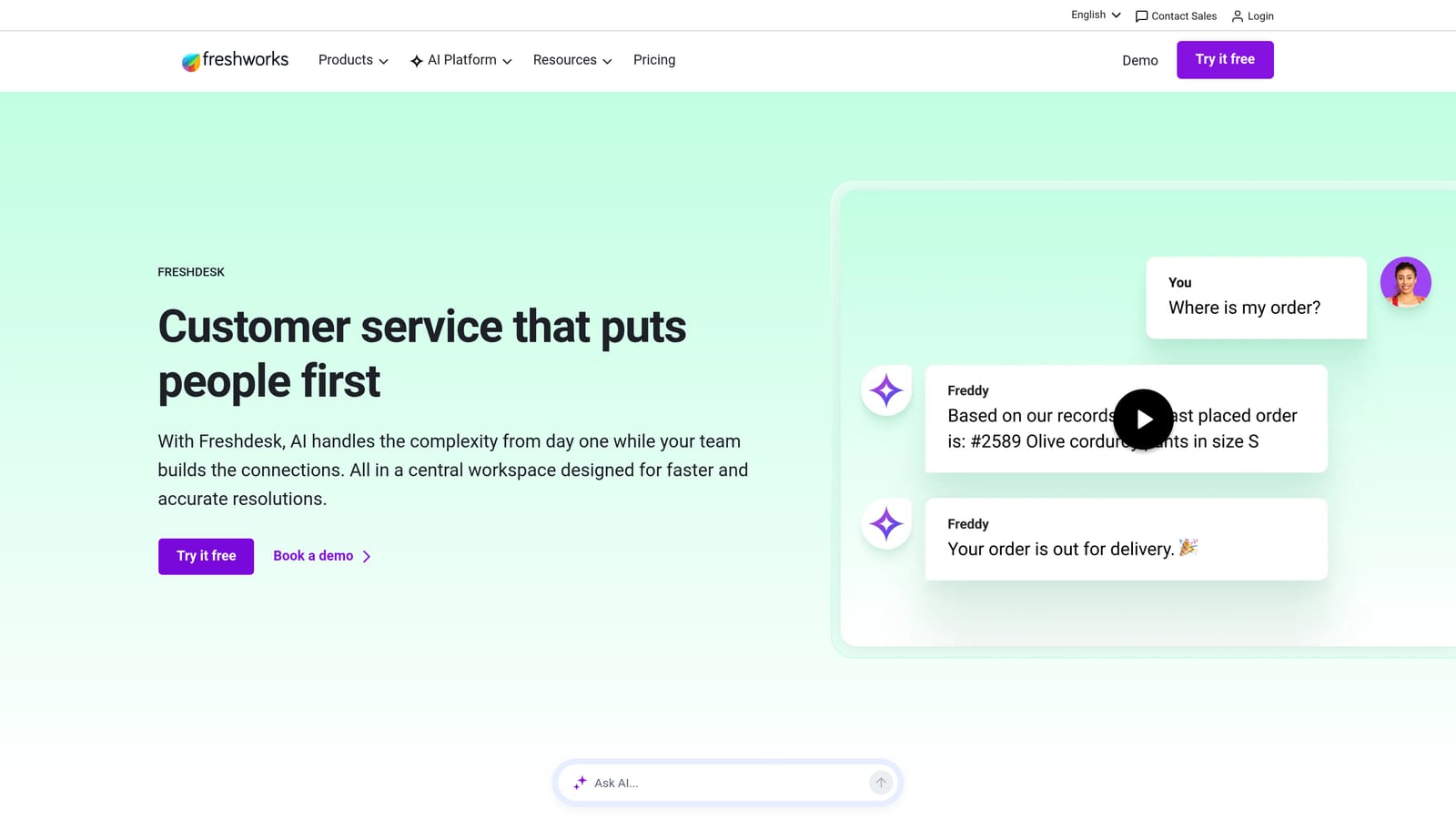
Freshdesk is Freshworks' helpdesk platform with Freddy AI embedded across self-service, agent assist, and analytics, positioned as a capable and value-oriented alternative to enterprise platforms.
Where This Tool Shines
Freshdesk consistently earns attention as the practical choice for mid-market teams that need real AI capability without the enterprise price tag. Freddy AI covers three distinct layers: self-service automation, agent assistance, and analytics insights. This breadth means teams can get meaningful AI value across the full support workflow without purchasing separate tools for each layer.
Integrations with Slack, Jira, and Salesforce make Freshdesk workable within typical SaaS tech stacks, and the pricing structure is generally more accessible than Zendesk for comparable feature sets. The trade-off is that Freddy AI's depth doesn't quite match the most AI-forward platforms on this list.
Key Features
Freddy Self Service: An AI bot that handles automated ticket resolution for common queries before they reach a human agent.
Freddy Copilot: Provides agents with response suggestions, conversation summarization, and writing assistance in real time.
Freddy Insights: AI-powered analytics that surface patterns and recommendations from support data.
Integration Library: Connects with Slack, Jira, Salesforce, and a broad range of SaaS tools common in tech company stacks.
Competitive Pricing Structure: Generally more accessible than enterprise alternatives for comparable core functionality.
Best For
Mid-market SaaS companies that want AI across self-service, agent assist, and analytics without committing to enterprise-level pricing or implementation complexity.
Pricing
Freddy AI features are available on the Growth plan and above. Check freshworks.com for current rates, as pricing tiers and module costs are updated regularly.
5. Forethought
Best for: Teams that want AI capability without migrating away from their existing helpdesk platform
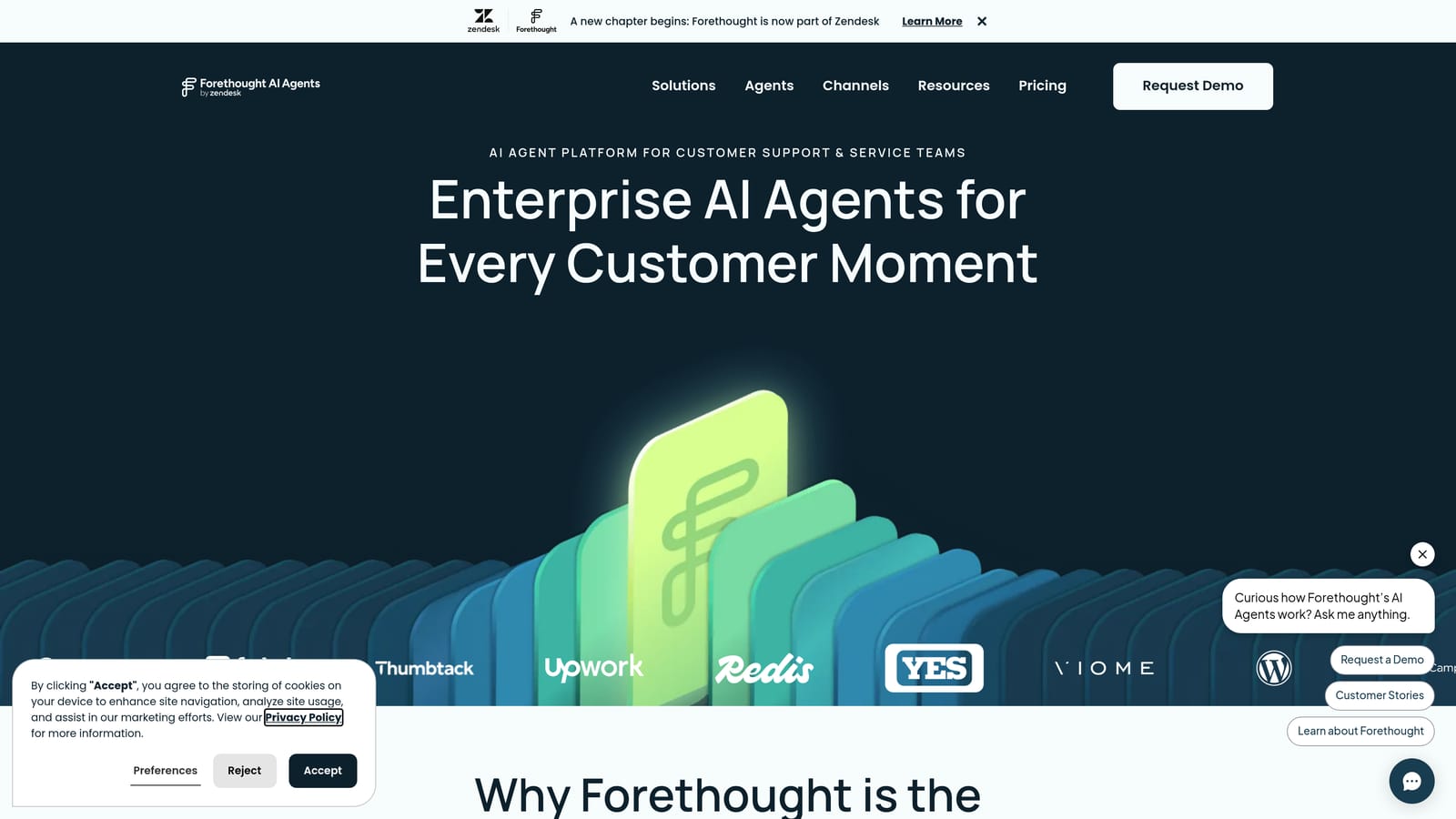
Forethought is an AI layer designed to sit on top of existing helpdesks like Zendesk and Salesforce, adding triage, agent assist, and automated resolution without requiring a platform migration.
Where This Tool Shines
Forethought solves a real organizational problem: many support teams are deeply embedded in platforms they can't easily replace, but they need AI capabilities those platforms don't fully deliver. Rather than forcing a migration, Forethought layers on top of what you have, adding intelligent triage, real-time agent suggestions, and automated resolution as a separate AI system that integrates with your existing infrastructure.
This approach is pragmatic for enterprise teams where platform migration carries significant switching costs. The limitation is that you're still operating within the constraints of your existing helpdesk's architecture, which means some of the more sophisticated AI-first capabilities, like page-aware context or autonomous bug routing, aren't available through this approach.
Key Features
Triage AI: Intelligently classifies and routes incoming tickets based on content and intent analysis.
Assist AI: Provides human agents with real-time response suggestions and relevant knowledge base content during live conversations.
Solve AI: Handles fully automated resolution for tickets that fall within defined parameters, without human intervention.
Platform Compatibility: Works with Zendesk, Salesforce Service Cloud, ServiceNow, and other major helpdesk platforms.
No Migration Required: Deploys as an AI layer over existing infrastructure, preserving current workflows and data.
Best For
Enterprise tech companies with significant investment in existing helpdesk platforms that want to add AI capability without the disruption and cost of a full platform migration.
Pricing
Custom enterprise pricing; contact Forethought's sales team directly for a quote.
6. Kustomer
Best for: Support teams that need full customer relationship context, not just ticket history, for every interaction
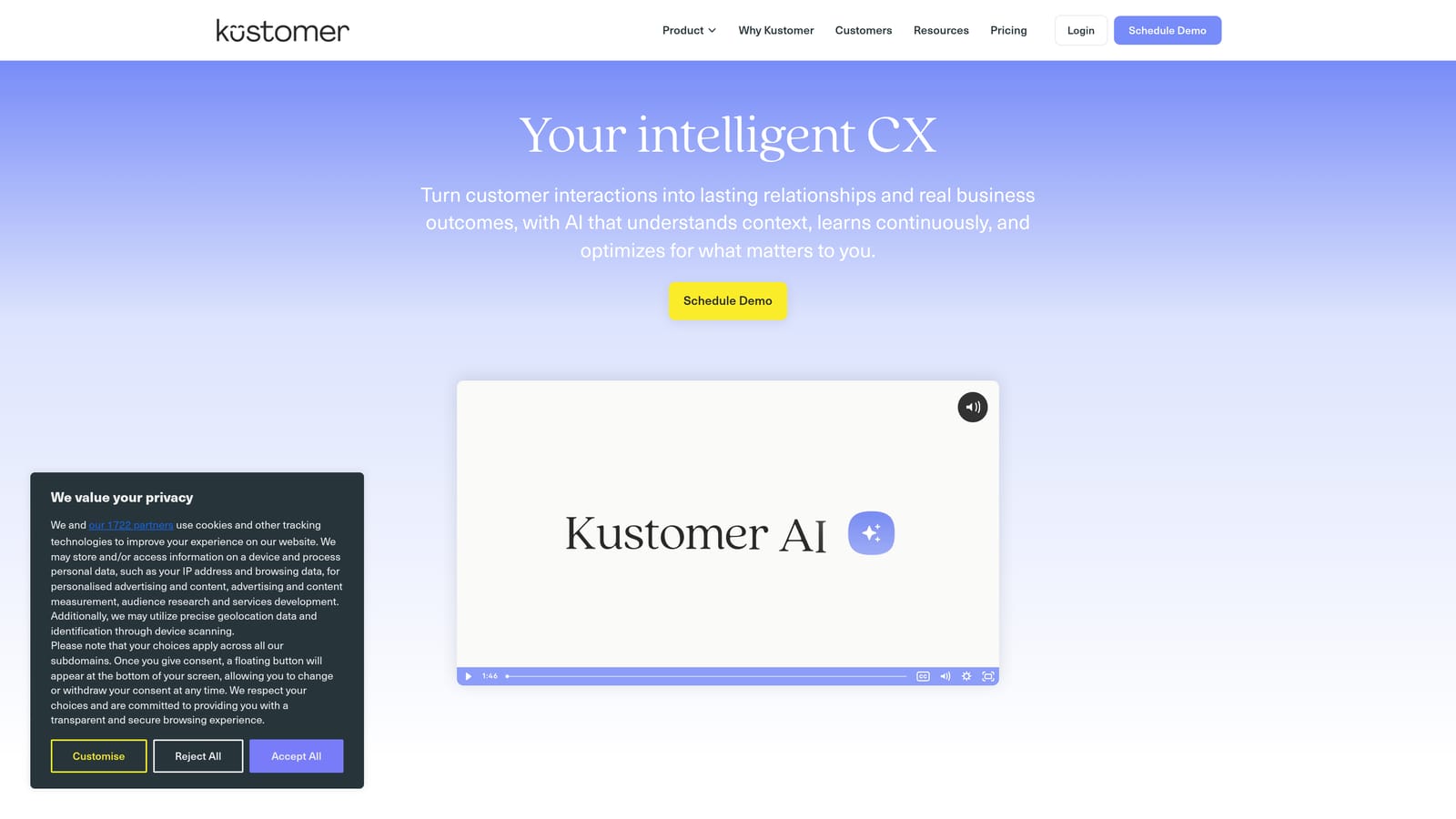
Kustomer is a CRM-native customer service platform where AI operates on a complete customer timeline, giving support teams richer context than ticket-centric platforms can provide.
Where This Tool Shines
Most helpdesks show agents the ticket. Kustomer shows agents the customer: their full history, interactions across channels, purchase or subscription data, and prior conversations all in one view. When AI operates on top of this richer dataset, routing and classification decisions become more accurate, and agents handling escalations have the context they need to resolve issues without asking customers to repeat themselves.
For tech companies where support quality directly affects renewal and expansion conversations, this customer-centric architecture has real value. The trade-off is that Kustomer is enterprise-focused in both pricing and implementation complexity, making it less accessible for smaller teams.
Key Features
CRM-Native Architecture: Every interaction is anchored to a complete customer timeline rather than isolated ticket records.
AI Routing and Classification: Intelligently routes and classifies conversations using full customer context, not just the current message.
Omnichannel Support: Handles chat, email, SMS, and social channels within a single unified customer view.
Workflow Automation: Automates processes across the customer journey, not just within individual ticket workflows.
Deep Data Integration: Connects customer data from across your stack to enrich every support interaction with relevant context.
Best For
Enterprise tech companies where support, success, and revenue teams share customer data and where the context of the full customer relationship is essential to effective support.
Pricing
Enterprise per-agent pricing; contact Kustomer for a quote. Implementation investment is typically significant.
7. Help Scout
Best for: Teams that want AI to accelerate human agents rather than replace them, with minimal setup complexity
Help Scout is a human-centric helpdesk with AI features designed to make agents faster and more effective, including AI Drafts, Summarize, and writing assistance tools.
Where This Tool Shines
Help Scout takes a deliberate philosophical position: AI should support human agents, not substitute for them. This makes it a strong fit for teams where the quality of human interaction is a competitive differentiator, or where the support team handles conversations too nuanced for autonomous AI resolution. The AI features that do exist, particularly Summarize for condensing long threads and Drafts for suggested replies, are genuinely useful and well-integrated.
The simplicity of Help Scout's UX is a real advantage for small teams. There's minimal setup friction, and the shared inbox model with collaboration tools makes it easy for agents to work together on complex tickets without a steep learning curve.
Key Features
AI Drafts: Generates suggested replies for agents to review, edit, and send, reducing the time spent on routine responses.
Summarize: Condenses long conversation threads into concise summaries so agents can get up to speed quickly on complex tickets.
Shared Inbox with Collaboration: Team-friendly inbox design with assignment, notes, and tagging built in.
Knowledge Base with AI Assist: Builds and maintains self-service documentation with AI-assisted content tools.
Clean, Low-Friction UX: Minimal setup and intuitive design that reduces onboarding time for new agents.
Best For
Early-stage startups and small-to-mid-size tech teams that prioritize human-led support quality and want AI as an accelerant rather than an autonomous resolution layer.
Pricing
Per-user pricing accessible for small and mid-size teams; check helpscout.com for current plan details.
8. Tidio
Best for: Teams wanting fast, low-friction AI chat deployment with a freemium entry point
Tidio is a chat and AI chatbot platform featuring Lyro AI, designed for rapid deployment and front-line automated customer conversations, increasingly adopted by tech and SaaS companies.
Where This Tool Shines
Tidio's primary advantage is speed to value. Lyro AI can be deployed quickly with minimal engineering lift, which matters for lean teams that need front-line chat automation without a lengthy implementation project. Originally built for e-commerce, Tidio has expanded its footprint into tech and SaaS, where the need for fast, always-on chat support is just as acute.
The freemium model also makes Tidio an accessible starting point for early-stage companies that want to experiment with AI chat before committing to a full platform investment. The trade-off is that Tidio doesn't offer the deep product integration, engineering escalation workflows, or business intelligence capabilities that more specialized platforms provide.
Key Features
Lyro AI Chatbot: Handles automated customer conversations across common queries without requiring human intervention.
Fast Deployment: Minimal engineering lift required to get Lyro live, making it accessible for small teams without dedicated implementation resources.
Live Chat with AI Handoff: Transitions seamlessly from automated Lyro conversations to live agents when needed.
Freemium Entry Point: Free tier available, with paid plans scaling based on Lyro conversation volume.
Platform Integrations: Connects with popular website platforms and a range of e-commerce and SaaS tools.
Best For
Early-stage tech companies and startups that want to add AI chat quickly with low upfront cost, and teams that need front-line automation without complex implementation requirements.
Pricing
Freemium plan available; paid tiers scale with Lyro conversation volume. Check tidio.com for current pricing.
9. Salesforce Service Cloud (Einstein AI)
Best for: Large enterprise tech companies already standardized on the Salesforce platform
Salesforce Service Cloud is enterprise customer service built on the Salesforce platform, with Einstein AI providing case classification, next-best-action recommendations, and conversational agent assistance deeply integrated with CRM and revenue data.
Where This Tool Shines
If your organization is already running on Salesforce, Service Cloud with Einstein AI is a natural extension rather than a separate tool. The integration with Sales Cloud and Marketing Cloud means support teams have access to the same customer data that revenue teams use, which enables richer context for every support interaction and tighter alignment between support outcomes and business metrics.
Einstein Copilot, which matured significantly through 2025, adds conversational AI assistance for agents handling complex cases. For enterprise tech companies where support, sales, and customer success operate from shared Salesforce data, this integration depth is a genuine differentiator. For companies not already in the Salesforce ecosystem, the implementation investment required makes it a harder case to justify.
Key Features
Einstein AI Case Classification: Automatically classifies and prioritizes incoming cases based on content and historical patterns.
Einstein Copilot: Provides conversational AI assistance to agents during live interactions, suggesting next actions and relevant knowledge.
Deep Salesforce Integration: Shares data natively with Sales Cloud, Marketing Cloud, and the broader Salesforce ecosystem.
Knowledge Management with AI: Surfaces relevant knowledge base articles and recommendations automatically during case handling.
Enterprise Security and Compliance: Meets the governance and compliance requirements of large, regulated enterprise environments.
Best For
Large enterprise tech companies that are already standardized on Salesforce and want to unify support, sales, and customer success data within a single platform architecture.
Pricing
Enterprise per-user pricing; significant implementation investment is typical. Contact Salesforce for a quote tailored to your organization's scale and configuration.
Which AI Help Desk Is Right for Your Tech Company?
The right choice depends heavily on where your company is, what your team looks like, and how much you want AI to own versus assist in your support workflow.
Early-stage startups with lean teams: Start with Halo AI if you want autonomous resolution from day one, or Help Scout if you prefer a human-led approach with AI acceleration. Tidio works well as a low-cost entry point for front-line chat automation.
Mid-market SaaS companies: Freshdesk offers the best balance of AI capability and cost for teams that don't need enterprise-grade infrastructure. Intercom is a strong alternative if in-app messaging and product-led growth patterns are central to your model.
Enterprise teams with existing infrastructure: If you're already on Zendesk, the AI upgrade path within that platform is logical. Salesforce Service Cloud is the clear choice for organizations standardized on Salesforce. Forethought is worth evaluating if you want AI capability without migrating your existing helpdesk.
Teams that want the deepest AI autonomy: Halo AI stands apart here. Its AI-first architecture means autonomous ticket resolution, page-aware product guidance, automatic bug routing to engineering, and business intelligence signals aren't features layered onto a legacy platform. They're core to how the system was built. For SaaS teams that want support to scale without scaling headcount, that architectural difference has compounding value over time.
Your support team shouldn't grow linearly with your customer base. See Halo in action and discover how continuous learning transforms every interaction into smarter, faster support, while your team stays focused on the complex issues that actually need a human touch.