9 Best AI Helpdesk Automation Platforms in 2026
Discover the nine leading AI helpdesk automation platforms of 2026, evaluated for their ability to help B2B support teams handle rising ticket volumes without scaling headcount. This guide breaks down each platform's AI capabilities, integration options, deployment ease, and pricing to help you find the right fit—whether you need self-service deflection, agent augmentation, or fully autonomous ticket resolution.
 Matt PattoliFounder13 min read
B2B support teams are caught in a familiar bind: ticket volumes climb, customer expectations for instant resolution keep rising, and hiring more agents doesn't scale linearly with demand. AI helpdesk automation platforms promise a way out, using intelligent agents, workflow automation, and contextual understanding to resolve tickets faster, reduce manual triage, and free human agents for the conversations that actually need them.
But the market is crowded, and not every platform delivers the same value. Some bolt AI onto legacy helpdesk architectures; others are built AI-first from the ground up. Some excel at self-service deflection, while others focus on agent augmentation or full autonomous resolution.
We evaluated dozens of platforms and narrowed the field to nine that stand out in 2026, based on AI capabilities, integration depth, ease of deployment, pricing transparency, and real-world suitability for B2B teams. Whether you're a startup looking for your first AI-powered support layer or an enterprise replacing a legacy helpdesk, this list will help you find the right fit.
1. Halo AI
Best for: B2B SaaS teams that want autonomous ticket resolution with product-aware context
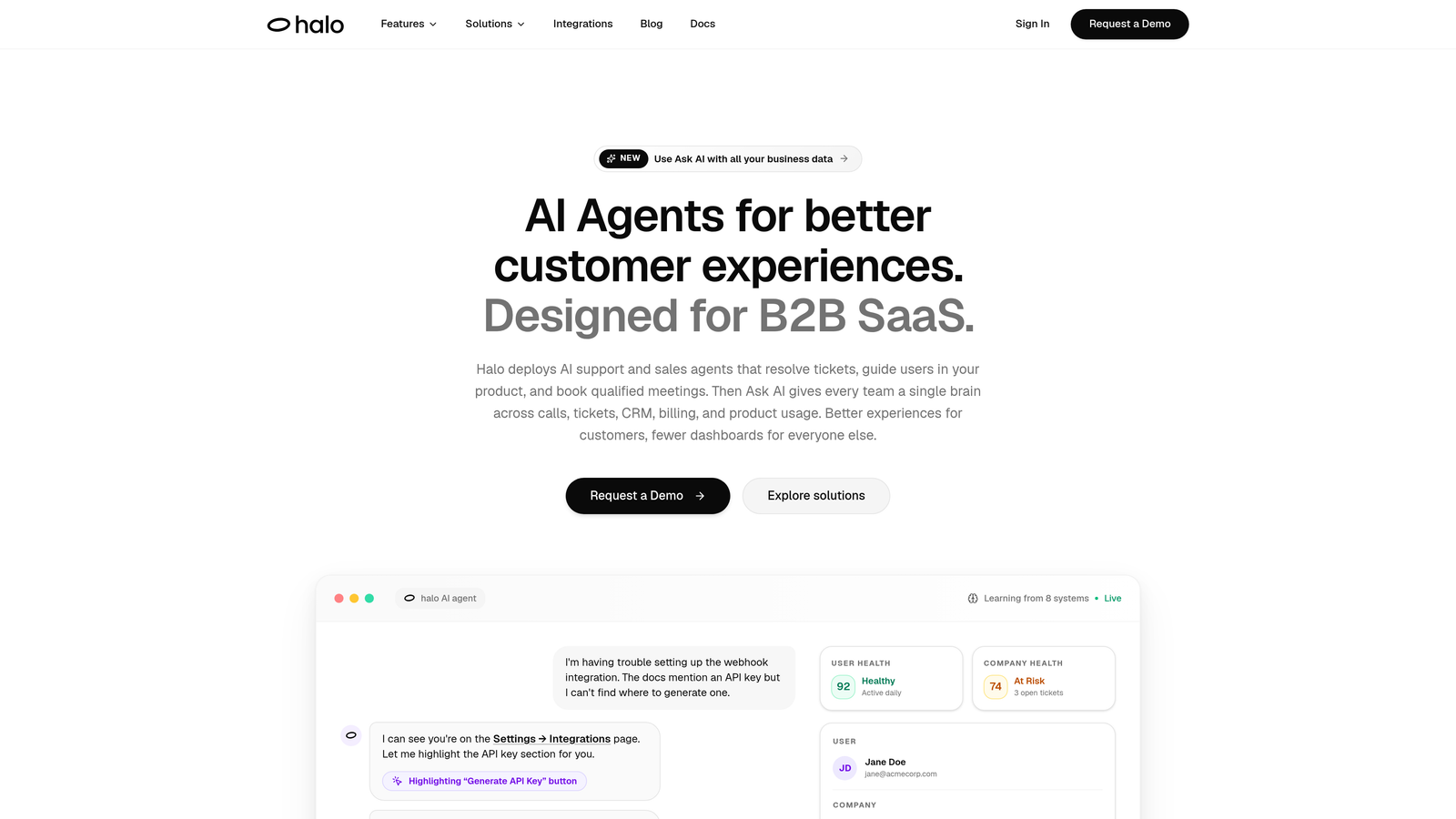
Halo AI is an AI-first helpdesk automation platform built around autonomous agents that resolve tickets, guide users through your product, and surface business intelligence from every interaction.
Where This Tool Shines
What separates Halo AI from most platforms on this list is the distinction between "copilot" and "autopilot." Rather than suggesting responses for human agents to approve, Halo's AI agents fully resolve tickets independently, escalating to humans only when the situation genuinely requires it. That's a meaningful architectural difference when your goal is reducing ticket volume rather than just speeding up agent workflows.
The page-aware chat widget is a standout capability. The AI can see exactly what a user is looking at inside your product, providing visual UI guidance that's grounded in real context rather than generic help center answers. Add continuous learning across every interaction, and the system gets demonstrably smarter over time without manual retraining.
Key Features
Autonomous AI Agents: Fully resolve support tickets without human intervention, handling the complete resolution loop from understanding to response to closure.
Page-Aware Chat Widget: Sees what users see within your product interface, delivering contextually accurate visual guidance rather than generic answers.
Smart Inbox with Business Intelligence: Goes beyond ticket management to surface customer health signals, revenue intelligence, and anomaly detection across your support data.
Auto Bug Ticket Creation: Automatically generates bug reports and routes them into Linear, Slack, and engineering workflows when user-reported issues warrant escalation.
Live Agent Handoff: Transfers complex conversations to human agents with full context preserved, so nothing gets lost in the transition.
Best For
Halo AI is built for B2B SaaS companies that want support automation to do more than deflect tickets. If you need AI that understands your product deeply, connects to your engineering and revenue stack, and delivers business intelligence alongside ticket resolution, this is the platform designed for that use case.
Pricing
Contact for pricing. Halo AI is designed for B2B SaaS teams scaling support operations and offers custom pricing based on team size and use case.
2. Zendesk AI
Best for: Teams already on Zendesk Suite who want AI layered into an existing workflow
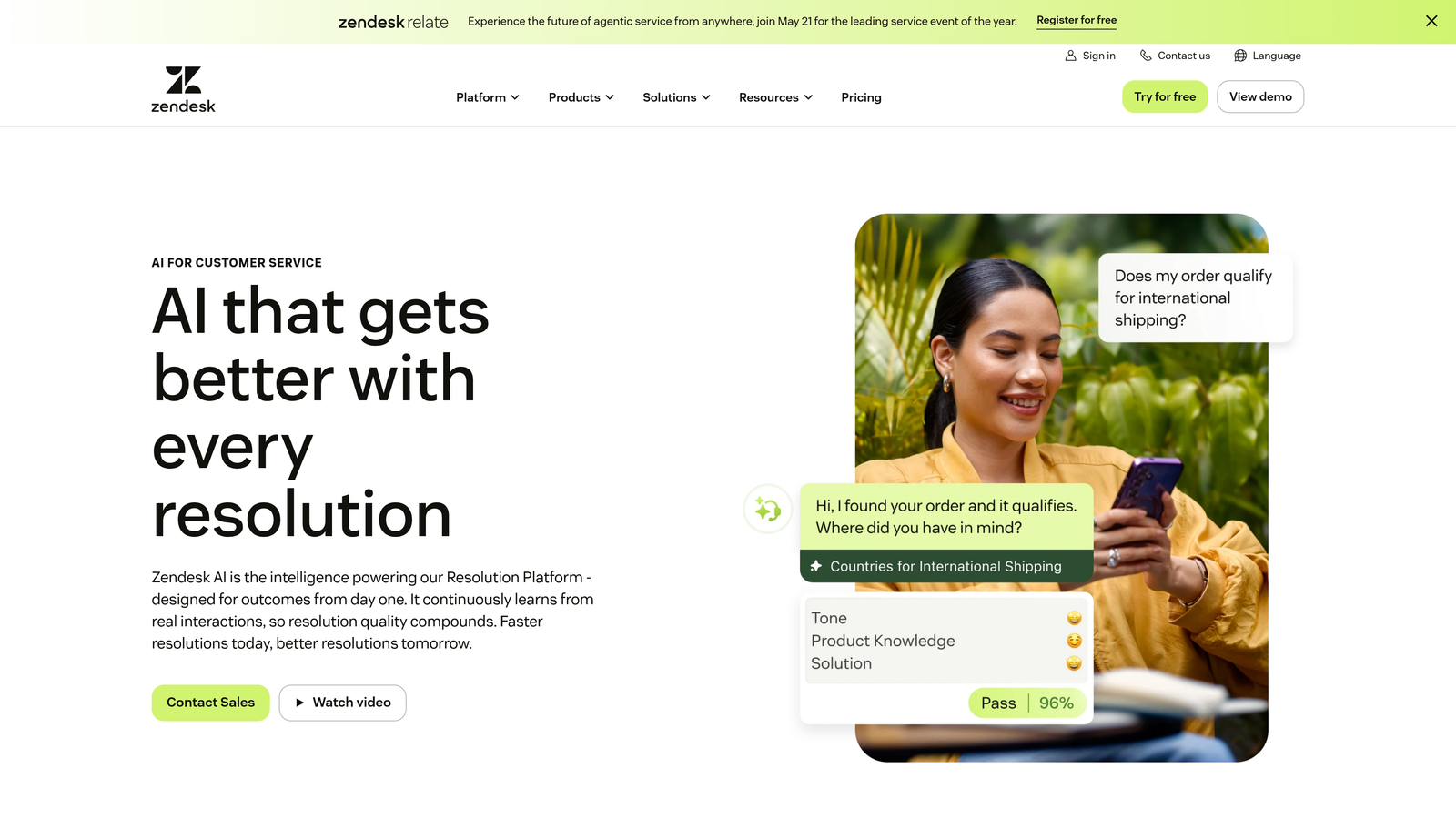
Zendesk AI is a set of AI capabilities built into the Zendesk Suite, covering self-service agents, agent productivity tools, and intelligent ticket triage.
Where This Tool Shines
Zendesk AI's biggest advantage is its native integration with the Zendesk ecosystem. If your team is already working in Zendesk for ticketing, help center, and messaging, the AI layer drops in without a migration project. The agent copilot functionality is particularly well-developed, helping human agents work faster through response suggestions, ticket summaries, and macro recommendations.
For teams that want AI augmentation rather than full autonomy, Zendesk AI offers a comfortable on-ramp. The intelligent triage system automatically detects intent, language, and sentiment, routing tickets more accurately than manual rule-based systems.
Key Features
AI Agents for Self-Service: Automated resolution across channels using help center content and trained knowledge bases.
Agent Copilot: Suggests responses, summarizes long ticket threads, and assists agents with macro selection to speed up resolution.
Intelligent Triage: Automatically classifies tickets by intent, language, and sentiment for more accurate routing and prioritization.
Native Suite Integration: Connects directly with Zendesk ticketing, help center, and messaging without additional configuration overhead.
Best For
Existing Zendesk customers who want to add AI capabilities without switching platforms. Also a strong fit for mid-market and enterprise teams that prefer the copilot model over full autonomous resolution.
Pricing
AI capabilities are available as an add-on to Zendesk Suite plans. Suite Team starts at $55 per agent per month; AI add-on pricing varies by plan tier.
3. Intercom Fin
Best for: Product-led growth companies wanting conversational AI with a per-resolution pricing model
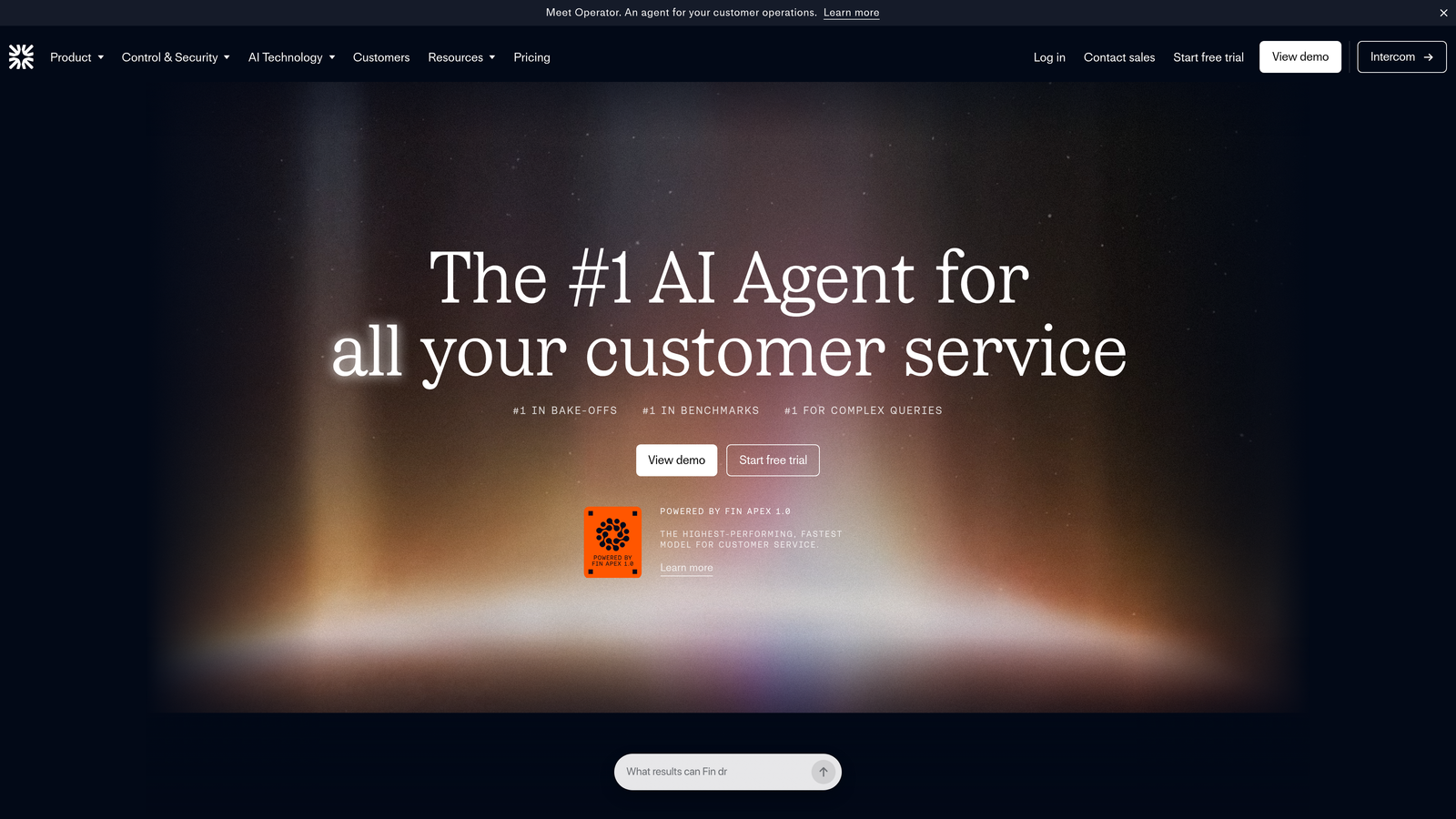
Intercom Fin is an AI-powered support agent built into Intercom's messenger platform, trained on your help center content to resolve customer questions conversationally.
Where This Tool Shines
Fin's per-resolution pricing model is genuinely different from the rest of the market. Rather than paying per seat regardless of AI performance, you pay only when Fin successfully resolves a conversation. That aligns the pricing model with the value delivered, which makes it easier to justify internally and evaluate ROI.
The conversational quality is strong, particularly for product and SaaS use cases where customers ask nuanced questions about features and workflows. Fin draws on help center articles, custom content sources, and conversation history to deliver answers that feel natural rather than scripted.
Key Features
Fin AI Agent: Answers customer questions using help center content, documentation, and custom knowledge sources without requiring manual flow building.
Per-Resolution Pricing: Charges only when Fin successfully resolves a conversation, starting at $0.99 per resolution.
Human Handoff: Transfers unresolved conversations to live agents with full conversation context intact.
Omnichannel Coverage: Deploys across Intercom's in-app messenger, email, and social channels from a single configuration.
Best For
SaaS and tech companies already using Intercom for customer communication. The per-resolution model works particularly well for teams with variable ticket volumes who want predictable cost-per-resolution metrics.
Pricing
Fin charges per resolution starting at $0.99. Intercom base plans start at $29 per seat per month. Total cost depends on resolution volume.
4. Freshdesk Freddy AI
Best for: Growing teams on Freshdesk who want AI automation without leaving the Freshworks ecosystem
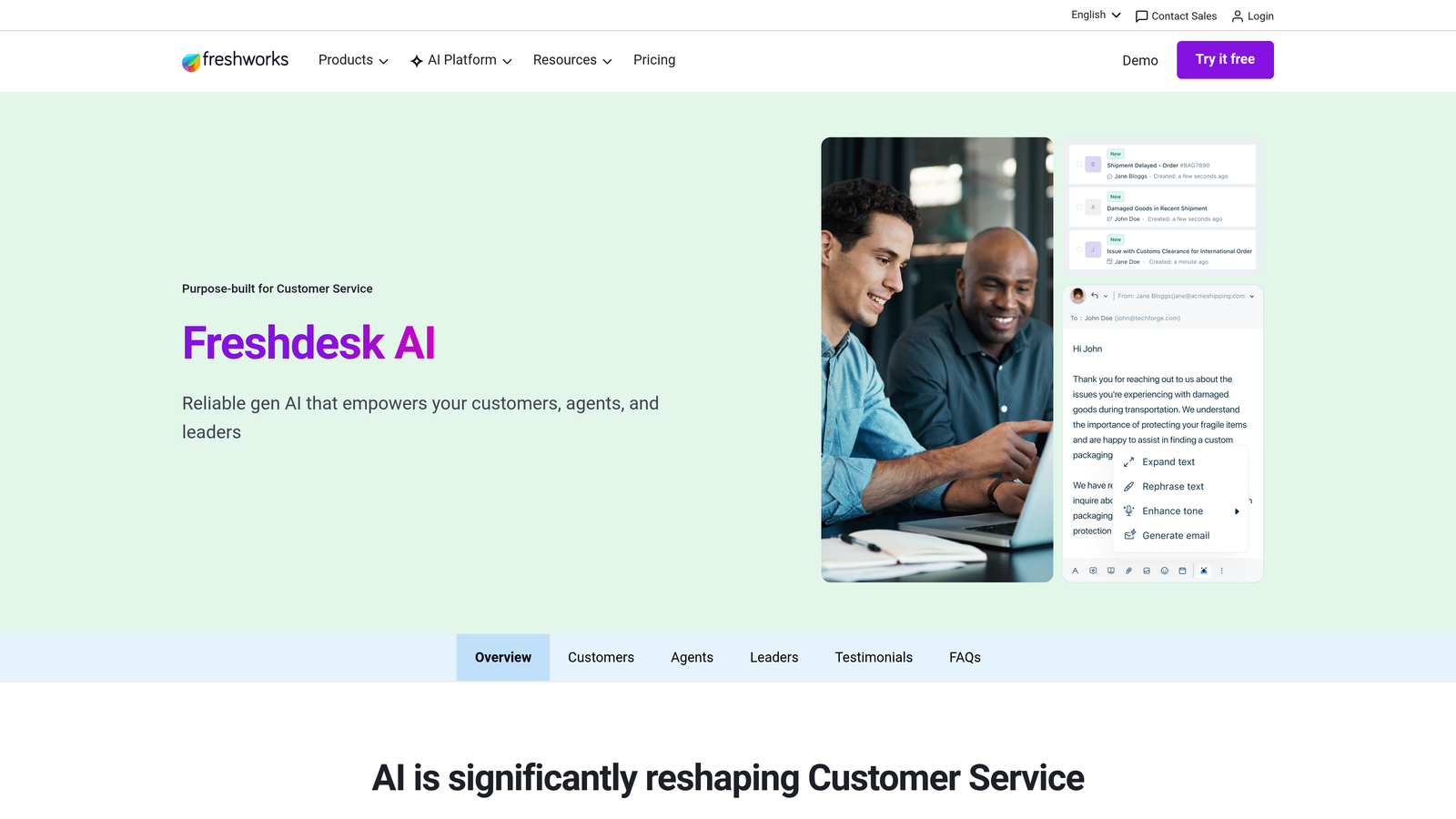
Freshdesk Freddy AI is the AI automation layer within Freshdesk, covering self-service chatbots, auto-triage, and AI-assisted agent responses.
Where This Tool Shines
Freddy AI benefits from deep integration across the entire Freshworks ecosystem. If your team uses Freshdesk alongside Freshworks CRM, ITSM tools, or marketing automation, Freddy can pull context from across those systems to inform support interactions. That cross-product visibility is a meaningful advantage for teams already invested in the Freshworks stack.
The auto-triage functionality handles the classification and routing work that typically falls on team leads, automatically prioritizing tickets based on urgency and routing them to the right agent or queue. For teams drowning in manual triage, this alone can recover significant time.
Key Features
Freddy AI Agent: Self-service resolution via chat widget and web interface, drawing on your knowledge base and help content.
Auto-Triage: Classifies, prioritizes, and routes incoming tickets automatically using AI-detected intent and urgency signals.
AI-Assisted Responses: Suggests canned replies and response drafts to help agents resolve tickets faster.
Freshworks Ecosystem Integration: Connects natively with Freshworks CRM, ITSM, and marketing tools for cross-product context.
Best For
SMB and mid-market teams on Freshdesk, particularly those using other Freshworks products. A solid choice for teams that want practical AI automation without significant implementation overhead.
Pricing
Free tier available. Pro plan with Freddy AI capabilities starts at $49 per agent per month. Enterprise pricing available for larger teams.
5. Ada
Best for: Enterprise teams needing no-code AI agent building with multilingual and omnichannel scale
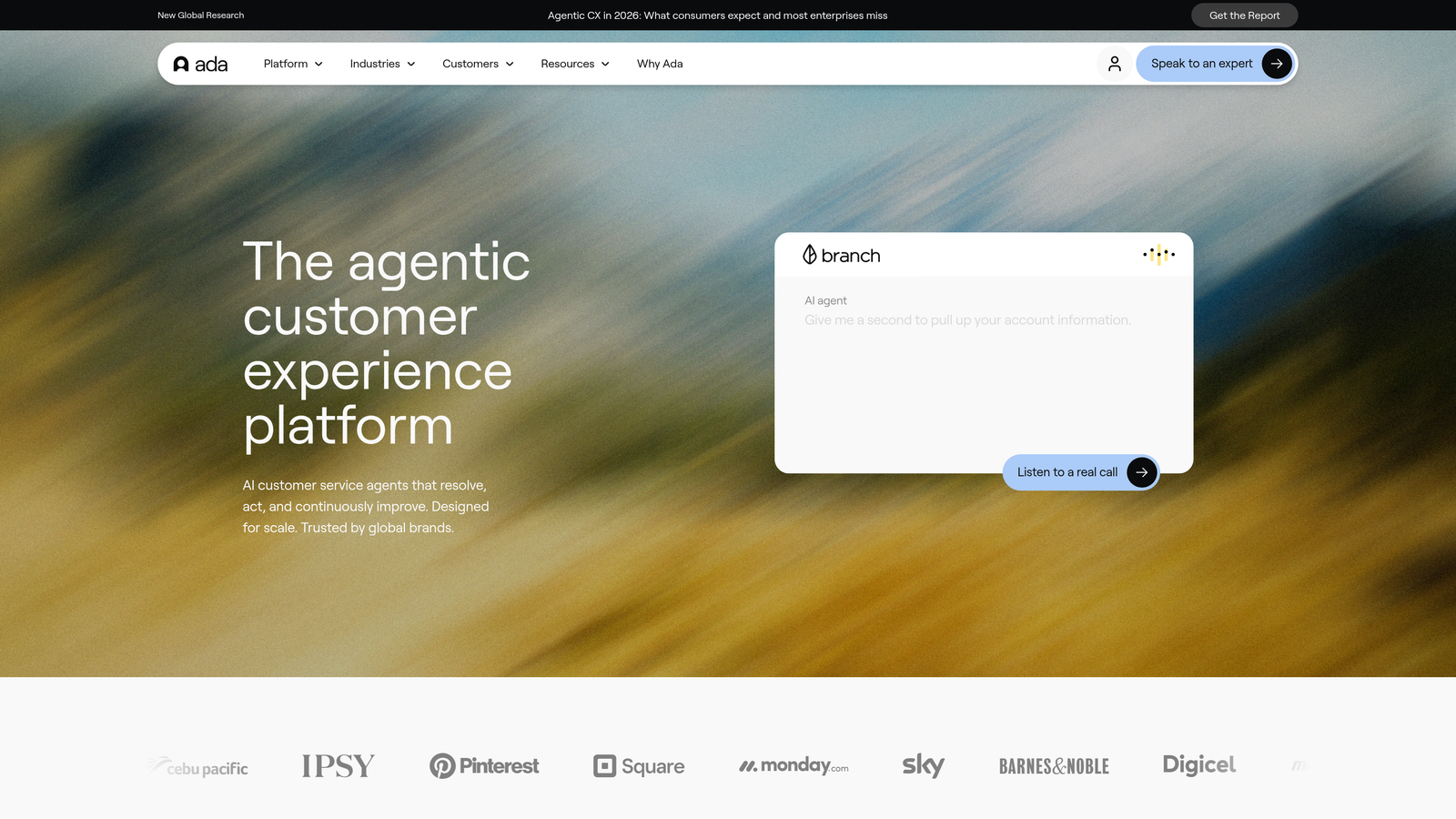
Ada is an enterprise-grade AI automation platform for customer service, offering a no-code AI agent builder with strong multilingual capabilities and broad channel coverage.
Where This Tool Shines
Ada's no-code builder makes it accessible to CX and operations teams who want to build and iterate on automated resolution workflows without engineering involvement. The visual interface allows non-technical users to create sophisticated conversation flows, connect to backend systems, and update content without touching code.
For global enterprises, Ada's support for 50+ languages is a genuine differentiator. Building and maintaining multilingual support automation at that scale is a significant undertaking on most platforms; Ada treats it as a core capability rather than an add-on.
Key Features
No-Code AI Agent Builder: Visual interface for creating automated resolution workflows without engineering resources.
50+ Language Support: Built-in multilingual capabilities for global customer bases across all channels.
Omnichannel Deployment: Deploys across web, mobile, social, and SMS from a single platform configuration.
Helpdesk and CRM Integrations: Connects with Zendesk, Salesforce, and other major platforms to pull and push customer data.
Best For
Enterprise organizations with global customer bases, complex resolution workflows, and a preference for no-code tooling. Particularly strong for teams managing support across multiple languages and channels simultaneously.
Pricing
Custom enterprise pricing. Contact Ada directly for a quote based on your volume and use case requirements.
6. Forethought
Best for: Teams wanting to add generative AI and intelligent triage on top of an existing helpdesk
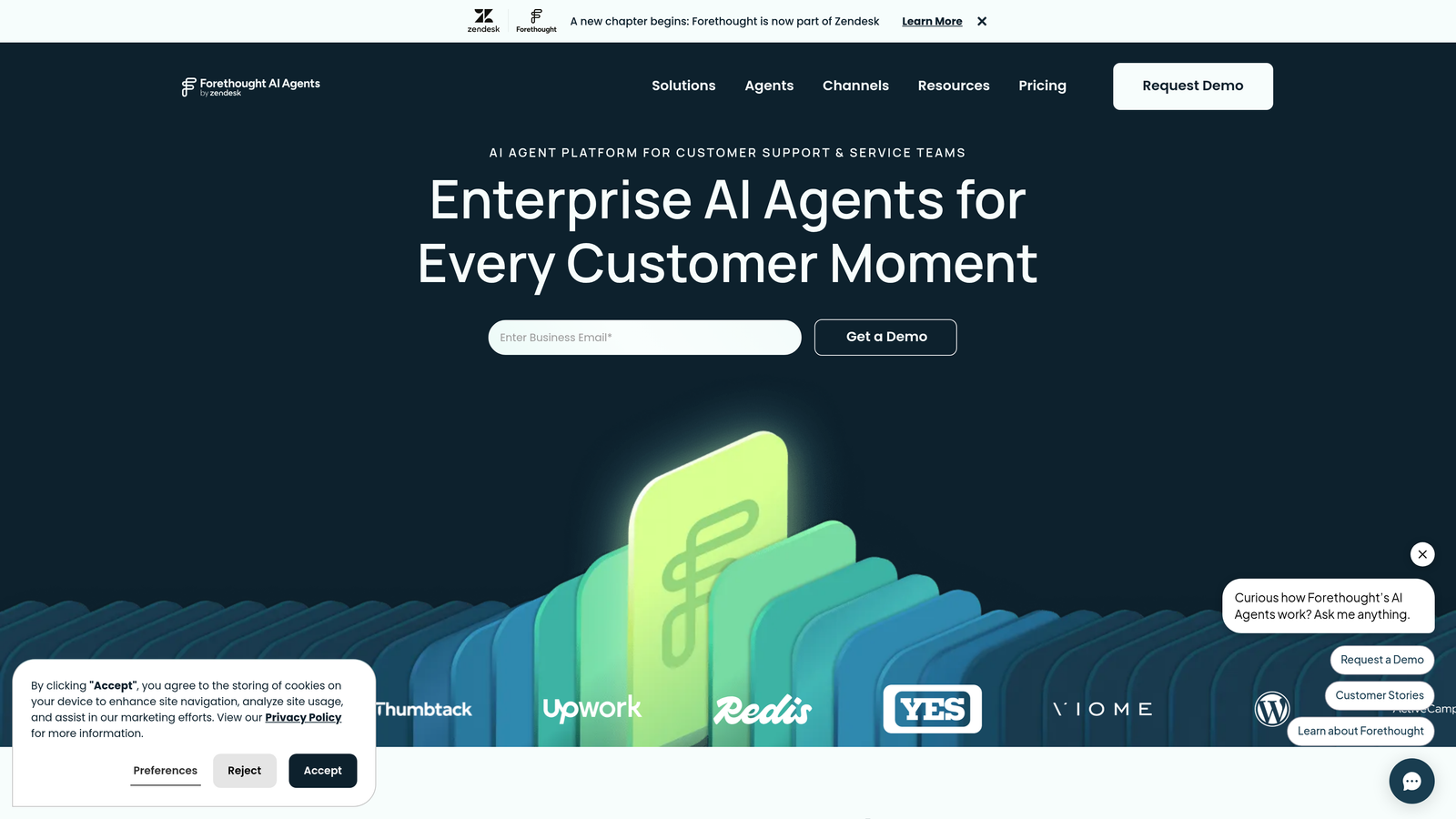
Forethought is an AI platform for customer support that layers intelligent triage, workflow automation, and generative AI capabilities on top of existing helpdesk systems like Zendesk and Salesforce.
Where This Tool Shines
Forethought's positioning as an AI overlay is its defining characteristic. Rather than asking you to replace your helpdesk, it sits on top of whatever you're already using and adds a generative AI layer for ticket responses, knowledge retrieval, and triage intelligence. For teams with significant investment in an existing platform, this approach reduces migration risk considerably.
SupportGPT, Forethought's generative AI engine, is designed specifically for support contexts, generating responses that draw on your existing knowledge base and ticket history rather than producing generic outputs. The analytics dashboard gives teams visibility into AI resolution rates and efficiency metrics over time.
Key Features
SupportGPT: Generative AI engine for ticket response drafting and knowledge retrieval, tuned for customer support contexts.
Intelligent Triage: Predicts intent, urgency, and optimal routing for incoming tickets before agents touch them.
Helpdesk Overlay Architecture: Works on top of Zendesk, Salesforce, and other existing platforms without requiring platform migration.
Analytics Dashboard: Tracks AI resolution rates, deflection metrics, and agent efficiency to quantify impact over time.
Best For
Mid-market and enterprise teams with established helpdesk investments who want to add generative AI capabilities without a full platform replacement. Strong fit for Zendesk and Salesforce Service Cloud users.
Pricing
Custom pricing based on ticket volume and use case. Contact Forethought for a quote tailored to your team's needs.
7. Tidio
Best for: SMBs and e-commerce businesses wanting accessible AI chat automation with a low barrier to entry
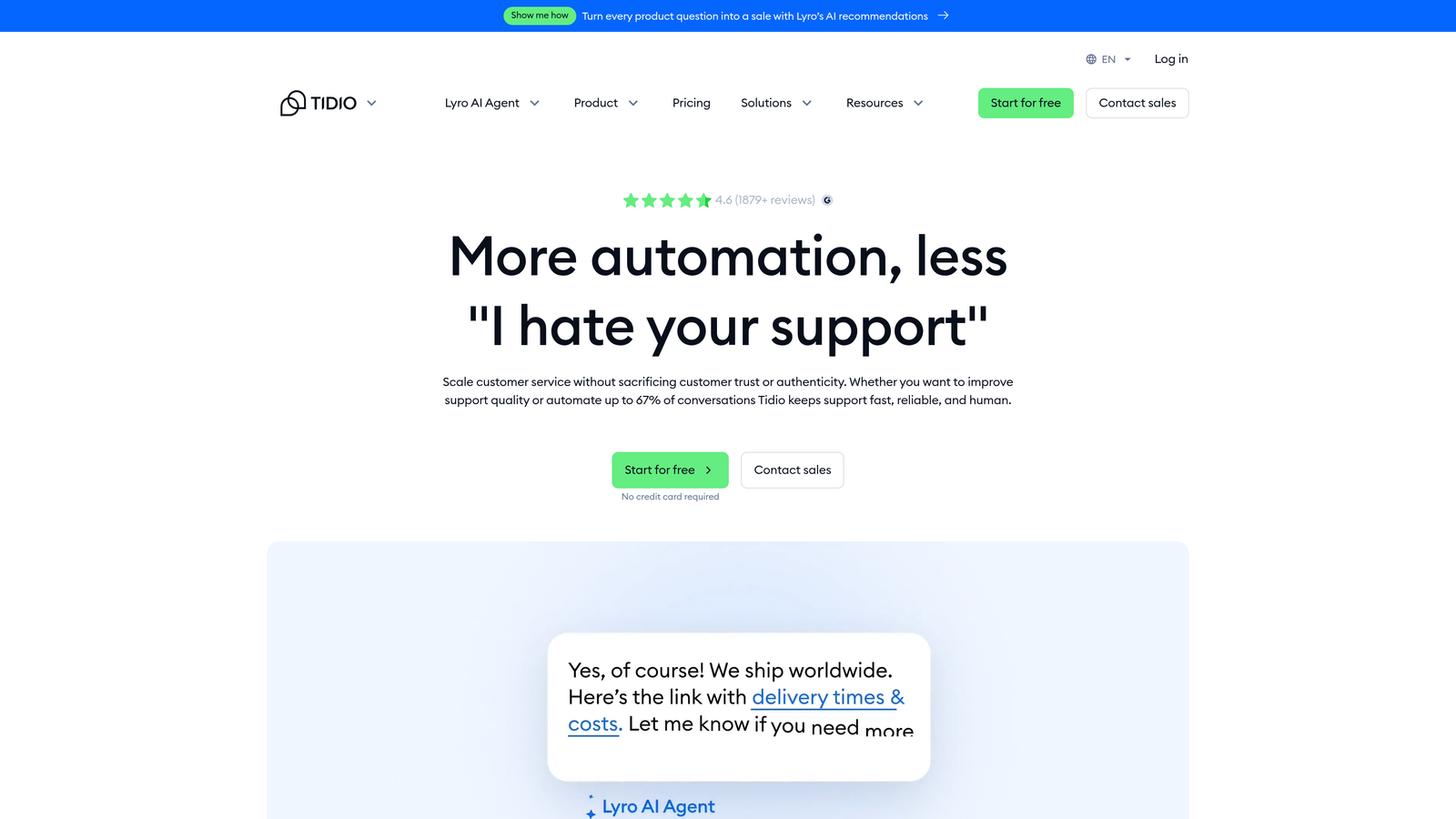
Tidio is an accessible AI chatbot and helpdesk platform combining live chat, the Lyro AI chatbot, and basic ticketing in a single interface.
Where This Tool Shines
Tidio's strength is accessibility. The platform is designed for teams without dedicated technical resources, and the visual chatbot flow builder lets non-technical users create automated conversations quickly. Getting from signup to a working AI chatbot is a matter of hours rather than weeks, which matters for small teams that need results fast.
Lyro, Tidio's AI chatbot, learns from your FAQ content and help documentation to answer questions autonomously. It's not as sophisticated as enterprise-grade platforms, but for common support scenarios in e-commerce and SMB contexts, it handles a meaningful share of incoming conversations without human involvement.
Key Features
Lyro AI Chatbot: Learns from FAQ and help content to autonomously answer customer questions without manual flow building.
Visual Flow Builder: Drag-and-drop chatbot builder accessible to non-technical users for creating custom conversation flows.
Unified Interface: Combines live chat, AI chatbot, and basic ticketing in one platform rather than requiring multiple tools.
E-Commerce Integrations: Native integrations with Shopify, WordPress, and other e-commerce platforms for context-aware support.
Best For
Small businesses, e-commerce stores, and teams new to AI-powered support automation. The free plan and low starting price make it a practical entry point without significant financial commitment.
Pricing
Free plan available. AI-enabled plans start at $29 per month. Pricing scales based on conversation volume and feature requirements.
8. Kustomer
Best for: High-volume support teams that need CRM-level customer context inside every support interaction
Kustomer is a CRM-centric customer service platform with AI-powered classification, routing, and a unified customer timeline that gives agents full context for every interaction.
Where This Tool Shines
Kustomer's unified customer timeline is genuinely useful for complex support environments. Rather than treating each ticket in isolation, agents see the complete history of every interaction a customer has had across all channels, alongside CRM data, order history, and previous resolutions. That context reduces the time agents spend gathering background information before they can actually help.
The AI capabilities are built to work with that rich data layer, using classification and sentiment analysis to prioritize and route tickets based on actual customer context rather than just ticket content. For teams managing high-value customer relationships, this combination of CRM depth and AI automation is a meaningful differentiator.
Key Features
Unified Customer Timeline: Aggregates all customer interactions across every channel into a single chronological view for agents.
AI Classification and Sentiment Analysis: Automatically classifies tickets and detects sentiment to inform routing and prioritization decisions.
CRM-Level Data Access: Customer data, purchase history, and relationship context are accessible directly within the support workflow.
Custom Automation Engine: Build tailored routing rules and workflow automations using a flexible rules-based system.
Best For
Mid-market and enterprise teams managing high-value customer relationships where context and history matter as much as speed. Strong fit for companies with complex, multi-channel support needs and existing CRM data they want to activate.
Pricing
Enterprise plan starts at $89 per user per month. Contact Kustomer for custom pricing based on team size and requirements.
9. HubSpot Service Hub
Best for: Teams in the HubSpot ecosystem who want AI-enhanced support connected to sales and marketing data
HubSpot Service Hub is an AI-enhanced customer service platform within the HubSpot ecosystem, including the Breeze AI chatbot, knowledge base, ticketing, and SLA management.
Where This Tool Shines
Service Hub's core advantage is its native connection to HubSpot's CRM, marketing, and sales tools. Support agents can see a customer's full lifecycle history, including deal stage, marketing engagement, and previous service interactions, without switching platforms. For teams where customer success and support overlap, that unified view is practically valuable.
The Breeze AI chatbot handles automated conversations and ticket deflection, while the knowledge base builder uses AI to suggest articles based on common ticket topics. It's not the most advanced AI resolution engine on this list, but for teams already running HubSpot, the integration value often outweighs the gap in pure AI sophistication.
Key Features
Breeze AI Chatbot: Automates customer conversations and deflects tickets using help content and conversation training.
Unified CRM View: Connects service tickets directly with HubSpot sales, marketing, and customer data for full lifecycle context.
AI-Suggested Knowledge Base: Recommends knowledge base articles based on common support topics to improve self-service coverage.
SLA and Ticket Pipeline Management: Manages service level agreements, ticket pipelines, and customer feedback surveys within the same platform.
Best For
Companies already using HubSpot for CRM, marketing, or sales who want to bring customer service into the same ecosystem. Also a practical choice for smaller teams that want free or low-cost entry-level support tooling with room to grow.
Pricing
Free tools available. Starter plan at $20 per month. Professional plan at $100 per seat per month. Enterprise pricing available for larger organizations.
Which Platform Is Right for Your Team?
The right choice depends on where you are today and what you're actually trying to solve. Here's a quick orientation by use case.
If you want true autonomous resolution with product-aware context and business intelligence built in, Halo AI is the platform built specifically for that outcome. It's the strongest fit for B2B SaaS teams that want AI agents handling the full resolution loop, not just assisting human agents.
If you're already on Zendesk or Freshdesk and want to add AI without migrating, Zendesk AI and Freddy AI are the natural paths. They won't require you to rebuild your support infrastructure, and they deliver meaningful productivity improvements within familiar workflows.
If you need generative AI layered on top of an existing helpdesk, Forethought is worth evaluating. Its overlay architecture is designed for exactly that scenario, with minimal disruption to current operations.
For enterprise scale with multilingual and omnichannel requirements, Ada is purpose-built for that complexity. And for teams where CRM context is central to support quality, Kustomer's unified timeline approach stands out.
For smaller teams and e-commerce businesses that need an accessible starting point, Tidio and HubSpot Service Hub both offer free tiers with a clear upgrade path.
The trend in 2026 is clear: buyers are moving away from copilot AI that assists agents and toward autopilot AI that resolves tickets independently. The platforms that handle that transition well, while maintaining quality through continuous learning, are the ones worth investing in.
Your support team shouldn't scale linearly with your customer base. Let AI agents handle routine tickets, guide users through your product, and surface business intelligence while your team focuses on complex issues that need a human touch. See Halo in action and discover how continuous learning transforms every interaction into smarter, faster support.