9 Best AI Helpdesk Software Plans in 2026
This guide compares nine leading AI helpdesk software plans on what matters most to B2B teams in 2026: out-of-the-box AI capability, honest pricing tier breakdowns, and the ability to scale support operations without inflating headcount costs. Whether you're a SaaS startup or an enterprise replacing a legacy helpdesk, this breakdown helps you cut through vendor noise and choose the right platform.
 Grant CooperFounder13 min read
If you're evaluating AI helpdesk software, you've probably noticed that pricing pages tell you very little about what you're actually getting. Most platforms bury their best AI features behind enterprise tiers, charge per-seat for capabilities that should be table stakes, or bolt automation onto legacy helpdesk infrastructure that was never designed for it.
This guide cuts through the noise. We've compared nine AI helpdesk platforms on what actually matters for B2B teams: how capable the AI is out of the box, what's included at each pricing tier, and whether the platform scales with your support operation without ballooning headcount costs.
Whether you're a SaaS startup automating your first support workflows or a scaling company ready to replace your legacy helpdesk entirely, here are the top AI helpdesk software plans worth evaluating in 2026.
1. Halo AI
Best for: B2B SaaS teams that want AI-native support with business intelligence built in
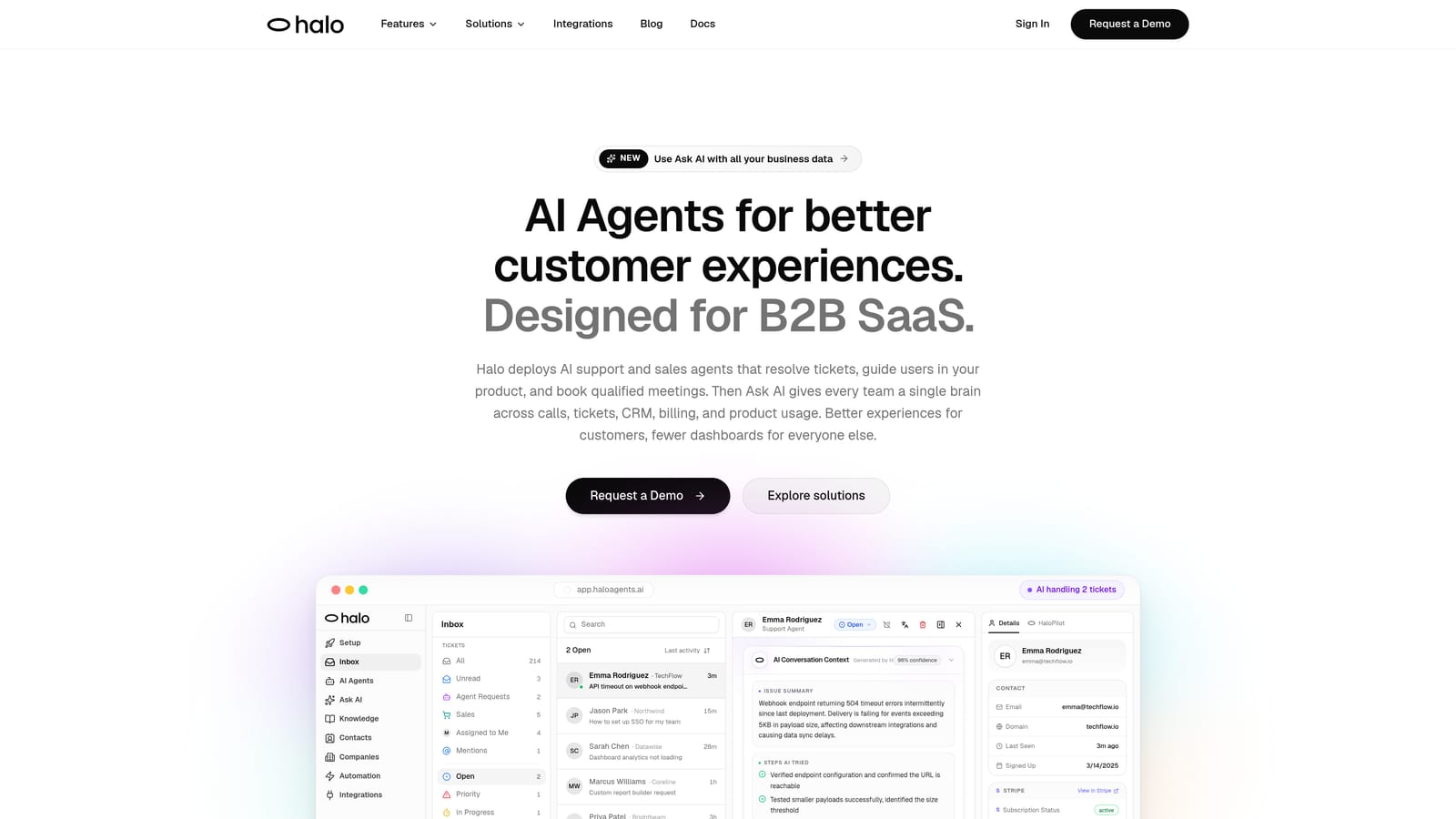
Halo AI is an AI-native customer support platform that deploys intelligent agents to resolve tickets, guide users through your product with page-aware context, and surface business intelligence — all while learning continuously from every interaction.
Where This Tool Shines
What separates Halo AI from most tools on this list is the architecture. It wasn't built by layering AI onto an existing helpdesk. The AI is the foundation, which means every feature, from ticket resolution to bug reporting to business intelligence, is designed around how AI actually works rather than how a 2012-era ticketing system works.
The page-aware chat widget is particularly notable. The AI understands what screen or page a user is on when they reach out, which means it can offer contextually relevant guidance rather than generic responses. Combined with continuous learning from every resolved interaction, the system gets meaningfully smarter over time rather than staying static.
Key Features
Page-Aware AI Agents: The AI understands the user's current screen context, enabling precise in-product guidance without requiring users to describe their situation from scratch.
Continuous Learning: Every resolved interaction feeds back into the model, improving response quality and resolution rates over time without manual retraining.
Auto Bug Ticket Creation: When users report issues, Halo automatically creates and routes bug tickets to Linear, closing the loop between support and engineering without manual handoffs.
Smart Inbox with Business Intelligence: Beyond support metrics, the inbox surfaces customer health signals, revenue intelligence, and anomaly detection, turning support data into operational insight.
Live Agent Handoff: Complex conversations escalate to human agents with full context preserved, so customers never have to repeat themselves.
Deep Integration Stack: Connects natively with Slack, HubSpot, Stripe, Zoom, Intercom, PandaDoc, and Fathom, making it a connective layer across your entire business stack.
Best For
B2B SaaS companies and product teams that want AI to handle routine ticket resolution while also generating business intelligence from support interactions. Particularly strong for teams that have outgrown bolt-on AI features and want a platform built for autonomous support from the ground up.
Pricing
Contact Halo AI directly for current plan details at haloagents.ai. Pricing is designed to scale with your support operation rather than your headcount.
2. Intercom
Best for: Teams that want a mature AI agent with strong natural language understanding
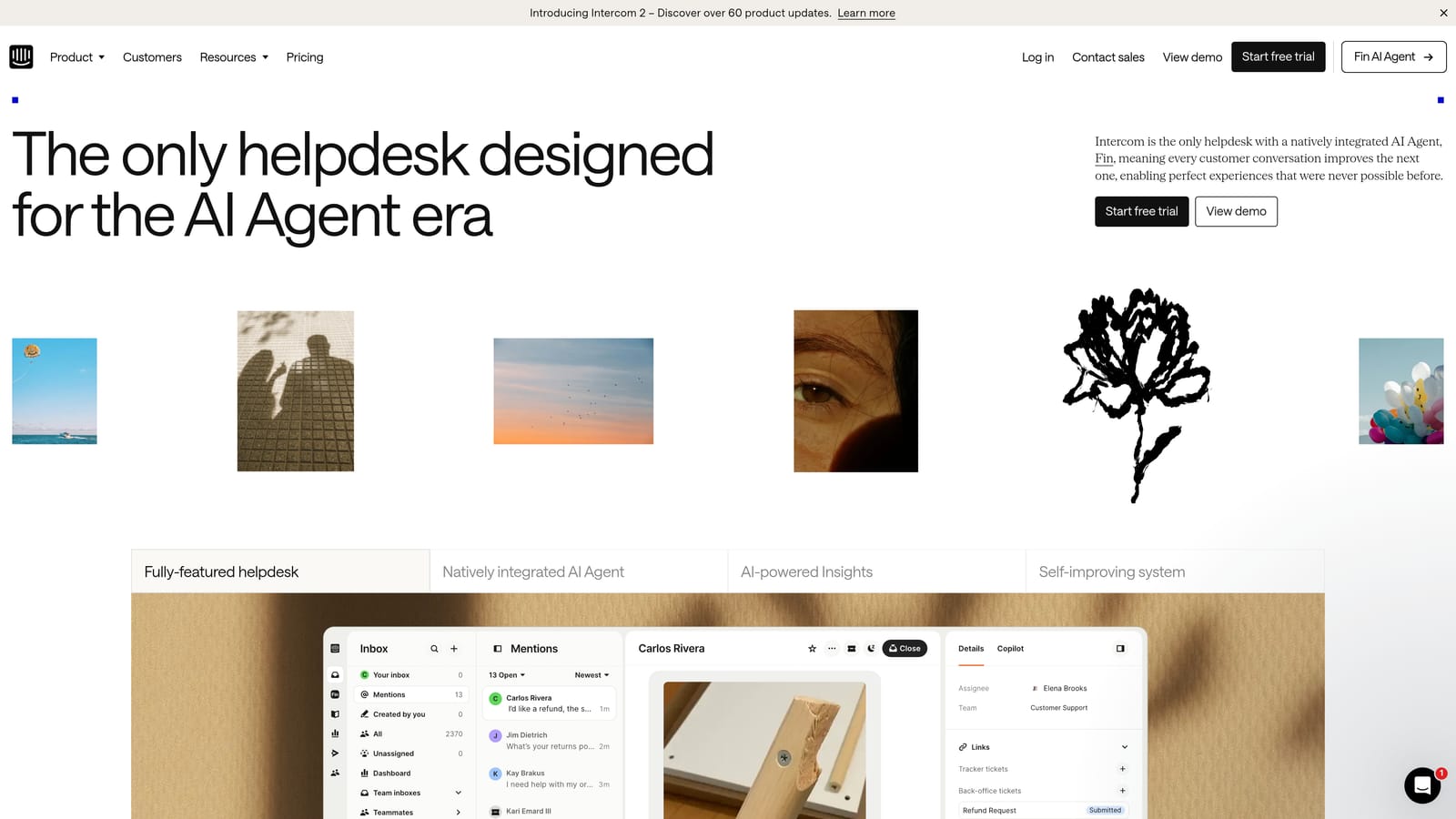
Intercom is a customer messaging platform with Fin, a well-regarded AI agent that handles support conversations using natural language understanding across multiple channels.
Where This Tool Shines
Fin is one of the more capable AI agents in the market when it comes to handling nuanced support conversations. It draws from your knowledge base and can resolve a wide range of queries without human intervention. The platform's omnichannel reach, covering chat, email, and social, makes it a strong fit for teams managing customer communication across multiple surfaces.
The per-resolution pricing model for Fin is worth understanding carefully. You pay per ticket that Fin resolves rather than a flat seat fee. This can be cost-effective if your resolution rates are high, but costs can compound quickly at scale. It's a model that rewards high-quality knowledge bases and well-scoped AI deployment.
Key Features
Fin AI Agent: Handles customer conversations with strong natural language understanding, drawing from your existing help content.
Per-Resolution Pricing: AI-resolved tickets are billed individually, separating AI costs from base platform costs.
Omnichannel Messaging: Unified inbox across chat, email, and social channels.
Agent Inbox with AI Assist: Human agents get AI-generated suggestions and summaries to speed up response times.
Robust Integration Ecosystem: Connects with a wide range of CRM, analytics, and product tools.
Best For
Growing SaaS companies with a strong knowledge base that want a proven AI agent without building custom workflows. Best suited to teams comfortable with usage-based pricing and willing to invest in knowledge base quality to maximize Fin's resolution rates.
Pricing
Starter plan is publicly listed; Fin is charged per resolution and may be included or available as an add-on depending on tier. Verify current pricing at intercom.com/pricing.
3. Zendesk
Best for: Enterprise teams needing a proven, extensible helpdesk with AI layered on top
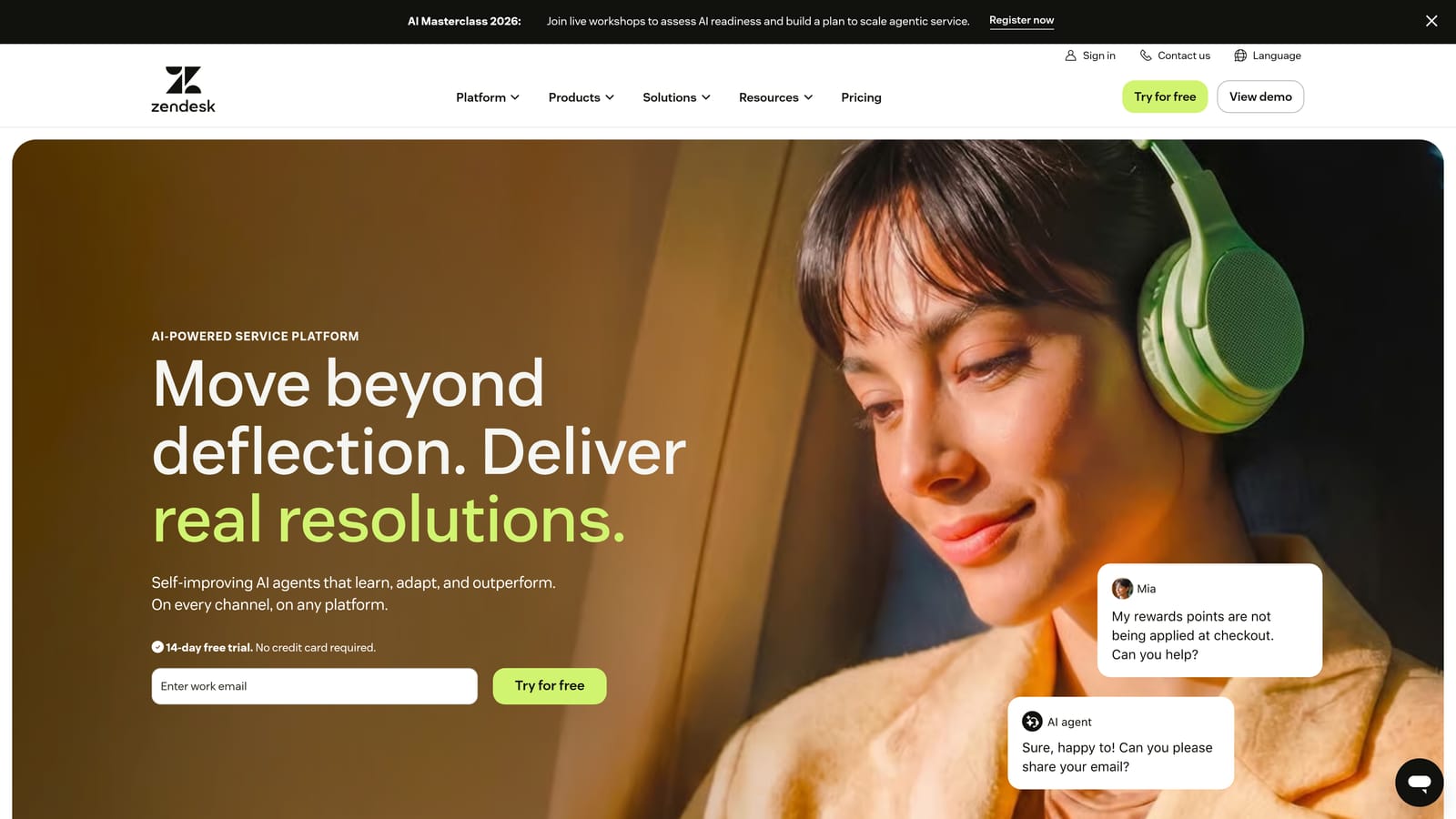
Zendesk is an enterprise-grade helpdesk platform with an AI Suite add-on that brings intelligent triage, agent copilot, and macro suggestions to its core ticketing infrastructure.
Where This Tool Shines
Zendesk's strength is breadth. It handles email, chat, voice, and social through a single platform, integrates with hundreds of tools via its app marketplace, and offers advanced reporting that large support operations genuinely need. For teams with complex routing requirements and multi-channel volume, the infrastructure is battle-tested.
The AI Suite add-on brings meaningful capabilities: intelligent triage routes tickets based on intent and sentiment, the agent copilot suggests responses and next steps, and macro suggestions automate repetitive reply patterns. The trade-off is that AI features are an additional cost on top of already substantial base plan pricing, which can make the total cost of ownership higher than it first appears.
Key Features
AI Suite Add-On: Adds intelligent triage, routing, and agent copilot capabilities to base Suite plans.
Agent Copilot: Suggests responses, macros, and next actions to speed up agent resolution times.
Multi-Channel Support: Handles email, chat, voice, and social from a single unified workspace.
Extensive App Marketplace: Hundreds of native integrations covering CRM, analytics, billing, and more.
Advanced Reporting: Granular analytics for SLA tracking, team performance, and ticket volume trends.
Best For
Enterprise support teams with high ticket volumes, complex routing needs, and existing investment in the Zendesk ecosystem. Less ideal for smaller teams where per-seat pricing plus AI add-on costs can become disproportionate to team size.
Pricing
Suite plans start from approximately $55 per agent per month; AI Suite is an additional cost. Verify current pricing at zendesk.com/pricing.
4. Freshdesk
Best for: SMBs and growing teams that want AI features at an accessible price point
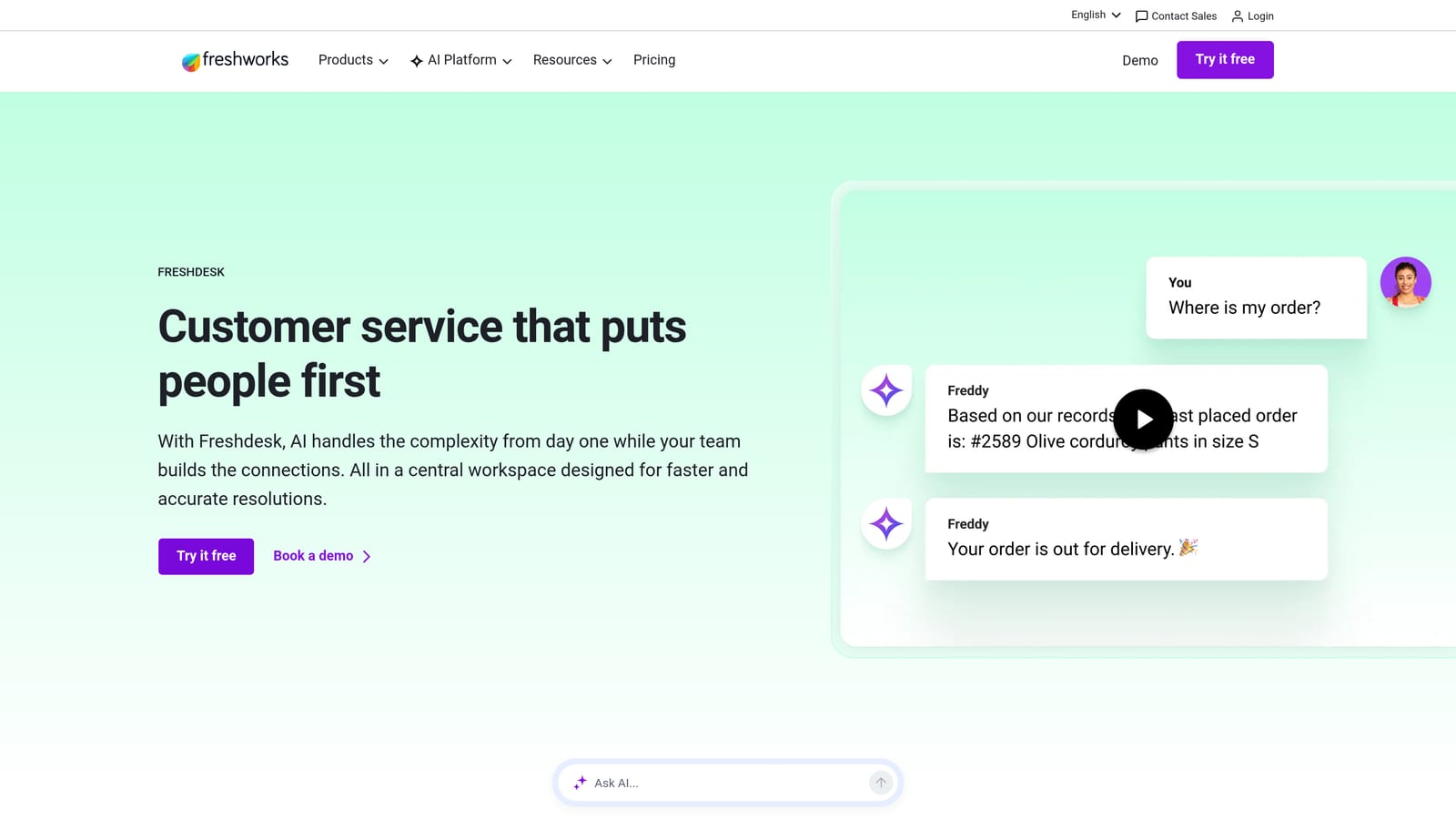
Freshdesk is a helpdesk platform with Freddy AI built across its tiers, offering both agent-assist and customer-facing self-service automation at competitive price points.
Where This Tool Shines
Freshdesk's biggest advantage is accessibility. The free plan gives small teams a real starting point, and Freddy AI appears across paid tiers rather than being locked exclusively behind enterprise pricing. For teams that want AI-assisted support without a significant upfront investment, this is one of the more approachable entry points in the market.
Freddy Copilot handles agent-side assistance, suggesting responses and summarizing ticket history. Freddy Self Service is the customer-facing bot for deflection and automated resolution. They're distinct products with separate pricing, so it's worth mapping out which capabilities you actually need before selecting a tier.
Key Features
Freddy AI Copilot: Assists agents with response suggestions, ticket summaries, and next-step recommendations.
Freddy Self Service: Customer-facing AI bot for automated query resolution and deflection.
Free Plan: Available for small teams with core ticketing features included.
Multi-Channel Ticketing: Email, chat, phone, and social channels unified in one inbox.
Affordable Paid Tiers: Growth and Pro plans offer meaningful AI features without enterprise-level pricing.
Best For
Small to mid-sized businesses that want AI-assisted support without committing to enterprise pricing. Also a strong fit for teams already using other Freshworks products, given the native integrations across the suite.
Pricing
Free plan available; paid plans start from approximately $15 per agent per month. Verify current pricing at freshdesk.com/pricing.
5. Help Scout
Best for: Teams that prioritize agent experience and human-first support philosophy
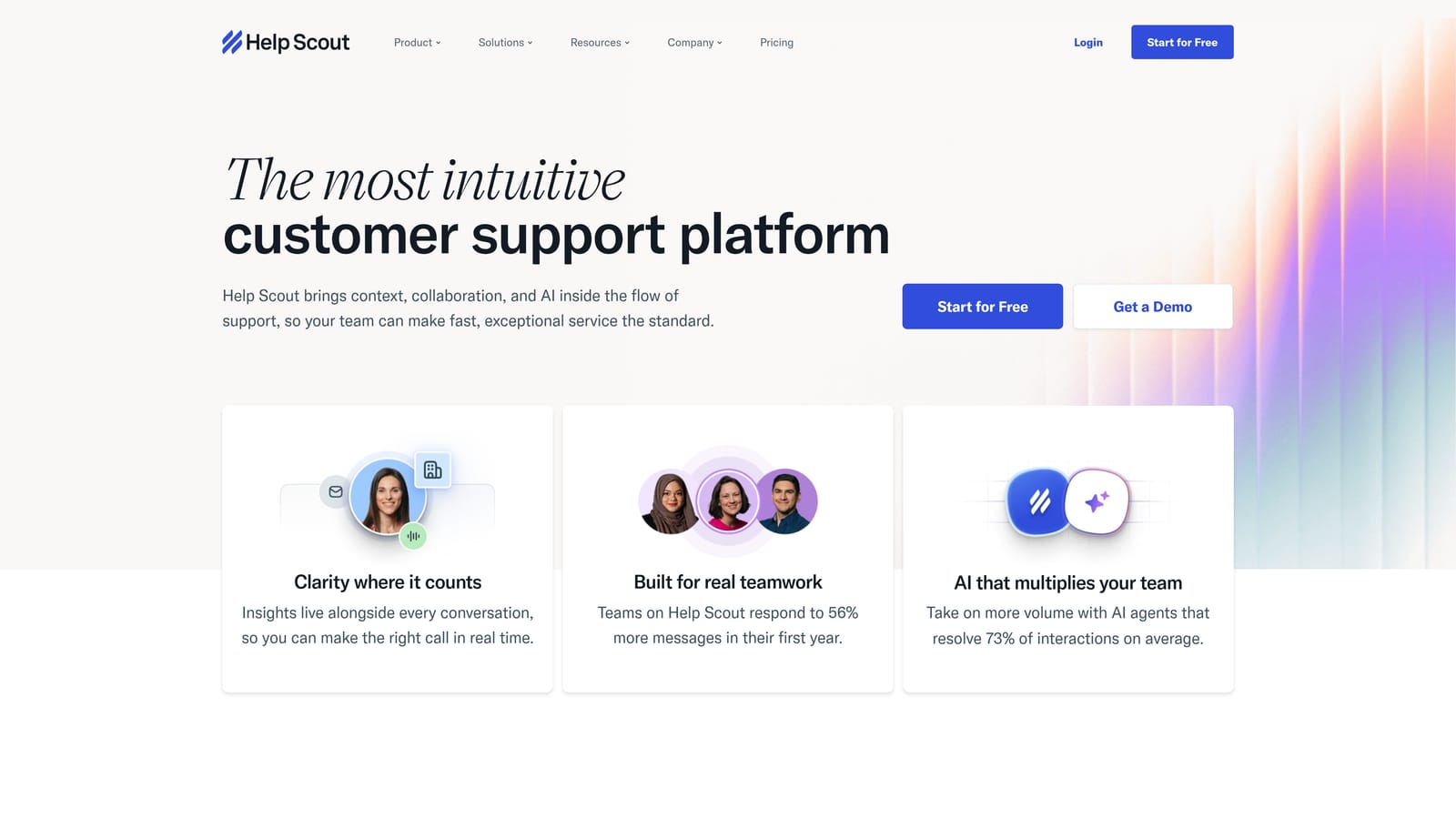
Help Scout is a human-first support platform that uses AI to assist agents rather than replace them, with clean UX and straightforward pricing that avoids the complexity of enterprise helpdesk tools.
Where This Tool Shines
Help Scout takes a deliberate philosophical stance: AI should make human agents faster and more effective, not replace them with bots. This shows up in the product design. AI Summarize gives agents instant context on long conversation threads. AI Drafts generates response suggestions that agents can refine and send. The focus is on reducing cognitive load rather than maximizing deflection rates.
For teams where support quality and relationship-building are core to the business model, this approach is genuinely differentiated. The UX is clean and onboarding is fast, which matters for smaller teams without dedicated support operations staff.
Key Features
AI Summarize: Condenses long conversation threads into quick context for agents picking up mid-ticket.
AI Drafts: Generates response suggestions based on conversation context for agents to review and send.
Shared Inbox with Collaboration Tools: Includes notes, assignments, and collision detection for team coordination.
Beacon Chat Widget: Embeddable chat widget for website and in-app support.
Docs Knowledge Base: Built-in knowledge base builder for self-service content.
Best For
Customer-focused teams where support quality matters more than deflection volume. Strong fit for SaaS companies with complex customer relationships, professional services teams, and any organization where human judgment is central to the support experience.
Pricing
Standard, Plus, and Pro plans available. Verify current pricing at helpscout.com/pricing.
6. Tidio
Best for: Small businesses and e-commerce stores that need fast AI chat setup
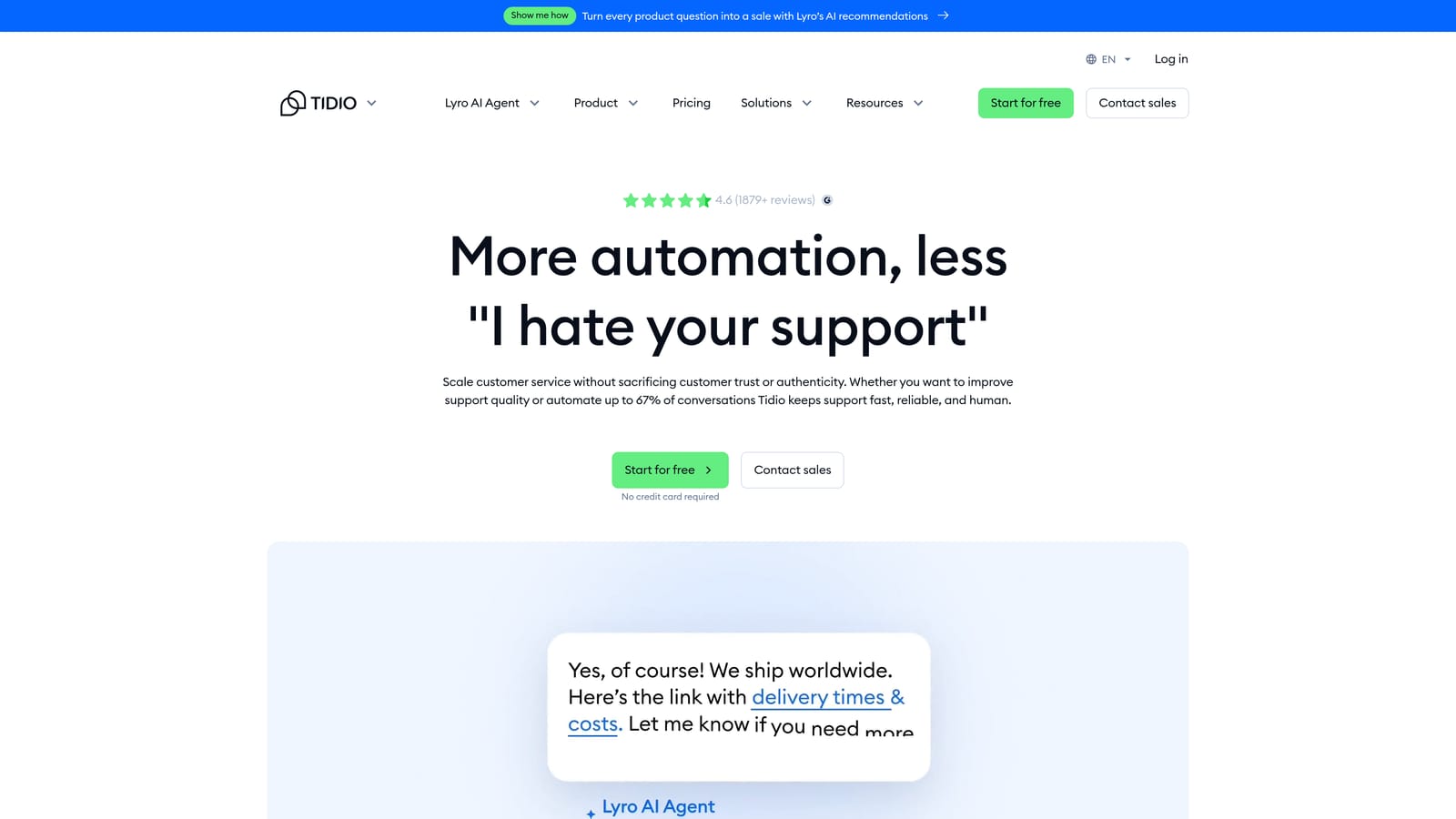
Tidio is a live chat and AI chatbot platform built for small businesses and e-commerce, featuring Lyro, an AI agent built on Anthropic's Claude for natural, context-aware conversations.
Where This Tool Shines
Tidio's standout quality is how quickly you can get an AI-powered chat experience live. The setup requires minimal technical resources, which makes it accessible to small teams without dedicated engineering support. Lyro, built on Claude, handles a broad range of customer queries with natural language quality that punches above its price point.
The e-commerce integrations with Shopify and WooCommerce are genuinely useful, allowing Lyro to answer order status questions, assist with returns, and handle product queries with real data rather than generic responses. For small online retailers, this is often the highest-volume support category.
Key Features
Lyro AI Chatbot: Built on Anthropic's Claude for natural, context-aware customer conversations.
Low-Code Setup: Deployable without technical resources, typically within hours.
Live Chat with Agent Handoff: Seamless escalation from Lyro to human agents when needed.
E-Commerce Integrations: Native connections to Shopify and WooCommerce for order-aware responses.
Free Tier: Available for teams getting started with limited conversation volume.
Best For
Small businesses, e-commerce brands, and teams that need a quick-to-deploy AI chat solution without complex implementation. Less suited for B2B SaaS teams needing deep product integrations or business intelligence capabilities.
Pricing
Free tier available; Lyro is a paid add-on. Starter, Growth, and Tidio+ plans available. Verify current pricing at tidio.com/pricing.
7. Zoho Desk
Best for: Teams already in the Zoho ecosystem that want context-aware AI at competitive pricing
Zoho Desk is a context-aware helpdesk with Zia AI for sentiment analysis, ticket tagging, and anomaly detection, tightly integrated with the broader Zoho business suite.
Where This Tool Shines
Zia brings a different flavor of AI to the helpdesk space. Rather than focusing purely on ticket deflection, Zia analyzes sentiment across conversations, automatically tags tickets by topic and urgency, and flags anomalies when ticket volumes spike unexpectedly. For support managers who want to understand what's happening in their queue, not just process it faster, this is genuinely useful intelligence.
The Zoho CRM integration is tight and meaningful. Agents can see full customer history, deal status, and account context without switching tools, which is particularly valuable for B2B support where customer context shapes how you handle issues.
Key Features
Zia AI Sentiment Analysis: Analyzes conversation tone to flag frustrated customers and prioritize responses accordingly.
Automatic Ticket Tagging: Zia categorizes and tags incoming tickets to streamline routing and reporting.
Anomaly Detection: Alerts support managers when ticket volume or patterns deviate from expected norms.
Deep Zoho CRM Integration: Full customer account context embedded directly in the agent view.
Multi-Channel Support: Email, chat, social, and phone channels managed from a single workspace.
Best For
Companies already using Zoho CRM or other Zoho products that want a helpdesk with strong native integration and competitive pricing. The value compounds significantly for existing Zoho customers who benefit from the unified data layer.
Pricing
Standard, Professional, and Enterprise tiers available. Verify current pricing at zoho.com/desk/pricing.
8. Gorgias
Best for: E-commerce brands with high-volume order-related support queries
Gorgias is a helpdesk built specifically for e-commerce brands, with AI automation focused on order management, returns, and shipping queries, plus revenue attribution built directly into the platform.
Where This Tool Shines
Gorgias is purpose-built for a specific problem: high-volume, repetitive support queries in e-commerce. Order status, return requests, shipping delays, and refund processing are the bread and butter of e-commerce support, and Gorgias automates these flows with deep integrations into Shopify, Magento, and BigCommerce. The AI can pull live order data and resolve common queries without agent involvement.
The revenue attribution feature is a genuine differentiator. Gorgias tracks which support interactions lead to purchases, giving support teams a way to demonstrate commercial value rather than just cost reduction. For e-commerce brands where support is also a sales touchpoint, this changes how the function is measured internally.
Key Features
Deep E-Commerce Integrations: Native connections to Shopify, Magento, and BigCommerce for order-aware automation.
AI Order Automation: Resolves order status, return, and shipping queries automatically using live store data.
Revenue Attribution: Tracks which support interactions contribute to purchases and revenue.
Ticket-Based Pricing: Billed by ticket volume rather than per agent seat, which can be more predictable for high-volume operations.
Macros and Rules Engine: Powerful automation for routing and templated responses at scale.
Best For
E-commerce brands with significant order-related support volume, particularly those on Shopify. Less suited for B2B SaaS companies or teams where support queries don't center on transactional e-commerce workflows.
Pricing
Ticket-based pricing model with Starter through Enterprise tiers. Verify current pricing at gorgias.com/pricing.
9. Kustomer
Best for: Enterprise support operations that need CRM-native context with every interaction
Kustomer is a CRM-native helpdesk with a unified customer timeline view, AI-powered routing, and workflow automation suited to high-volume enterprise support operations.
Where This Tool Shines
Kustomer's core proposition is the unified customer timeline. Every interaction, whether email, chat, phone, or social, appears in a single chronological view attached to the customer record. Agents never need to piece together context from multiple systems. For enterprise teams handling complex, multi-touch customer relationships, this alone reduces resolution time meaningfully.
The AI layer handles conversation routing and assignment intelligently, directing tickets to the right agent or team based on intent, customer tier, and historical patterns. AI-generated conversation summaries help agents get up to speed on long threads quickly, which is particularly valuable in shift-based support environments where handoffs are frequent.
Key Features
Unified Customer Timeline: All touchpoints across channels consolidated in a single chronological view per customer.
AI-Powered Routing: Intelligent conversation assignment based on intent, customer attributes, and team availability.
Workflow Automation: Low-code builder for creating complex support workflows without engineering resources.
AI Conversation Summaries: Automatically generated summaries to speed up agent context-gathering on long threads.
CRM Data in Every Interaction: Customer account data, purchase history, and relationship context embedded in the agent view.
Best For
Enterprise support operations with high interaction volume across multiple channels, particularly those where CRM context is essential to every support interaction. The platform is enterprise-focused in both features and pricing, making it less accessible for smaller teams.
Pricing
Enterprise and Ultimate plans available; contact sales for pricing details at kustomer.com.
Which AI Helpdesk Platform Is Right for Your Team?
The right choice depends less on feature lists and more on where your support operation is today and where it needs to go.
If you're a B2B SaaS company that wants AI-native support with business intelligence built in, Halo AI is the strongest fit. It's the only platform on this list built from the ground up around AI rather than retrofitted onto a legacy helpdesk, and its page-aware context, continuous learning, and integration depth make it particularly well-suited to product-led teams where support and product experience are closely linked.
For teams already deep in the Zendesk or Freshdesk ecosystem, the path of least resistance is adding their respective AI tiers, though it's worth stress-testing the total cost at your actual agent count before committing. Intercom's Fin is a strong standalone AI agent if you're willing to manage per-resolution pricing carefully.
E-commerce brands should look seriously at Gorgias for its order-focused automation and Tidio for quick, affordable AI chat deployment. Help Scout remains the best choice for teams where human judgment is central and agent experience is the priority. Zoho Desk wins on value for existing Zoho customers, and Kustomer is the enterprise pick when CRM-native context is non-negotiable.
One final note on pricing models: the shift from per-seat to per-resolution and usage-based pricing is worth understanding before you sign any contract. Per-seat pricing is predictable but scales with headcount. Per-resolution pricing rewards high AI performance but can surprise you at volume. Map your expected ticket volume and resolution rates against each model before making a final call.
Your support team shouldn't scale linearly with your customer base. Let AI agents handle routine tickets, guide users through your product, and surface business intelligence while your team focuses on complex issues that need a human touch. See Halo in action and discover how continuous learning transforms every interaction into smarter, faster support.