9 Best AI Helpdesk Software Options Compared by Pricing in 2026
This guide compares nine AI helpdesk software pricing models side by side, cutting through misleading headline rates to expose hidden costs like per-resolution fees and enterprise-only feature gates. It's designed for B2B teams evaluating genuine AI-powered ticket resolution platforms who need transparent, predictable cost breakdowns before committing to a solution.
 Grant CooperFounder14 min read
Evaluating AI helpdesk software is harder than it looks. Most vendors lead with a headline price, then layer on per-resolution fees, AI add-ons, and enterprise-only feature gates that make true cost comparison feel like reading a lease agreement. If you've ever tried to forecast your annual support spend across three different pricing models, you know exactly what we mean.
This guide breaks down the top AI helpdesk platforms by what you actually pay, what you get at each tier, and where the hidden costs tend to appear. We prioritized platforms with genuine AI-powered ticket resolution (not just basic chatbots relabeled as "AI"), transparent or at least predictable pricing structures, and strong value-to-cost ratios for B2B teams.
Whether you're evaluating your first AI-powered helpdesk or looking to replace a legacy system that's had AI awkwardly bolted on, this comparison gives you a clear picture. If you want to see what an AI-native approach looks like in practice, the Halo AI customer support platform is worth exploring alongside this list.
1. Halo AI
Best for: B2B teams that want AI-native support with business intelligence, not a legacy helpdesk with AI features added on top.
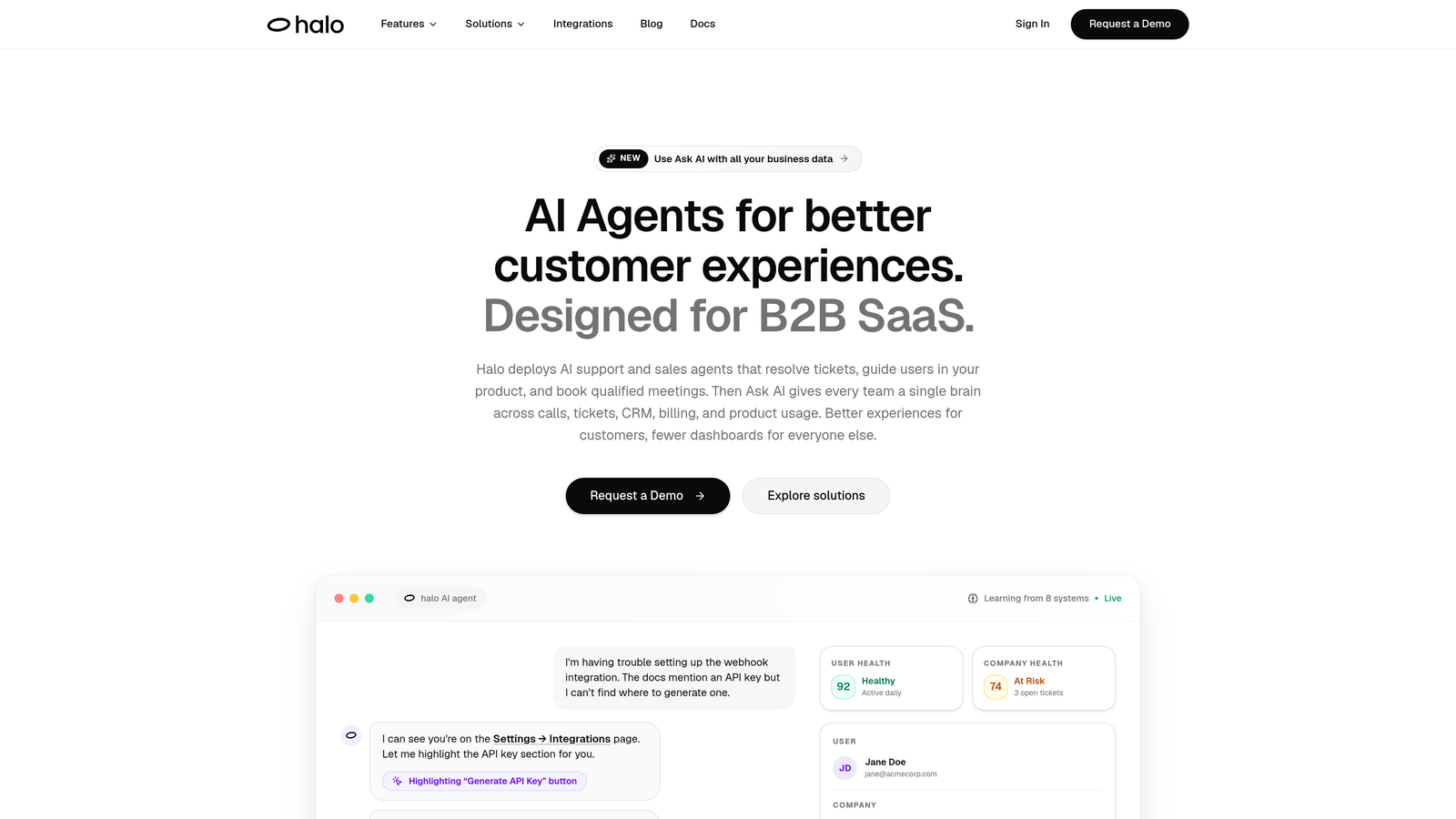
Halo AI is an AI-first customer support platform built from the ground up around intelligent agents, not retrofitted from a traditional ticketing system.
Where This Tool Shines
The core distinction with Halo AI is architectural. Rather than adding AI features to an existing helpdesk, the entire platform is designed around AI agents that learn continuously from every interaction. This means the system gets genuinely smarter over time, rather than relying on static rule sets or pre-configured intent libraries.
One standout capability is page-aware context. Halo's chat widget sees what your user is looking at in real time, which means guidance is specific to their exact situation rather than generic. Combined with a smart inbox that surfaces customer health signals, anomaly detection, and revenue intelligence, Halo functions as more than a support tool. It becomes a source of business intelligence.
Key Features
Autonomous AI Agents: Resolve support tickets independently with continuous learning that improves resolution quality over time.
Page-Aware Chat Widget: Delivers contextual, visual guidance based on what the user is actually looking at in your product.
Smart Inbox with Business Intelligence: Surfaces customer health signals, anomaly detection, and revenue intelligence alongside standard ticket management.
Auto Bug Ticket Creation: Automatically generates bug reports and routes them to the right team, with live agent handoff for complex issues.
Deep Integrations: Connects natively with Linear, Slack, HubSpot, Intercom, Stripe, Zoom, PandaDoc, and Fathom.
Best For
Product-led B2B SaaS companies that want support to scale without scaling headcount. Particularly well-suited for teams where support data feeds into product decisions and customer health monitoring matters as much as ticket resolution speed.
Pricing
Contact for pricing. Halo AI uses a transparent scaling model tailored to your team's resolution volume and integration needs rather than a one-size-fits-all per-seat structure.
2. Zendesk AI
Best for: Large teams that need a proven, enterprise-grade helpdesk with AI capabilities layered across existing workflows.
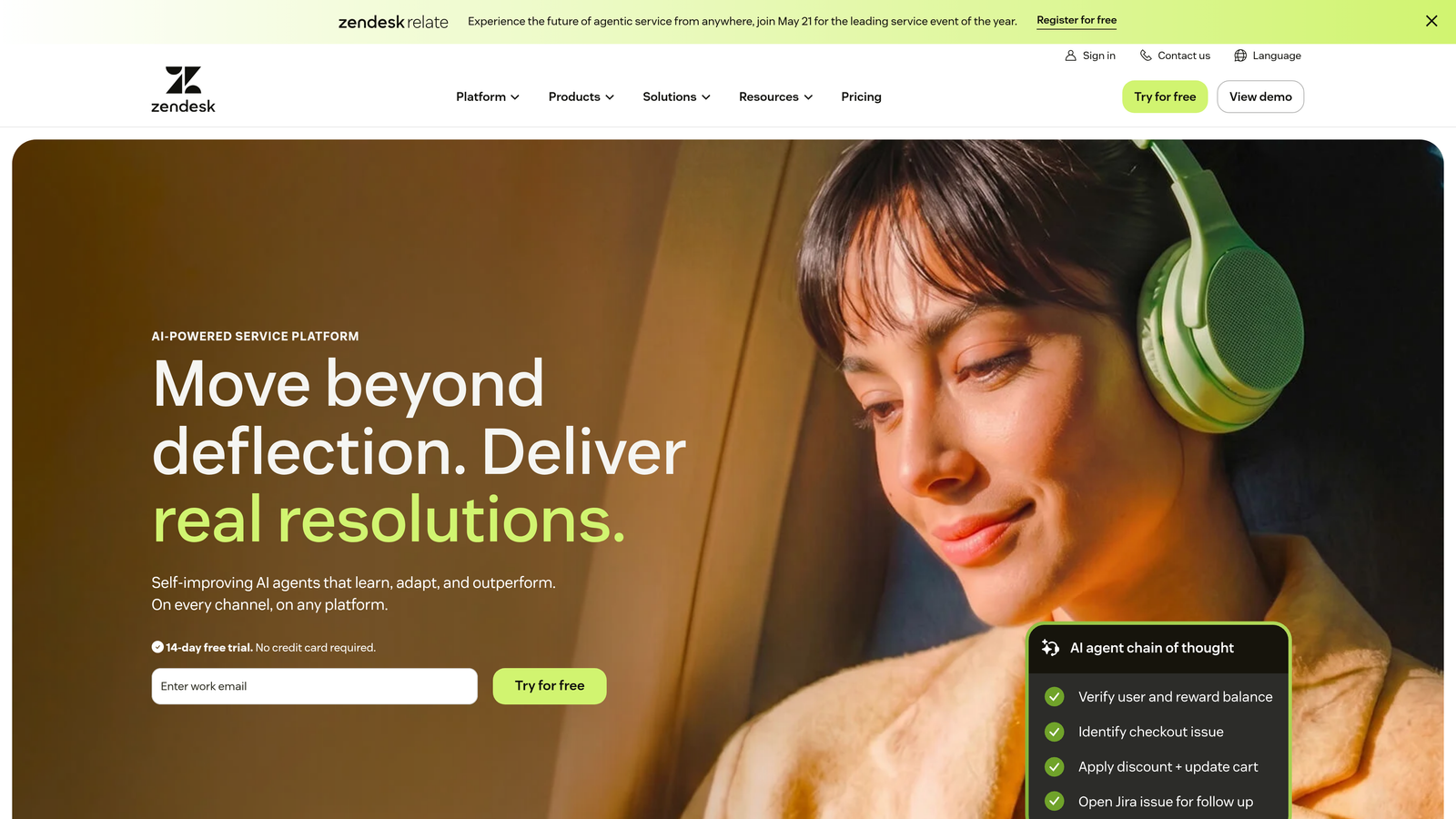
Zendesk is one of the most established names in customer support, with AI agents and generative features available on top of its per-agent tier pricing.
Where This Tool Shines
Zendesk's strength is breadth. The platform handles email, chat, voice, and social channels with mature routing, SLA management, and a massive app marketplace. For teams that have already built workflows around Zendesk, the AI layer adds meaningful value without requiring a platform migration.
The challenge is cost complexity. AI agents are priced as an add-on based on automated resolutions, which means your monthly bill can shift significantly depending on ticket volume. Teams need to model their resolution rates carefully before committing to avoid bill shock at scale.
Key Features
AI Agents: Automated resolution across email, chat, and messaging channels using your existing knowledge base.
Intelligent Triage and Routing: Automatically classifies and routes tickets based on intent, sentiment, and urgency.
Generative AI for Agents: Includes tone adjustment, message expansion, and conversation summarization tools for human agents.
App Marketplace: Over 1,500 integrations available for connecting Zendesk to your broader tech stack.
Advanced Analytics: Detailed reporting on ticket volume, resolution rates, agent performance, and AI effectiveness.
Best For
Mid-market and enterprise teams with established Zendesk workflows who want to add AI capabilities incrementally. Less ideal for companies starting fresh who want AI baked in from the beginning rather than added on top.
Pricing
Suite plans start at $55 per agent per month. AI agents are priced separately as an add-on based on automated resolutions, so total cost depends heavily on your volume and resolution rate.
3. Intercom Fin
Best for: Teams that want per-resolution pricing transparency and a conversational AI agent built on a mature messaging platform.
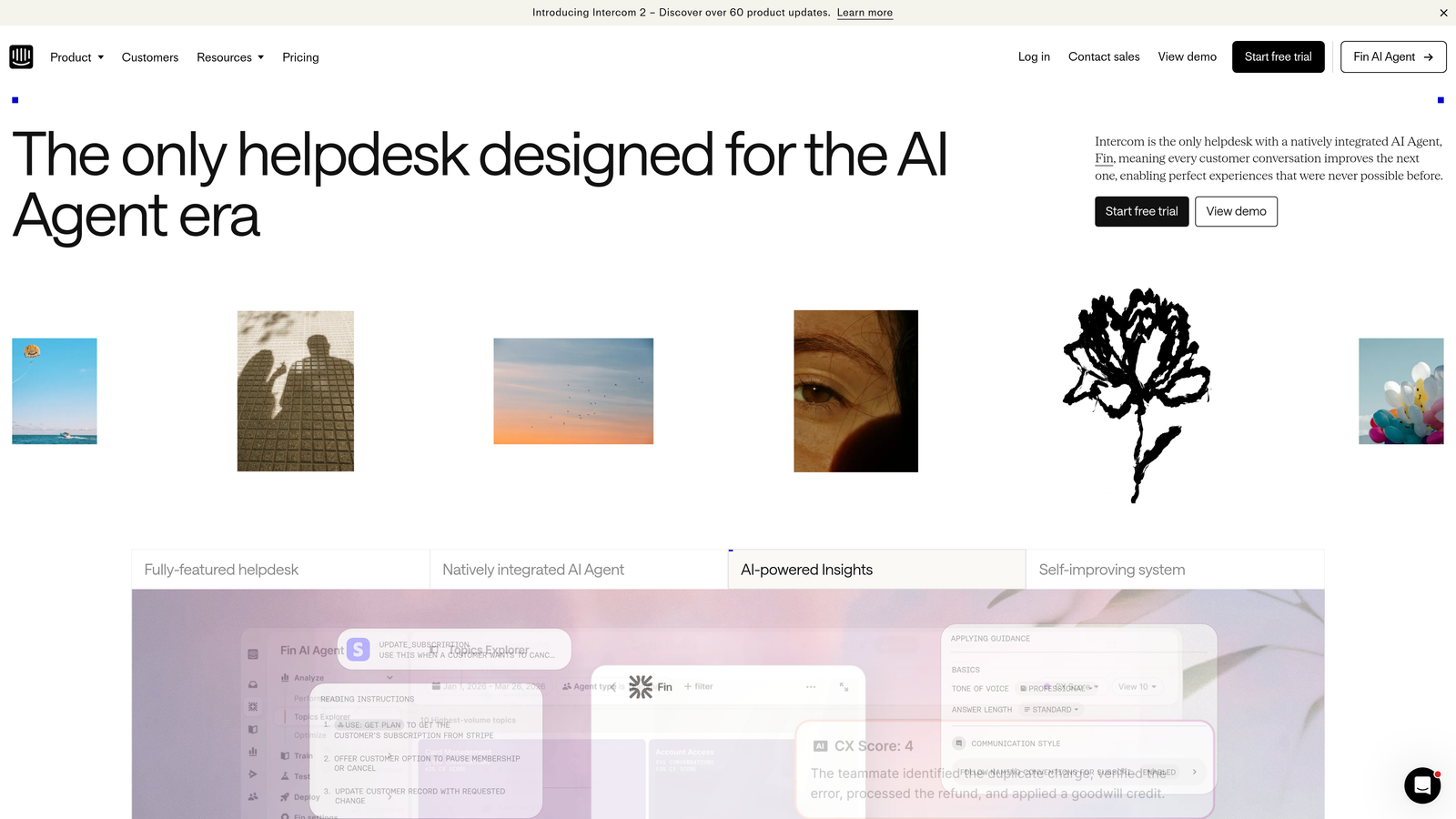
Intercom offers Fin, an AI agent that resolves customer questions using your knowledge base, with a per-resolution pricing model that's straightforward in concept but worth modeling carefully at scale.
Where This Tool Shines
Fin's approach to pricing is refreshingly direct: you pay per resolution rather than per seat, which aligns cost with actual value delivered. For teams with high deflection rates, this can be cost-effective. The conversational interface is polished, and Intercom's broader platform handles omnichannel support well.
The risk is that per-resolution pricing can become expensive as volume grows. At $0.99 per resolution, a team handling thousands of AI-resolved tickets monthly will see costs add up quickly. Modeling your expected resolution volume before committing is essential.
Key Features
Fin AI Agent: Resolves customer questions using your knowledge base with per-resolution pricing that ties cost directly to outcomes.
Omnichannel Support: Covers chat, email, SMS, and social channels from a unified platform.
Custom AI Workflows: Build conversation routing and escalation logic without code.
Product Tours and Proactive Messaging: Engage users proactively with guided tours and targeted messages.
AI Performance Analytics: Track Fin's resolution rate, handoff frequency, and customer satisfaction scores.
Best For
SaaS companies with strong knowledge bases and predictable support patterns who want to pay for outcomes rather than seats. Teams with highly variable ticket volumes should model costs carefully before choosing the per-resolution model.
Pricing
Essential plan starts at $29 per seat per month. Fin AI agent is charged at $0.99 per resolution on top of the base plan, making total cost volume-dependent.
4. Freshdesk Freddy AI
Best for: Budget-conscious teams that want a capable helpdesk with AI features unlocking progressively as they grow.
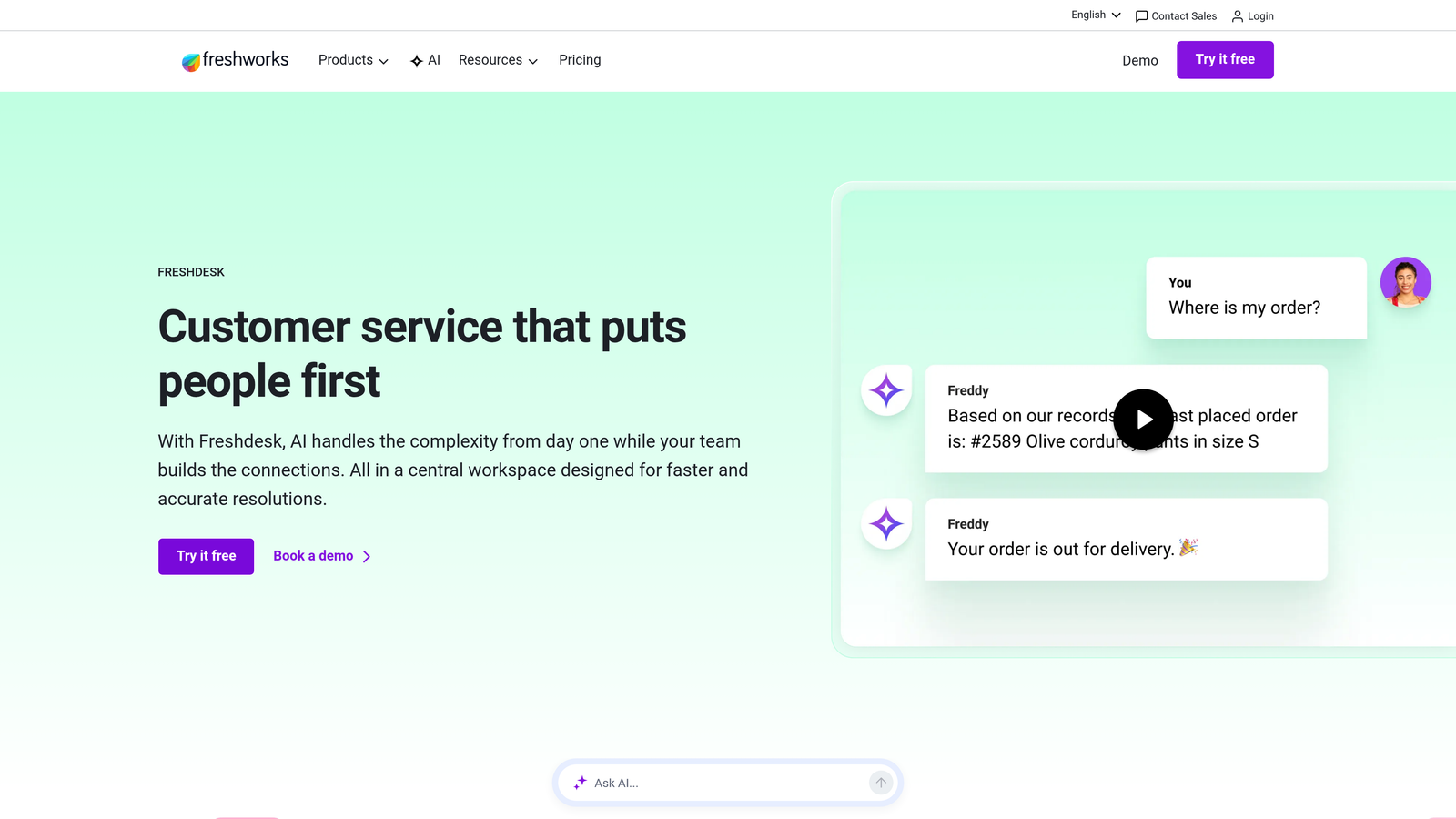
Freshdesk offers one of the most accessible entry points in this category, with a free tier and Freddy AI capabilities included at higher paid tiers rather than charged as separate add-ons.
Where This Tool Shines
Freshdesk's tiered model is genuinely friendly for growing teams. The free plan supports up to two agents and covers core ticketing, which lets small teams get started without a financial commitment. As you scale, Freddy AI capabilities unlock at the Pro and Enterprise tiers, which keeps pricing predictable.
Freddy Copilot, the agent-assist layer, provides response suggestions and ticket summaries that help human agents work faster. The automated resolution capabilities are solid, though teams expecting enterprise-grade AI sophistication may find Freshdesk's AI features less advanced than purpose-built AI-native platforms.
Key Features
Free Plan: Supports up to two agents with core ticketing, email, and knowledge base functionality at no cost.
Freddy AI Agent: Automated ticket resolution using your knowledge base, included in Pro and Enterprise tiers.
Freddy Copilot: Agent-assist tools including response suggestions, tone adjustment, and ticket summarization.
Omnichannel Ticketing: Handles email, chat, phone, and social channels within a unified inbox.
Built-in Knowledge Base: Create and manage self-service content with SEO-friendly article management.
Best For
Small to mid-sized teams that want to grow into AI features without paying for them upfront. Especially useful for companies that want a single platform covering ticketing, chat, and knowledge base without assembling multiple tools.
Pricing
Free plan available for up to two agents. Paid plans start at $15 per agent per month. Freddy AI is included in the Pro tier at $49 per agent per month and Enterprise at $79 per agent per month.
5. Tidio
Best for: Small businesses and e-commerce teams that want accessible AI chat with conversation-based pricing rather than per-seat fees.
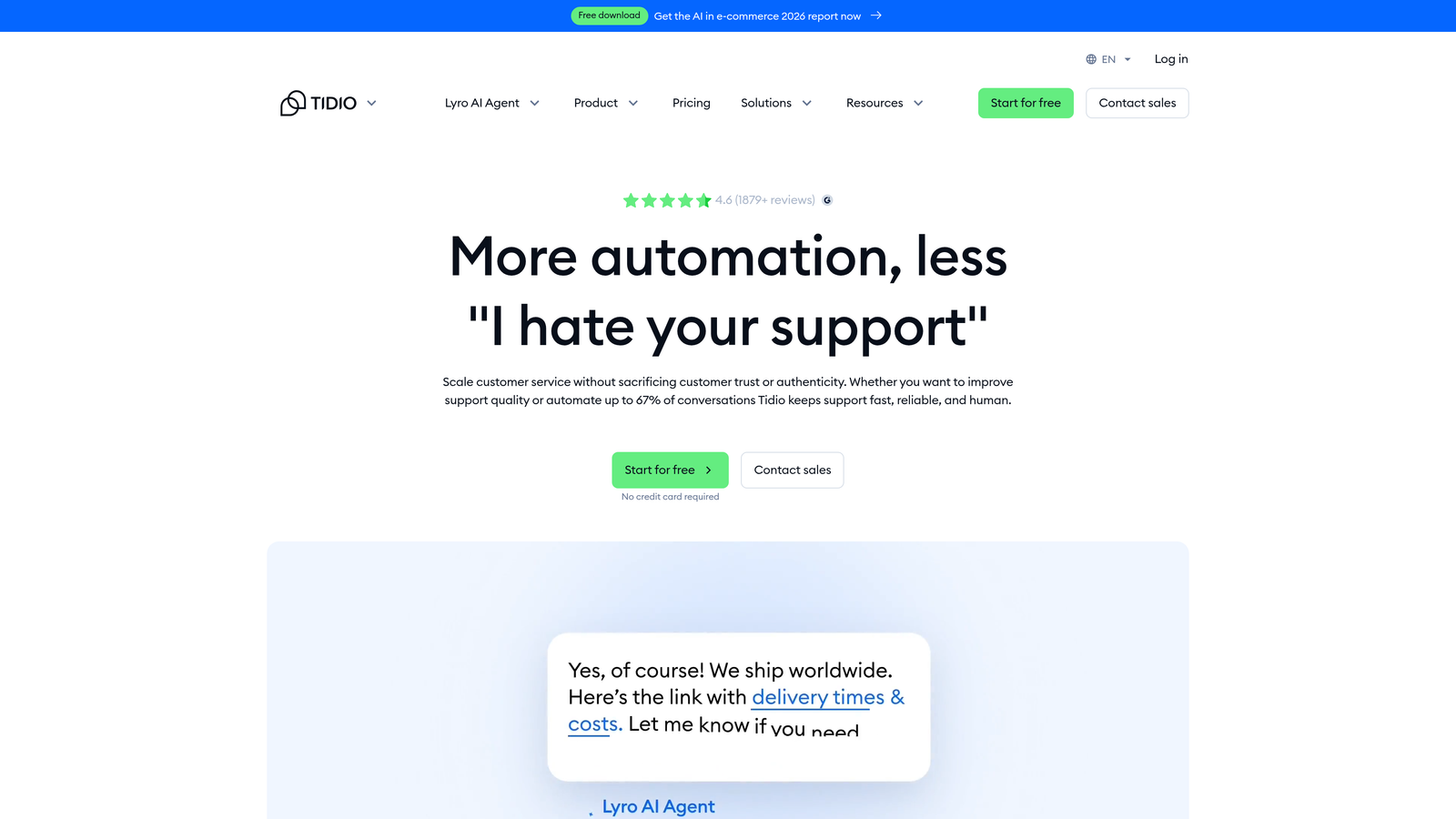
Tidio combines live chat with Lyro, an AI chatbot that handles customer conversations using a credit-based model designed for businesses that don't need enterprise-scale infrastructure.
Where This Tool Shines
Tidio's Lyro AI is approachable in a way that many enterprise tools aren't. Setup is fast, the interface is clean, and the conversation-credit model means you only pay for what you use rather than locking into large per-seat commitments. For e-commerce businesses using Shopify or WordPress, the integrations are seamless.
The trade-off is ceiling. Tidio works well for straightforward customer interactions but lacks the deep business intelligence, multi-channel complexity handling, and enterprise security features that B2B SaaS companies typically need. It's a strong fit for its target market, but that market is narrower than some of the other platforms here.
Key Features
Lyro AI Chatbot: Handles customer conversations using your FAQ and knowledge content, charged on a per-conversation credit basis.
Live Chat Widget: Real-time chat with visitor tracking and proactive engagement triggers.
Helpdesk Ticketing: Basic ticket management for conversations that need follow-up.
Visual Chatbot Builder: No-code flow builder for creating custom conversation paths.
E-commerce Integrations: Native connections to Shopify, WordPress, and other e-commerce platforms.
Best For
Small businesses, e-commerce brands, and early-stage startups that want AI chat without enterprise pricing. Less suited for B2B SaaS teams needing complex ticket routing, deep integrations, or business intelligence from support data.
Pricing
Free plan available with limited features. Lyro AI starts at $39 per month for 50 conversations. Pricing scales with conversation volume, making it important to estimate your usage before selecting a tier.
6. Zoho Desk with Zia
Best for: Teams already using the Zoho ecosystem who want AI-assisted support tightly integrated with Zoho CRM and analytics.
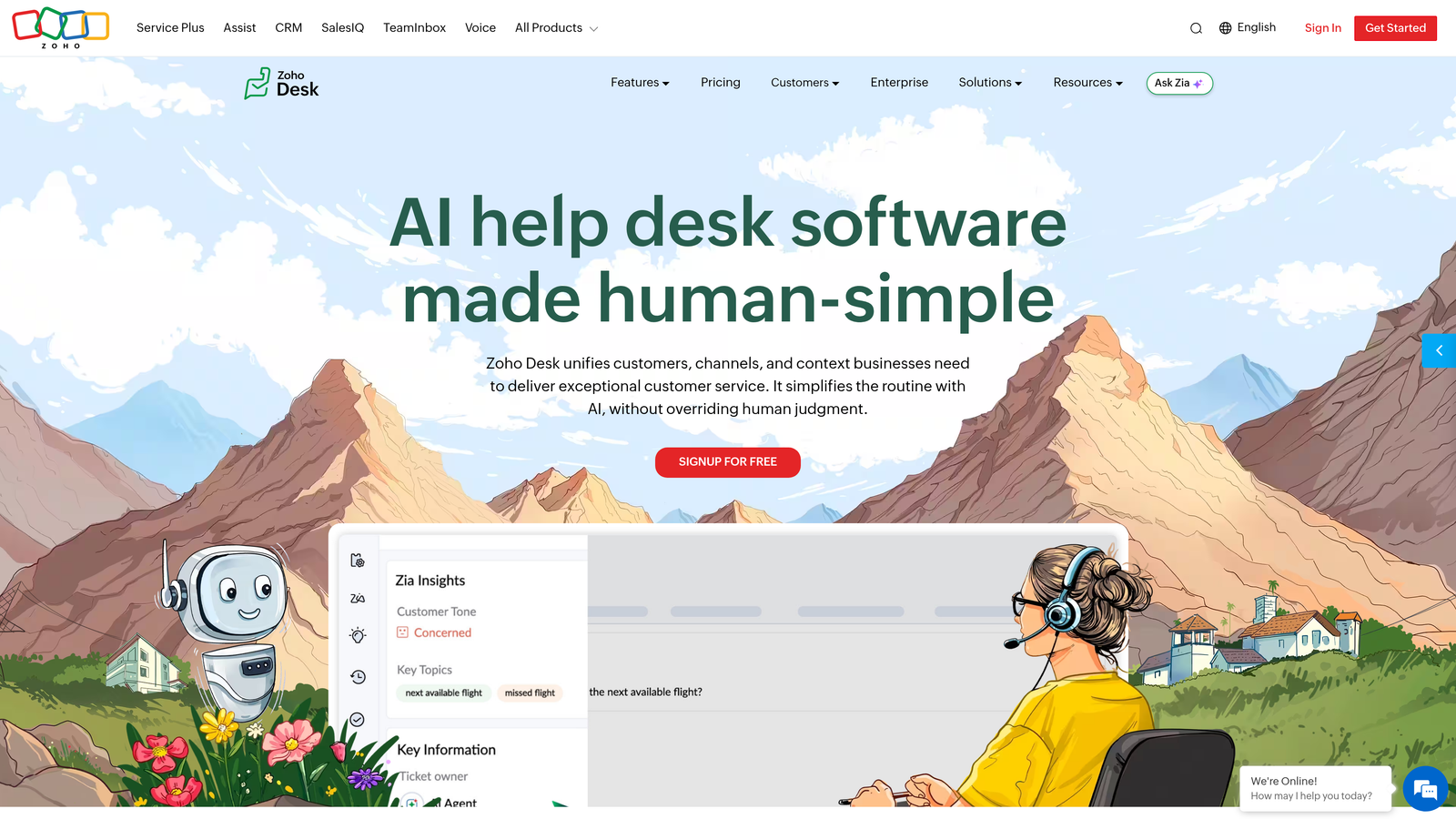
Zoho Desk is a feature-rich helpdesk with Zia, an AI assistant that provides sentiment analysis, ticket tagging, and anomaly detection at the Enterprise tier.
Where This Tool Shines
If your business runs on Zoho, Desk is a natural fit. The integration with Zoho CRM means support agents see full customer context without switching tools, and Zia's anomaly detection can flag unusual ticket volume spikes before they become a crisis. The platform also handles multi-department and multi-brand support well, which is useful for businesses with complex organizational structures.
Zia's AI capabilities are solid within the Zoho ecosystem but are less sophisticated than purpose-built AI agents. Teams looking for autonomous ticket resolution at scale will find Zia more of an assist layer than a full resolution engine.
Key Features
Zia AI: Provides sentiment analysis, field predictions, response suggestions, and anomaly detection for ticket volume and patterns.
Zoho Ecosystem Integration: Deep native connections with Zoho CRM, Analytics, Campaigns, and the broader Zoho suite.
Multi-Department and Multi-Brand Support: Manage multiple brands or business units from a single Zoho Desk instance.
Workflow Automation and SLA Management: Automate ticket routing, escalation, and SLA tracking with configurable rules.
Community Forums and Knowledge Base: Built-in self-service tools for deflecting common questions.
Best For
Businesses already invested in the Zoho ecosystem, particularly those using Zoho CRM for sales and wanting unified customer data across sales and support. Less compelling for teams not already in the Zoho stack.
Pricing
Standard plan starts at $14 per agent per month. Zia AI features are available in the Enterprise tier at $40 per agent per month, making it one of the more affordable paths to AI-assisted support.
7. Help Scout
Best for: Teams that prioritize personal, human-feeling customer relationships and want AI that assists agents rather than replacing them.
Help Scout takes a deliberately human-first approach, with AI features focused on making agents faster rather than deflecting conversations away from humans entirely.
Where This Tool Shines
Help Scout's AI Drafts feature generates reply suggestions that agents can edit and send, which maintains the personal tone that many support teams work hard to preserve. The platform is genuinely easy to use, and the pricing model is clean with no hidden fees or usage-based add-ons layered on top of the base plan.
The trade-off is autonomous resolution. Help Scout isn't designed to resolve tickets without human review, which means it won't dramatically reduce headcount the way AI-native platforms can. For teams where relationship quality matters more than deflection rates, that's a feature, not a bug.
Key Features
AI Drafts: Generates reply suggestions based on conversation context, which agents review and send.
AI Summarize: Produces quick conversation summaries so agents can get up to speed without reading full thread histories.
Shared Inbox with Collision Detection: Prevents two agents from replying to the same ticket simultaneously.
Beacon Chat Widget: Self-service chat widget with knowledge base search and proactive messaging options.
Transparent Per-User Pricing: No usage-based add-ons or AI surcharges layered on top of the base price.
Best For
Small to mid-sized teams where customer relationship quality is a competitive differentiator. Particularly well-suited for companies in professional services, consulting, or any context where customers expect personal, thoughtful responses.
Pricing
Standard plan starts at $25 per user per month. Plus plan at $50 per user per month includes advanced AI features, reporting, and additional customization options.
8. Ada
Best for: Enterprise teams handling high volumes of customer interactions across multiple channels who need a purpose-built AI agent platform.
Ada is an enterprise-grade AI agent platform designed specifically for high-volume automated resolution across web, mobile, social, and phone channels.
Where This Tool Shines
Ada's reasoning engine is built for complex, multi-step queries that simpler chatbots can't handle. The no-code platform makes it possible for non-technical teams to build sophisticated AI workflows without engineering resources, and enterprise security and compliance features make it suitable for regulated industries.
The custom pricing model means you won't find a number on the website, which can slow down the evaluation process. But for enterprise teams with high resolution volumes, the custom contract often reflects the scale of deployment in ways that per-seat pricing can't accommodate efficiently.
Key Features
Multi-Channel AI Agent: Resolves customer interactions across web, SMS, social media, and phone from a unified platform.
No-Code Workflow Builder: Build and iterate on AI conversation flows without engineering support.
Reasoning Engine: Handles complex, multi-step customer queries that require contextual understanding across multiple turns.
Enterprise Security and Compliance: Includes features for data privacy, access controls, and compliance requirements in regulated industries.
Advanced Resolution Analytics: Detailed reporting on resolution rates, escalation patterns, and channel performance.
Best For
Enterprise organizations with high support volumes, multiple customer channels, and compliance requirements. Ada's pricing model and feature set are calibrated for scale, making it less practical for small or mid-sized teams.
Pricing
Custom enterprise pricing based on resolution volume and channels. Contact Ada directly for a quote. No self-serve pricing is publicly available.
9. HubSpot Service Hub with Breeze AI
Best for: Teams already on HubSpot CRM who want support, sales, and marketing on a single platform with shared customer data.
HubSpot Service Hub includes Breeze AI for automated customer interactions and agent assistance, with strong value for teams already invested in the HubSpot ecosystem.
Where This Tool Shines
The core advantage of Service Hub is the unified CRM. When your support team can see the full customer timeline, including sales conversations, marketing interactions, and billing history, without switching tools, the quality of support interactions improves naturally. Breeze AI adds automation on top of that context, which gives it more to work with than standalone chatbots.
For teams not already on HubSpot, the value proposition is less clear. The platform is powerful but broad, and the AI features are most effective when the underlying CRM data is rich and well-maintained. Teams evaluating HubSpot purely for support should weigh the full platform cost against more focused alternatives.
Key Features
Breeze AI Chatbot: Handles automated customer interactions using your knowledge base and CRM data for context.
Unified CRM Timeline: Shared customer view across sales, marketing, and service teams with no data silos.
Ticketing, Knowledge Base, and Customer Portal: Full self-service and ticketing infrastructure within a single platform.
SLA Management and Reporting: Track response times, resolution rates, and team performance against defined service levels.
Free Tools with Paid Tier Upgrades: Meaningful free functionality with clear upgrade paths as needs grow.
Best For
Companies already using HubSpot for CRM, marketing, or sales who want to consolidate support onto the same platform. The unified data model creates genuine value for teams where customer context flows across departments.
Pricing
Free tools available with limited features. Starter at $20 per seat per month. Professional at $100 per seat per month with advanced AI, automation, and reporting capabilities.
Picking the Right AI Helpdesk for Your Budget
After reviewing these platforms, a few patterns emerge that should guide your decision based on your situation rather than headline pricing alone.
If you want AI-native architecture with business intelligence: Halo AI is built differently from the rest of this list. Rather than adding AI to a helpdesk, the entire platform is designed around intelligent agents that learn continuously and surface insights beyond ticket resolution. It's the right choice if you want support to feed product decisions, not just close tickets.
If you're budget-conscious and growing: Freshdesk offers the most accessible entry point with a real free tier and predictable per-agent pricing as you scale. Zoho Desk is worth considering if you're already in the Zoho ecosystem and want AI at a lower per-seat cost than most competitors.
If you're enterprise-scale: Zendesk and Ada are the mature choices, though both require careful cost modeling. Zendesk's AI add-on pricing can escalate quickly with volume, and Ada's custom contracts require a full evaluation cycle.
If ecosystem integration drives your decision: HubSpot Service Hub wins for teams already on HubSpot CRM. The unified timeline alone justifies the platform if your team lives in HubSpot already.
Whichever platform you evaluate, run the numbers on your actual ticket volume, expected AI resolution rates, and total cost including add-ons before committing. The headline price rarely tells the full story.
Your support team shouldn't scale linearly with your customer base. AI agents should handle routine tickets, guide users through your product, and surface business intelligence while your team focuses on complex issues that need a human touch. See Halo in action and discover how continuous learning transforms every interaction into smarter, faster support.