9 Best AI Messaging Platforms for Business Communication in 2026
Modern AI messaging platforms have transformed business communication by understanding context, learning from interactions, and delivering personalized responses that go beyond basic chatbots. This guide evaluates the nine best AI messaging platforms in 2026 based on learning capabilities, integrations, scalability, and value—helping you find the right solution whether you need customer support automation, sales acceleration, or comprehensive omnichannel communication.
 Matt PattoliFounder12 min read
Business messaging has evolved far beyond basic chatbots that follow rigid scripts. Today's AI messaging platforms understand context, learn from every conversation, and deliver personalized responses that feel genuinely helpful rather than robotic. The best platforms don't just automate responses—they surface business intelligence, integrate deeply with your existing tools, and get smarter with every interaction.
We evaluated platforms based on AI learning capabilities, integration ecosystems, deployment complexity, scalability, and overall value. What you'll find here ranges from customer support-focused solutions to sales acceleration tools to comprehensive omnichannel communication hubs. Each serves different needs, but all represent the cutting edge of AI-powered business messaging.
Here are the top AI messaging platforms transforming how businesses communicate in 2026.
1. Halo AI
Best for: B2B teams seeking AI agents that continuously learn and provide business intelligence beyond support
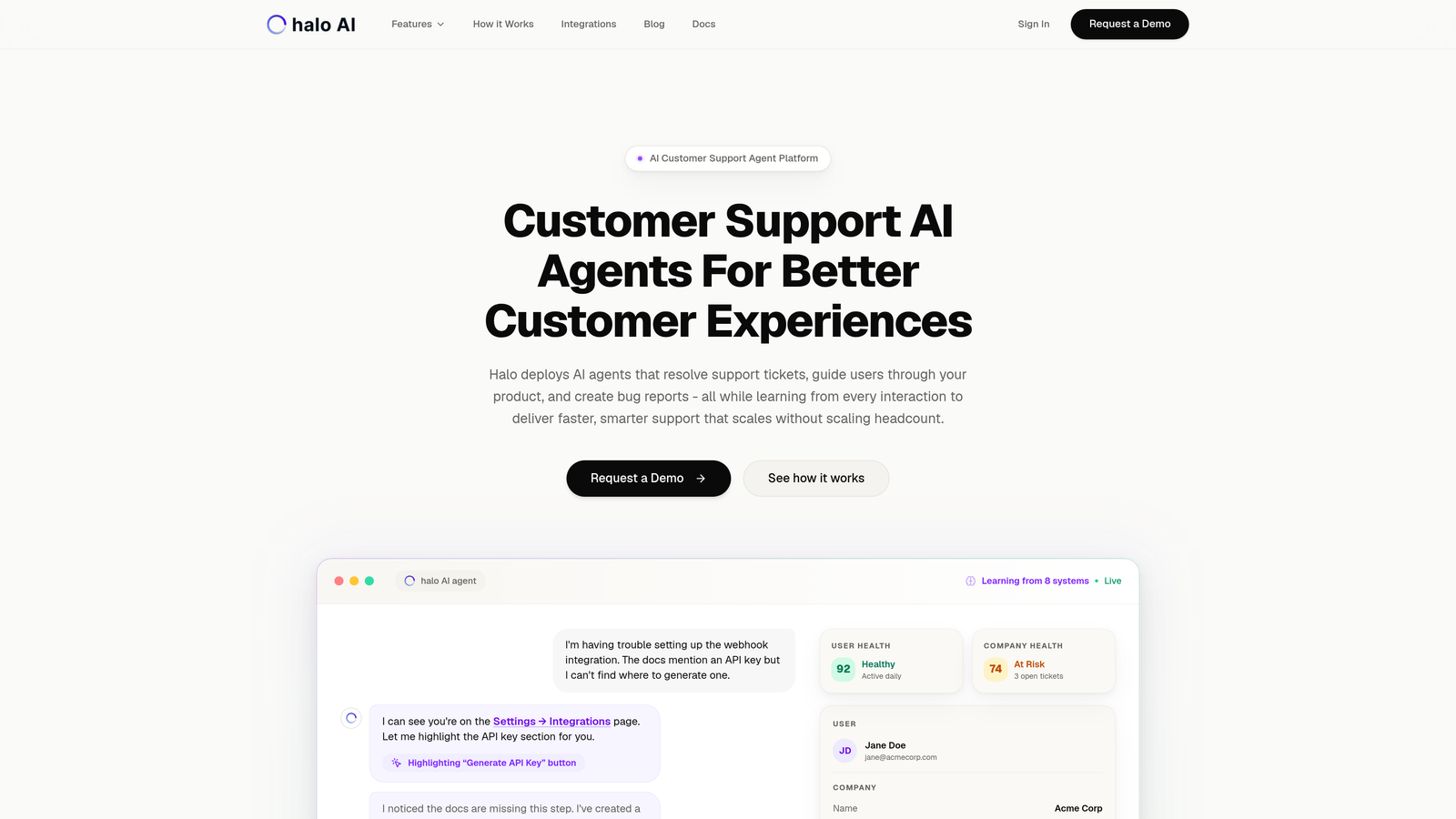
Halo AI takes an AI-first approach to customer support, deploying intelligent agents that don't just resolve tickets—they learn from every interaction to deliver progressively smarter assistance.
Where This Tool Shines
Unlike platforms that bolt AI onto existing helpdesk infrastructure, Halo is built from the ground up around intelligent agents. The platform's page-aware context means agents can see exactly what users see, enabling visual guidance that goes beyond text-based responses.
The continuous learning architecture sets Halo apart. Every resolved ticket, every escalation, every customer interaction feeds back into the system's intelligence. This means your support gets smarter over time without manual retraining or constant bot updates.
Key Features
Autonomous AI Agents: Resolve support tickets independently while learning from every interaction to improve future responses.
Page-Aware Chat Widget: Sees what users see on your product interface, enabling precise visual guidance and contextual help.
Smart Inbox with Business Intelligence: Surfaces customer health signals, revenue intelligence, and anomaly detection beyond basic support metrics.
Auto Bug Ticket Creation: Automatically creates detailed bug reports in Linear when issues are identified, with full context and reproduction steps.
Seamless Human Escalation: Hands off complex issues to human agents with complete conversation context and customer history.
Best For
B2B companies and product teams who need more than basic ticket deflection. Particularly valuable if you're using multiple tools across your business stack (Linear, Slack, HubSpot, Intercom, Stripe) and want AI that connects the dots between them to provide holistic customer intelligence.
Pricing
Contact for custom pricing based on your team size and integration needs. Designed specifically for B2B teams rather than high-volume consumer support.
2. Intercom
Best for: Product-led growth companies combining customer support with product engagement and onboarding
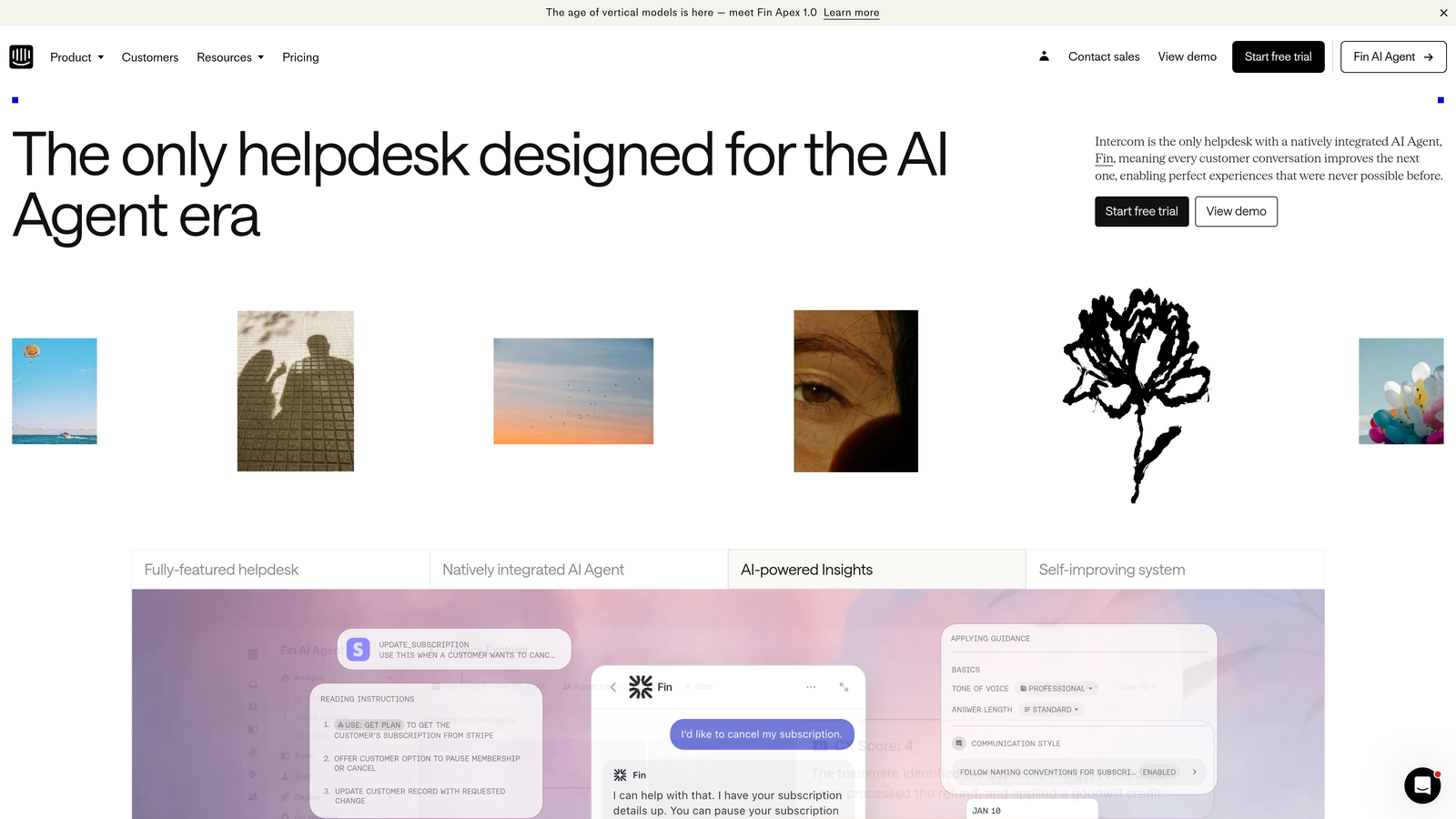
Intercom unifies AI-powered customer messaging with product tours, onboarding flows, and engagement tools in one platform.
Where This Tool Shines
Intercom excels when you need messaging that does double duty—handling support questions while also guiding users through product adoption. The Fin AI agent resolves common queries automatically, but the real power comes from integrating support conversations with product tours and targeted messaging campaigns.
The mobile SDK is particularly robust, making Intercom a strong choice if your product includes iOS or Android apps. You get consistent messaging experiences across web and mobile with deep integration into your product interface.
Key Features
Fin AI Agent: Automated resolution of customer questions using AI trained on your help content and past conversations.
Product Tours: Create guided walkthroughs and onboarding flows that integrate seamlessly with your messaging strategy.
Unified Inbox: Manage conversations across email, chat, and social channels in one interface with team collaboration tools.
Custom Bots and Workflows: Build automated conversation flows for qualification, routing, and self-service without coding.
Mobile SDK: Deep integration for in-app messaging on iOS and Android with feature parity to web.
Best For
SaaS companies focused on product-led growth who want to blur the line between support, onboarding, and product engagement. Works especially well for teams that view messaging as part of the user experience rather than just a support channel.
Pricing
Starts at $39 per seat monthly for basic features. Fin AI is priced separately based on resolution volume, which can add significant cost at scale.
3. Drift
Best for: B2B sales teams using conversational marketing to qualify leads and accelerate pipeline
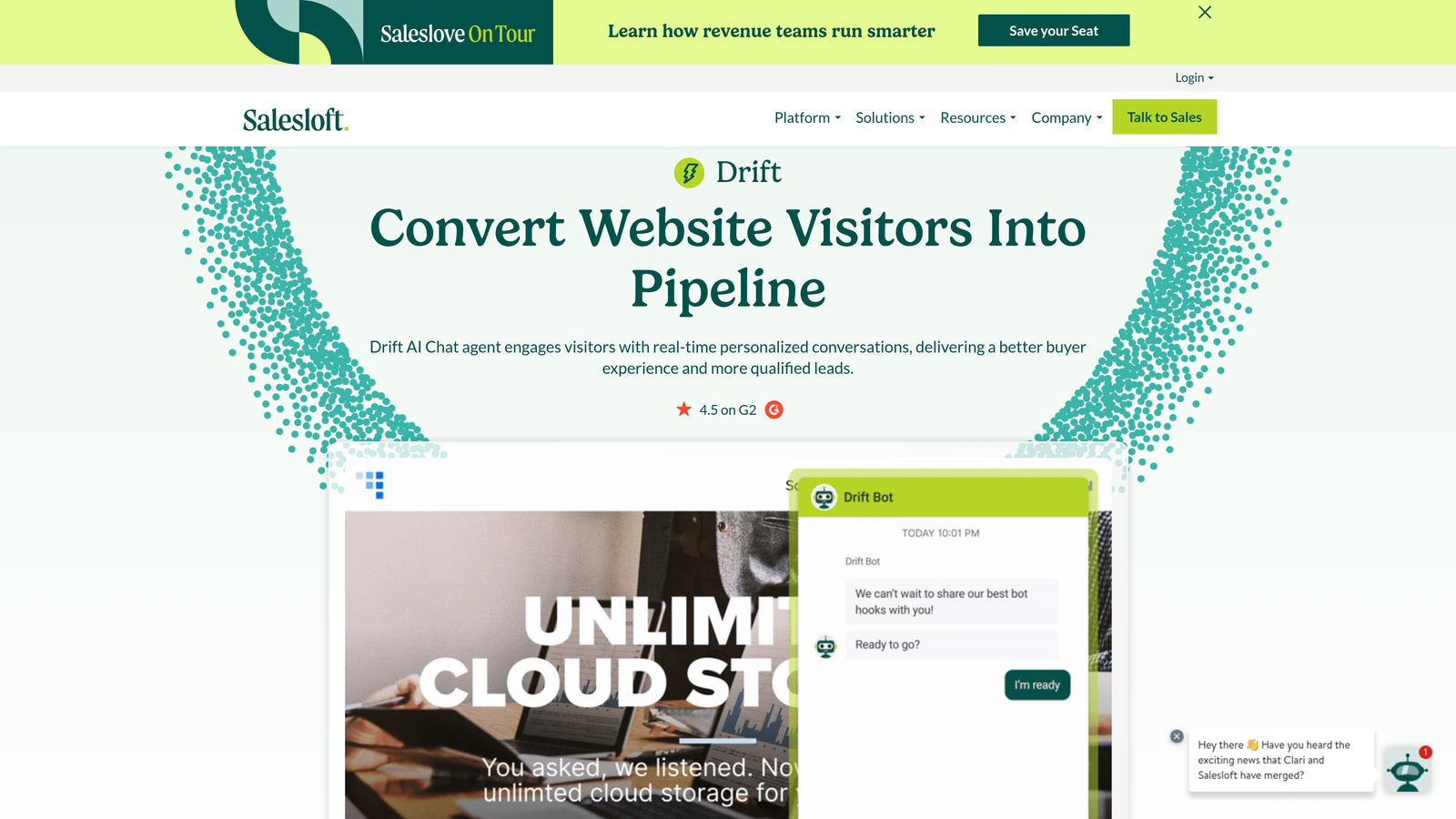
Drift positions itself as a revenue acceleration platform, using AI-powered conversations to qualify leads, book meetings, and move prospects through the sales funnel faster.
Where This Tool Shines
Think of Drift less as a support tool and more as a sales development representative that never sleeps. The platform excels at identifying high-intent visitors, engaging them with personalized conversations, and routing qualified leads directly to sales calendars.
The account-based marketing capabilities stand out. Drift can recognize visitors from target accounts and trigger customized conversation flows based on account tier, industry, or engagement history. This makes it powerful for enterprise sales teams running ABM plays.
Key Features
AI-Powered Lead Qualification: Chatbots that ask qualifying questions, score leads, and route high-value prospects to the right sales reps.
Account-Based Targeting: Recognize visitors from target accounts and personalize conversations based on account data and engagement history.
Integrated Meeting Scheduling: Book meetings directly from chat conversations with automatic calendar synchronization for sales teams.
Conversational Landing Pages: Replace static forms with dynamic conversations that increase conversion rates and gather richer qualification data.
Revenue Attribution: Track how conversations influence pipeline and revenue with detailed analytics and reporting.
Best For
B2B companies with complex sales cycles and high deal values where qualifying leads efficiently makes a significant revenue impact. Less suitable for customer support or post-sale engagement—this is primarily a sales tool.
Pricing
Premium tier starts around $2,500 monthly with enterprise pricing varying based on features and volume. Positioned as a sales investment rather than a support cost center.
4. Zendesk AI
Best for: Enterprise organizations needing omnichannel AI messaging within an established support ecosystem
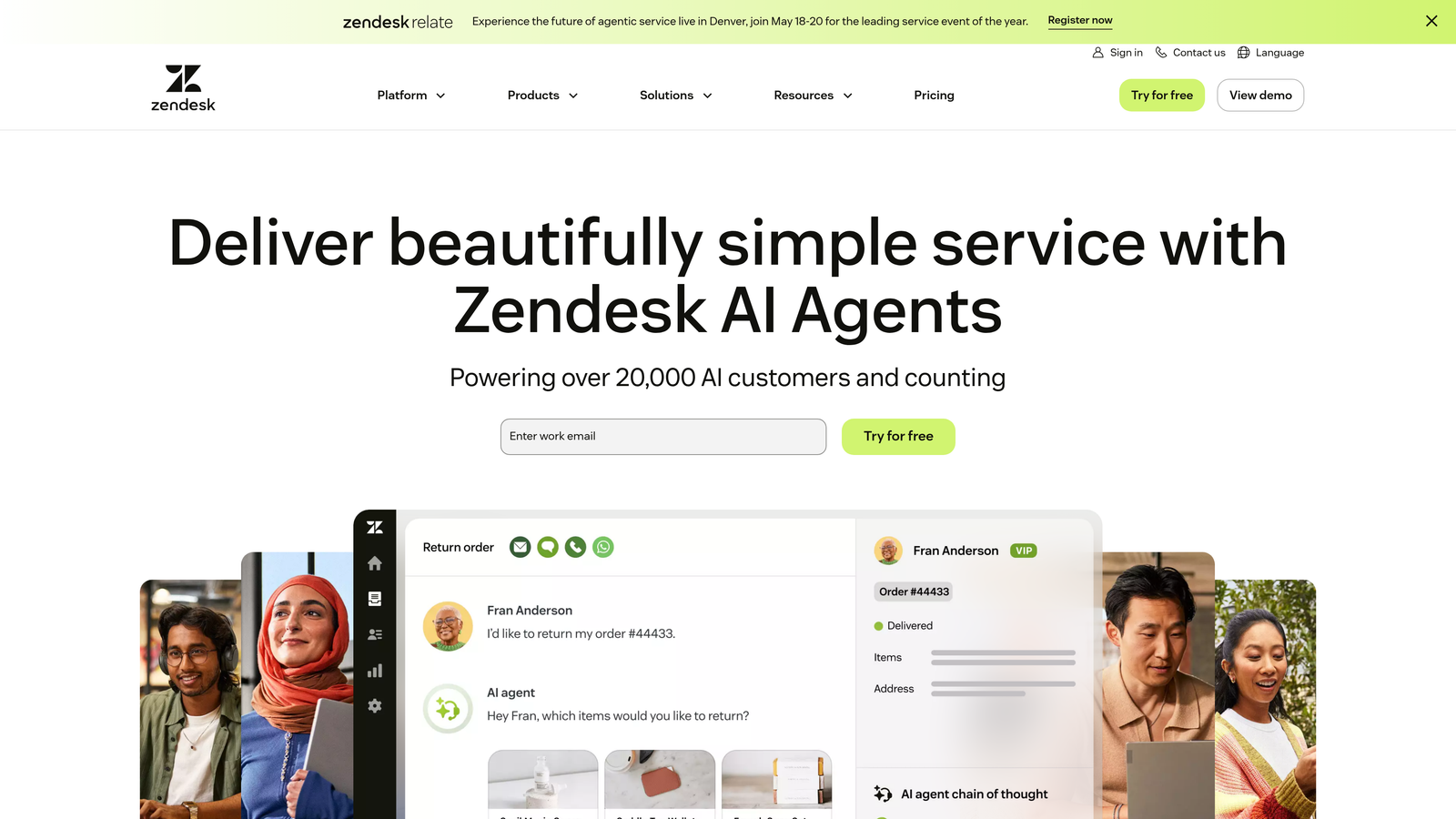
Zendesk AI brings sophisticated AI capabilities trained on billions of customer service interactions to the widely-adopted Zendesk platform.
Where This Tool Shines
Zendesk's AI benefits from massive training data—billions of real customer service interactions across industries. This means the AI agents often handle nuanced questions better than platforms with smaller datasets, particularly for common support scenarios.
The omnichannel capabilities are genuinely comprehensive. Email, chat, social media, voice, SMS—everything flows into the same agent workspace with consistent AI assistance across channels. For large organizations supporting customers across multiple touchpoints, this unified approach prevents conversations from falling through cracks.
Key Features
Pre-Trained AI Agents: Leverage AI trained on billions of customer interactions across industries for better out-of-the-box performance.
Omnichannel Messaging: Unified support across email, chat, social media, voice, and SMS with consistent AI assistance on every channel.
Agent Workspace with AI: Suggestions for responses, article recommendations, and sentiment analysis integrated directly into the agent interface.
Extensive Integration Marketplace: Thousands of pre-built integrations with CRM, e-commerce, and business tools for comprehensive ecosystem connectivity.
Advanced Analytics: Detailed reporting on AI performance, resolution rates, customer satisfaction, and operational efficiency.
Best For
Established enterprises with complex support operations spanning multiple channels and regions. Particularly valuable if you already use Zendesk and want to add AI capabilities, or if you need proven enterprise-grade reliability and compliance.
Pricing
Suite Team starts at $55 per agent monthly. Advanced AI features require higher-tier plans, with enterprise pricing for large deployments and custom needs.
5. Freshdesk Freddy AI
Best for: Mid-market companies seeking strong AI automation at competitive pricing
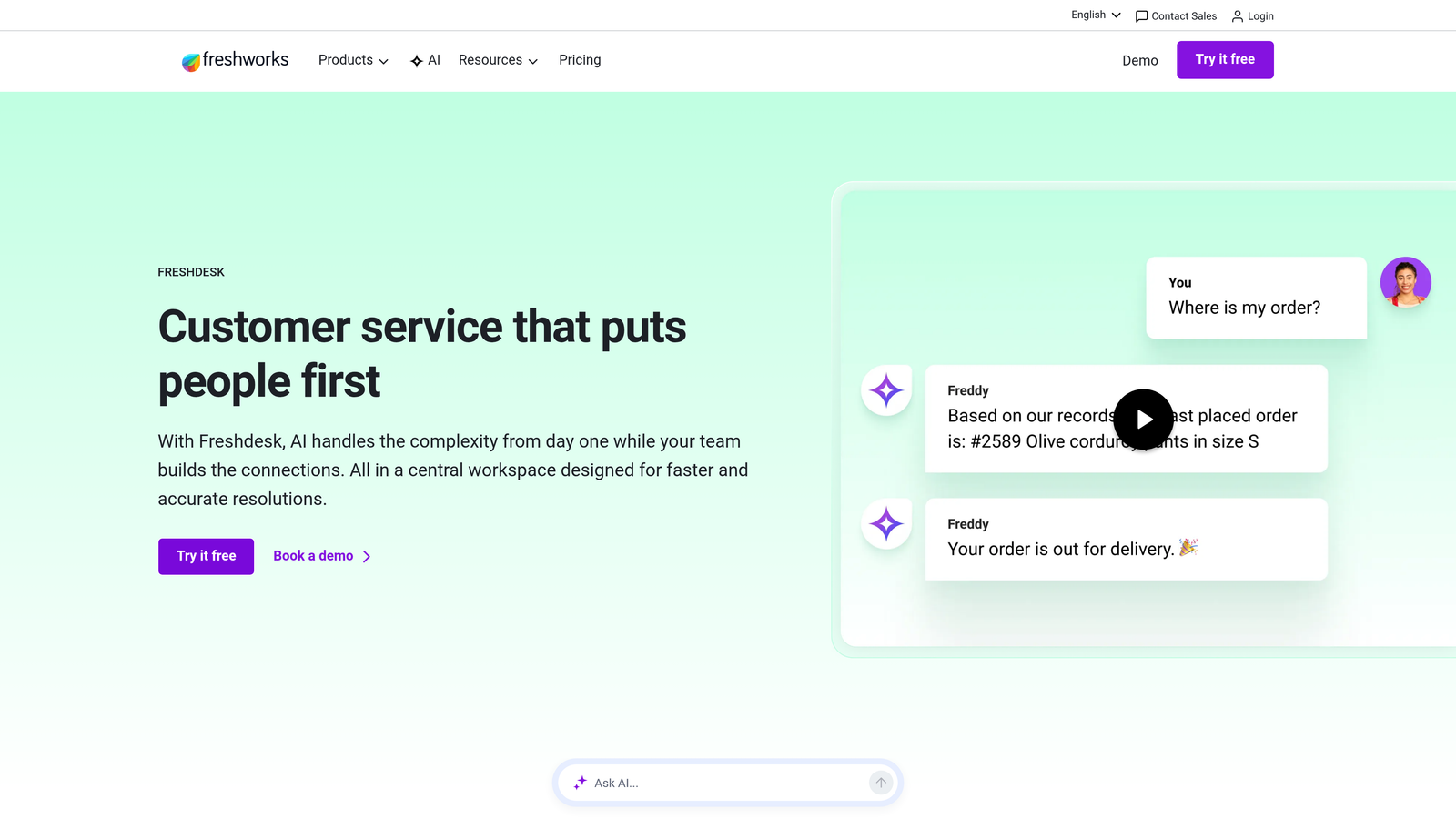
Freshdesk Freddy AI delivers capable AI-powered customer support with automation features that punch above its price point.
Where This Tool Shines
Freshdesk hits a sweet spot for mid-market companies that need more than basic helpdesk software but aren't ready for enterprise pricing. Freddy AI handles both customer-facing self-service and agent-facing assistance, suggesting responses and articles based on ticket content.
The multi-channel support includes WhatsApp Business integration, which many competitors charge extra for or don't support well. For companies serving customers who prefer WhatsApp over email or traditional chat, this native integration is valuable.
Key Features
Freddy AI Self-Service: Automated chatbot that resolves common questions and deflects tickets before they reach human agents.
AI-Powered Ticket Prioritization: Automatically categorizes and prioritizes incoming tickets based on content, sentiment, and urgency.
Smart Response Suggestions: Recommends canned responses and knowledge base articles to agents based on ticket context.
WhatsApp Business Integration: Native support for WhatsApp as a customer service channel alongside email and chat.
Team Collaboration Tools: Shared ownership, parent-child ticketing, and team huddles for complex issue resolution.
Best For
Growing companies that have outgrown basic helpdesk tools but aren't ready for enterprise-tier pricing. Works well for teams that need solid AI capabilities without complex implementation or extensive customization.
Pricing
Free tier available for basic features. Pro plan at $49 per agent monthly; Freddy AI available as an add-on with pricing based on resolution volume.
6. Ada
Best for: High-volume automated resolution across multiple languages and regions
Ada is purpose-built for companies that need to automate customer service at scale across languages, channels, and complex query types.
Where This Tool Shines
Ada's reasoning engine handles more complex queries than typical chatbots by breaking down multi-part questions and maintaining context across conversation turns. This means customers can ask follow-up questions without starting over, creating more natural interactions.
The multi-language capabilities are genuinely robust rather than basic translation. Ada supports localization that accounts for regional differences in how customers phrase questions and what information they expect in responses.
Key Features
Advanced Reasoning Engine: Handles complex, multi-turn conversations by breaking down queries and maintaining context throughout interactions.
Multi-Language Support: Comprehensive localization across languages with regional customization for phrasing and response expectations.
No-Code Conversation Builder: Design and deploy conversation flows without technical resources using visual workflow tools.
CRM and Helpdesk Integrations: Connect with major platforms like Salesforce, Zendesk, and Shopify for data synchronization and workflow automation.
Containment Analytics: Detailed reporting focused on automation rates, resolution metrics, and opportunities to improve self-service.
Best For
Companies handling high volumes of customer inquiries across multiple regions and languages. Particularly valuable for e-commerce, financial services, and telecommunications where automation directly impacts operational costs.
Pricing
Custom enterprise pricing based on resolution volume and feature requirements. Typically positioned for companies handling thousands of monthly conversations.
7. Tidio
Best for: Small businesses and e-commerce stores seeking affordable AI automation
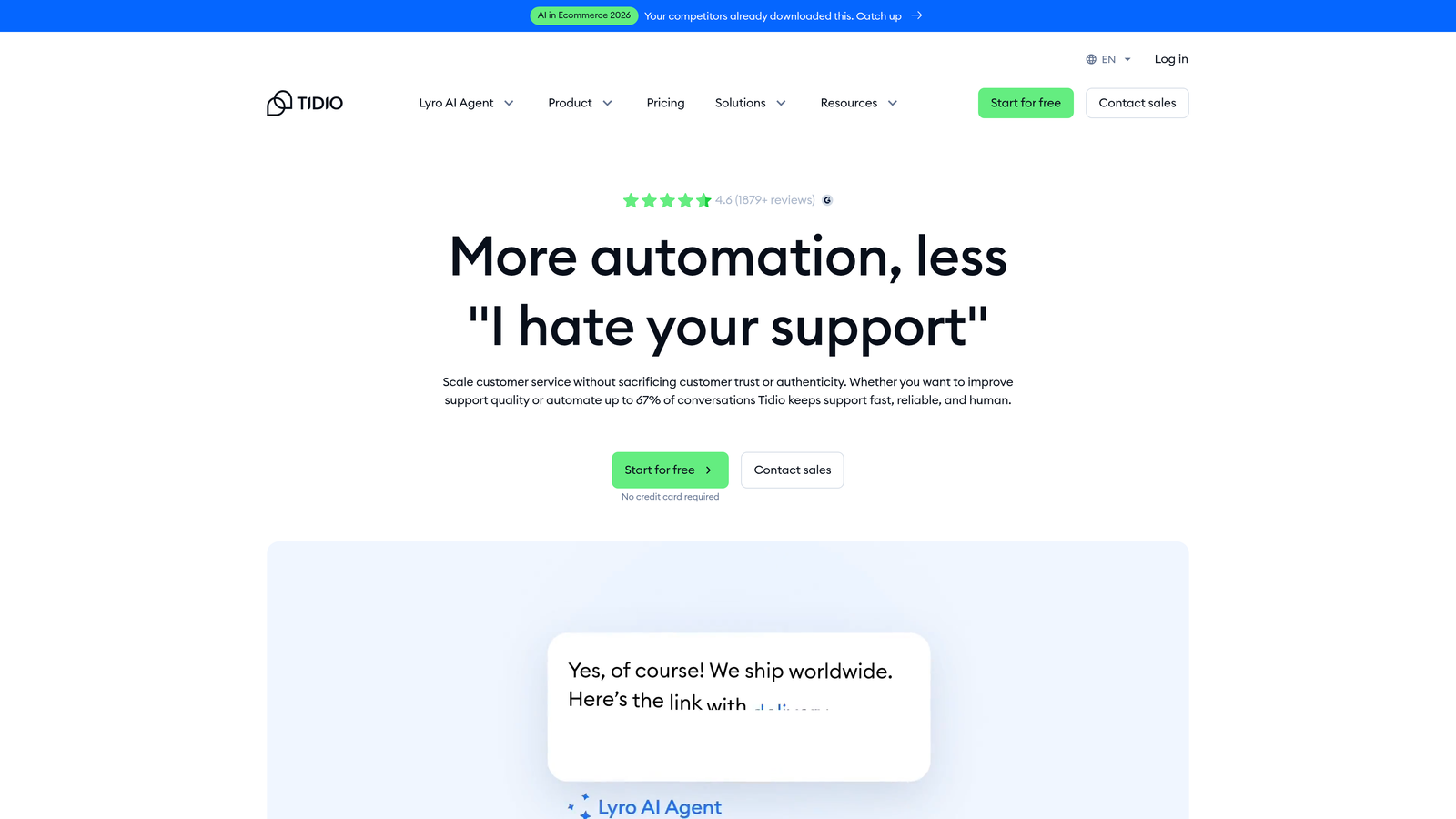
Tidio makes AI-powered customer messaging accessible to small businesses with Lyro AI and straightforward e-commerce integrations.
Where This Tool Shines
Tidio removes the complexity barrier that keeps small businesses from adopting AI messaging. The platform offers chatbot templates for common e-commerce scenarios—order tracking, product recommendations, FAQ responses—that work out of the box with minimal configuration.
The Shopify and WooCommerce integrations are particularly well-executed, pulling in order data, inventory status, and customer history automatically. This means the AI can answer specific questions about orders without customers needing to copy-paste order numbers or dig through confirmation emails.
Key Features
Lyro AI Chatbot: Conversational AI that handles customer questions using natural language understanding trained on e-commerce interactions.
Live Chat with Visitor Tracking: See what pages visitors browse and trigger proactive messages based on behavior and time on site.
E-Commerce Platform Integrations: Native connections to Shopify and WooCommerce with automatic order data synchronization.
Pre-Built Templates: Ready-to-use chatbot flows for common scenarios like order tracking, product questions, and lead capture.
Mobile Apps: Respond to customer messages from iOS and Android apps for support on the go.
Best For
Online stores, small service businesses, and startups that need AI messaging without enterprise complexity or pricing. Less suitable for B2B SaaS or companies requiring deep customization and advanced integrations.
Pricing
Free tier available with basic live chat. Lyro AI starts at $29 monthly, making it one of the most accessible AI messaging options for small businesses.
8. Kustomer
Best for: Customer-centric organizations prioritizing complete journey visibility and context-rich conversations
Kustomer reimagines the customer service platform around timeline views that show complete customer journeys rather than isolated tickets.
Where This Tool Shines
Kustomer's timeline approach fundamentally changes how agents understand customer context. Instead of seeing a ticket in isolation, agents see every previous conversation, purchase, support interaction, and product usage event in chronological order. This context enables more personalized, informed responses.
The custom objects capability lets you model data specific to your business. If you're a subscription service, you can create objects for billing cycles and plan changes. If you're a marketplace, you can track buyer and seller interactions separately. This flexibility makes Kustomer adaptable to unique business models.
Key Features
Customer Timeline View: Complete chronological history of every customer interaction, purchase, and product event in one unified interface.
AI Sentiment Analysis and Routing: Automatically detect customer emotion and urgency to route conversations to appropriate agents or escalation paths.
Omnichannel Unified View: Conversations from email, chat, social media, and voice appear in single threads rather than separate tickets.
Custom Objects: Flexible data modeling to track business-specific information beyond standard customer and ticket fields.
Proactive Messaging: Trigger outbound messages based on customer behavior, lifecycle stage, or product usage patterns.
Best For
Companies where customer relationships matter more than transaction volume. Subscription services, high-touch B2B, and premium consumer brands benefit most from the comprehensive context and relationship focus.
Pricing
Enterprise tier starts at $89 per user monthly with annual commitment. Custom pricing for larger deployments and advanced feature requirements.
9. LivePerson
Best for: Large enterprises unifying voice and messaging AI for conversational commerce at scale
LivePerson provides enterprise-grade conversational AI that bridges traditional voice support with modern messaging channels.
Where This Tool Shines
LivePerson's Conversational Cloud architecture handles massive scale—think major retailers, telecommunications companies, and financial institutions serving millions of customers. The platform doesn't just add messaging to existing channels; it creates unified conversational experiences whether customers start on voice and switch to chat or vice versa.
The Intent Manager is sophisticated, using AI to understand not just what customers say but what they're trying to accomplish. This intent-based routing ensures conversations reach agents or bots best equipped to resolve specific needs rather than generic topic-based routing.
Key Features
Conversational Cloud: Unified platform for AI-powered messaging across web, mobile, SMS, WhatsApp, and social channels at enterprise scale.
Voice AI Integration: Connect traditional voice support with messaging channels for seamless cross-channel conversations.
Intent Manager: AI-powered understanding of customer goals and needs for intelligent routing and personalized responses.
Conversation Builder: Design custom AI conversation flows with visual tools and integration to backend systems and data sources.
Enterprise Security and Compliance: SOC 2, HIPAA, PCI compliance with enterprise-grade security controls and data governance.
Best For
Large enterprises with complex compliance requirements, high conversation volumes, and existing voice infrastructure they want to modernize. The platform's sophistication and pricing make it overkill for small or mid-market companies.
Pricing
Custom enterprise pricing based on conversation volume, features, and deployment complexity. Typically positioned for organizations handling hundreds of thousands of monthly conversations.
Finding Your Best Fit
The right AI messaging platform depends heavily on your specific use case and existing infrastructure. B2B support teams seeking continuous learning and business intelligence beyond basic messaging should explore Halo AI's AI-first architecture. Product-led companies that blur the line between support and user engagement will find Intercom's unified approach valuable.
Sales-focused organizations accelerating pipeline through conversational marketing should evaluate Drift, while enterprises with established support operations spanning multiple channels might prefer Zendesk's comprehensive ecosystem. Budget-conscious mid-market teams can find solid value in Freshdesk or Tidio, depending on whether they need broader business tools or focused e-commerce features.
For companies prioritizing high-volume automation across languages, Ada's reasoning engine and localization capabilities stand out. Organizations focused on customer journey context and relationship history should consider Kustomer's timeline approach. Large enterprises requiring conversational commerce at massive scale with voice integration will find LivePerson's enterprise architecture appropriate.
The most important evaluation criteria? Integration depth with your existing stack and whether the AI actually learns from interactions or requires constant manual updates. Your support team shouldn't scale linearly with your customer base. Let AI agents handle routine tickets, guide users through your product, and surface business intelligence while your team focuses on complex issues that need a human touch. See Halo in action and discover how continuous learning transforms every interaction into smarter, faster support.