9 Best AI-Powered Live Chat Software Tools in 2026
AI powered live chat software has evolved far beyond simple chatbots — today's platforms autonomously resolve tickets, surface business intelligence, and escalate to humans only when necessary. This guide evaluates the 9 best tools available in 2026 across AI capability, integrations, deployment ease, and value for B2B SaaS support teams.
 Matt PattoliFounder13 min read
If your support team is still manually triaging every chat, you're leaving speed and scale on the table. AI-powered live chat software has moved well beyond basic chatbots. Today's platforms resolve tickets autonomously, surface business intelligence, and hand off to human agents only when it genuinely matters.
The result: faster resolutions, leaner teams, and customers who don't feel like they're talking to a wall. This guide covers the best AI-powered live chat tools available in 2026, evaluated across five criteria: depth of AI capability, integration ecosystem, ease of deployment, escalation handling, and value for B2B SaaS teams.
Whether you're replacing a legacy helpdesk, augmenting an existing setup, or building a support stack from scratch, there's a right fit here. Let's get into it.
1. Halo AI
Best for: B2B SaaS teams wanting AI-first autonomous resolution with business intelligence built in
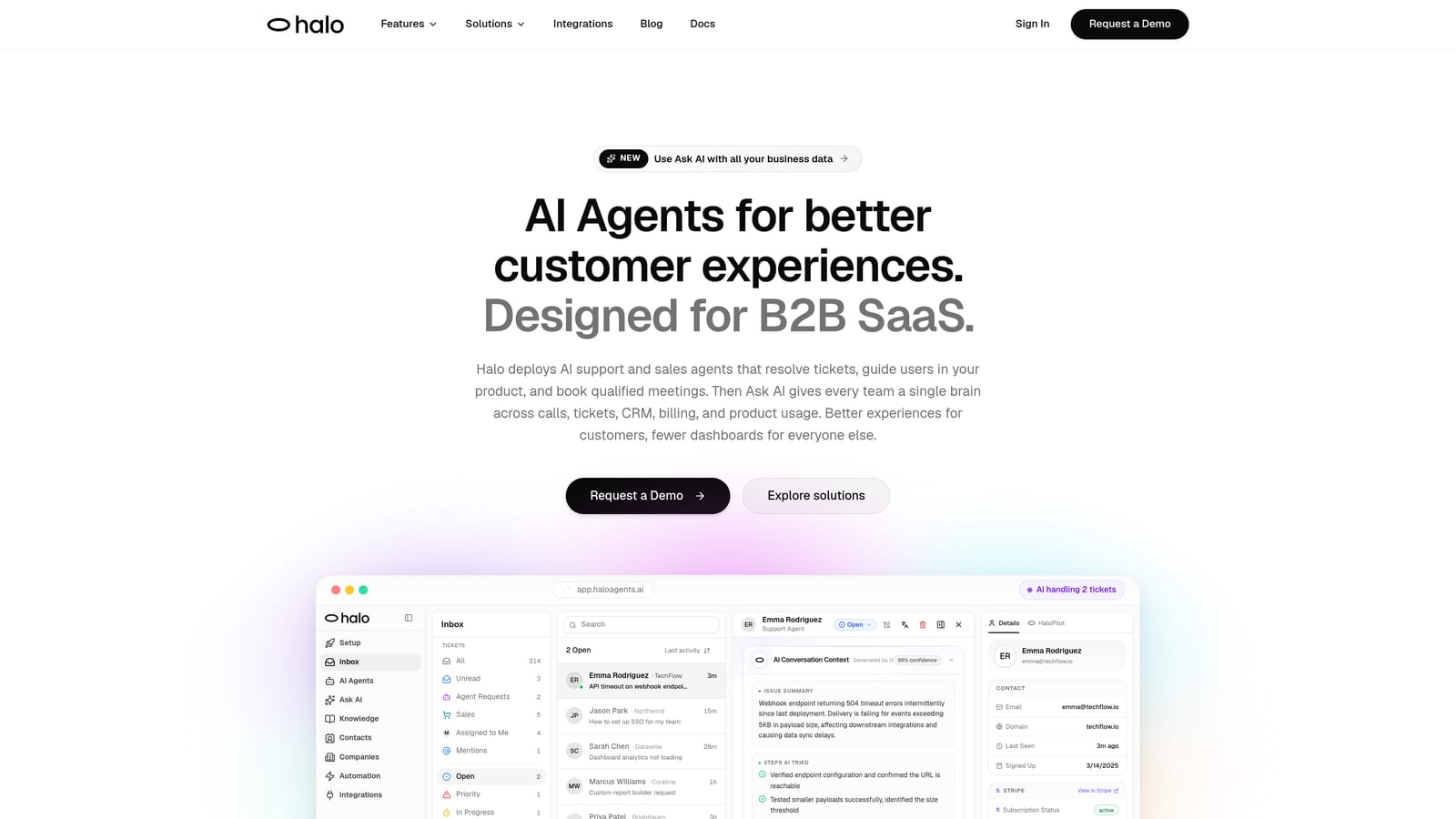
Halo AI is an AI-first customer support platform that autonomously resolves tickets, guides users through products with page-aware visual context, and surfaces business intelligence through a smart inbox.
Where This Tool Shines
Most tools on this list started as helpdesks and bolted AI on later. Halo was built the other way around: AI resolution is the core architecture, not a feature layer. That distinction matters more than it sounds. When AI is foundational rather than additive, context flows naturally through every interaction instead of being patched together from disconnected systems.
The standout capability is the page-aware chat widget. The AI understands what screen the user is currently on and can provide visual UI guidance in context, not just generic text answers. Pair that with a smart inbox that surfaces customer health signals and revenue anomalies alongside ticket data, and you have a support platform that tells you things your helpdesk never could.
Key Features
Page-Aware Chat Widget: Understands the user's current screen and delivers visual UI guidance relevant to their exact context.
Autonomous Ticket Resolution: AI agents resolve support tickets end-to-end, with intelligent escalation to live agents when complexity warrants it.
Smart Inbox with Business Intelligence: Surfaces customer health signals, revenue anomalies, and trend detection beyond standard support metrics.
Auto Bug Ticket Creation: Automatically generates and routes bug tickets to Linear or connected project management tools without manual intervention.
Deep Integration Stack: Connects to HubSpot, Slack, Intercom, Stripe, Zoom, PandaDoc, Fathom, and Linear for a unified view of the business.
Best For
B2B SaaS product teams and support leaders who want AI that genuinely resolves tickets rather than suggesting replies for humans to send. Particularly compelling for teams that want support data connected to revenue signals, not siloed in a separate helpdesk.
Pricing
Demo-first model with custom pricing. Visit haloagents.ai to book a demo and discuss your team's specific requirements.
2. Intercom
Best for: Mid-market SaaS teams already invested in the Intercom ecosystem
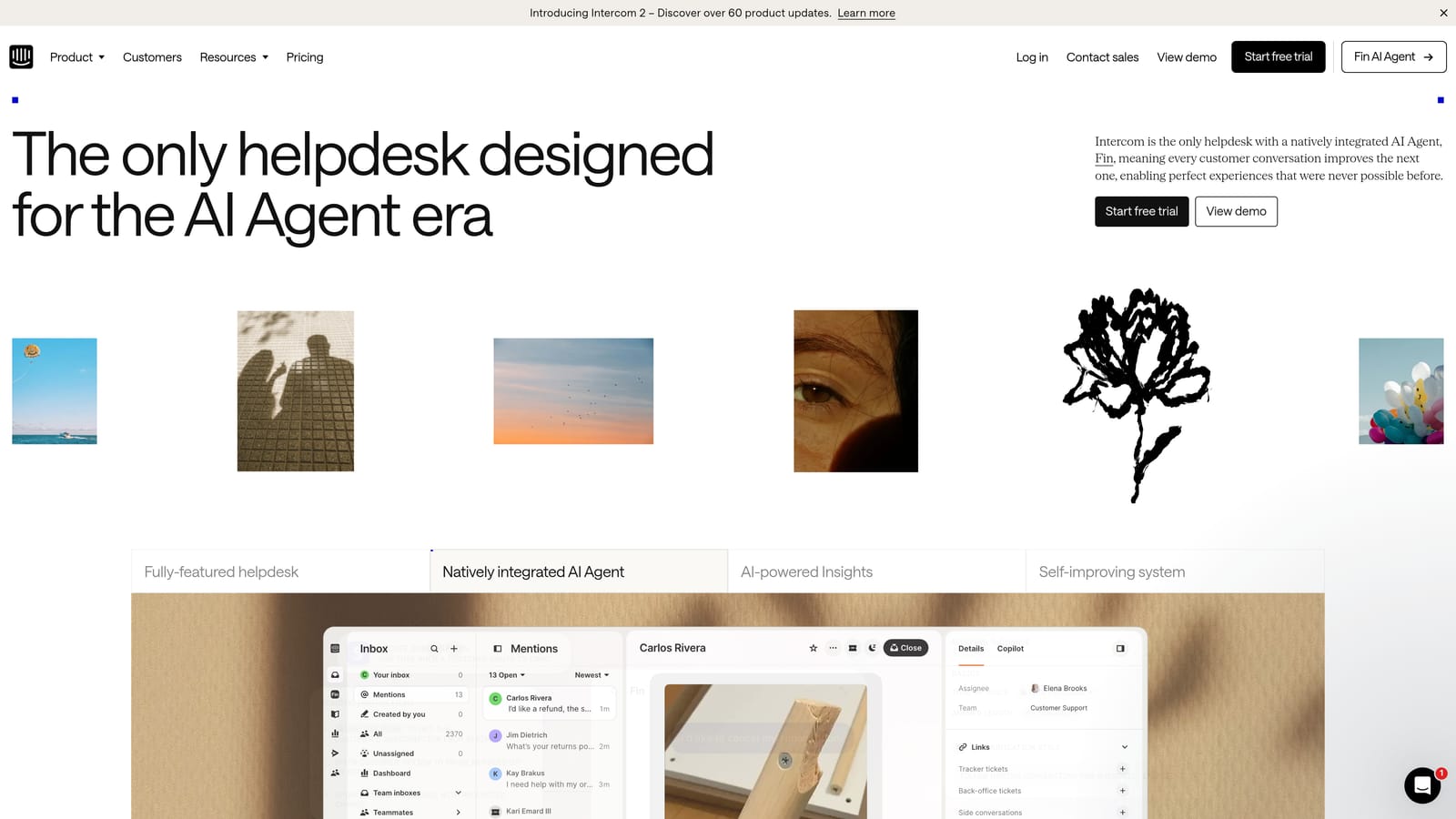
Intercom is a mature conversational support platform with Fin, its LLM-powered AI agent, built on top of rich customer profile data.
Where This Tool Shines
Intercom's biggest advantage is the depth of customer context it already holds. Fin doesn't just answer questions in isolation; it draws on Intercom's CRM-adjacent profile system, which means it knows who the customer is, what plan they're on, and what they've done recently before the conversation even starts. That context makes AI responses meaningfully more relevant.
The platform is also genuinely mature. The integration marketplace is extensive, the omnichannel coverage is solid, and the product has been refined over many years of real-world deployment. For teams already running their customer communications through Intercom, adding Fin is a natural extension rather than a platform change.
Key Features
Fin AI Agent: LLM-powered autonomous resolution that draws on your help content and customer profile data to close tickets without human input.
Rich Customer Profile Context: AI responses informed by existing customer history, plan data, and behavioral signals.
Extensive Integration Marketplace: Connects to a wide range of third-party tools across CRM, billing, and project management.
Omnichannel Support: Covers chat, email, and in-product messaging from a single platform.
Best For
SaaS teams already using Intercom for customer communications who want to layer in autonomous AI resolution without migrating platforms. Less compelling as a greenfield choice if you're not already in the ecosystem.
Pricing
Tiered plans with AI features included at higher tiers. Check intercom.com for current pricing as plans evolve regularly.
3. Zendesk AI
Best for: Enterprise teams with existing Zendesk infrastructure looking to add AI capabilities
Zendesk AI is an AI capability layer built into Zendesk's enterprise-grade ticketing infrastructure, covering intelligent triage, intent detection, and agent-assist features.
Where This Tool Shines
Zendesk's strength is its enterprise foundation. If your organization has significant compliance requirements, complex security policies, or regulatory constraints, Zendesk's established posture in those areas is genuinely valuable. The AI capabilities sit on top of infrastructure that many large organizations already trust.
The agent-assist features are practical and well-integrated: suggested replies, macro recommendations, and sentiment detection that help human agents work faster without requiring a full workflow overhaul. For teams that aren't ready to go fully autonomous, Zendesk AI offers a middle path.
Key Features
Intelligent Triage: Automatically categorizes, prioritizes, and routes incoming tickets based on intent and sentiment detection.
AI-Suggested Replies: Surfaces relevant response suggestions and macro recommendations to accelerate agent handling time.
Enterprise Infrastructure: Built on Zendesk's established ticketing backbone with strong compliance and security capabilities.
Intent and Sentiment Detection: Identifies customer intent and emotional tone to inform routing and prioritization decisions.
Best For
Organizations with existing Zendesk deployments and enterprise compliance requirements. Less ideal for teams evaluating fresh deployments where a more AI-native architecture might serve them better long-term.
Pricing
AI capabilities are offered as add-ons layered on existing Zendesk plans. Contact Zendesk directly for current AI pricing as it varies by tier and usage.
4. Freshdesk Freddy AI
Best for: SMBs and growing teams wanting AI support without enterprise complexity or cost
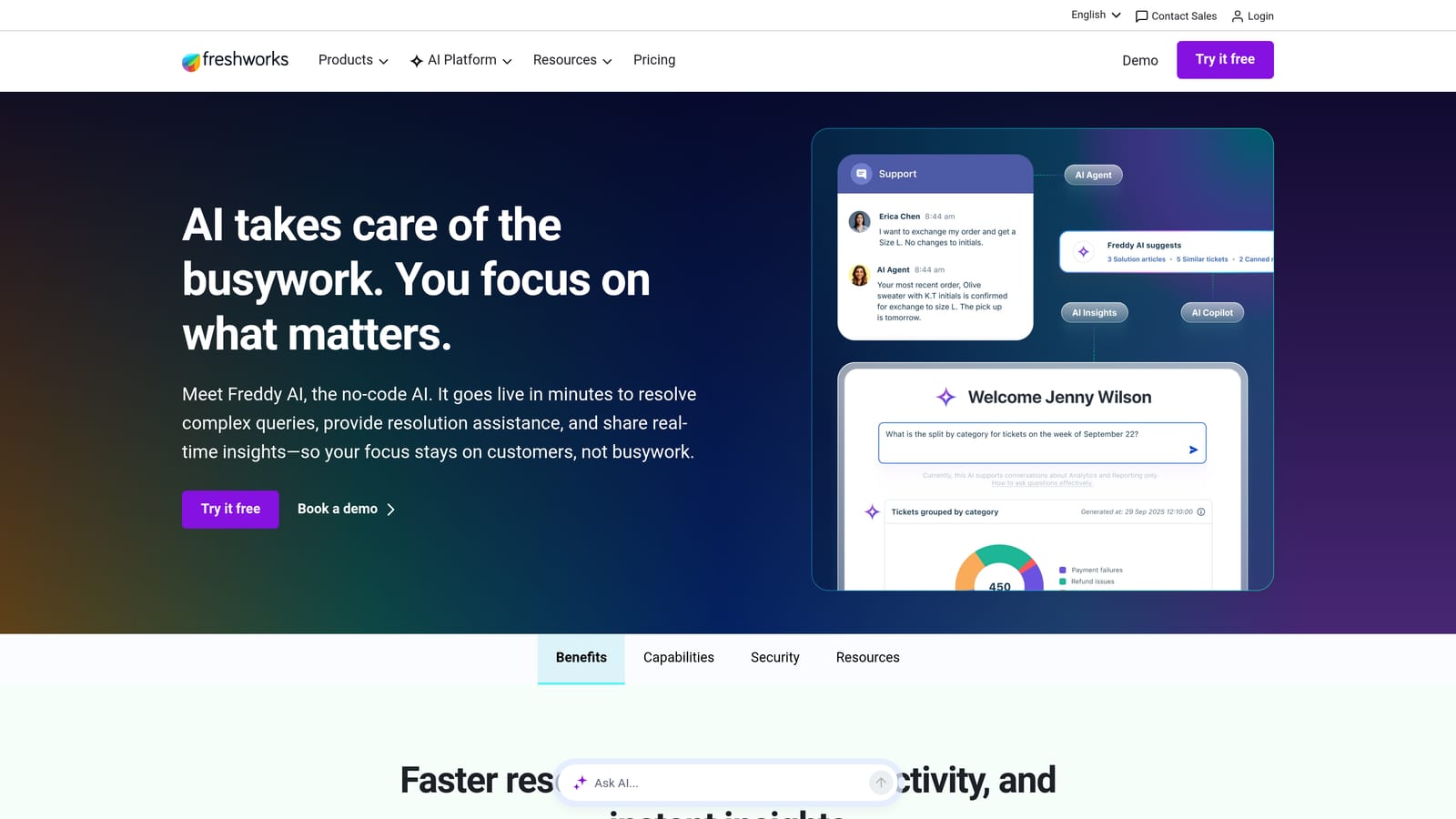
Freshdesk Freddy AI is Freshworks' AI layer spanning self-service bots, agent copilot, and analytics insights across the Freshdesk support suite.
Where This Tool Shines
Freddy AI is structured across three distinct layers, which makes it flexible for teams at different stages of AI adoption. You can start with the self-service bot for deflection, add the agent copilot for efficiency, and layer in analytics insights as your team matures. That progression is genuinely useful for teams that don't want to overhaul everything at once.
Pricing accessibility is a real differentiator here. Freshdesk offers AI features at price points that don't require enterprise budget approval, which opens the door for smaller teams to start experimenting without significant financial commitment.
Key Features
Freddy Self Service: No-code AI bot builder for autonomous ticket deflection without requiring developer resources.
Freddy Copilot: Real-time agent assist with suggested responses to reduce handling time for human agents.
Freddy Insights: AI-driven analytics that surface trends and anomalies across your support data.
Freshworks Suite Integration: Connects natively with Freshsales and Freshservice for a unified view across sales and IT support.
Best For
SMBs and mid-market teams wanting accessible AI support features without the complexity or cost of enterprise platforms. Also a natural fit for teams already using other Freshworks products.
Pricing
AI features available on Growth plans and above, with SMB-friendly pricing. Check freshworks.com for current plan details.
5. Drift (Salesloft)
Best for: Revenue teams where sales and support conversations overlap significantly
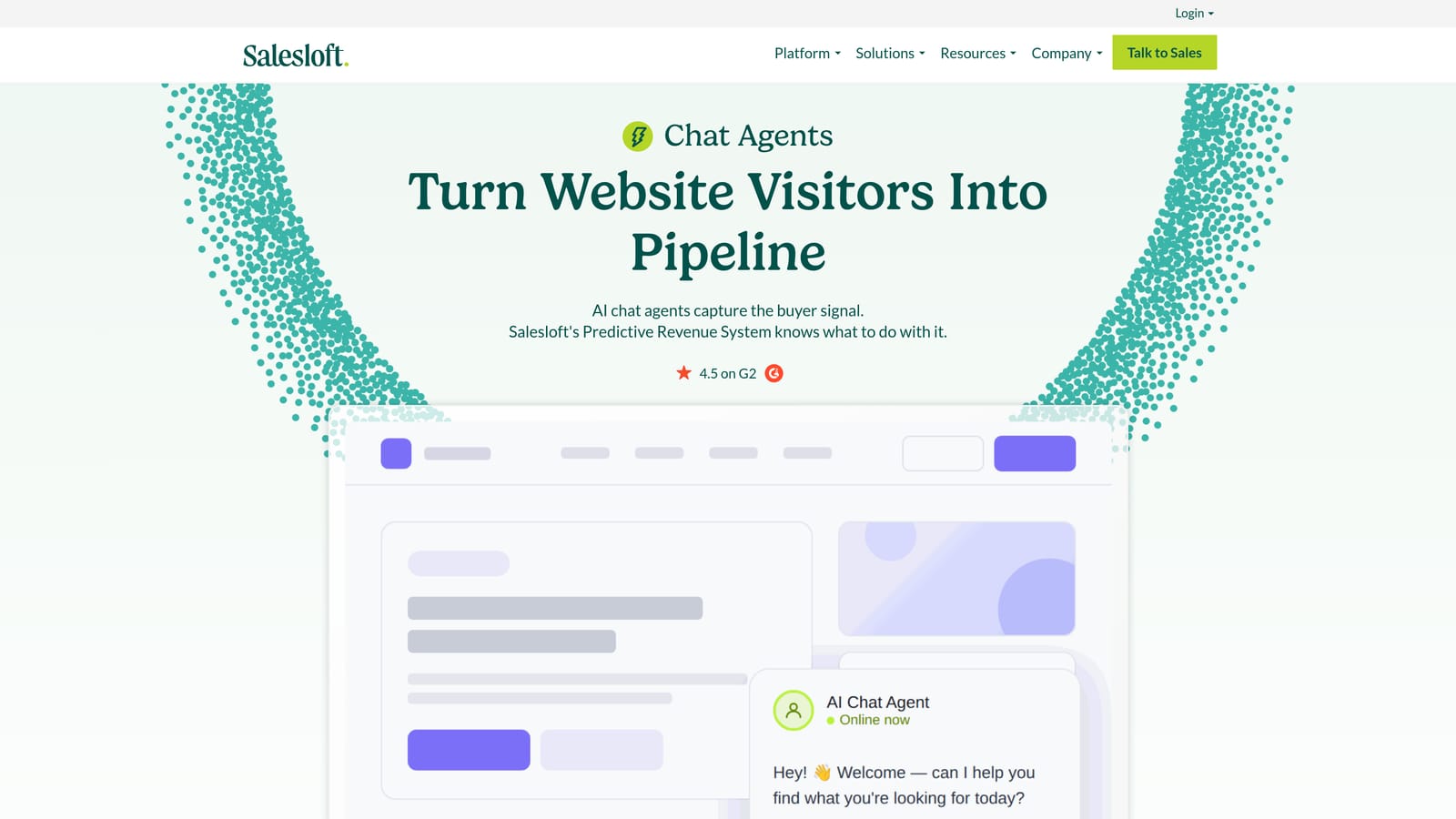
Drift is a revenue-focused conversational AI platform combining sales and support chat with pipeline-aware routing and account-based marketing targeting.
Where This Tool Shines
Drift's core strength is its pipeline awareness. The AI doesn't just route conversations; it routes them with knowledge of where each account sits in the sales cycle, what deals are open, and which visitors match your ideal customer profile. That makes it genuinely useful for teams where the line between support and sales is blurry.
Following its acquisition by Salesloft, Drift has become more deeply embedded in the broader revenue engagement workflow. If your team is already running outbound and deal management through Salesloft, the conversation intelligence integration creates useful continuity between inbound chat and outbound sequences.
Key Features
ABM Targeting and Pipeline-Aware Routing: Routes conversations based on account status, deal stage, and ICP fit rather than simple queue logic.
Conversation Intelligence: Ties chat interactions to CRM and deal data for revenue-relevant context.
Playbook-Based Automation: Configurable workflows for both sales qualification and support resolution scenarios.
Salesloft Integration: Deep connection to Salesloft's revenue engagement platform for teams operating across both systems.
Best For
B2B revenue teams where sales, marketing, and support conversations converge. Less suited for pure support use cases where pipeline context isn't relevant.
Pricing
Enterprise-oriented pricing. Contact Drift or Salesloft directly for current quotes as pricing is customized by use case and team size.
6. Tidio
Best for: E-commerce businesses and small teams wanting fast, accessible AI chat deployment
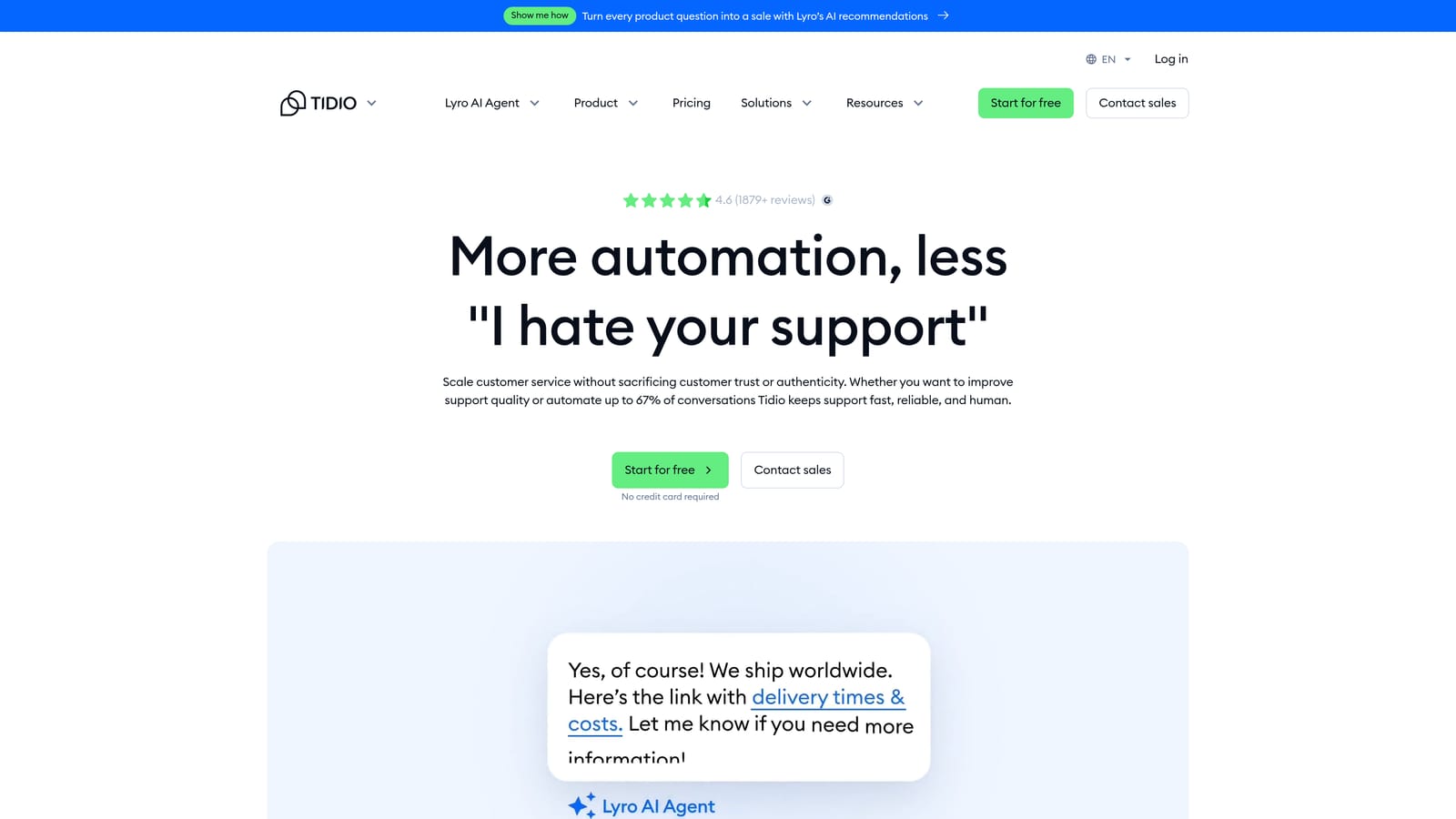
Tidio is an accessible AI live chat platform with Lyro AI agent designed for fast deployment, particularly strong for e-commerce and small business scenarios.
Where This Tool Shines
Tidio's setup speed is genuinely impressive. Teams can go from signup to a deployed AI agent handling real conversations in a very short window, with no code required. For small businesses that need something working quickly without dedicated technical resources, that deployment simplicity is a meaningful advantage.
The Shopify and WooCommerce integrations are native and well-maintained, which makes Tidio a natural fit for e-commerce teams where order status, returns, and product questions make up the bulk of support volume. Lyro handles these transactional queries effectively.
Key Features
Lyro AI Agent: Autonomous resolution of common customer queries using conversational AI without requiring bot-building expertise.
No-Code Setup: Fast deployment with no developer resources required, designed for non-technical teams.
E-Commerce Integrations: Native connections to Shopify and WooCommerce for order and product context within chat.
Free Tier Available: Entry-level access without upfront cost, with paid plans unlocking higher conversation volumes.
Best For
E-commerce businesses, small teams, and anyone needing a quick-to-deploy AI chat solution. Less suited for complex B2B SaaS support scenarios with nuanced product questions or enterprise escalation requirements.
Pricing
Free tier available with paid plans at accessible SMB price points. Check tidio.com for current plan details and volume limits.
7. Help Scout
Best for: Teams with a strong human support culture who want AI efficiency without losing brand voice
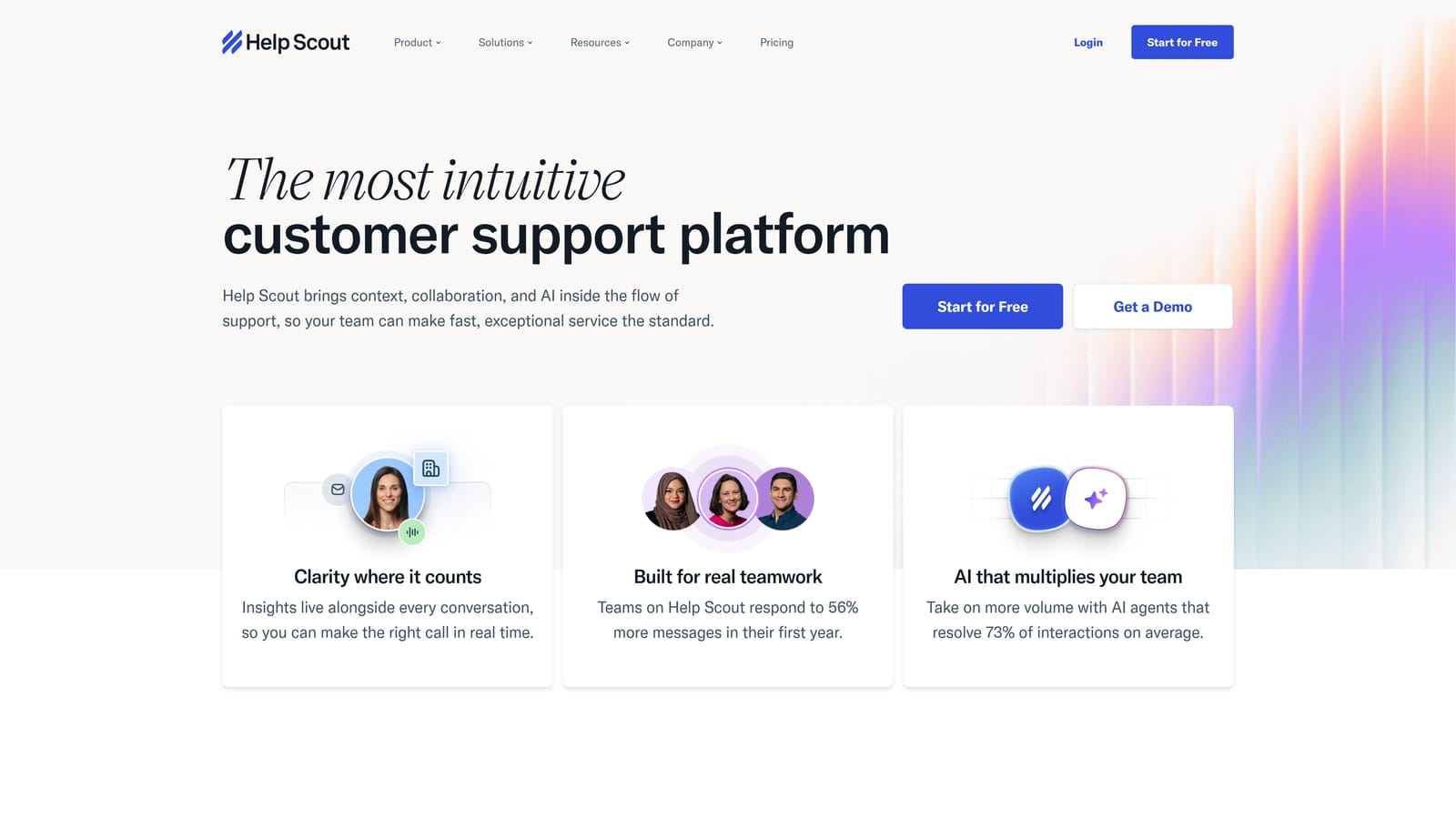
Help Scout is a customer-centric support platform with AI features designed to augment human agents rather than replace them, preserving brand voice and relationship quality.
Where This Tool Shines
Help Scout has a clear and consistent philosophy: AI should make your agents better, not redundant. That's a deliberate positioning choice, and for teams where the quality of human interaction is a core part of the brand promise, it's the right one. The AI features are practical and focused on reducing friction rather than removing humans from the loop.
AI Summarize is particularly useful for teams handling long, complex threads. Getting an instant summary of a conversation history before responding saves meaningful time without changing the nature of the human response. It's a good example of AI augmentation done well.
Key Features
AI Summarize: Instant thread summaries that give agents full context without reading entire conversation histories.
AI Assist: Drafts reply suggestions that agents can review, edit, and send in their own voice.
AI Answers: Self-service resolution drawn from your knowledge base for common questions before reaching an agent.
Human-First Design Philosophy: AI positioned as an efficiency layer, not an autonomous replacement for human support relationships.
Best For
Teams that prioritize relationship quality and brand voice in support interactions, where full AI autonomy isn't the goal. Strong fit for professional services, high-touch SaaS, and any business where customer relationships are a competitive differentiator.
Pricing
Transparent per-user pricing at mid-range price points. Check helpscout.com for current plan details.
8. Zoho SalesIQ
Best for: Teams operating within the Zoho ecosystem who want integrated chat and lead intelligence
Zoho SalesIQ is an AI-powered chat and visitor intelligence platform deeply integrated with the Zoho ecosystem, featuring a no-code bot builder and built-in lead scoring.
Where This Tool Shines
For teams already using Zoho CRM, Zoho Desk, or other Zoho products, SalesIQ's integration depth is a genuine advantage. The Zobot builder pulls directly from CRM data, which means the AI has access to contact records, deal history, and customer segments without any custom development work. That context makes conversations more relevant from the first message.
The visitor tracking and behavioral lead scoring features add an interesting dimension beyond pure support. Teams can see which companies are browsing, score them based on behavior, and trigger proactive chat at the right moment, combining support and sales intelligence in a single interface.
Key Features
Zobot Builder: No-code AI bot creation with direct access to Zoho CRM data for context-aware conversations.
Visitor Tracking and Lead Scoring: Real-time identification of website visitors with behavioral scoring for sales prioritization.
Zoho Ecosystem Integration: Native connections across Zoho CRM, Desk, and Campaigns without third-party middleware.
Competitive Pricing: Particularly cost-effective for teams already paying for Zoho products across the business.
Best For
Businesses running Zoho across sales, support, and marketing who want a unified chat and visitor intelligence layer. Significantly less compelling for teams outside the Zoho ecosystem where the integration advantages don't apply.
Pricing
Free tier available with paid plans scaling based on usage. Check zoho.com/salesiq for current pricing details.
9. Kustomer
Best for: High-volume subscription and D2C businesses needing unified customer timeline context
Kustomer is an AI-powered customer service CRM with a unified timeline view combining chat, email, social, and order history for rich conversational context.
Where This Tool Shines
Kustomer's core differentiator is the unified customer timeline. Rather than treating each conversation as an isolated ticket, Kustomer assembles a complete picture of every customer interaction across every channel, including purchase history, previous support contacts, and social interactions. The AI uses that full context to generate responses that feel genuinely informed rather than generic.
For high-volume consumer businesses, this timeline approach solves a real problem: agents (and AI) no longer need to ask customers to repeat themselves or search across systems for order details. Everything is in one view, which improves both resolution speed and customer experience quality.
Key Features
Unified Customer Timeline: Complete view of all touchpoints across chat, email, SMS, social, and purchase history in a single interface.
Context-Rich AI Resolution: AI powered by full customer history rather than just the current conversation thread.
True Omnichannel Coverage: Chat, email, SMS, and social channels managed from one unified platform.
High-Volume Architecture: Built to handle the scale demands of subscription businesses and direct-to-consumer brands.
Best For
High-volume D2C brands, subscription businesses, and consumer-facing companies where order history and multi-channel interaction context are central to support quality. Less suited for B2B SaaS teams where the product complexity and enterprise integrations matter more than consumer transaction history.
Pricing
Enterprise pricing with implementation complexity to match. Contact Kustomer directly for current rates and deployment requirements.
Which Tool Is Right for Your Team
The right AI-powered live chat platform depends less on feature lists and more on where your support strategy is actually headed. Here's a quick map to help you orient.
AI-first with business intelligence: Halo AI is the standout choice for B2B SaaS teams that want autonomous resolution paired with revenue and customer health signals beyond standard ticket metrics.
Enterprise helpdesk with AI layered in: Zendesk AI makes sense if you have significant existing infrastructure investment and compliance requirements that make platform migration unappealing.
Established SaaS mid-market: Intercom with Fin is a natural fit for teams already running customer communications through the platform who want AI resolution without switching ecosystems.
Budget-conscious SMB: Tidio's free tier and fast deployment make it the lowest-friction starting point. Freshdesk Freddy AI is the better choice if you want more structured AI layers and a path to scaling.
Sales and support overlap: Drift is purpose-built for revenue teams where pipeline context matters as much as ticket resolution.
Human-first augmentation: Help Scout for teams where relationship quality is non-negotiable and AI should assist, not replace.
Zoho ecosystem: Zoho SalesIQ is the obvious choice if you're already operating across Zoho products.
High-volume consumer CRM: Kustomer for D2C and subscription businesses where unified customer timeline context drives resolution quality.
Before committing to any platform, ask three questions: Does the AI actually resolve tickets, or does it just suggest replies for humans to send? How does the platform handle escalation to a human, and what context does it pass along? What data does it surface beyond ticket volume? The right tool should make your support team faster and smarter, not just busier managing a bot.
Your support team shouldn't scale linearly with your customer base. Let AI agents handle routine tickets, guide users through your product, and surface business intelligence while your team focuses on complex issues that need a human touch. See Halo in action and discover how continuous learning transforms every interaction into smarter, faster support.