9 Best AI-Powered Ticket Management Systems in 2026
Discover the 9 best AI-powered ticket management systems of 2026, evaluated on genuine AI capabilities, integration depth, and scalability for growing SaaS teams. This guide breaks down platforms that go beyond basic automation to autonomously classify, route, and resolve support tickets—helping teams reduce bottlenecks, improve resolution times, and handle increasing ticket volume without sacrificing customer experience.
 Grant CooperFounder13 min read
Support ticket volume doesn't slow down. As your customer base grows, so does the flood of incoming requests, and traditional ticket queues were never designed to handle the scale that modern SaaS teams face. Manual triage, inconsistent routing, and slow resolution times create compounding bottlenecks that hurt both customers and agents.
AI-powered ticket management systems change the equation. The best ones don't just sort tickets faster; they classify, prioritize, route, and in many cases resolve tickets autonomously, learning from every interaction along the way. But the market has matured quickly, and not every platform is created equal. Some are legacy helpdesks with AI features layered on top. Others are built from the ground up around autonomous resolution.
This guide covers standout options across both camps, evaluated on genuine AI capabilities (not just rule-based automation), integration depth, scalability for B2B teams, and overall value. Whether you're running a lean startup support team or managing a high-volume enterprise queue, there's a fit here for your stack and support philosophy. If you're also exploring how AI agents can resolve tickets end-to-end, the comparison below will help you separate the real AI-native platforms from the helpdesks that bolted on a chatbot.
1. Halo AI
Best for: B2B SaaS teams that want autonomous ticket resolution, product-aware guidance, and business intelligence in one platform.
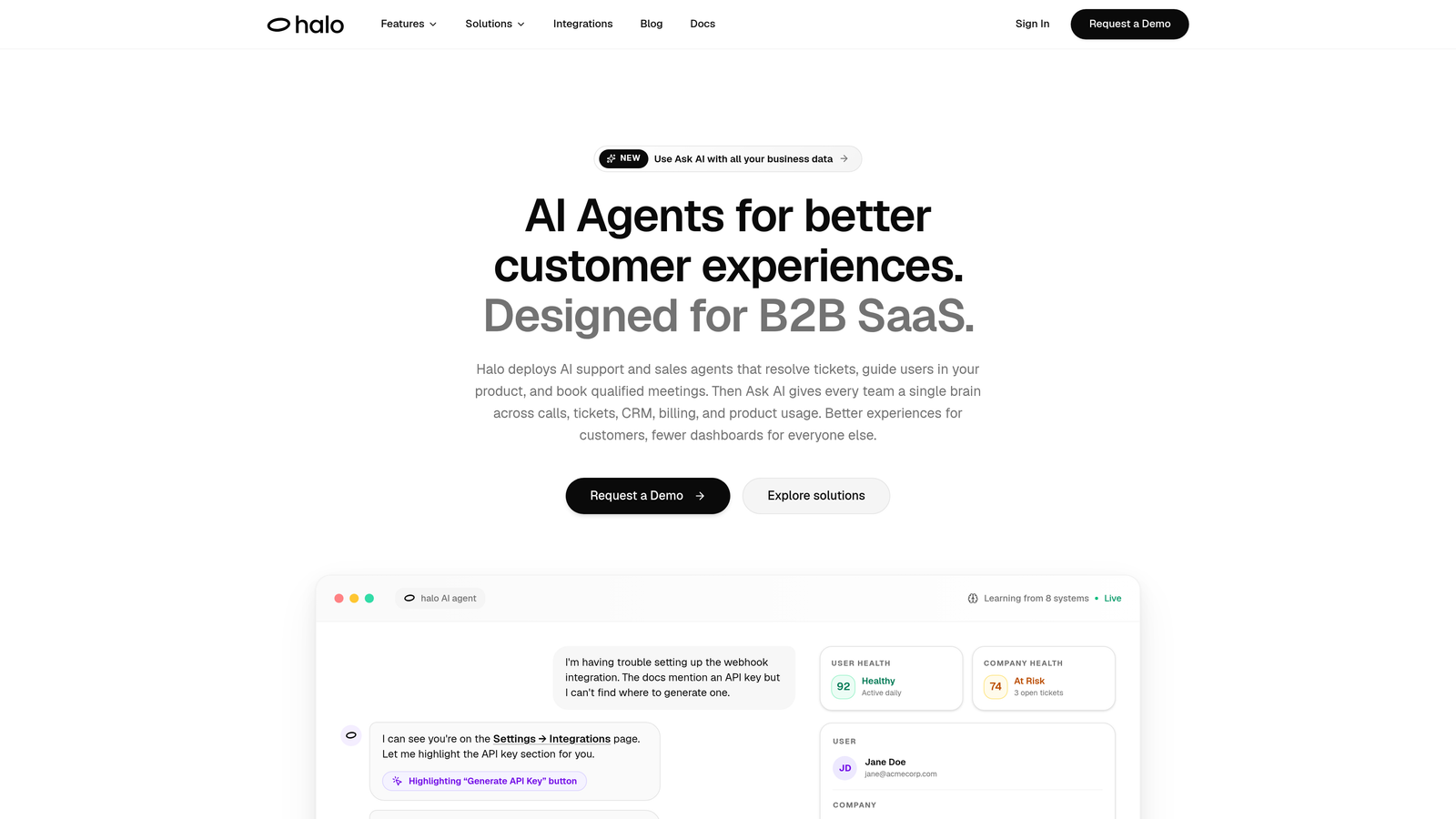
Halo AI is an AI-native customer support platform built from the ground up around autonomous agents, not adapted from a legacy helpdesk.
Where This Tool Shines
Most platforms on this list use AI to assist human agents. Halo AI takes a different approach: its agents are designed to handle the full ticket lifecycle autonomously, from first contact through resolution, without needing a human to shepherd each interaction along. That distinction matters enormously at scale.
What sets Halo apart further is its page-aware context engine. The chat widget can see what the user sees, meaning it provides guidance that's specific to where someone is in your product rather than generic help center responses. Combine that with business intelligence signals surfaced from support conversations, and you get a platform that makes your support data genuinely useful beyond deflection metrics.
Key Features
Autonomous AI Agents: Resolve tickets end-to-end, not just triage or suggest responses, handling the full resolution workflow without human intervention for routine issues.
Page-Aware Chat Widget: Sees the user's current context within your product and delivers guidance tailored to their exact location in the UI, reducing back-and-forth significantly.
Smart Inbox with Business Intelligence: Surfaces customer health signals, revenue intelligence, and anomaly detection from support data, giving product and success teams actionable signals beyond basic ticket metrics.
Auto Bug Ticket Creation: Converts support conversations into structured bug reports automatically and integrates directly with Linear, closing the loop between support and engineering.
Full Business Stack Integrations: Connects to Slack, HubSpot, Intercom, Stripe, Zoom, PandaDoc, and Fathom, making it a genuine hub rather than a siloed support tool.
Best For
Halo AI is the strongest fit for B2B SaaS companies and product teams that want to move beyond ticket deflection and toward true autonomous resolution. It's particularly well-suited for teams that need support data to feed into product decisions, customer health monitoring, and revenue intelligence, not just agent productivity metrics.
Pricing
Contact for pricing. Halo operates on a usage-based model focused on resolutions, which aligns costs with actual value delivered rather than agent seat count.
2. Zendesk AI
Best for: Large enterprise support organizations already invested in the Zendesk ecosystem.
Zendesk AI is an enterprise-grade AI layer built into the Zendesk Suite, adding intelligent triage, agent assistance, and automated resolution to one of the most established helpdesks in the market.

Where This Tool Shines
Zendesk's strength has always been its depth: deep workflows, extensive customization, and a reporting engine that enterprise teams rely on. The AI layer extends that foundation with intent detection, sentiment analysis, and generative tools that help agents move faster without rebuilding their existing processes.
For organizations that have already built significant Zendesk infrastructure, the AI features integrate naturally. The trade-off is that the AI is fundamentally agent-assist oriented: it accelerates human agents rather than replacing them for routine tickets.
Key Features
Intelligent Triage: Auto-classifies ticket intent, language, and sentiment to route conversations to the right team without manual intervention.
AI-Generated Macro Suggestions: Recommends relevant response templates and macros based on ticket content, reducing the time agents spend searching.
Generative AI Tools: Helps agents expand, summarize, and adjust the tone of replies directly within the ticket interface.
AI-Powered Bots: Handles automated resolution across chat and email channels before tickets reach a human agent.
Zendesk Explore Analytics: Deep reporting on AI performance, ticket trends, and agent productivity within the existing Explore framework.
Best For
Enterprise support teams with high ticket volumes, complex routing needs, and existing Zendesk infrastructure. Less suited for teams looking for AI-native autonomous resolution or those not already in the Zendesk ecosystem.
Pricing
AI features are available on Suite Professional and above, starting around $115/agent/month. Full AI capabilities require the Advanced AI add-on, which carries an additional cost.
3. Freshdesk Freddy AI
Best for: Mid-market teams looking for solid AI-assisted ticket management within the Freshworks ecosystem at a competitive price.
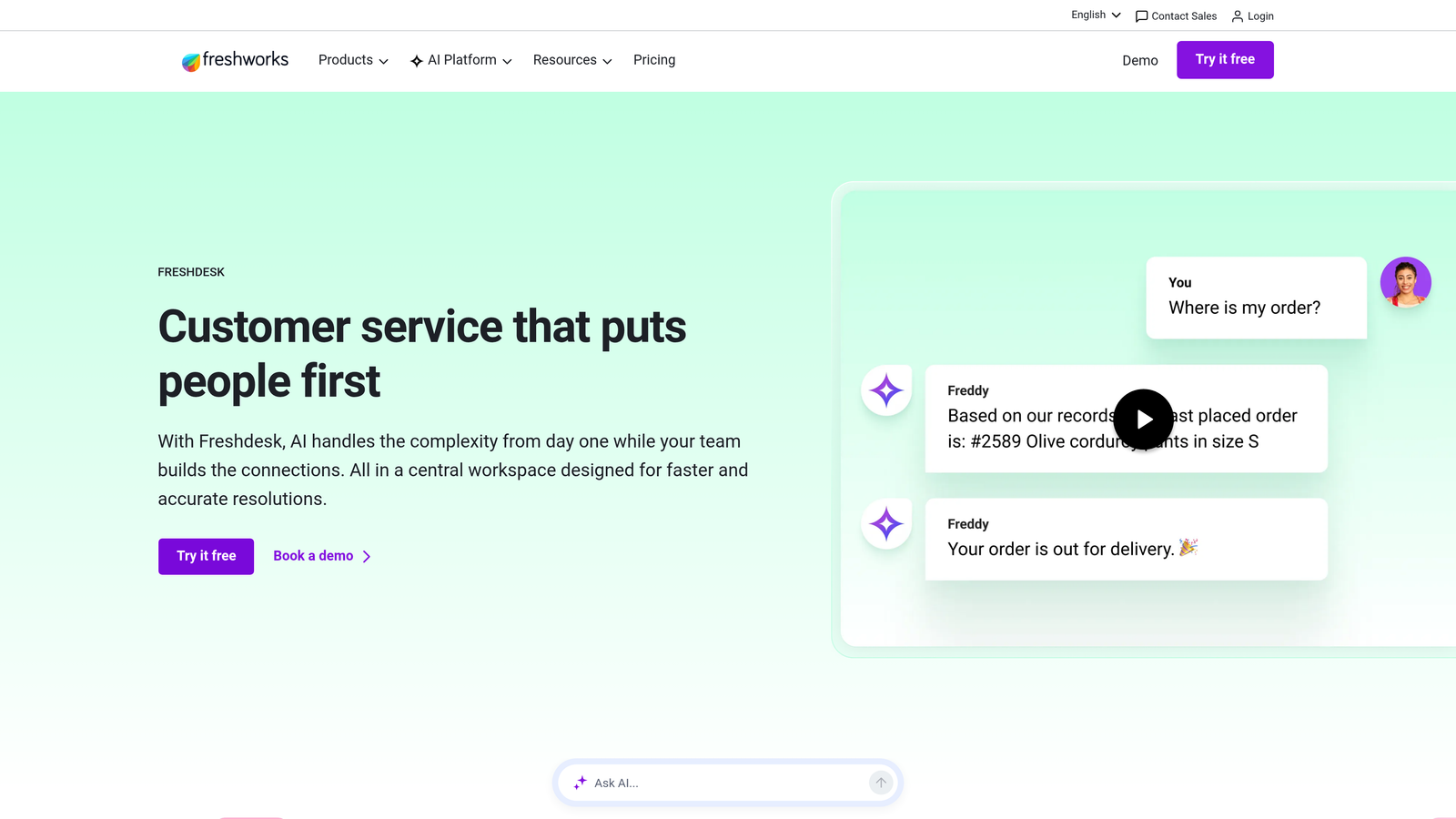
Freshdesk uses Freddy AI to bring intelligent triage, suggested responses, and ticket resolution automation to teams that want capable AI without enterprise pricing.
Where This Tool Shines
Freddy AI covers the core AI ticket management use cases well: auto-classification, priority prediction, and response suggestions drawn from your knowledge base and historical resolutions. For teams already using Freshworks products, the native CRM and chat integrations mean less configuration overhead.
The thank-you detection feature is a practical touch that prevents tickets from reopening unnecessarily when customers send a simple acknowledgment, a small thing that adds up meaningfully in high-volume queues.
Key Features
Freddy Auto-Triage: Classifies and prioritizes incoming tickets automatically based on content, reducing manual sorting for agents.
AI-Suggested Responses: Pulls from your knowledge base and past resolutions to recommend relevant replies, speeding up agent response time.
Thank-You Detection: Identifies customer acknowledgment messages and prevents resolved tickets from incorrectly reopening.
Freddy Copilot: Agent-assist tool that summarizes conversations and suggests next steps to help agents resolve complex tickets faster.
Native Freshworks Integration: Connects directly with Freshworks CRM, Freshchat, and Freshsales for a unified customer view across the product suite.
Best For
Mid-market companies already in the Freshworks ecosystem, or teams that want capable AI-assisted ticket management without committing to enterprise-level pricing. Not the strongest choice for teams outside the Freshworks stack.
Pricing
Free tier available for small teams. AI features begin on the Pro plan at $49/agent/month. Advanced Freddy AI capabilities are available as add-ons at additional cost.
4. Intercom Fin
Best for: Product and support teams that want to resolve questions conversationally before they ever become formal tickets.
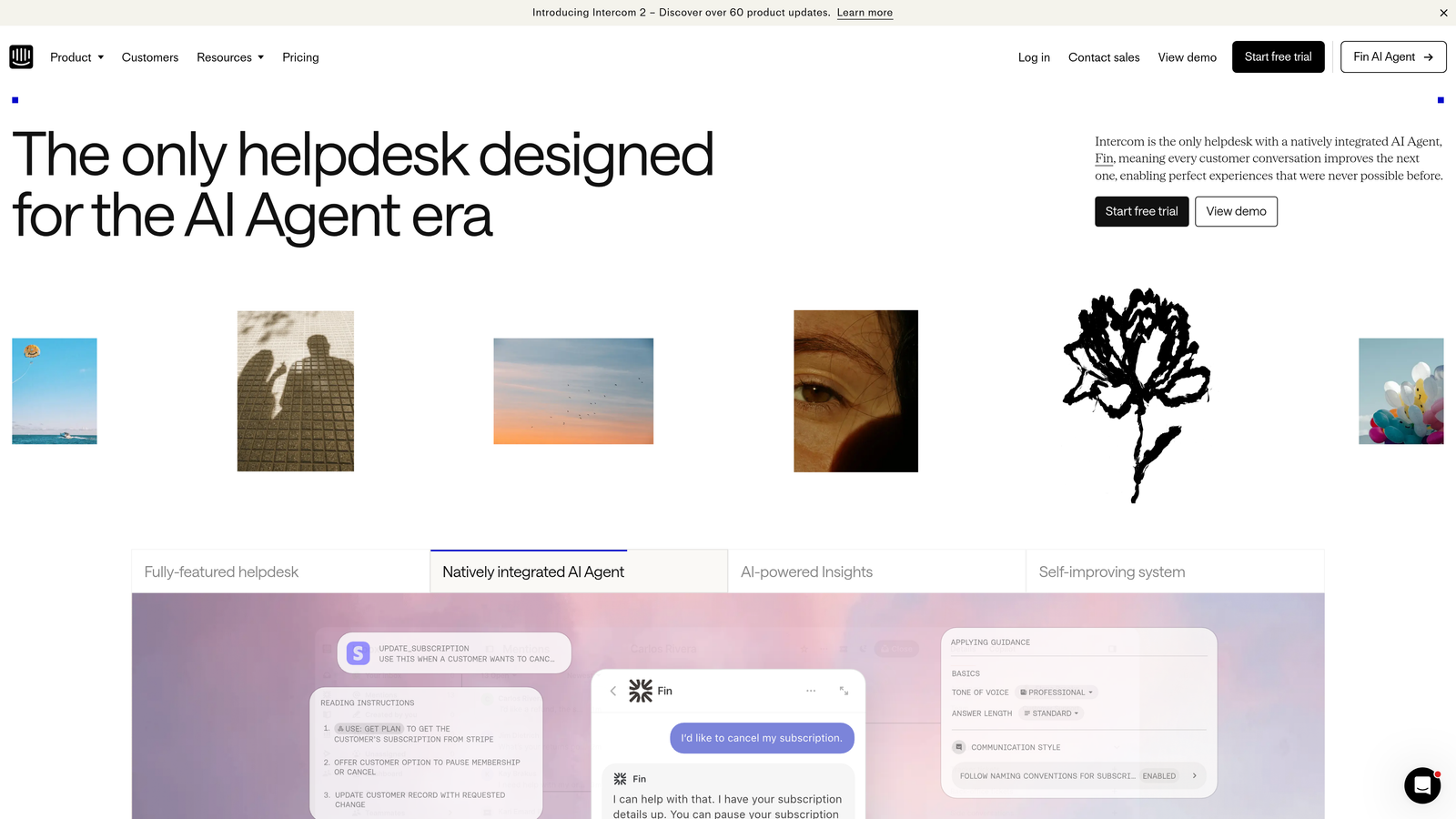
Intercom Fin is a conversational AI agent that handles customer questions directly in chat, reducing ticket volume at the source rather than managing tickets after they're created.
Where This Tool Shines
Fin's approach is fundamentally different from traditional ticket management: it tries to resolve the question before it becomes a ticket at all. Using your help center content and custom knowledge sources, Fin engages customers conversationally and resolves a meaningful portion of inquiries without human involvement.
When Fin can't resolve an issue, handoff to a human agent is smooth, with full conversation context preserved. The per-resolution pricing model is worth noting: it aligns costs directly with value delivered, which appeals to teams skeptical of paying for seats regardless of AI impact.
Key Features
Fin AI Agent: Resolves customer questions conversationally using your help center content and custom knowledge sources across chat, email, and social channels.
Multi-Channel Coverage: Works across chat, email, and social without requiring separate configurations for each channel.
Seamless Human Handoff: Transfers conversations to human agents with full context intact, so customers never have to repeat themselves.
Custom Fin Behaviors: Configure Fin's tone, escalation triggers, and response boundaries to match your brand and support policies.
Resolution Rate Reporting: Built-in analytics show exactly what Fin is resolving, what it's escalating, and what topics are driving volume.
Best For
SaaS and product teams with a strong help center who want to deflect common questions before they hit the queue. Works best when your knowledge base is well-maintained and comprehensive.
Pricing
Fin charges $0.99 per resolution. Intercom platform plans start at $39/seat/month. Costs scale with resolution volume, so high-volume teams should model this carefully.
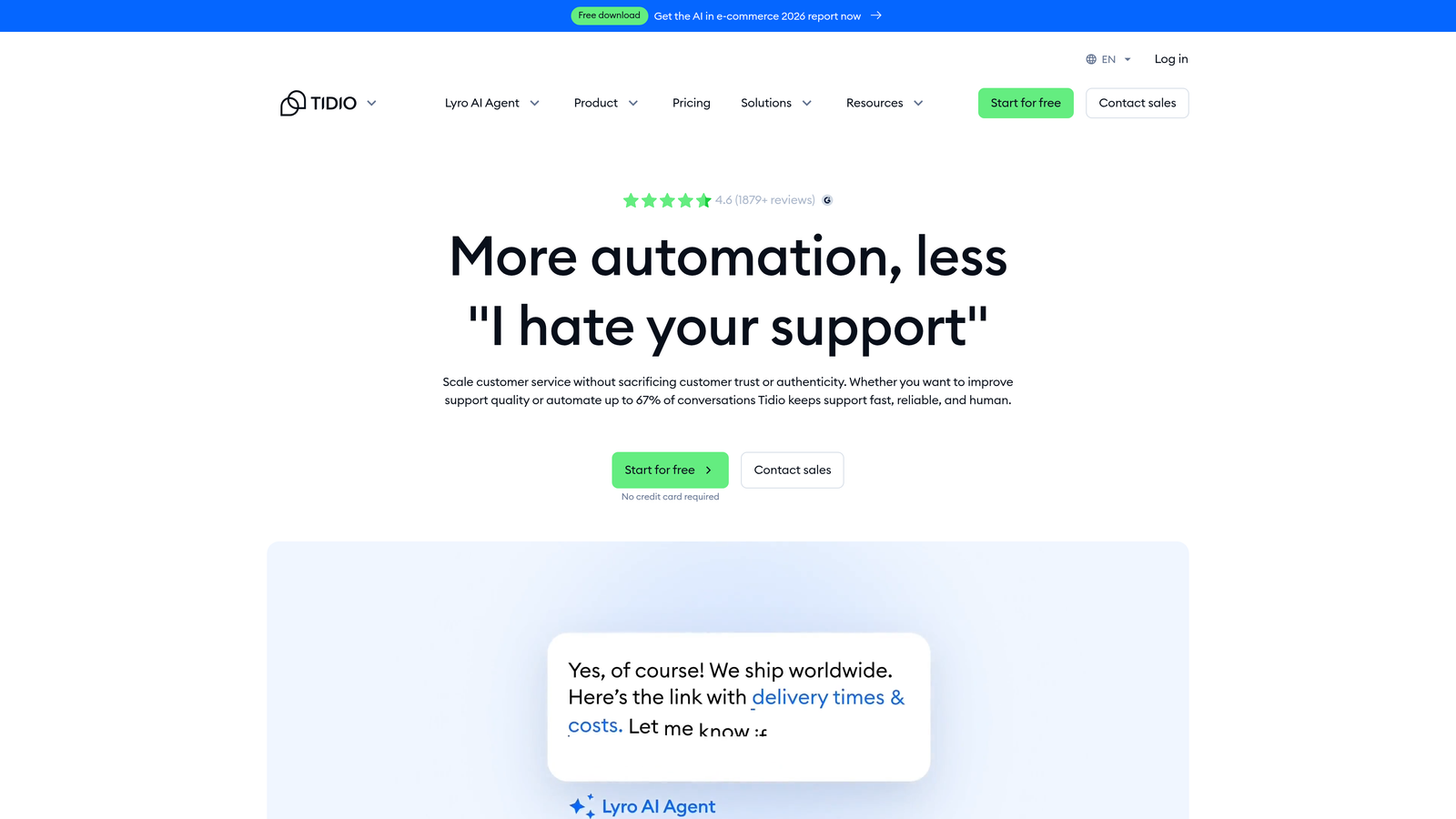
5. Tidio
Best for: Small-to-mid-sized businesses and e-commerce teams that need accessible AI-powered support without enterprise complexity.
Tidio combines a live chat platform with Lyro AI, its conversational chatbot designed to handle common support questions and ticket routing for growing businesses.
Where This Tool Shines
Tidio's strength is accessibility. The setup is straightforward, the pricing is approachable, and the e-commerce integrations with Shopify, WooCommerce, and BigCommerce make it a natural fit for online retail teams that need support automation without a dedicated IT team to configure it.
Lyro AI handles common questions using your knowledge base and can route more complex issues to human agents. It won't match the autonomous resolution depth of AI-native platforms, but for its target market, it delivers solid value at a fraction of the cost.
Key Features
Lyro AI Chatbot: Resolves common customer questions using your knowledge base content without requiring manual rule configuration.
AI-Powered Ticket Routing: Categorizes and routes incoming tickets to the right team or agent based on content.
E-Commerce Integrations: Native connections to Shopify, WooCommerce, and BigCommerce for order status, returns, and product queries.
Visual Flow Builder: Drag-and-drop chatbot builder for teams that want custom automation beyond the default AI responses.
AI-Assisted Reply Suggestions: Helps live agents respond faster with contextually relevant suggestions during active conversations.
Best For
Small businesses, e-commerce stores, and early-stage SaaS teams that want to automate common support interactions without a large budget or technical implementation overhead.
Pricing
Free plan available. Lyro AI starts at $39/month. Premium plans with advanced AI features begin at $59/month, making it one of the more affordable options on this list.
6. Zoho Desk Zia
Best for: Teams operating within the Zoho ecosystem that want AI-powered ticket management tightly integrated with Zoho CRM and analytics.
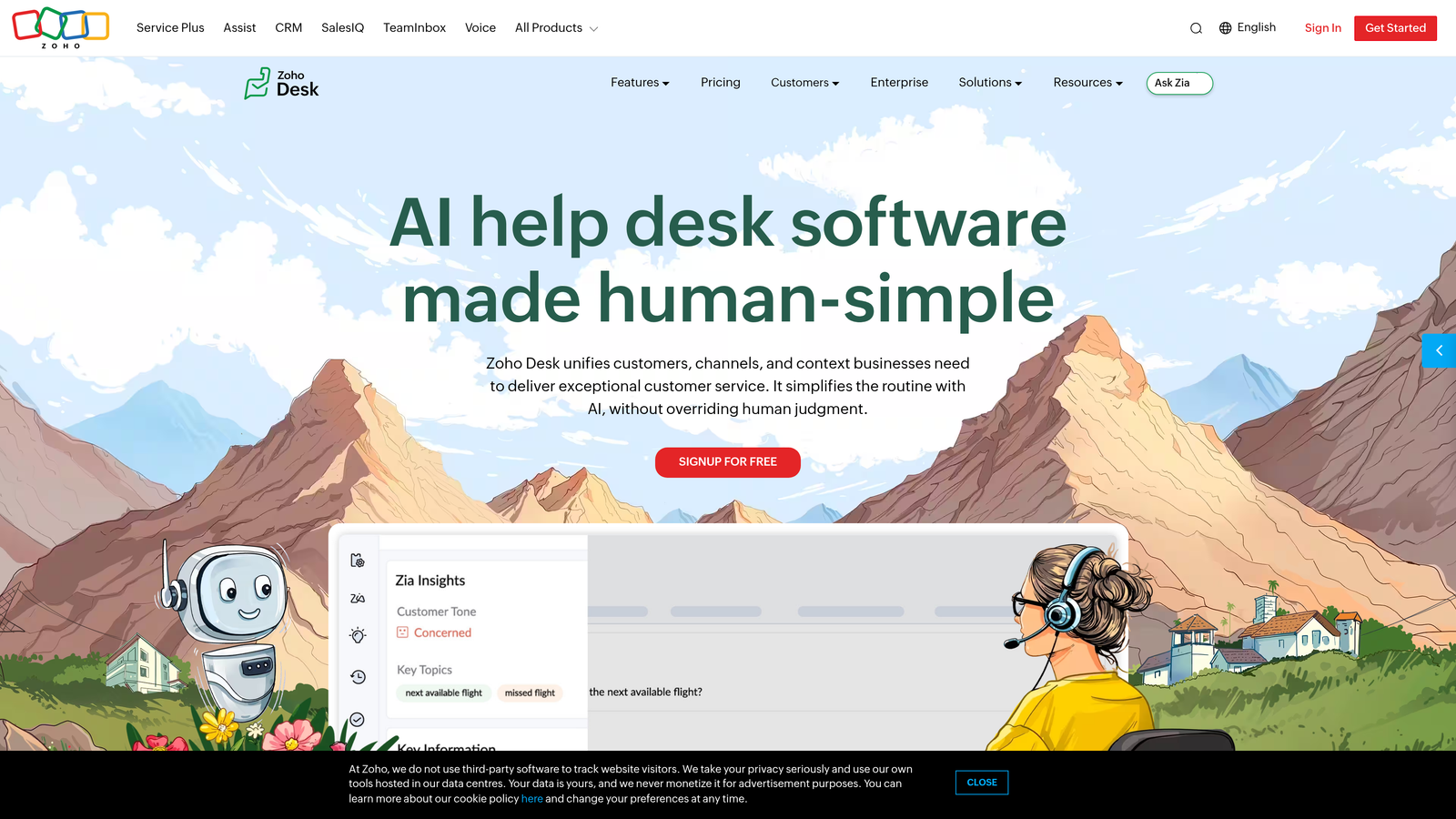
Zoho Desk embeds Zia, its AI assistant, to handle ticket tagging, sentiment analysis, anomaly detection, and field prediction for support teams already using Zoho's broader product suite.
Where This Tool Shines
Zia's anomaly detection is a standout feature: it alerts teams when ticket volume spikes unexpectedly, giving support managers early warning before a backlog develops. Combined with sentiment analysis that flags frustrated customers, Zia helps teams be proactive rather than reactive.
The tight integration with Zoho CRM and Zoho Analytics means support data flows naturally into broader business reporting. For teams already in the Zoho ecosystem, this cohesion is a genuine advantage over piecing together third-party integrations.
Key Features
Zia Auto-Tagging: Predicts and applies ticket tags, categories, priorities, and assignees automatically based on ticket content.
Sentiment Analysis: Detects frustration and urgency in incoming tickets to help teams prioritize high-risk interactions.
Anomaly Detection: Alerts when ticket volume deviates from expected patterns, enabling proactive resource management.
AI Reply Assistant: Suggests relevant knowledge base articles and response templates to speed up agent replies.
Zoho Suite Integration: Deep native connections to Zoho CRM, Zoho Analytics, and the broader Zoho product ecosystem.
Best For
Companies already using Zoho CRM or other Zoho products who want AI-powered ticket management without introducing a separate vendor. Zia's value compounds significantly within the Zoho ecosystem.
Pricing
Zia features are available on the Enterprise plan at $40/agent/month billed annually, making it competitive for teams that need the full feature set.
7. HappyFox
Best for: Operations-focused teams that need structured, reliable ticket workflows with strong SLA management and AI-assisted categorization.
HappyFox is a helpdesk platform that combines AI-driven ticket categorization and smart routing with robust SLA management for teams where process consistency is non-negotiable.
Where This Tool Shines
HappyFox is built for teams that value operational rigor. The SLA management tools are among the strongest in this category, with automated breach alerts that keep teams accountable before deadlines are missed. The smart rules engine allows for sophisticated conditional routing that goes well beyond simple keyword matching.
It's not the most AI-native platform on this list, but for teams where ticket workflow consistency and SLA compliance are the primary concerns, HappyFox delivers a reliable, well-structured system.
Key Features
AI Auto-Tagging and Categorization: Classifies incoming tickets automatically to reduce manual sorting and ensure consistent routing.
Smart Rules Engine: Conditional routing and escalation rules that handle complex workflow logic without custom code.
Robust SLA Management: Automated breach alerts and SLA tracking across all ticket types and channels.
AI-Suggested Templates: Canned actions and response suggestions that help agents reply faster without sacrificing quality.
Multi-Channel Support: Handles tickets from email, chat, phone, social media, and web forms within a unified queue.
Best For
Operations teams, internal IT helpdesks, and customer support organizations where SLA compliance and workflow consistency are primary requirements. Well-suited for teams that need structure before they need autonomy.
Pricing
Plans start at $29/agent/month. Enterprise plans with advanced AI and automation features are available at higher tiers; pricing is available directly from HappyFox.
8. Hiver
Best for: Small-to-mid-sized teams that live in Gmail and want AI-powered ticket management without leaving Google Workspace.
Hiver turns Gmail into a shared helpdesk with Harvey AI handling email classification, auto-assignment, and thank-you detection, all without requiring agents to switch tools.
Where This Tool Shines
Hiver's core advantage is zero context switching. For teams that already manage support through Gmail, adding a separate helpdesk platform creates friction and adoption challenges. Hiver solves this by layering AI-powered ticket management directly onto the inbox agents already use every day.
Harvey AI handles the classification and routing work in the background, while collision detection prevents two agents from accidentally responding to the same email. It's a pragmatic solution for teams that want AI capabilities without a platform migration.
Key Features
Harvey AI Bot: Classifies incoming emails, suggests tags, and detects thank-you messages to prevent unnecessary ticket reopening.
Shared Inbox Management: Gives teams visibility into a shared queue with collision detection to avoid duplicate responses.
AI-Powered Auto-Assignment: Routes tickets to agents based on current workload and skill tags, balancing the queue automatically.
SLA Tracking: Monitors response and resolution time targets within the Gmail interface without requiring a separate dashboard.
Native Google Workspace Integration: Works entirely within Gmail and Google Workspace, requiring no tool switching or data migration.
Best For
Small support teams and professional services organizations that operate primarily through email and don't want to migrate to a full helpdesk platform. Ideal for Google Workspace-first companies.
Pricing
Free plan available for small teams. Paid plans start at $19/user/month. AI features are included on the Pro plan at $49/user/month.
9. SysAid Copilot
Best for: IT service desks that need generative AI for internal ticket resolution, asset management, and ITSM workflows.
SysAid Copilot is a generative AI layer built into SysAid's ITSM platform, designed specifically for internal IT support teams managing employee tickets, assets, and change workflows.
Where This Tool Shines
SysAid Copilot is purpose-built for IT service desks, which means its AI features are tuned for ITSM use cases: employee self-service, change management approvals, and asset-aware ticket resolution. The generative AI copilot helps IT agents resolve complex internal tickets faster by surfacing relevant knowledge and suggesting resolution steps.
For organizations that need CMDB integration and formal change management workflows alongside AI-powered ticket handling, SysAid provides a cohesive package that general-purpose helpdesks don't match.
Key Features
Generative AI Copilot: Assists IT agents with ticket resolution and supports employee self-service through conversational AI interactions.
AI-Powered ITSM Classification: Routes and prioritizes internal IT tickets automatically based on content and urgency.
Asset Management and CMDB: Integrates ticket context with asset data, so agents understand the configuration environment before responding.
Change Management Workflows: Automates change request routing and approval processes within the ITSM framework.
AI-Driven Self-Service Portal: Surfaces relevant knowledge base suggestions to employees before they submit a ticket, reducing inbound volume.
Best For
Mid-to-large IT departments that need a full ITSM platform with generative AI capabilities. Not designed for external customer support; this is squarely an internal IT service desk solution.
Pricing
Contact SysAid for pricing. Quotes are typically customized based on asset count and agent seat requirements.
Finding the Right AI Ticket Management Fit
The tools on this list cover a wide spectrum, from AI-native autonomous resolution platforms to legacy helpdesks with intelligent add-ons. The right choice depends on where your team sits on that spectrum and what you actually need AI to do.
If you're an IT service desk managing internal workflows, SysAid Copilot is purpose-built for that environment. If your team lives in Gmail and doesn't want a platform migration, Hiver is the pragmatic choice. E-commerce teams with straightforward support needs will find Tidio's approachable pricing and Shopify integrations hard to beat.
For B2B SaaS teams that want more than ticket deflection, the calculus shifts. Zendesk AI and Freshdesk Freddy AI are solid if you're already invested in those ecosystems, but they're fundamentally agent-assist tools. Intercom Fin takes a clever approach by resolving questions before they become tickets, though its per-resolution pricing deserves careful modeling at scale.
Halo AI stands apart for teams that want genuine autonomous resolution combined with product-aware guidance and business intelligence. It's not just managing tickets; it's learning from every interaction and surfacing signals that make your entire product and customer success operation smarter.
Your support team shouldn't have to scale linearly with your customer base. Let AI agents handle routine tickets, guide users through your product, and surface business intelligence while your team focuses on the complex issues that genuinely need a human touch. See Halo in action and discover how continuous learning transforms every support interaction into smarter, faster resolution.