9 Best AI Support Assistants for SaaS in 2026
This guide evaluates the 9 strongest AI support assistants for SaaS in 2026, helping teams find platforms that autonomously resolve tickets, integrate deeply with existing tools, and handle the technical complexity SaaS products demand—without scaling headcount alongside ticket volume.
 Grant CooperFounder12 min read
SaaS support teams face a familiar bind: ticket volumes scale with growth, but headcount can't keep pace. AI support assistants have moved well beyond basic chatbots. Today's platforms resolve tickets autonomously, learn from every interaction, and surface business intelligence that helps teams get ahead of problems before customers notice them.
This list covers the strongest AI support assistants built specifically for SaaS environments, evaluated on autonomous resolution capability, integration depth, contextual awareness, and how well they handle the technical complexity SaaS products demand. Whether you're replacing a legacy helpdesk, augmenting a lean support team, or looking for an AI-first alternative to bolt-on chatbot features, there's a fit here. Pricing and feature sets are current as of May 2026.
1. Halo AI
Best for: B2B SaaS teams that want AI-first support without retrofitting a legacy helpdesk
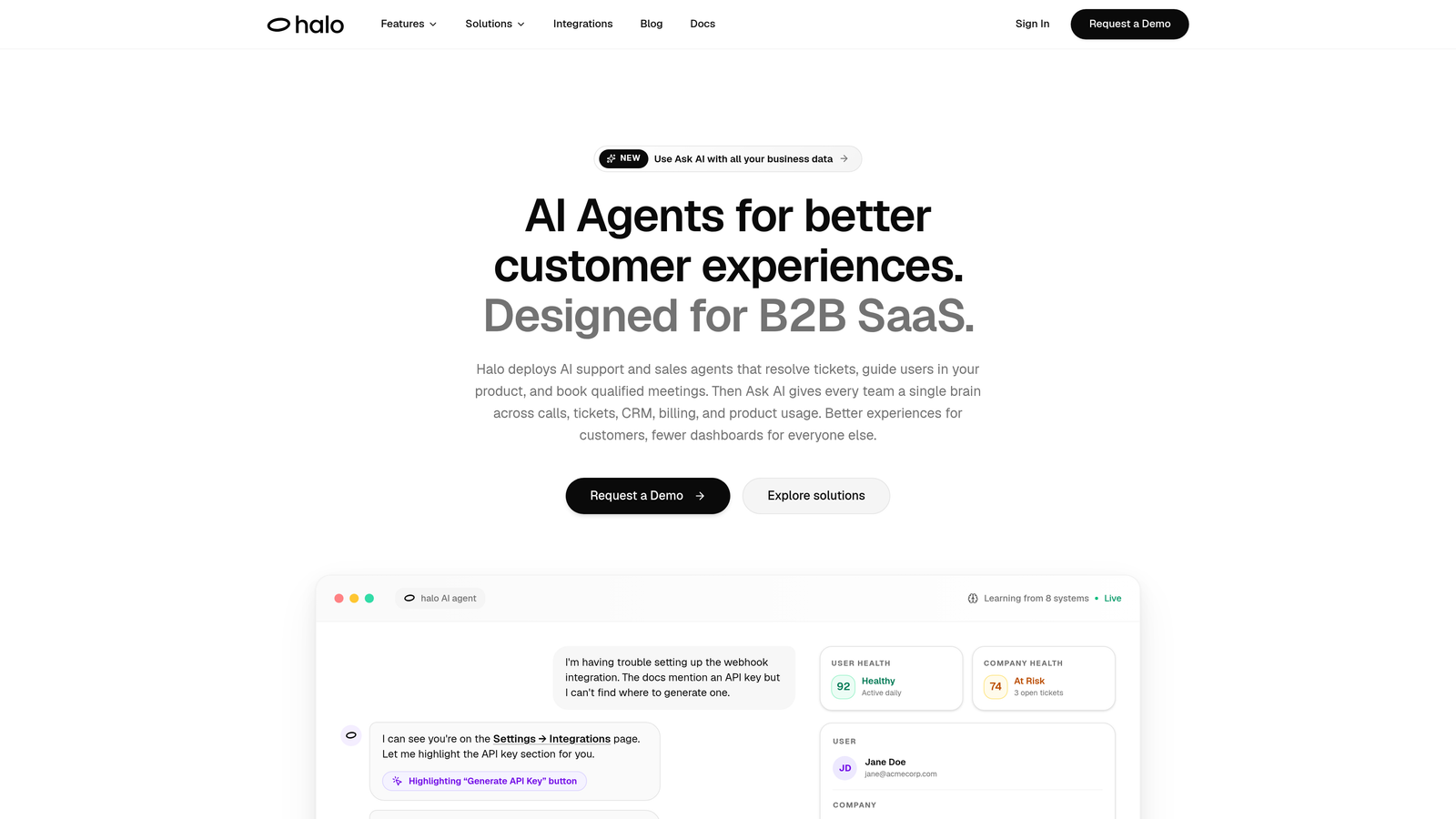
Halo AI is an AI-first customer support platform built from the ground up for SaaS teams, not adapted from a traditional ticketing system.
Where This Tool Shines
What separates Halo from most tools on this list is its page-aware architecture. The chat widget understands what screen or feature a user is currently on, so agents can provide contextual UI guidance rather than generic troubleshooting steps. That context travels through every interaction, making resolutions faster and more relevant.
Beyond ticket resolution, Halo's smart inbox surfaces business intelligence that most support tools simply don't offer: customer health signals, revenue intelligence, and anomaly detection. Your support data becomes a strategic asset, not just a queue to clear. The continuous learning loop means every resolved ticket makes the next one faster.
Key Features
Page-Aware Chat Widget: Agents see what users see in real time, enabling contextual UI guidance rather than generic answers.
Smart Inbox with Business Intelligence: Surfaces customer health signals, revenue intelligence, and anomaly detection directly from support conversations.
Auto Bug Ticket Creation: Converts support conversations into structured bug reports automatically, with no manual logging required.
Live Agent Handoff: Escalates to human agents with full conversation context preserved, so customers never have to repeat themselves.
Deep Integration Stack: Connects natively with Linear, Slack, HubSpot, Intercom, Stripe, Zoom, PandaDoc, and Fathom.
Continuous Learning: Every resolved interaction improves the AI's future performance without manual retraining.
Best For
B2B SaaS product teams and support leaders who want to scale without scaling headcount. Particularly strong for teams that need developer tooling integrations (Linear for bug tracking), revenue context from Stripe, and CRM alignment through HubSpot, all in one platform.
Pricing
Contact for pricing at haloagents.ai. Custom quotes based on team size and usage.
2. Intercom Fin
Best for: Teams already using Intercom who want AI resolution without switching platforms
Intercom Fin is an AI resolution layer built natively into Intercom's messaging platform, powered by large language models and trained on your help center content.
Where This Tool Shines
Fin's biggest advantage is how naturally it fits into an existing Intercom setup. If your team already lives in Intercom Inbox and your help center is built on Intercom Articles, Fin can be deployed quickly with minimal configuration. It resolves queries directly from your existing content without requiring a separate AI system to manage.
The handoff experience is genuinely smooth. When Fin can't resolve something, it escalates to a human agent within the same conversation thread, with full context intact. For teams that have invested heavily in Intercom's ecosystem, this cohesion is a real operational benefit.
Key Features
Help Center Resolution: Resolves queries directly from help articles and custom answers you've already created.
Seamless Human Handoff: Passes conversations to agents in Intercom Inbox without breaking the conversation thread.
Multi-Language Support: Handles customer queries across multiple languages without separate configuration.
Resolution-Based Pricing: You pay per resolved conversation rather than per seat, aligning cost with outcomes.
Native Workflow Integration: Works within Intercom's full suite of messaging, routing, and automation tools.
Best For
SaaS teams already paying for Intercom who want to add AI resolution without introducing a new vendor. Less compelling as a standalone purchase if you're not already in the Intercom ecosystem.
Pricing
Per-resolved-conversation pricing on top of an existing Intercom plan. Verify current structure at intercom.com.
3. Zendesk AI
Best for: Established SaaS teams deeply invested in Zendesk Suite who want AI without migration
Zendesk AI brings intelligent triage, agent assist, and automated ticket handling to teams already running on the Zendesk platform.
Where This Tool Shines
Zendesk AI's core value is frictionless adoption. If your workflows, macros, and reporting are already built around Zendesk, adding AI capabilities through the same platform avoids the disruption of a migration. Intelligent triage handles intent, sentiment, and language detection automatically, routing tickets before a human ever touches them.
The Agent Copilot feature is particularly useful for teams with mixed experience levels. Suggested responses and AI-generated ticket summaries help newer agents work at the quality level of your best performers, reducing handle time across the board.
Key Features
Intelligent Triage: Automatically detects intent, sentiment, and language to route tickets to the right queue or agent.
AI-Generated Ticket Summaries: Condenses long conversation threads so agents can catch up instantly.
Macro Suggestions: Recommends relevant response templates based on ticket content.
Agent Copilot: Provides real-time suggested responses to help agents reply faster and more consistently.
Advanced AI Add-On: Higher-tier automation available for teams with more complex resolution needs.
Best For
Mid-market and enterprise SaaS teams with significant Zendesk investment who want to add AI capabilities incrementally, without rebuilding their support stack from scratch.
Pricing
Add-on to existing Zendesk Suite plans. Verify current pricing tiers at zendesk.com.
4. Freshdesk Freddy AI
Best for: Freshdesk customers who want a three-layer AI approach covering deflection, assist, and analytics
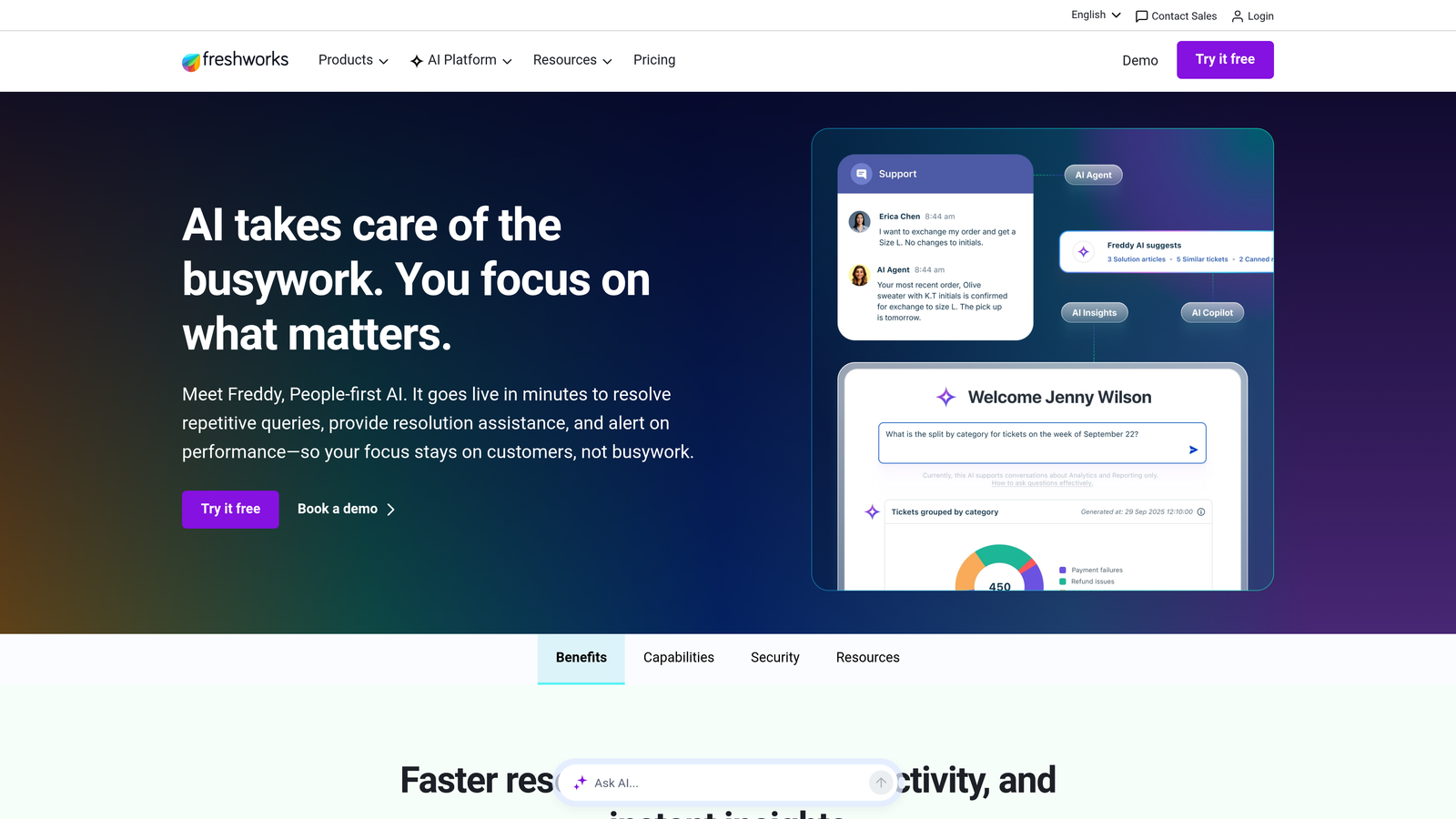
Freshdesk Freddy AI is a three-layer AI system embedded across Freshdesk's platform, covering self-service deflection, agent assistance, and support analytics.
Where This Tool Shines
Freddy's layered structure means you're not just getting a chatbot. Freddy Self Service handles deflection by training on your knowledge base. Freddy Copilot assists agents in real time with suggested replies and sentiment cues. Freddy Insights then surfaces trends and anomalies in your support data so team leads can identify systemic issues, not just individual tickets.
For teams already on Freshdesk, the value proposition is strong because most of these capabilities are bundled into existing plan tiers rather than priced as separate add-ons. The learning curve is also low since the AI works within familiar Freshdesk workflows.
Key Features
Freddy Self Service: Knowledge-base-trained deflection bot that handles FAQs before they reach your queue.
Freddy Copilot: Provides suggested replies, ticket summaries, and sentiment cues to agents during live conversations.
Freddy Insights: Identifies trends and anomalies in support data to help team leads spot patterns proactively.
Bundled Pricing: Core features included in Freshdesk Growth, Pro, and Enterprise tiers.
Low Adoption Barrier: Works within existing Freshdesk workflows with minimal configuration.
Best For
SaaS teams already using Freshdesk who want AI across the full support lifecycle without adding a new vendor. Limited appeal outside the Freshdesk ecosystem.
Pricing
Bundled with Freshdesk plans; some features require add-ons. Verify current structure at freshworks.com.
5. Tidio Lyro
Best for: Early-stage SaaS teams that need fast deployment and high-volume chat deflection
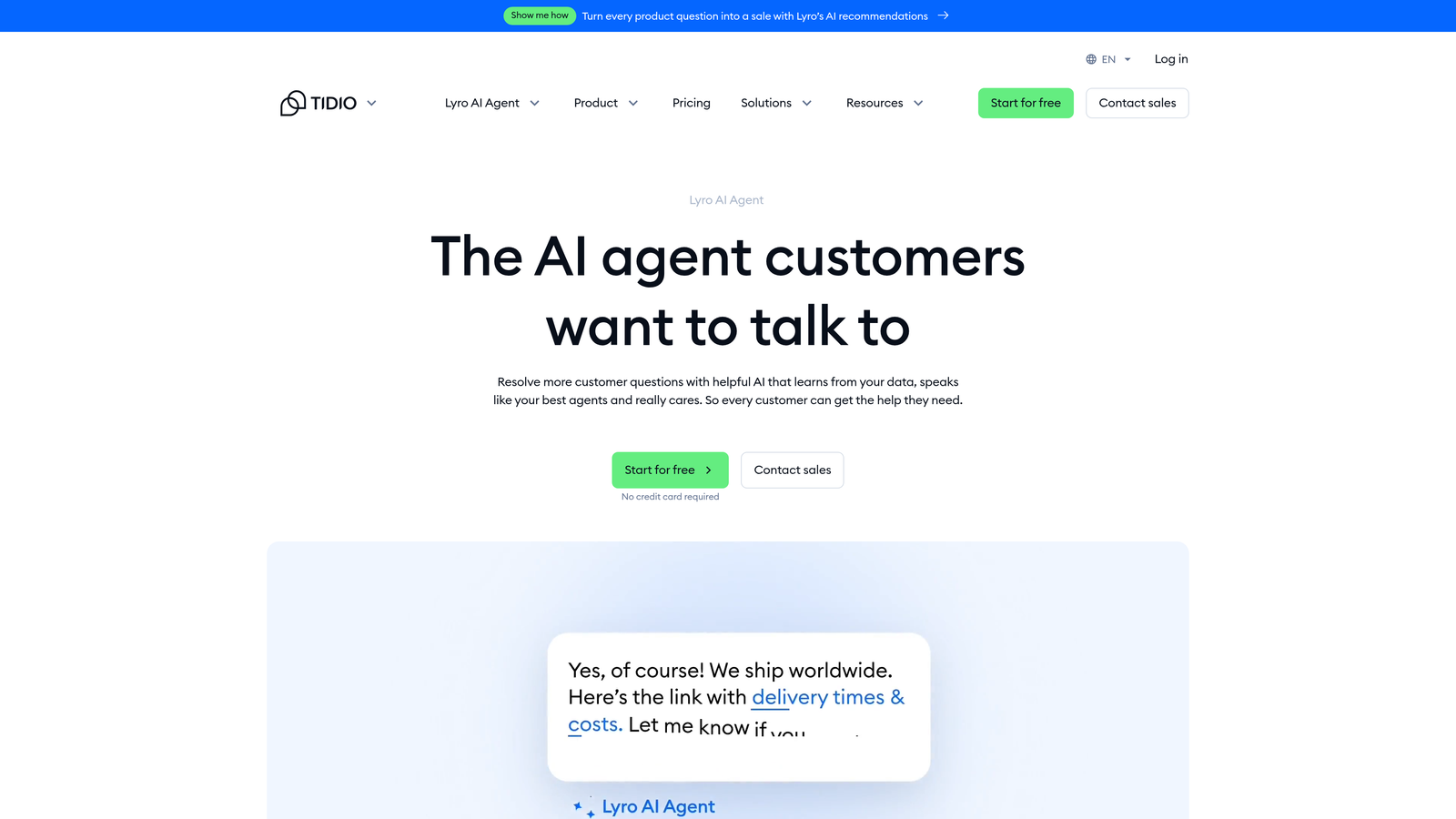
Tidio Lyro is a conversational AI assistant built on Tidio's live chat platform, designed for rapid deployment and seamless human fallback.
Where This Tool Shines
Lyro's standout quality is speed to value. Most teams can deploy it in hours rather than weeks, training it on existing help content without a complex onboarding process. For early-stage SaaS teams where support is still handled by a small team or even the founders, that quick setup is genuinely meaningful.
The live chat fallback is well-implemented. When Lyro reaches the edge of its knowledge, it passes the conversation to a human agent without dropping context or creating a frustrating experience for the customer. It's a practical safety net for teams that can't afford dropped conversations.
Key Features
Help Content Training: Learns from your existing FAQ and help documentation to handle common queries autonomously.
Fast Deployment: Deployable in hours, not weeks, with minimal technical setup required.
Live Chat Fallback: Seamlessly hands off to human agents when queries exceed AI capability, with no conversation drop.
Multi-Language Support: Handles customer queries in multiple languages without additional configuration.
Free Tier Available: Entry-level access with limited conversations for teams testing AI deflection before committing.
Best For
Early-stage SaaS teams, bootstrapped companies, or teams with high chat volume and limited support staff who need deflection running quickly without a lengthy implementation project.
Pricing
Lyro available as an add-on to Tidio plans; free tier available with limited conversations. Verify current tiers at tidio.com.
6. Forethought SupportGPT
Best for: Mid-market and enterprise SaaS teams that need AI across the entire ticket lifecycle
Forethought SupportGPT is an end-to-end AI platform covering triage, agent assist, autonomous resolution, and analytics for complex support environments.
Where This Tool Shines
Forethought's four-product architecture is its defining characteristic. Rather than offering a single AI feature bolted onto a helpdesk, it covers the full ticket journey: intelligent routing before a ticket is assigned, real-time suggestions while an agent works it, autonomous resolution for tickets that don't need a human, and analytics to understand what's driving volume. That end-to-end coverage is rare.
The sentiment analysis and intent classification capabilities are particularly strong for SaaS teams dealing with technically complex tickets. Routing a billing dispute versus an API integration failure to different queues automatically reduces misrouting and handle time.
Key Features
Triage: Intelligent routing and prioritization based on intent, sentiment, and ticket content.
Assist: Real-time agent suggestions during live ticket resolution.
Solve: Autonomous ticket resolution for common query types without agent involvement.
Discover: Analytics and trend identification to surface what's driving support volume.
Broad Integrations: Connects with Zendesk, Salesforce, Freshdesk, and ServiceNow.
Best For
Mid-market to enterprise SaaS teams with high ticket volumes and complex routing needs, particularly those already using Zendesk, Salesforce, or ServiceNow as their system of record.
Pricing
Enterprise pricing; not self-serve. Contact Forethought for a quote at forethought.ai.
7. Kustomer
Best for: Subscription SaaS teams where customer lifetime value context shapes every support interaction
Kustomer is a CRM-native customer service platform with AI assist features woven throughout, giving both agents and AI a complete customer history alongside every ticket.
Where This Tool Shines
Most support tools treat each ticket in relative isolation. Kustomer's CRM-native architecture means every interaction happens in the context of a full customer timeline: purchase history, previous tickets, subscription status, and sentiment trends over time. For subscription SaaS where a single support interaction can influence renewal, that context changes how you handle the conversation.
The AI Assist layer works within that same context, providing suggested responses and auto-summaries informed by the customer's full history rather than just the current thread. It's a meaningful difference for support teams that want to be proactive rather than reactive.
Key Features
Full Customer Timeline: Complete customer history visible to both AI and human agents simultaneously during every interaction.
AI Assist: Suggested responses, auto-summarization, and sentiment detection informed by customer history.
CRM-Native Architecture: No separate CRM integration required; customer data lives inside the platform.
Omnichannel Coverage: Email, chat, social, and SMS handled in a single unified view.
LTV-Focused Support: Particularly strong for subscription models where customer history and renewal context matters.
Best For
SaaS companies with subscription models where customer lifetime value and retention context should inform every support interaction, and where teams want CRM and support data unified rather than synced.
Pricing
Per-agent pricing; contact for enterprise quotes at kustomer.com.
8. Capacity
Best for: SaaS teams that want to consolidate customer-facing and internal employee support AI in one platform
Capacity is a unified AI platform combining helpdesk, knowledge base, and internal support automation for teams that want to address both customer and employee support needs together.
Where This Tool Shines
Capacity's differentiation is its dual focus. Most tools on this list are built exclusively for customer-facing support. Capacity spans both: the same AI and knowledge base infrastructure that handles customer queries can also serve internal employee helpdesk needs. For SaaS companies where the IT team, HR, and customer support all field repetitive questions, that consolidation can meaningfully reduce tooling overhead.
The knowledge base management is flexible. You can train the AI on uploaded documents, website URLs, and connected systems, which makes it adaptable to organizations with documentation spread across multiple formats and locations.
Key Features
Flexible AI Training: Learns from uploaded documents, URLs, and connected systems rather than requiring a single structured knowledge base.
Dual-Purpose Coverage: Spans both customer-facing support and internal employee helpdesk in one platform.
Process Automation: Built-in workflow builder for automating repetitive support processes beyond just answering questions.
Knowledge Base Management: AI-powered suggestions help keep your knowledge base current and accurate over time.
Business Tool Integrations: Connects with major business platforms to pull context from existing systems.
Best For
SaaS companies that want to reduce the number of AI vendors they manage by consolidating customer support and internal IT or HR helpdesk automation into a single platform.
Pricing
Tiered plans available; contact for enterprise pricing at capacity.com.
9. Aisera
Best for: Enterprise SaaS organizations with both customer support and IT service management needs
Aisera is an enterprise generative AI platform for customer support and IT service management, with domain-specific training and agentic multi-step resolution capabilities.
Where This Tool Shines
Aisera is built for complexity. Its domain-specific AI training means it can be configured for technical and industry-specific contexts rather than relying on generic language model behavior. For enterprise SaaS teams with specialized product categories or regulated environments, that specificity matters for resolution quality.
The agentic AI capabilities set it apart from simpler resolution tools. Rather than answering a single question and stopping, Aisera can execute multi-step workflows autonomously: gathering information, checking systems, and completing actions across connected platforms before returning a resolution. That's a meaningful capability difference for organizations with complex service processes.
Key Features
Domain-Specific AI Training: Configurable for technical and industry-specific contexts, not just generic FAQ resolution.
Agentic Multi-Step Resolution: Executes complex, multi-step workflows autonomously across connected systems.
Strong ITSM Integrations: Native connections with ServiceNow and Jira Service Management for IT service desk use cases.
Dual Coverage: Addresses both customer support and internal IT service desk from a single platform.
Enterprise Security and Compliance: Built-in controls for organizations with strict security and regulatory requirements.
Best For
Larger SaaS organizations where customer support and IT service management overlap, particularly those running ServiceNow or Jira Service Management and needing enterprise-grade security controls alongside AI resolution.
Pricing
Enterprise pricing; contact Aisera for a quote at aisera.com.
Which Tool Is Right for Your Team
The right choice depends heavily on where you are in your growth journey and what you're trying to solve.
If you're an early-stage SaaS team that needs something running quickly without a long implementation, Tidio Lyro is the lowest-friction starting point. It deploys in hours and covers the basics of chat deflection effectively.
If you're already committed to a helpdesk platform, the AI layer built into that platform is often the path of least resistance. Zendesk AI and Freshdesk Freddy AI add meaningful capabilities without requiring migration, and Intercom Fin is the natural choice for teams living in Intercom's ecosystem.
For mid-market teams with complex ticket routing needs and multi-platform infrastructure, Forethought SupportGPT offers end-to-end lifecycle coverage that simpler tools can't match. And for enterprise organizations where customer support and IT service management converge, Aisera handles that complexity with agentic resolution and enterprise-grade controls.
For B2B SaaS teams that want to move beyond reactive ticketing entirely, Halo AI stands apart. The page-aware context, business intelligence layer, and continuous learning architecture aren't features added to a traditional helpdesk. They're built into the platform's foundation. Your support data becomes a signal for customer health, revenue risk, and product improvement, not just a queue metric.
Your support team shouldn't scale linearly with your customer base. Let AI agents handle routine tickets, guide users through your product, and surface business intelligence while your team focuses on complex issues that need a human touch. See Halo in action and discover how continuous learning transforms every interaction into smarter, faster support.